Tochigi 栃木県
Tochigi 栃木県
Utsunomiya 宇都宮市
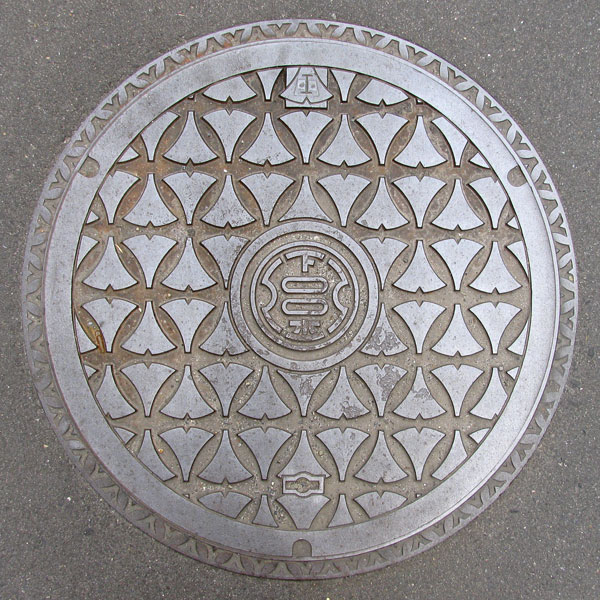
A manhole cover with a pattern of the leaves of the ginkgo tree, the city tree of Utsunomiya.
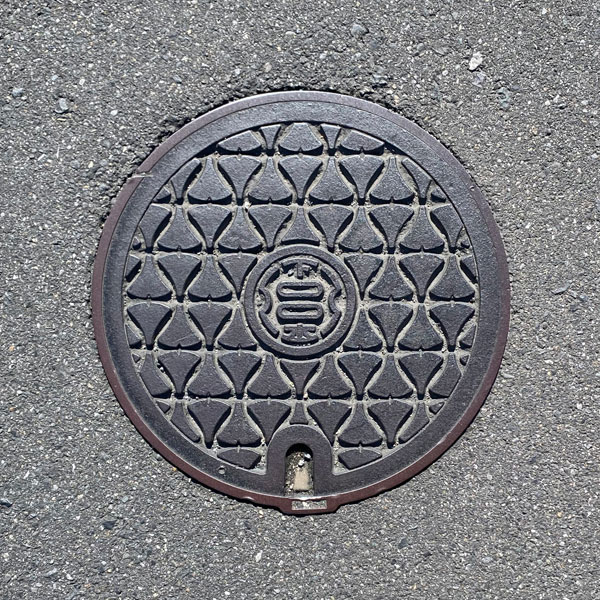
A smaller, handhole-sized panel with the same design as above.
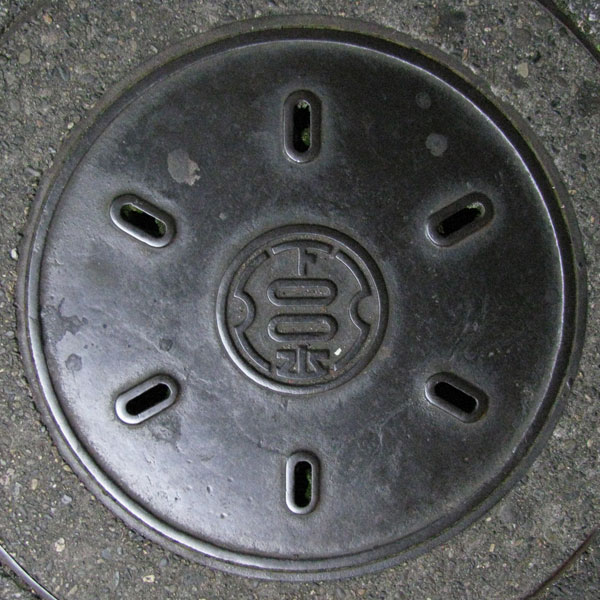
The lid looks very old.
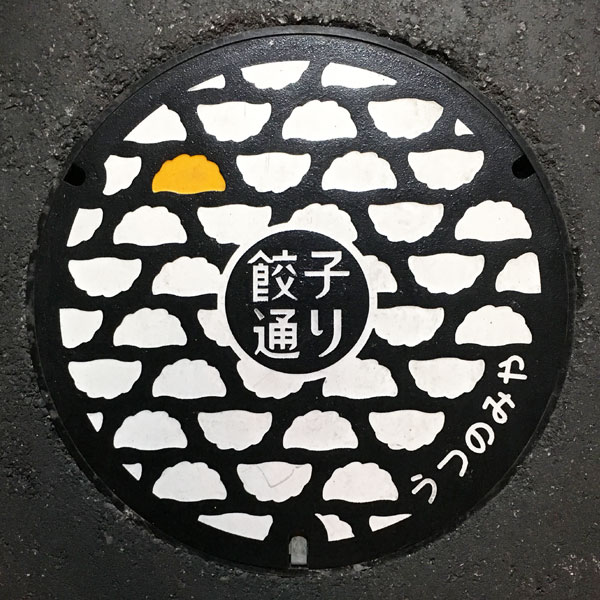
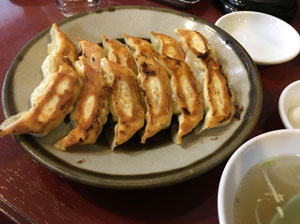
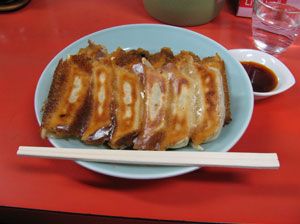
On April 27, 2018, a 160-meter section of Miyajima-cho Street was named "Gyoza Street" by the Utsunomiya City DC Promotion Committee (composed of Utsunomiya City and tourism, accommodation, and transportation businesses). This section is home to five of Utsunomiya's most famous gyoza restaurants.
Following the display of banners, signs, and gyoza-shaped flags, this colorful manhole cover depicting gyoza was installed in the fall. The words "Gyoza Street" are in the center, and "Utsunomiya" is in the lower right corner. The single gyoza with a browned exterior amongst the many is a charming detail.
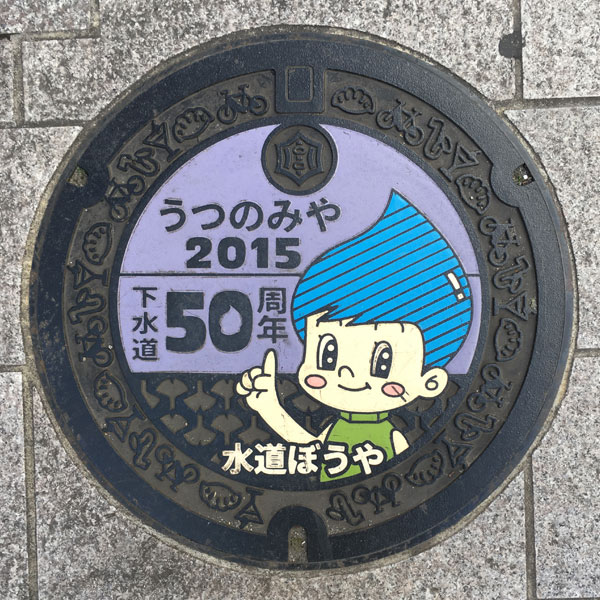
This manhole cover was designed to commemorate the 50th anniversary of the start of sewage treatment in Utsunomiya City.
Inside the circular cover, from top to bottom, are the Utsunomiya City Waterworks emblem, the words "Utsunomiya 2015," "50th Anniversary of Sewerage," and a design featuring the Utsunomiya City Waterworks Bureau's mascot character, "Suido Boya," and the city's tree, the ginkgo. Surrounding it are illustrations of Utsunomiya's specialties: gyoza, cocktails, jazz, and bicycles.
The inside of the "0" in "50th Anniversary of Sewerage" is a silhouette of Suido Boya's face.
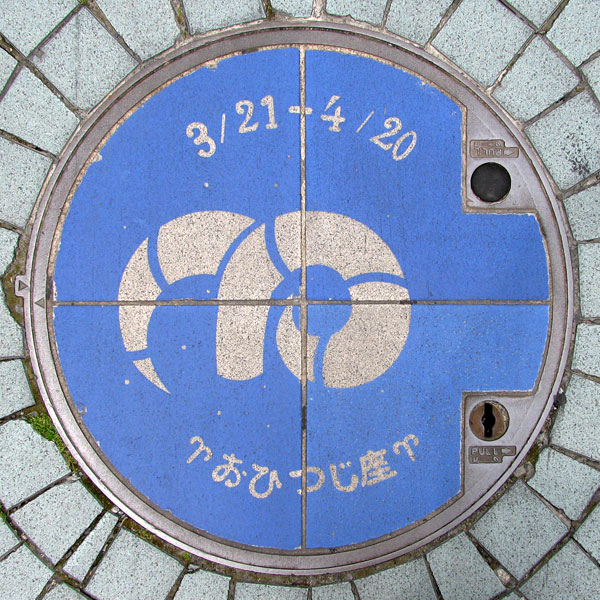
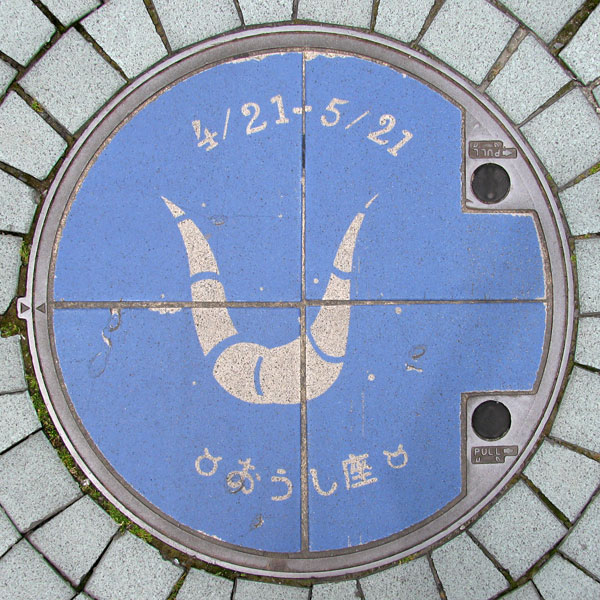
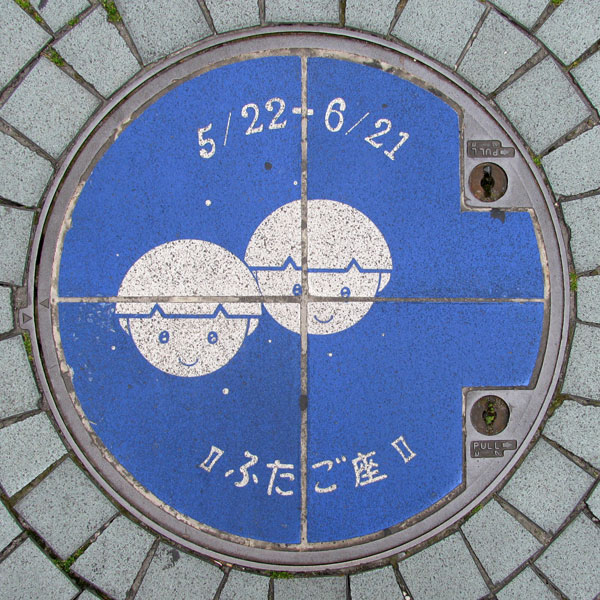
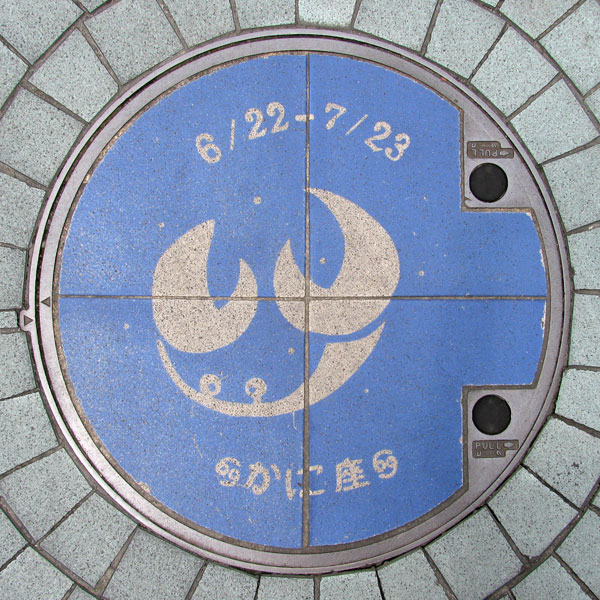
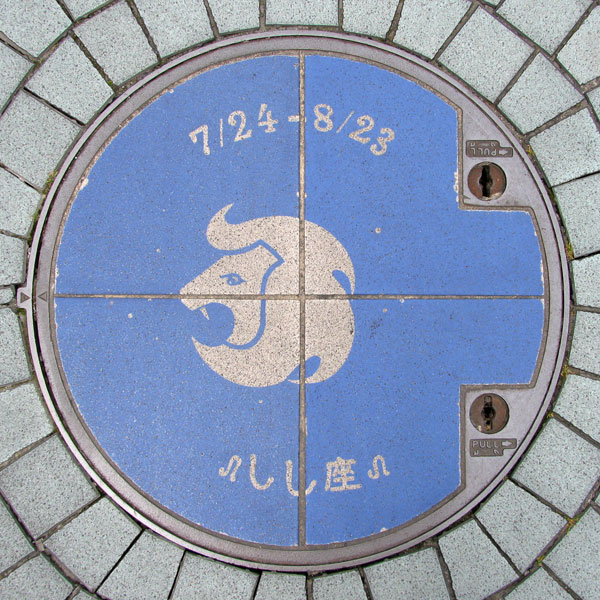
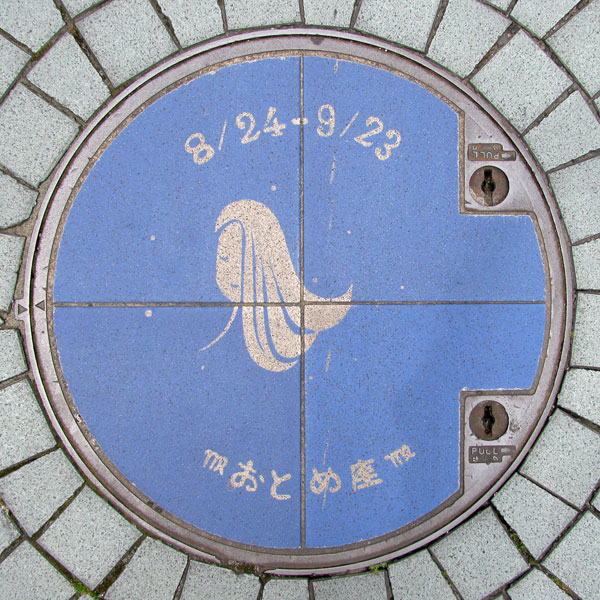
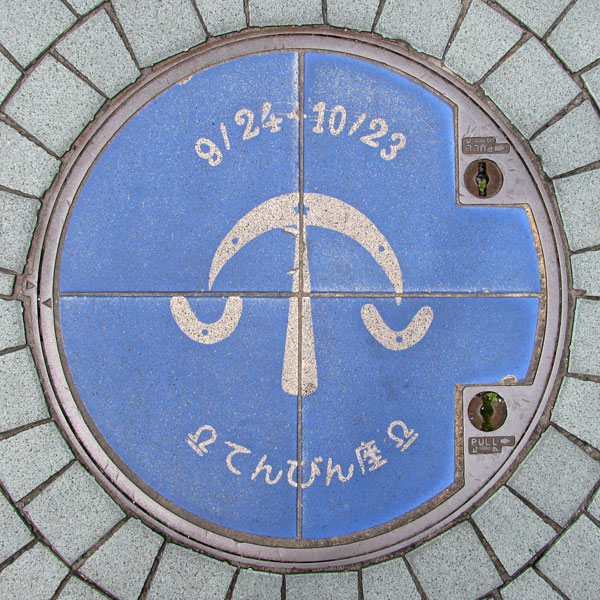
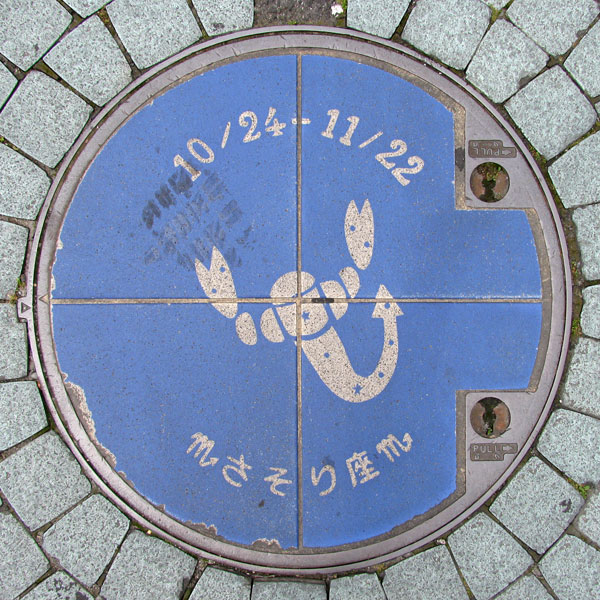
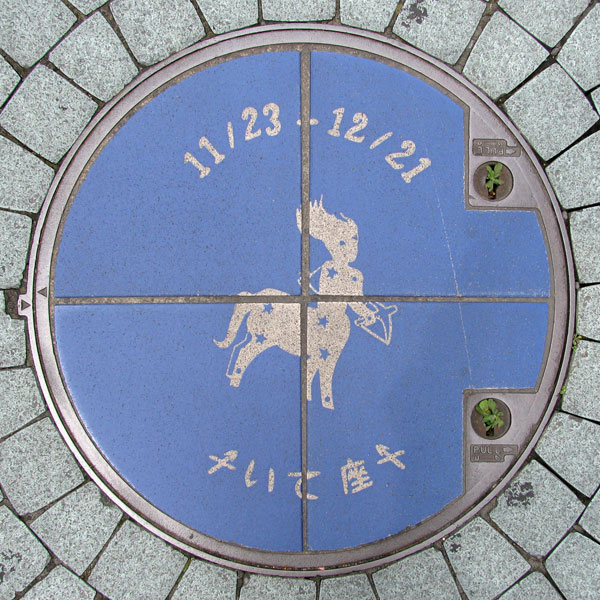
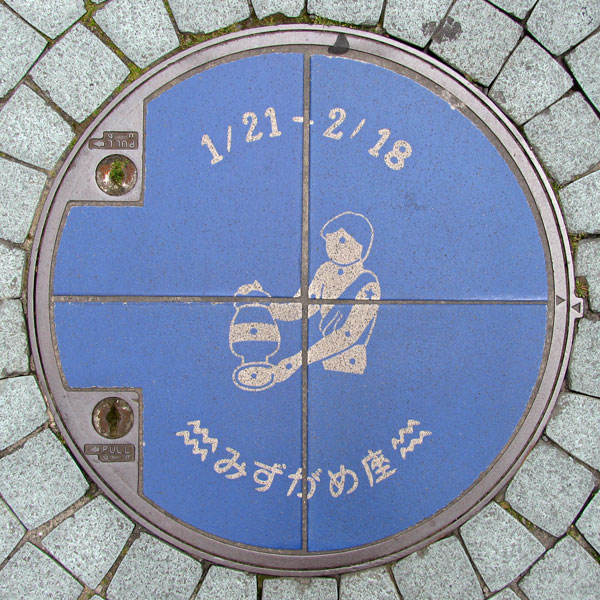
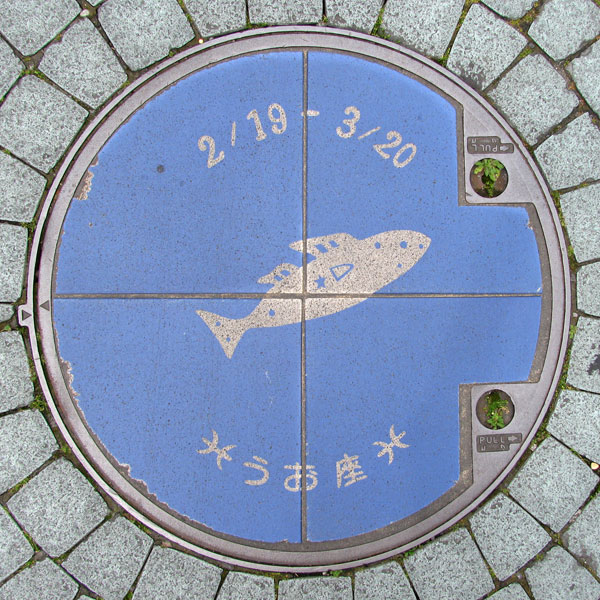
These manhole covers depict the twelve signs of the zodiac, lined up along Union Street near Tobu Utsunomiya Station on the Tobu Utsunomiya Line. Or so I'd like to say, but upon reviewing the image, I noticed there are two Aquarius covers and no Capricorn cover.
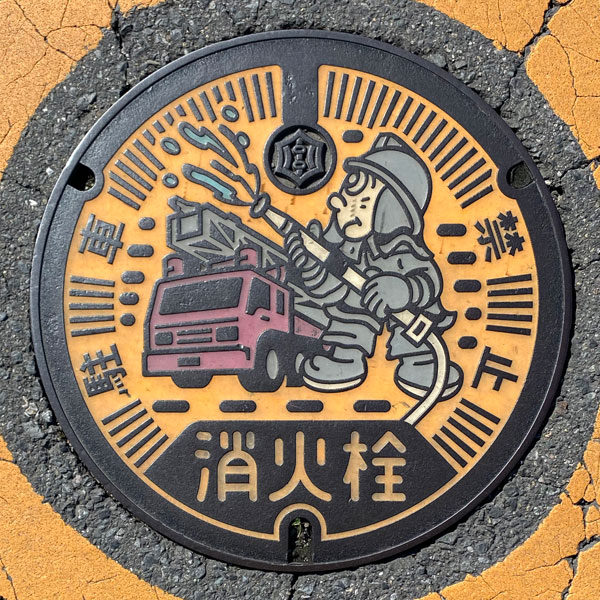
A fire hydrant cover with the Utsunomiya City Waterworks emblem on top.
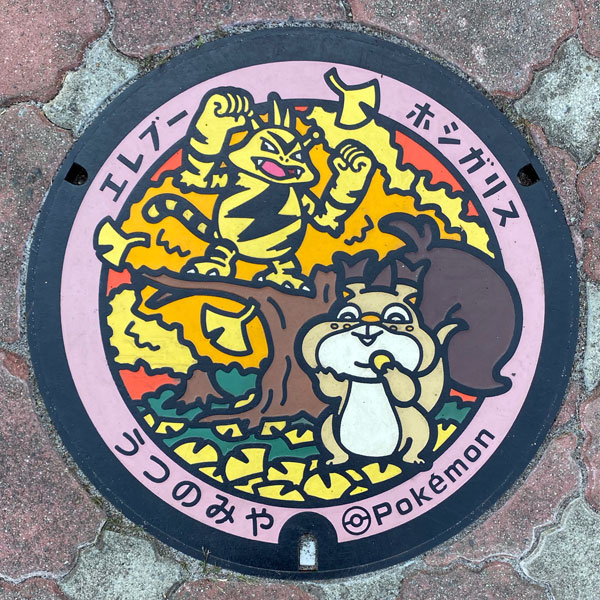
The "Pokémon Manhole Cover 'Poké-lid'" was donated by The Pokémon Company.
Depicted are Electabuzz and Skwovet. The words "Utsunomiya" are on the lower left, and a Poké Ball and "Pokémon" are on the right.
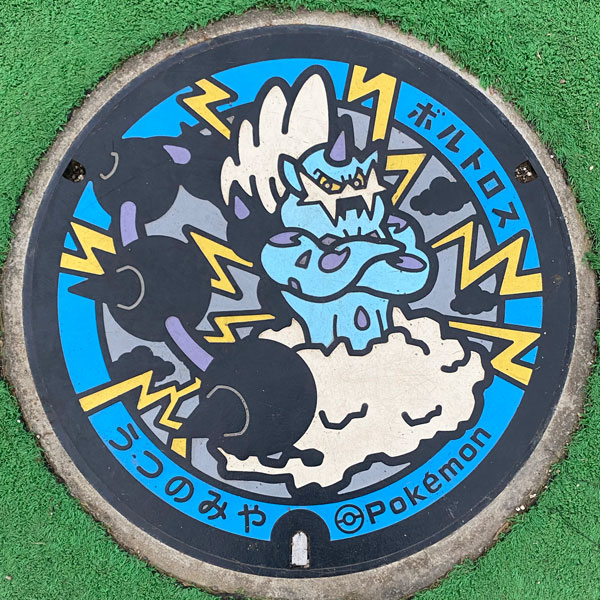
The "Pokémon Manhole Cover 'Poké-lid'" was donated by The Pokémon Company.
The design features Thundurus. The words "Utsunomiya" are written on the lower left, and a Poké Ball and the word "Pokémon" are on the right.
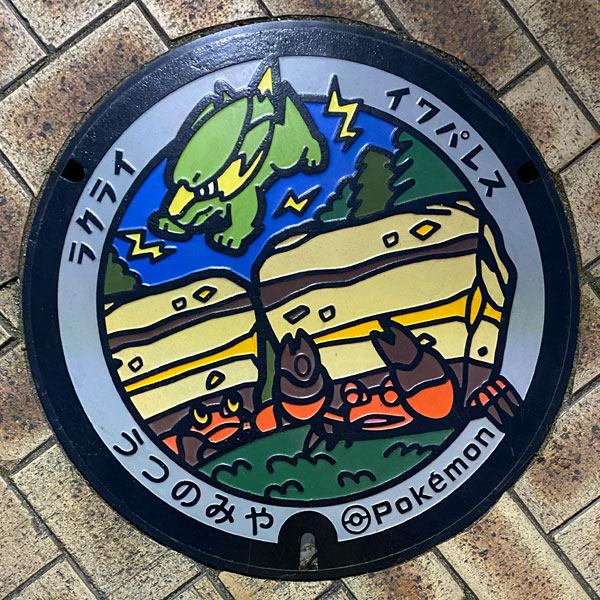
The "Pokémon Manhole Cover 'Poké-lid'" was donated by The Pokémon Company.
Depicted are "Electrike" and "Crustle". "Utsunomiya" is written on the lower left, and a Poké Ball and the word "Pokémon" are on the right.
Kawachi 河内町
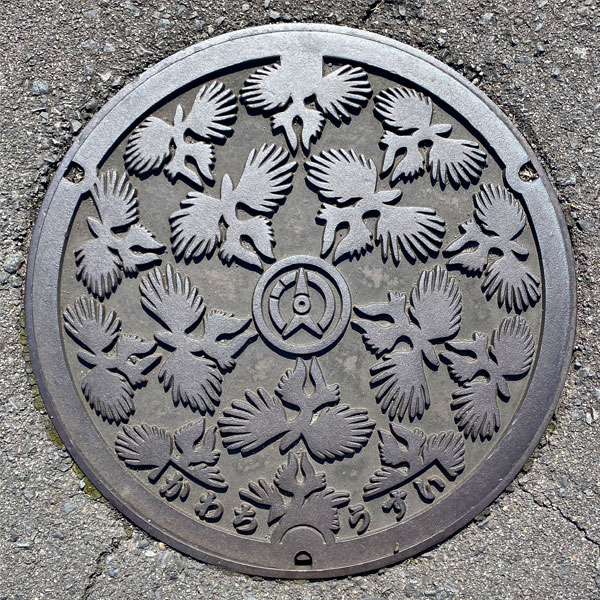
The design features the town's flower, the egret flower. The town emblem is in the center, and the characters "Kawachi" and "Osui" are written at the bottom.
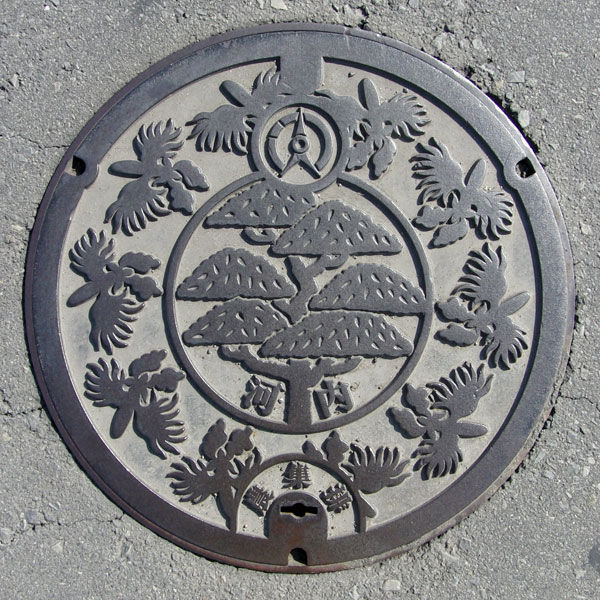
This is a manhole cover for agricultural wastewater treatment in the Nakaokamoto area.
The design features the town flower, the "Sagisou" (Egret Orchid), and the town tree, the "Tsuga" (Boxwood). The town emblem is at the top, the word "Kawachi" is written below the boxwood in the central circle, and the words "Agricultural Wastewater Treatment" are at the bottom.
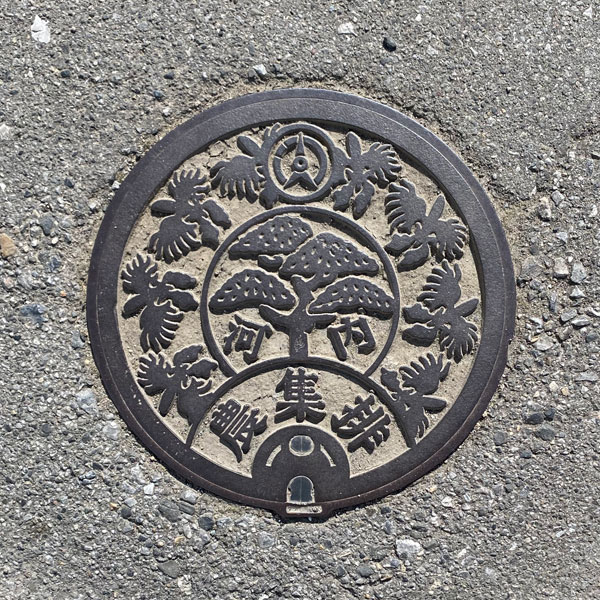
A small manhole cover for agricultural wastewater in the Shimogahashi Kawara area. The number of egret orchids and boxwood branches has decreased.
Kamikawachi 上河内町
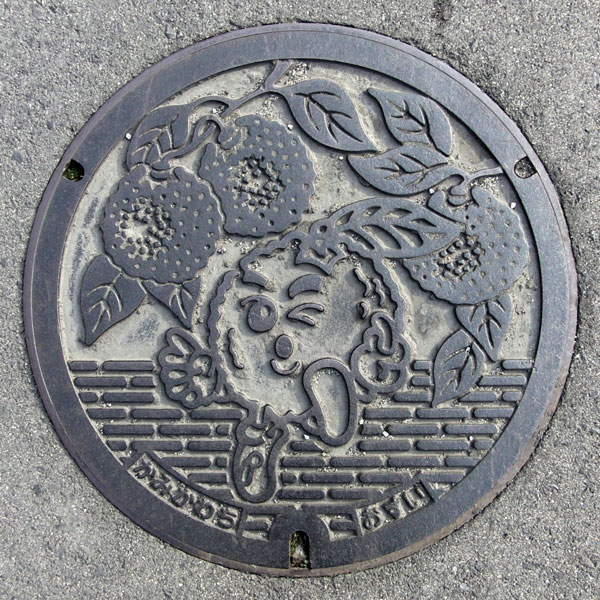
The design features the town's official tree, the yuzu citrus fruit. In the center is the mascot, Yuppy.
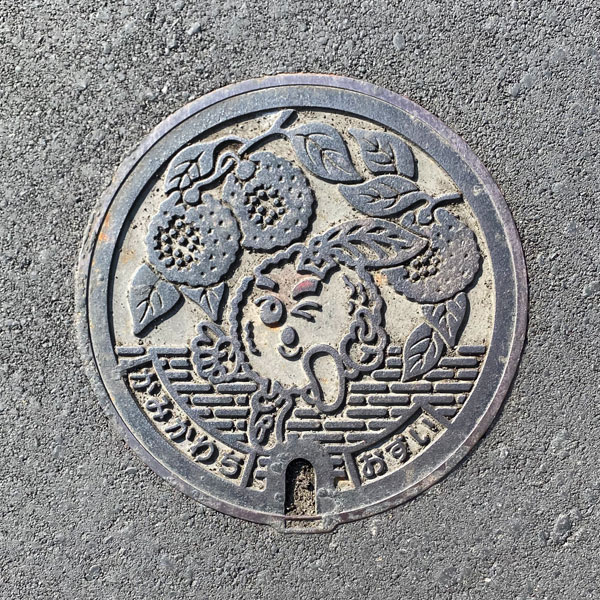
A smaller version with the same design as above.
Nasushiobara 那須塩原市
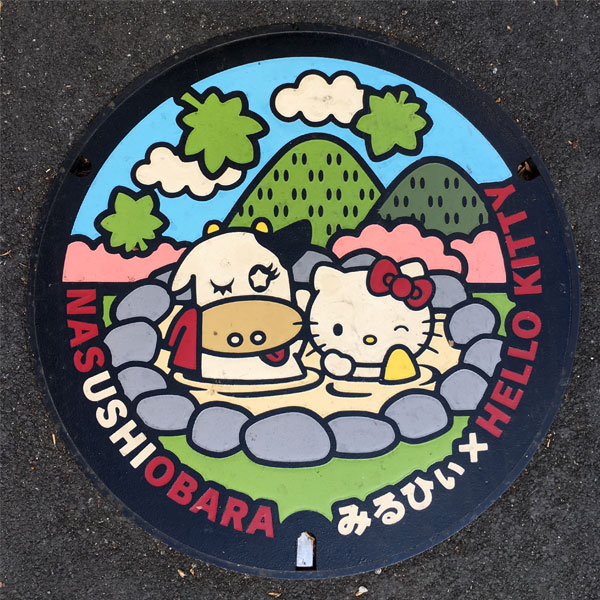
This manhole cover features a spring design of Nasushiobara City's brand character "Miruhii" and Sanrio's representative character "Hello Kitty" enjoying a hot spring bath together.
"Miruhii" is a character created because Nasushiobara City is the top producer of raw milk on Honshu. The pattern on her back is said to be the shape of Nasushiobara City, but this is not visible on this cover.
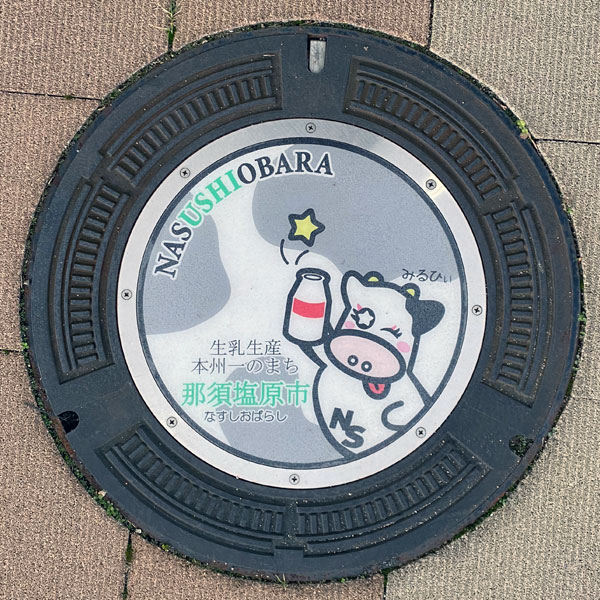
The manhole cover features Nasushiobara City's brand character, "Miruhi," holding a milk bottle. The words "NASUSHIOBARA" are in the upper left corner. To the left of "Miruhi," it reads "Raw Milk Production / Honshu's No. 1 Town," "Nasushiobara City," and "Nasushiobara-shi."
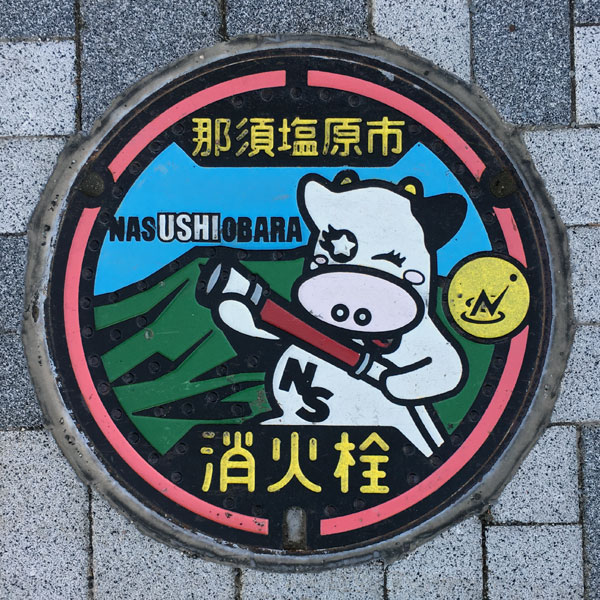
A somewhat small fire hydrant cover featuring Nasushiobara City's brand character, "Miruhi," holding a hose.
The words "Nasushiobara City" are at the top and "Fire Hydrant" at the bottom. The Nasushiobara City emblem is on the right. The "NASUSHIOBARA" lettering on the left has the "USHI" part, which can be read as "ushi," in a different color.
Kuroiso 黒磯市
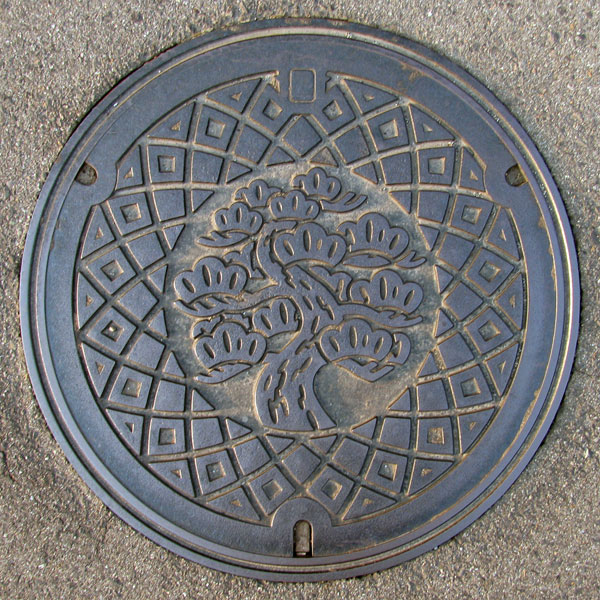
The city's official tree is the pine.
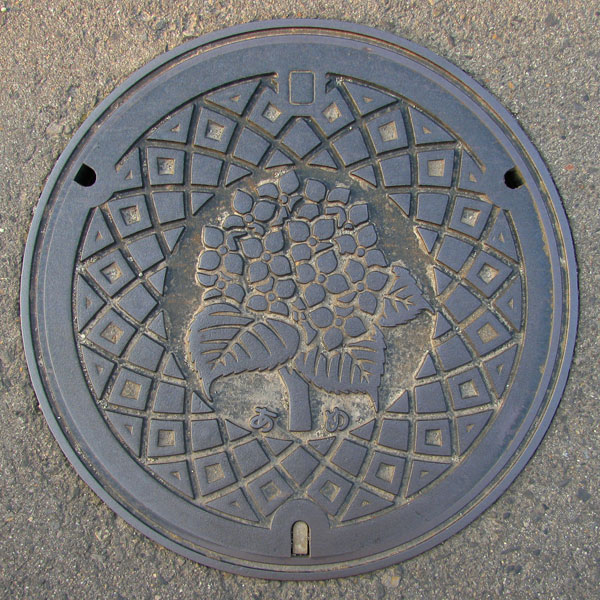
The city flower is the hydrangea. The rainwater has the character for "rain" in it.
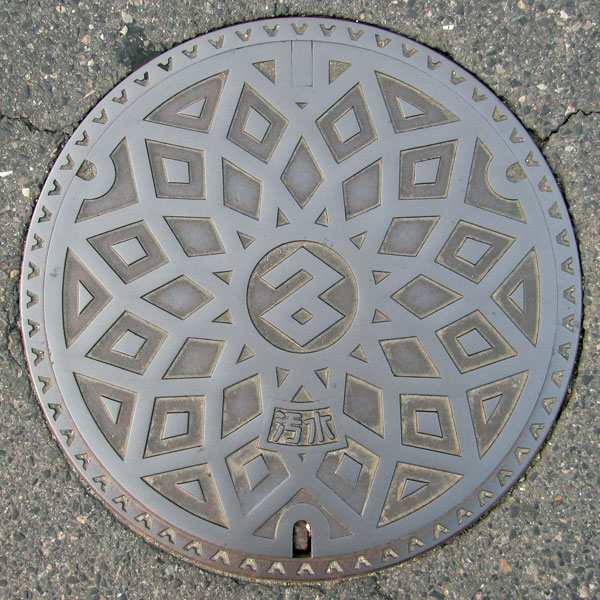
The city emblem is featured.
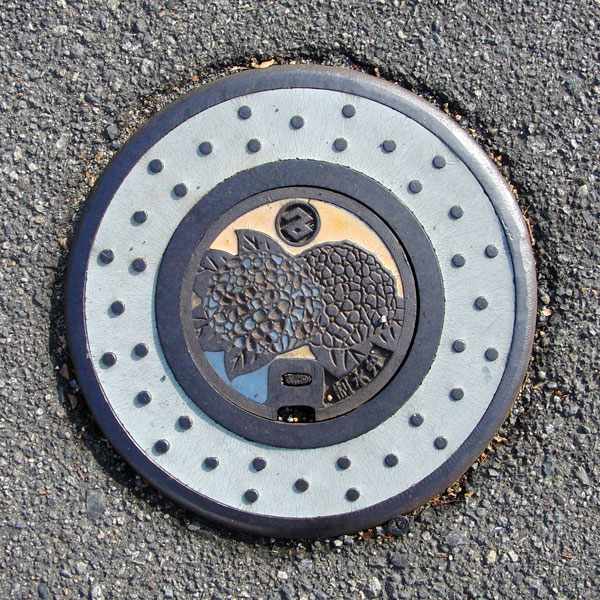
A water control valve cover decorated with hydrangeas.
Nishinasuno 西那須野町
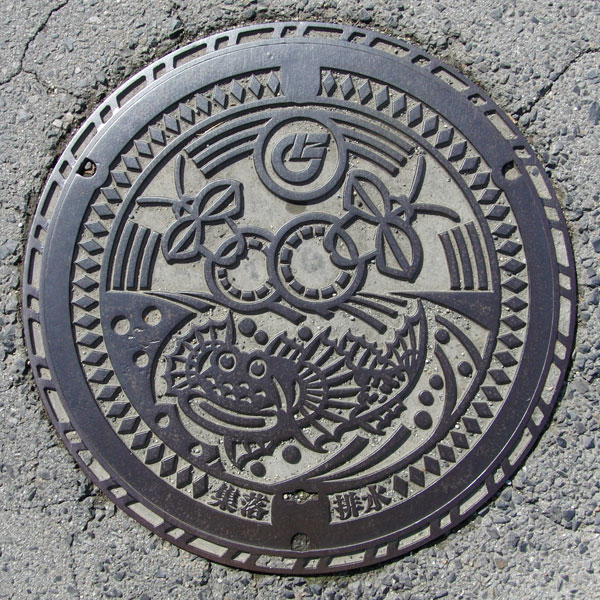
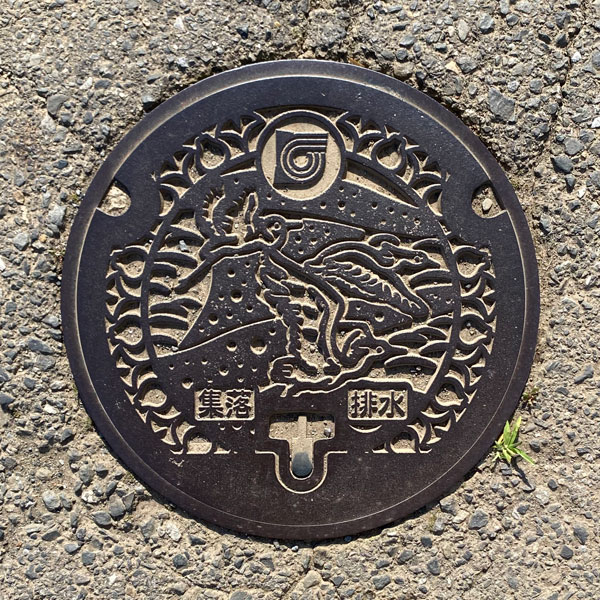
A manhole cover for a community drainage system, depicting fireflies and a sculpin. The sculpin has a nice expression.
Otawara 小田原市
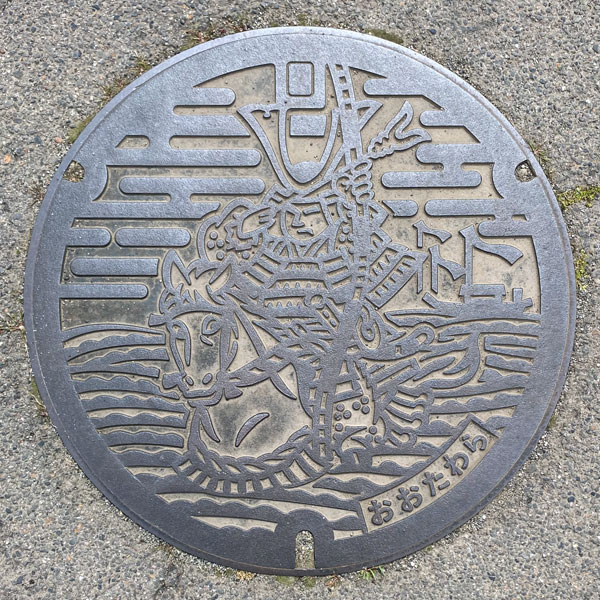
This is a manhole cover for sewage, depicting Nasu Yoichi, a resident of Shimotsuke Province who, at the command of Yoshitsune, rode his horse into the sea to shoot at a fan target, as seen in "The Tale of the Heike."
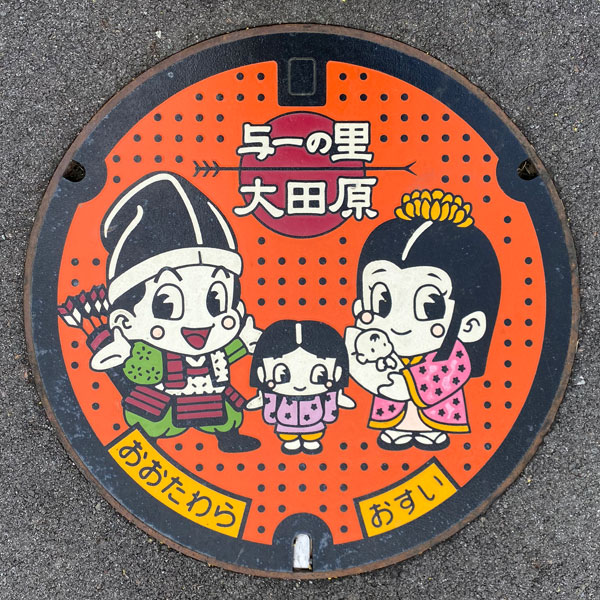
A colorful manhole cover for sewage featuring the Yoichi family.
With a dark orange background that could easily be mistaken for a fire hydrant cover, the manhole cover depicts "Yoichi," his daughter "Rurihime," his wife "Ayumi," and their son "Ichiya" from left to right. The family names appear to have been chosen through a public contest. The top features the "Yoichi no Sato / Otawara" mark, and the bottom has the words "Otawara" and "Osui" (sewage).
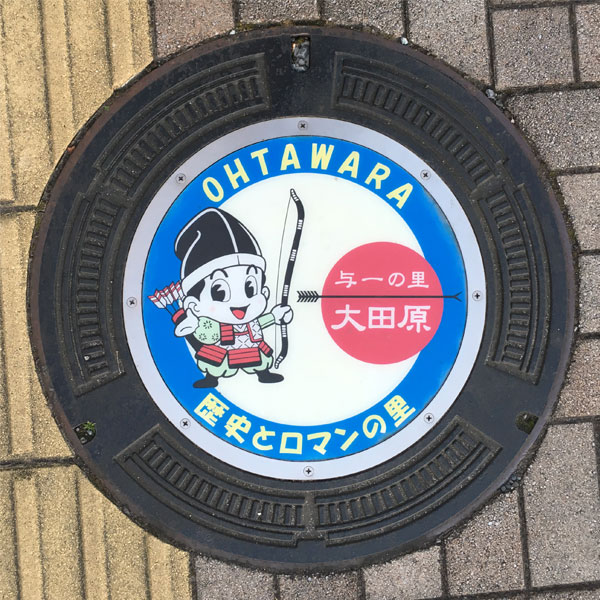
A color plate-shaped manhole cover featuring "Yoichi-kun," the character belonging to the Otawara City Tourism Association. The words "OHTAWARA" are at the top and "Village of History and Romance" at the bottom.
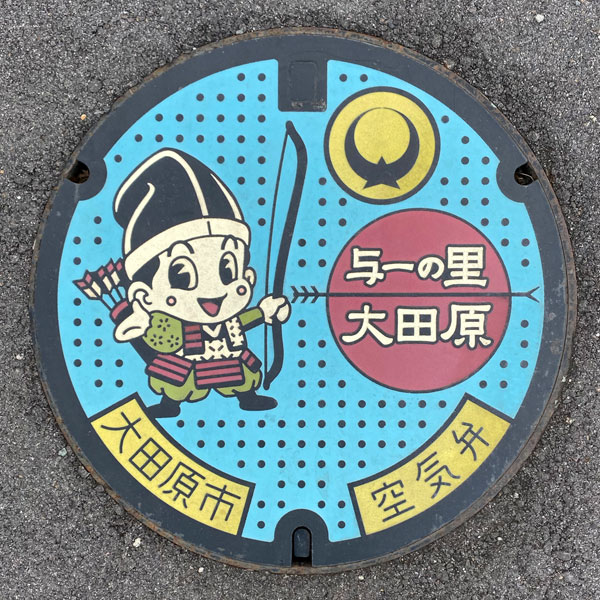
A colorful manhole cover for an air valve, featuring "Yoichi-kun," a character belonging to the Otawara City Tourism Association, with the same design as above.
It has a light blue background, typical of air valves, with the city emblem on the upper right, the "Yoichi no Sato / Otawara" mark on the right, and the words "Otawara City" and "Air Valve" at the bottom.
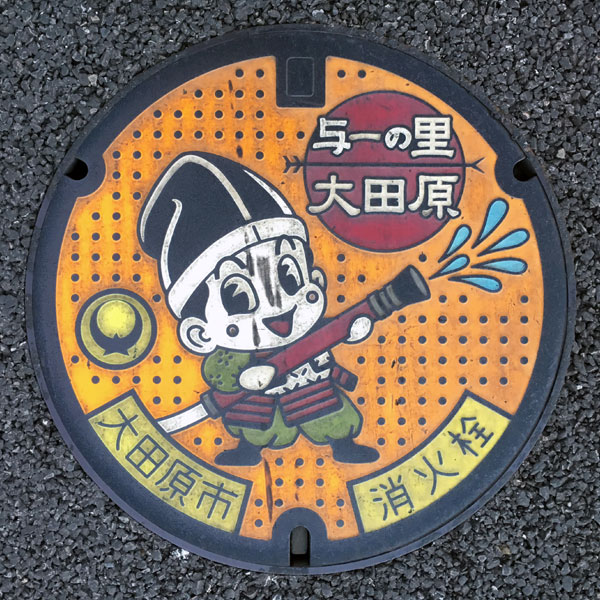
This is a fire hydrant cover featuring "Yoichi-kun," a character belonging to the Otawara City Tourism Association.
This one has an orange background, typical of fire hydrants. The upper right shows the "Yoichi no Sato / Otawara" mark, the left the city emblem, and the bottom has the words "Otawara City" and "Fire Hydrant."
Kurobane 黒羽町
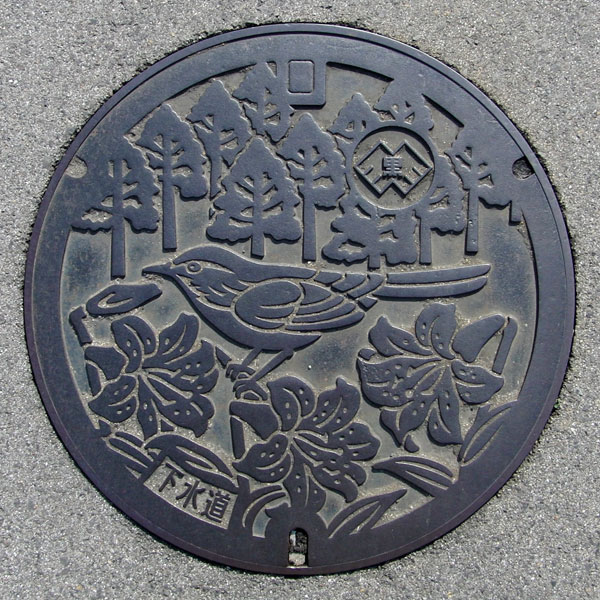
The former Kurobane town's tree, the cedar; its flower, the mountain lily; and its bird, the Japanese bush warbler. The town emblem, with the character "black" inside the character "feather," is in the upper right corner.
This is a manhole cover for the Kurobane treatment area of the designated environmentally protected public sewer system.
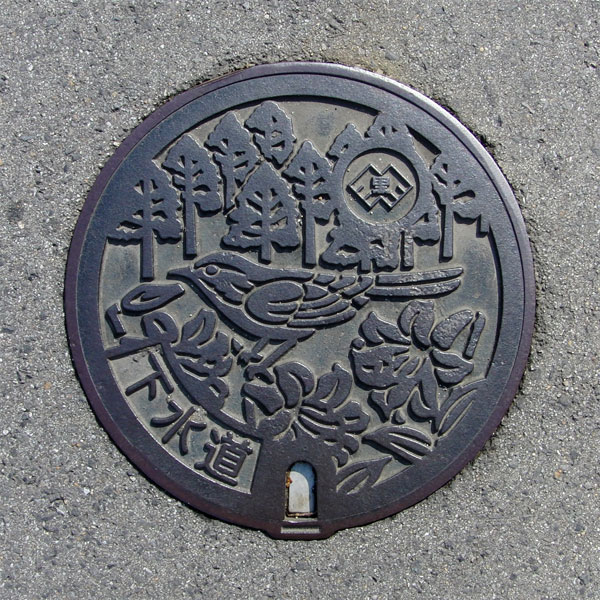
Small version of the manhole above.
Yaita 矢板市
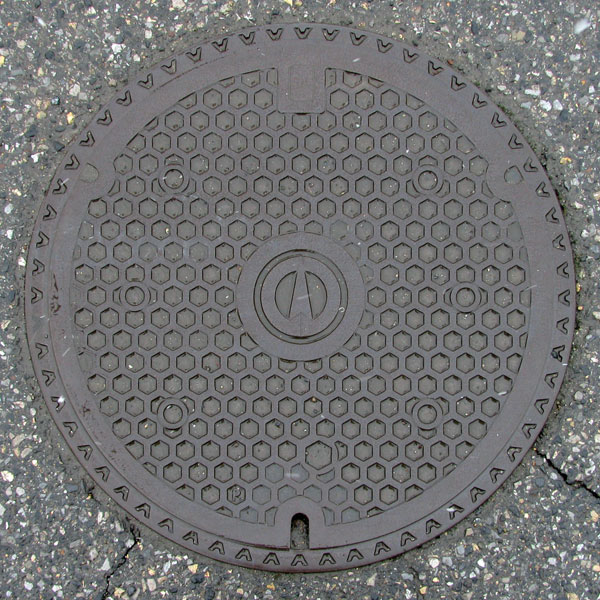
In the center is the city emblem, a stylized representation of an arrowhead and the "i" from "Yaita."
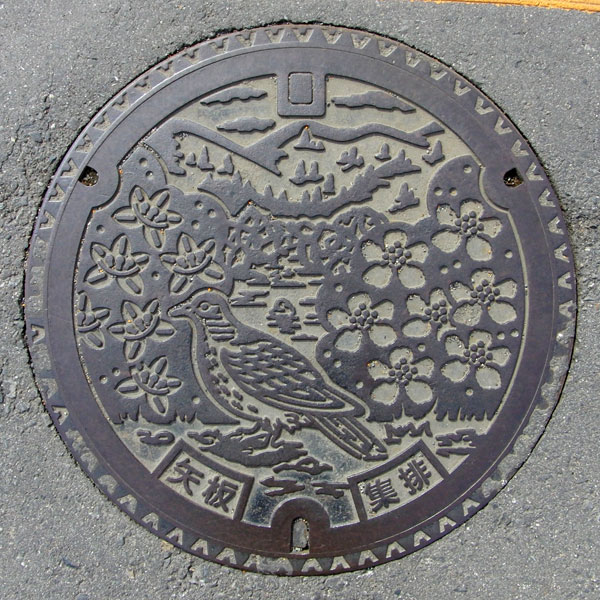
This community drainage manhole cover features the city tree "Summer Camellia," the city flower "Rhododendron molle," and the city bird "Oriental Turtle Dove." It's not just a simple arrangement; I think it's a pretty good design.
This particular cover is from the Sawa district (parts of Sawa and Tsuchiya), and the covers in the Sakaibayashi district (parts of Kawasaki Sorimachi, Sakaibayashi, Kohata, and Tatenokawa) have the same design.
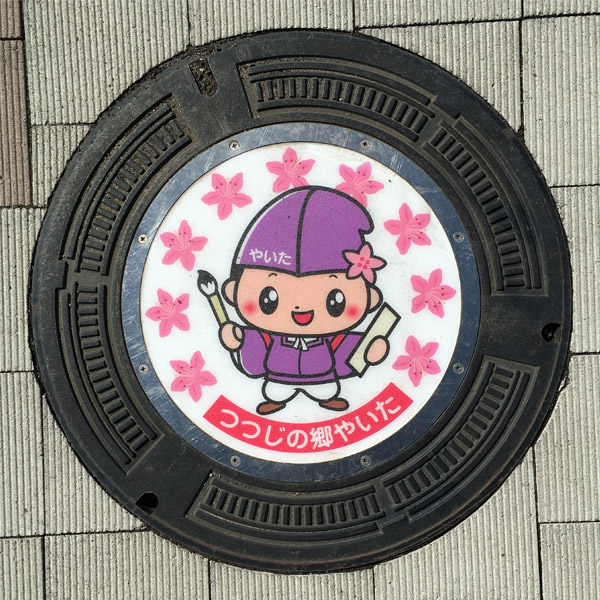
The image depicts "Tomonari-kun," a character created based on Shioya Tomonari, the lord of Kawasaki Castle who was a samurai, retainer, and poet from the late Heian period to the early Kamakura period. Surrounding "Tomonari-kun" are the city flower, the "Yashio azalea," and below it are the words "Yaita, the Village of Azaleas." Installed in 2016.
Nikko 日光市
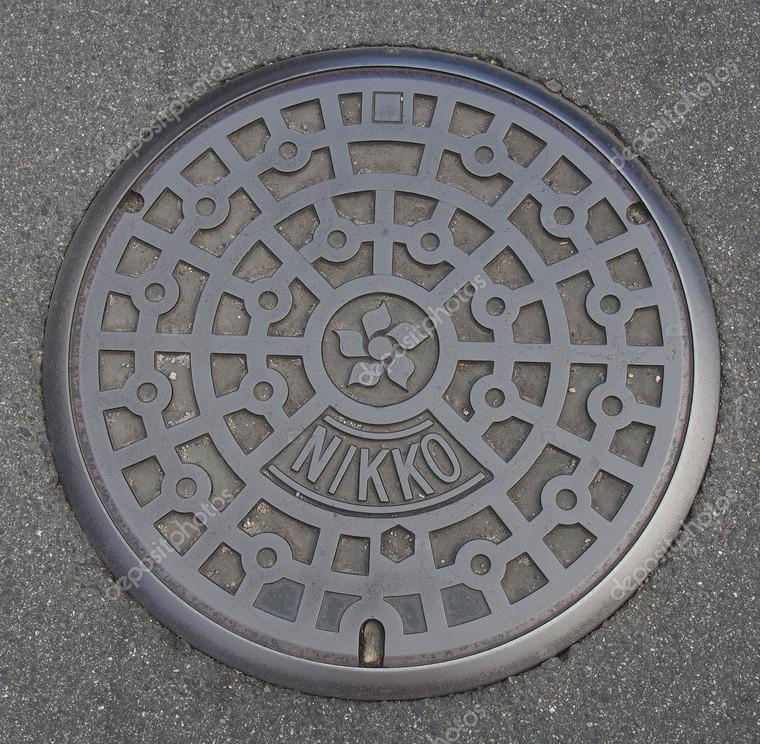
City emblem in the center.
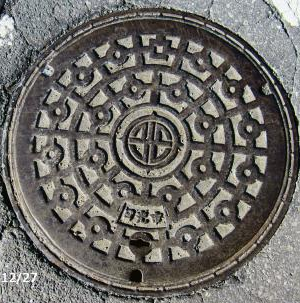
A stylized 光 in the center.
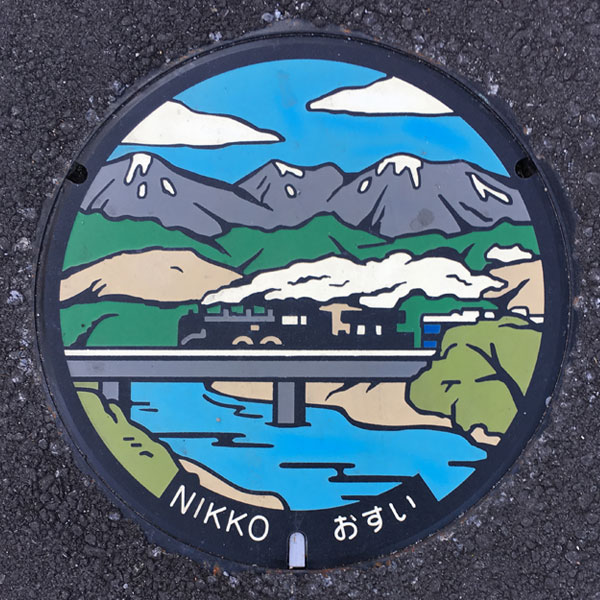
A colorful manhole cover featuring designs of the Nikko mountain range, the SL Taiju steam locomotive, and the Daiya River.
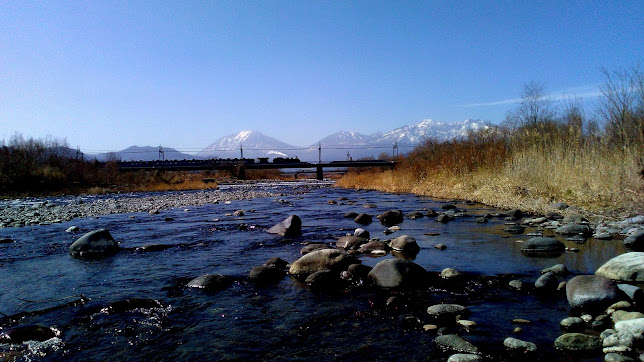
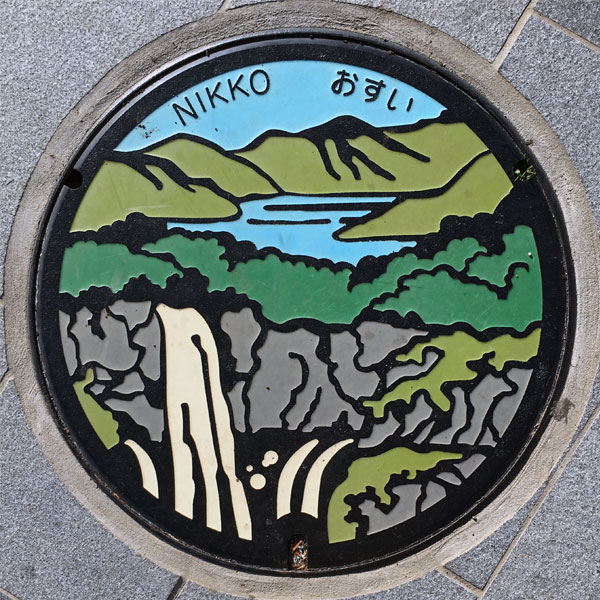
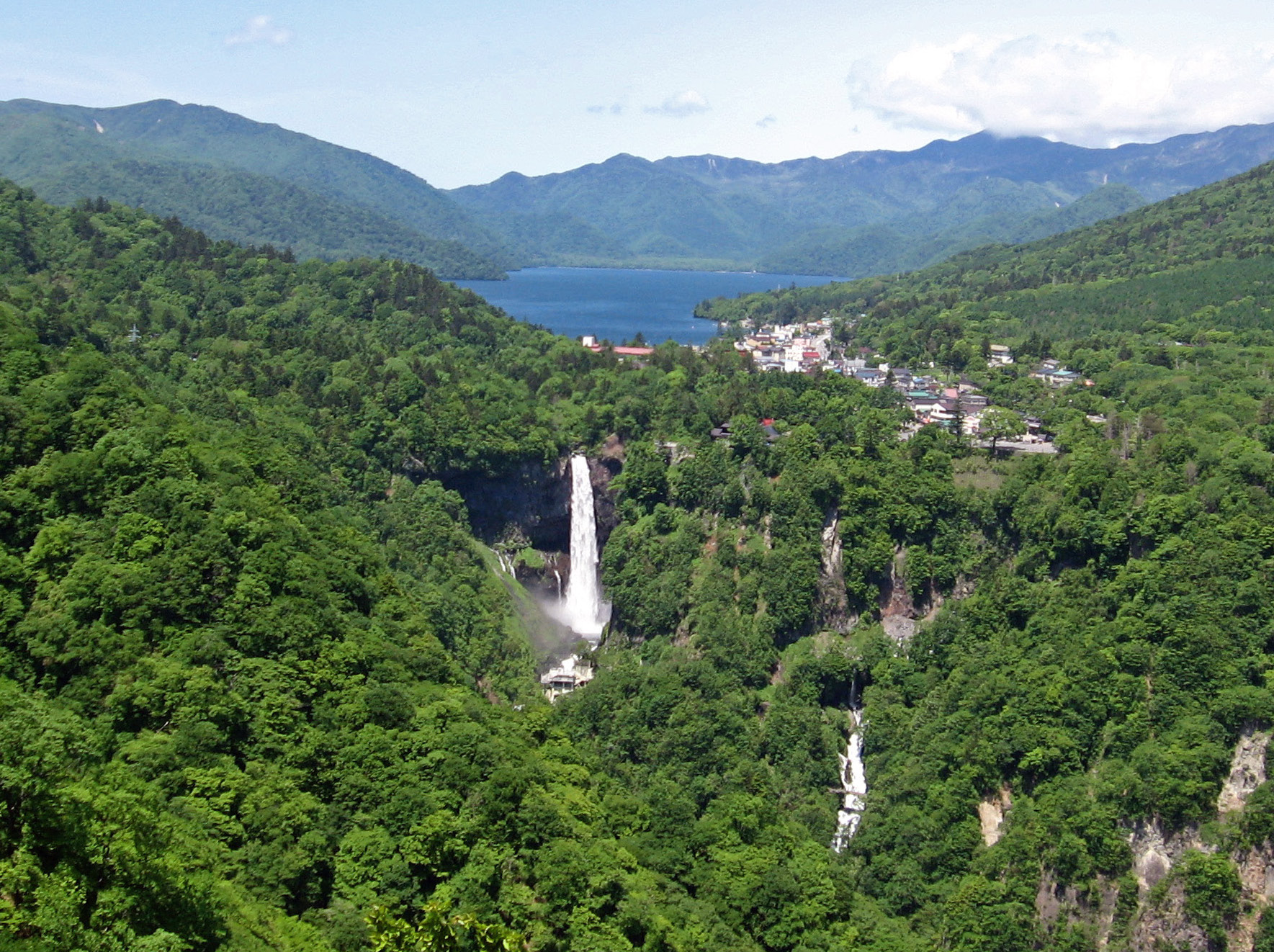
A colorful manhole cover depicting Kegon Falls and Lake Chuzenji when the water level is high.
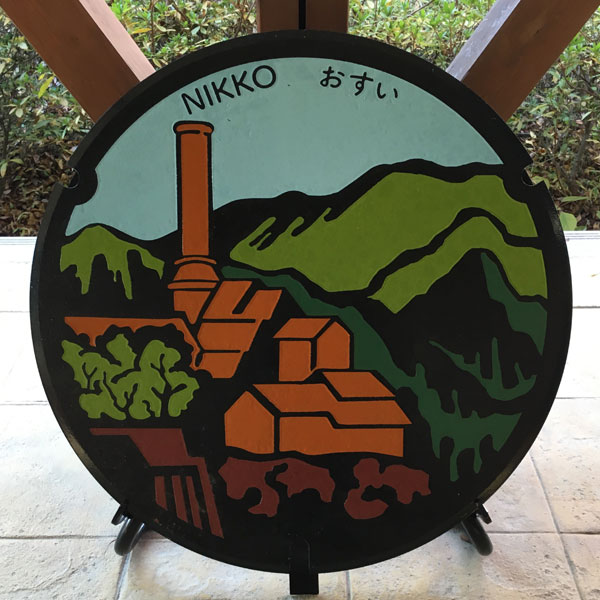
A colorful manhole cover depicting the Ashio Smelting Plant.
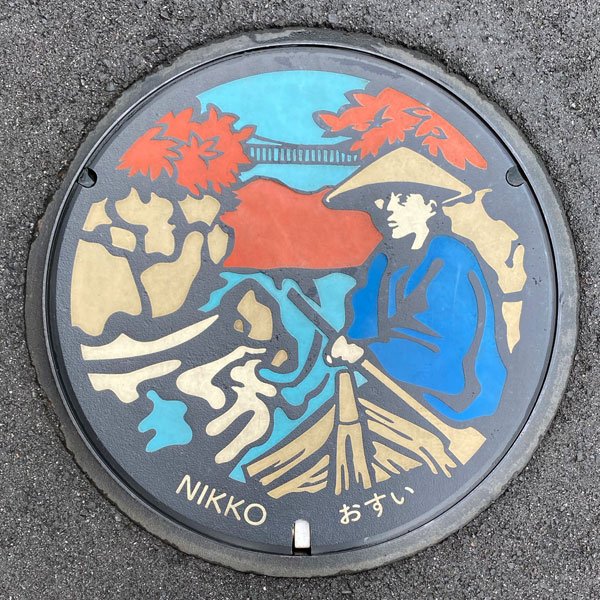
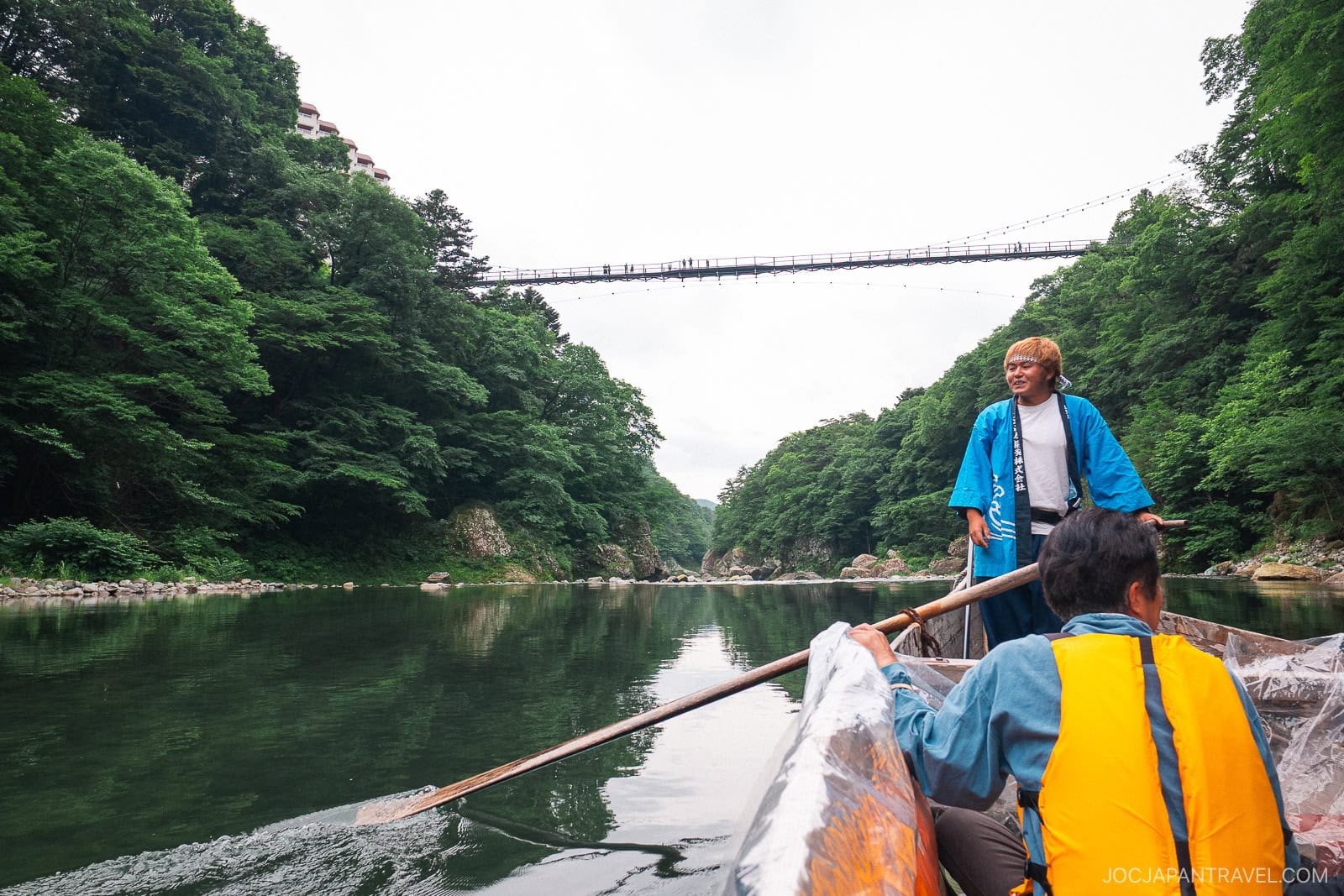
A colorful manhole cover depicting the Kinugawa River boat ride.
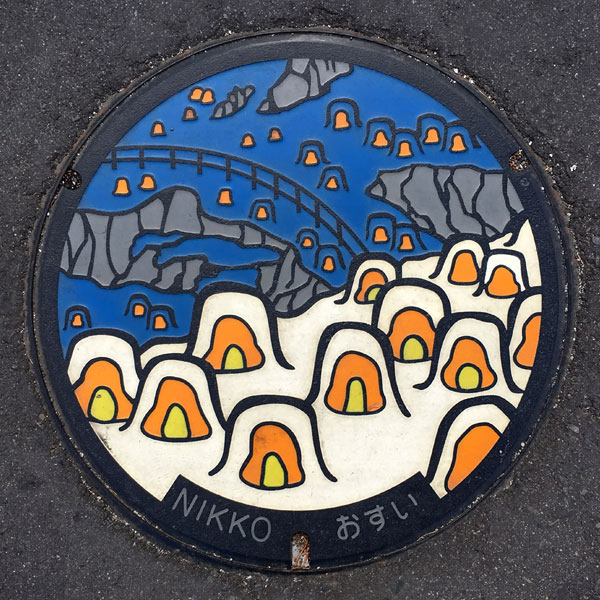
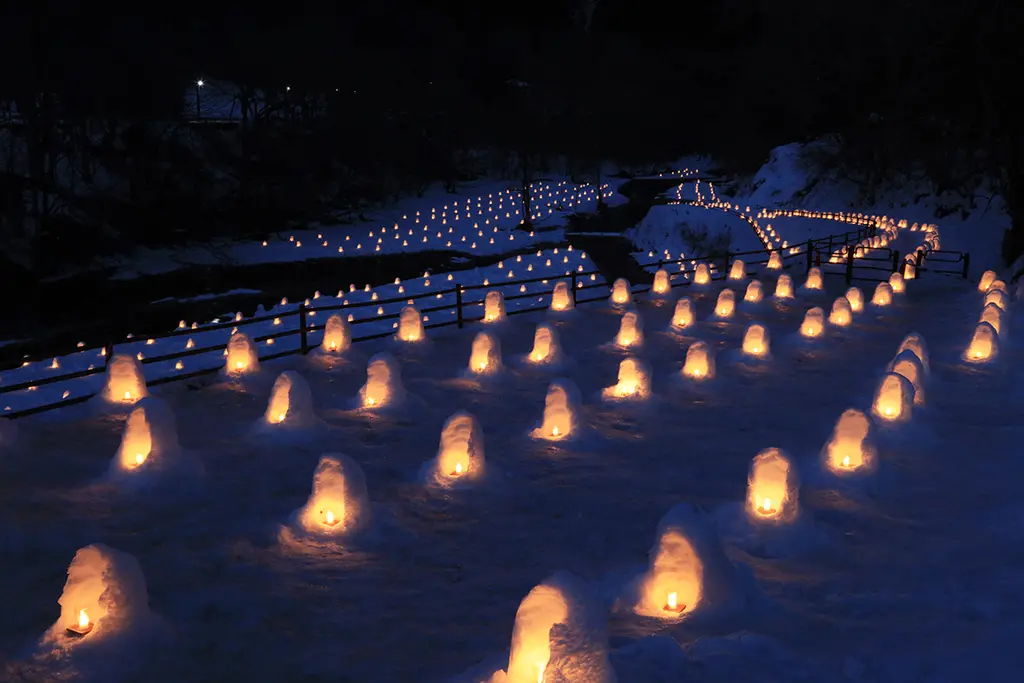
A colorful manhole cover depicting the Yunishigawa Onsen Kamakura Festival.
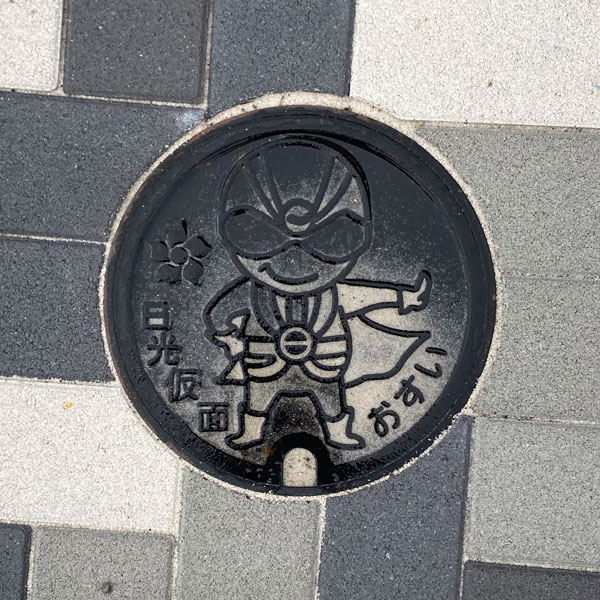
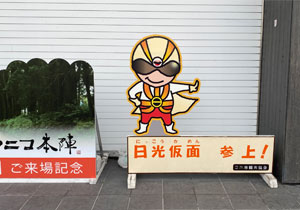
A manhole cover the size of a handhole, depicting "Nikko Kamen," a slightly overweight middle-aged hero from Nikko City (affiliated with the Nikko Tourism Association).
Imaichi 今市市
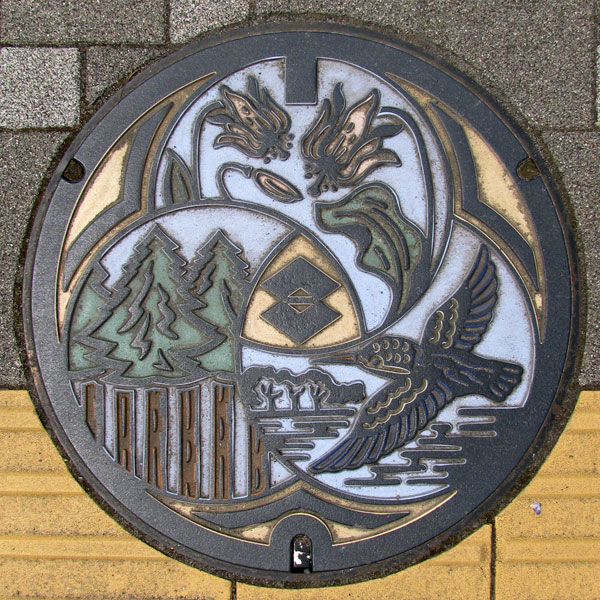
The design features the city flower "Erythronium japonicum," the city tree "Japanese cedar," and the city bird "Kingfisher." The former Imaichi City emblem is in the center.
Sakura さくら市
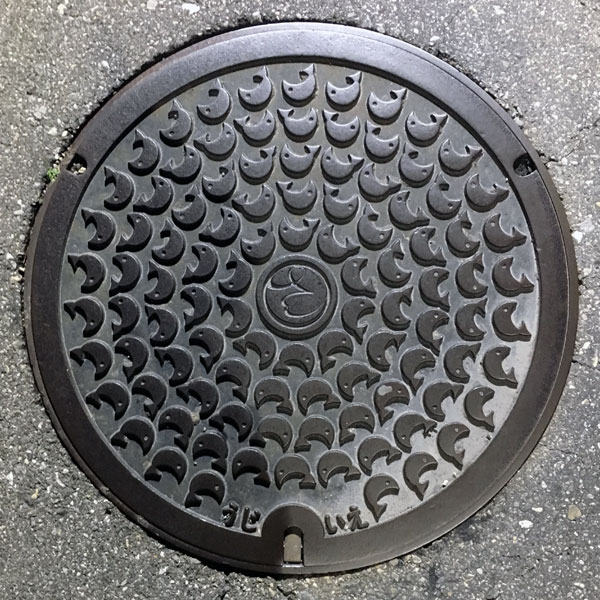
From the outermost circle, 27, 26, 21, 15, and 10 fish are depicted leaping in a five-tiered circle, totaling 99 fish. These are likely ayu (sweetfish) from the Kinugawa River, and this number is probably the largest ever seen on a manhole cover depicting fish.
In the center is the Sakura City emblem. At the bottom are the characters "Ujiie".
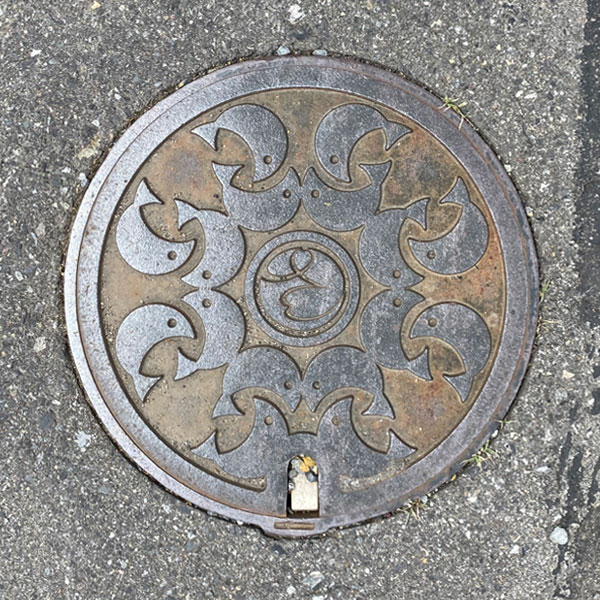
This is a slightly smaller manhole cover, similar to the one in the former Ujiie Town, featuring 32 leaping fish. The center has been replaced with the new city emblem.
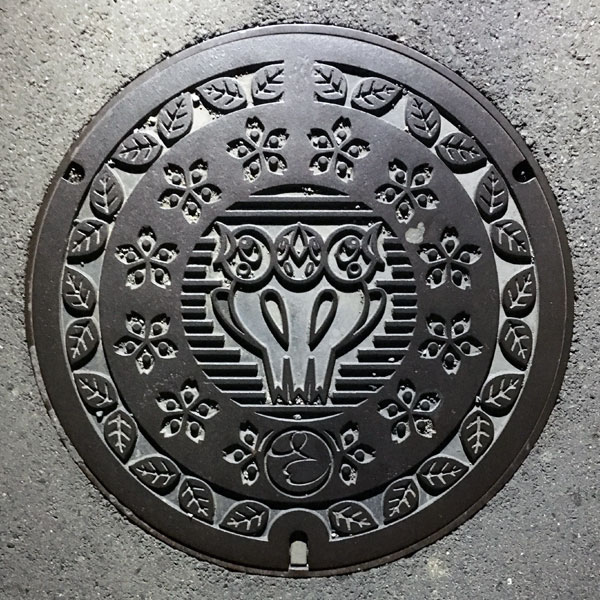
A manhole cover with the former Kitsuregawa town emblem replaced with the Sakura City emblem.
Ujie 氏家町
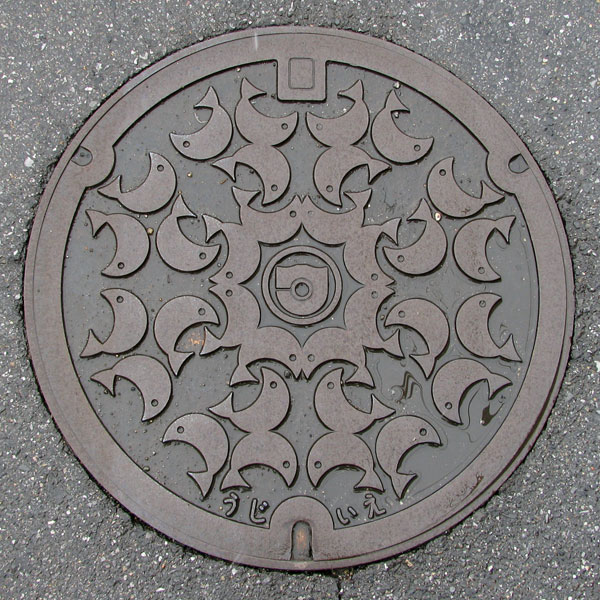
32 fish are leaping. They are likely ayu (sweetfish) from the Kinugawa River. The former town emblem is in the center.
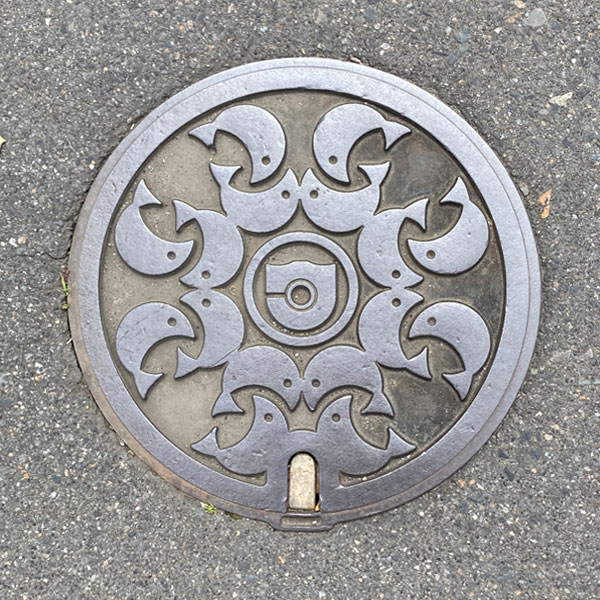
A miniature version of the above. It looks like the center of a regular-sized cover has been cropped.
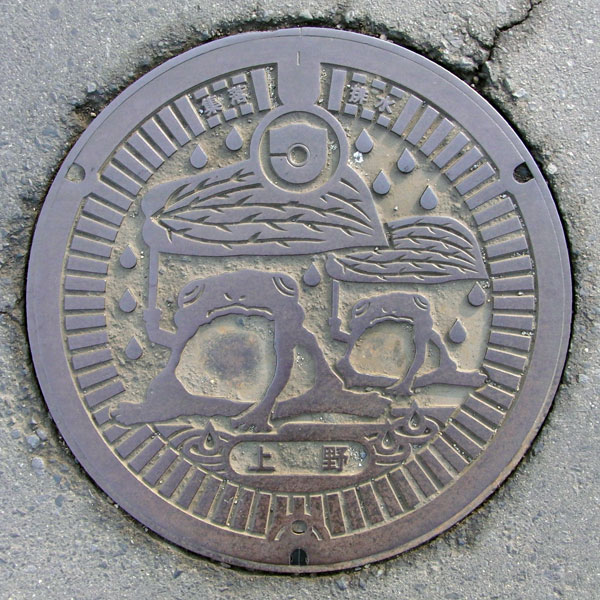
The design, featuring a frog holding a leaf umbrella, seems to be for rainwater, but it says "Community Drainage" at the top. The frog's expression is unique. The treatment facility is the Ueno Water Treatment Center.
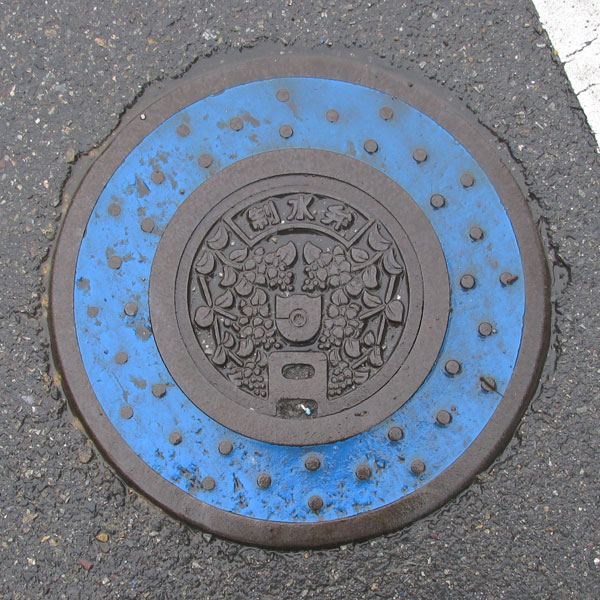
A water control valve bearing the town emblem and a flower pattern.
Kitsuregawa 喜連川町
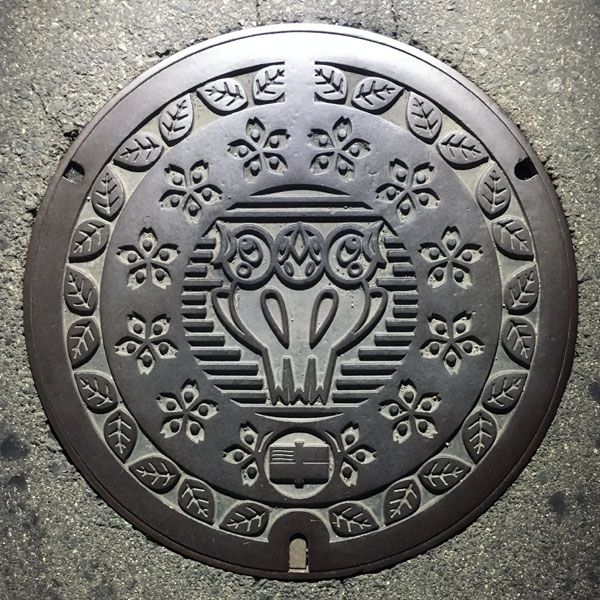
The former Kitsuregawa town emblem is at the bottom.
The former Kitsuregawa town's tree was the Japanese red pine, and its flower was a type of azalea called "Gobinishiki," but the flower depicted on this cover appears to be a cherry blossom. The surrounding leaves are also those of a broad-leaved tree. The three birds in the center are the town's mascots, the "Happy Trio."
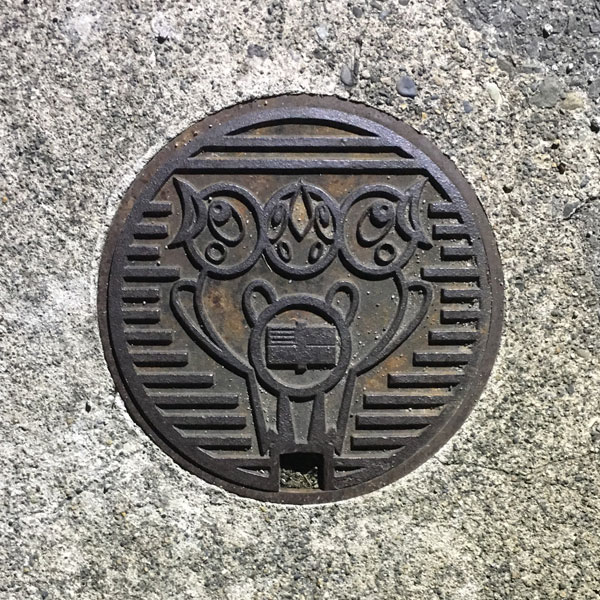
A sewage manhole cover with the central part of the top lid cut out. The former Kitsuregawa town emblem is at the bottom center.
Nasukawasuyama 那須川須山市
Karasuyama 烏山町
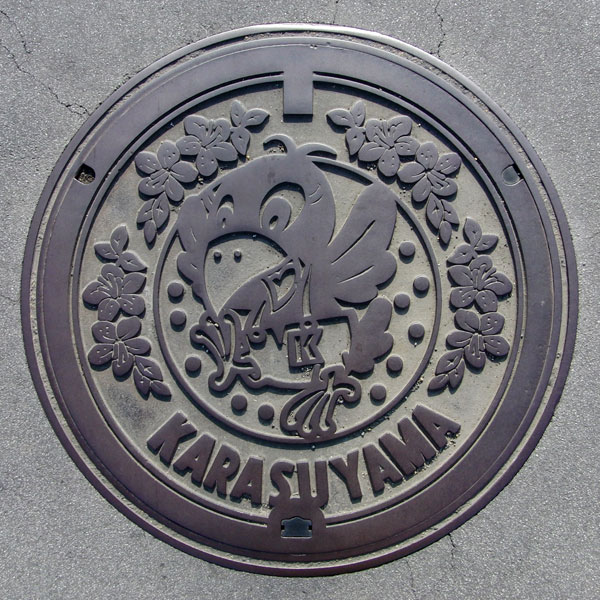
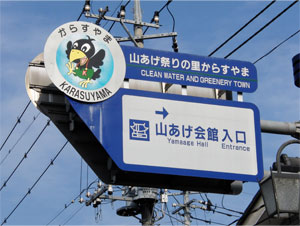
The illustration depicts a crow, which is currently the city's official bird.
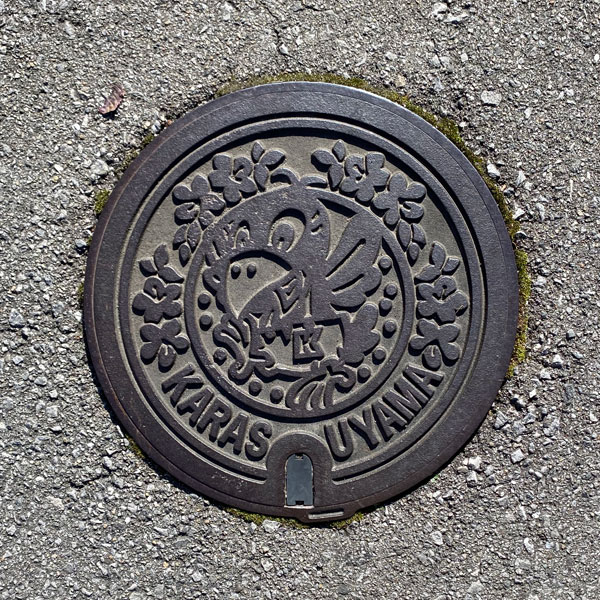
A smaller version with the same design as above.
Minaminasu 南那須町
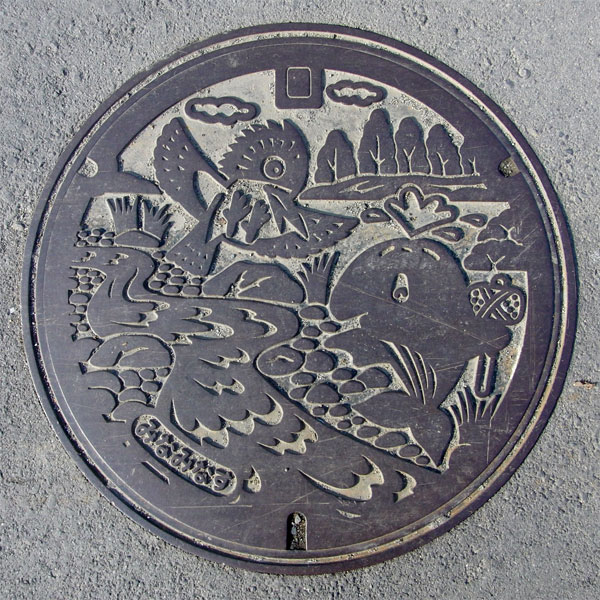
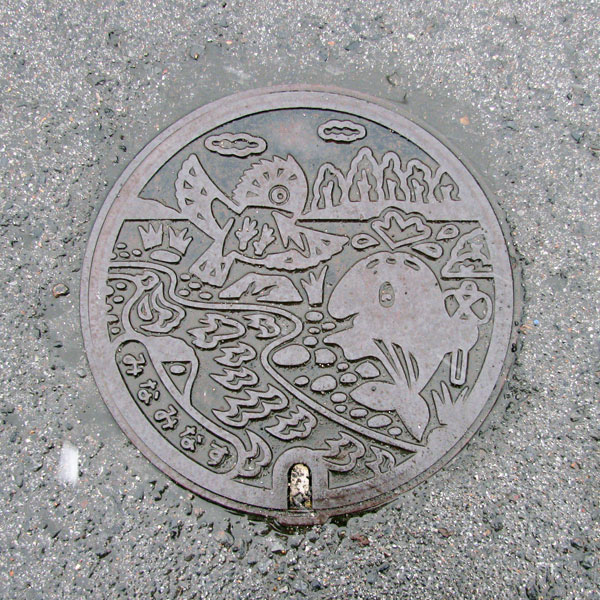
With the Arakawa River flowing through the town as a backdrop, the town's mascot, "Ku-chan the Whale," and the town's bird, the "Skylark," are playing. A whale in such an inland area? It makes sense, as this whale is based on a 1.5 million-year-old baleen whale (Great White-fronted Whale) discovered in the Arakawa Group (near Ogane) along the Arakawa River. The skylark's beak is quite long, though.
A smaller version with the same design as above.
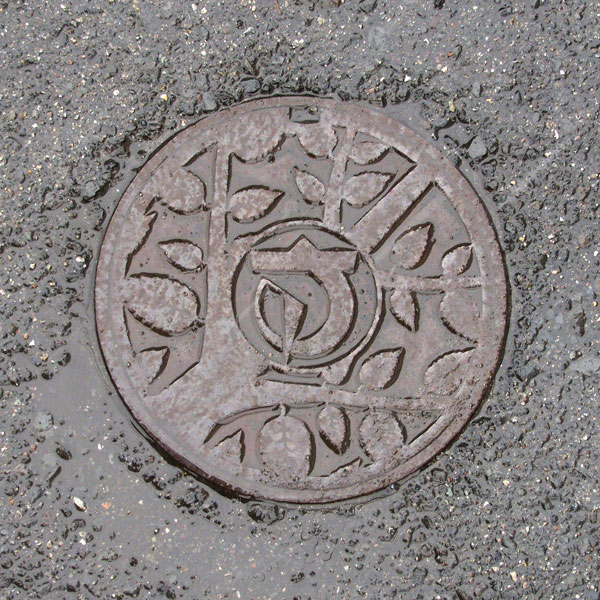
Is this the town tree, the zelkova? The former Minami-Nasu town emblem is in the center.
Kanuma 鹿沼市
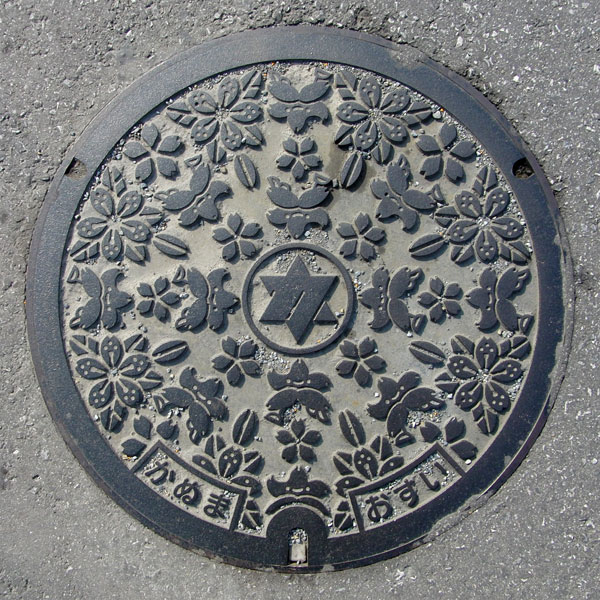
At first glance, it looks like all the flowers are azaleas, but then you see something running around. The manhole cover features "Sacchan," the symbol of Kanuma City, which is based on the city flower, the azalea.
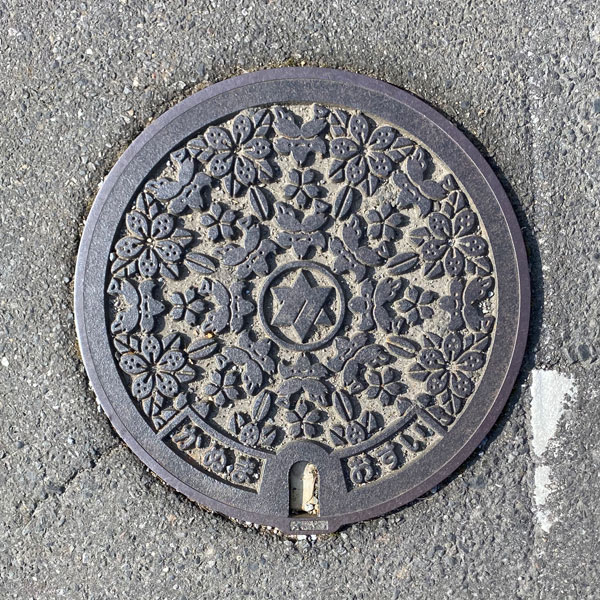
A smaller version with the same design as above.
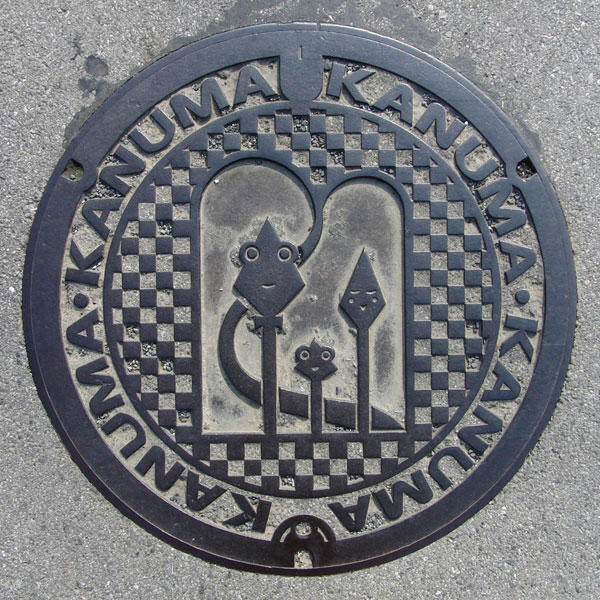
This is a manhole cover from the Shimonanma district of Kanuma City featuring "Suginami-kun," the city's symbol based on the city's tree, the cedar. The covers in the Sakanoya and Kikuzawa-Nishi districts appear to have the same design.
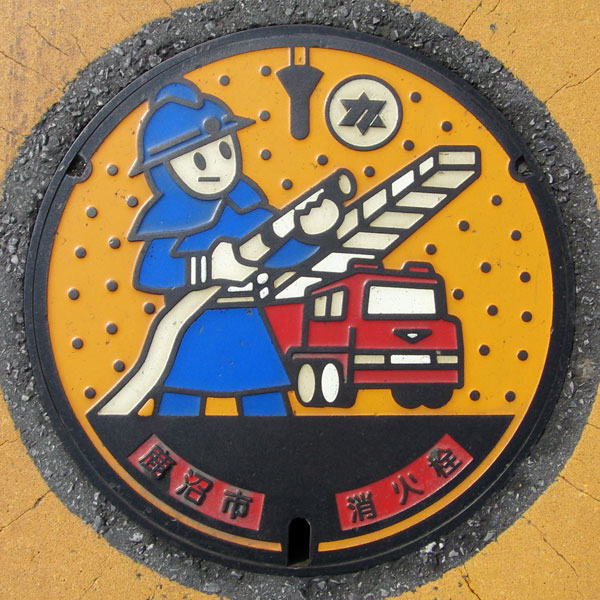
A fire hydrant with the city emblem on the top right.
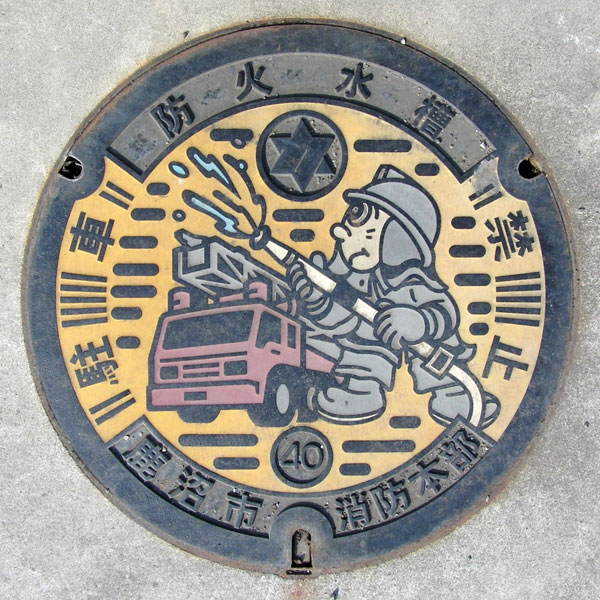
Fireproof water tank cover with the city emblem in the top middle.
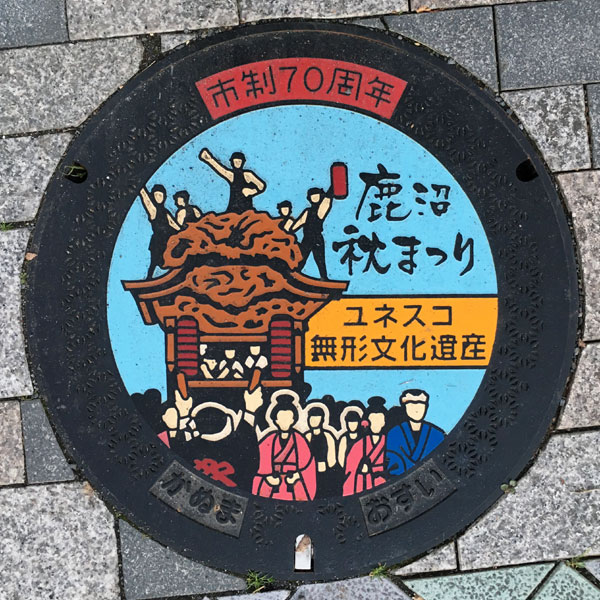
A colorful manhole cover for sewage, depicting the "carved floats" of the Kanuma Autumn Festival. It is surrounded by "Kanuma Kumiko," a traditional woodworking technique. It was created to commemorate the 70th anniversary of the city's founding.
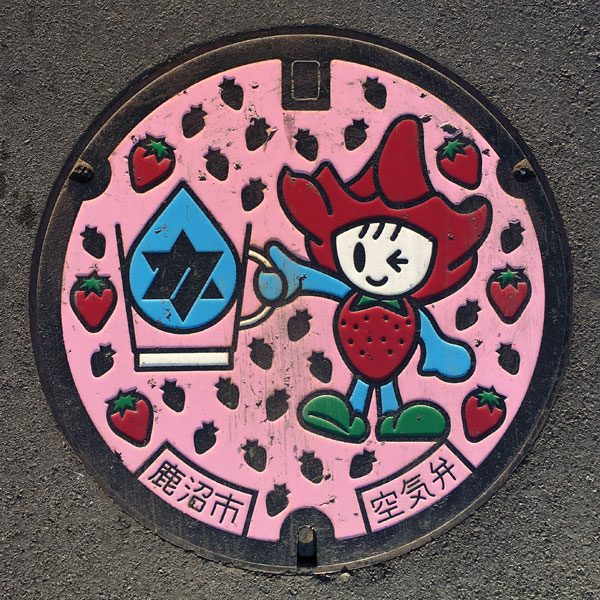
The air valve cover features a design of "Berry-chan," the mascot character of "Strawberry City."
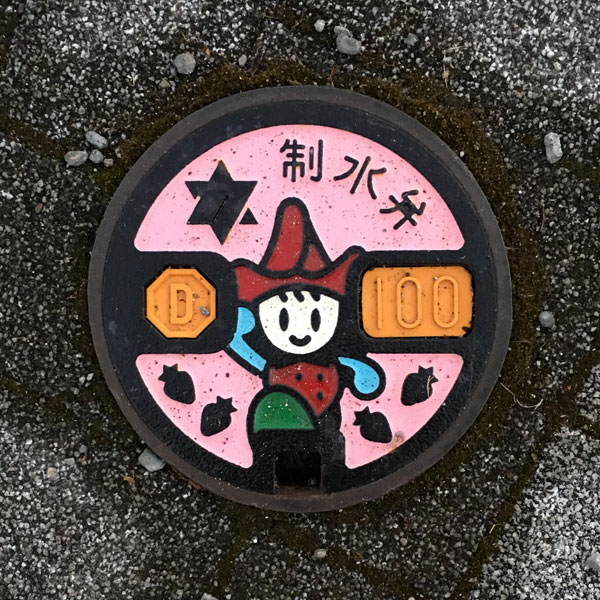
A water control valve cover featuring "Berry-chan," the mascot character of "Strawberry City."
Awano 粟野町
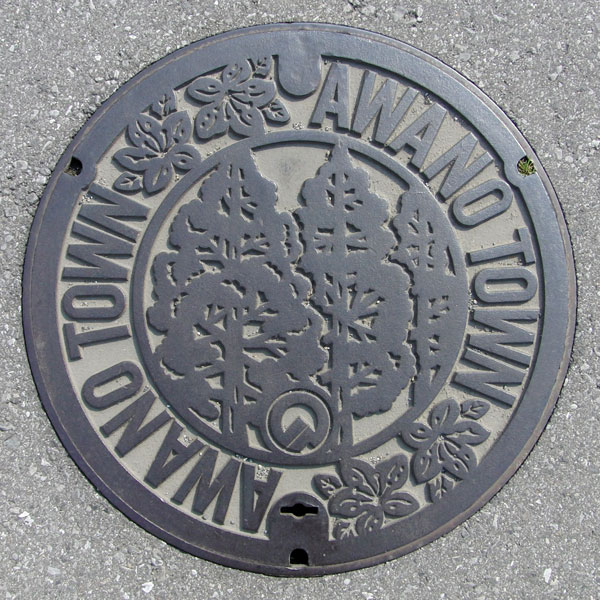
The manhole cover depicts the former Awano town tree, the Japanese cedar ("sugi"), and the town flower, the Japanese azalea ("yamatsutsuji").
Moka 真岡市
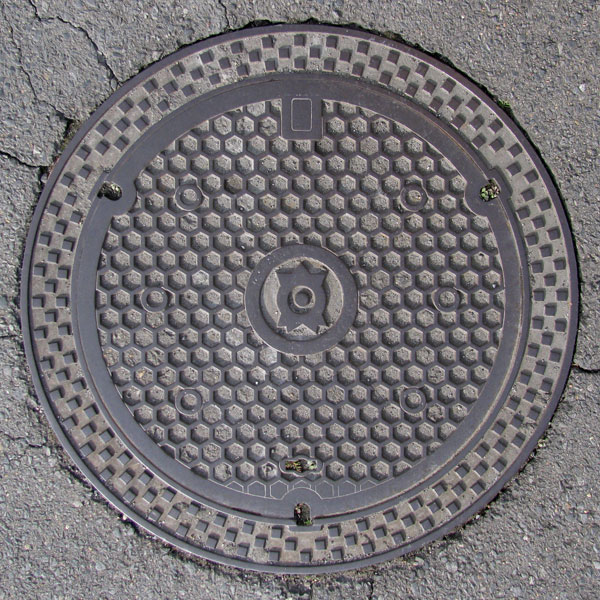
City emblem in the middle.
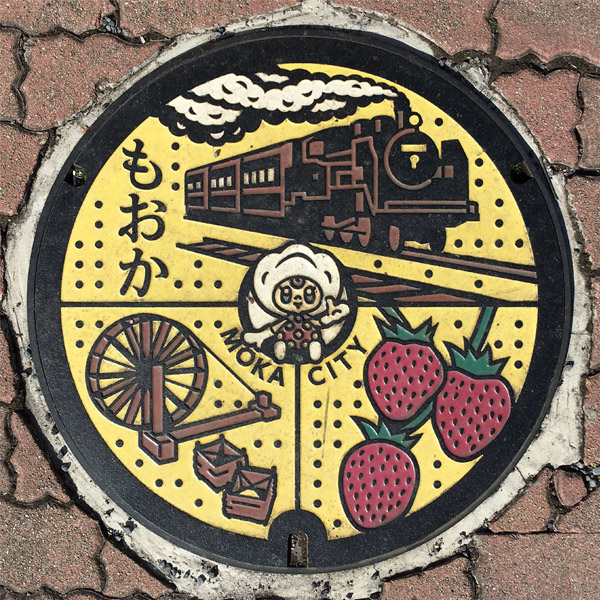
The manhole cover features Mooka City's mascot character, "Cotberry," along with the "SL Mooka" steam locomotive of the Mooka Railway (a third-sector railway company that inherited the former JNR Mooka Line), a spinning wheel for traditional Mooka cotton, and strawberries, a local specialty for which Mooka City boasts the highest production volume in Japan.
The word "Mooka" is written next to the steam locomotive. Previously, there were two pronunciations, "Mooka" and "Moka," but it seems that "Mooka" is now the standard. The Romanized spelling is "Moka," and "MOKA CITY" is written below "Cotberry."
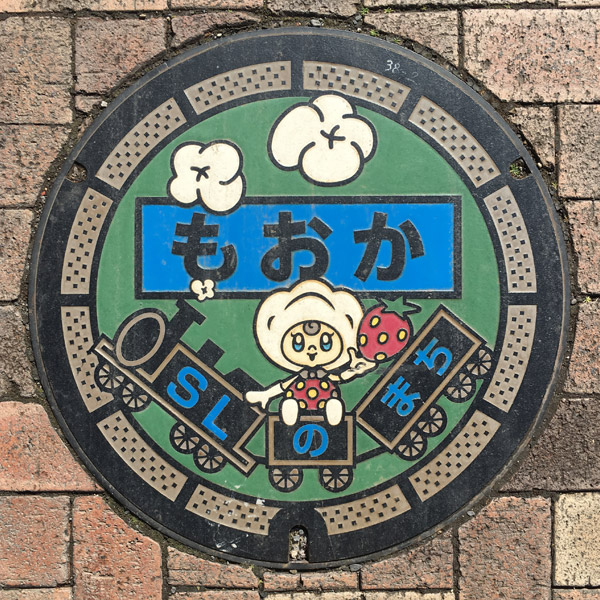
This manhole cover features Mooka City's mascot character "Cotberry," the city flower "cotton," a steam locomotive with the words "SL Town" written on it, and strawberries.
"Cotberry" is a character created to commemorate the first anniversary of the merger of Mooka City and Ninomiya Town, and its motifs are strawberries and cotton.
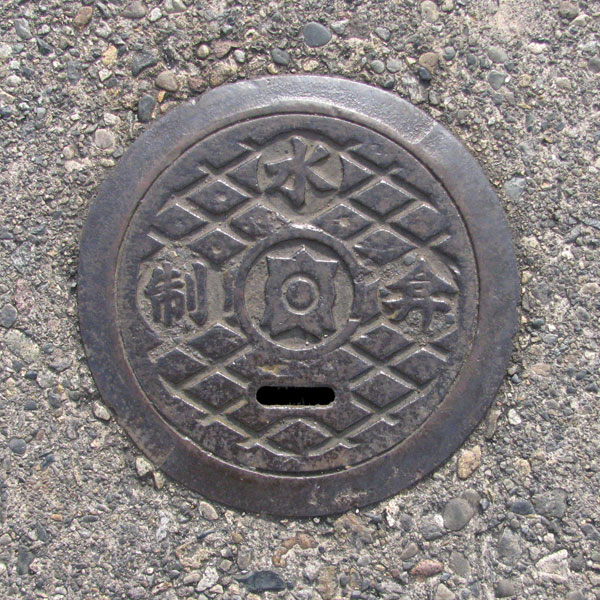
A water control valve bearing the city emblem.
Ninomiya 二宮町
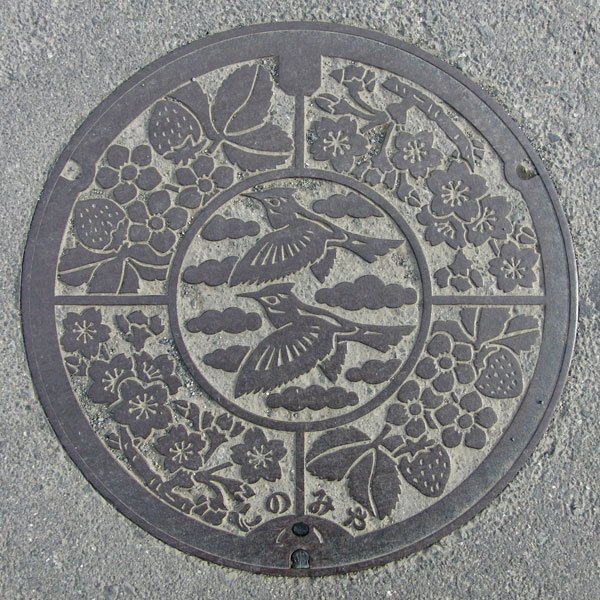
They depict the town's bird, the skylark; the town's tree, the cherry blossom; and the town's flower, the strawberry.
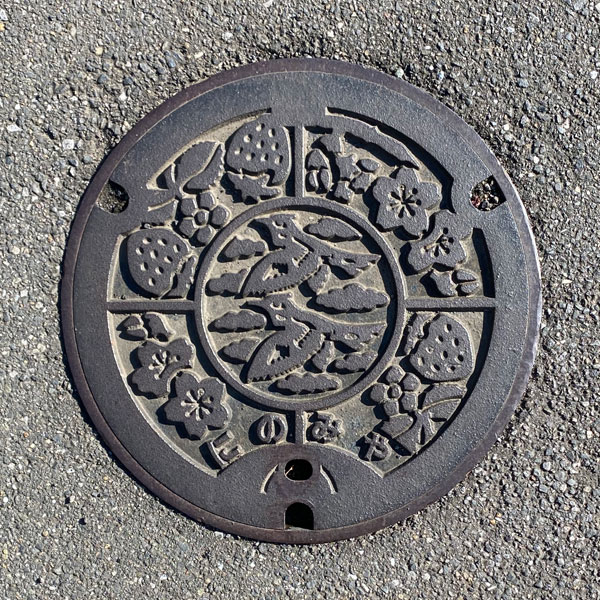
A smaller version with the same design as above.
Tochigi 栃木市
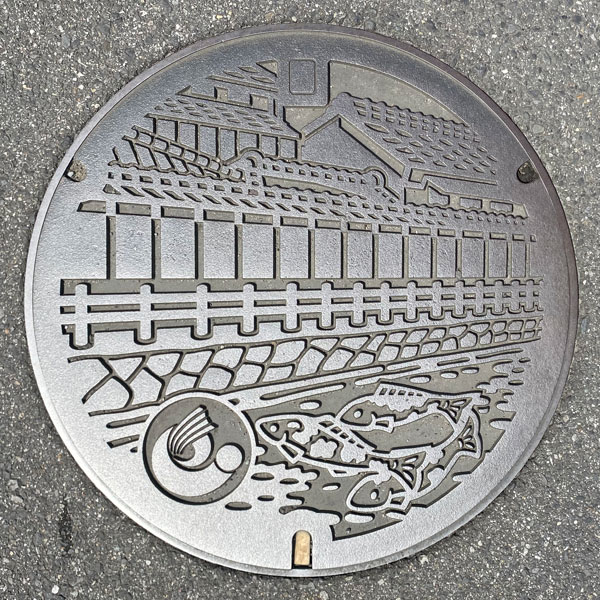
The design is the same as that of the old Tochigi City manhole covers, featuring the "Tsukada Historical and Legendary Museum" and the Uzumagawa River that flows alongside it.
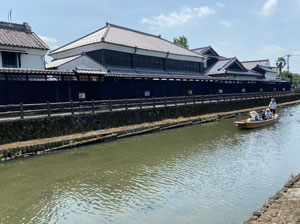
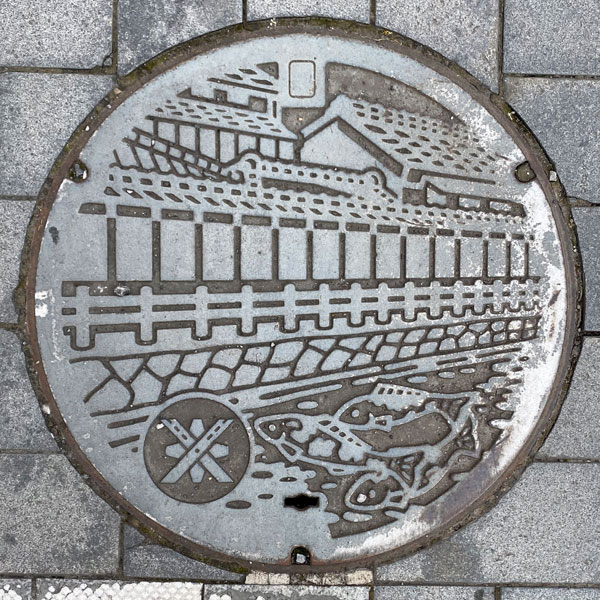
The design features the "Tsukada Historical and Legendary Museum" and the "Uzuma River" flowing beside it. This scenery is said to be representative of Tochigi.
The Tsukada family were wealthy merchants who ran a timber shipping business from the late Edo period. At that time, they transported timber assembled on rafts via the Uzuma River and Tone River to the lumber yard in Fukagawa, Edo.
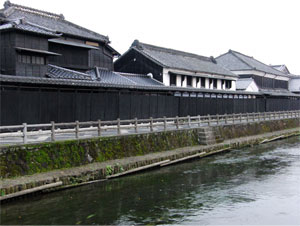
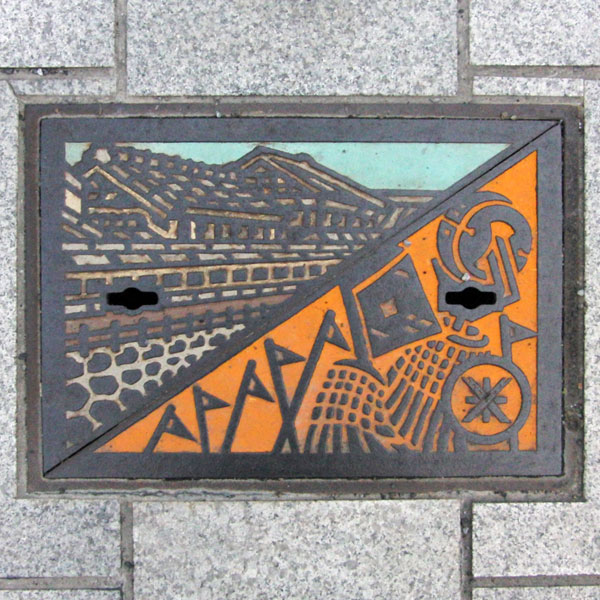
A view of the "Tsukada Historical and Legendary Museum" and a fire hydrant cover depicting a banner and a fire hook, as seen from the Uzumagawa Tsunade Road.
Ohira 大平町
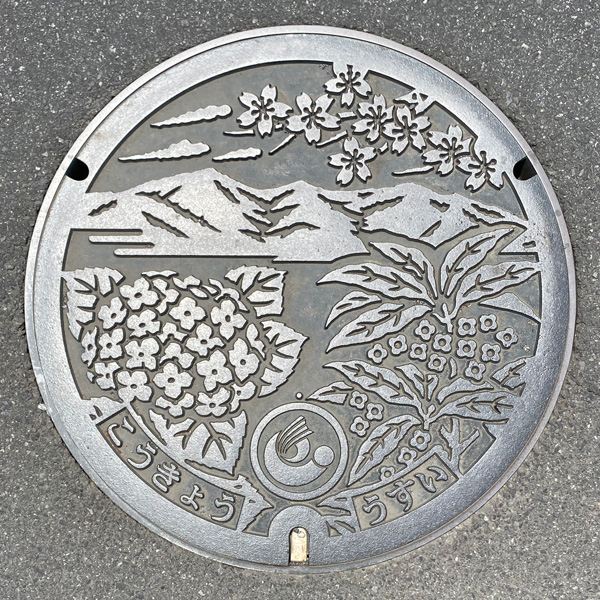
A rainwater manhole cover featuring the new city emblem on the design of the former Ohira Town.
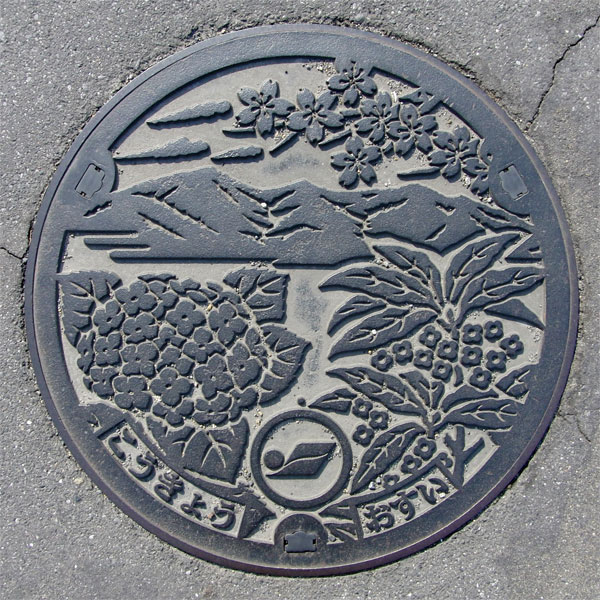
The design features the town flower (hydrangea), town tree (osmanthus), and cherry blossoms against the backdrop of Mt. Koseki and Mt. Ohira. A luxurious version using eight colors.
At the bottom are the town emblem, featuring hydrangea petals as a motif, and the words "Kokyo" and "Usui."
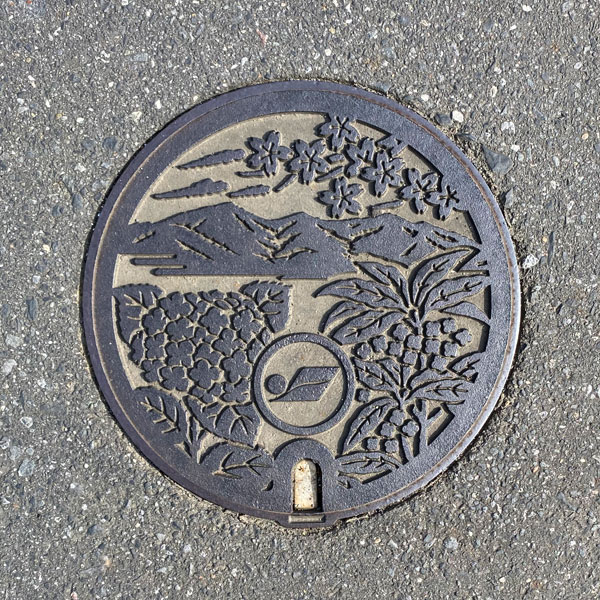
A smaller version with the same design as above.
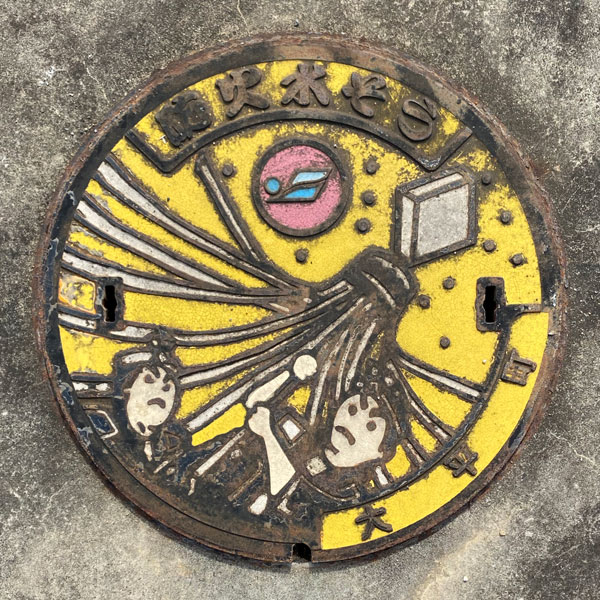
A fire hydrant cover with the town's colorful emblem.
Fujioka 藤岡町
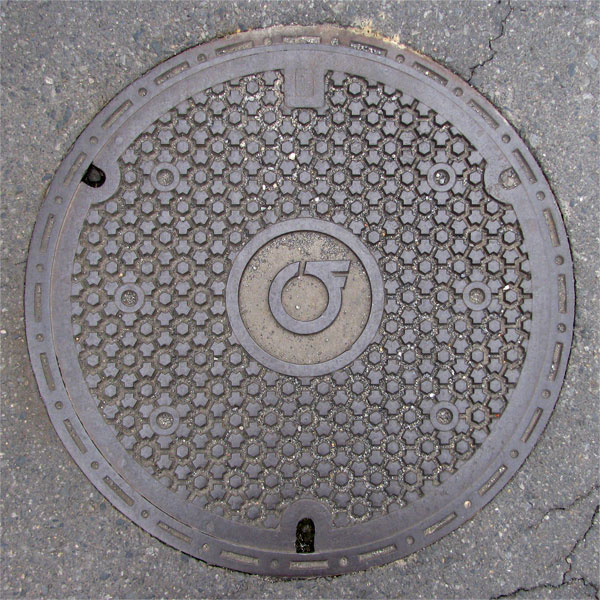
The manhole cover features alternating small triangular and hexagonal protrusions. In the center is the town emblem, a stylized "F" representing the initials of "Fujioka".
Iwafune 岩舟町
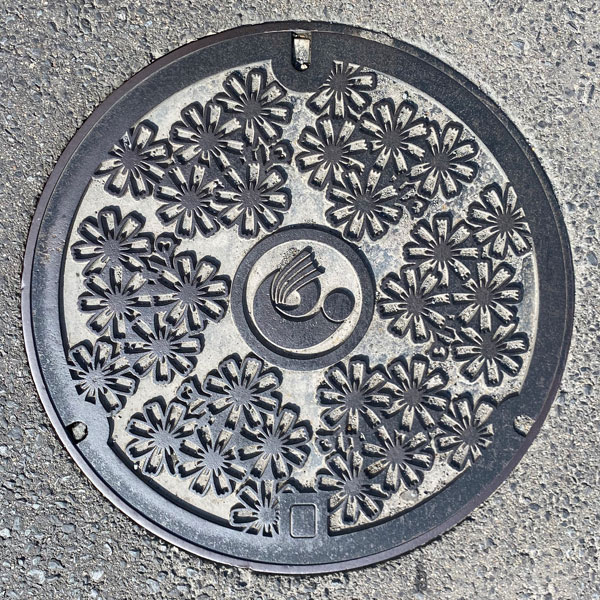
This manhole cover features the cosmos design from the former Iwafune town, with the center replaced by the new Tochigi City emblem.
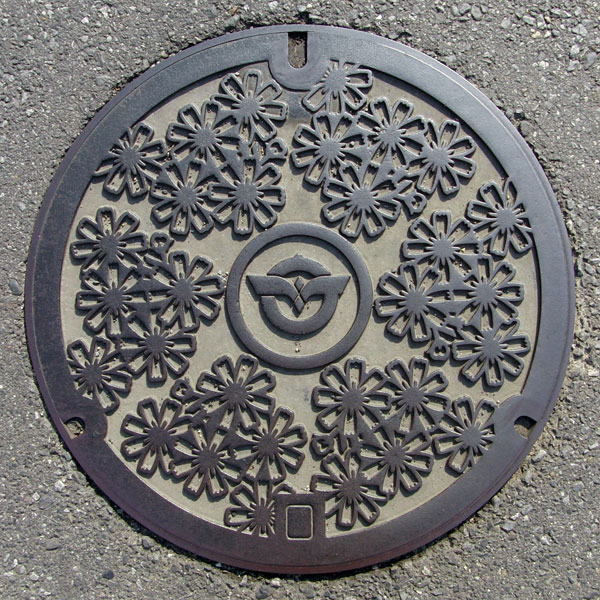
The design features the town's flower, the cosmos. The town emblem, a stylized representation of an "Iwafune" (rock boat), is in the center.
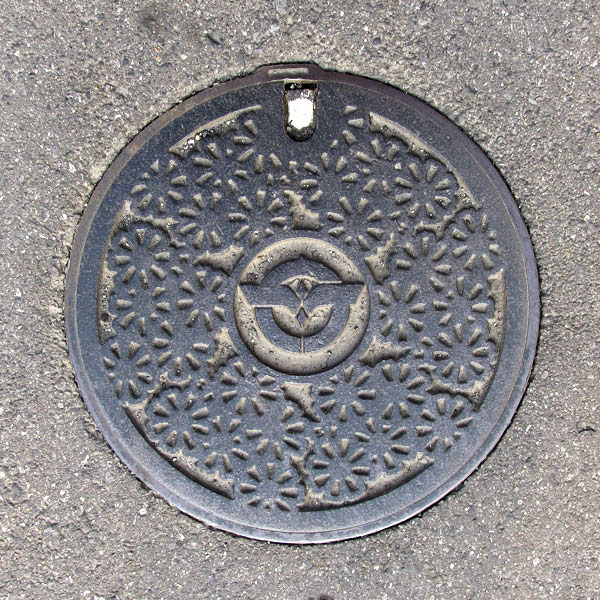
A smaller version with the same design as above.
Tsuga 都賀町
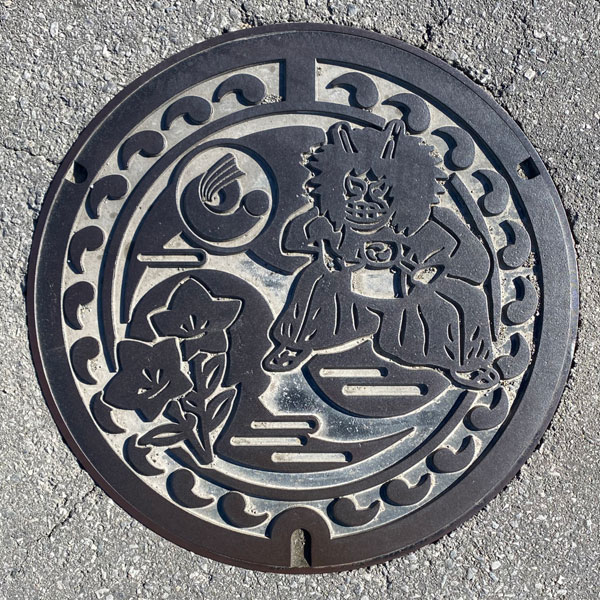
This manhole cover features a design from the former Tsuga Town, with the town emblem replaced by the new Tochigi City emblem.
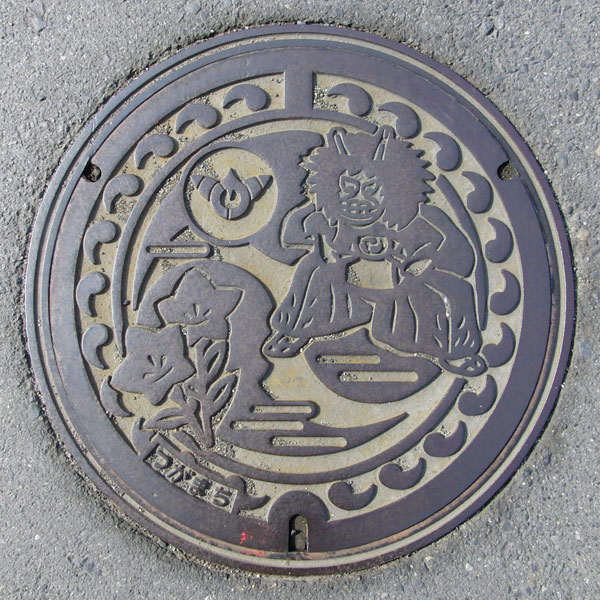
The lion dance from the Atago Shrine's annual festival, which is said to have been performed to pound the ground during the construction of Nikko Toshogu Shrine, and the bellflower, the former town flower of Tsuga. The town emblem is a stylized representation of the characters "Tsu" and "Ga".
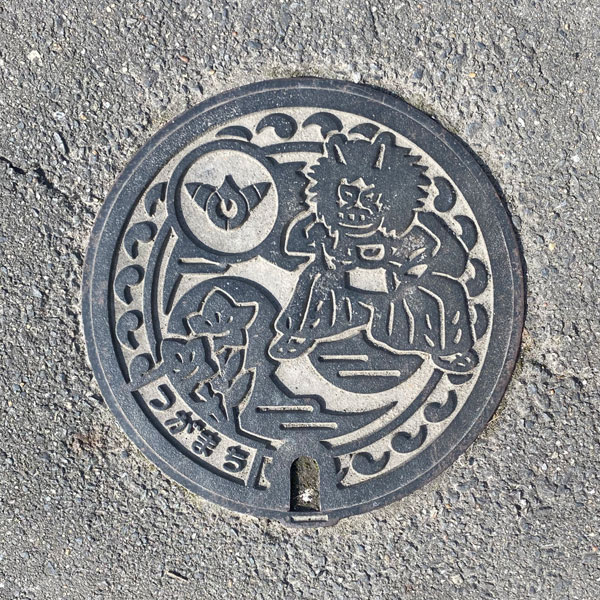
A smaller version with the same design as above.
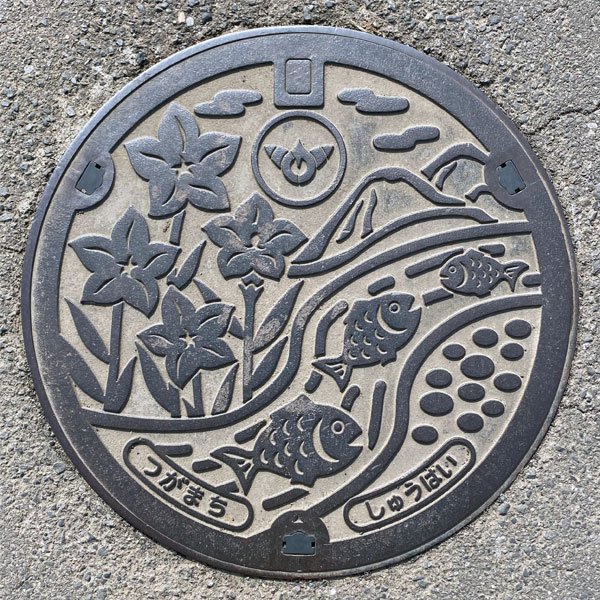
The manhole cover depicts a river with mountains, fish resembling taiyaki (fish-shaped cakes), and the town flower, the bellflower (kikyo). The Tsuga-machi emblem is at the top. The Akatsu River flows through the Tomihari area where this cover was found. The mountains depicted are unclear as there are no particularly prominent mountains in the area.
The words "Tsuga-machi" and "Shuhai" are written at the bottom, but neither the "Tochigi City Agricultural Village Wastewater Treatment Business Management Strategy" (December 2016) nor the "Tochigi City Ordinance Concerning the Establishment of Agricultural Village Wastewater Treatment Facilities" (March 29, 2010) lists the treatment area for agricultural wastewater from the former Tsuga-machi. It's possible that the agricultural wastewater from the Tomihari area was incorporated into the public sewer system before those dates.
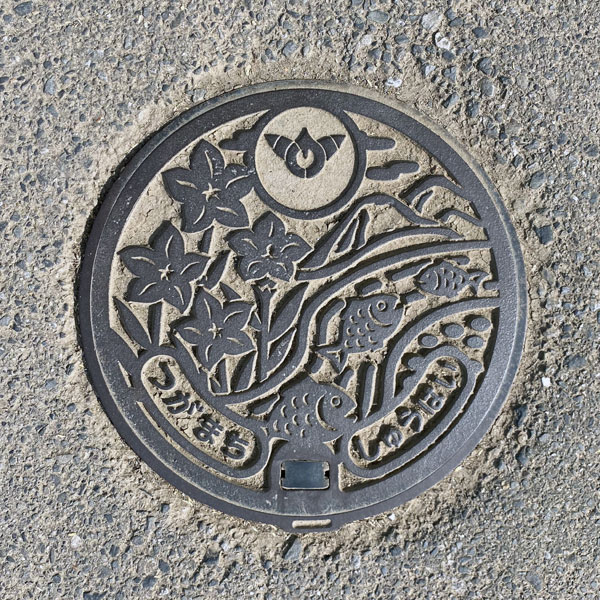
A smaller version with the same design as above.
Nishikata 西方町
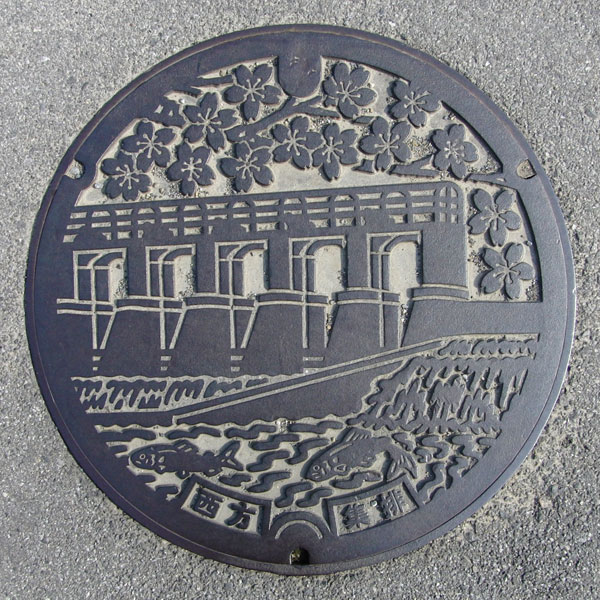
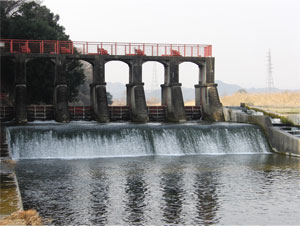
This is a manhole cover for agricultural wastewater treatment plants, depicting the Ogura Weir on the Omoigawa River.
Shimotsuke 下野市
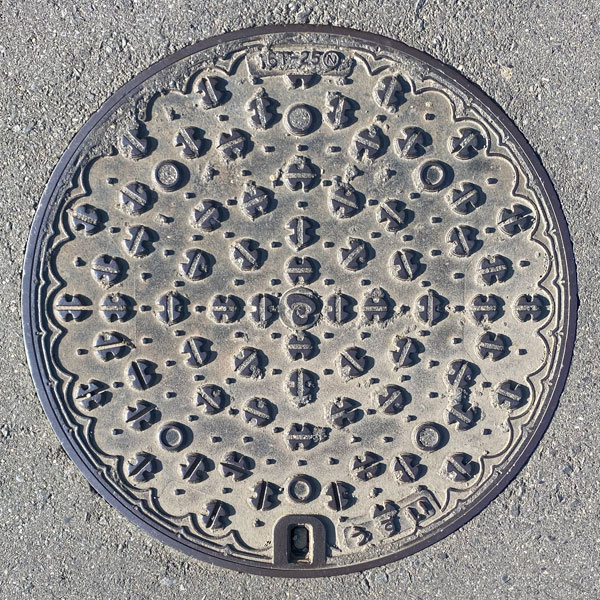
A rainwater manhole cover designed for slip resistance. A small new city emblem is in the center.
It doesn't have a very spiky appearance, but there seems to be some ingenuity in the shape of the raised parts and the direction of the grooves.
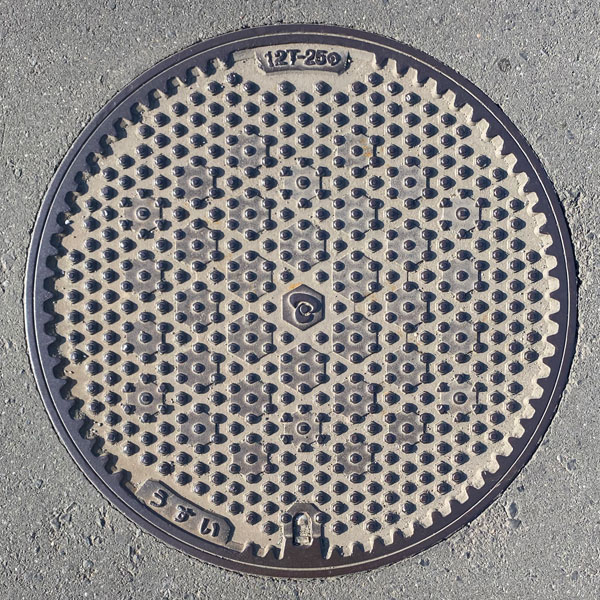
A manhole cover designed for rainwater, featuring a slip-resistant surface. A small new city emblem is displayed in the center.
Minamikawachi 南河内町
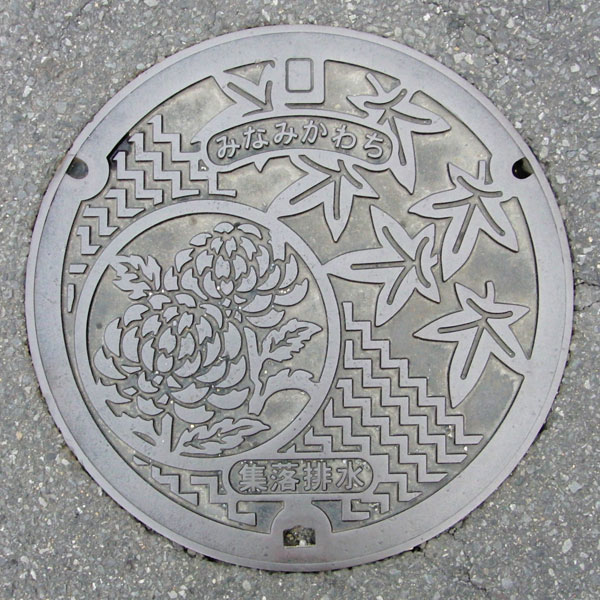
A manhole cover for the community drainage system in the Yoshida-Nishi district of the former Minami-Kawachi town. The design features the town's tree, the maple, and its flower, the chrysanthemum. The wavy lines might represent the Kinugawa River.
Kokubunji 国分寺町
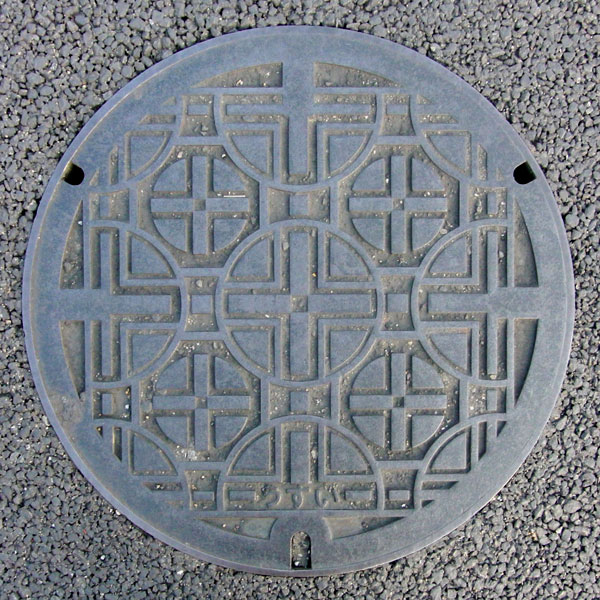
What kind of pattern is that? It's a manhole cover for rainwater.
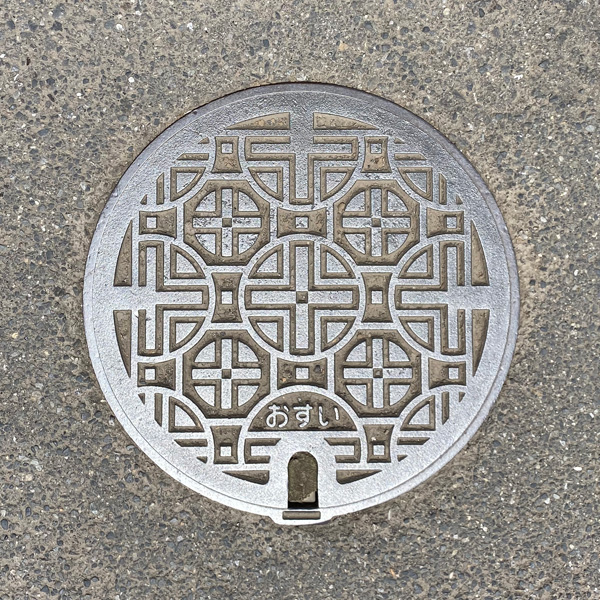
A small wastewater drain with the same design as above.
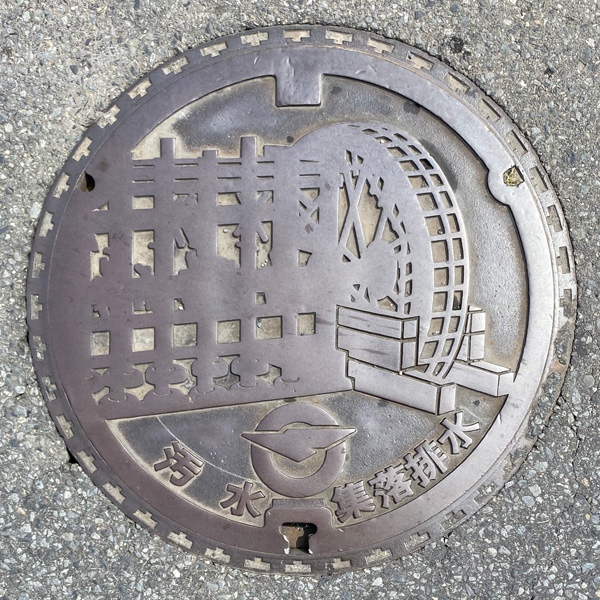
This is a manhole cover for agricultural community wastewater in the western district of the Sugata River in the former Kokubunji town. The design is based on a mechanical waterwheel from about 100 years ago, which was relocated and preserved at "Tenpyo no Oka Park" from Nishikata town. The treatment plant is the "Sugata River Western District Clean Center".
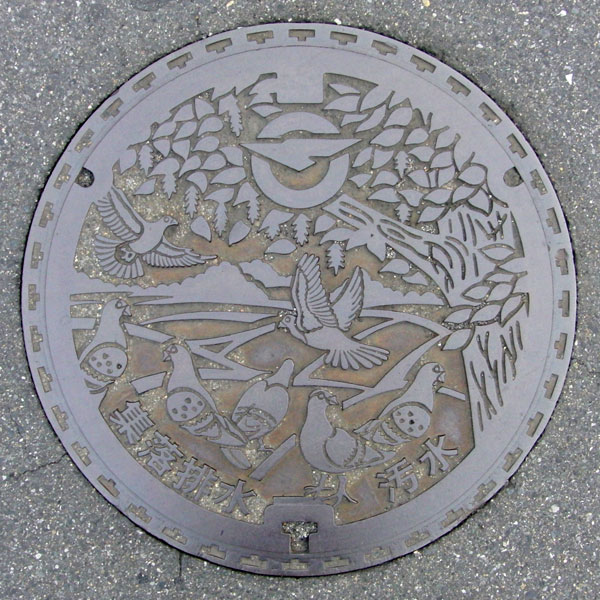
This is a manhole cover for a community drain in the Shibaminami-Higashi district of the former Kokubunji town. The design features the town's tree, the "Akasone (Japanese hornbeam)," and the town's bird, the "dove." The treatment plant is the "Shibaminami-Higashi District Clean Center."
Based on the wing band, the dove on this cover appears to be a "feral pigeon."
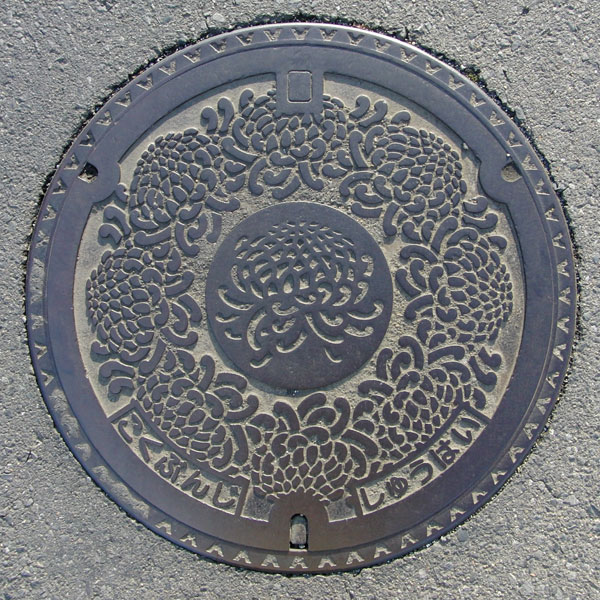
A manhole cover for the community drainage system in the Shibaminami district of the former Kokubunji town. The design features the town's flower, the chrysanthemum. The treatment plant is the "Shibaminami District Clean Center".
Ishibashi 石橋町
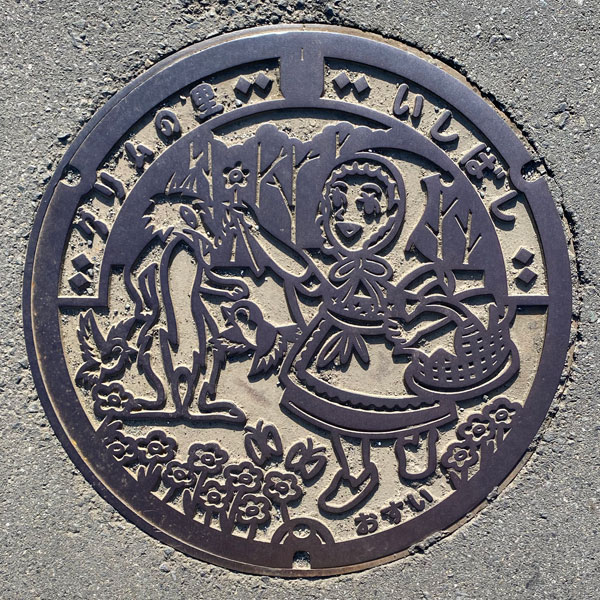
For sewage. The design is "Little Red Riding Hood."
"Grimm's Village Ishibashi" originated from exchanges with Steinbrücken (meaning "stone bridge" in Japanese), a village in Hesse, Germany, where the Brothers Grimm were born, during the time when Ishibashi Town was still in operation. Currently, Ishibashi Town is part of Shimotsuke City, and Steinbrücken is now part of Dietzhölztal, but the sister city relationship continues. Incidentally, it is said that the Brothers Grimm were the ones who created the story of Little Red Riding Hood and her grandmother being rescued from the wolf's stomach. In earlier versions of the story, there was no hunter, and the two were not rescued.
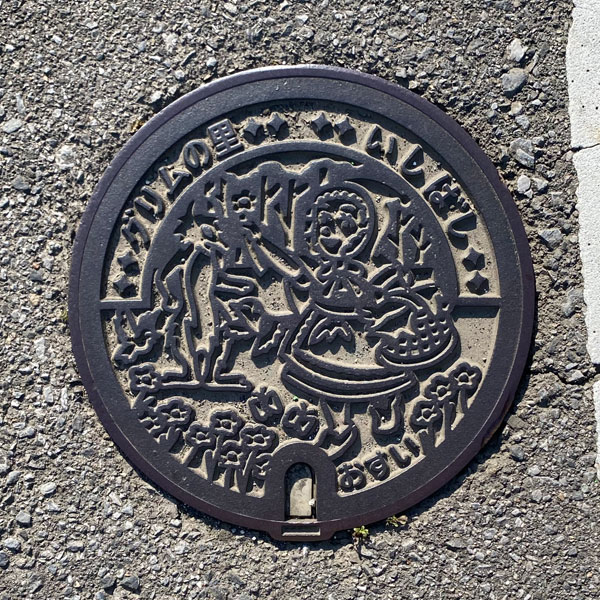
A smaller, handhole-sized panel with the same design as above.
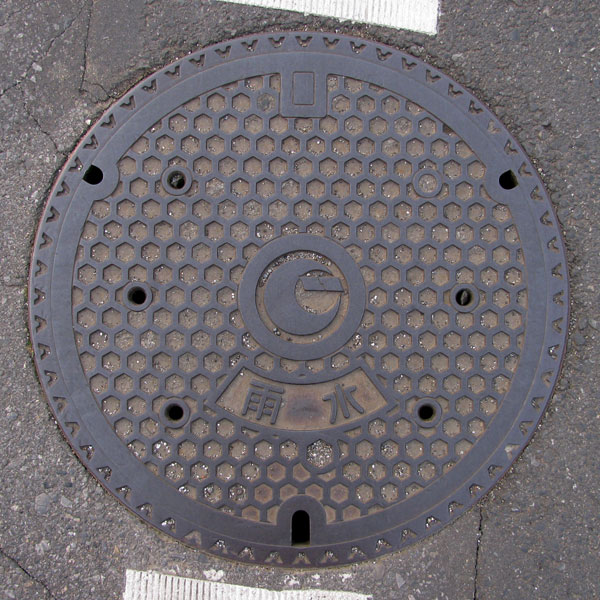
A rainwater drain with a fine tortoiseshell pattern. The former town emblem of Ishibashi Town, featuring a stylized "stone" in the center.
Ashikaga 足利市
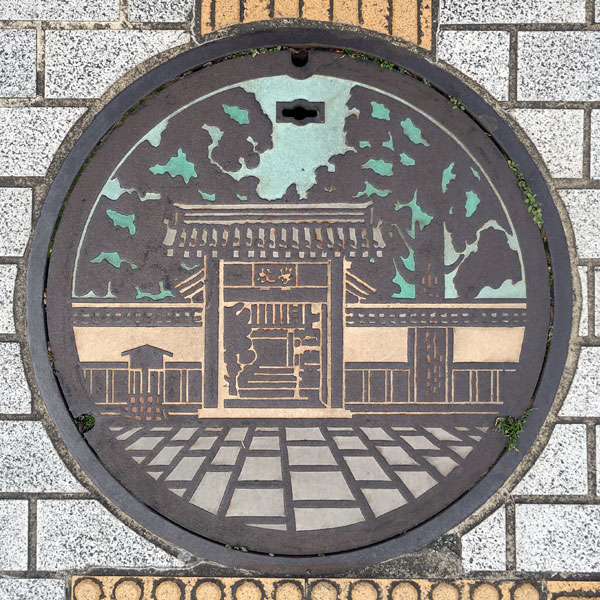
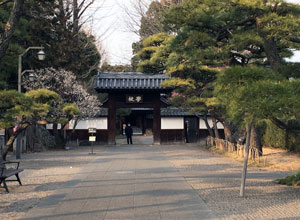
The design is based on the "school gate" of Ashikaga School.
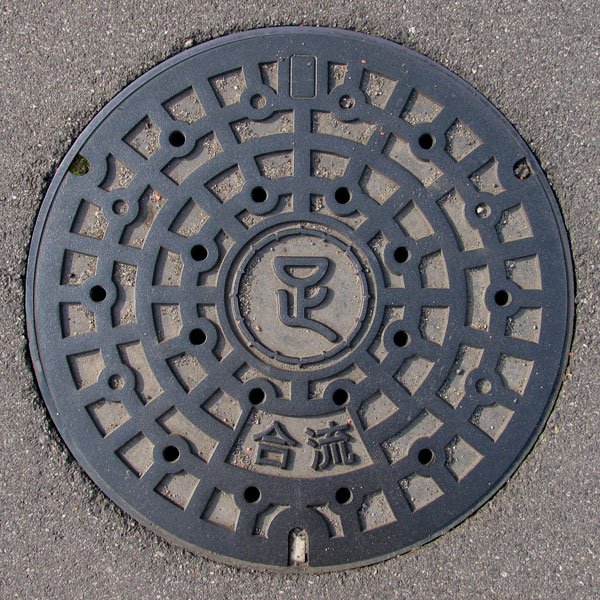
For use in merging JIS standard patterns. The city emblem of Ashikaga City features an ancient mirror (sacred mirror) as its outline, with the character for "foot" (足) placed in the center.
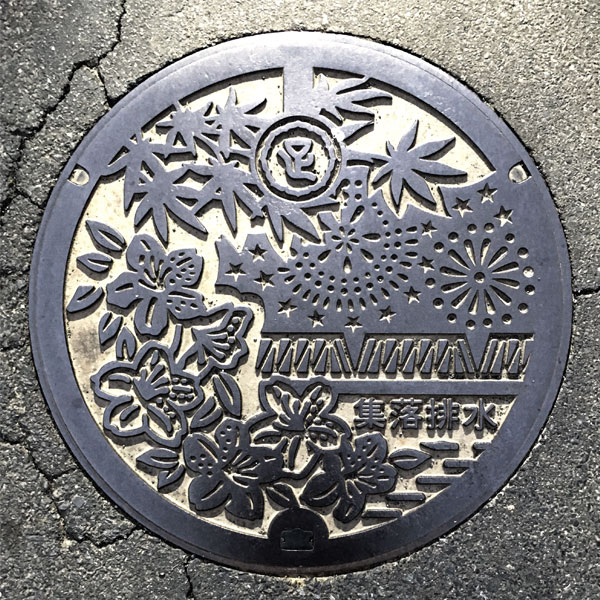
This is a manhole cover for agricultural drainage in the Hikotani district. At the top are the city emblem and the city tree, the maple; at the bottom, the city flower, the azalea; to the right, a series of fireworks over a bridge; and below that, the words "Community Drainage."
The Ashikaga Fireworks Festival is one of the leading fireworks festivals in the Kanto region, with a history of over 100 years. It's said to attract so many spectators that it's called "300,000 People Enjoying the Evening Cool." The venue is said to be downstream from Tanaka Bridge, but the bridge depicted on the cover is a truss bridge, so it appears to be the Watarase Bridge.
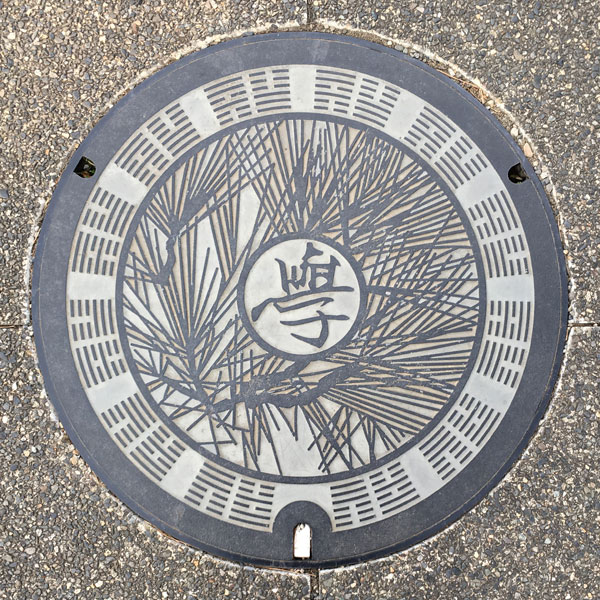
In the center is the character "Gaku" (学) inside a circle, which was inscribed on a flag presented by Tokugawa Ieyasu to the headmaster of Ashikaga School (though not in Ieyasu's handwriting). Outside of this is the "Kanafurimatsu" (字降松), a pine tree where, according to legend, students would write illegible characters on paper and tie them to the branches, to which phonetic readings and annotations would be added. Around the perimeter are depictions of hexagrams used in I Ching (Book of Changes).
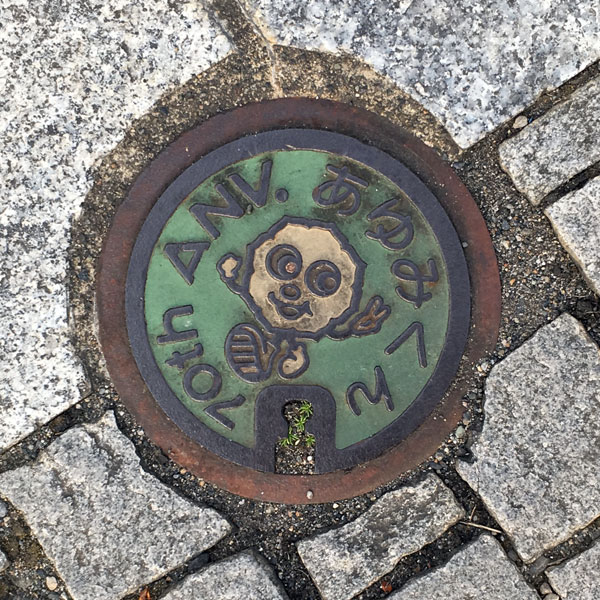
This is a miniature manhole cover featuring Ashikaga City's mascot character, "Ayumi-kun," running while making a V-sign. The design was created in 1990 to commemorate the 70th anniversary of the city's founding and the 60th anniversary of its water supply system.
Sano 佐野市
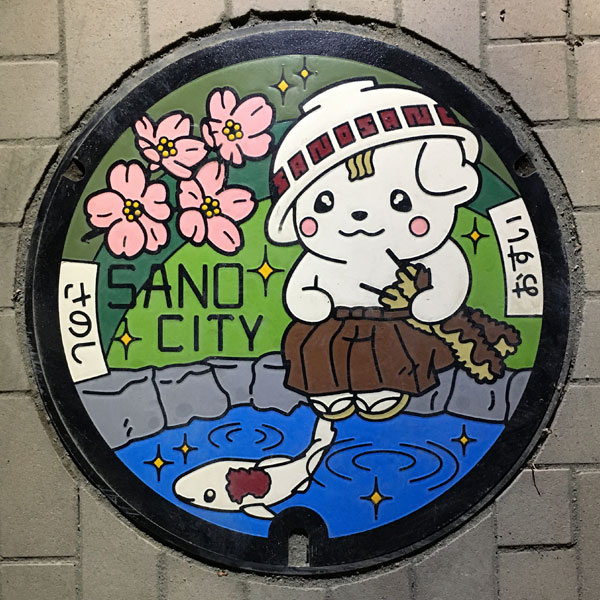
A colorful manhole cover for sewage featuring Sano's brand character, "Sanomaru," has appeared. It seems to have been installed in late September 2018.
Sanomaru is depicted sitting by a pond, gazing at carp, wearing his familiar ramen bowl on his head and carrying two "imo fry" (fried sweet potato snacks) at his waist. Perhaps he's enjoying the cherry blossoms and the sparkling sunlight, as his eyes are different from those on the fire hydrant cover, displaying his usual droopy-eyed expression.
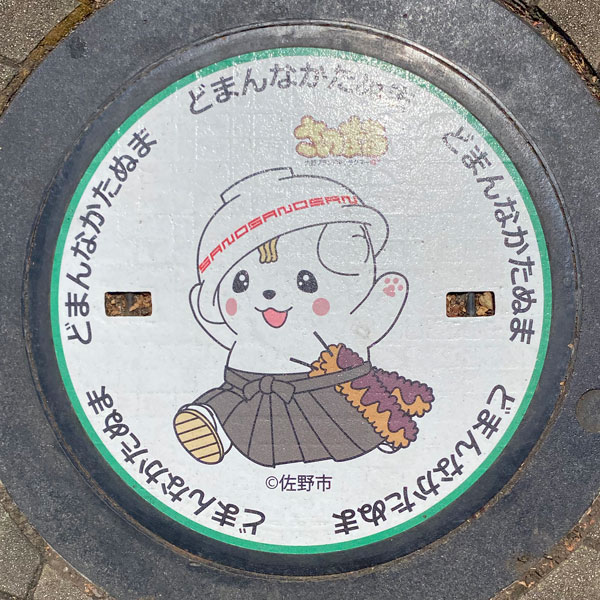
The first color sticker disc featuring "Sanomaru".
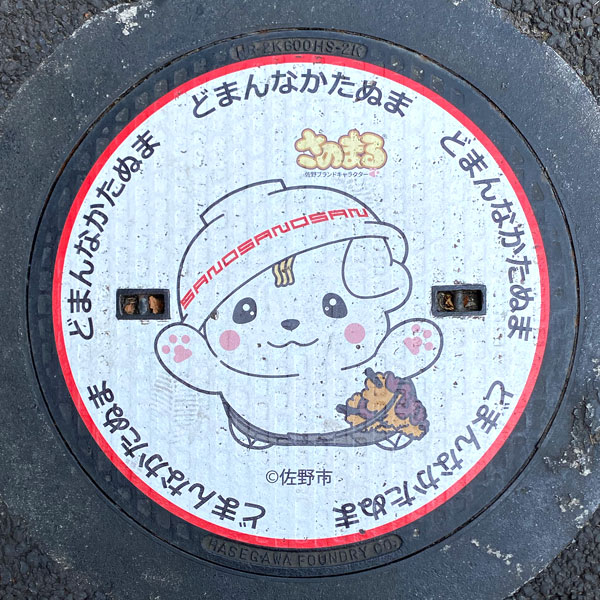
The second color sticker disc featuring "Sanomaru".
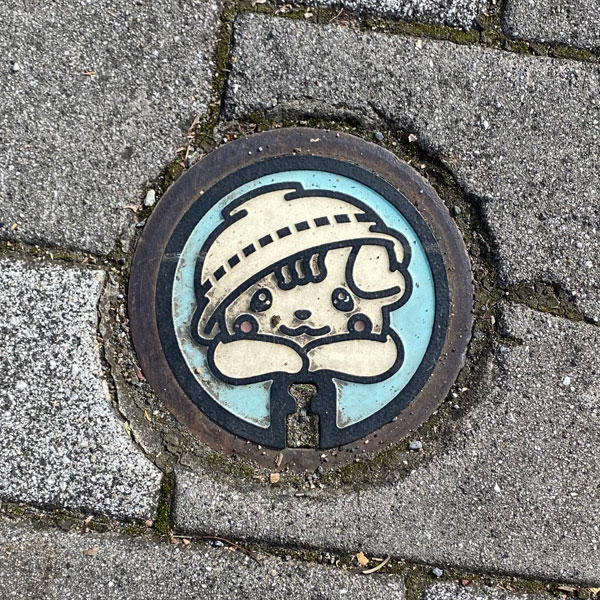
It's either a gate valve or a control valve, and the cover, including the frame, is about 20cm in diameter. This pose of "Sanomaru" was also used on signs for Sano ramen restaurants.
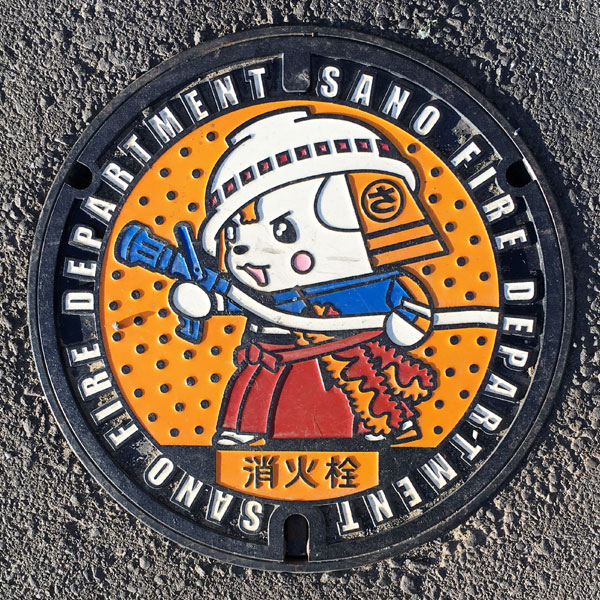
A fire hydrant cover featuring Sano's brand character, "Sanomaru," holding a fire hose. The words "SANO FIRE DEPARTMENT" are inscribed around it.
The details are impressive; Sanomaru, usually shirtless, is wearing a blue and orange fire suit. A "shikoro" (a type of neck guard) with the character "sa" inside a circle hangs from his Sano ramen bowl helmet. While Sanomaru usually has droopy eyes, he now has a dignified expression, though he hasn't forgotten the "imo fry" (fried potato) on his waist. I imagine his clothes would get sticky with fruit sauce if he wore that...
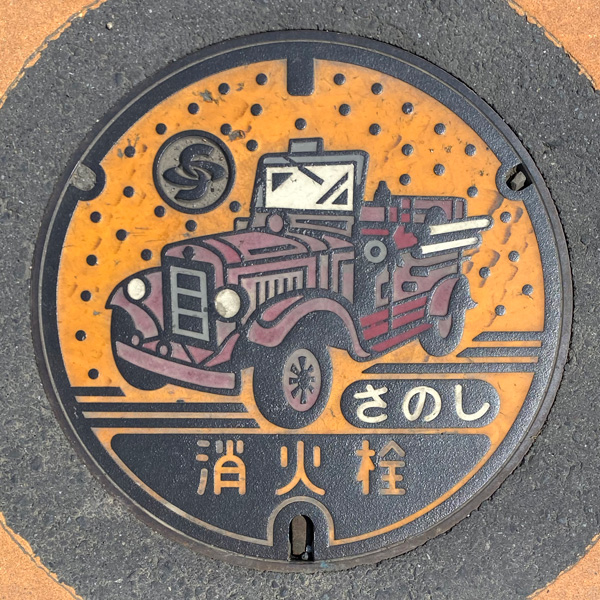
The fire hydrant cover features a retro-style fire truck, but it also includes the new city emblem.
Sano 佐野市
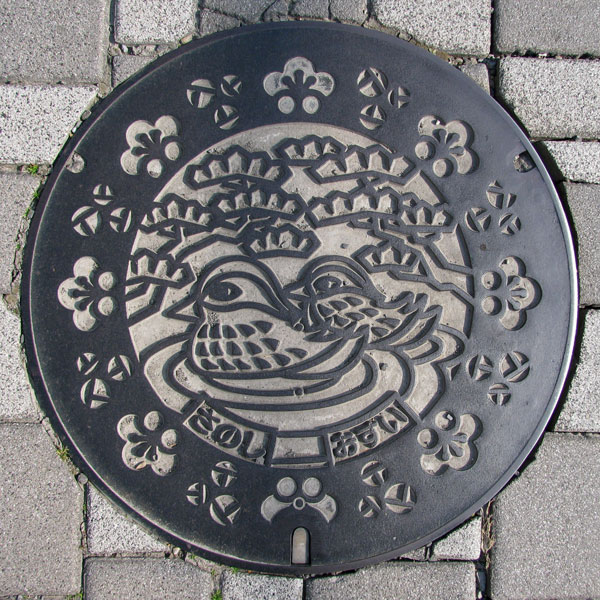
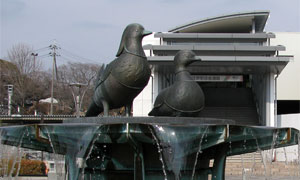
The design features the city tree, the pine, and the city bird, the mandarin duck. Surrounding it are the city flowers from before the merger, the plum blossom. It's a shame that only the male mandarin duck is depicted and there are no ginkgo feathers. (The mandarin duck monument in front of Sano Station has both male and female.)
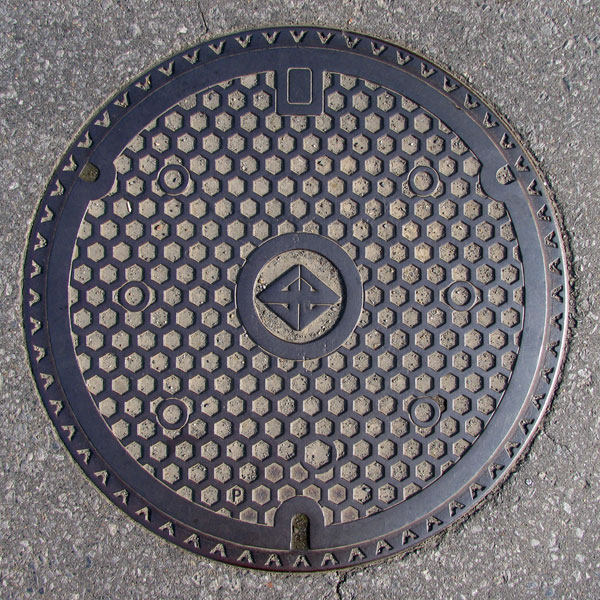
A tortoiseshell pattern. The former Sano City emblem is in the center.
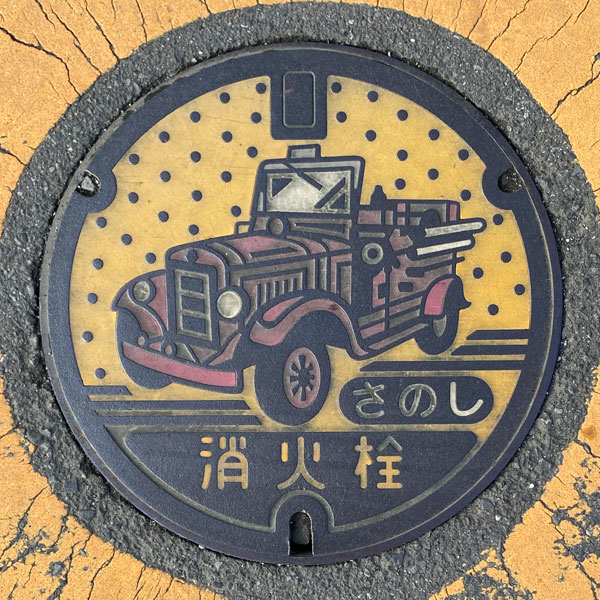
A fire hydrant cover featuring a retro fire truck. Judging from its open design, flared fenders, and protruding headlights, it appears to be a Ford fire pump truck from the 1930s.
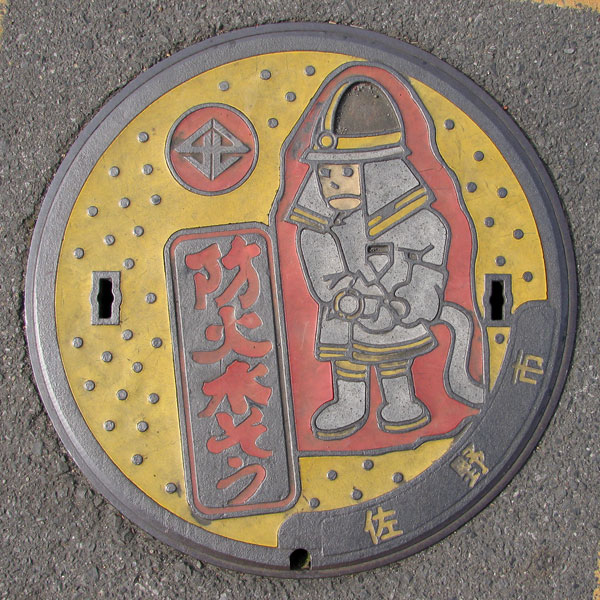
The lid of a fire hydrant.
Tanuma 田沼町
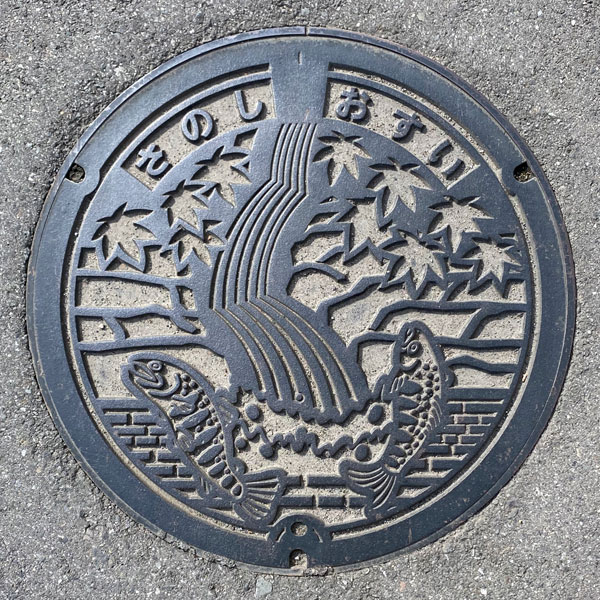
A manhole cover for sewage, with the "Tanuma" characters from the former Tanuma town design replaced with "Sanoshi".
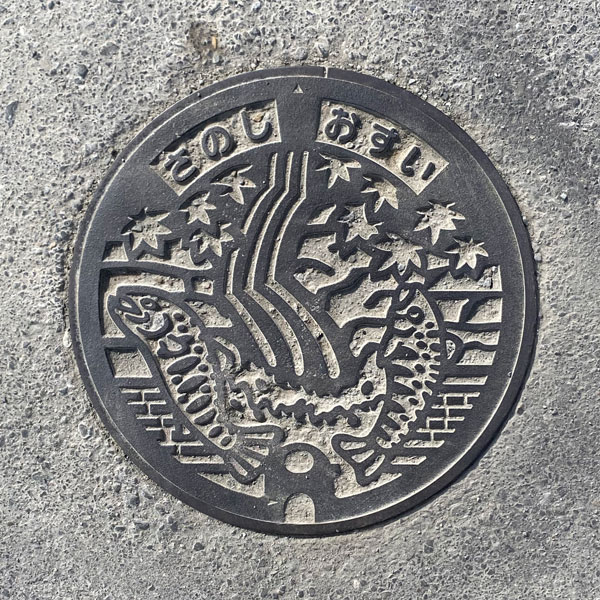
A smaller version with the same design as above.
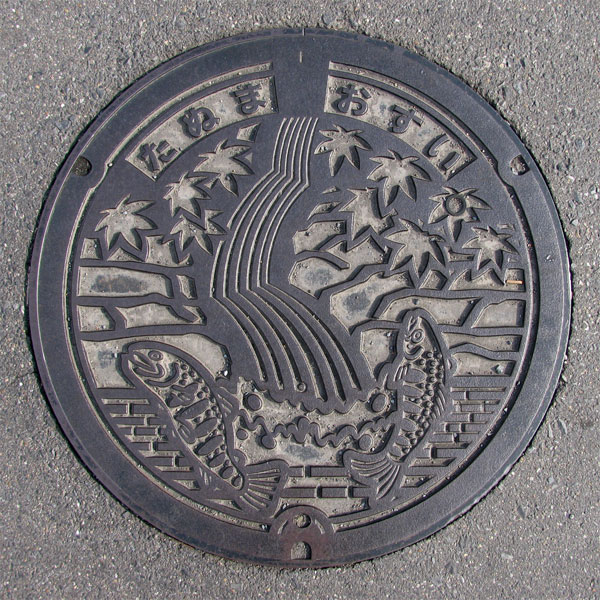
In the center is "Mitaki," located at the source of the Hatagawa River and selected as one of the 100 most beautiful waters in the Tone River system. While it's said that "Iwana" (char) can be caught at the source of the Hatagawa River, the clear parr marks (spots) on its side suggest it might be a "Yamame" (cherry salmon). The color version features a beautiful autumn-colored "Momiji" (maple), but the town's official tree is the "Kiri" (paulownia).
The words "Tanuma" and "Osui" (sewage) are at the top.
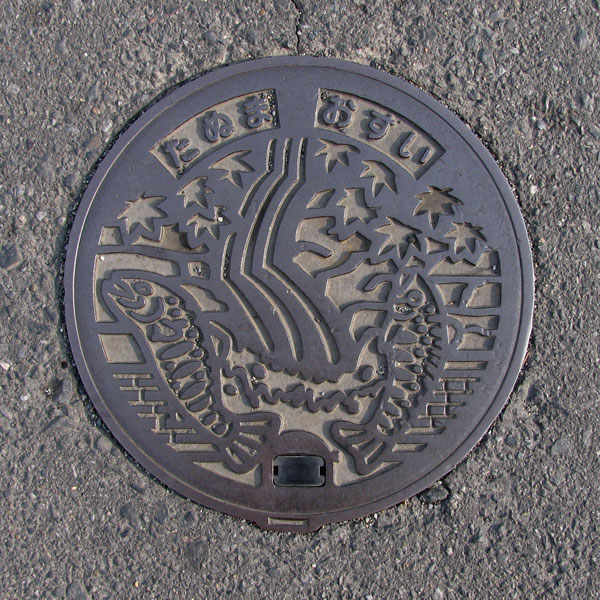
A smaller version with the same design as above.
Kuzuu 葛生町
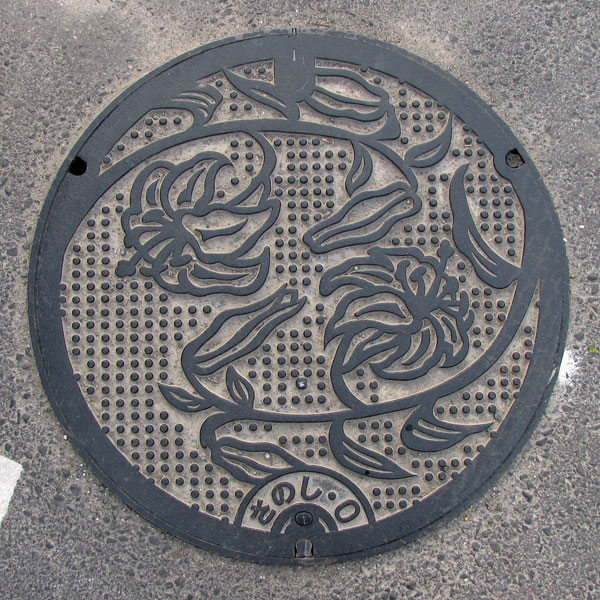
This is a monochrome manhole cover for sewage, depicting the "Yamayuri" (mountain lily), the flower of the former Kuzuu Town, but it also bears the name "Sano City."
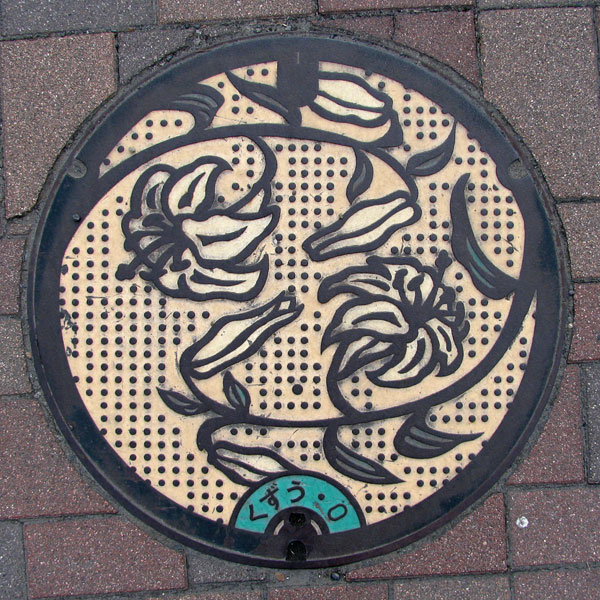
The design features the mountain lily, the former flower of Kuzuu Town. There are many of these manhole covers on the sidewalks near Kuzuu Station.
Oyama 小山市
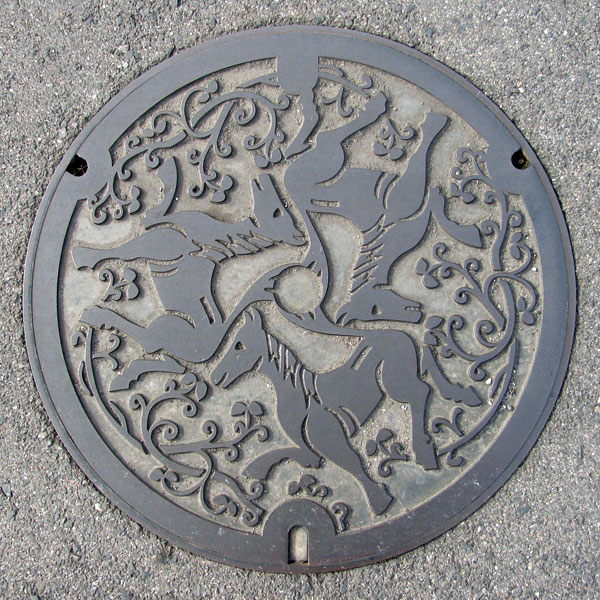
This manhole cover has been in use since fiscal year 1996. The horse and vine design have no particular connection to Oyama City.
According to the Oyama City website, the design was commissioned from students of Hakuoh University, located within the city. From 88 entries, the design was reviewed based on criteria such as "unique to Oyama City" and "not being constrained by emphasizing Oyama City's characteristics," and the winning design was chosen based on "design quality."
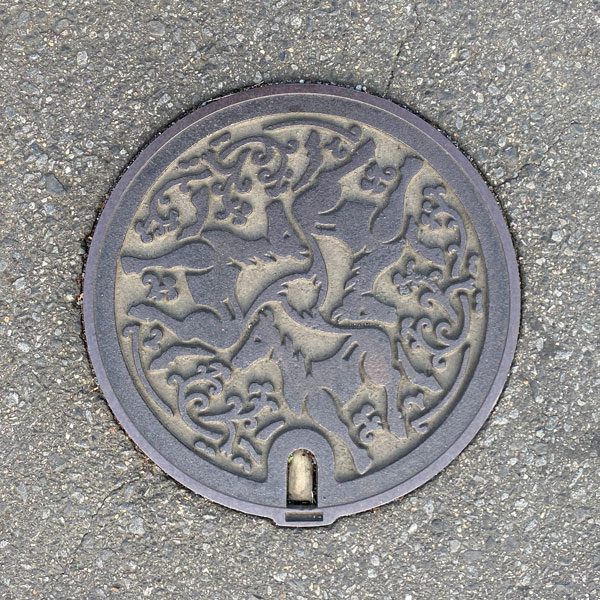
A smaller version with the same design as above.
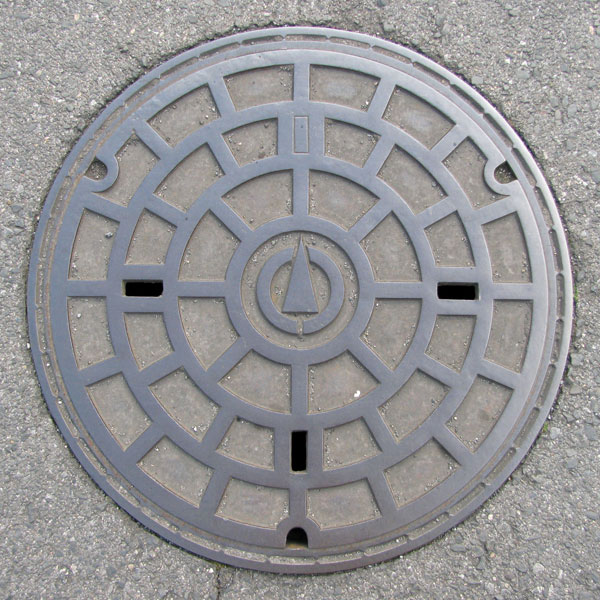
The city emblem is a stylized representation of the character "小" (ko) from the name "Oyama" (小山).
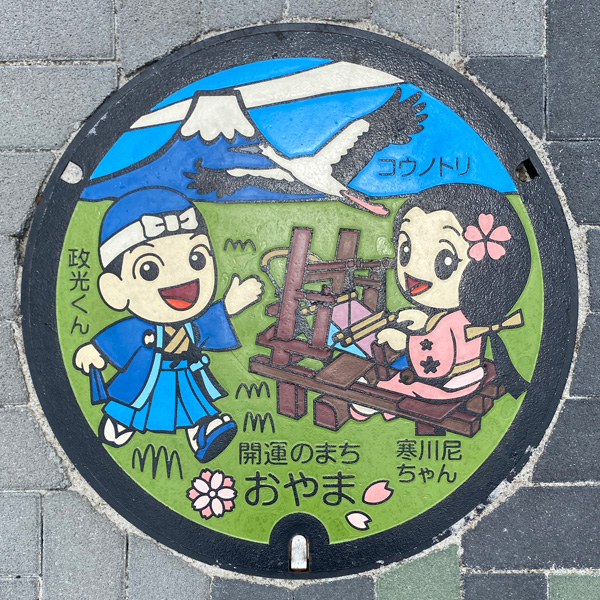
Because the "Battle of Nogimiya" marked the beginning of the establishment of the Kamakura Shogunate, and the "Oyama Council" paved the way for the establishment of the Edo Shogunate, Oyama City uses the slogan "Oyama, the City of Good Fortune."
The characters depicted are "Masamitsu-kun" and "Sangagawani-chan," characters belonging to the city's tourism association. They are modeled after Oyama Masamitsu, the ancestor of the Oyama clan, and his wife, Sangawani-chan, who was appointed as a local administrator by the Kamakura Shogunate for her "great achievements despite being a woman." A stork that bred in the wild within the Oyama City area of the Watarase Floodplain is flying above them.
Nasu 那須町
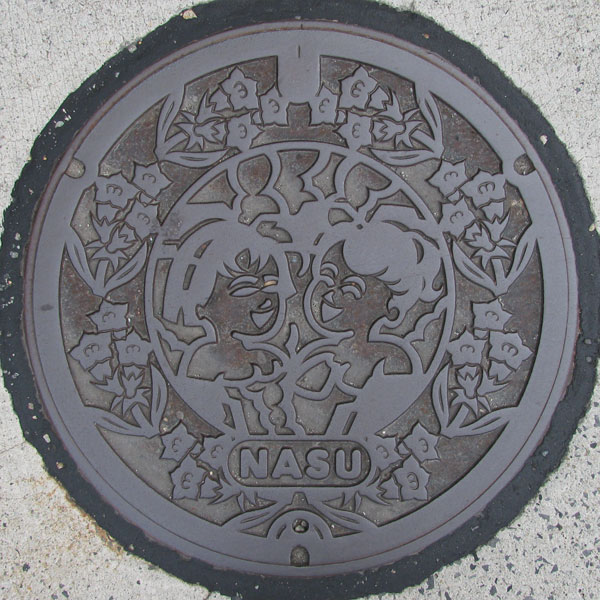
A manhole cover featuring a hot spring in the center, typical of Nasu, surrounded by the town's flower, the gentian.
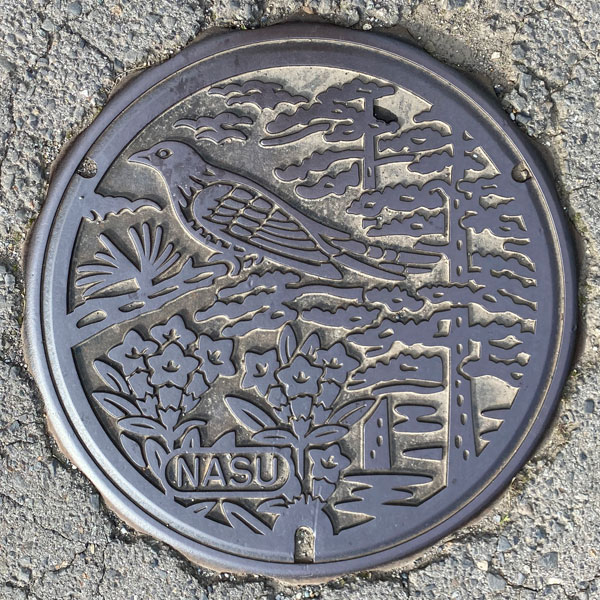
A manhole cover featuring the town's tree, the Japanese white pine, the town's bird, the cuckoo, and the town's flower, the gentian.
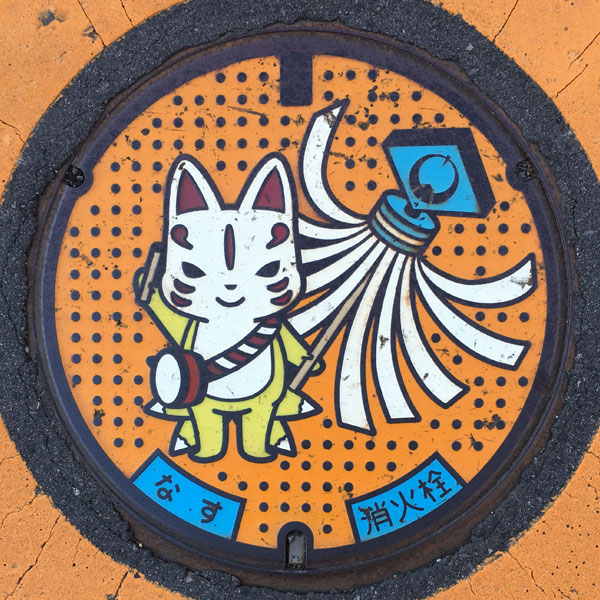
A fire hydrant cover featuring the design of "Kyubi," the tourism ambassador of Nasu Town. The top of the banner is adorned with the Nasu Town emblem.
Shioya 塩谷町
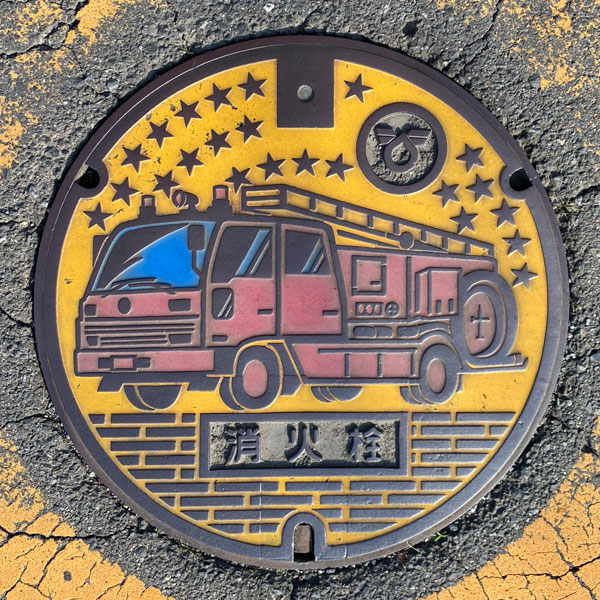
A fire hydrant cover depicting a ladder truck. The town emblem is at the top.
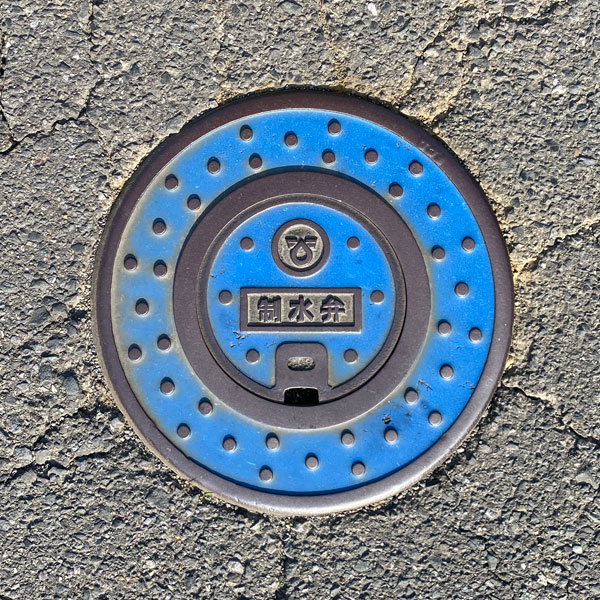
A water control valve cover with the town emblem at the top.
Nakagawa 那珂川町
Ogawa 小川町
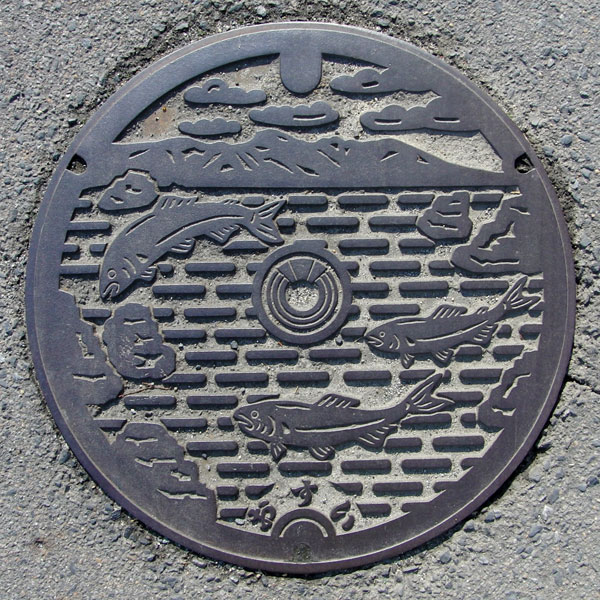
The lid depicts sweetfish in the Nakagawa River. The mountain in the distance is probably Mount Nasu.
Batou 馬頭町
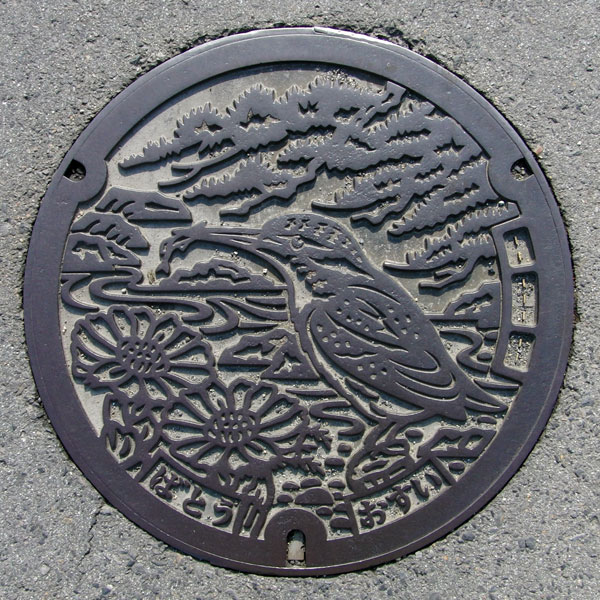
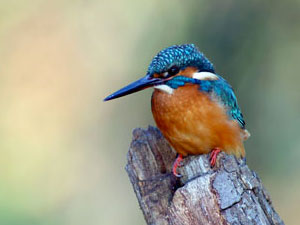
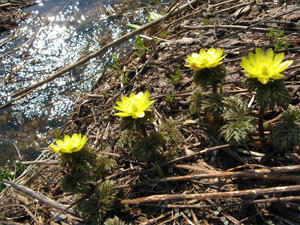
Depicts the town's bird, the kingfisher, the town's tree, the pine tree, and the town's flower, the ambrosia.
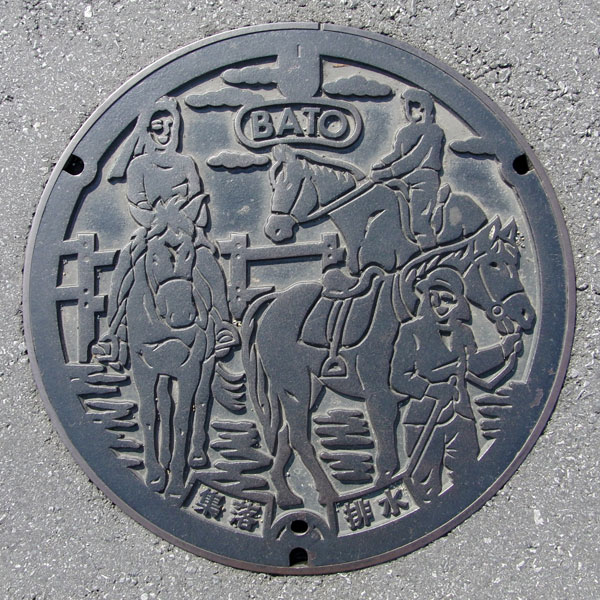
Community drainage. The image depicts a horse being led, and since Nakagawa Town has a place called "Batou Horse Land," this is likely a scene from that.
Takanezawa 高根沢町
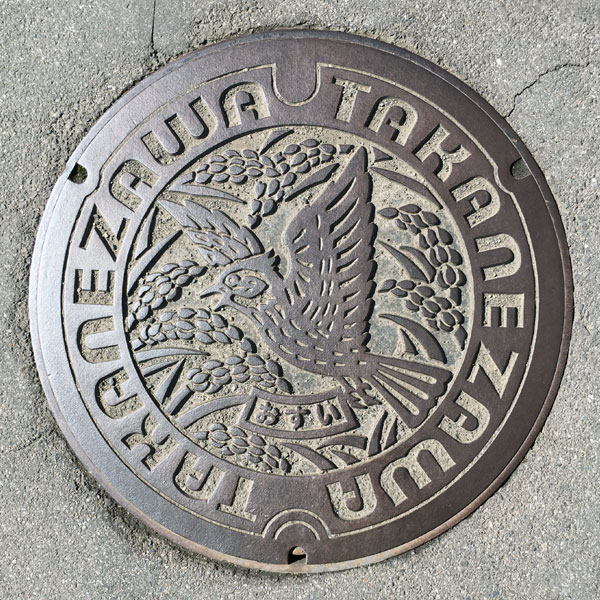
The design features the town's bird, the skylark, and rice stalks. It's located right in front of the train station.
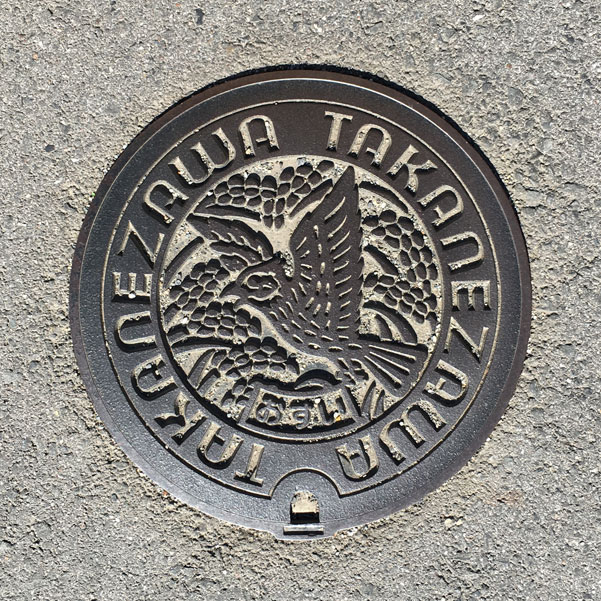
A small wastewater drain with the same design as above.
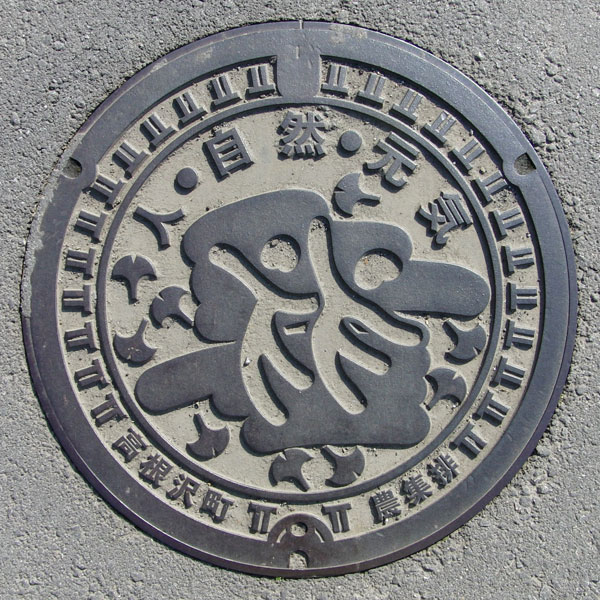
A manhole cover for the Eastern District agricultural community wastewater treatment.
Haga 芳賀町
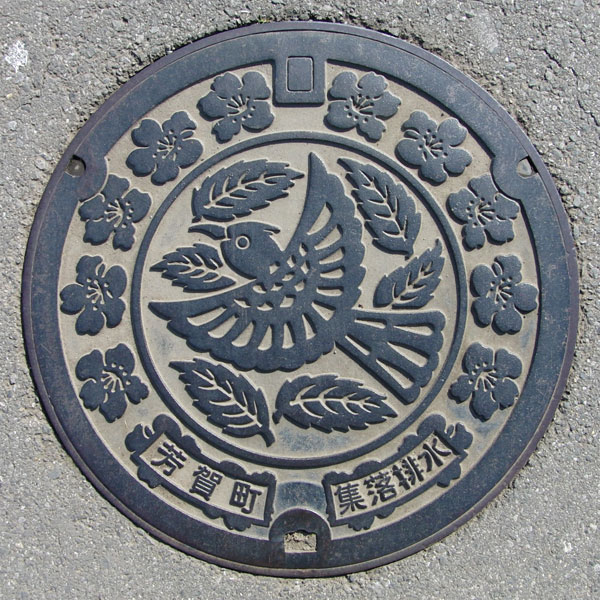
This manhole cover for agricultural wastewater in the Yatsugi district features the town's bird, the skylark, the town's tree, the zelkova, and the town's flower, the pear blossom, in the surrounding area.
Ichikai 市貝町
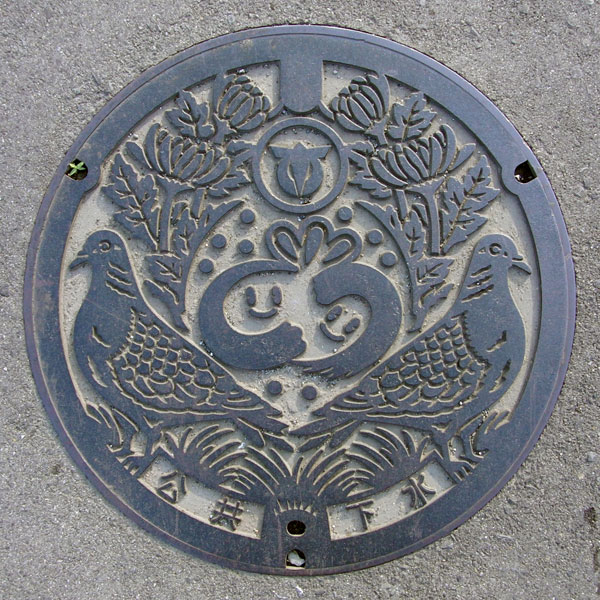
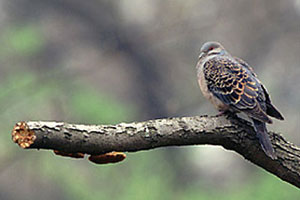
The town's flower, the chrysanthemum, and the town's bird, the turtle dove, are depicted.
Motegi 茂木町
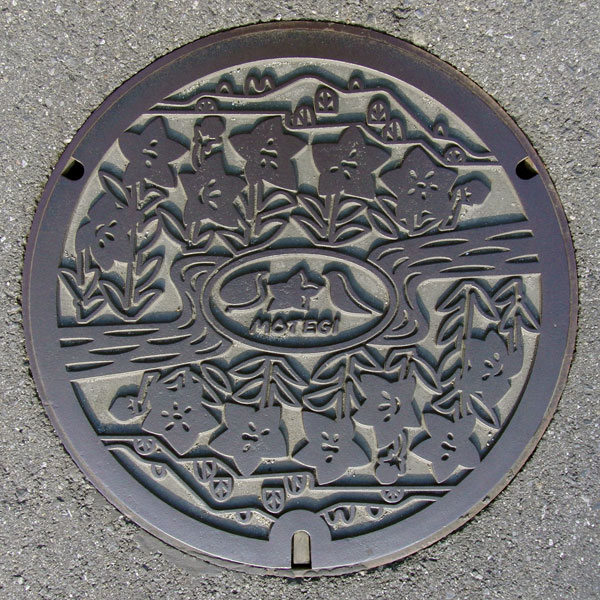
The town flower, the bellflower ("Kikyo"), is depicted. The river is either the Naka River or the Sakagawa River that flows through the town. The center represents the town's symbols, depicting a zelkova tree, a bellflower, and a Japanese bush warbler from left to right.
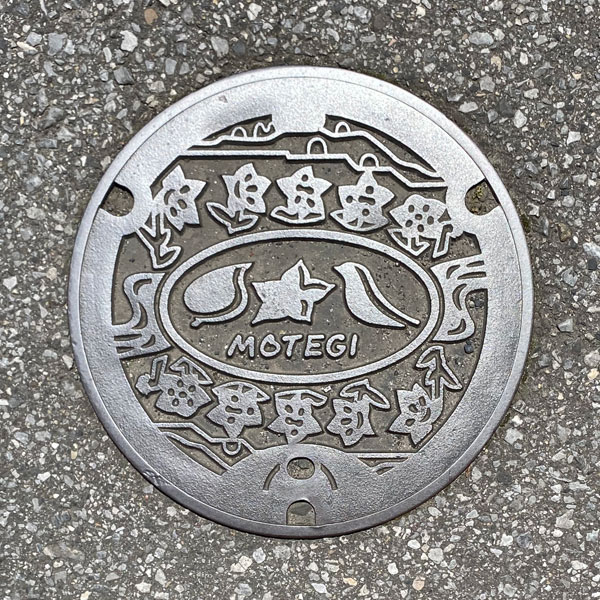
A smaller version with the same motif as above.
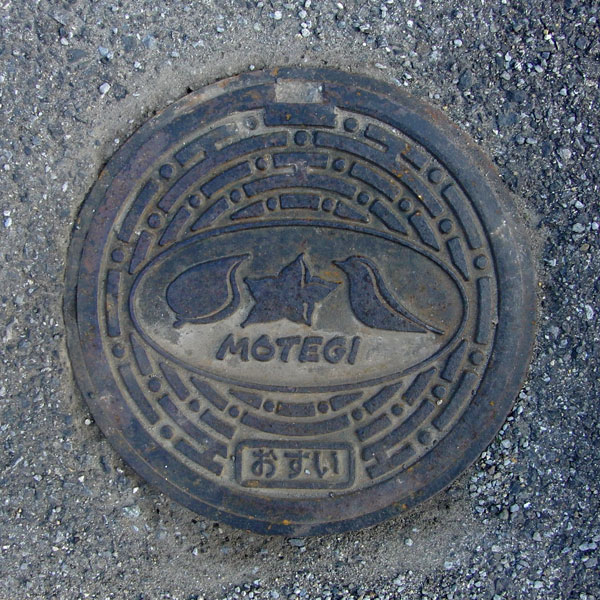
A small manhole cover featuring the town's symbol.
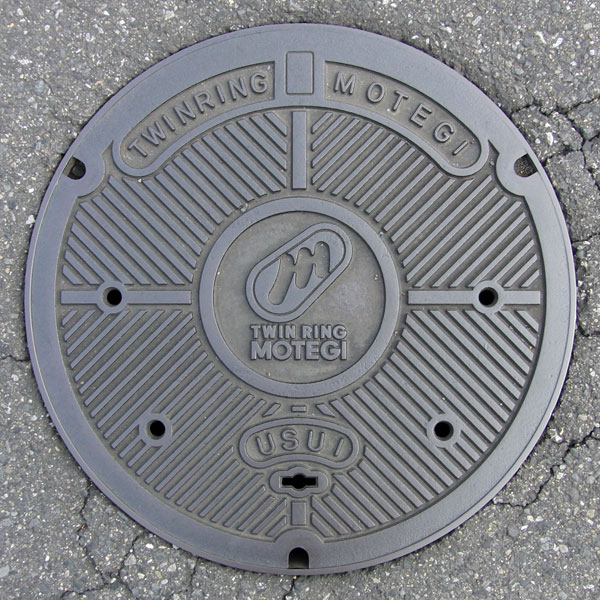
A manhole cover at Twin Ring Motegi, where the IndyCar Series (IRL) and the Road Racing World Championship (MotoGP) are held.
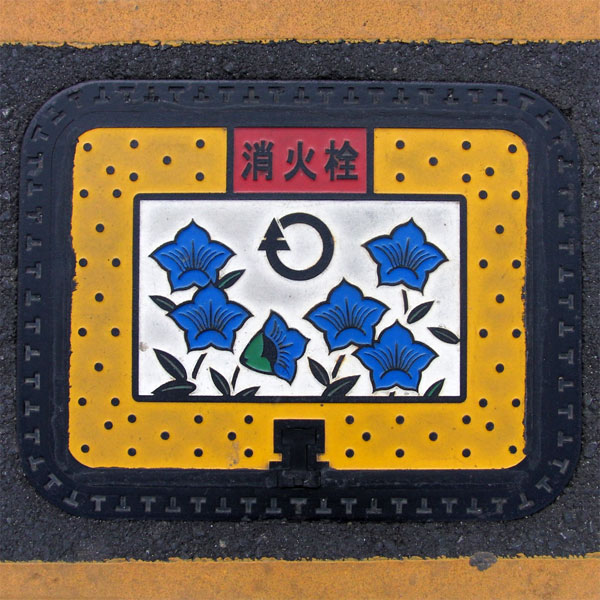
This fire hydrant features the town's official flower, the bellflower. These colored fire hydrants are quite common.
Mibu 壬生町
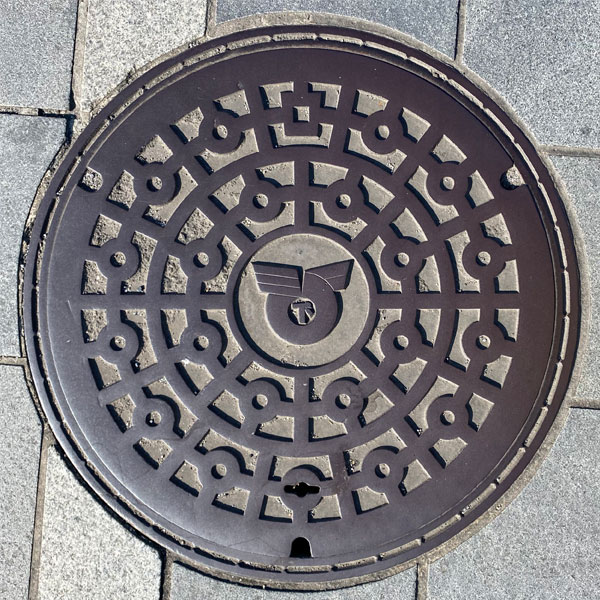
A standard patterned manhole cover for a public sewer system. The town emblem is combined with the character "下" (shita, meaning "down") in the center.
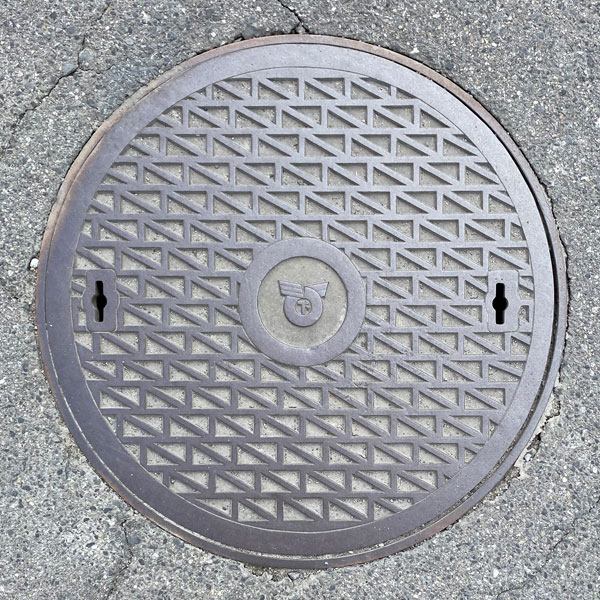
A manhole cover for a sewage drain, with the town emblem in the center. The town emblem also contains the character "下" (shita, meaning "down" or "below").
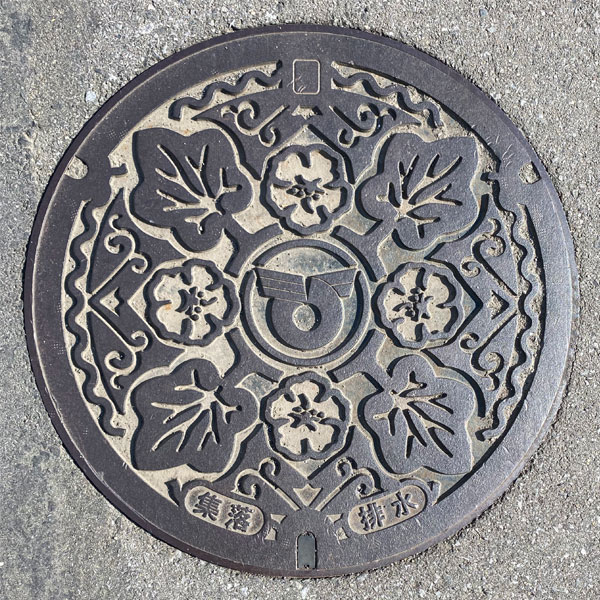
This is a manhole cover from the Kurokawa East district of an agricultural wastewater treatment plant, depicting the town's flower, the "bottle gourd."
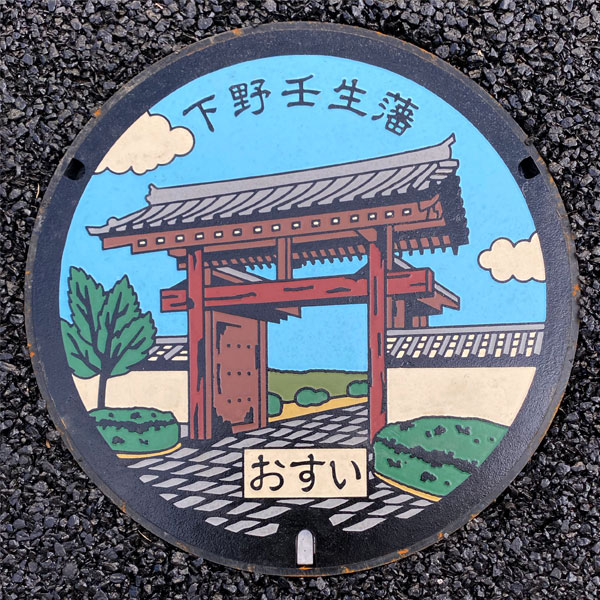
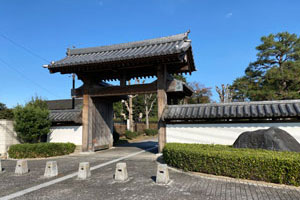
The design features the Ninomaru Gate of the castle ruins park and the words "Shimotsuke Mibu Domain" and "Sewage".
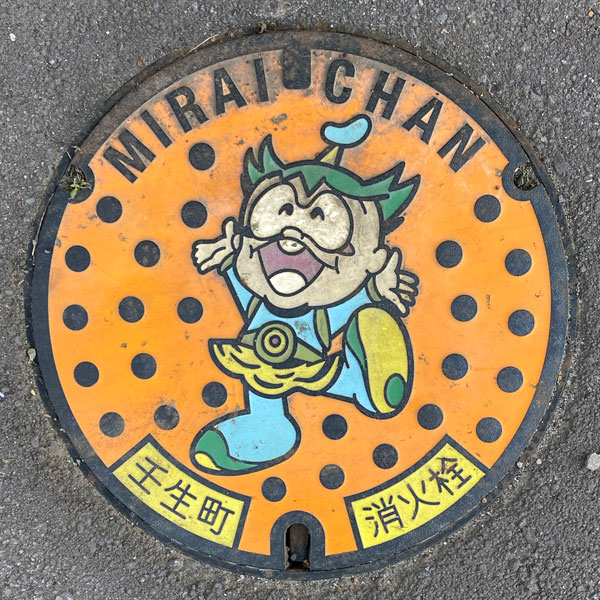
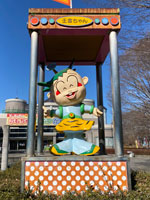
A fire hydrant cover featuring Mibu Town's official character, "Mirai-chan." The words "MIRAICHAN" are at the top, and "Mibu Town" and "Fire Hydrant" are at the bottom.
"Mirai-chan" was created as the museum's mascot character at the opening of the Mibu Town Toy Museum, and later became an officially recognized character of Mibu Town.
The "Mi" in "Mirai-chan" naturally comes from "Mibu Town." "Rai" comes from the fact that Mibu Town experiences many thunderstorms. And of course, it's a play on words with "Mirai" (future).
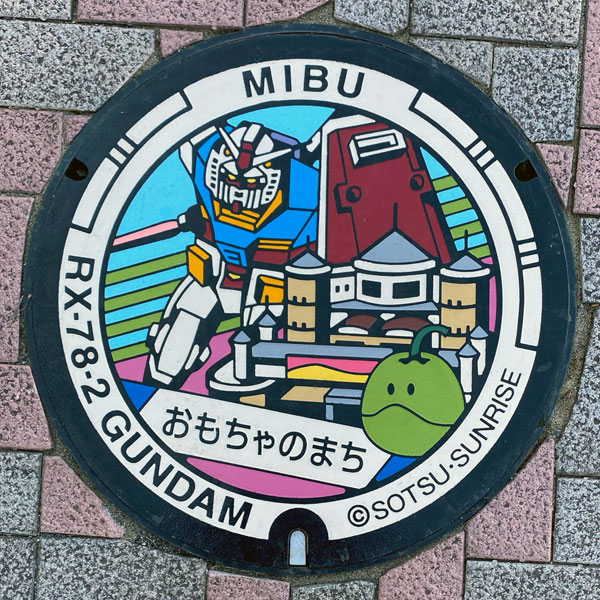
The design features Gundam, the Mibu Toy Museum and the words "Omocha-no-machi" in the foreground, and a "Haro" made from Mibu's local specialty, kanpyo (dried gourd strips). (Reference: Gundam Portal Site)
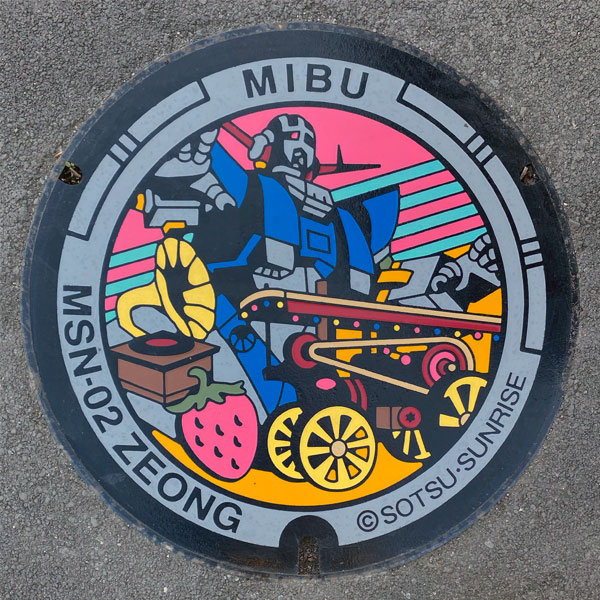
The "Zeong" design features a steam-powered automobile (Pendel Princess) and a phonograph (Edison Collection) from the Bandai Museum in the foreground, along with strawberries, a specialty of Mibu Town. (Reference: Gundam Portal Site)
Kaminokawa 上三川町
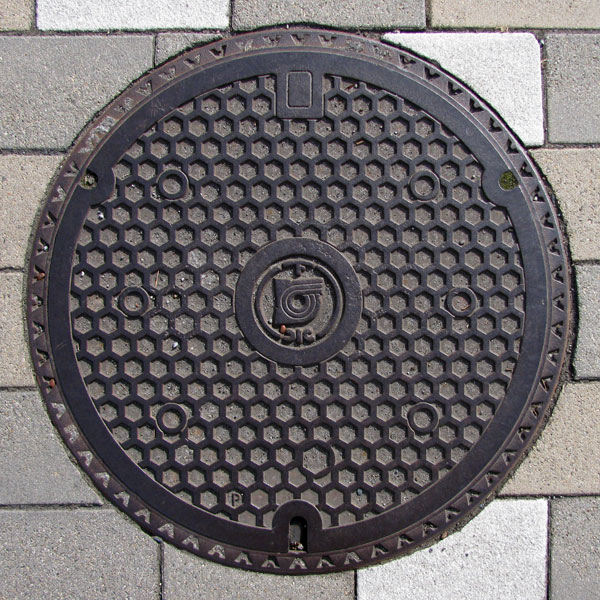
A small tortoiseshell pattern. The town emblem is in the center.
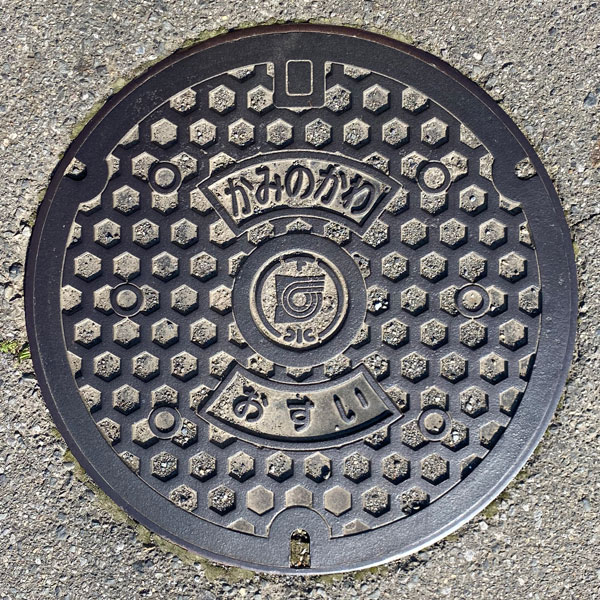
A large tortoise shell pattern. The town emblem is in the center. The words "Kaminokawa" and "Osui" are above and below the town emblem.
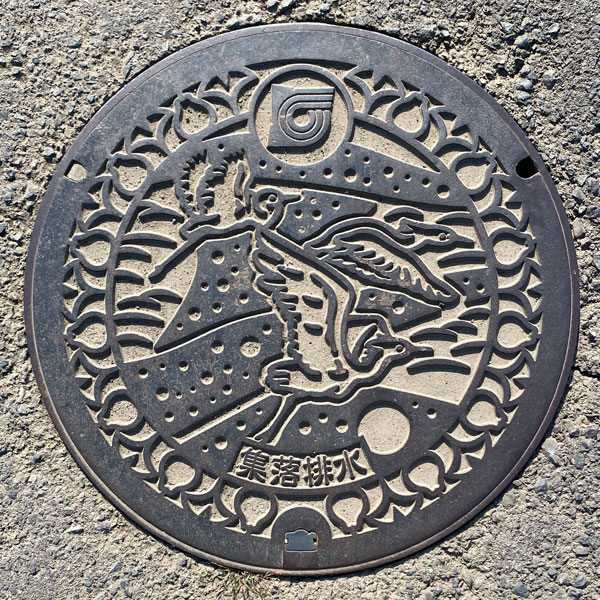
This is a manhole cover for agricultural sewage in the Oyama district, with the town emblem at the top. The inside depicts the town's bird, the egret, and the edges are lined with alternating ginkgo leaves (the town's tree) and bottle gourd fruits (the town's flower).
A smaller version of the agricultural wastewater treatment system in the Oyama district, with the same design as above.
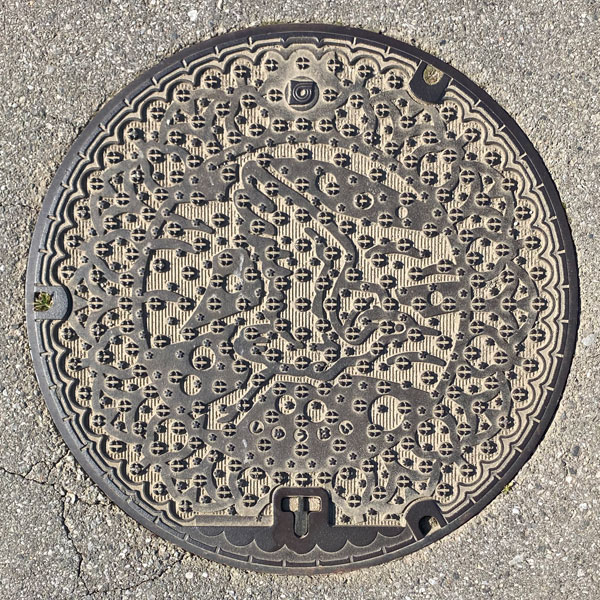
This manhole cover for agricultural settlements in the southern district features a small town emblem at the top. The motif is the same as before, with the town's bird, the egret, on the inside, and the leaves of the town's tree, the ginkgo, and the fruit of the town's flower, the bottle gourd, around the edge. However, it has large and small protrusions to prevent slipping. Perhaps because of this, there is only one egret depicted.
Mashiko 益子町
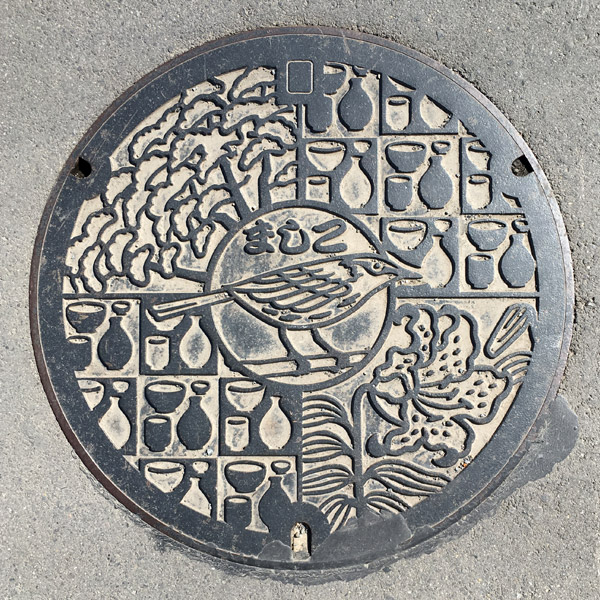
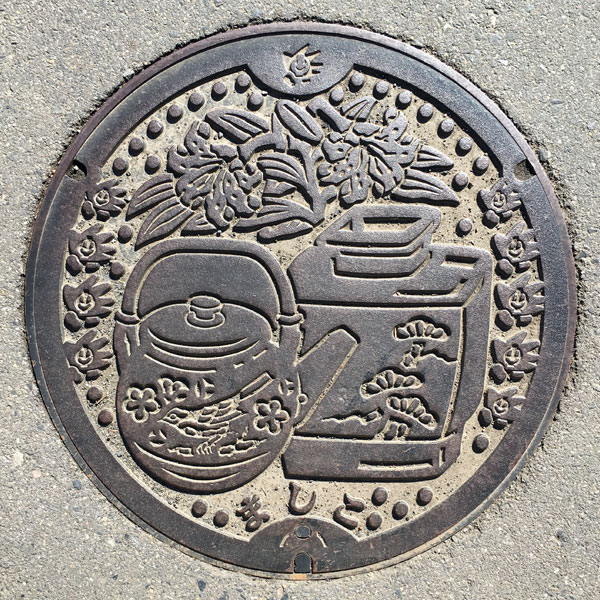
The manhole cover features the town's bird, the Japanese bush warbler, along with the town's tree, the Japanese red pine, the town's flower, the mountain lily, and Mashiko pottery.
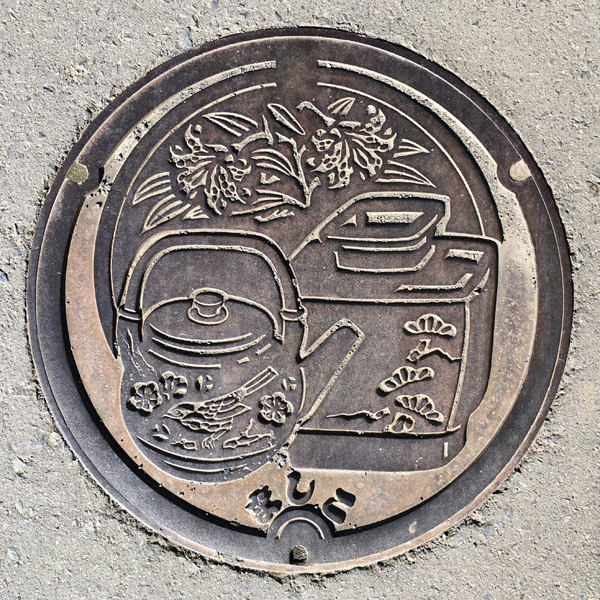
This manhole cover for the agricultural wastewater treatment plant in the Nagatsutsumi-Kamiyama district features a design inspired by Mashiko ware pottery. The design also depicts the town's flower, the lily, the town's bird, the Japanese bush warbler, and the town's tree, the Japanese red pine, as motifs for tea utensils and flower vases.
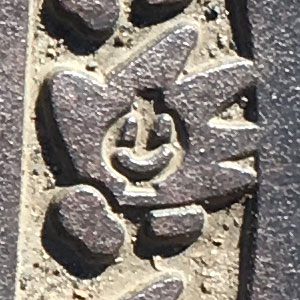
This manhole cover from the Higashidai district agricultural drainage system has almost the same design as the cover above, but perhaps because the surface area was too flat and slippery on the cover above, the semi-circular tray-like section has been removed, the lily flower that was engraved inside has become a raised area, and small polka-dot-like protrusions and something resembling a palm with a face have been added to the surface.
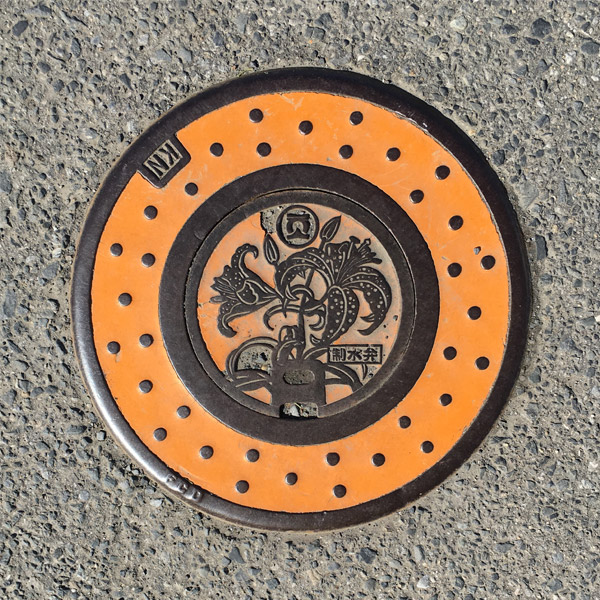
A water control valve cover featuring the town's official flower, the "mountain lily."
Nogi 野木町
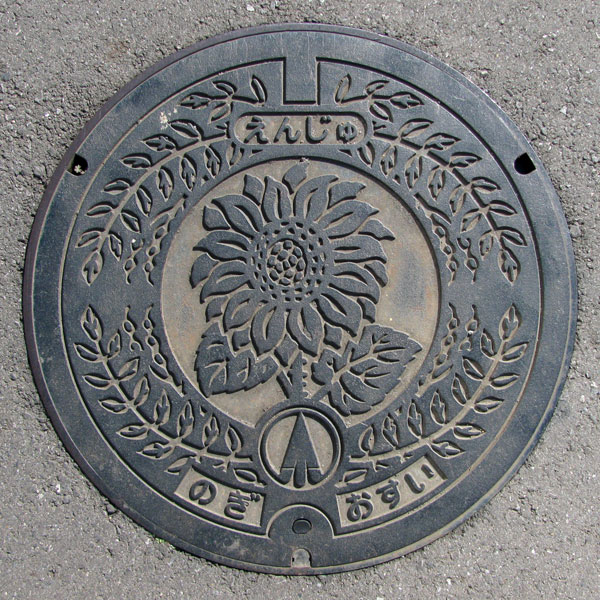
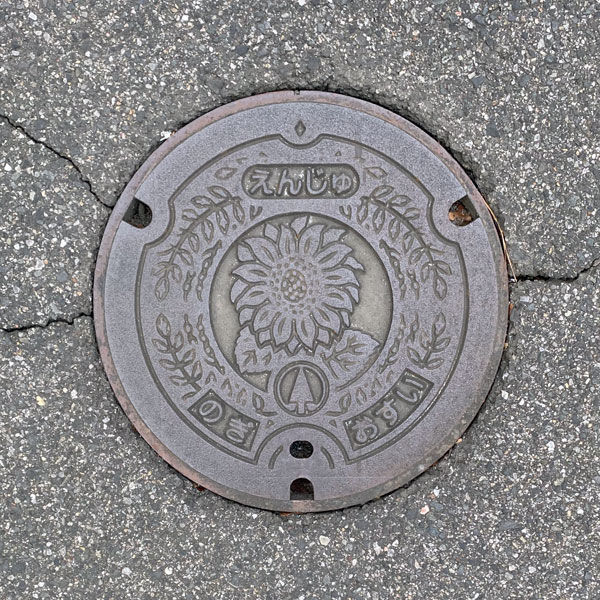
A manhole cover for sewage featuring the town flower, the sunflower, at its center, surrounded by the town tree, the Japanese pagoda tree (Sophora japonica). The town emblem, a stylized representation of a tree, is at the bottom.
A smaller version with the same design as above.
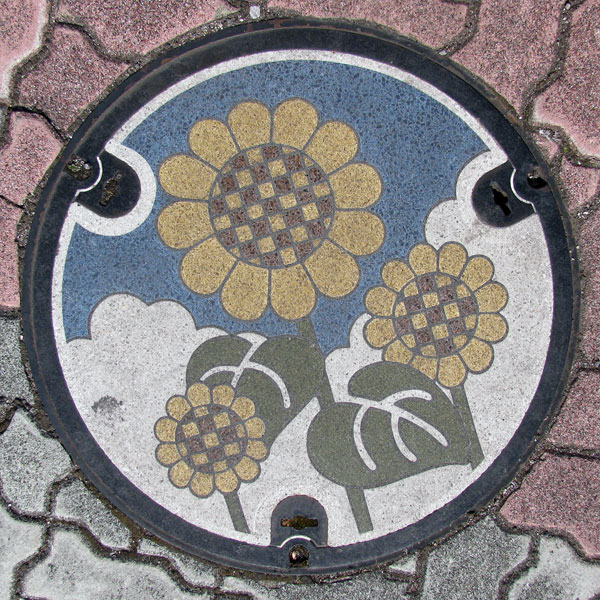
A manhole cover featuring the town's official flower, the sunflower.
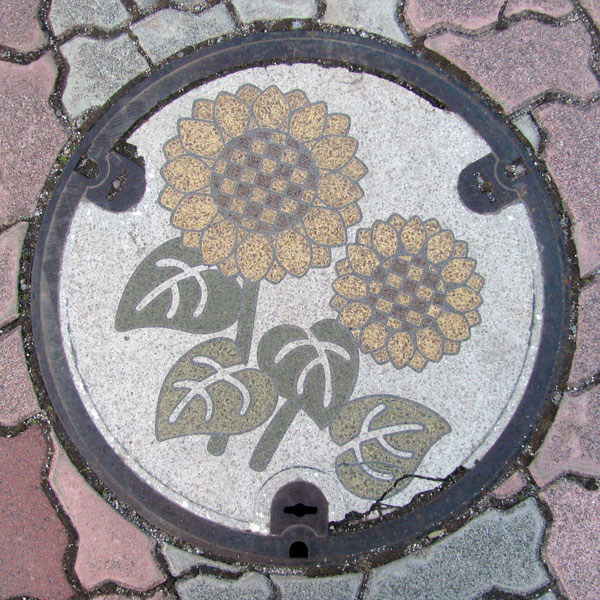
Even though they're both sunflowers, this one has a different design. The petals here are somewhat more realistic.
Tochigi Prefecture 栃木県
Tochigi Prefecture Basin Sewerage System 栃木県流域下水道
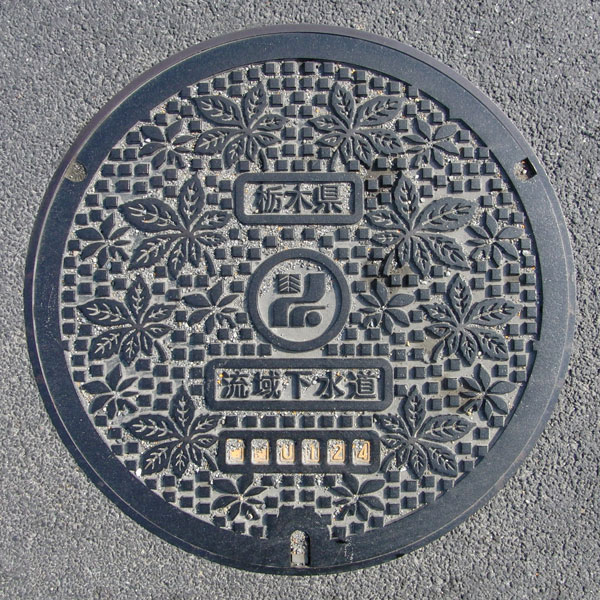
This is a manhole cover for the "Uzumagawa River Basin Sewerage System," which handles wastewater from northern Tochigi City and Mibu Town. As expected of Tochigi Prefecture, it features a horse chestnut leaf design. The center displays the prefectural emblem, a stylized representation of the character "Tochi" (栃).
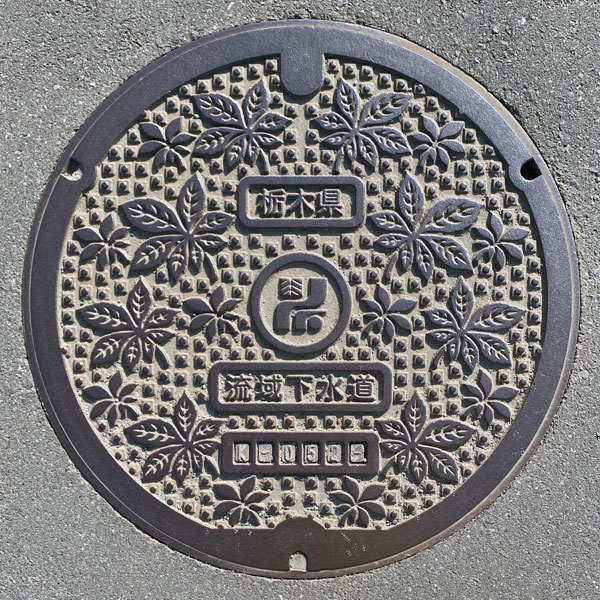
This is a manhole cover for the "Kinugawa River Upper Basin Sewerage System (Central Treatment Area)," which handles wastewater from Utsunomiya City, Shimotsuke City, and Kaminokawa Town. It depicts horse chestnut leaves. The center features the prefectural emblem, a stylized representation of the horse chestnut character ("Tochi"). The design differs from the manhole cover photographed in Tochigi City.
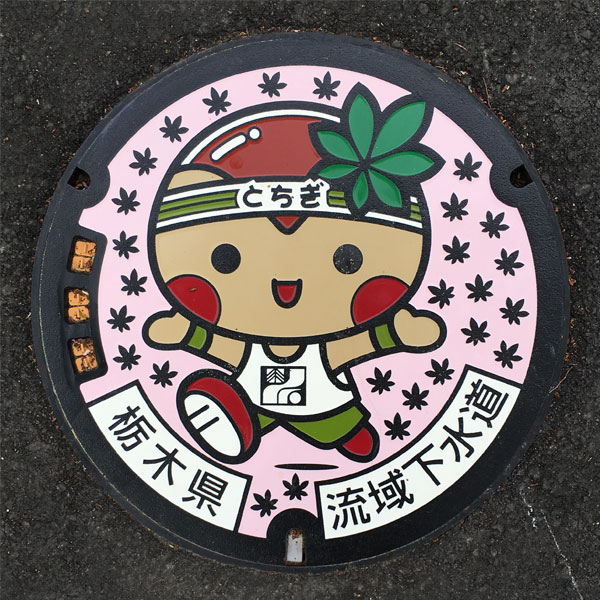
A colorful manhole cover for the basin sewerage system featuring Tochigi Prefecture's mascot character, "Tochimaru-kun." It was installed at the Central Wastewater Treatment Center on January 30, 2018.
The background is pink, reminiscent of Tochigi's specialty strawberries, with scattered horse chestnut leaves. Tochimaru-kun, with a head shaped like a horse chestnut, a headband inscribed with "Tochigi" and adorned with horse chestnut leaves, and the Tochigi Prefecture emblem printed on his chest, is running with both hands raised, seemingly saying, "Let's all do our best together!" The words "Tochigi Prefecture" and "Basin Sewerage System" are at the bottom.
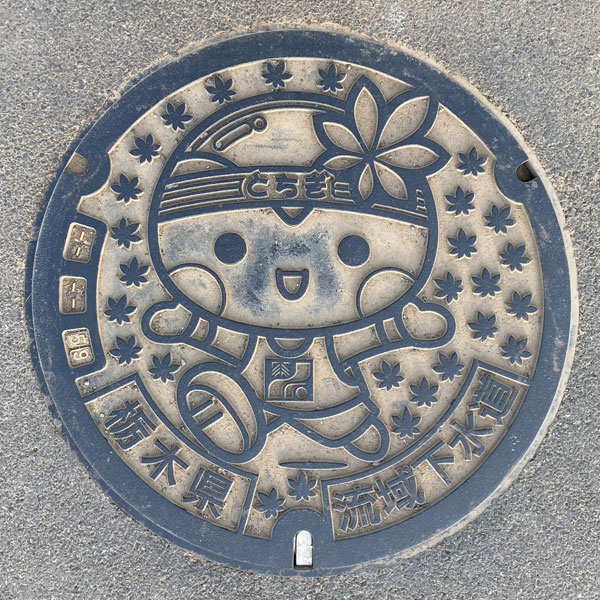
A monochrome sewage system indicator featuring Tochigi Prefecture's mascot character, "Tochimaru-kun."
Ministry of Land, Infrastructure, Transport and Tourism 国土交通省
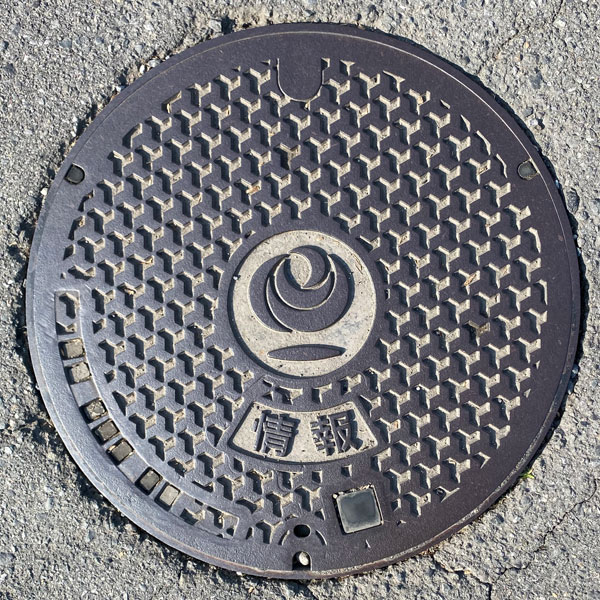
A manhole cover from the Ministry of Land, Infrastructure, Transport and Tourism. It has a design resembling a three-bladed windmill, with the Ministry's symbol in the center and the word "Information" at the bottom.