X Kumamoto 熊本県
Kumamoto 熊本県
Kumamoto 熊本市
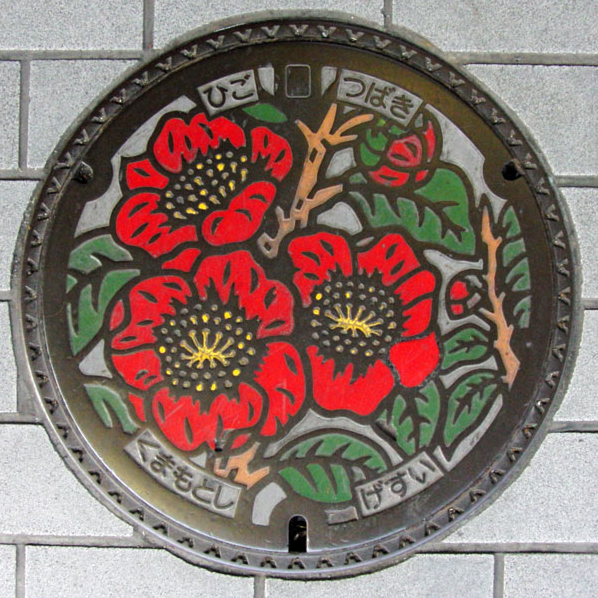
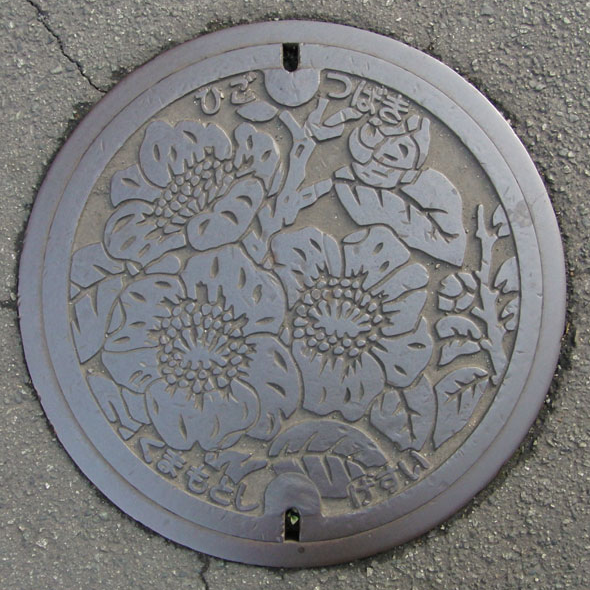
The design features the city's flower, the 'Higo Camellia.' This colored lid can be seen frequently in the Shimodori Arcade.
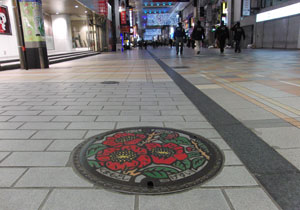

A colorful manhole cover depicting ginkgo leaves and ginkgo nuts, just like the name of the street. 'Ginkgo' is the tree of Kumamoto City.
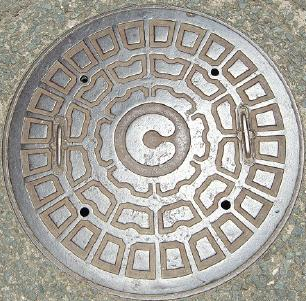
Contains the city emblem with a stylized 'ku' character.
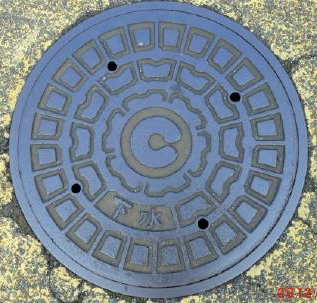
It has a hole with the city emblem, but it has the word 'sewage' on it.
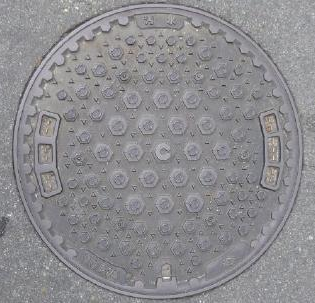
ASD manhole. The city emblem in the center with the word 'Sewage' above it.
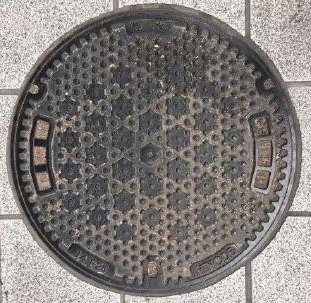
It is an ASD (Anti-Slipping Design) type, with the emblem of Kumamoto City in the center, "Sewage" at the top, and "14T-25" and "HINODE" at the bottom. There are number frames on both sides, and the surrounding design is of the ▼▼▼ type.
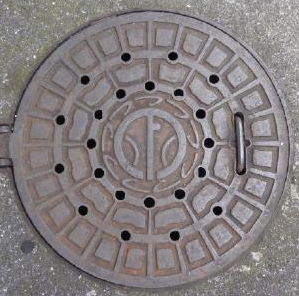
The outer hinge-lidded manhole cover has a sewage symbol. It seems that the design features the character for 'water' surrounded by '9 katakana ma' characters. 9 (ku) + ma = Kuman (bear). According to someone, the 'water' character is designed in a way that it can also be read as 'hon,' giving it a double meaning of 'Kumamoto' and 'water.' The center also has a design that looks like the character 'water' is surrounded by 'shita,' so just by looking at the center, it can be read as 'sewage.' (From Mie)
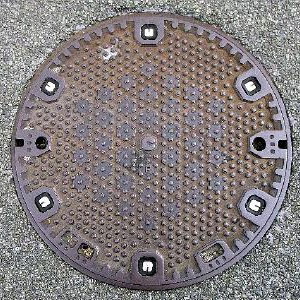
ASD specification, manhole cover with the emblem of Kumamoto City in the center and the letter 'E' immediately below it.


A square cover for sidewalks with two connected sections, featuring underground line markings and the emblem of Kumamoto City.
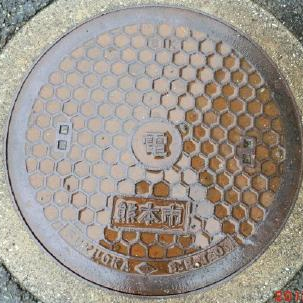
With the characters 'Kumamoto' and 'Den'.
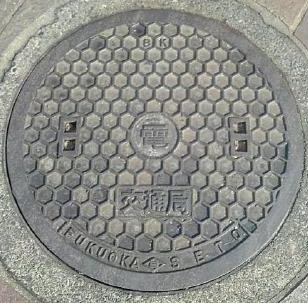
Tortoise-shell pattern, with 'Den' in the center and 'Kōtsūkyoku' written below it.
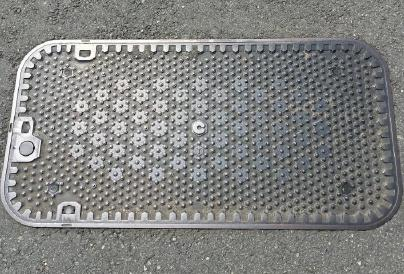
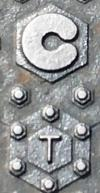
ASD (Anti-Slipping Design) type. In the center, the city emblem of Kumamoto City, and just below it, a square cover with a 'T'.
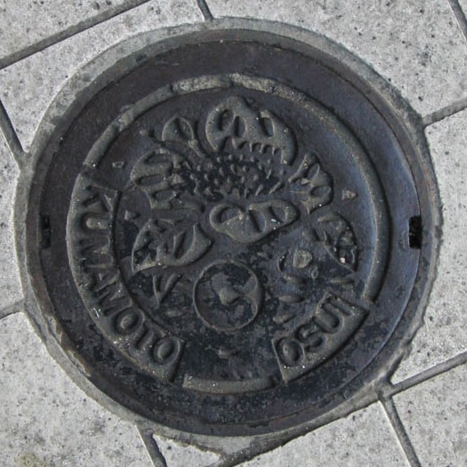
The city emblem and the city's flower, Higo camellia, with the letters 'KUMAMOTO' and 'OSUI'.
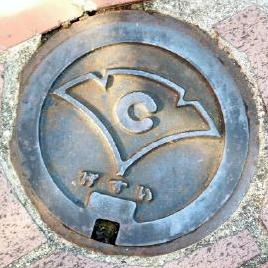
Inside the leaves of the city's ginkgo tree, there is the city emblem.
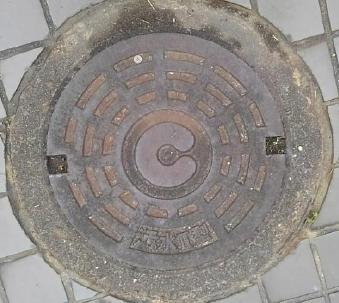
The city emblem and the characters 'Sewage Type II'.
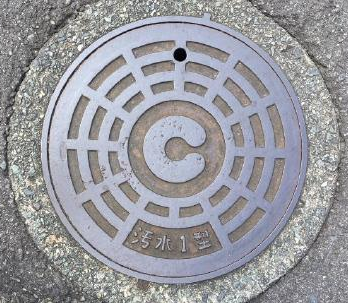
The city emblem and the characters 'Sewage Type I'.
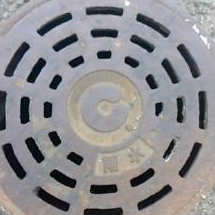
It is a small lid with holes in a spiderweb pattern. The city emblem is in the center, with the word 'rainwater' below it.
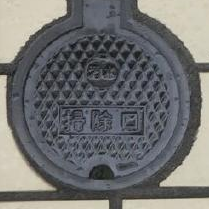
△Small cover with external hinges, featuring the words 'sewage' and 'cleanout' on the ground pattern.

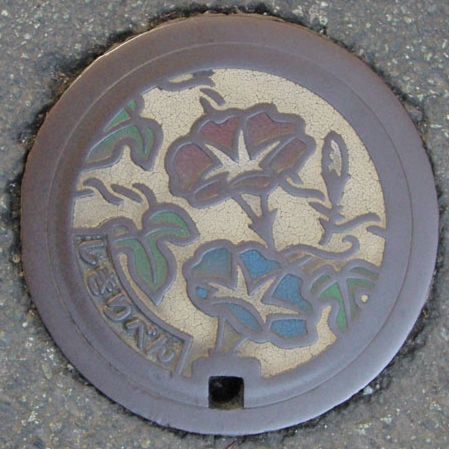
A valve cover with red and blue morning glories painted on it.
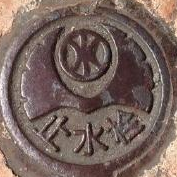
A fire hydrant cover with a design of the city's tree, ginkgo leaves.

It is completely colored yellow, and at the central upper part of the elongated oval dot pattern resembling sesame seeds, there is the mark of the Kumamoto City Waterworks Bureau. In the center are the characters 'Fire Hydrant'.
Square fire hydrant cover.
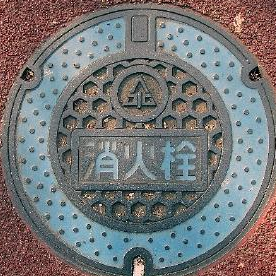
Tortoiseshell pattern with the Kumamoto City Waterworks Bureau emblem on top, 'Fire Hydrant' below, and a blue outer edge with polka dots. Round fire hydrant cover.
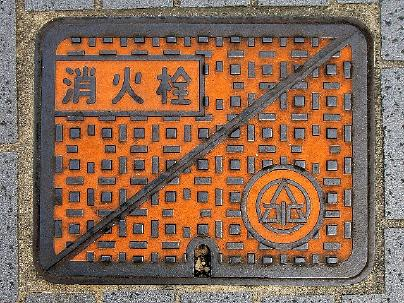
A continuous pattern of squares and rectangles on an orange background, with 'Fire Hydrant' in the upper left and the Kumamoto City Waterworks Bureau emblem in the lower right.
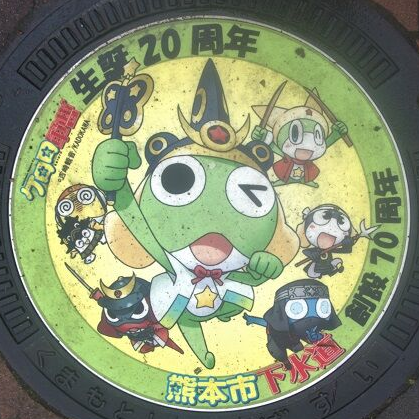
Color design of Kumamoto City Waterworks 90th Anniversary Character "Maruru." A replica was created by the Waterworks Bureau. *It is not actually installed in the town. It is said to be a [limited-time exhibition] at the Kumamoto City Waterworks Bureau. *As of February 3, 2019, it is exhibited at the "Water Science Museum" in Kumamoto City. The waterworks of Kumamoto City celebrated its 90th anniversary in 2014 (Heisei 26), and to commemorate this, the polar bear "Maruru" from Kumamoto City Zoological and Botanical Gardens was appointed as a commemorative character. Maruru is energetically swimming in a groundwater pool even today. To protect this important groundwater and its circulation system in the Kumamoto region and pass it on to future generations, we created a manhole cover designed with Maruru. (From the explanation nearby)
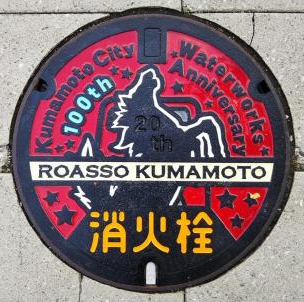
Since Kumamoto City will celebrate the 100th anniversary of its water supply on November 27, 2024, four fire hydrant covers collaborating with Kumamoto City and Kumamoto's sports teams were installed on October 8, 2024. They feature a color design with the emblem of Roasso Kumamoto (J2 soccer), the words 'Kumamoto City Waterworks Anniversary 100th,' and 'Fire Hydrant'.
Former Kawachi 旧河内町
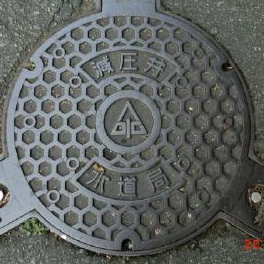
A manhole cover with a hexagonal pattern and a pressure-reducing valve, featuring the emblem of the Kumamoto City Waterworks Bureau.
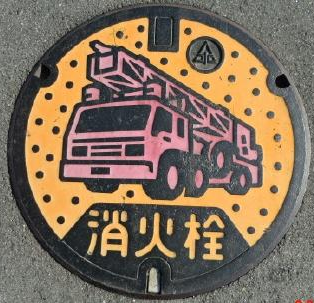
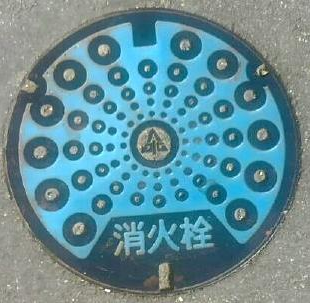
Fire hydrant manhole cover with the Kumamoto City Waterworks Bureau emblem.
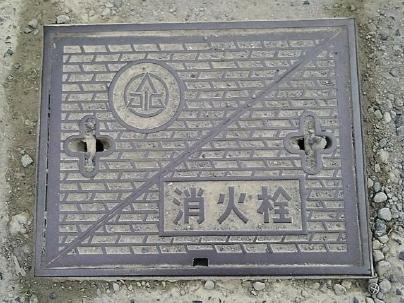
It is a diagonally divided square lid with a block-style ground pattern. The town emblem is in the upper left, and the characters 'Fire Hydrant' are in the lower right.
Former Hokubu 旧北部町
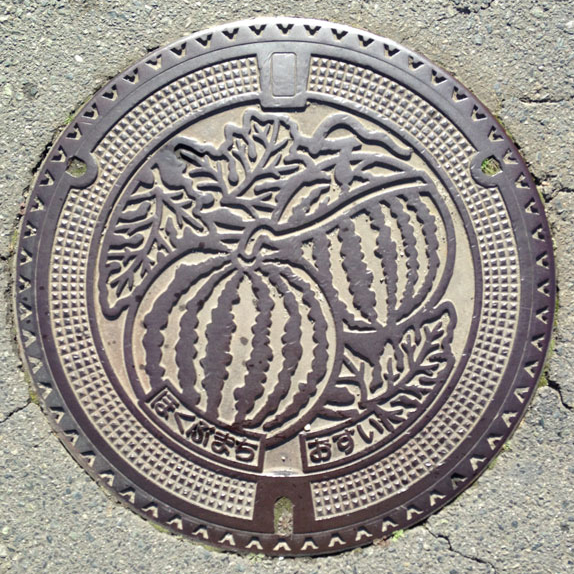
A specialty product, 'watermelon', is depicted.
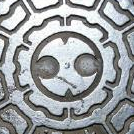
With the old town emblem.
Former Tomiai 旧富合町
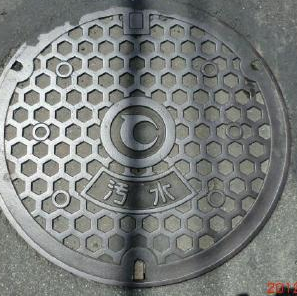
Kikko pattern with the emblem of Kumamoto City.
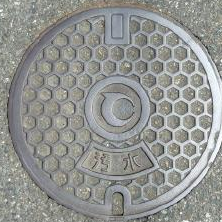
A tortoiseshell pattern with the Kumamoto City emblem, with the characters 'sewage' at the bottom.
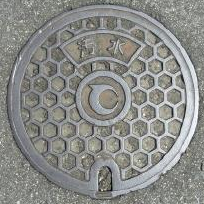
Hexagonal pattern with the Kumamoto City emblem, with the characters 'Sewage' at the top.
Former Ueki 旧植木町
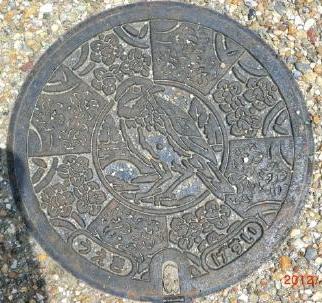
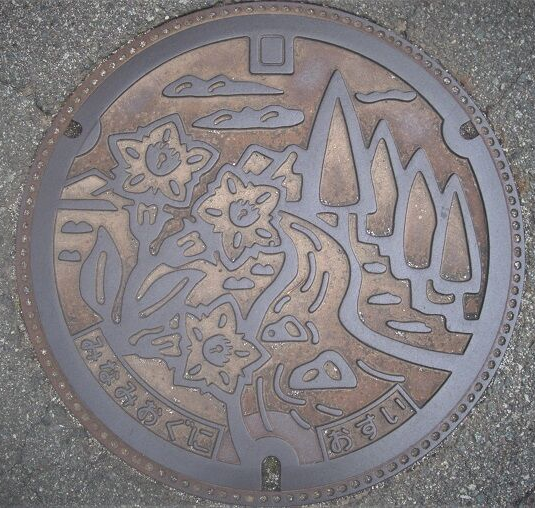
The flowers of the old town, daffodils, and the town's bird, the bunting. The characters 'ueki' and 'gesui'.
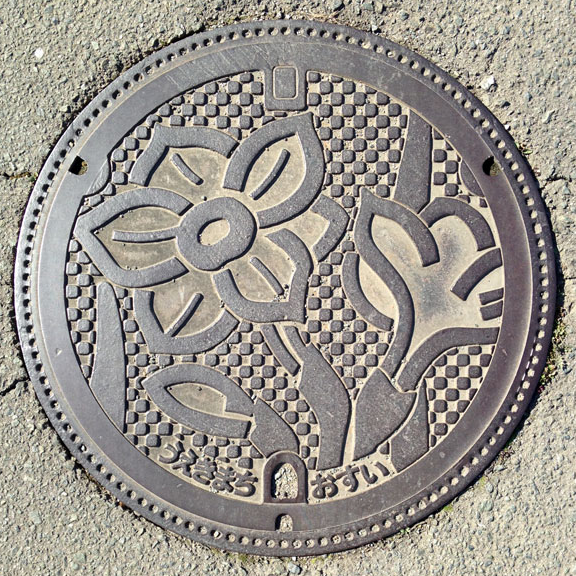
A manhole cover of the agricultural settlement drainage in the eastern Shandong region, depicting the town's flower, the daffodil.
Former Jonan 旧城南町
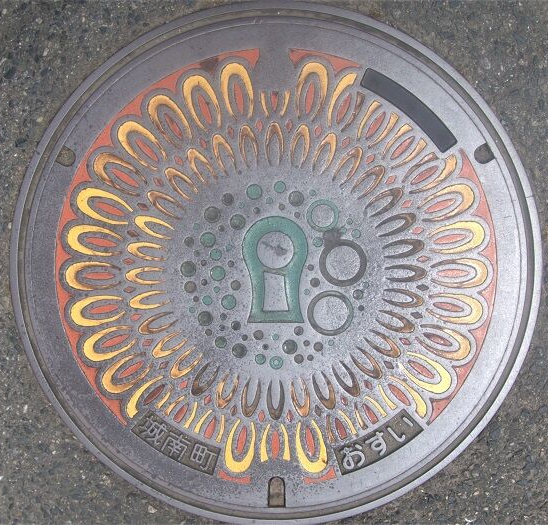
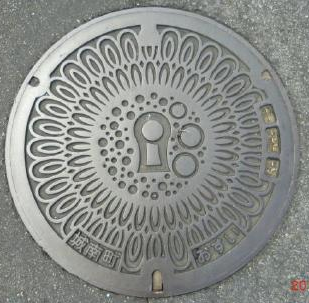
The design of the town's flower, the chrysanthemum, and the Tsukahara Kofun group.
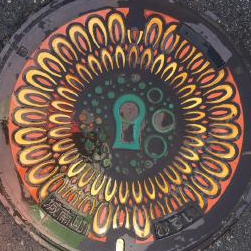
Kumamoto Northern Purification Center display lid. Color version of the same design as above.
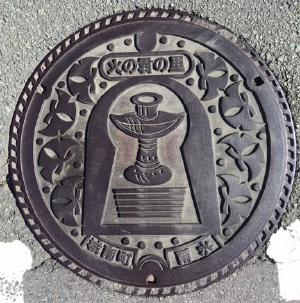
In the center is a keyhole-shaped burial mound and a nationally designated Important Cultural Property, the 'Dai-tsuki Funagata Pottery' excavated locally. Around it is depicted the nationally designated natural monument, the Shimoda Ginkgo Tree. At the top are the town's catchphrase 'Home of the Fire Lord.' At the bottom are the words 'Jonan Town' and 'Usui.' The 'Fire Lord' is said to have been the greatest local noble of Higo Province during the Kofun period.
Former Tenmei 旧天明町
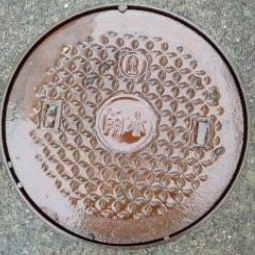
It has the characters '雨水' (rainwater). There is nothing special about it. Since it was raining, it's a little hard to see... but the part of the road that was laid was all covered with Kumamoto City's 'Higo Tsubaki' lids.
Former Akita 旧飽田町
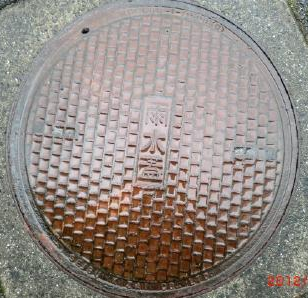
It has no special features (lol).
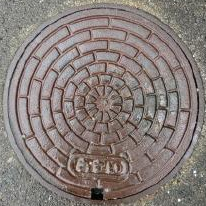
With the characters 'Rainwater Cover'.
Related: Minamata 水俣市, Yamaga 山鹿市
Aso 阿蘇市
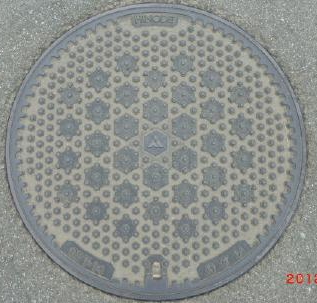
Anti-slip manhole made by HINODE with the city emblem.
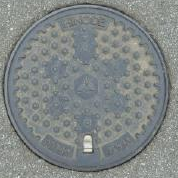
Small slip-resistant lid with city emblem.
Former Aso 旧阿蘇町
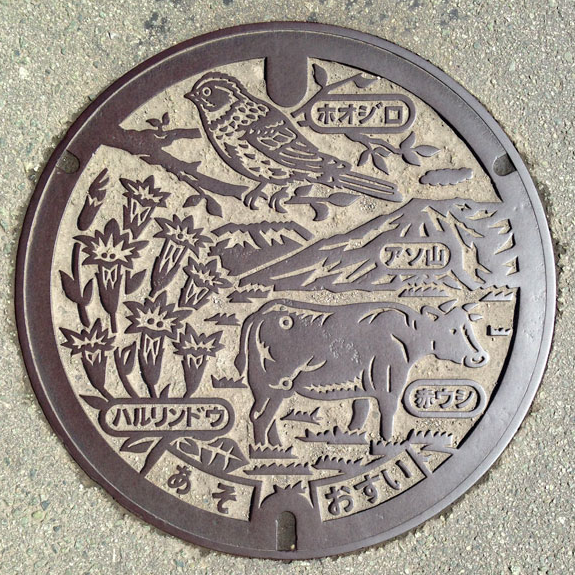
A wastewater manhole cover depicting the town bird 'Hoojiro,' the town flower 'Harurindou,' and the specialty 'Red Cow,' with Mount Aso in the background. Each design is kindly labeled with text.
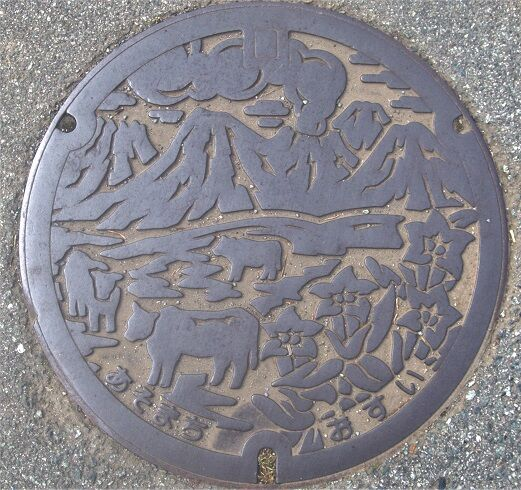
Hoojiro, Aso Mountain, Harurindou, there are no characters for Akaushi.
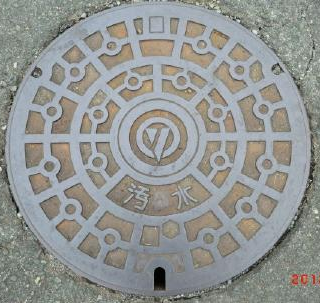
JIS standard manhole with the old town emblem.
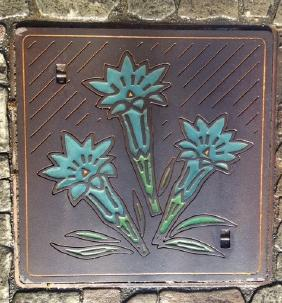
This is a square lid with the color design of the old town's flower, 'Harurindou.' It was on the sidewalk. Could it be a sewer lid?
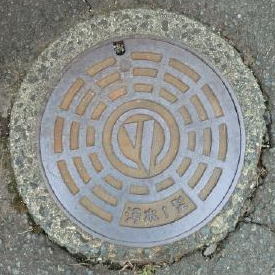
Small lid with the old town emblem.
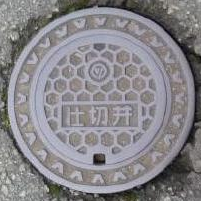
Hexagonal pattern with the old town emblem and the characters 'Shikiriben', V-shaped pattern on the receiving frame.
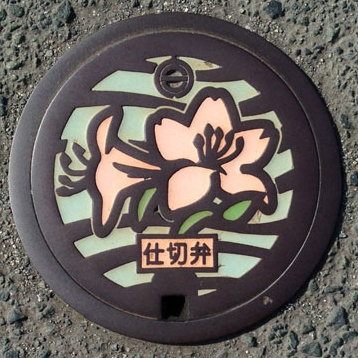
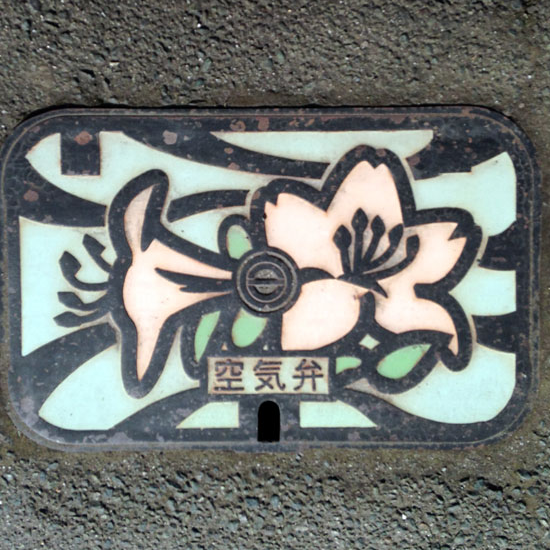
A fire hydrant cover depicting 'Miyama Kirishima,' a type of azalea that is the town's flower.
Former Namino 旧波野村
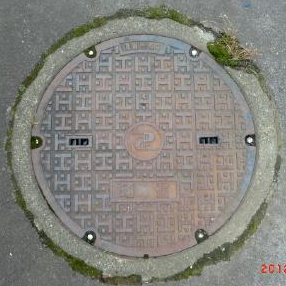
Old Hanano Village※The sewer system was not developed.
A communication manhole cover with the mark of the former Ministry of Construction (now the Ministry of Land, Infrastructure, Transport and Tourism).
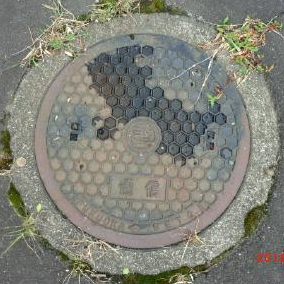
Old Hano Village ※ The sewer system was not developed.
Kikko-pattern communication manhole cover with the old Ministry of Construction mark.
Amakusa 天草市
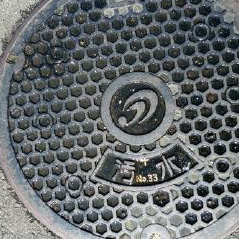
Tortoise shell pattern with the city emblem.
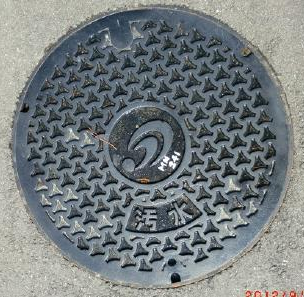
Tetrapod pattern with the city emblem.
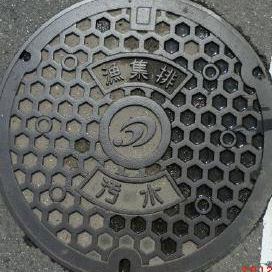
Tortoise shell pattern with city emblem. Includes the characters '漁集排' and '汚水'.
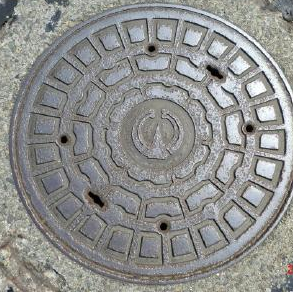
With the city emblem.
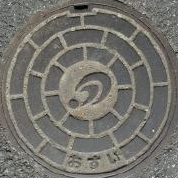
Small lid with a circular pattern featuring the city emblem.
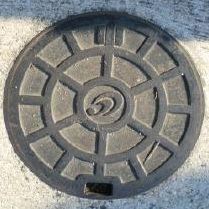
Small lid with standard design featuring the city emblem.

A dolphin design with the city emblem.
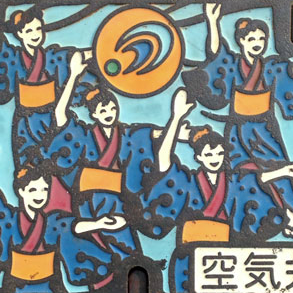
A manhole cover in Amakusa City depicting five women dancing the 'Ushibuka Haiya.' It features the emblem of Amakusa City.
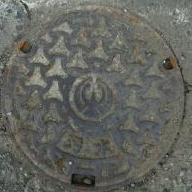
Small lid with an irregular tetrapod pattern featuring the city emblem.
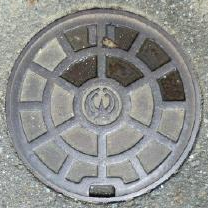
Small lid with a standard pattern featuring the city emblem.
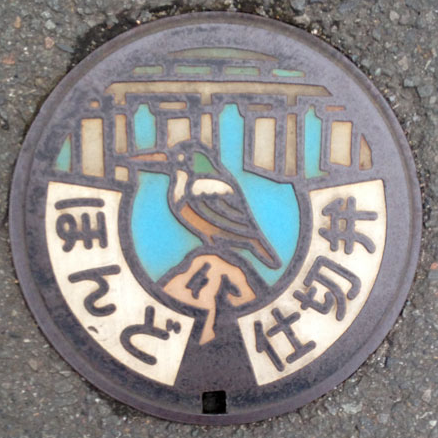
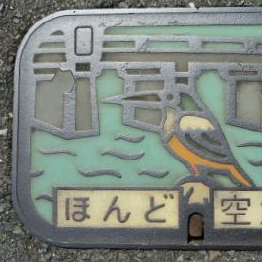
A valve cover of a stop valve with a design similar to the topmost air valve.
Former Kawaura 旧河浦町
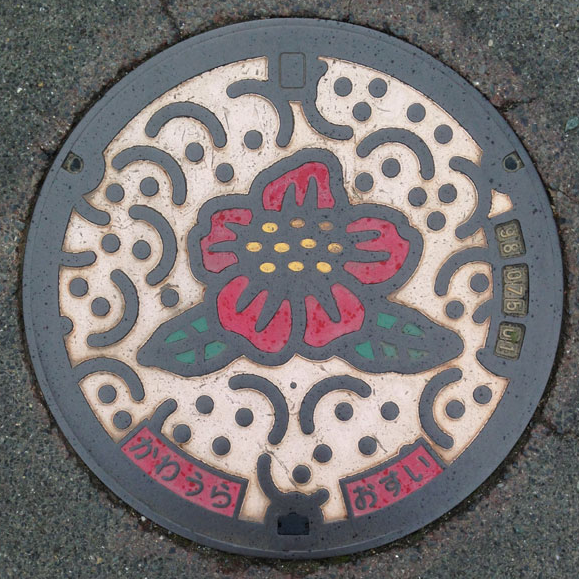
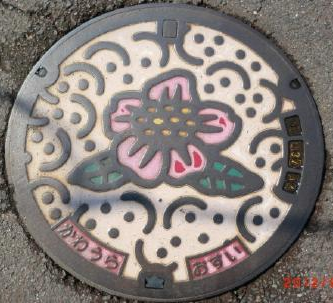
A manhole cover of a specific environmental conservation public sewer depicting the town's flower, the sasanqua. There are also pictures of sasanqua on the nearby road shoulders.
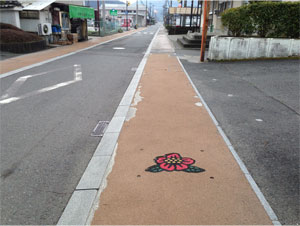
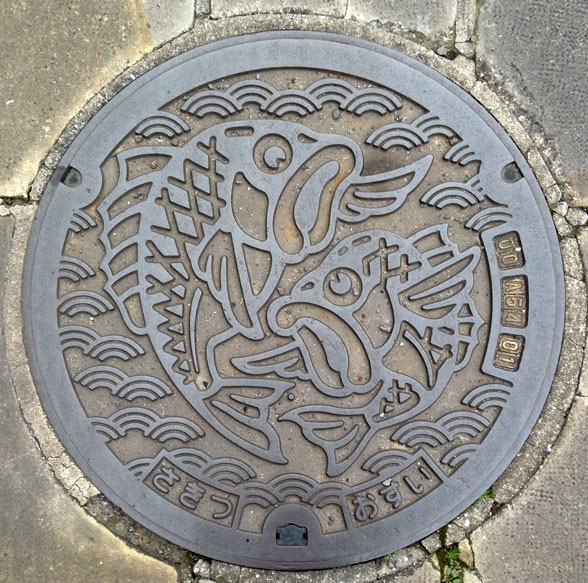
A manhole cover for the drainage of the Sakitsu fishing village area, depicting two sea bream.
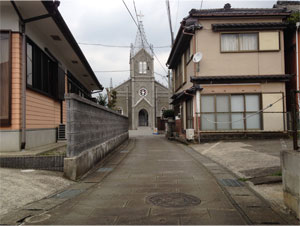
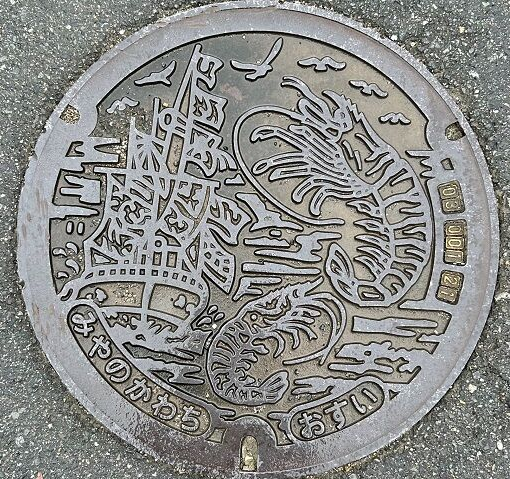
A manhole cover for the Funatsu District fishing village drainage, depicting shrimp and a fishing boat.
Former Amakusa 旧天草町
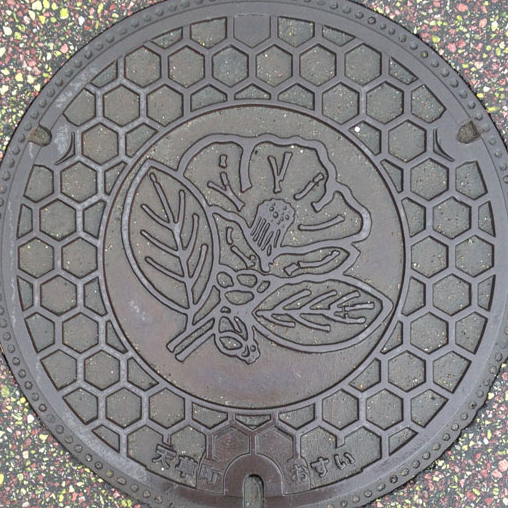
A manhole cover of the Specific Environmental Conservation Public Sewer featuring the town flower 'sasanqua'. The words 'Amakusa Town' and 'Sewer' are written at the bottom.
Former Itsuwa 旧五和町
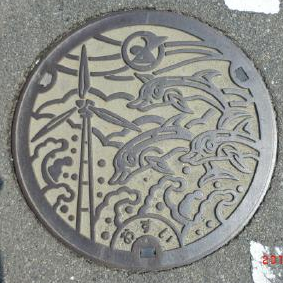
Because dolphin watching is famous and the island has wind power generation, those elements and the town emblem are also designed on the lid.
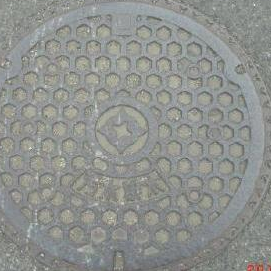
Tortoise shell pattern with the old city emblem.
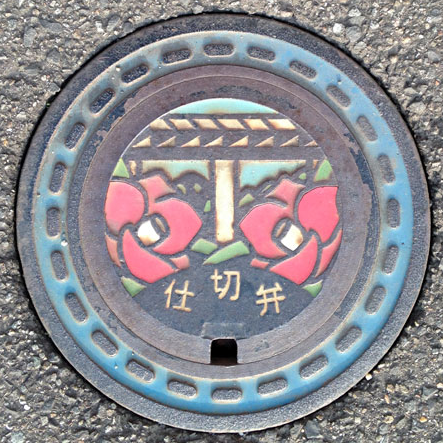
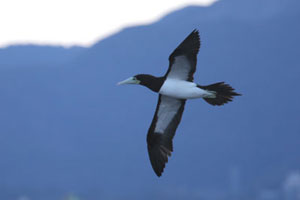
A fire hydrant cover depicting the city's bird, the 'booby,' and the 'Haiya Bridge.' A fish that appears to be a yellowtail is also depicted, but the details are unknown. There are covers with the same design but with different words such as 'shut-off valve,' 'control valve,' and 'air valve.'
Former Goshora 旧御所浦町
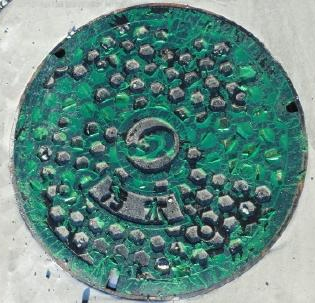
It is a tortoiseshell pattern with the emblem of Amakusa City, but it is a manhole cover that is still covered with plastic during sewer construction. I went there by boat on purpose, but there was no original design cover. Sewage manhole cover.
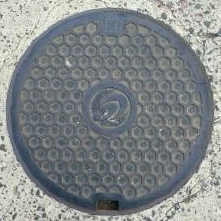
Small sewage manhole cover.
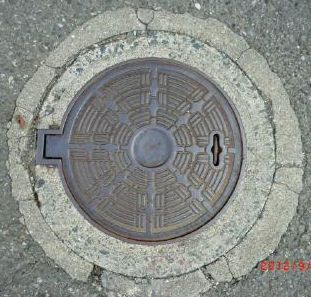
Small sewage cover.
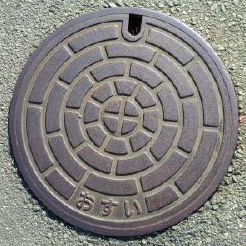
Small sewage manhole cover.
Former Ariake 旧有明町
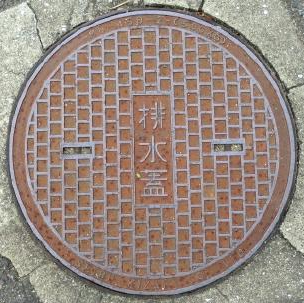
As of October 25, 2012, there is no sewage system in the former Ariake Town, so this is a drainage cover on the grounds of the city hall branch office.
Related: Kamiamakusa 上天草市
Arao 荒尾市
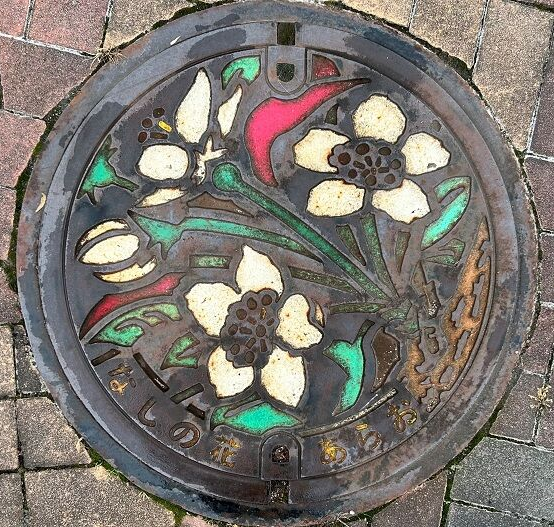
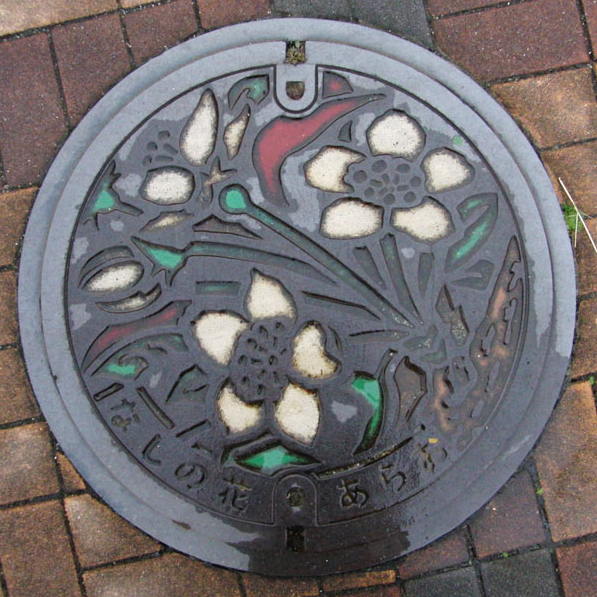
A sewage manhole cover featuring a drawing of the town's flower, the 'pear blossom'.
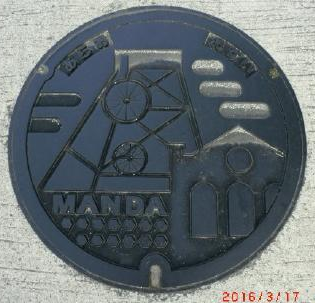
The design of the Manda Pit, one of the entrances of the Miike Coal Mine. The characters 'MANNDA', 'arao', and 'osui'.
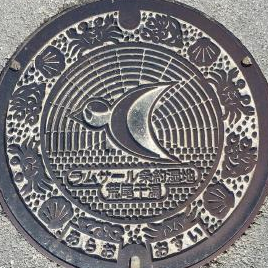
In the center is the migratory bird Kentish plover, below it are the words 'Ramsar Convention Wetland Arao Tidal Flat,' and around the edges are illustrations of sea creatures such as crabs, shells, and hermit crabs. It is installed around the Ariake Coast. On July 3, 2012, the Arao Tidal Flat was registered as a Ramsar Convention Wetland.
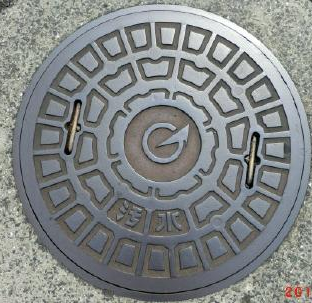
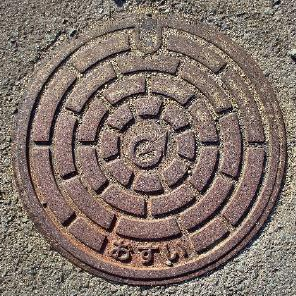
City emblem with the word 'sewage'.
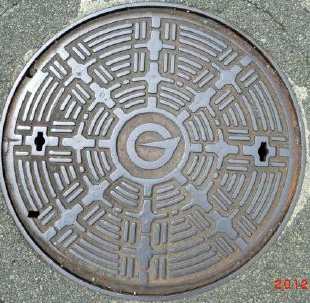
With the city emblem.
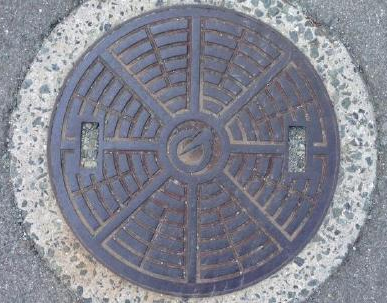
Manhole cover with the city emblem in a spider web pattern.
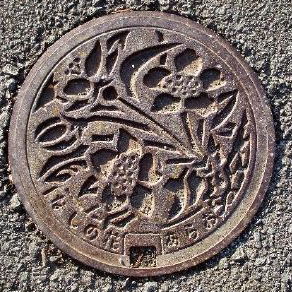
A small sewage manhole cover with a design of the city's quince flowers. The relief of the design and characters is reversed.
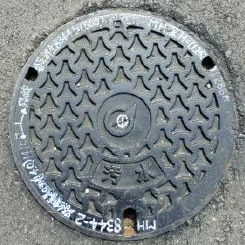
Small with a city emblem-patterned irregular tetrapod design.
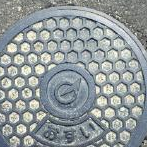
Small size with a tortoiseshell pattern and city emblem.
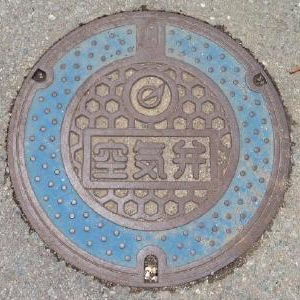
On the upper section, 'Shikiriben' (shut-off valve), in the middle section, the city emblem with the characters '100', and on the lower section, a blue background with a polka dot pattern. There are lids with the same design but with different characters, such as 'Shikiriben' and 'Kūkiben' (air valve).
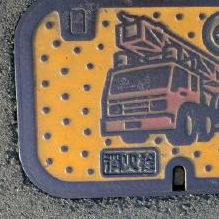
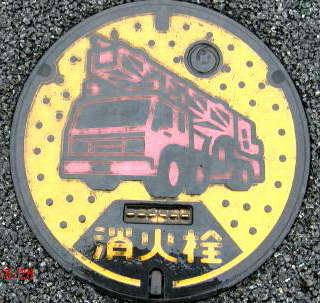
Polka dots on a yellow background, a ladder truck and the city emblem, with the words 'fire hydrant'.
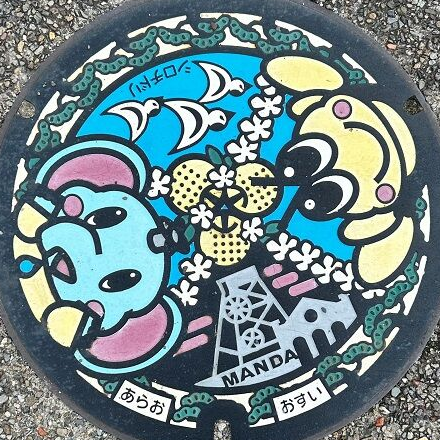
This is a manhole card cover. It is a colored cover featuring motifs of Manda Mine, Arao Pear, the city bird 'Kentish Plover,' the city tree 'Kodai Pine,' the city fish 'Majaku,' the city character 'Majakki' based on these motifs, and the Arao City Enterprise Bureau character 'Arazou-kun.'
Uki 宇城市
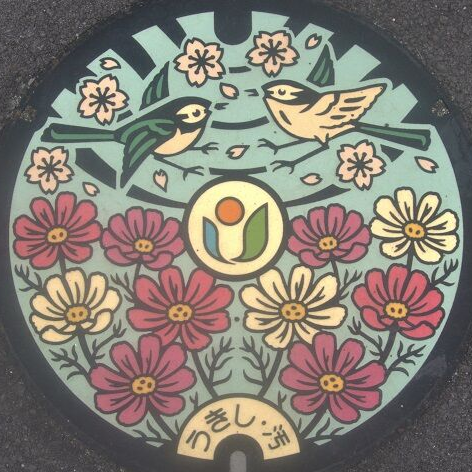
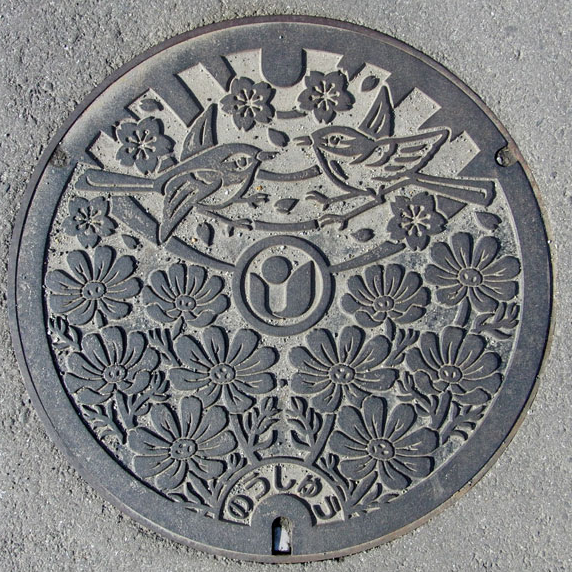
This lid is a manhole cover of Uto City for agricultural drainage. In the center is the city emblem established in February 2010. The city's tree 'Cherry,' the city's flower 'Cosmos,' and the city's bird 'Bush Warbler' are depicted.
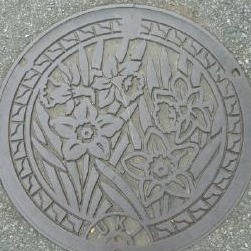
The design features the daffodil of the former Ogawa Town, and the town name has been changed to UKI.
Former Matsubase 旧松橋町
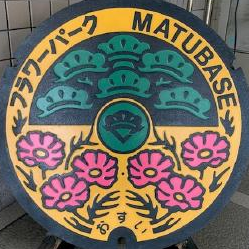
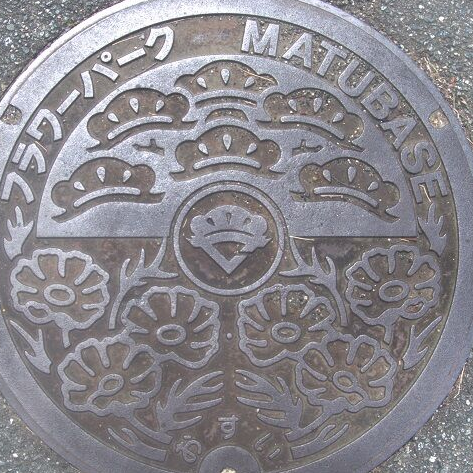
This is a colored design manhole cover displayed at the entrance of the former Matsubase Town and Uki City Hall. The town emblem is in the center, the town tree pine is in the upper half, and the town flower cosmos is in the lower half. It has the letters 'Flower Park MATUBASE'.
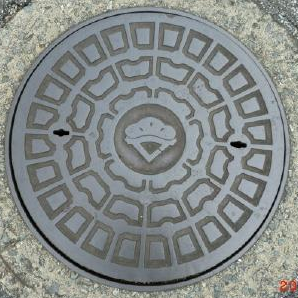
A pattern like the calyx of a persimmon with the town emblem.
Former Ogawa 旧小川町
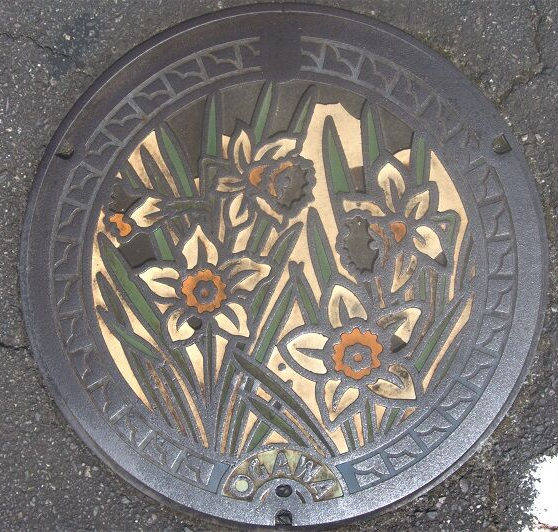
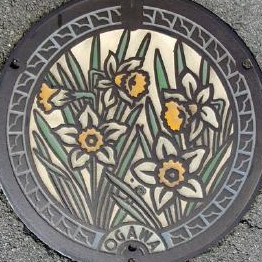
Color display cover of Yashiro North Purification Center. Design of the town's flower, the daffodil. The word 'OGAWA' at the bottom.
Former Toyono 旧豊野町
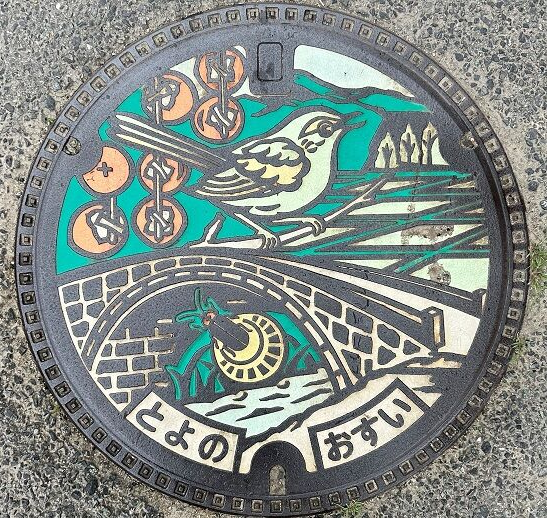
The town's symbol is the bush warbler, the town's specialty is dried persimmons, fireflies, and colored manhole covers with a stone bridge design.
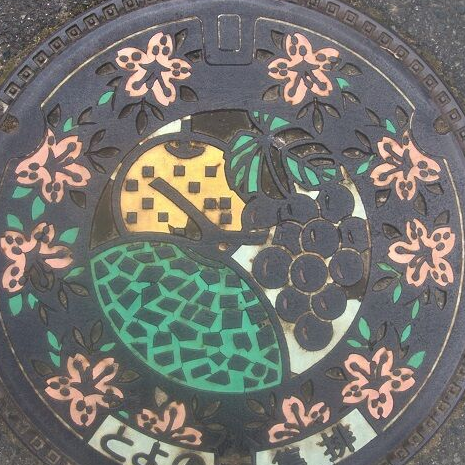
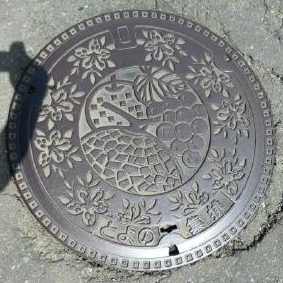
It seems to be a fruit kingdom, with designs of grapes, melons, pears, and the town's flower, azaleas.
Former Shiranui 旧不知火町

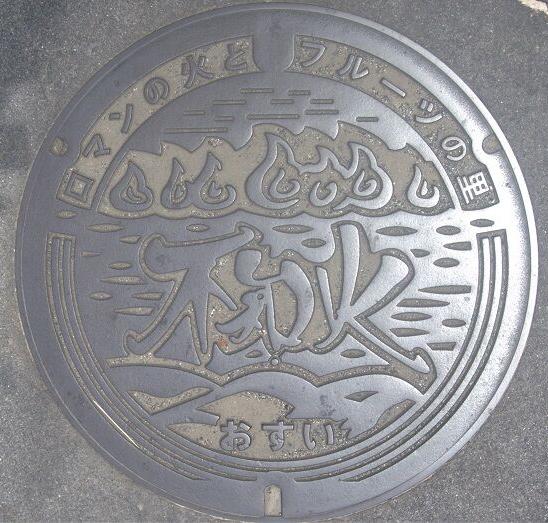
This is a colorfully designed manhole cover displayed at the entrance of Uki City Hall. It features a design of 'Shiranui,' a type of mirage that appears around the 1st of August in the lunar calendar in Yatsushiro Sea, where flames appear lined up horizontally, with the words 'Flames of Romance and the Village of Fruit' and 'Osui' included.
Former Misumi 旧三角町
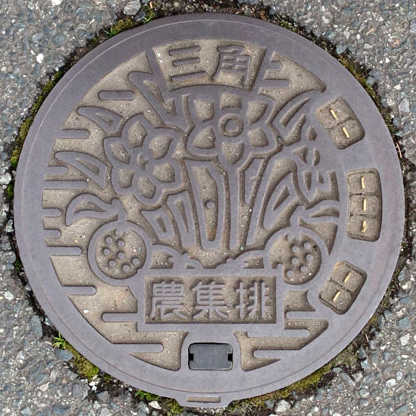
A handhole cover with the same motif as above. The number of daffodils is the same, but there are fewer mandarins. (Shiranuhimachi, Uto District)
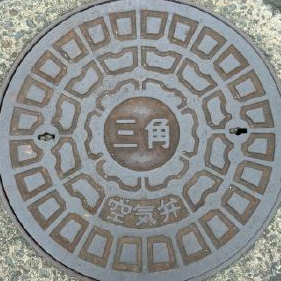
'Triangle' and the place name are in the center.
Related: Partial Affairs Association 一部事務組合, Yatsushiro Northern Basin Sewerage 八代北部流域下水道
Uto 宇土市
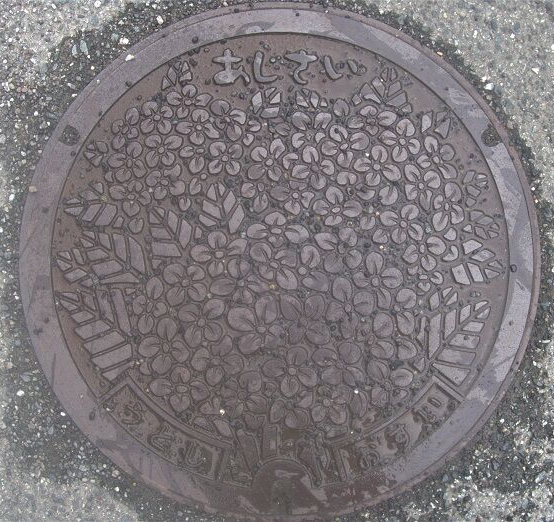
Color design of the city's flower, hydrangea.
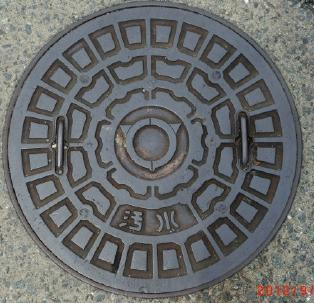
The city emblem is in the center. Around it is a pattern resembling the calyx of a persimmon, and around that is a pattern surrounded by a square shape.
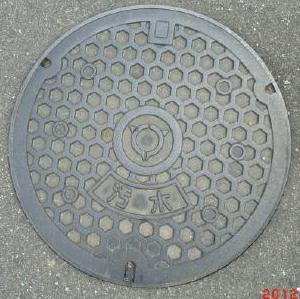
A tortoiseshell pattern with the city emblem in the center.
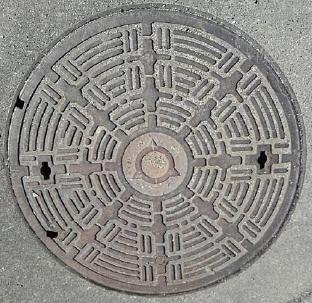
The city emblem is in the center, and the surrounding area is divided into eight sections with a pattern resembling a spider web.
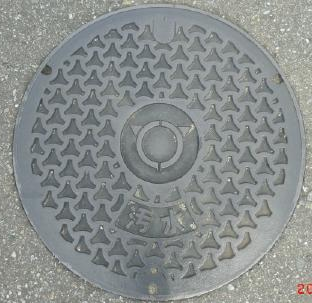
Irregular tetrapod pattern with the city emblem in the center.
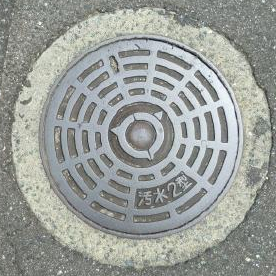
A spider web-like pattern with the city emblem in the center. Sewage Type I
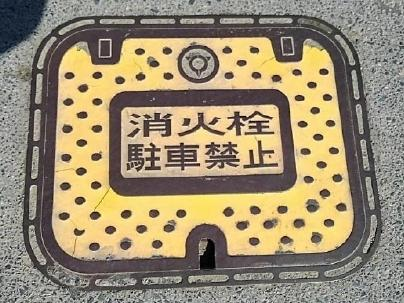
On a yellow background with polka dot patterns, the words 'Fire Hydrant No Parking' are written in large characters inside a central square, with the city emblem above.
Kamiamakusa 上天草市
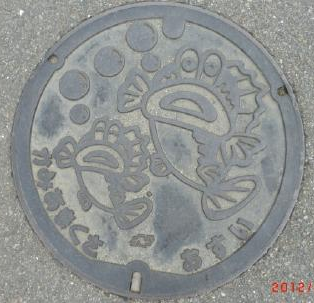
In the Kamikamakusa City area, there is a fish called 'Garakabu' (scientific name: Kasago), and it is said that this name carries the wish, 'Through the sewerage project, let's protect the sea where Garakabu parents and children can continue to live forever.' The sewerage project was carried out only in the former Matsushima Town and not in the other three towns, so originally the design of the former Matsushima Town was used, with only the name changed to 'Kamikamakusa'.
Former Matsushima 旧松島町
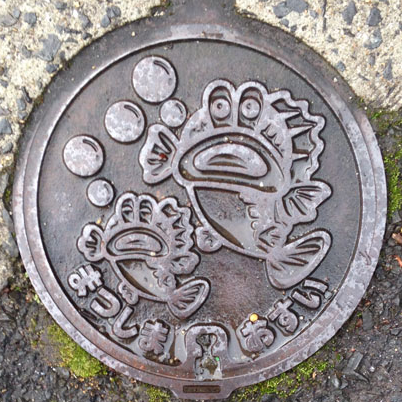
A sewage manhole cover featuring a drawing of a 'Mudskipper'.
Former Himedo 旧姫戸町

A partition valve with no distinctive features that was in front of the branch office.
Related: Amakusa 天草市
Kikuchi 菊池市
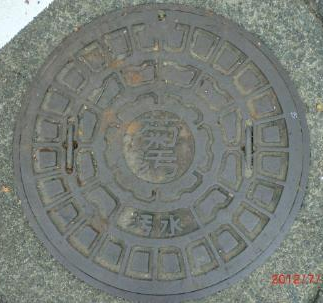
In the center, there are the characters 'Kiku Yogo'.
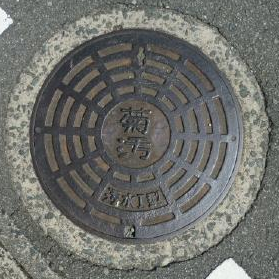
In the center, there are the characters 'Kiku Yo' and 'Wastewater Type I' with a spiderweb-like design.
Former Kikuchi 旧菊池市
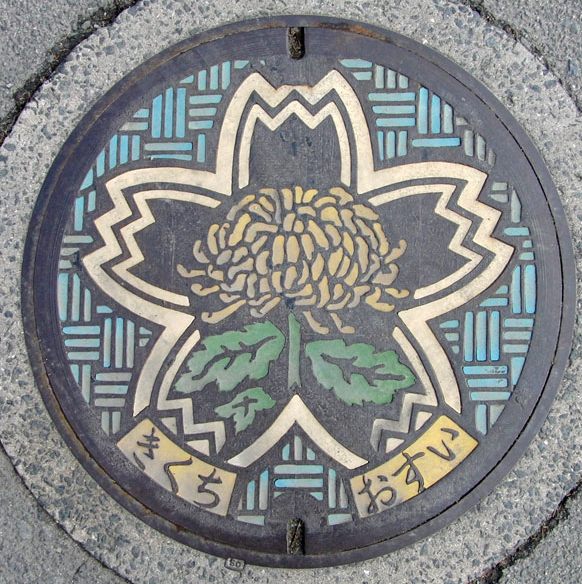
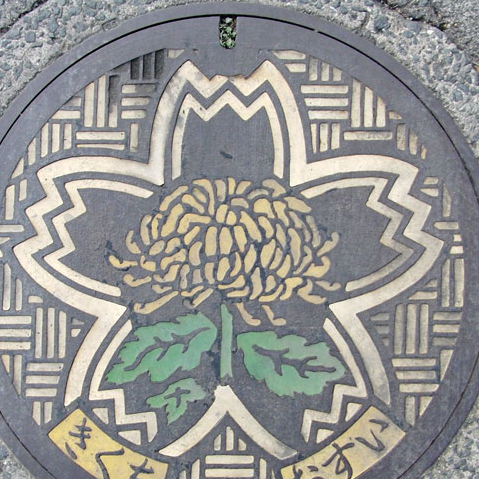
A colored manhole cover for sewage, depicting the city's flower 'chrysanthemum' within the city tree 'cherry blossom'.
Former Shisui 旧泗水町
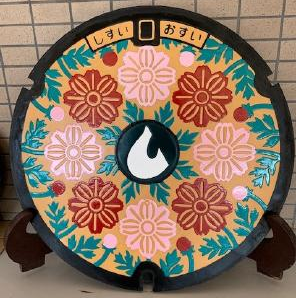
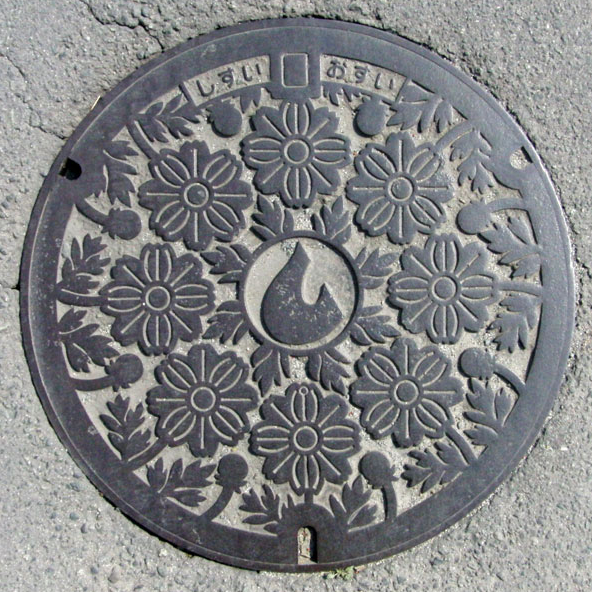
A sewage manhole cover depicting the town's flower, the 'cosmos.' Why is there a Confucius Park here? The birthplace of Confucius is 'Qufu County, Shandong Province.' In other words, it’s connected by 'Qufu.' However, the first village mayor loved Confucius, and it is said that, inheriting his will, it was built as part of creating a 'hometown of the soul.' It seems to be quite authentic, with craftsmen brought from China and stones from China used, but at that time, I didn't have enough time to see it.
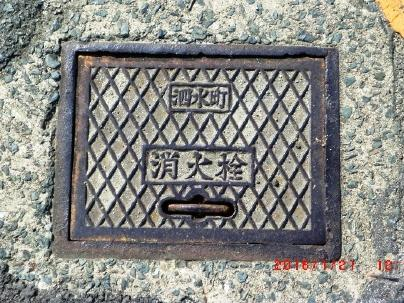
Square lid with the town emblem and the letters '消防栓' (fire hydrant). Diamond-shaped background pattern.
Square fire hydrant lid.
Former Shichijo 旧七城町
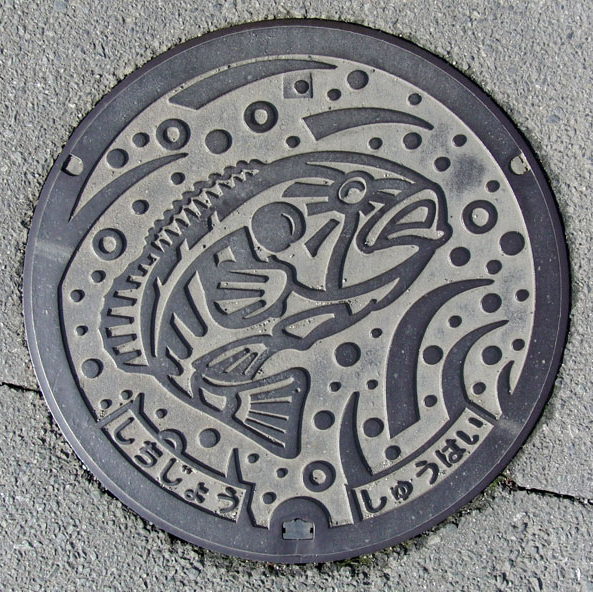
A manhole cover in the Nanbu area of Shichijo. It depicts the freshwater fish of the family Percidae called “Oyanirami,” which inhabits places where groundwater wells up from the bottom, seen only in places like the Kikuchi River, Kurokawa, and Lake Ezu. They are 10–13 cm in length. Locally, they are also called “Seijanbaba,” “Yotsume,” or “Mizukuriseibei.” Among these names, “Yotsume” is easy to understand, as it refers to the eye-like spots located behind the eyes. Oyanirami are said to fiercely chase intruders, so the Oyanirami on this manhole cover, with its smiling eyes, is probably a very good-natured individual.
Former Kyokushi 旧旭志村
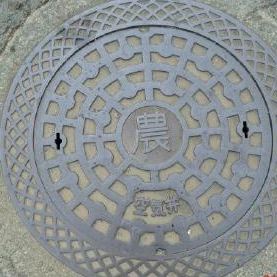
Air valve cover for agricultural water managed by the Kikuchi Plateau Irrigation Land Improvement District.
Koshi 合志市
Former Nishigoshi 旧西合志町
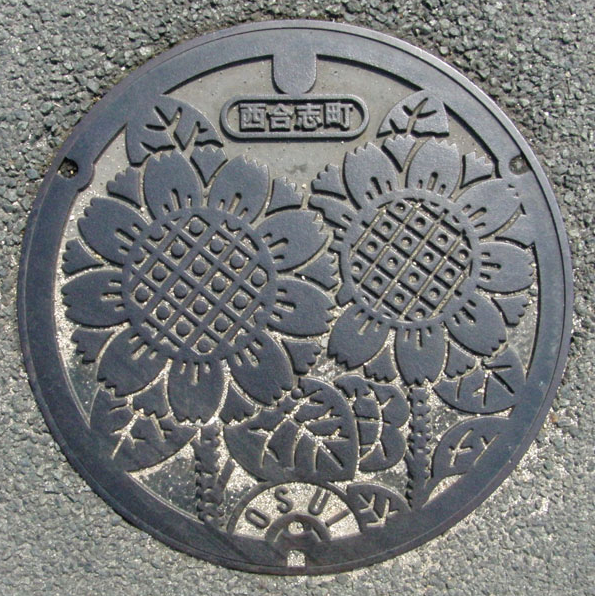
A sewage manhole cover featuring a drawing of the town's flower, the sunflower.
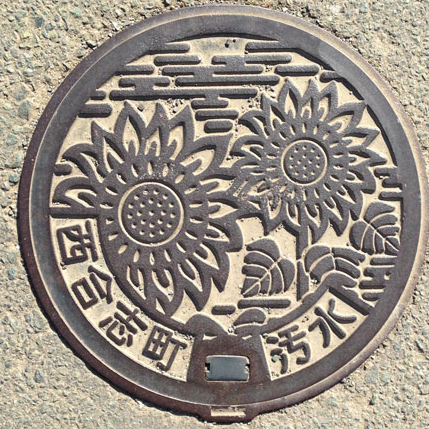
A sewage manhole cover featuring a drawing of the town's flower, the sunflower.
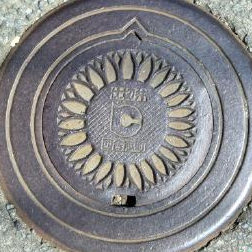
Sunflowers, the town's flower, are depicted largely on the entire surface of the lid, with the town emblem placed in the center of the flowers.

A design featuring the old town emblem and three sunflowers.
Air valve manhole cover.
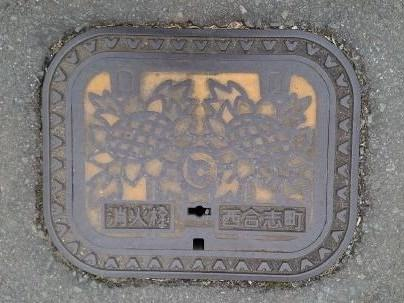
Sunflowers are depicted on the left and right sides of the old town emblem, with the words 'Fire Hydrant' and 'Nishi-Aikoshi Town.' A square fire hydrant manhole cover.
Former Goshi 旧合志町
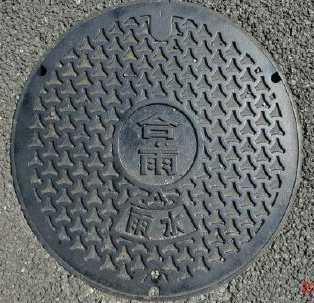
Tetrapod pattern. In the center are the characters '合 汚' and '汚水'.
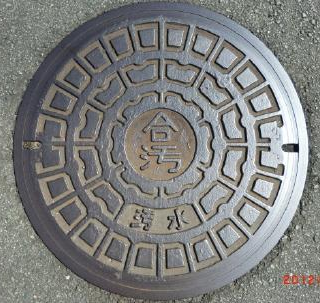
The characters '合 汚' and '汚水' are written in the center.
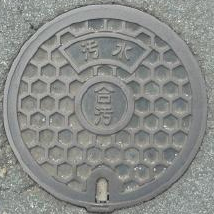
Handhole cover of the above design. The characters for 'sewage' are at the top.
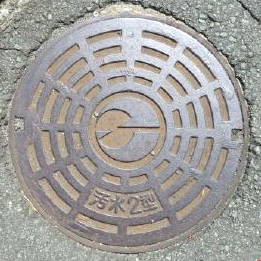
The old town emblem and the characters 'Wastewater Type 2'.
Tamana 玉名市
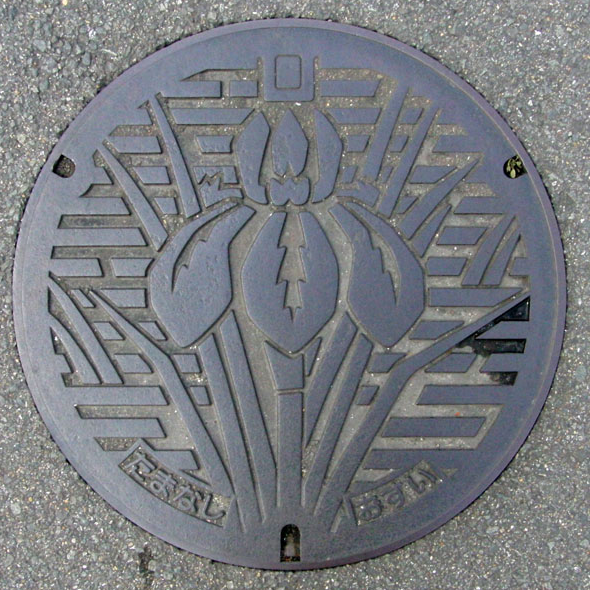
It is an achromatic version with the same design as above, but the relief is different. Nearby the shooting location, there are the Akimaru Mirror Bridge and the Takase Mirror Bridge spanning the back river. It's a pity that there is no water or irises.
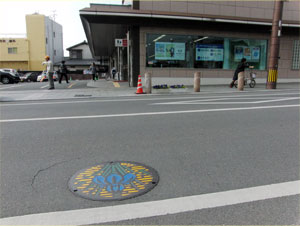

A colored manhole cover for sewage depicting the city's flower, 'Higo Iris'.

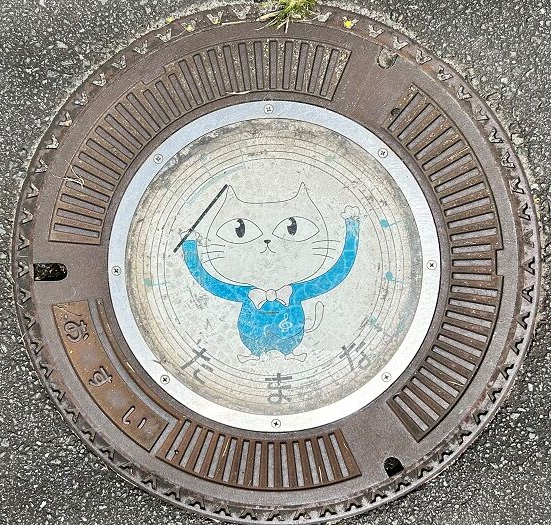
Tamanyan, the mascot of Tamana City born from the poster contest for the 1st Tamana Citizens' Music Festival (October 21, 2007), is wearing a red bow tie and waving a baton. Around him are musical notes ♪ and other symbols, designed to promote 'Tamana, the City of Music.' The words 'Tamana' and 'Osui' are also written. On January 30, 2015, two posters were installed near Tamana City Hall.
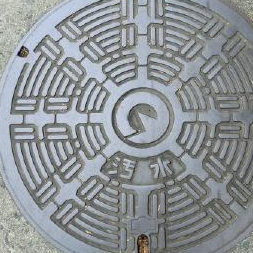
With the old city emblem.
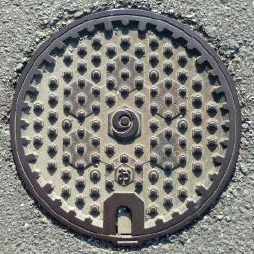
A slip-resistant manhole with the city emblem and a small 'O' on it.
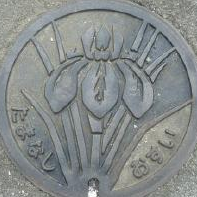
A small cover of the city's flower, Higo iris.
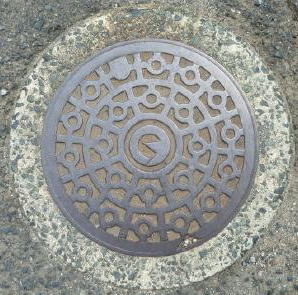
Small JIS-standard lid with old city emblem.
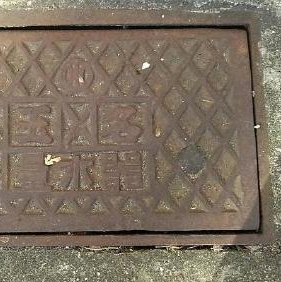
Made of iron cover with the characters 'Tamana' and 'Water Meter'.
Former Yokoshima 旧横島町
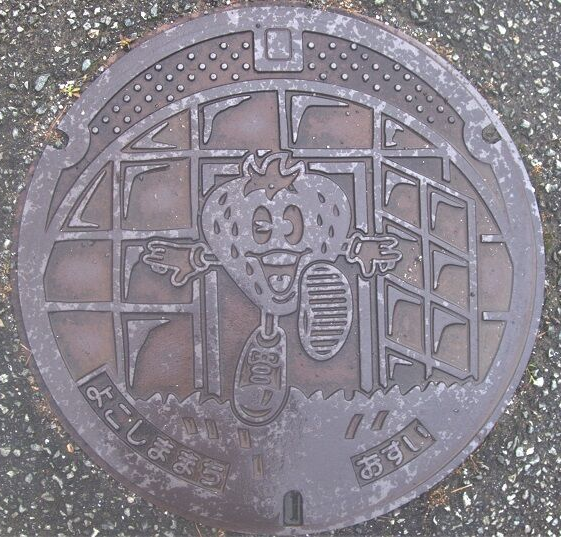
The design depicts the locally produced strawberries energetically running out of the vinyl greenhouse.
Former Taimei 旧岱明町
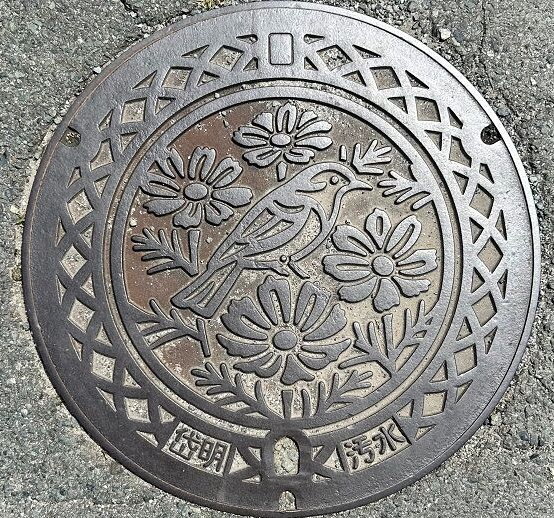
A design featuring the town's flower, the cosmos, and the town's bird, the Japanese white-eye.
Former Tensui 旧天水町
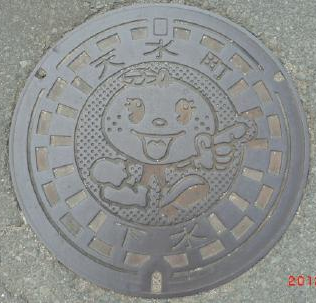
It doesn't seem to be a mascot character, but it is a design that personifies the specialty mandarin oranges.
Hitoyoshi 人吉市
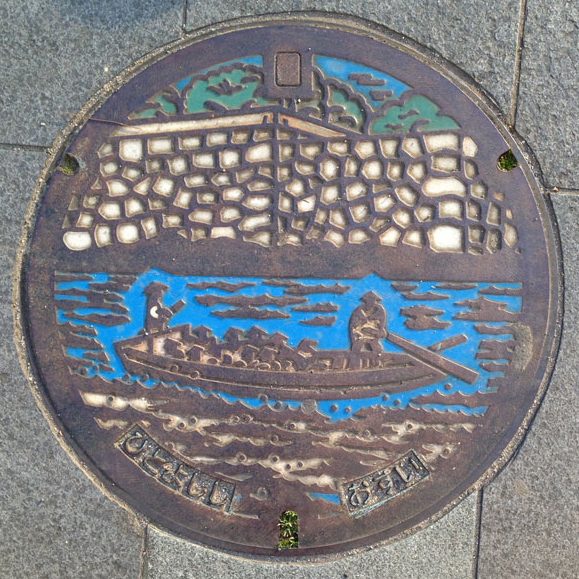
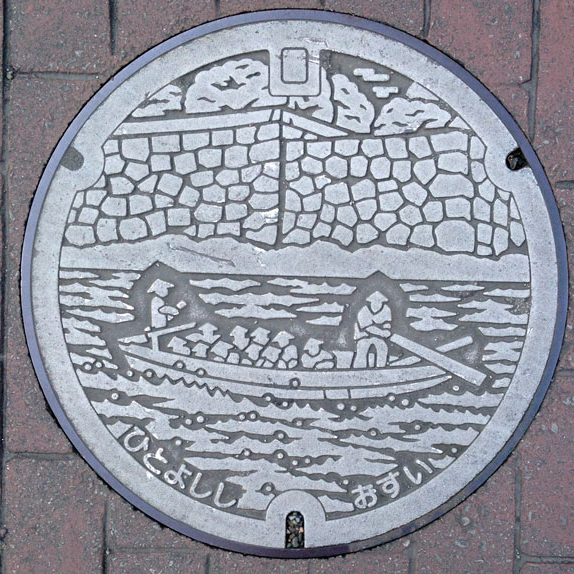
"The 'Warrior-Repelling Stone Walls' of Hitoyoshi Castle and the Kumagawa River boat ride are depicted."
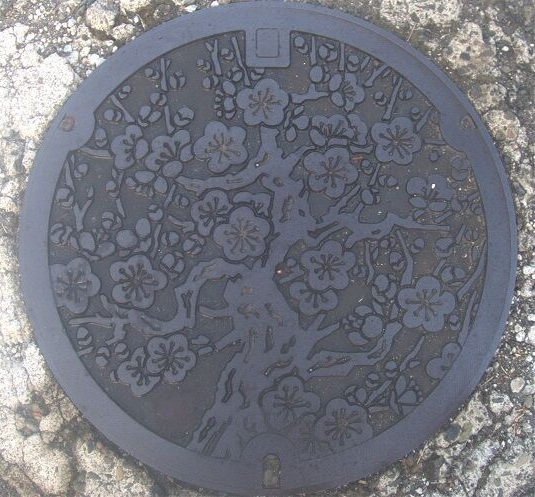
Design of the city's flower, the plum.
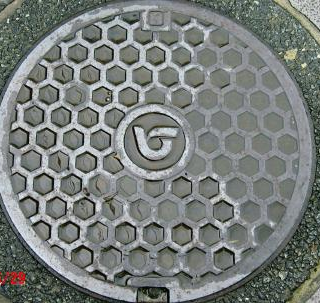
Tortoiseshell pattern. The mark is the emblem of Hitoyoshi City.
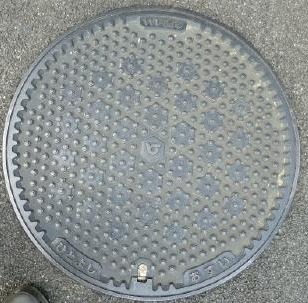
Slip-resistant manhole with city emblem.
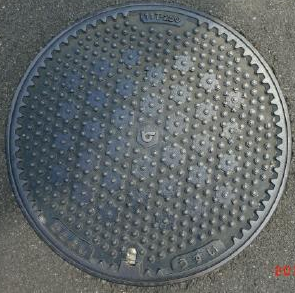
Slip-resistant manhole with city emblem.
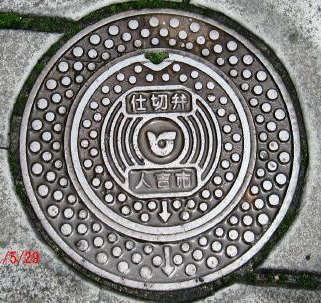
Mark is the emblem of Hitoyoshi City
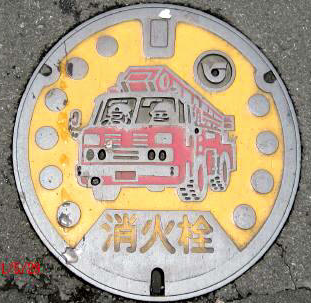
The mark is the emblem of Hitoyoshi City (the 'Hi' of Hitoyoshi stylized).
Minamata 水俣市
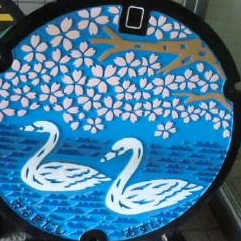
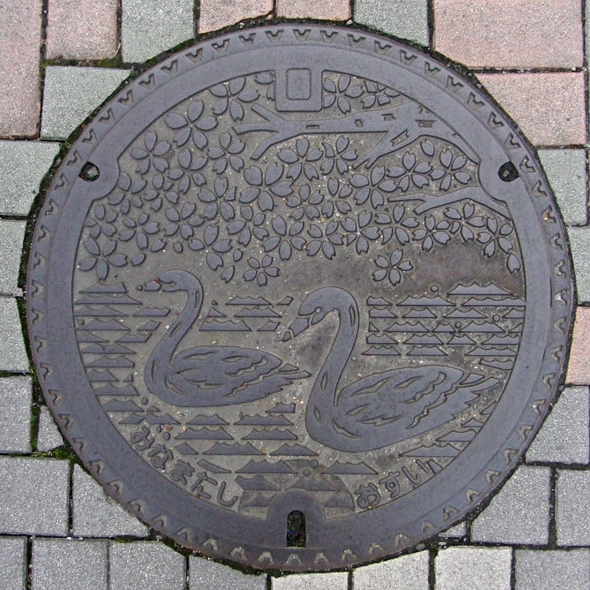
The city's tree is the 'Cherry Blossom', and the bird seems to be a 'Black Swan' based on the atmosphere of its beak. For sewage use.
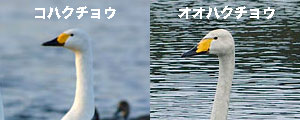
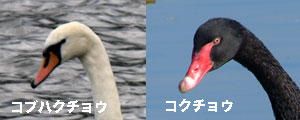
There is a line near the tip of the beak on the lid of this bird. Comparing it with the image below, it corresponds to the 'Black Swan'.
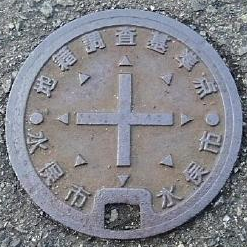
There is a cross in the center, and small triangles are arranged in the eight sections around it, giving a design reminiscent of the Southern Cross. It is about 15 centimeters in diameter. The outer circumference has the words 'Cadastral Survey Benchmark' and 'Minamata City'.
Related: Kumamoto 熊本市, Ashikita 芦北町
Yatsushiro 八代市
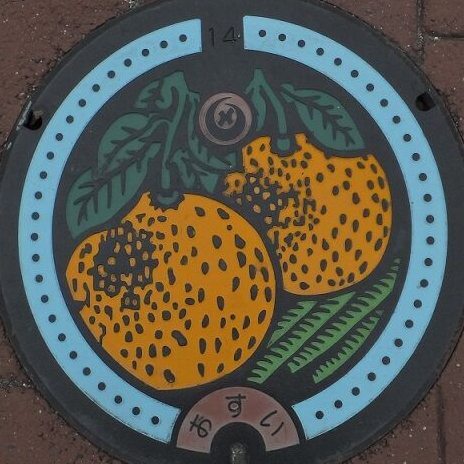
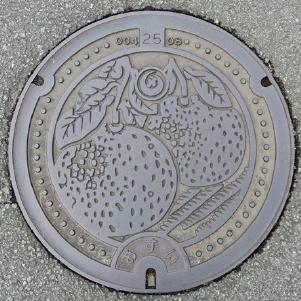
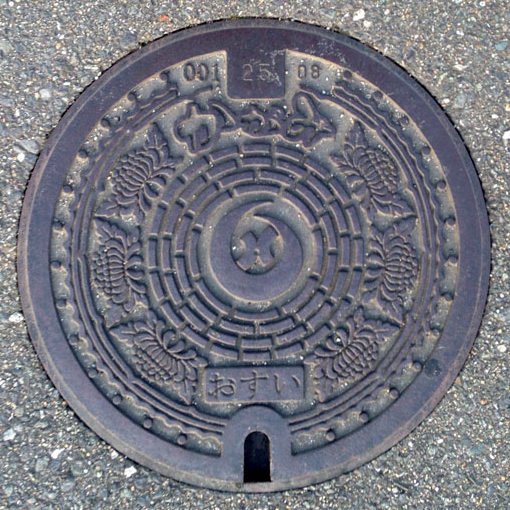
It is the city emblem of Shin-Yatsushiro City. The design features Yatsushiro's specialty, banpeiyu (a type of pomelo), and igusa (rush grass). At the top, '004 14 09'.
Sewage pipe manhole cover.
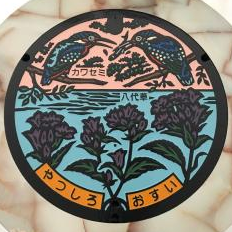
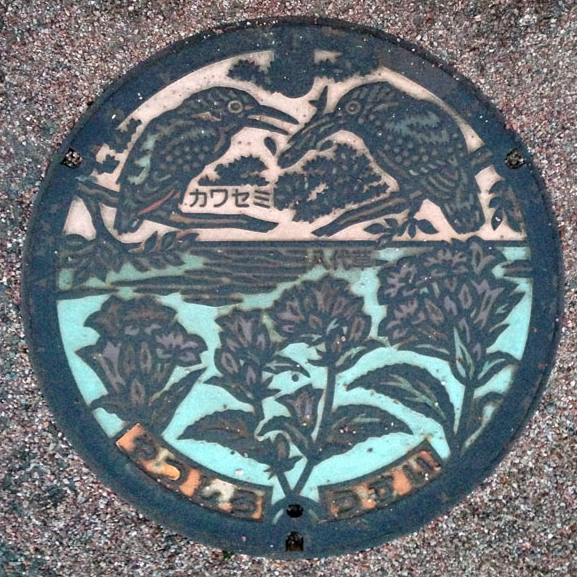
A colored rainwater manhole cover with the city's bird, the 'kingfisher', depicted on the top, and the city's flower, 'Yatsushirosou', depicted on the bottom.
A small plate with the same design as above.
The mark in the upper right is the new 'Yatsushiro City' emblem.
Former Yatsushiro 旧八代市
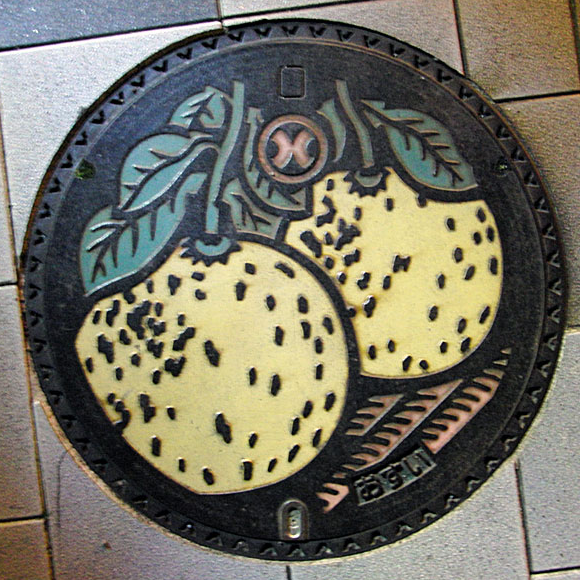
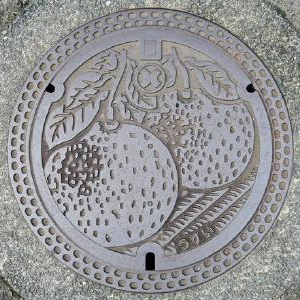
It was immediately clear that the special product of Yatsushiro City, 'Banpeiyu' (a type of citrus), was depicted, but when I wondered what the item in the lower right was and looked it up, I found that igusa products are also a specialty, so it is thought to be a tatami mat surface. The emblem of the former Yatsushiro City is included at the top.
There were many of these lids in front of Yatsushiro Station, but unfortunately, I couldn’t take a clear photo because I arrived at night.
(Kagamimachi, Yatsushiro District)
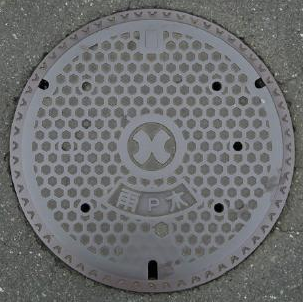
Perforated with a tortoiseshell pattern, with the old city emblem and the inscription 'Ame P Mizu'.
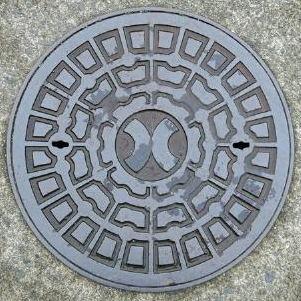
In the center, the old Yatsushiro city emblem, with manhole covers with keyholes on both sides.
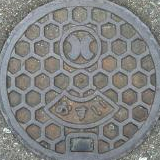
Small lid with a hexagonal pattern featuring the old city emblem. Small sewage pit lid.
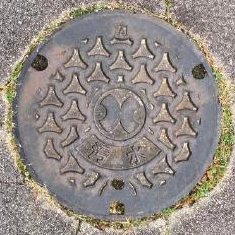
A small cover with a deformed tetrapod ground pattern, the old city emblem, and the characters for 'sewage'.
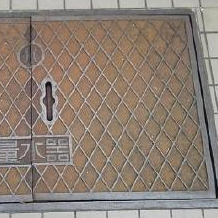
This is a water meter cover with the first city emblem of the former Yatsushiro City, prior to the current city emblem. The vertical two-part seam features the first city emblem and the words 'Water Meter.' All three covers in the lower row appear to be postwar covers.
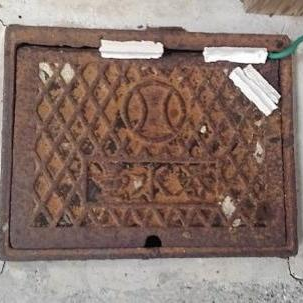
This is the first city emblem before the city emblem of the former Yatsushiro City, and it includes the characters 'Measuring Water Device'.
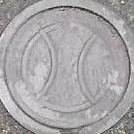
A 10 cm diameter lid featuring only the first city emblem before the emblem of the former Yatsushiro City. It is believed to be a water shutoff valve cover.
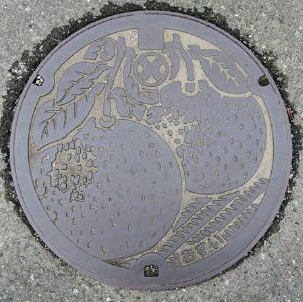
Inside the upper circle is the former Yatsushiro city emblem, a design stylizing the '八' of Yatsushiro.
In a non-colored version of the above design, there is the local specialty Banpeiyu (a type of pomelo with a diameter of 12–25 cm).
Towards the bottom, there is also tatami made from the locally produced igusa (rush grass).
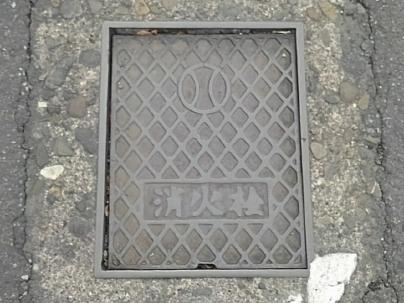
A vertical long cover with the first city emblem of the former Yatsushiro City before the current city emblem, featuring a diamond-shaped background pattern and the characters 'Fire Hydrant'.
Former Kagami 旧鏡町

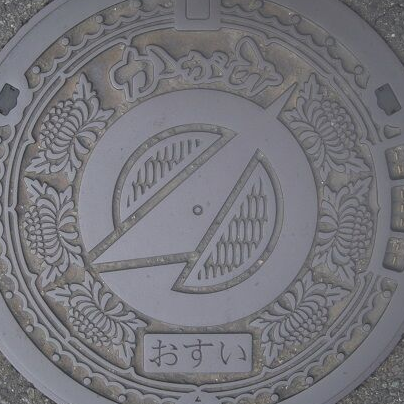
Color display lid of the Yatsushiro Northern Purification Center. Inside the large town emblem, special igusa tatami is depicted, and chrysanthemums are drawn around it. The characters 'kagami' and 'osui'.
Former Sencho 旧千丁町

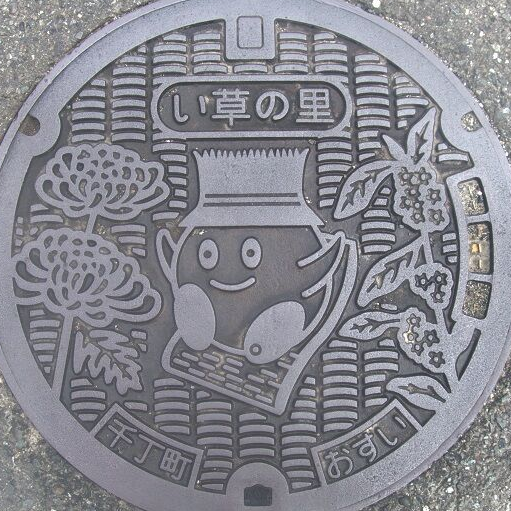
Color display cover of the Yatsushiro Northern Purification Center.
The mascot of 'Igusa no Sato,' 'Igusa-kun,' the specialty igusa tatami mats, the town's flower chrysanthemum, and the town's tree osmanthus. The words 'Senchomachi' and 'Osui'.
Former Izumi 旧泉村
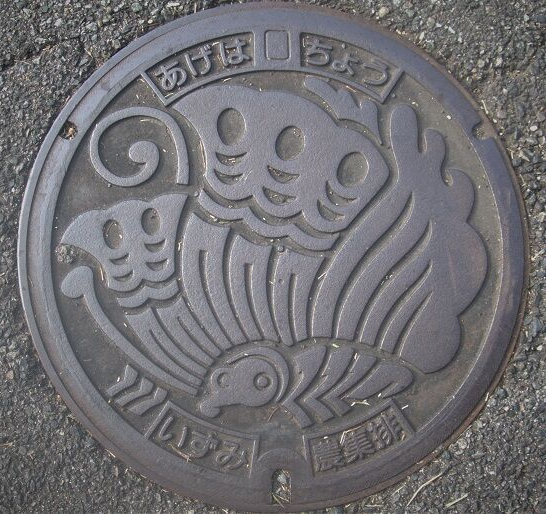
A design of a large swallowtail butterfly. Izumi Village is known for the legend of the Heike fugitives, and this swallowtail butterfly is the crest of the Heike family.
Former Toyo 旧東陽村
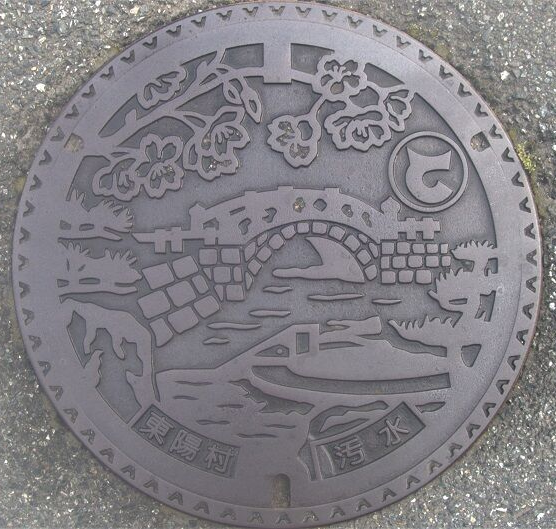
Depicted are Ishibashi and the flowers of the old village Han'ei-anji, pine trees, and the emblem of the old village.
The stonemasons of the former Toyo Village, known as a village of stonemasons, built many stone bridges that are famous nationwide.
* It is said to be the first encounter with a manhole cover for the tall man with thin hair and a beard. By chance, on a rainy day, he visited the stone bridge museum called 'Toyo Sekisho-kan' in Yatsushiro City, Kumamoto Prefecture. While holding an umbrella and looking down as he walked, he noticed that the manhole cover had 'Ishibashi' depicted on it.
Village of Stonemasons Historical Museum, Sekisho-kan
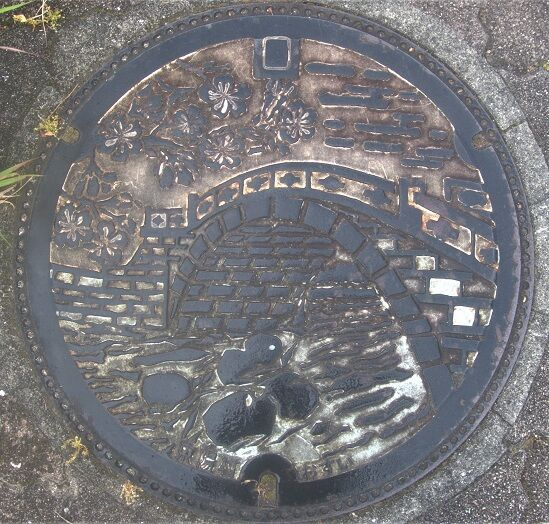
Here, the stone bridge and the village's Hanagae Anji cherry blossoms are depicted, and there is no village emblem. The characters for 'osui' are written in hiragana.
Related: Hikawa 氷川町, Yatsushiro Northern Basin Sewerage 八代北部流域下水道
Yamaga 山鹿市
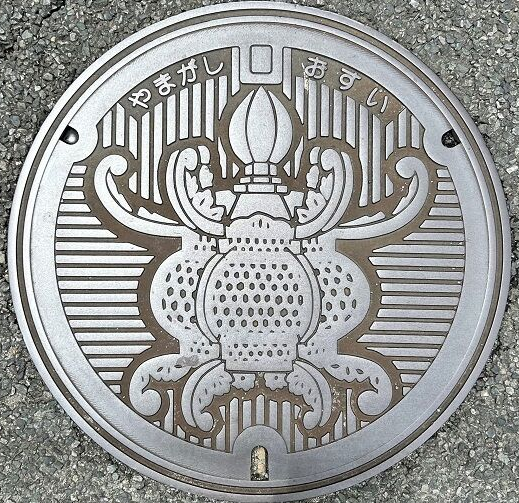
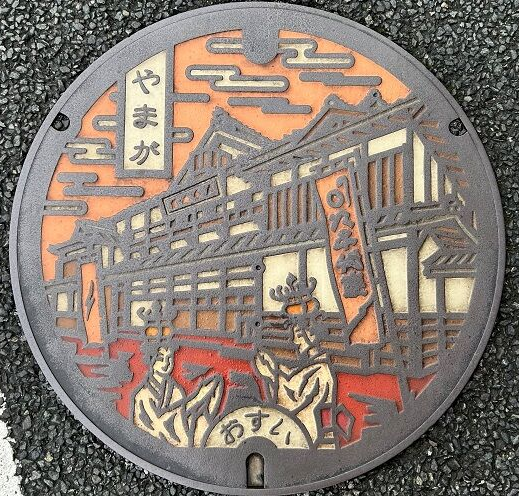
Design of the kanatōrō (gold lantern). At the Yamaga Lantern Festival, women in yukata dance with kanatōrō (gold lanterns) held on their heads.
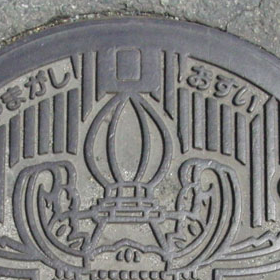
A manhole cover for sewage with the same design as above, but the convex and concave parts of the golden lantern are reversed.
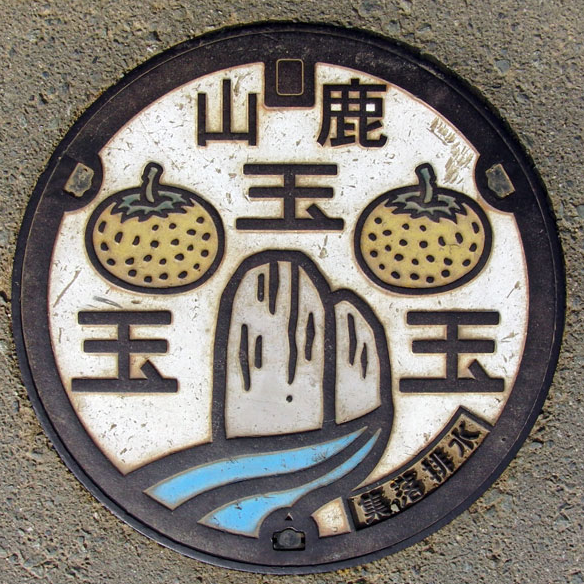
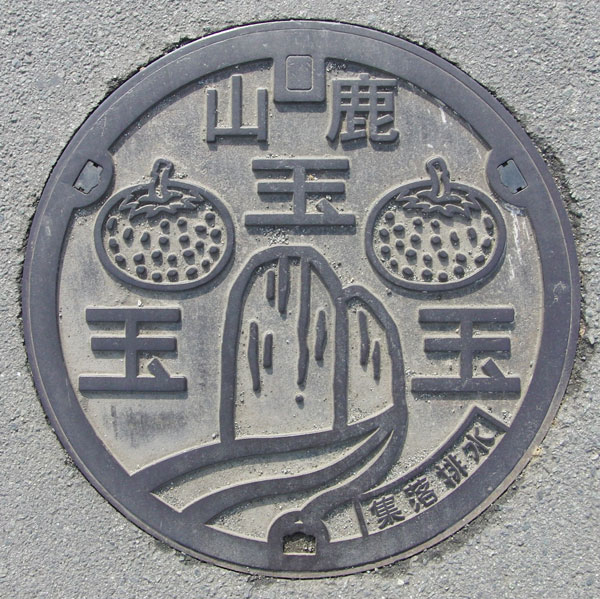
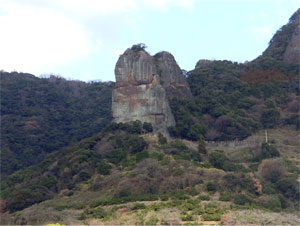
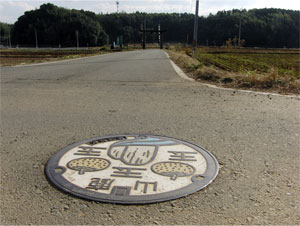
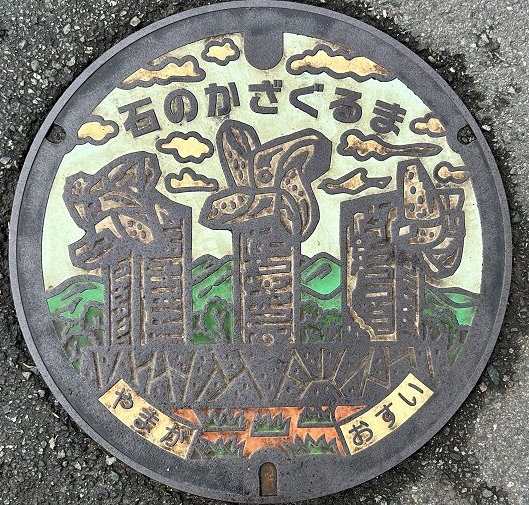
The design features "Fudoiwa," "mikan," and three balls (Mitama). This lid is a cover for the village drainage in the Mitama area, and it seems to be found only around here. While driving along Prefectural Route 197 aiming for Fudoiwa, I noticed the black torii gate of Konpira Shrine (in the back of the left photo). The road that goes under the torii appeared to lead to Fudoiwa, so when I drove down it, I found this lid on the street.
The name of the strange rock, "Fudoiwa," is said to derive from the mountain ascetics in the Heian period who secluded themselves in the mountains and enshrined Acala (Fudo Myoo) as their principal deity. Incidentally, there was a sumo wrestler in the Showa era named "Fudoiwa," a giant wrestler from Kumamoto Prefecture with a height of 214 cm. Although he was born in Kumamoto City, not in Yamaga, perhaps his ring name was inspired by this rock.

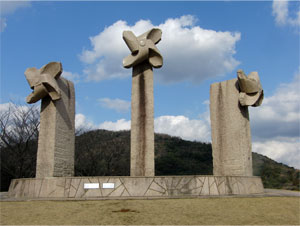
The 'stone pinwheel' at Ipponmatsu Park. It actually spun in the wind.
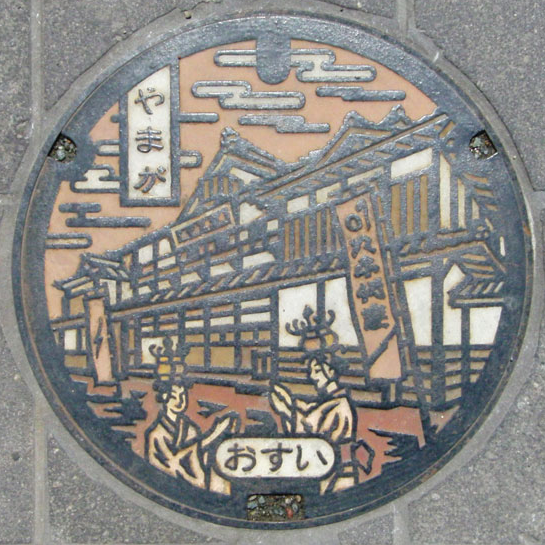
A small plate that was also near 'Yachiyoza'.
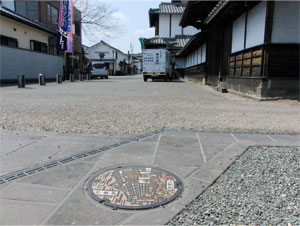
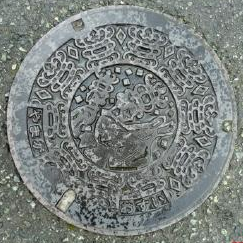
In the center, two women are dancing while holding golden lanterns on their heads, and many golden lanterns are drawn around them.

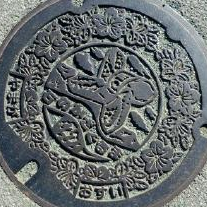
There is a stone pinwheel and the flowers of Tsutsuji, the flower of Yamaga City, are depicted around it.
Former Yamaga 旧山鹿市
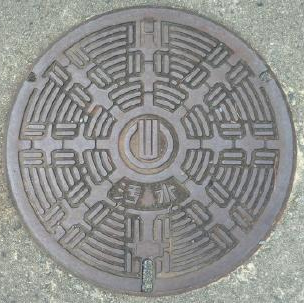
Lid with the old city emblem. Background pattern like a complicated spider web.
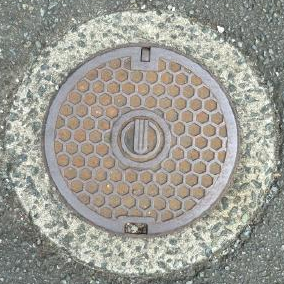
A small lid with an old city emblem in a tortoiseshell pattern.
Former Kikuka 旧菊鹿町
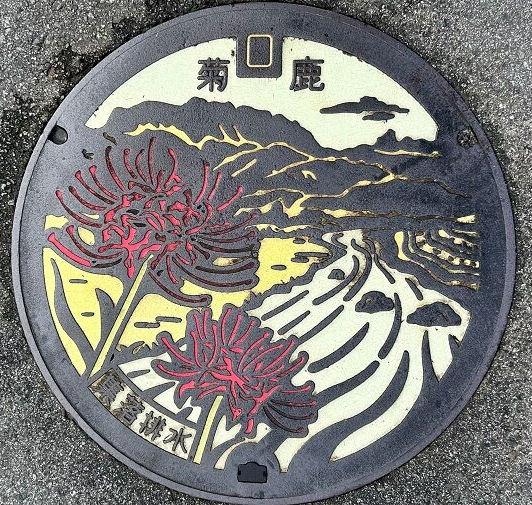
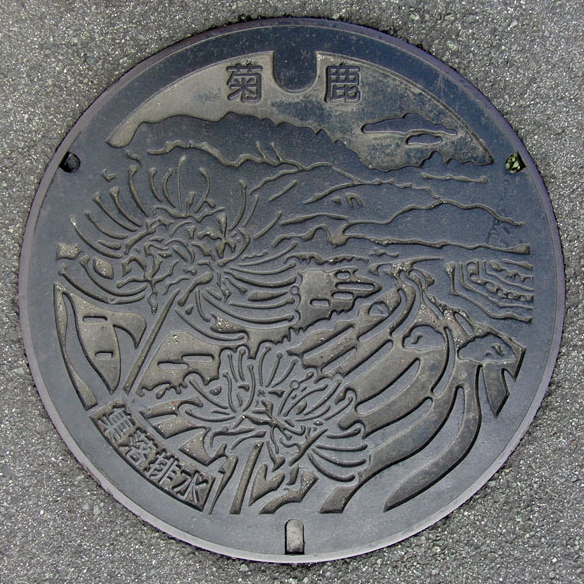
A manhole cover depicting the scenery of the 'Bansho' area, known as Kumamoto Prefecture's top spot for red spider lilies and also famous for its terraced rice fields, along with the town's flower, the red spider lily. The mountain in the background is Mount Happogadake.
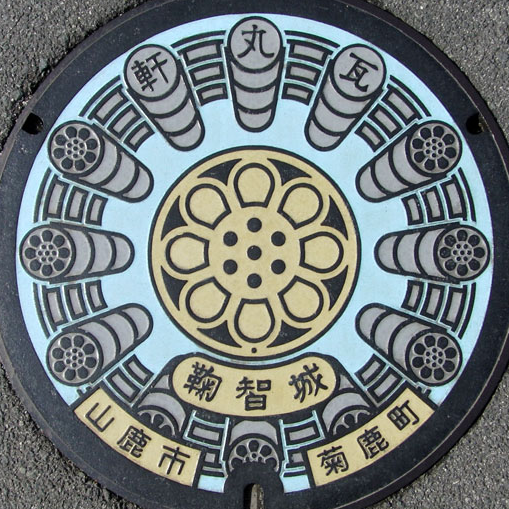
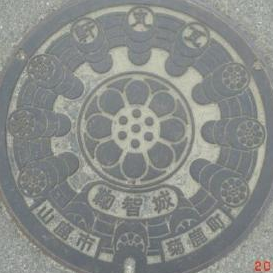
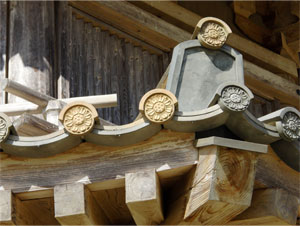
A lid depicting the eaves-end tiles of Kikuchi Castle.
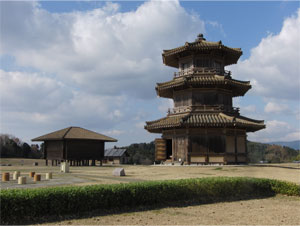
Kikuchi Castle (Kikuchi-jō / Kukuji-jō) is an ancient mountain castle (Korean-style mountain fortress) built in the latter half of the 7th century as a military base to defend against invasions. It was one of six castles under the jurisdiction of Dazaifu.
Since 1994, the site has been developed as a historic park, Kikuchi Castle and the Onko Soseikan, with reconstructions of a storehouse in the azekura-zukuri style, barracks, and an octagonal drum tower.
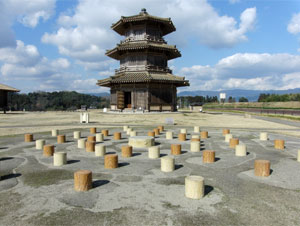
The octagonal drum tower has been reconstructed slightly north of the location where the ruins were excavated. What appears to be a scarf in the foreground of the photo is the remains of pillars. With so many pillars, there is almost no living space even if you look inside the tower. That is why it was designated as a drum tower...
There are also many ancient tombs in this area, making the theory that Yamatai-koku was located in Kyushu feel quite plausible.
Former Kao 旧鹿央町

It is displayed inside the Yamaga Water Purification Center. In the center is a kofun, and around it are drawn magatama and haniwa. At the bottom are the characters 'Yamaga' and 'Kaou.' It is a new lid from Yamaga City, but only the display lid exists, and there is no monochrome version.
Former Kahoku 旧鹿北町
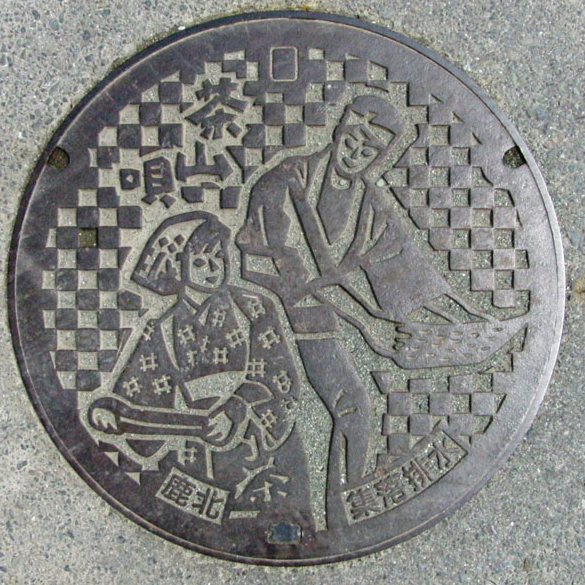
It depicts the scene of 'Kahoku Chayama Song,' where a national tournament is said to be held every October.
Former Kamoto 旧鹿本町
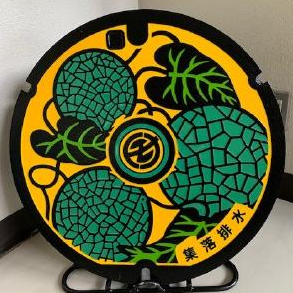
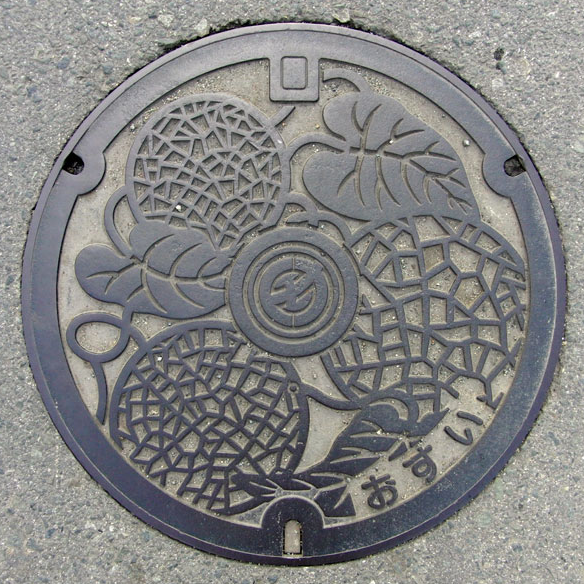
The specialties of the former Kamoto Town are 'chrysanthemums,' 'melons,' 'strawberries,' and 'Kutama Shibuchiwa' (Kutama-style persimmon leaf fans). Among these, there is a manhole cover for sewage depicting 'melons.'
The 'stone pinwheel' at the top was created during the Kamoto Town era, inspired by the idea of turning a fan into wind and then into a pinwheel. I think it would have been nice to have a fan version of the cover as well. The 'stone pinwheel' cover has the word 'Yamaga' on it, but it is installed in the Kokutami shopping street of former Kamoto Town.
Related: Kumamoto 熊本市
Asagiri あさぎり町
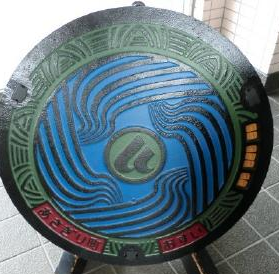
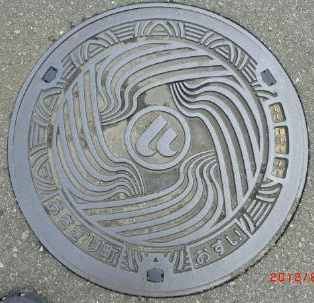
Kumagawa River Basin Purification Center display color lid. A design around the town emblem inspired by the Kumagawa River.
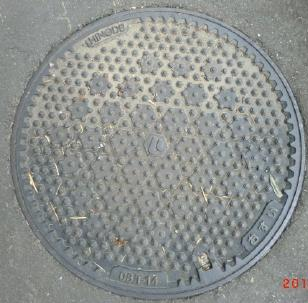
Town emblem slip-resistant manhole.
Former Ue 旧上村
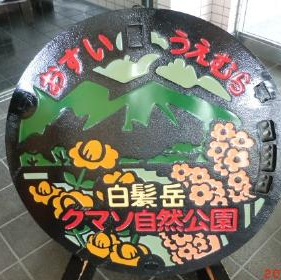
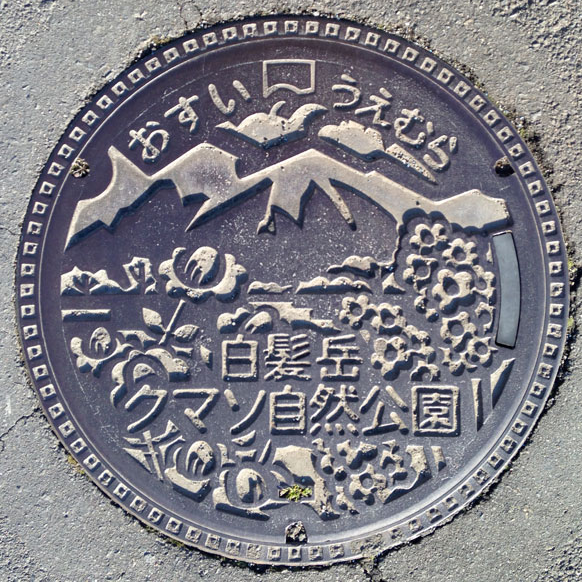
A scenery of 'Shiragake Kuma-so Nature Park' is depicted. In the background is Shiragake, and flowers are drawn on the left and right, but the details are unknown. In the color sample plate published by the Japan Manhole Cover Society, the flower on the right is painted pink, and the flower on the left is painted yellow. The pink flower might be a type of primrose? The yellow flower, with small and narrow leaves near the top of the stem, might be a lesser buttercup? However, this is only speculation.
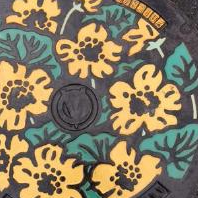
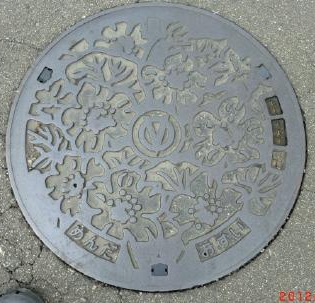
Design of the town emblem and the town flower, marsh marigold.
Former Okaharu 旧岡原村
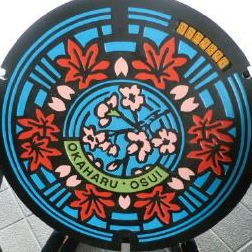
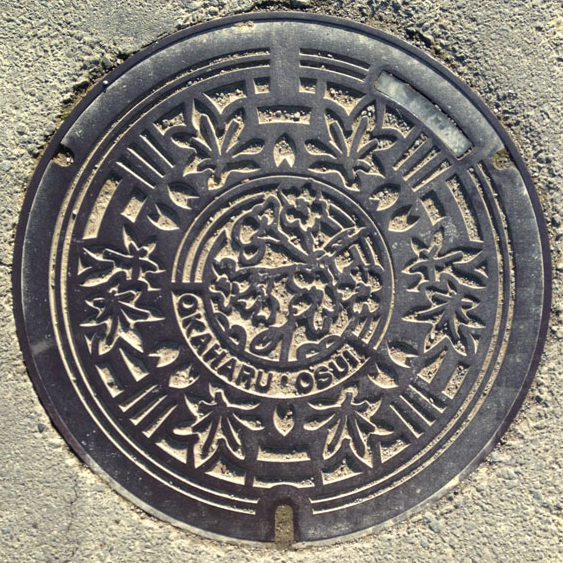
In the center are the village's flower 'Sakura' and the words 'OKAHARU・OSUI,' and around them you can see the village tree 'Momiji' leaves and Sakura petals.
Former Sue 旧須恵村
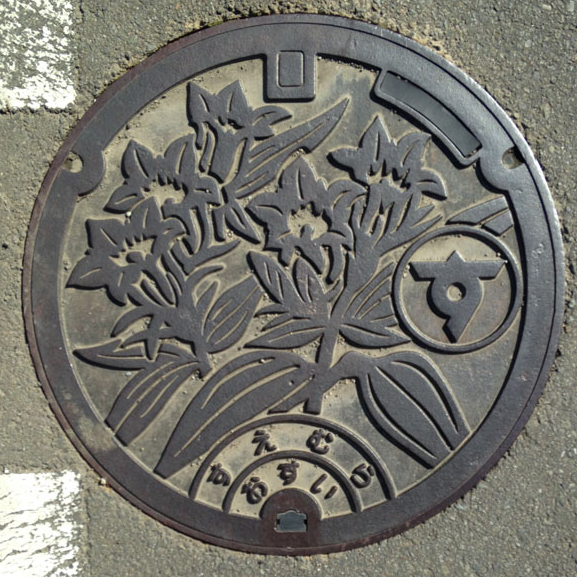
The village flower 'Gentian' is depicted. The village emblem is on the right.
Former Fukada 旧深田村
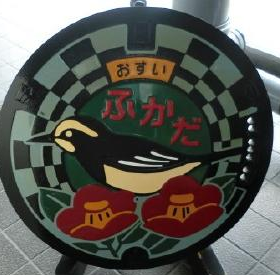
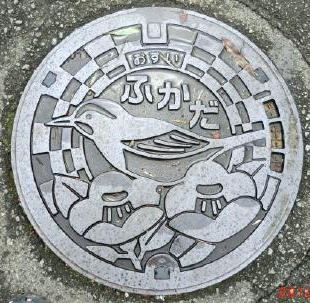
Kumagawa River Basin Purification Center display lid. A color design of the village flower, camellia, and the village bird, wagtail.
Related: Itsuki 五木村, Kumagawa River Basin Sewerage 球磨川流域下水道, Kumagawa River Upper Basin Sewerage 球磨川上流流域下水道
Ashikita 芦北町
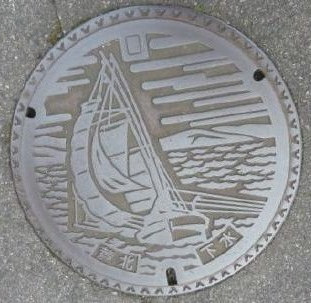
Design of the 'Utase boat' used in the traditional Utase net fishing method. The words 'Ashikita Town' and 'community sewage'.
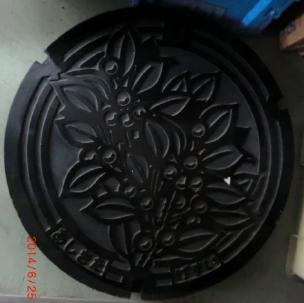
This one was also displayed at the town hall until last year, but due to circumstances, it was moved and stored inside the purification center. It has the same design as the one mentioned above. I asked the staff to let me take a photo of it.
Former Ashikita 旧芦北町
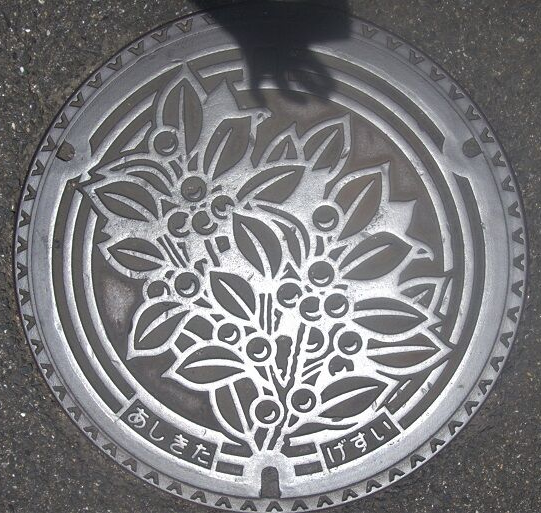
The town tree of the former Ashikita Town, the holly, is the design. (I heard this from the person in charge at the Ashikita Town Hall)
Former Taura 旧田浦町
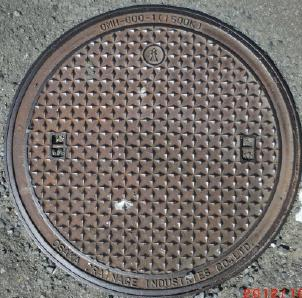
There are no ribs or any other distinguishing features, so I can't tell what kind of cover it is, but it might be a septic tank cover.
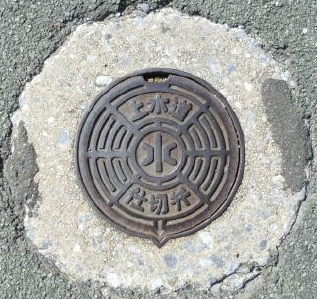
Potable water shut-off valve handhole. There are covers with the same design but different inscriptions, such as 'shut-off valve' and 'air valve'.
Related: Minamata 水俣市
Ozu 大津町
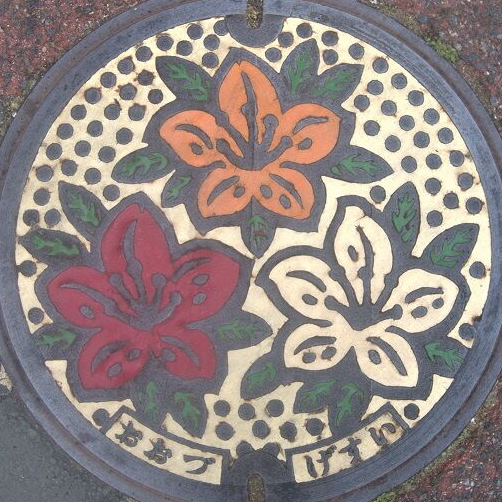
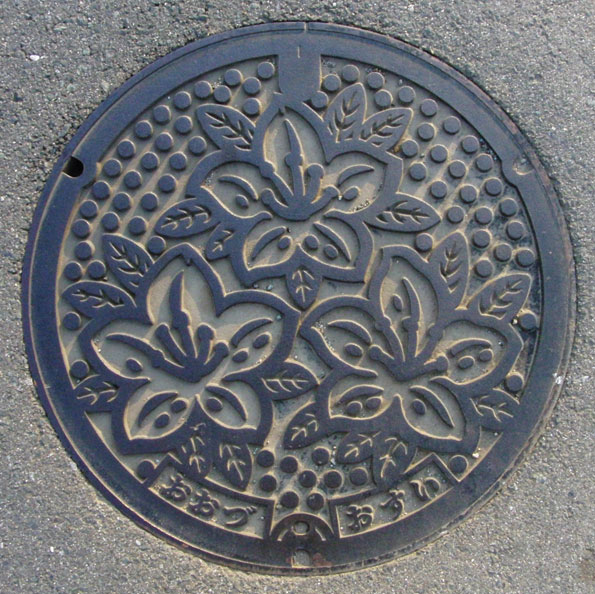
A colored manhole cover for sewage depicting the town's flower, the azalea.
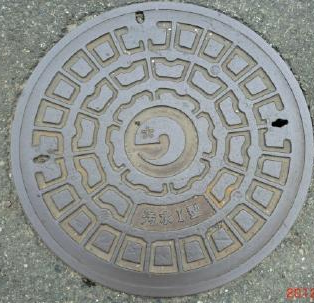
It has the text for sewage with the Otsu Town emblem.
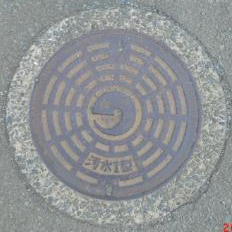
Small lid with a spider web-like pattern featuring the Otsu town emblem. It has the characters 'Sewage Type I'.
Related: Otsukikuyo Waterworks Authority 大津菊陽水道企業団
Oguni 小国町
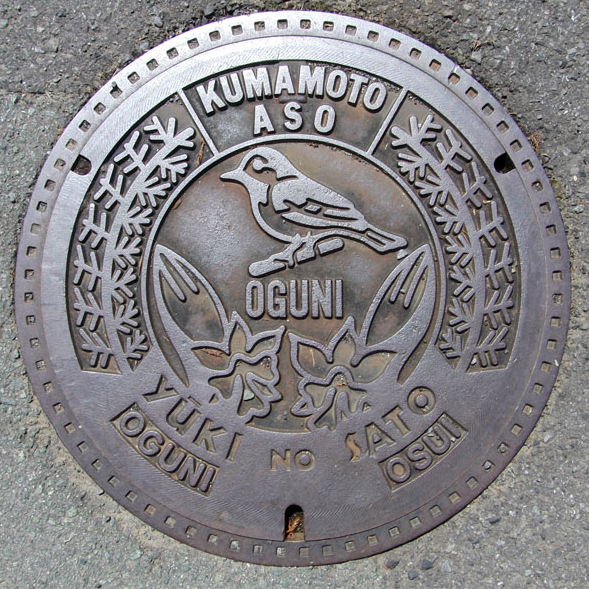
A lid with an unusually large number of inscriptions. From the top, it says 'KUMAMOTO', 'ASO', 'OGUNI', 'YUKI NO SATO', 'OGUNI', 'OSUI'.
The town tree is 'Cedar', the town flower is 'Ebine', and the bird is the town bird 'Varied Tit'. For sewage use.
A small lid with designs of the town's tree, cedar, the town's flower, epidendrums, and the town's bird, the varied tit.
Related: Minamioguni 南小国町
Kashima 嘉島町
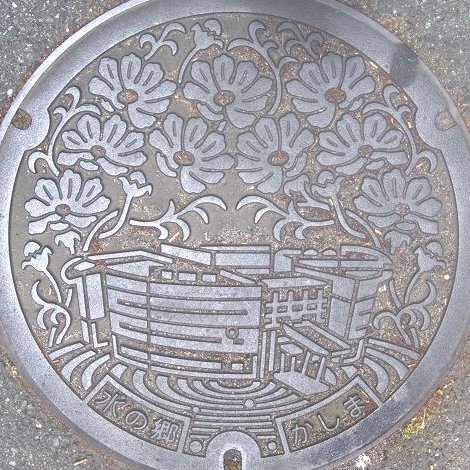
The town hall building designed by the late Kisho Kurokawa, inspired by the town flower, cosmos, and the Ide Ancient Tomb, is depicted, along with the words 'Mizu no Sato Kashima' and spring water, reflecting the fact that the town has been selected as one of the 100 best water towns and practices town development utilizing spring water.
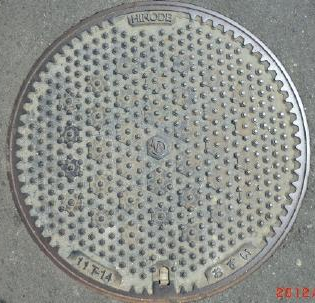
Manhole cover with town emblem, slip-resistant.
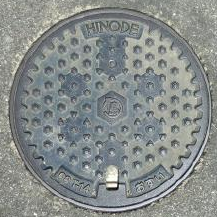
Handhole cover with town emblem, slip-resistant.
Kikuyo 菊陽町
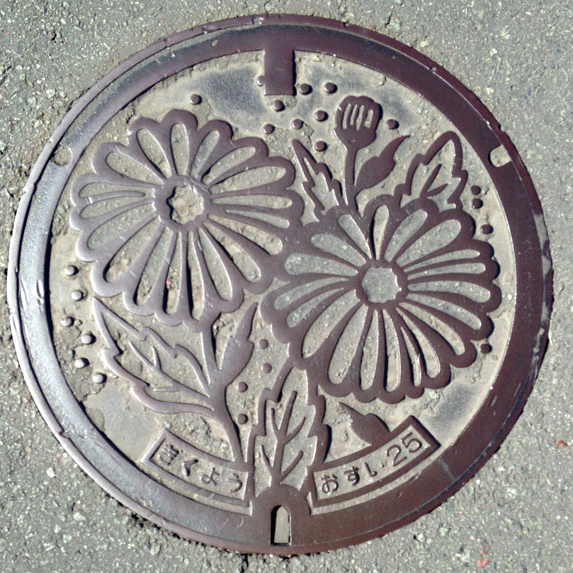
The town's flower, the 'chrysanthemum,' is depicted. Many of the chrysanthemums depicted on manhole covers are impressive ornamental ones, but in the case of this cover, it looks like a simple wild chrysanthemum.
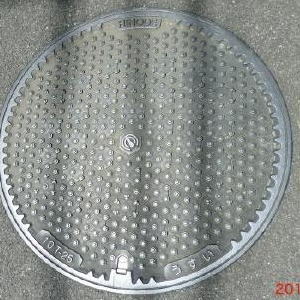
A manhole with the town emblem and slip-resistant structure.
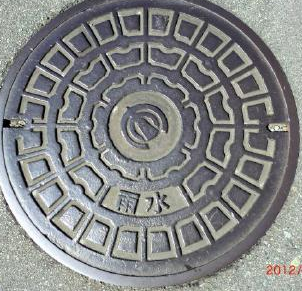
With the town emblem.
Related: Otsukikuyo Waterworks Authority 大津菊陽水道企業団
Gyokuto 玉東町
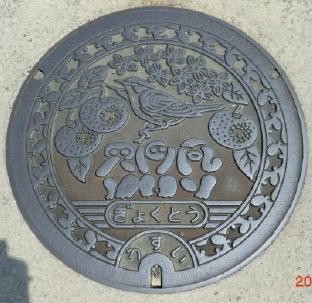
The town's flower, the mikan, and the town's bird, the bush warbler, along with a Konoha monkey, and the town's trees, ginkgo, are depicted. The Konoha monkey is a toy monkey in unglazed form representing 'see no evil, hear no evil, speak no evil,' and it has been designated as a traditional craft of Kumamoto Prefecture.
Kosa 甲佐町
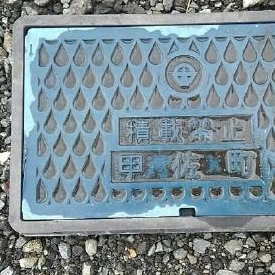
From the top, the town emblem, 'No Loading,' and the characters 'Kosa Town' are on a light blue plastic background with a droplet pattern.
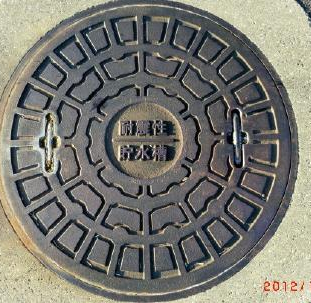
Seismic-resistant water storage tank manhole cover (there is no town mark, though...).
Takamori 高森町
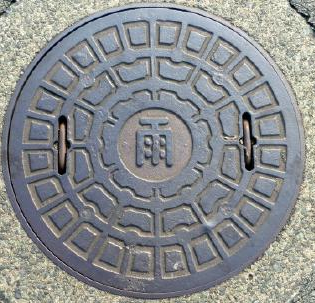
Finally found a 'Rain' manhole cover without the town emblem on the third search.
Related: Sagara 相良村
Taragi 多良木町

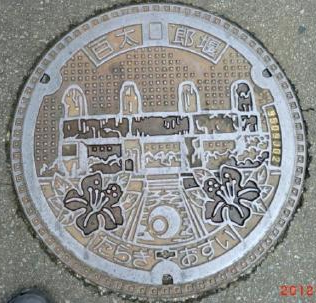
Hyakutarō Weir (Hyakutarō Ditch) is an irrigation waterway that takes water from the Kuma River in Taragi. The waterway was dug over more than a century starting around the end of the 16th century, and the old Hyakutarō Weir sluice gate, which was used until a major renovation in the 1960s, is depicted on this lid.
Related: Kumagawa River Basin Sewerage 球磨川流域下水道, Kumagawa River Upper Basin Sewerage 球磨川上流流域下水道
Tsunagi 津奈木町
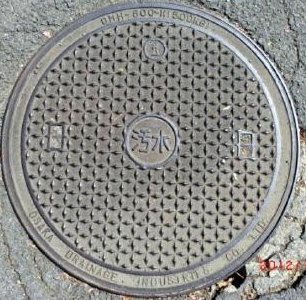
There are no chapters or other features at all. It says 'sewage,' but Tsunagi Town does not have a public sewer system.
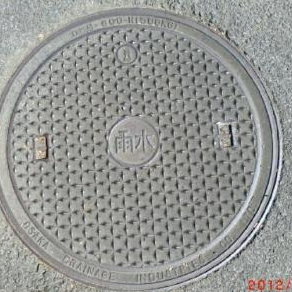
This also says 'rainwater,' but public sewage systems have not been developed in Tsunagi Town.
Nagasu 長洲町
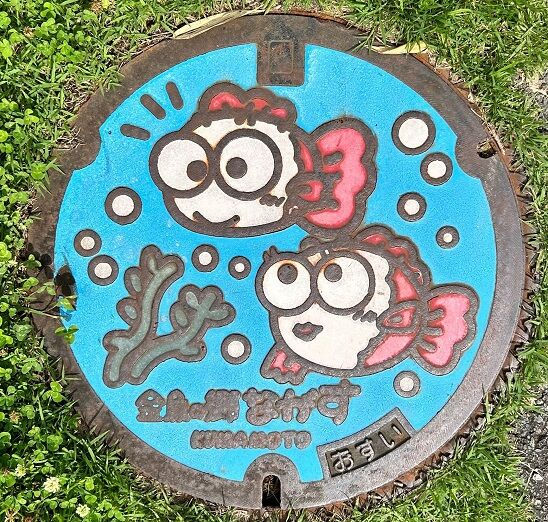
A color design featuring two cute goldfish with big eyes, aquatic plants, and the text 'Kingyo no Sato Nagasu' and 'KUMAMOTO'.
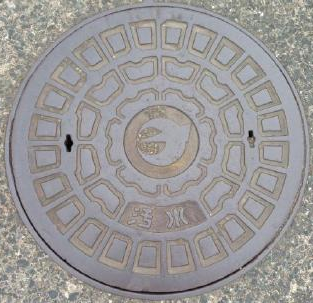
The town emblem and the characters for 'sewage' in concentric circle patterns, with keyholes on both sides.
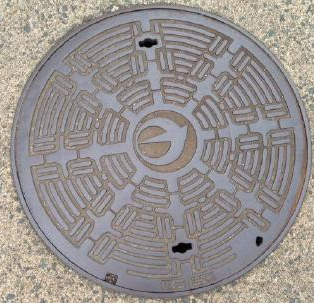
You could call it a complex spiderweb pattern… (^_^.) In the center is the town emblem, with a keyhole on either side.
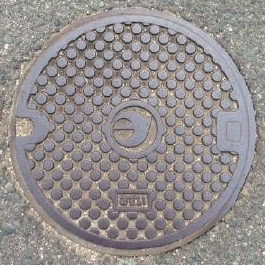
A small lid with a polka dot pattern, featuring the town emblem and the hiragana characters for 'osui'.
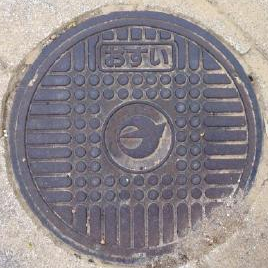
The central part has a polka dot pattern, surrounded by fingertip-like patterns, enclosed in a square, with a small lid featuring 'Osui' and the town emblem.
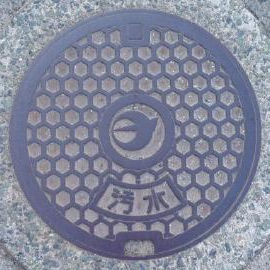
A small cover with a tortoiseshell pattern, the town emblem, and the word 'sewage' below.
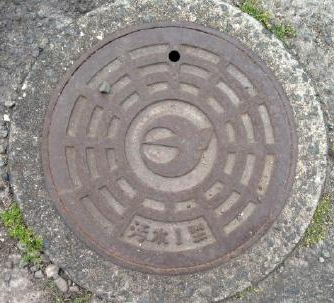
Concentric circle pattern with the town emblem and the characters 'Sewage Type 1'. One hole at the top.
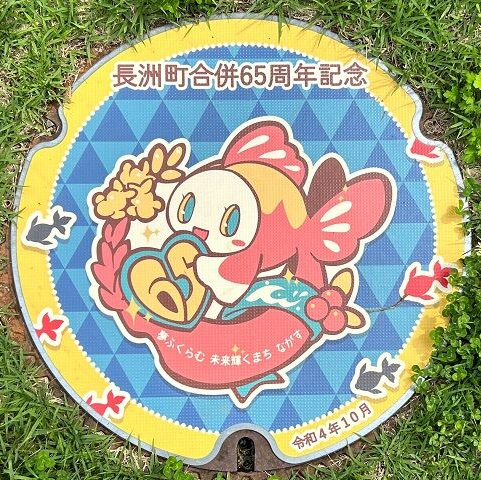
This manhole cover was installed as a symbol to commemorate the 65th anniversary of the merger of Nagasu Town. It is a printed seal cover (made by Nagashima Casting) with a logo design inspired by goldfish, the town tree 'Kurogane-mochi,' the town flower 'Snapdragon,' and the Ariake Sea. It is installed in the 'Goldfish and Carp Village Square,' where goldfish manholes can be found.
Nagomi 和水町
Former Kikusui 旧菊水町
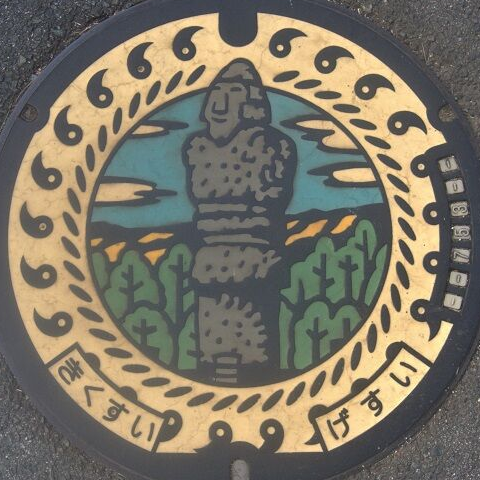
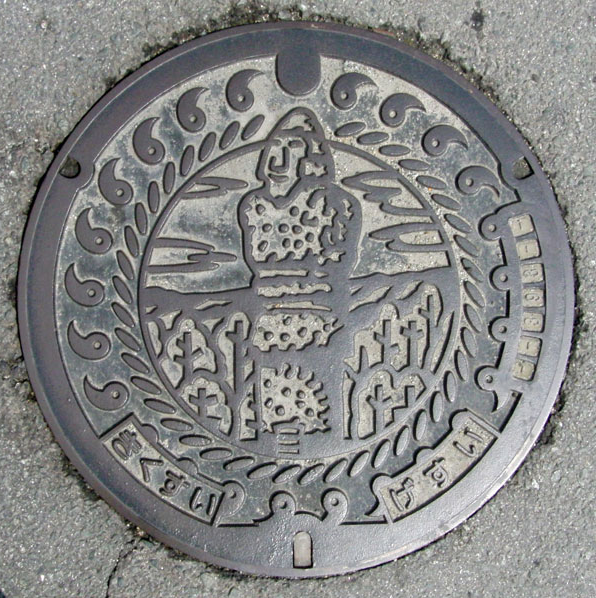
The 'Eda Funayama Kofun' is located in the town and has been developed as the ancient Higo forest. At its center is a 'stone figure,' which has become a symbol and can be seen clearly from the road, and magatama (curved beads) are depicted around it. Below are the giant stone figure and the Eda Funayama Kofun (keyhole-shaped burial mound).
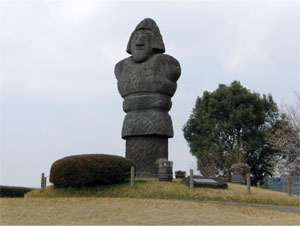
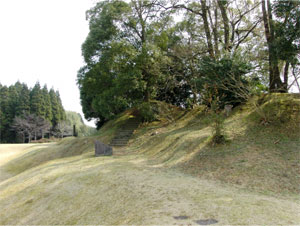
The design of the magatama and kiku-sui stone figures in the ancient village. Around the late 5th century to the early 6th century, people carved figures, horses, weapons, and ritual objects from Aso pseudo-limestone and erected them on burial mounds; these are called stone figures and stone horses.
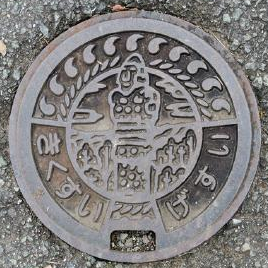
The characters 'kikusui gesui' are small, and there are worn holes in the 2 o'clock and 10 o'clock directions.
Former Mikawa 旧三加和町
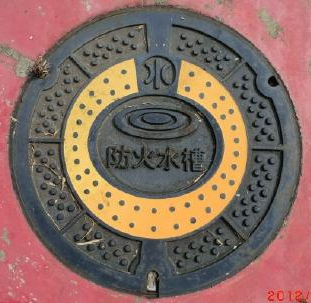
Today was the third exploration, but I still couldn't find any manhole covers that could identify the town emblem or other marks of Sankawa Town.
Firefighting water tank manhole cover.
Nankan 南関町
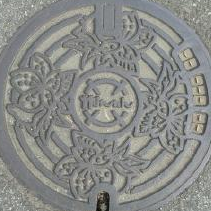
The color design of the town's flowers, azaleas. 'Nankan' is written inside the central mark.
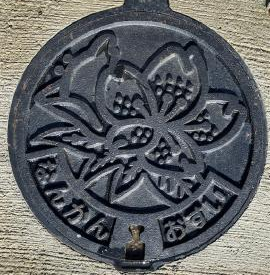
It is a smaller size than the one above, with a single azalea drawn. The bottom has the characters 'Nankan' and 'Osui'.
Nishiki 錦町
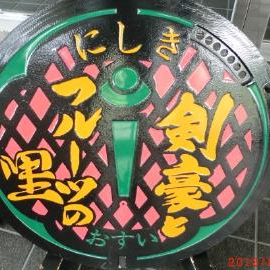
Kumagawa River Basin Purification Center display color lid. The words 'Village of Swordsmen and Fruits' are drawn on the sword guard.
Related: Kumagawa River Basin Sewerage 球磨川流域下水道, Kumagawa River Upper Basin Sewerage 球磨川上流流域下水道
Hikawa 氷川町
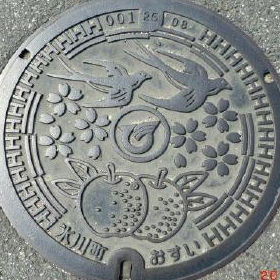
The design features the town emblem, the town tree (pear), the town flower (cherry blossom), and the town bird (swallow), with the surrounding area encircled by the letter 'H' for Hikawa Town.
Former Miyahara 旧宮原町
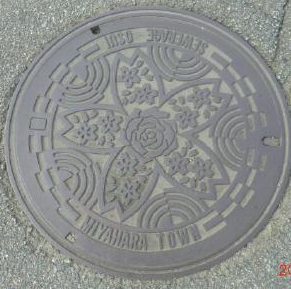
The town tree, cherry blossoms, has the town flower, roses, depicted within it. The five semi-circular lines around the lid are said to represent 'Hikawa.' 'Hikawa' is the name of the river that flows between the former Ryuhoku Town and the former Miyahara Town. Thank you to the town office staff who researched this. There are also the words SEWERAGE, OSUI, and MIYAHARA TOWN.
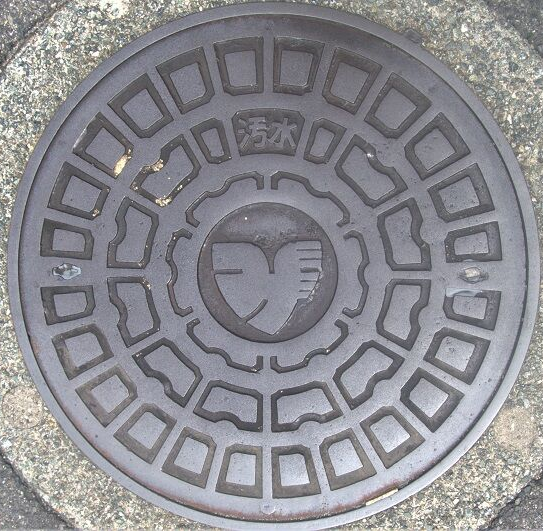
Former Miyahara town emblem with the word 'sewage' included.
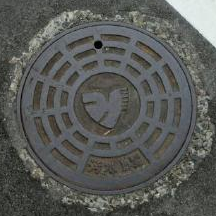
A handhole with a spider web pattern, the town emblem, and the characters 'Sewage Type 1'.
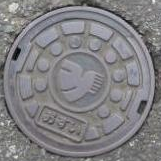
○ has a concentric circle pattern with the town emblem and the characters 'おすい'.
Former Ryuhoku 旧竜北町
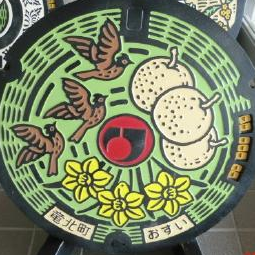
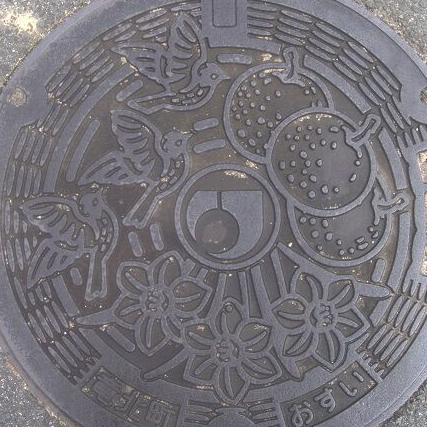
Yatsushiro North Purification Center Color Display Lid.
The town emblem, the town tree pear, the town flower daffodil, the town bird skylark, and around it, the town's specialty igusa tatami mats are depicted. The characters 'Ryuhoku Town' and 'Sewage'.
Related: Yatsushiro 八代市, Yatsushiro Northern Basin Sewerage 八代北部流域下水道
Mashiki 益城町
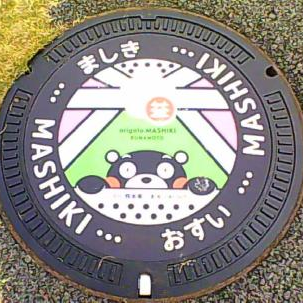
Kumamon is peeking out from a background inspired by 'Mashi' from Mashiki Town. A communication mark combining plum blossoms and 'Mashi' is used, creating a colorful image. The surrounding area features the logo 'MASHIKI ましき おすい'.
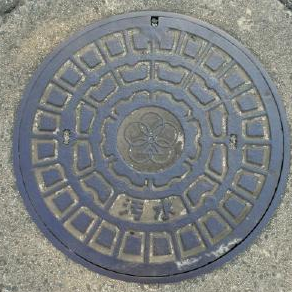
With the town emblem.
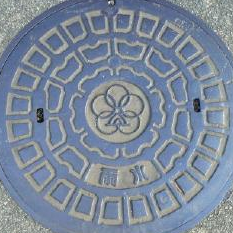
With the town emblem.
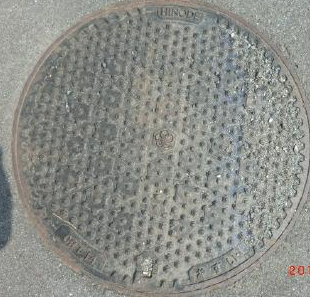
Town emblem slip-resistant manhole.
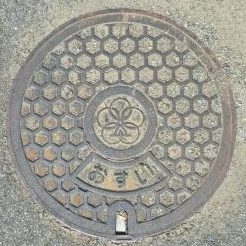
Tortoise shell pattern with the town emblem.
Misato 美里町
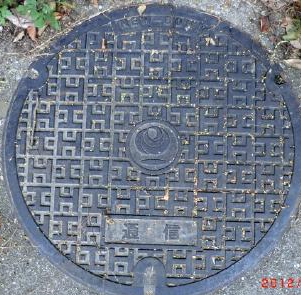
Communication cover with the Ministry of Land, Infrastructure, Transport and Tourism mark.
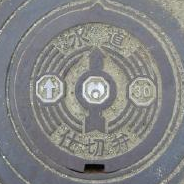
Water supply valve handhole with town emblem.

Fire hydrant cover with the town emblem.
Former Tomochi 旧砥用町
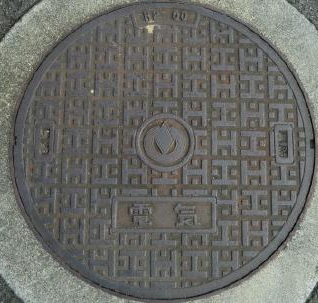
With the old Toyo Town emblem.
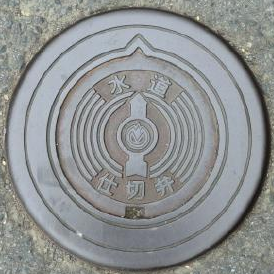
With the old Toyo Town emblem.
Former Chuo 旧中央町
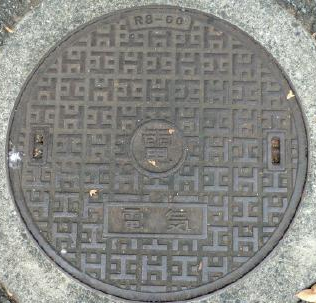
The character 'electricity'. There is no town emblem or other distinguishing features.
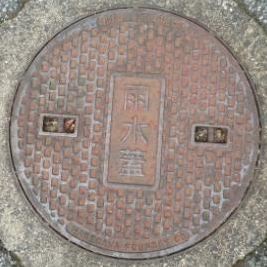
The characters '雨水蓋' (rainwater cover). There are no town emblems or other distinguishing features. Since the sewage system is undeveloped and this is photographed within the town hall premises, it is probably a septic tank cover.
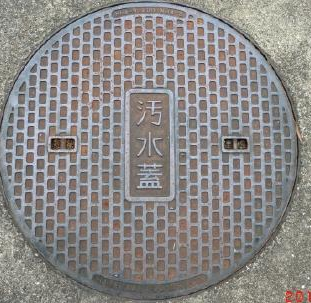
"The words 'Sewage Cover.' There is no town emblem or other distinctive features. It appears to be the cover of a septic tank.
Minamioguni 南小国町
A design featuring a clear stream (Shigase River), the town tree cedar (Oguni cedar), and the town flower gentian. The characters 'Minamioguni' and 'Osui'.
It seems that the town has joined the "Most Beautiful Villages in Japan" association to preserve the beautiful agricultural and mountain village scenery and culture for the future.
Minamioguni Town, Nakahara District, Agricultural Village Sewage Project, Sewage Pipe Manhole Cover
Small lid with the same design as above.
Related: Oguni 小国町
Mifune 御船町
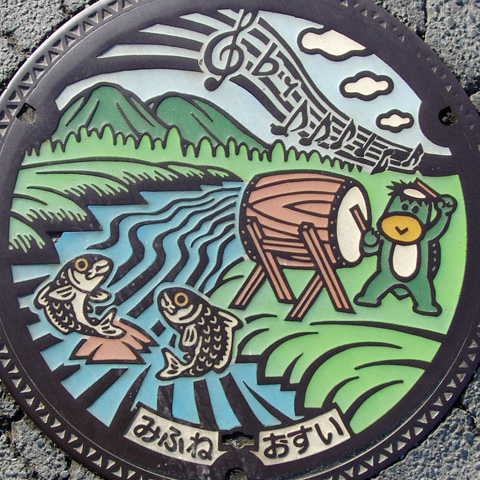
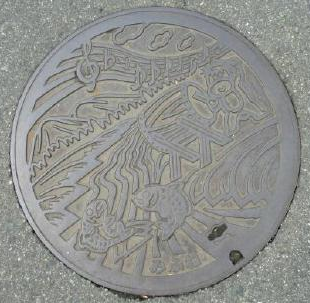
The design features a river, fish, a kappa playing a drum, and a musical staff. The musical staff represents the fact that there is a music university in the town. The river is the Mifune River that flows through the town, and the fish is likely a carp because it has whiskers on its mouth. As for the kappa, Mifune Town has a summer festival called the 'Mifune Ga-aappa Festival,' which is representative of the town, and it is said that kappas have lived in the Mifune River since long ago.

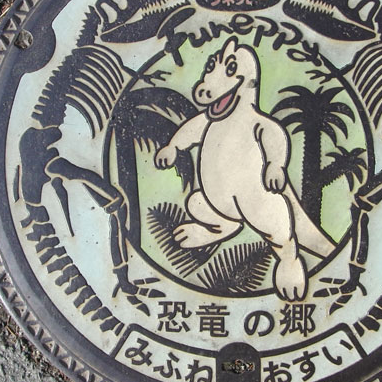
Mifune Town is the place where the first fossilized teeth of a carnivorous dinosaur were discovered in Japan. It was named 'Mifuneryu.' The name 'Funeppei' can be seen, as it seems to be the town's mascot character.
Near the town hall, there is the 'Mifune Dinosaur Museum,' which plays a role in promoting the town as the home of dinosaurs.
Just like the 'Gaa-ppa' covers above, there seem to be such covers all around the town, but the ones near where this cover was photographed were in good condition with little fading.
Yamato 山都町
Former Yabe 旧矢部町
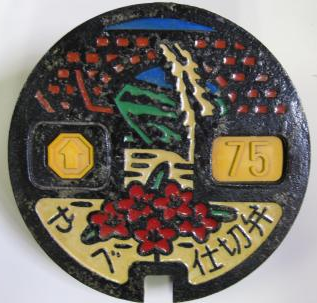
Water discharge from Tsūjun Bridge and the flower rhododendrons of the former Yabe Town.
Former Soyo 旧蘇陽町
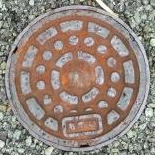
Sewage handhole cover. There are no village emblems or other features.
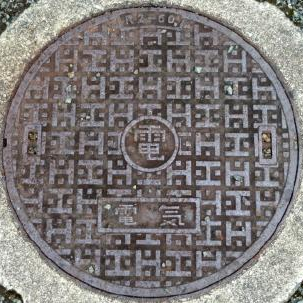
Manhole cover for electricity. It has no village emblem or other features.

Fireproof water tank lid. It has no village emblem or other features.
Former Kiyokazu 旧清和村
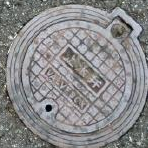
Water shutoff valve and wastewater handhole cover. There are no village emblems or other features.
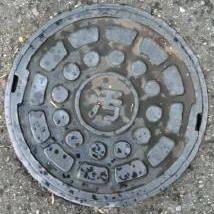
Sewage handhole cover. There are no village emblems or other features.
Yunomae 湯前町
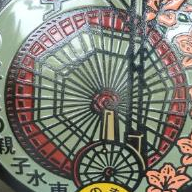
Kumagawa River Basin Purification Center display lid. A color design featuring Japan's number one parent-child waterwheel and the town's flower, azalea.
Related: Kumagawa River Basin Sewerage 球磨川流域下水道, Kumagawa River Upper Basin Sewerage 球磨川上流流域下水道
Reihoku 苓北町

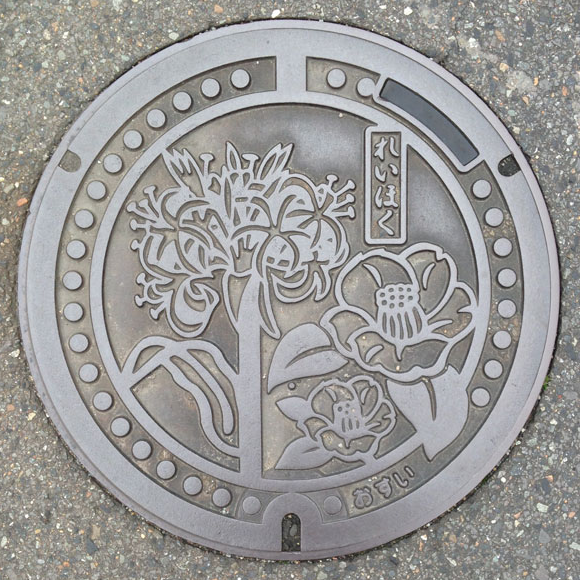
The town tree, 'Camellia,' and the town flower, 'Hama-yu,' are depicted.
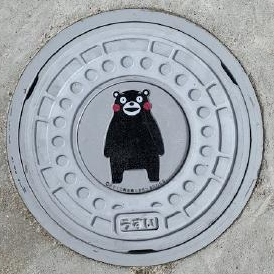
This is a small plastic masu lid featuring Kumamon and the letters 'Usui'.
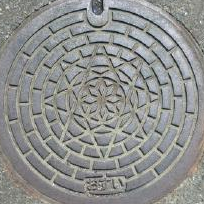
A design that combines circles, stars, and flowers.
Itsuki 五木村
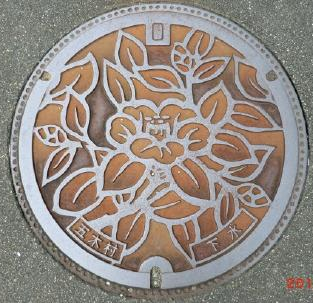
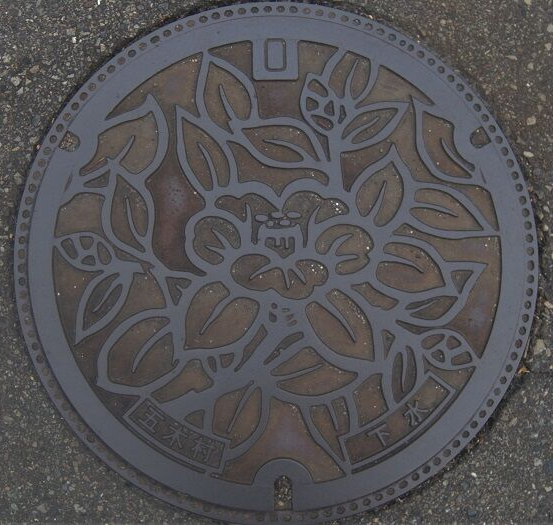
The town's flower, camellia, is depicted in a large size. The brown is not color, but rust.
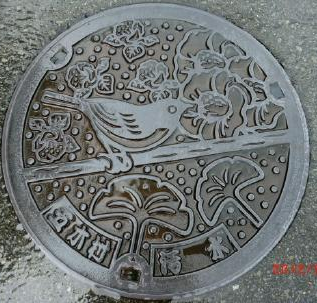
Design featuring the town's flower, the camellia; the town's tree, the ginkgo; and the town's bird, the Japanese white-eye.
Related: Asagiri あさぎり町
Ubuyama 産山村
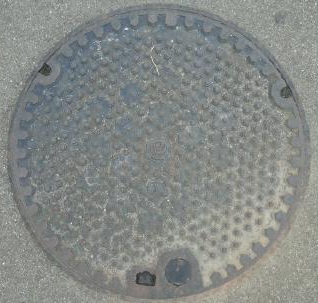
A slip-resistant manhole cover with the Ministry of Land, Infrastructure, Transport and Tourism mark in the center.
Kuma 球磨村
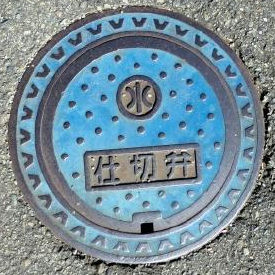
Water main shut-off valve handhole cover. There are covers with the same design but different text, such as "shut-off valve" and "air valve."
Sagara 相良村
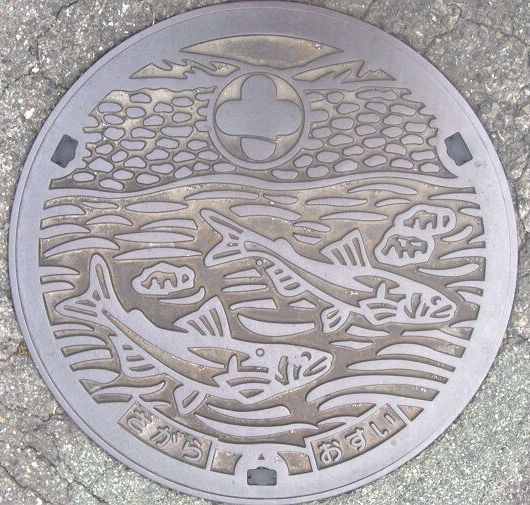
The village emblem and two sweetfish swimming in a clear stream are depicted.
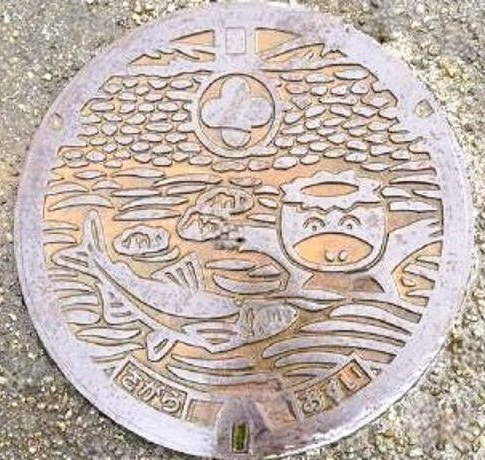
A design featuring ayu swimming in the river and a kappa, with the village emblem and the characters 'Sagara' and 'Osui'. In Sagara Village, where kappa legends remain, kappa play a role in promoting the village.
Related: Takamori 高森町
Nishihara 西原村
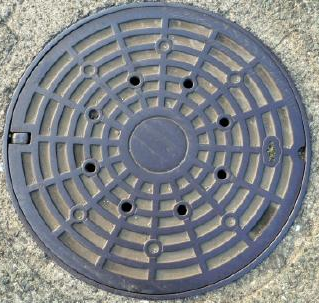
I finally found it on the third search, a manhole with an unknown purpose and no village emblem.
Minamiaso 南阿蘇村
Former Shirozu 旧白水村
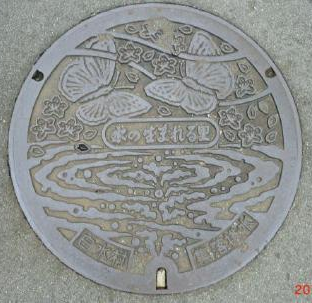
The villagers' butterfly, the Great Azure Blue, the cherry blossoms, and 'Shirakawa Suigen,' selected as one of the 'Top 100 Water Villages,' along with the words of its theme, 'The Village Where Water is Born.'
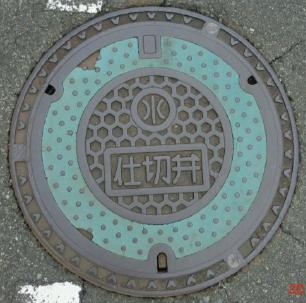
A water shut-off valve the size of a manhole.
Former Choyo 旧長陽村
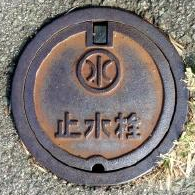
Finally found it on the third search—the cover of the stopcock with no distinctive features or marks
Former Kugino 旧久木野村
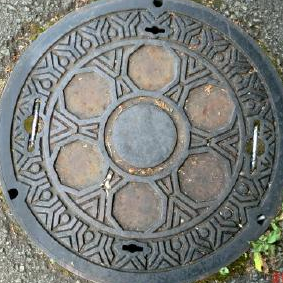
This is also a lid I finally found after the third search, with a 'fire' design around it. Nothing is written on it, so it cannot be specifically identified, but it is a fireproof water storage tank lid.
Mizukami 水上村
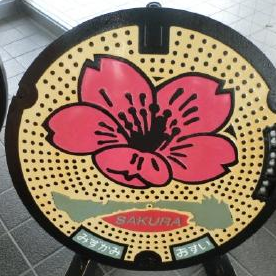
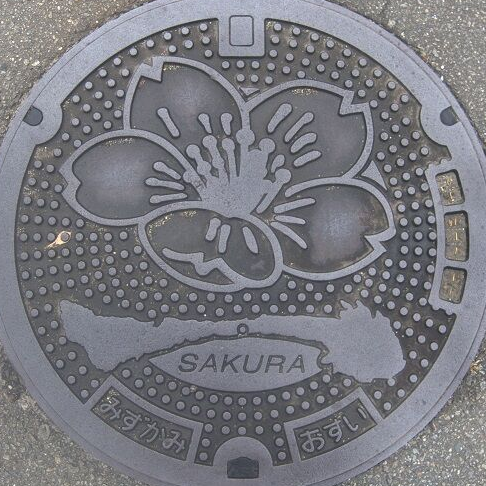
The flower of Mizukami Village is the 'rhododendron,' but what is depicted here are 'cherry blossom petals.' The character '一' written below seems to be because, during the 'Kumamoto Japan Number One Creation Movement' that started in 1984, 10,000 cherry trees were planted around the Ichifusa Dam.
Related: Kumagawa River Basin Sewerage 球磨川流域下水道, Kumagawa River Upper Basin Sewerage 球磨川上流流域下水道
Yamae 山江村
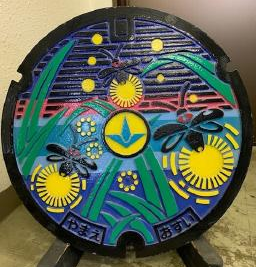
Color display lid of the design below.
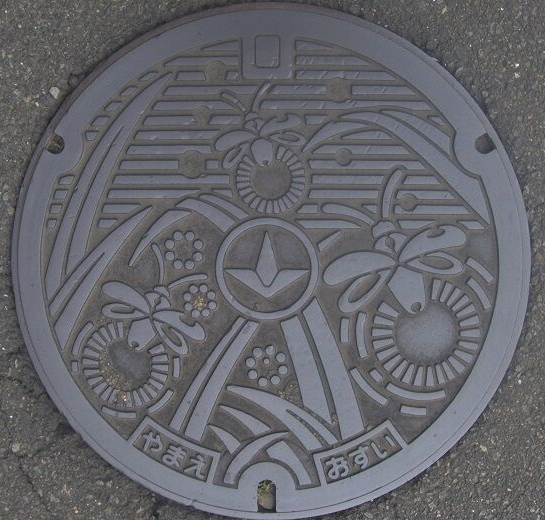
A design featuring the village emblem and fireflies flying around. The characters 'Yamae' and 'Osui' are at the bottom.
Kumamoto Prefecture 熊本県
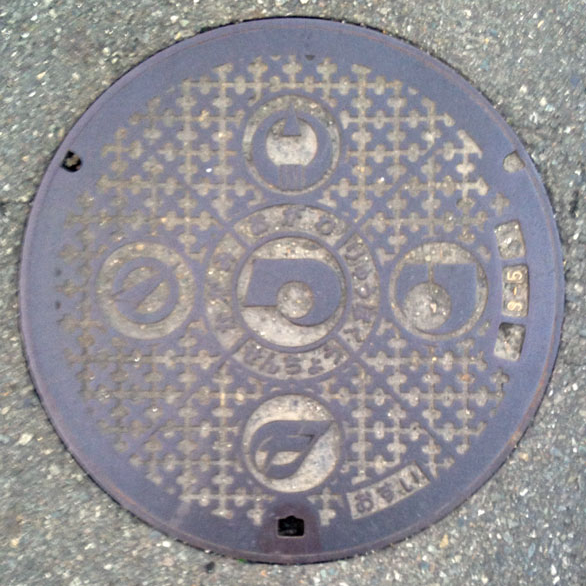
Manhole covers for the basin sewer system targeting the former towns of Kagami, Senchō (now Yatsushiro City), Ogawa (now Uki City), and Ryuhoku (now Hikawa Town). The center features the emblem of Kumamoto Prefecture, with Ogawa Town at the 12 o'clock position, Ryuhoku Town at 3 o'clock, Senchō Town at 6 o'clock, and Kagami Town at 9 o'clock, along with the towns' emblems and names.
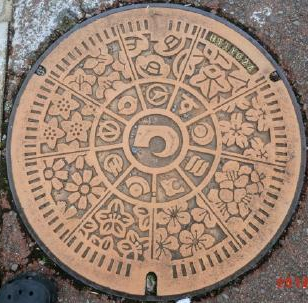
Kumagawa River Basin Purification Center exhibition color lid. The above is the color version. Since fiscal year 2006, operation and management have been carried out under the designated manager system.
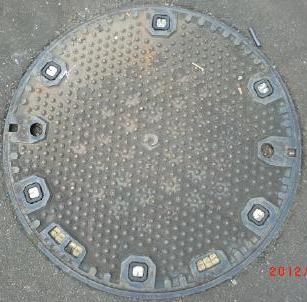
In the center, a Kumamoto Prefecture emblem anti-slip manhole.
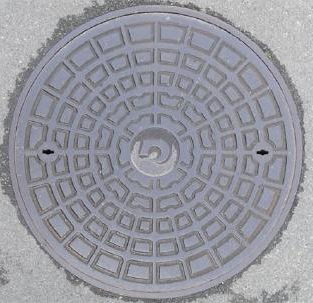
The Kumamoto Prefecture emblem is in the center.
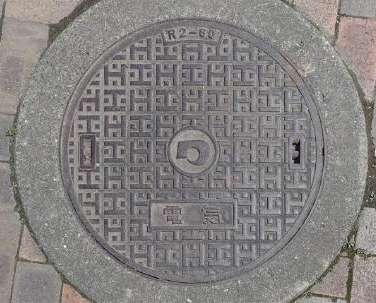
In the center is the prefectural emblem, and the background pattern is arranged in an alternating fashion with a design resembling the character '工' with two dots, which is often seen on electric covers in Kyushu.
Partial Affairs Association 一部事務組合
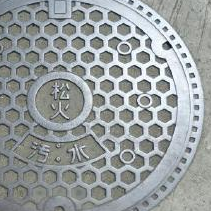
On the tortoiseshell-patterned lid, it says "Matsu Hi" and "Wastewater." The following is the response from the city hall regarding "Matsu Hi" (verbatim):
Our city's sewerage project has been carried out as a single project (Matsuhashi Shiranui Public Sewerage Project) through a partial administrative association formed by the former Matsuhashi Town and the former Shiranui Town. Accordingly, the abbreviation "Matsu Hi" is used for Matsuhashi Shiranui, and it is also adopted on the manhole lids.
Related: Uki 宇城市
Otsukikuyo Waterworks Authority 大津菊陽水道企業団
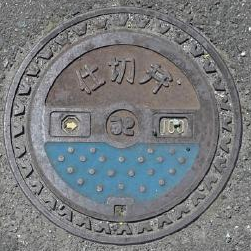
On the left of the central band is an arrow indicating the flow direction, in the center is the mark of the Ōzu Kikuyō Waterworks Enterprise, and on the right is the number "100" indicating the pipe diameter. At the top are the characters for "shut-off valve," and the bottom features a dot pattern colored in blue. The Ōzu Kikuyō Waterworks Enterprise is a water utility composed of Ōzu Town and Kikuyō Town in Kikuchi District. The emblem of the organization is based on the character for "water" (み), symbolizing the spread and development of waterworks through the harmony of Ōzu Town and Kikuyō Town. There are lids with the same design but different characters, such as "shut-off valve" and "air valve."

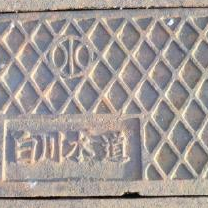
This is a water meter cover labeled 'Shirakawa Waterworks.'
The following is the response from the General Affairs Division of the Otsu Kikuyo Waterworks Association: 'It is believed to be from the former Shirakawa Midstream District Waterworks Association before the merger. The water meter is lent from the association, but the water meter box (meter box) is the property of the individual. Since it is installed on the premises when a house is built, it is believed to be installed in houses built before 1979.' There was also a note that if the owner is unknown and it is left somewhere, they would like to come and collect it.
Related: Ozu 大津町, Kikuyo 菊陽町
Yatsushiro Northern Basin Sewerage 八代北部流域下水道

Color display lid of the Yatsushiro Northern Purification Center. In the center is the prefectural emblem, and around it, clockwise from the top, are the names and town emblems of four towns: Kagami, Ogawa, Ryuhoku, and Sendcho. The relevant areas are Yatsushiro City (formerly Kagami Town and Sendcho Town), Uki City (formerly Ogawa Town), and Hikawa Town (formerly Ryuhoku Town).
Related: Uki 宇城市, Yatsushiro 八代市, Hikawa 氷川町
Kumagawa River Basin Sewerage 球磨川流域下水道
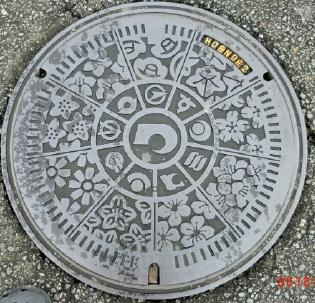
Kumagawa River Basin Sewerage (Targeting Nishiki Town, Taragi Town, Yunomae Town, Mizukami Village, Asagiri Town (former Kamimura, former Menda Town, former Okahara Village, former Sue Village, former Fukada Village))
The Kumamoto Prefecture emblem is in the center. Around it are the emblems and town flowers of the nine target towns and villages. From the top, moving clockwise: former Fukada Village in Asagiri Town (Camellia), former Sue Village in Asagiri Town (Gentian), Taragi Town (Hyakutarō Azalea), Mizukami Village (Rhododendron), former Okahara Village in Asagiri Town (Cherry), Nishiki Town (Hakusen Rose), former Kamimura in Asagiri Town (Cosmos), former Menda Town in Asagiri Town (Marsh Marigold), Yunomae Town (Azalea).
Related: Asagiri あさぎり町, Taragi 多良木町, Nishiki 錦町, Yunomae 湯前町, Mizukami 水上村
Kumagawa River Upper Basin Sewerage 球磨川上流流域下水道
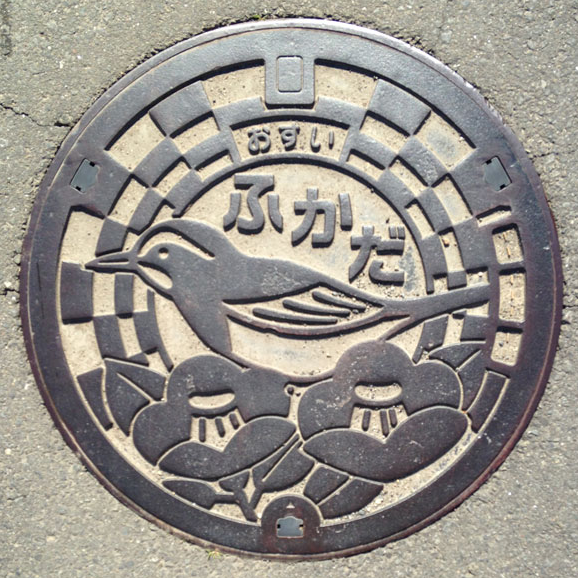
The village flower 'Camellia' and the village bird 'Wagtail' are depicted.
Kumagawa Upper Stream Basin Sewerage
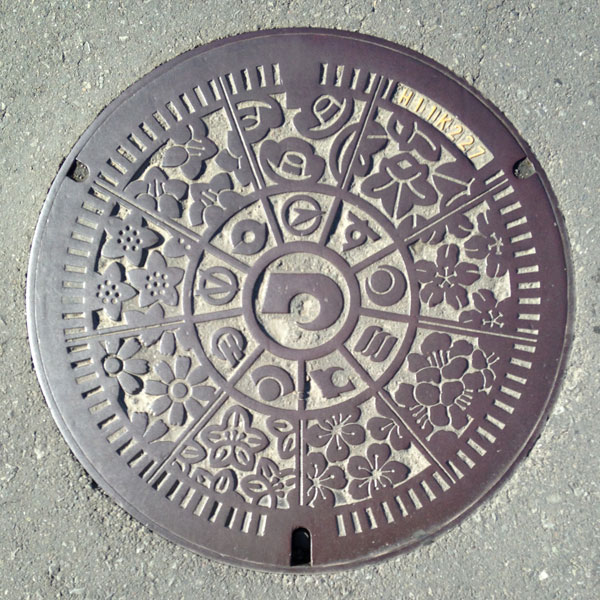
This is a sewer cover for the Kumagawa Upper Stream Basin Sewerage, targeting Nishiki Town, Taragi Town, Yunomae Town, Mizukami Village, and Asagiri Town (formerly Kami Village, Menda Town, Okaharu Village, Sue Village, and Fukata Village) in Kuma District.
At the center is the emblem of Kumamoto Prefecture, and moving clockwise from the top, the emblems and flowers of the towns and villages are depicted as follows: former Fukata Village (Camellia), former Sue Village (Gentian), Taragi Town (Hyakutarō Azalea), Mizukami Village (Rhododendron), former Okaharu Village (Cherry Blossom), Nishiki Town (Brambles), former Kami Village (Cosmos), former Menda Town (Caltha palustris), and Yunomae Town (Azalea).
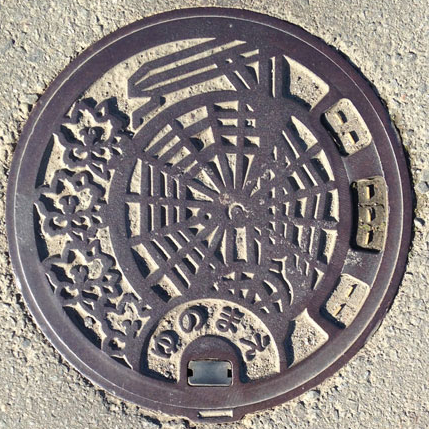
A small plate with the same motif as above.
Kumagawa Upper Stream Basin Sewerage
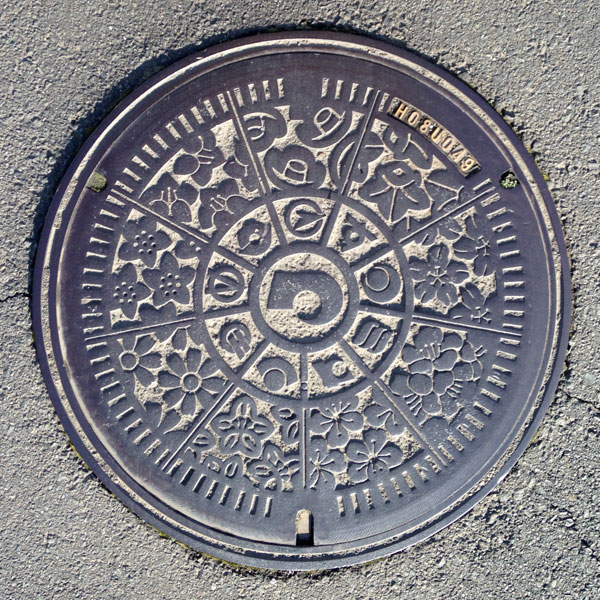
Covers Nishiki Town, Taragi Town, Yunomae Town, Mizukami Village, and Asagiri Town (former Kami Village, former Menda Town, former Okaharu Village, former Sue Village, former Fukada Village) in Kuma District, with a manhole cover for the Kumagawa Upper Stream Basin Sewerage.
In the center is the emblem of Kumamoto Prefecture, and clockwise from the top, the town and village emblems and flowers are depicted as follows: former Fukada Village (Camellia), former Sue Village (Gentian), Taragi Town (Hyakutarō Azalea), Mizukami Village (Rhododendron), former Okaharu Village (Cherry Blossoms), Nishiki Town (Tsukushi Rose), former Kami Village (Cosmos), former Menda Town (Caltha), Yunomae Town (Azalea).
Related: Asagiri あさぎり町, Taragi 多良木町, Nishiki 錦町, Yunomae 湯前町, Mizukami 水上村