X Okinawa 沖縄県
Okinawa 沖縄県
 Naha 那覇市
Designer
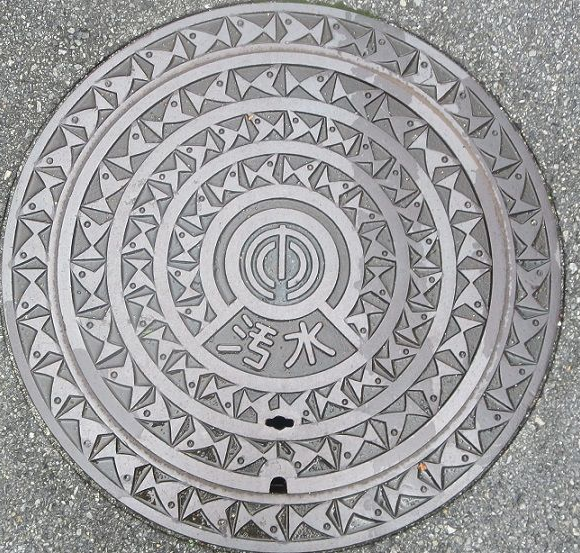
The innermost fish faces right, there is no 'T-14' lettering, and a fish is also drawn on the receiving frame.
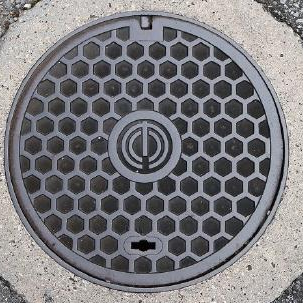
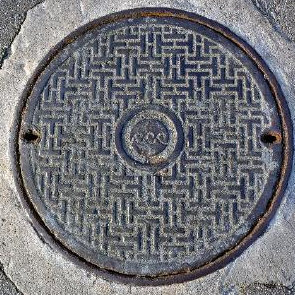
The city emblem is in the center circle. The lid surface has a tortoise shell pattern. Since most of the manhole covers in Naha City are now designed with a 'fish' design, we never know when the old covers will be removed, so I thought I should document them and went to look for them.
Emblem
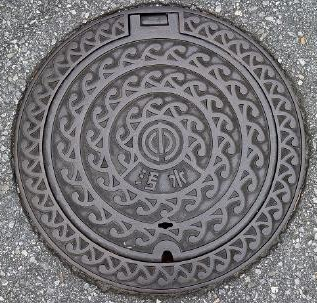
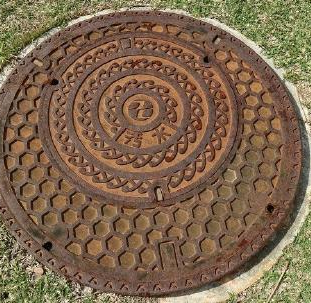
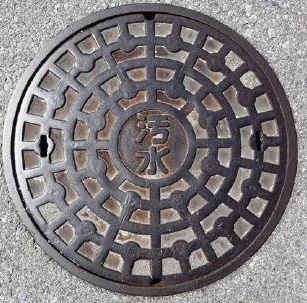
A ground pattern resembling a complex spider web, with the city emblem and the characters for 'sewage' included.
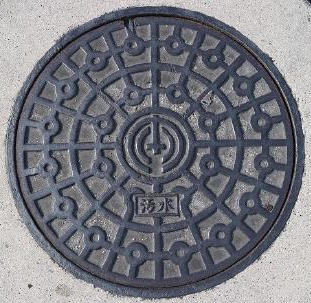
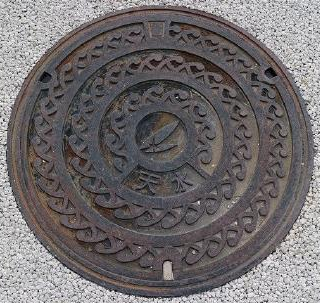
It is a derivative type of standard manhole cover, with the outer ring divided into 16 sections. The distinctive feature is that the central Naha City emblem has the kanji '本' instead of 'ナハ'. It is unlikely that the city would tamper with the city emblem, so it is probably a mistake by the cover manufacturer. It's one of the 'interesting covers.'
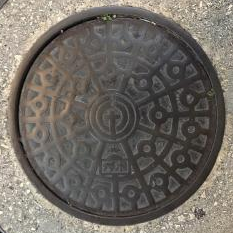
Variant (inner 8 divisions, outer 16 divisions) JIS pattern, with a horizontal bar across the central Naha City emblem that is also upside down, and the characters 'sewage' at the bottom.
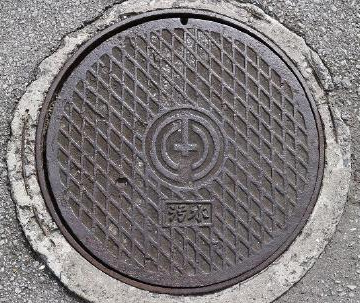
A diagonal lattice pattern with the city emblem and the word 'Sewage' inscribed. The city emblem is 'Hon' instead of 'Naha'. This manhole cover is one of several types installed between the early 1960s, when Naha City started its sewerage project, and the early 1970s, and it is quite deteriorated. It will probably be removed within a few years and will no longer be seen. It is one of the 'interesting covers'.
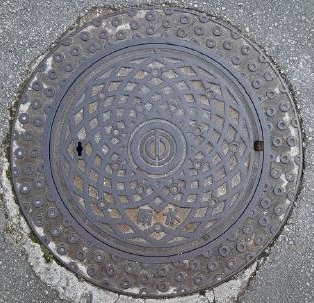
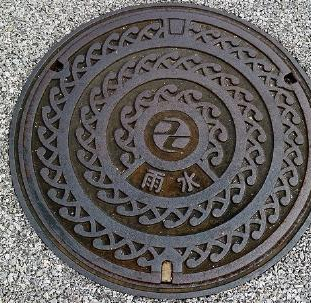
In the center of the temari-patterned background is the city emblem, with the notation 'Rainwater' at the bottom. The receiving frame has a circle pattern.
Handhole
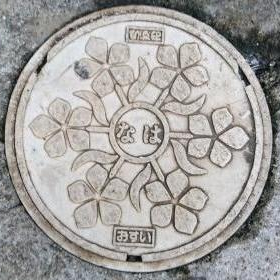
Inside the central circle, the characters 'naha' are placed, and from there, a flower extends with five petals in six directions. What kind of flower could it be? It doesn't look like the city's flower, bougainvillea.
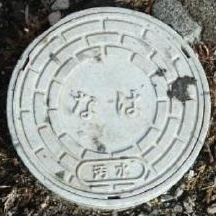
A small PVC lid labeled 'naha'.
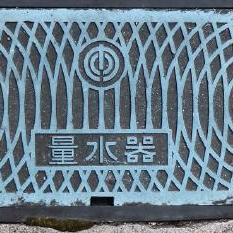
The square lid of the water meter has a ground pattern where water ripples spread from both sides and intersect. This pattern is the brand pattern (MC pattern) of "Mikuni Celluloid Co., Ltd.," established in 1927. After World War II, Mikuni Celluloid shifted from producing celluloid products to manufacturing and selling plastic products, and in 1973, the company name was changed to "Mikuni Plastics Co., Ltd." Later, when the business was transferred from Daicel Chemical Industries Co., Ltd. to Aron Kasei Co., Ltd. in 2008, the company name was changed to "Mikuni Plastics Co., Ltd.," and finally, with the complete merger into Aron Kasei in 2015, the name "Mikuni" disappeared. However, even today, in Aron Kasei's product introduction, it is listed as the "MC Meter Box," and both the "MC" name and the ground pattern appear to have been inherited and continue to be manufactured.
Fire Hydrant
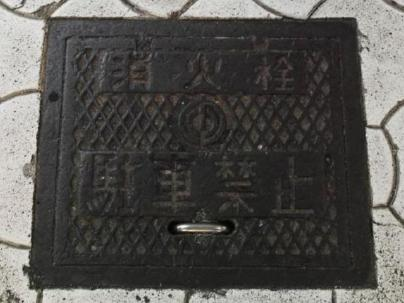
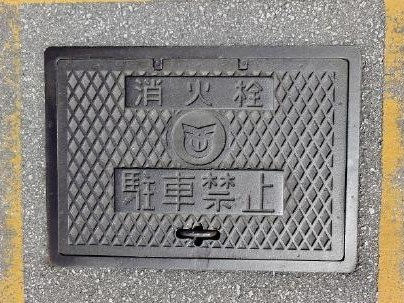
A square fire hydrant cover with a diamond-shaped ground pattern, the city emblem in the center, 'Fire Hydrant' above, and 'No Parking' below.
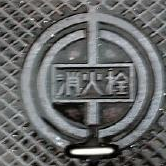
A square lid with a diagonal lattice pattern, a large city emblem in the center, and the characters 'Fire Hydrant' superimposed on the city emblem.
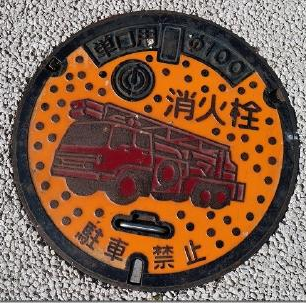
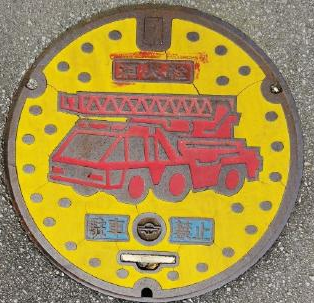
Design of a red ladder truck within an orange background and polka dot pattern. 'For single outlet Φ100', city emblem, and the words 'No Parking' and 'Fire Hydrant'.
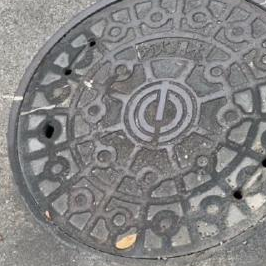
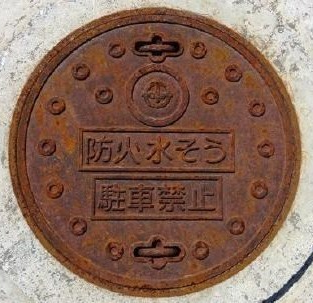
JIS cover, city emblem in the center, and the characters 'Firefighting Water' just above it.
Collaboration
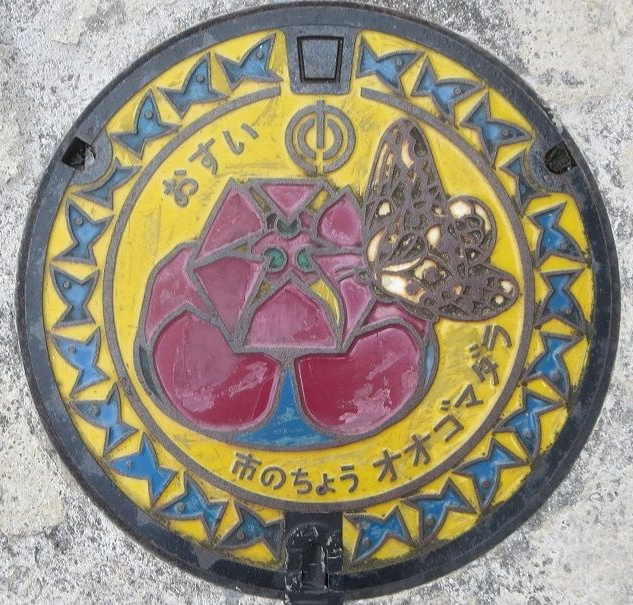
One of the five types of colored sewer manhole covers installed by the city to contribute to forming a pleasant streetscape suitable for a tourist city. At the top center is the city emblem, with the character 'Naha' designed in a circular pattern. Features the flower hat of Ryukyu dance and the city butterfly, the Great Eggfly. Incidentally, the chrysalis of this butterfly is a beautiful golden color. Legendary (?) fish are swimming around it. The words 'City Butterfly Great Eggfly' and 'Sewage'.
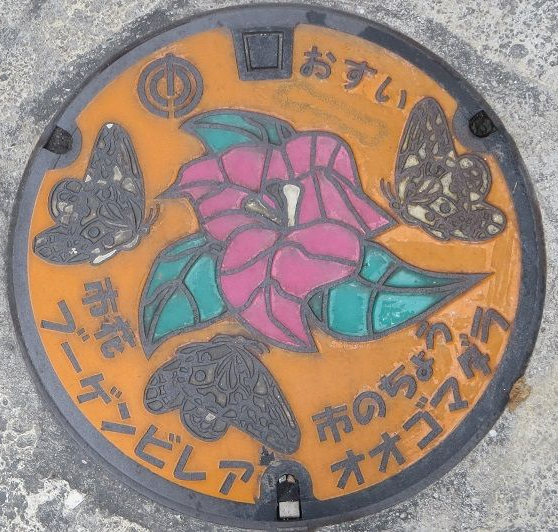
One of the five types of colored sewer covers installed to contribute to the formation of a pleasant streetscape suitable for a tourist city. The Naha City emblem is on the top left. The city flower, bougainvillea, and the city butterfly, the great eggfly (Idea leuconoe).
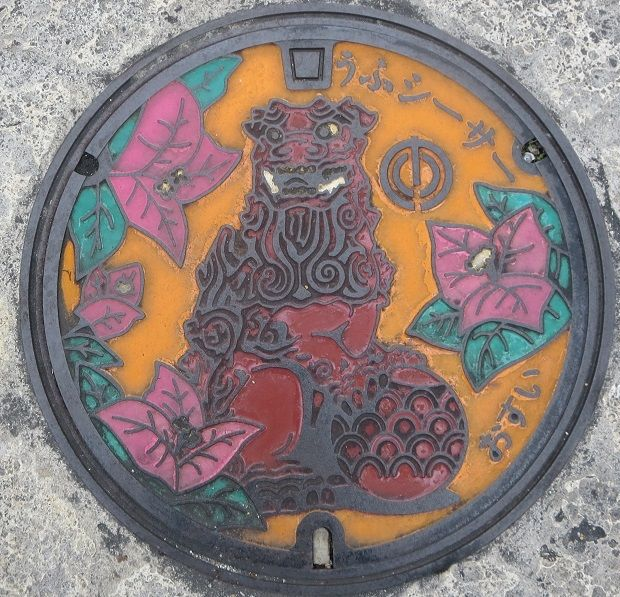
This is a cover at the card coordinate location. A cover of the same design was received on July 1, 2015, in the Tsuboya district, photographed by Mr. Morimura. It is one of five colored sewer manhole covers installed to contribute to the formation of a pleasant cityscape suitable for a tourist city. The city emblem is on the center-right. There is a Ufu Shisa and the city flower Bougainvillea. 'Ufu' means large. 'Ufu Shisa' over 3 meters tall are installed in the Tsuboya district and near Makishi Station at Sion Square. Incidentally, the flower of the Bougainvillea is the small white part in the center. The parts that look like petals are leaves surrounding the flower, and leaf veins are also depicted on the manhole cover. (From Mr. Morimura)
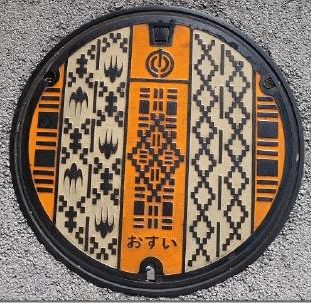
Inside the central circle is the Naha City emblem. The inner band around the city emblem has a tortoiseshell pattern, with "Φ450" above the city emblem and "Control Valve" below. The outer band features dotted protrusions arranged in a staggered pattern, going around three times. (Size 63 cm) There are manhole covers with the same design but with different inscriptions: "Gate Valve," "Butterfly Valve," "Control Valve," and "Stop Valve."
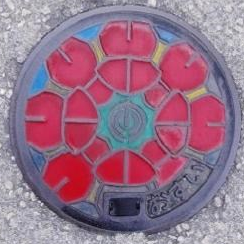
One of the five colored sewer covers installed by the city to contribute to the formation of a pleasant cityscape suitable for a tourist city. The center features the city emblem. The design includes a flower hat from Ryukyu dance.
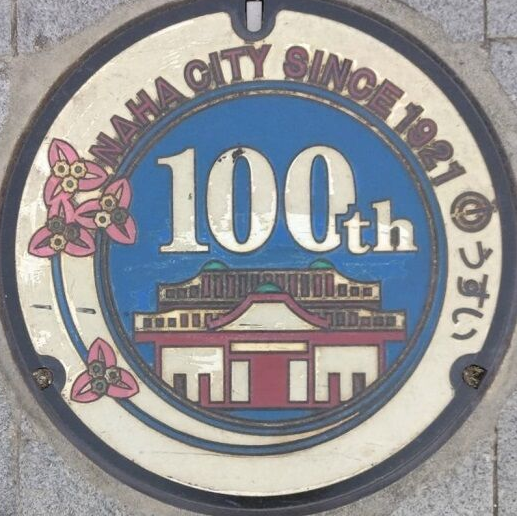
This is the 'light' version of the logo design for the 100th anniversary of the city's establishment.
Other
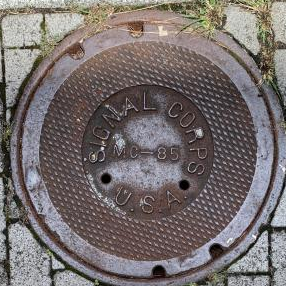
The central part is a plain circle with the words 'SIGNAL CORPS USA' and 'MC-85' inscribed on it. The outer edge has a raised diamond pattern. It is a lid from the era of United States administration and is said to be a lid from the U.S. Army Signal Corps. There are also some in Uruma City, so please take a look.
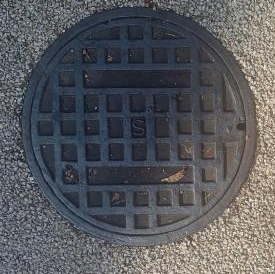
In the center of the lattice pattern, there is an 'S' mark. This manhole cover was installed during the period of the U.S. Civil Administration before Okinawa Prefecture was returned to Japan. It is probably the 'S' of the Okinawa Sewerage Corporation O.S.C., which was the administrator at that time. It has also been posted by Okinawa Prefecture, so please take a look.
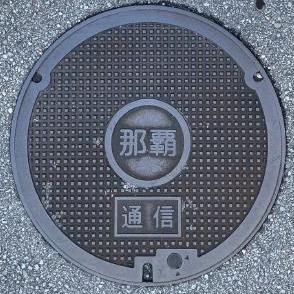
In the central circle, the characters 'Naha' are written, and below that, inside a square, the characters 'Communication' are written, with a small square grid pattern on the outer edge.
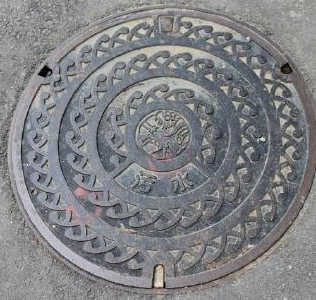
The word 'Development Agency' in the center and 'Electricity' at the bottom.
Related: Chubu Basin Sewerage 中部流域下水道
 Ishigaki 石垣市
Designer
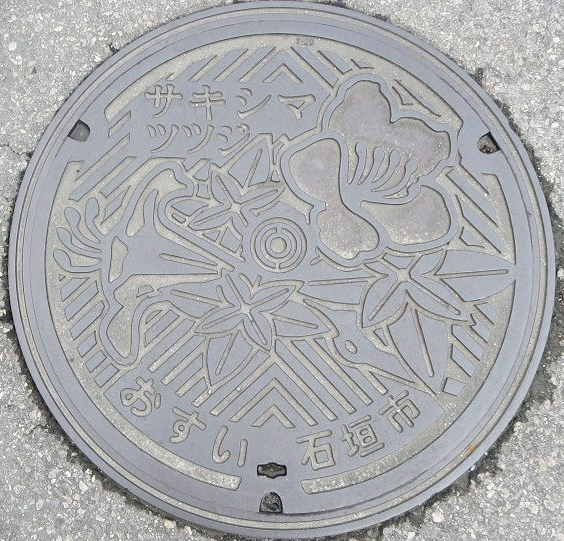
A designed lid depicting the flower of Ishigaki City (Sakishima Azalea) and the city emblem.
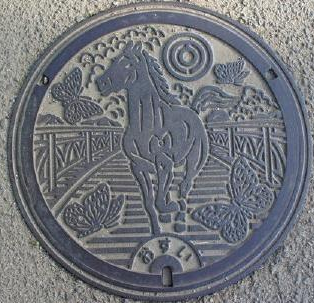
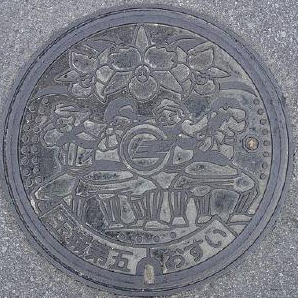
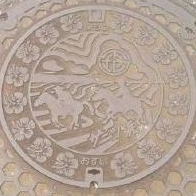
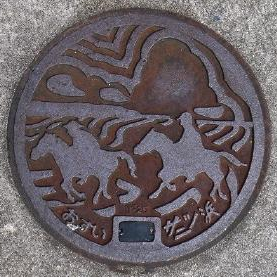
A design depicting a horse from the 'Red Horse Legend', which is handed down in the Miyara area of Ishigaki City, crossing the Miyara Bridge, with Ishigaki City's city butterfly (Idea leuconoe) included. The round mark at the top is the Ishigaki City emblem, and the text 'おすい' is at the bottom. It seems this illustration was designed by students of the local Miyara Elementary School. In Ishigaki City, they apparently solicit drawings from students in each area for their projects. Therefore, the designs differ depending on the project area. We received this information from Mr. Uechi in the Public Relations Section of the Planning and Policy Division, Ishigaki City.
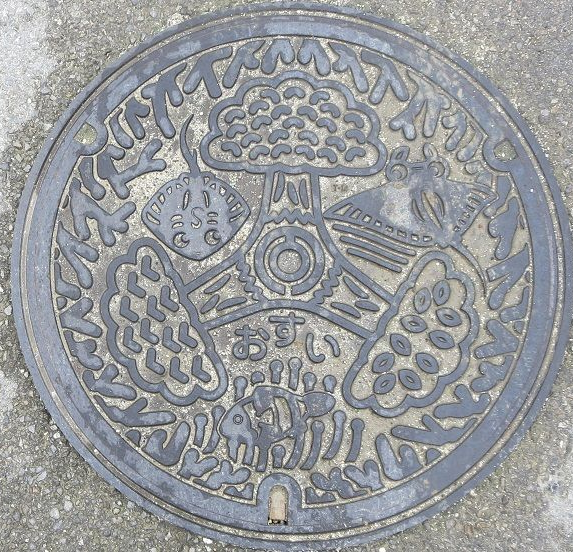
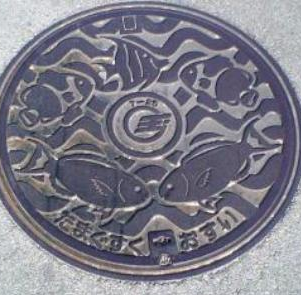
The roots of three trees are connected to form a circle, and the city emblem is inside it. The outer circumference is coral, with a manta ray at the upper right, a stingray at the upper left, and a clownfish in a sea anemone nest at the bottom, well representing the richness of the sea in Shiraho. Based on information that the design was by a 6th-grade student of Shiraho Elementary School (as explained by the aforementioned Mr. Utsumuki Oyaji), when visiting Shiraho Elementary School, I saw three giant trees standing in a row in the schoolyard, so I realized that these were the trees in the design.
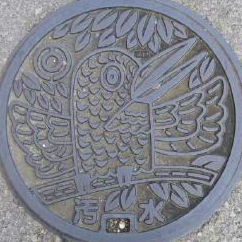
A design of a ruddy kingfisher perched on a tree branch, flapping its wings. The city emblem is in the upper left, with the words 'Ruddy Kingfisher' and 'Wastewater' at the bottom. The Ryukyu ruddy kingfisher is characterized by its red color, so much so that it is also called the bird of fire (flame). It is a migratory bird that flies in from the south in spring, breeds and raises its young on Ishigaki Island, and then returns around autumn. It is the motif of Ohama Elementary School's mascot character 'Okapi'. The design, created by students of the school, carries the sentiment of 'wanting to forever protect the rich natural environment of the Ohama area, where ruddy kingfishers visit.'
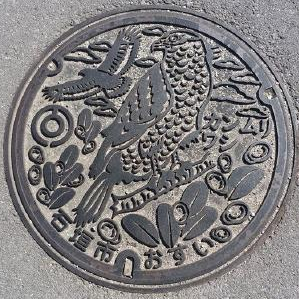
The city's bird, the crested serpent eagle, and the city's tree, the Yaeyama kokutan, are featured in the design. It also includes the city emblem and the words 'Ishigaki City' and 'Osui'. 'Washinu Tori Bushi', a song that marks the beginning of celebrations in Yaeyama, is a song that describes the crested serpent eagle hatching from its egg and spreading its wings.
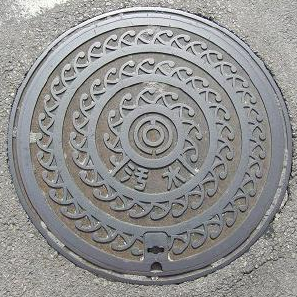
A design where the waves of the East China Sea surround the central city emblem.
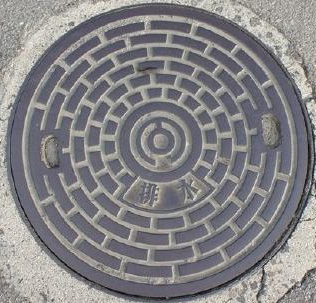
This is a lid with a block pattern drawn around the city emblem. It has the inscription 'Drainage'.
Handhole
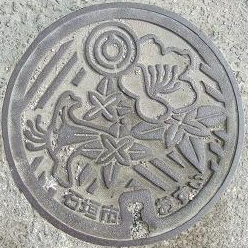
This is a small lid depicting the city flower, Sakishima azalea. The words 'Sakishima azalea' are not present; the city emblem is at the top, and the words 'Ishigaki City' and 'おすい' are written in the opposite direction from the manhole.
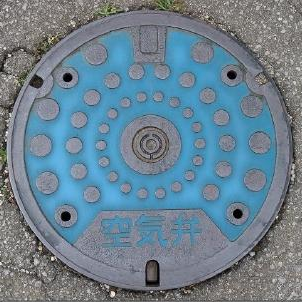
In the center of the blue area, the Ishigaki City emblem. Around it, a design of small, medium, and large polka dots in three circles. At the bottom, the words 'air valve'.
Fire Hydrant
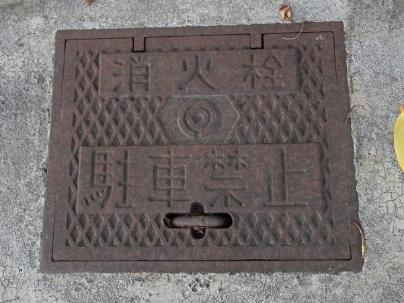
Diamond-patterned background, city emblem in the center, 'Fire Hydrant' above, and 'No Parking' below.
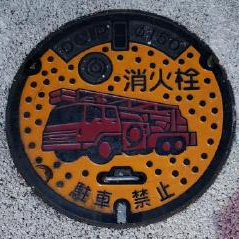
Yellow background with polka dot pattern, fire truck design with the city emblem and the characters 'Fire Hydrant'. At the top, the characters 'DOIP Φ100', and at the bottom, the characters 'No Parking'.
Generic

In the center of the wave pattern, there is the character '農' (agriculture), below it is '空気弁' (air valve), and at the top in small letters is 'T-25'. Since there was the Miyara River Land Improvement District's 'Agricultural Water Supply Station' No. 5 nearby, it is believed to be a supply pipe for that station. I received a 12 o'clock difference from Mō-san. There are lids with the same design but with different characters such as '弁蓋' (valve cover), '仕切弁' (stop valve), and '空気弁' (air valve).
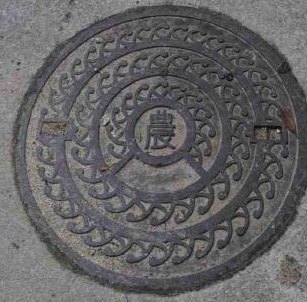
The character '農' in the center of the wave pattern, with hooks for opening and closing on both sides. The Miyara River, Ōura River, and Nagura River Land Improvement Districts merged to become the Ishigaki Island Land Improvement District in April 2008.
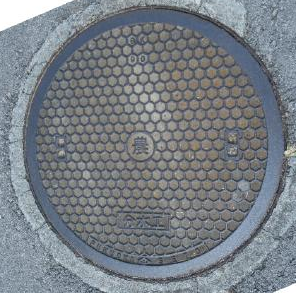
A detailed tortoiseshell pattern, with the character '農' in the central circle, '分水工' below it, and the text 'HUKUOKA SETO' at the bottom, along with the Seto Manufacturing mark 'S' inside a diamond shape. A '分水工' is a device for diverting water from the main agricultural irrigation channels into multiple branch channels.
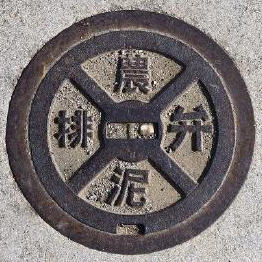
The entire lid is divided into four sections with ×, and there are the characters '農', '排', '泥', and '弁'.
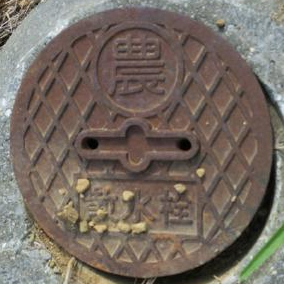
Diamond-shaped ground pattern, with the characters 'Nō' on top and 'Sansuisen' on the bottom. It is a small cover of about 20 cm.
 Itoman 糸満市
Designer

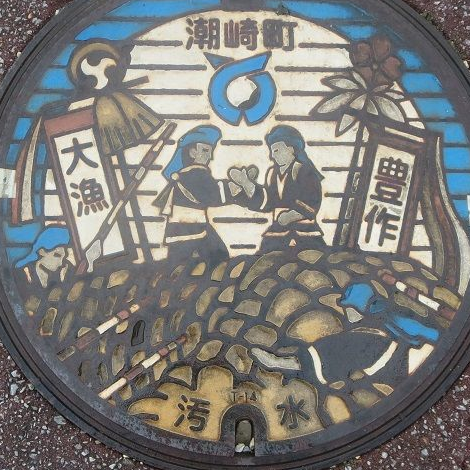
One of Okinawa's three major tug-of-war events, the Itoman Great Tug-of-War, features a design with the city emblem and the words 'Shiozaki Town' and 'Sewage.' The Itoman Great Tug-of-War is performed to pray for a good harvest, a big catch, family safety, and good health, and it celebrates the anticipated abundance through the joining of male and female ropes split into north and south. The rope is said to have a diameter of about 1.5 meters, a total length of about 180 meters for both male and female ropes, and a total weight of about 10 tons.
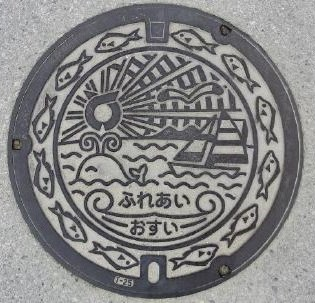
The characters only say 'fureai' and 'osui.' You might wonder which municipality’s manhole this is, but the sun has the Itoman City emblem. Whales, seagulls, and yachts are depicted, and the surrounding fish are the city fish, taman (?). The notation 'T-25.' The island is Ukahajima. On that Ukahajima, there are whale fossils. And in winter, humpback whales come to the waters of Okinawa to give birth and raise their young.
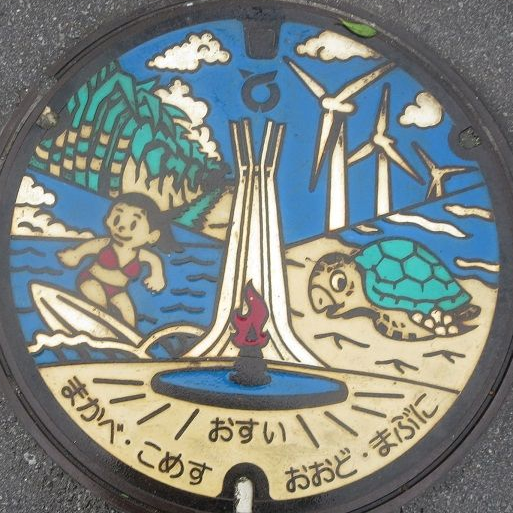
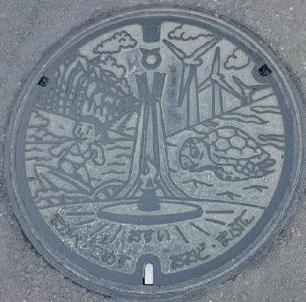
In the last fierce battle zone of the Battle of Okinawa, the center of the manhole features a design of the flame of peace and the peace bell. There is also a color version designed with the symbolic wind power turbine, sugarcane, the crowded Ōwatari Coast with surfers, and sea turtles coming to lay eggs. These are sewage manhole covers for agricultural community drainage in the Makabe, Yonezu, Ōwatari, and Mabuni areas.
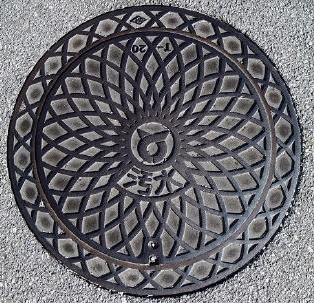
"We are designing a fishing net that symbolizes Itoman City, which has developed through the fishing industry." (From '30 Years of Progress in Sewage: Published by the Okinawa Prefecture Sewerage Division, December 1994) The pattern extends to the receiving frame. The city emblem is in the center, immediately below it is 'Sewage,' and above is 'T-20.'
Handhole
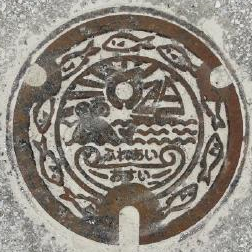
Whale, yacht, seagull, the city's fish taman (?) and the sun of the city emblem. Small sewage pit cover. 'Fureai' is from Itoman Fishing Port Fureai Park.
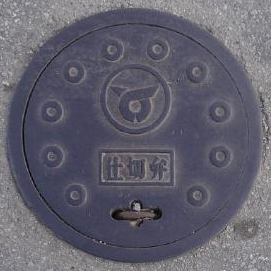
In the center is the city emblem, and below it, the characters for 'shikiriben' are in a slightly smaller Mincho font. Small circles are arranged in a circle around it.
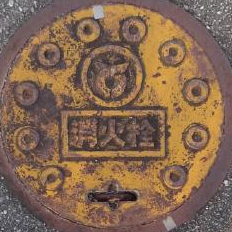
It is the same as above, but the whole thing is painted yellow.
Fire Hydrant
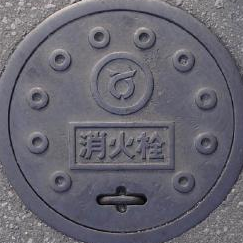
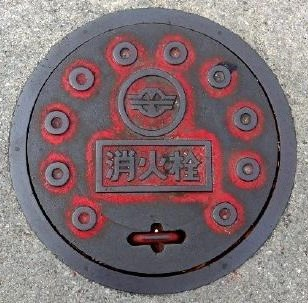
A small fire hydrant cover. In the center is the city emblem, below it the characters '消火栓' enclosed in a square. Small circles are arranged in a ring around the edge.
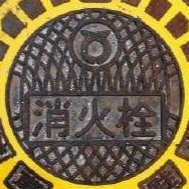
A concentric circle ground pattern with a center on the left and right. The city emblem and fire hydrant notation. If you look closely at the yellow part around it, from the left it reads 'No Parking'. It is a '?' cover. Round fire hydrant cover.
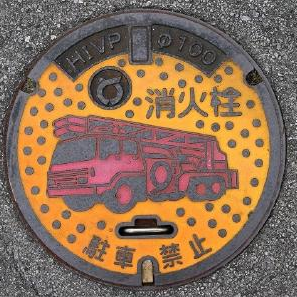
Yellow background with polka dots, 'Ladder Truck' in the center. At the top, the city emblem and 'HIVP φ100' 'Fire Hydrant', at the bottom, a handle and the words 'No Parking'.
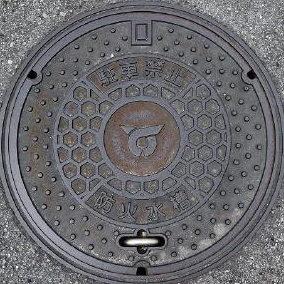
The city emblem is inside the central circle. The inner band around it has a tortoiseshell pattern. The top has the characters 'No Parking' and the bottom has 'Fire Water Tank'. The outer band has a polka dot pattern.
Other
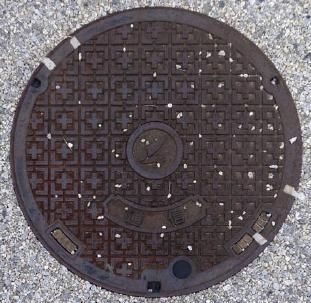
The watermark has a pattern that looks like a '+' enclosed in quotation marks, with the Cabinet Office emblem in the center. It seems that the emblem was changed when it was reorganized as a local branch of the Cabinet Office, and this emblem should be understood not as representing the Cabinet Office itself, but as the emblem of the Okinawa General Bureau. The fan-shaped text frame under the logo contains the word 'Communication'.
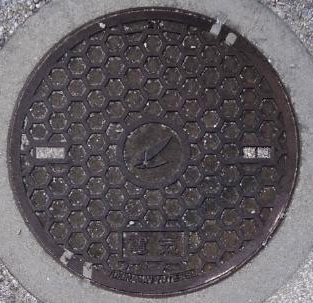
In the center of the tortoiseshell pattern is the mark of the Cabinet Office (Okinawa General Bureau), and below it are the characters 'Electricity'.
Generic
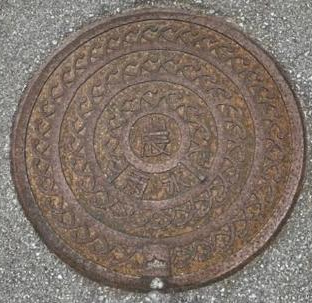
In the center of the lid with a wave-pattern design is the character '農', and just below it are the characters '雨水'.
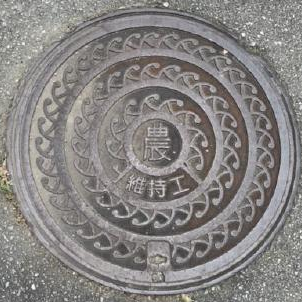
In the center of the lid with a wave crest pattern, the character '農', and just below it, the characters '維持工'.
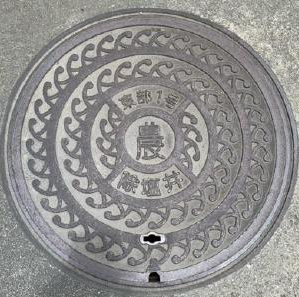
In the center of the wave-patterned lid is the character '農', just below it is '除塩井', and just above it is '東部1号'.
 Urasoe 浦添市
Designer
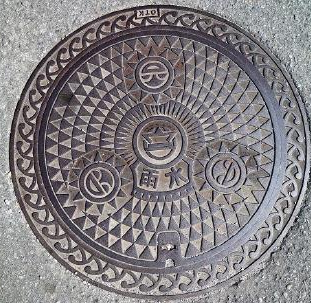
The name 'City of Tedako (Child of the Sun), Urasoe' comes from the time when Urasoe prospered as the royal government of the Ryukyu Kingdom, and King Eiso was respectfully called the 'Child of the Sun.' 'Teda (teida)' is an Okinawan word for sun, and 'ko' is the standard Japanese word for child. In Urasoe, the civic hall is called 'Tedako Hall,' and the name of the monorail station (Yui Rail), scheduled to open in 2019, is also decided as 'Tedako-Uranishi Station.' The manhole cover has the city emblem in the center, three smiling Tedako figures (?), and the sea is designed in the background. The standard size is 63 cm.
Emblem
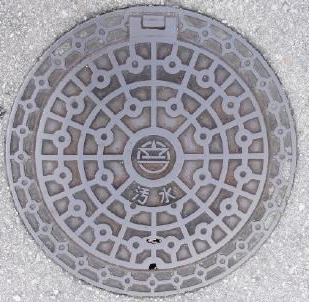
In the center of the standard is the city emblem, with the characters 'Sewage' below it. The receiving frame also has a pattern connecting the circles of the standard.
Fire Hydrant
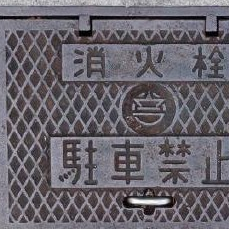
A fire hydrant cover with a diagonal lattice, the city emblem, and 'No Parking' on it.

In the center is the Urasoe City emblem. Around it, the inner circle has a tortoiseshell pattern, with 'No Parking' at the top and 'Fire Hydrant' at the bottom. The outer band has a polka dot pattern. The area outside the tortoiseshell section is yellow.
Related: Chubu Basin Sewerage 中部流域下水道
 Uruma うるま市
Handhole
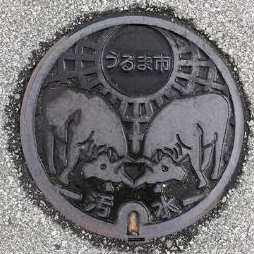
A small cover from the former Gushikawa City, with the old city emblem changed to 'Uruma City.'
Small sewer cover.
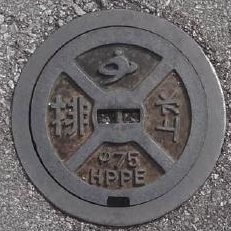
In the four quarters divided by a cross, there are the Uruma City emblem and the words '排', 'Φ75/HPPE', and '上水'. HPPE refers to the material of polyethylene pipes used for water distribution, meaning Higher Performance Polyethylene, and it seems that a 75 mm diameter distribution pipe is connected. '排' probably means exhaust.
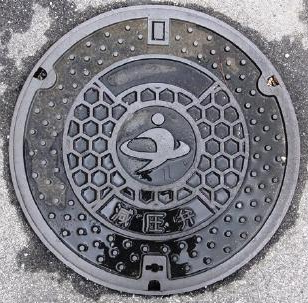
Inside the inner circle are the Uruma City emblem and the words 'Air Valve,' with a tortoise shell pattern as the background design. A band of dotted patterns surrounds the outside. There are lids with the same design but different words, such as 'Air Valve' and 'Pressure Relief Valve.'
Fire Hydrant
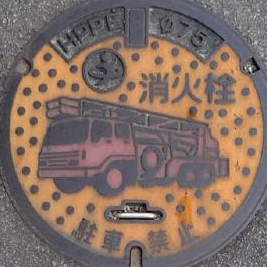
In the center of the dotted pattern is a fire truck, above it are the Uruma City emblem and the characters for 'fire hydrant,' and below are the characters for 'No Parking.' On the upper edge, 'HPPE' and 'Φ75' are written.
Other
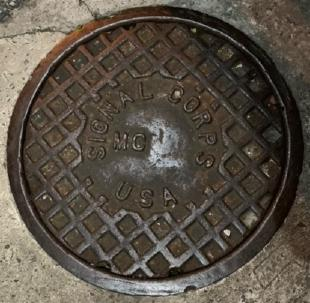
The lid has a diagonal lattice pattern, with the central part forming a plain circular area that has the letters 'SIGNAL CORPS USA' and 'MC'. It is a lid from the period of American governance and is said to be a lid of the United States Army Signal Corps. 'MC' seems to be the standard of the lid. There is also one in Naha City, so please take a look.
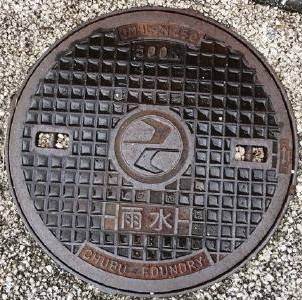
In the center of the lattice-patterned background is the seal of the Okinawa General Bureau. Below that are the characters 'Rainwater'.
 Former Ishikawa 旧石川市
Designer
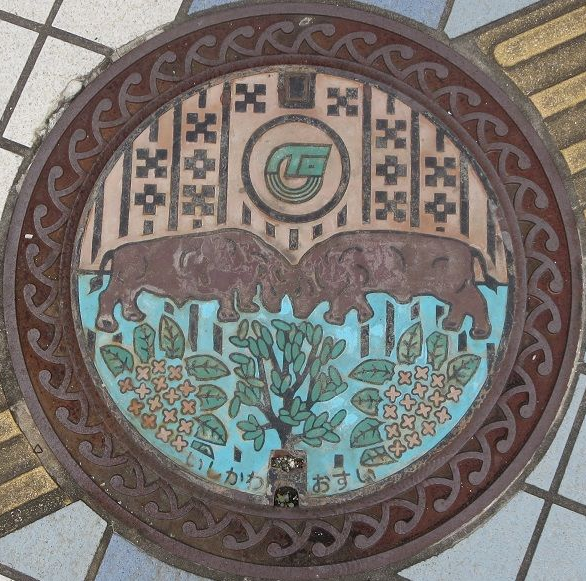
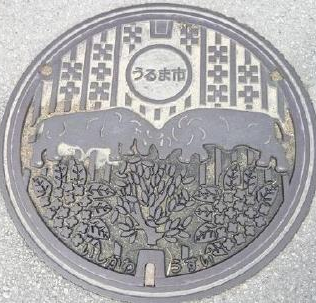
It is a manhole cover with the design of former Ishikawa City, where the Ishikawa City emblem part has been changed to 'Uruma City.' Features include Ina Menser weaving, bullfighting, and below, Ishikawa City's flower, Gardenia. The characters 'Ishikawa' and 'Usui.' A rainwater pipe manhole cover.
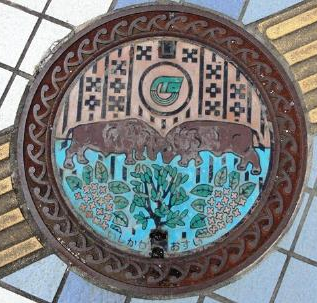
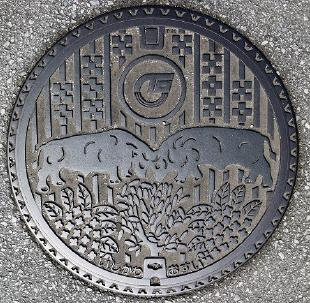
Former Ishikawa City (Ishikawa-shi) – At the upper center is the former Ishikawa City emblem, which stylizes the characters for 'Ishi' (stone) and 'Kawa' (river). Above it is Ihe Meshan weaving. The middle section features bullfighting. On the lower left and right are the flowers of former Ishikawa City and Uruma City, Sanderkan (Santan), and in the center is the tree of former Ishikawa City and Uruma City, Ryukyu Kokutan (Kuroki). The characters 'Ishikawa' and 'Osui' appear. The border frame has a wave crest pattern. Sanderkan, along with Deigo and Oogochou, is counted among the three famous flowers of Okinawa.
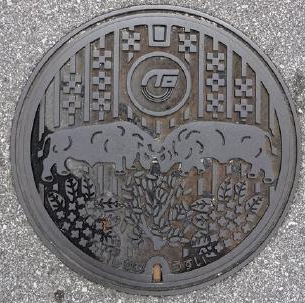
In the upper center is the former Ishikawa City emblem. From the top, Iha Mensa weave, bullfighting, and below, the city flower, sandanka. The characters 'Ishikawa' and 'Usui.' Rainwater pipe manhole cover.
Emblem
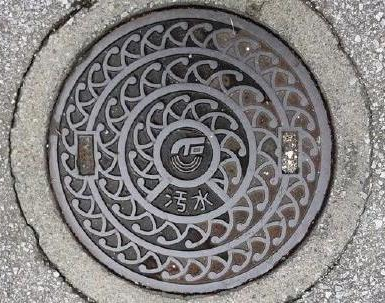
In the center of the wave-pattern, the former Ishikawa City emblem, with the characters 'sewage' below it. Handles on both sides.
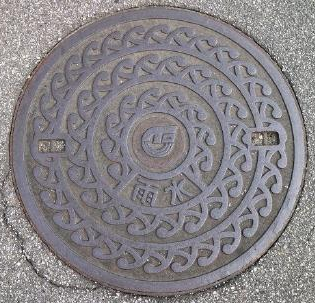
In the center of the wave crest pattern, the former Ishikawa City emblem, with the characters 'Rainwater' below it. There are handles on both sides.
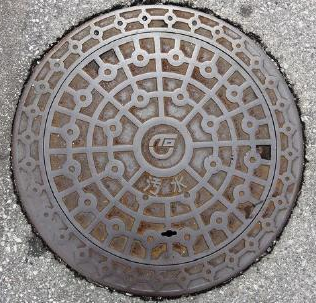
In the center of the patterned design is the former Ishikawa City emblem, with the characters 'Sewage' below it. The same pattern is also on the receiving frame.
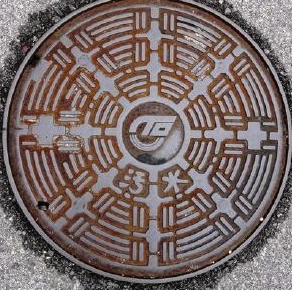
In the center of a pattern combining concentric circles and radial lines, the former Ishikawa City emblem, and below it, the characters for 'sewage'.
Rectangular
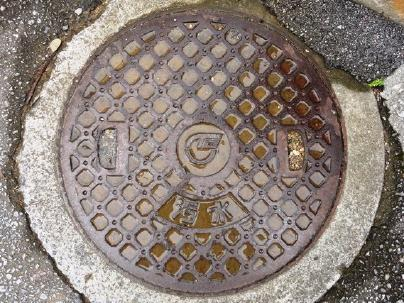
In the center of the pattern of rounded rectangles is the former Ishikawa City emblem. Below it are the characters 'Sewage'.
Handhole
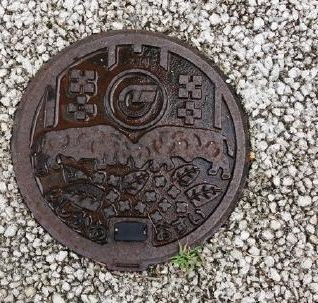
Former Ishikawa City emblem, Inami mensa weaving, small lid of Sandanka. The characters 'Ishikawa' and 'Osui.' Above the city emblem is 'T-14.' The mensa weaving, composed of five ■ and four ■, is said to contain a woman's feelings for a man from the time when the custom of visiting marriage existed, wishing 'Please continue to come to me diligently through the generations of five and four.'
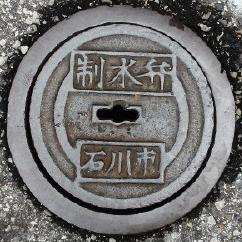
A gate valve cover with the emblem of the former Ishikawa City. There are covers with the same design but with different inscriptions: 'Gate Valve' and 'Water Control Valve'.
Fire Hydrant

A fire hydrant cover with a circular pattern. Former Ishikawa City emblem, the words 'No Parking' and 'Fire Hydrant.' Manhole size.
 Former Gushikawa 旧具志川市
Designer
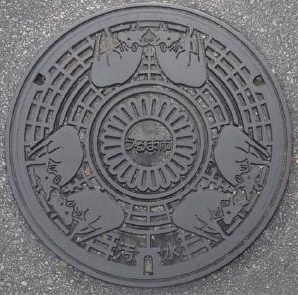
A design of chrysanthemums and bullfighting from the former Gushikawa City, with the center changed to the text 'Uruma City'.
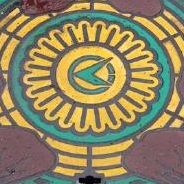
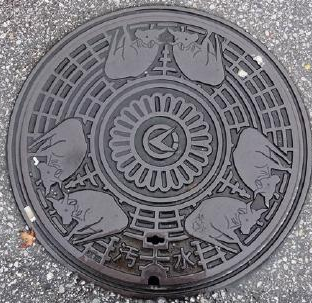
In the center is the flower of former Gushikawa City, the 'Chrysanthemum.' Inside it is the former Gushikawa City emblem designed with 'Gushi.' Then, scenes of three pairs of bulls fighting. The characters for 'sewage.' A colored sewage pipe manhole cover. This color scheme is because the flower of former Gushikawa City is the 'Chrysanthemum.'
Emblem
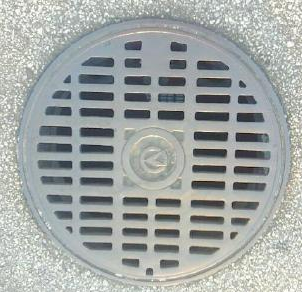
It is a medium-sized lid with the emblem of the former Gushikawa City in the center, and the entire lid has grid-like holes for rainwater collection.
Handhole
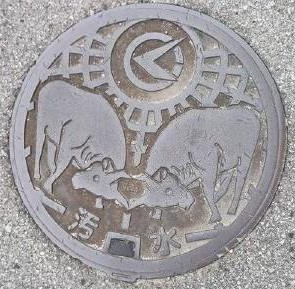
The famous bullfighting of Gushikawa is designed in a big way. The old city emblem and the words 'sewage.' The size is small.
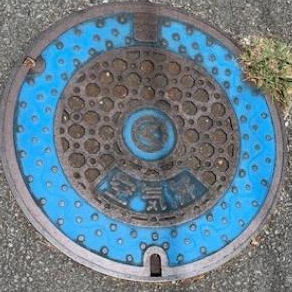
A ground pattern combining octagons and small squares, on a blue background with the former Gushikawa City emblem in the center, and the words 'Air Valve' below it; the outer edge is also blue with a polka dot pattern. There are lids with the same design but with different words: 'Water Control Valve', 'Mud Discharge Valve', and 'Air Valve'.
 Former Katsuren 旧勝連町
Designer
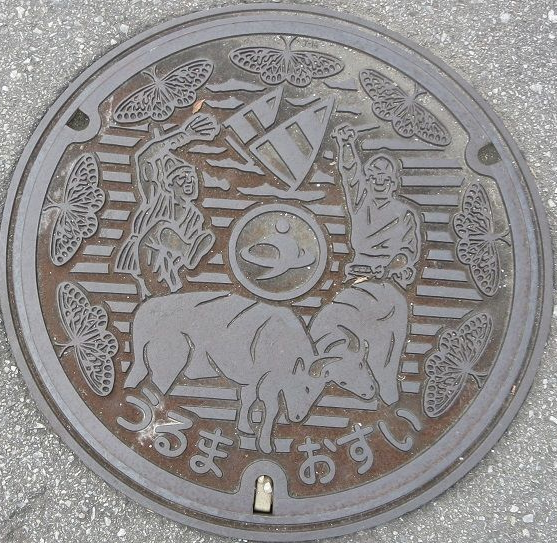
Around the city emblem are designs of the Eisa from former Katsuren Town, bullfighting from Gushikawa City, sailing on the Kaichu Road, and the city butterfly, the Great Eggfly. The characters 'Uruma' and 'Osui'.
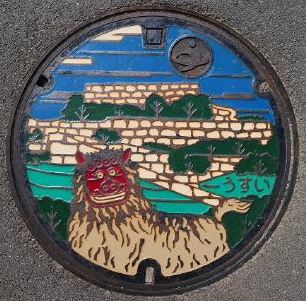
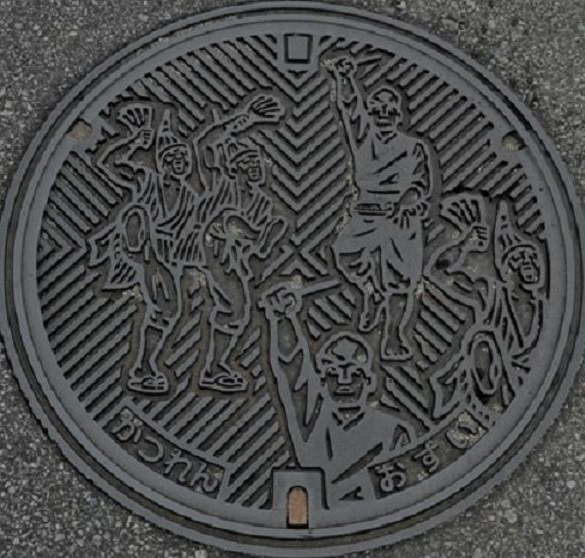
The lid and design are the same as the former Katsuren Town. Changed from 'Katsuren' to 'Uruma City Katsuren.' Chondara dancing while holding a kuba fan, young people holding a paranku (a single-headed drum about the size of a tambourine) and drumsticks. The words 'Uruma City Katsuren' and 'Sewage.' People who know would probably be able to tell which youth association it is from the costumes and posture. Sewage pipe manhole cover.
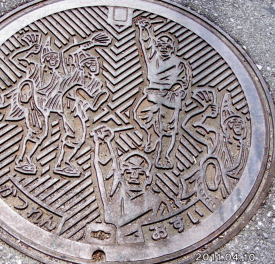
I am drawing Eisa. Eisa is a traditional performing art danced during the Obon festival in Okinawa Prefecture.
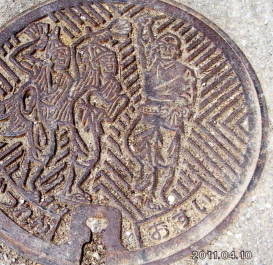
Design the eiser (slightly different from the above).
At the bottom, the characters 'Katsuren' and 'Osui'.
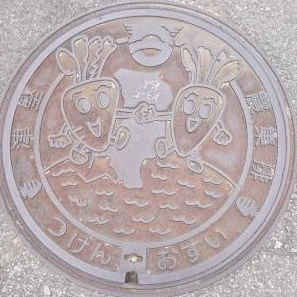
This is a manhole from Tsuken Island. Tsuken Island is also known as Carrot Ai Land, and carrot production is thriving there. The manhole depicts Tsuken Island and a character-like carrot, with the old Renshō Town emblem and the words 'Tsuken,' 'tsuken,' 'osui,' and 'Nōshūhai' around the outer circumference.
Handhole
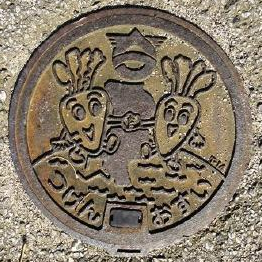
Small sewer cover in Katsuren Town, Tsuken. Under the arms of a carrot holding hands is a map of Tsuken Island. The long breakwater in the southwest of the island is depicted. Below it is probably the Pacific Ocean. The characters 'つけん', 'おすい', and 'T-14'.
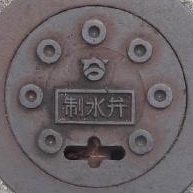
This is the cover of a small water control valve. The pattern of small circles arranged in a circle, commonly seen in Okinawa, is featured, but since it is small, there are seven circles. At the top center is the former Katsuren Town emblem, and below it are the characters 'Water Control Valve'.
 Former Yonashiro 旧与那城町
Designer
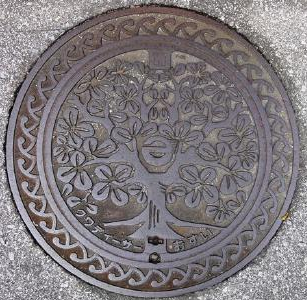
A large tree of the former Yonashiro Town's kuwai-dei-sa is depicted, and within it, the town emblem is shown. Kuwai-dei-sa is the Okinawan dialect name, and the standard Japanese name is Kobateishi (Momotamana). It is a large tree with leaves 20–30 centimeters in size, providing shade, and is commonly seen along coastlines. The words 'Kuwai-dei-sa' and 'Amamizu'.
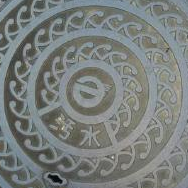
The background pattern has a wave crest design repeated three times, with the Yonashiro Town emblem in the center, and the characters 'Sewage' just below it.
Handhole
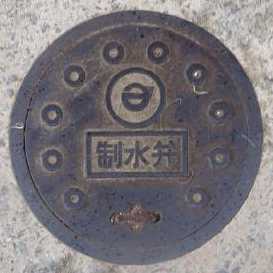
This is the cover of a small water control valve. It has a design similar to the one in Katsuren Town, but it is slightly larger and has 10 small circles. At the center top is the former Yonashiro Town emblem, and below it are the characters 'water control valve'.
Related: Chubu Basin Sewerage 中部流域下水道
 Okinawa 沖縄市
Designer
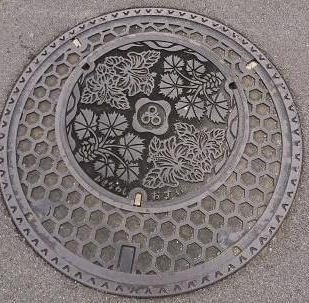
Designed with the city's tree, Biro, and the city's flower, Hibiscus. The city emblem of Okinawa City is in the center, with the words 'おきなわし' and 'おすい' at the bottom.
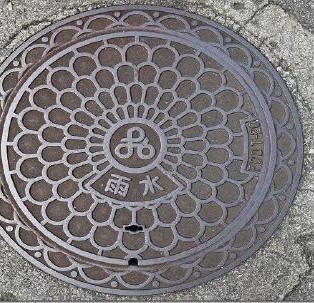
It is a lid with a 'Rainwater' marking featuring a four-petal design. The receiving frame has small dots between the petals.
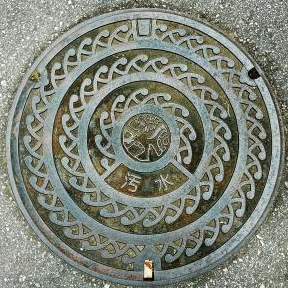
This is a sewage manhole cover at the zoo 'Okinawa Kodomo no Kuni' in Okinawa City. It has a wave crest pattern, and the center depicts animal tails and legs. It is an original mark of Kodomo no Kuni, but it was changed to a new logo after renovation. Just below that, the characters 'sewage' are written.
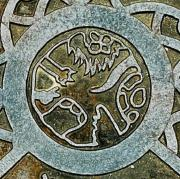
Emblem
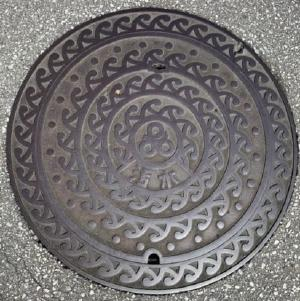
A rainwater pipe manhole cover with a wave crest pattern. The city emblem is in the center. It is labeled 'Rainwater.' The receiving frame also has a wave crest pattern, but the wave crests on the outside of the cover are sprinkled with water droplets.
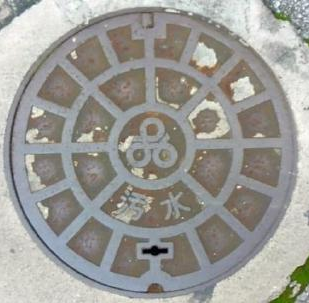
, In the center is the city emblem, surrounded by eight divisions, and outside of that are sixteen divisions on the lower lid. Just below the city emblem are the characters 'sewage,' with a single keyhole beneath.
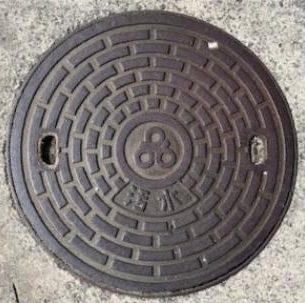
A ground pattern with rectangles arranged in concentric circles, the city emblem in the center, the characters 'Wastewater' just below, and horizontal hooks on the left and right of the center.
Handhole
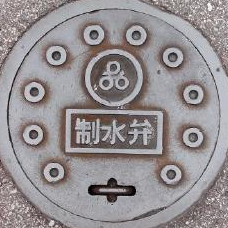
A water valve cover with a handle and a circular pattern featuring the city emblem and the characters for 'water valve.' There are covers with the same design but different characters, reading 'water valve' or 'mud release valve.'
Collaboration
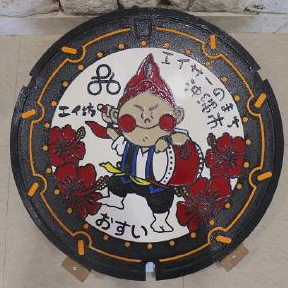
The city emblem, the city flower hibiscus, and the city's Eisa character 'Eibou' are featured in the design.
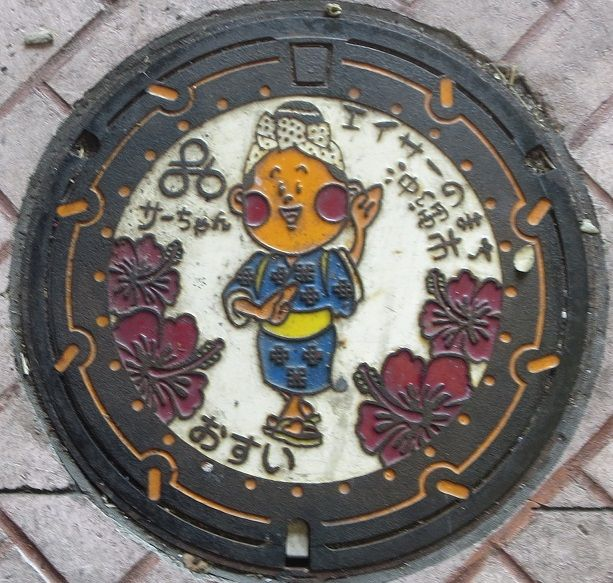
The words 'Eisa no Machi Okinawa City,' 'Sā-chan,' and 'Osui.' On the lid is Sā-chan performing a hand dance. The city's flower, hibiscus. The Okinawa City emblem. Around the lid is a design of a small drum. In the past, men played the drums and women performed hand dances, but in recent years it is also common to see women playing the drums. Other Eisa characters include 'Tā-kun,' who plays the small drum, and 'Sanajii,' a clown role in Eisa.
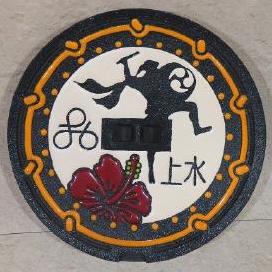
The emblem of Okinawa City and the characters for 'Josui' (Water Supply). Inside the design of the rope drum, there are people playing the large drum and dancing Eisa, along with the city flower, the hibiscus. Additionally, the design of the dancing people is the logo mark of the All Okinawa Eisa Festival.
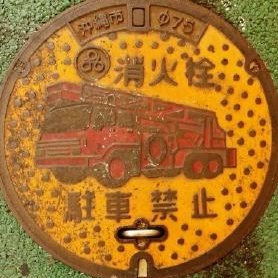
Red ladder truck on a yellow background with polka dots. From above: 'Okinawa City', 'Φ75', Okinawa City emblem, the words 'Fire Hydrant' and 'No Parking'. Round fire hydrant cover with handle.
 Former Koza 旧コザ市
Emblem
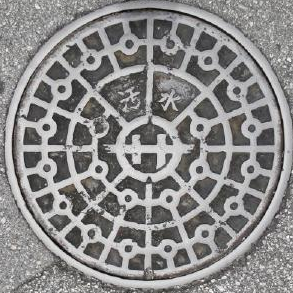
The standard lid is from the Koza City era. In the center is the Koza City emblem, with the character 'ザ' encircled with 'コ' in a circular design. It has the characters for 'sewage.' Since Koza City merged in 1974, this is an old lid.
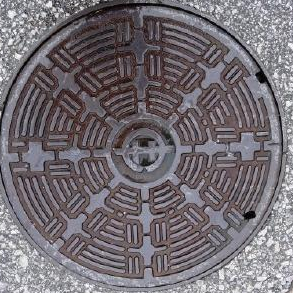
The center is the former Koza City emblem. A manhole-sized lid.
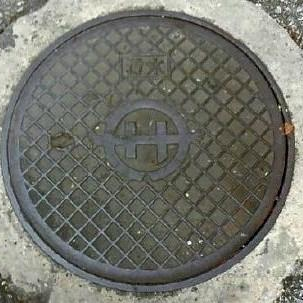
Diagonal lattice pattern, old Goza city emblem in the center, with the word 'Sewage' above. Sewage manhole cover
Handhole
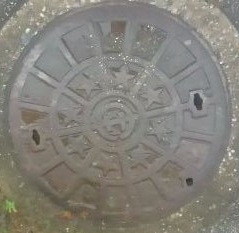
It is a lid surrounded by eight stars with the old Goza City emblem. Could it be a sewage manhole cover?
 Former Misato 旧美里村
Emblem
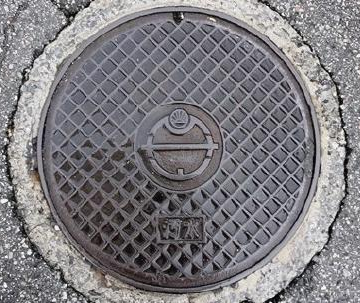
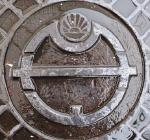
The center of the diagonal lattice pattern features the Misato Village emblem. The lower part has a notation for sewage. The village emblem has the katakana characters 'サ' and 'ト' in the middle and lower sections of a circle. Perhaps the protruding parts at 6 o'clock and the 'M' represent 'MI', or maybe the three lines of the arc and straight lines represent 'ミ'. The meaning of the morning sun is unclear.
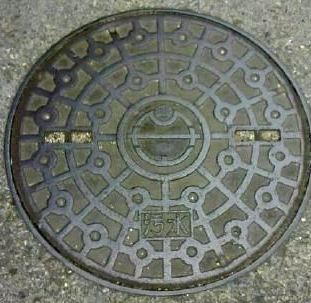
A standard patterned lid with the village emblem and the characters 'sewage'. Sewage manhole cover
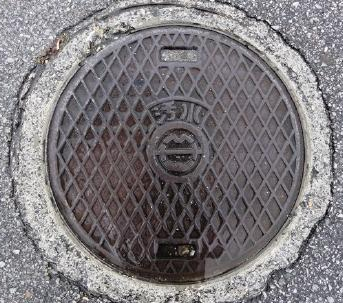
The center of the diamond-patterned background features the Misato Village emblem. At the top, there is a notation for sewage. This village emblem does not have a sun. Sewage service began in 1970, and the merger of Koza City and Misato Village occurred in 1974, so this period lasted slightly less than four years. It is unclear which one is newer or whether both were used simultaneously.
Related: Chubu Basin Sewerage 中部流域下水道
 Ginowan 宜野湾市
Designer
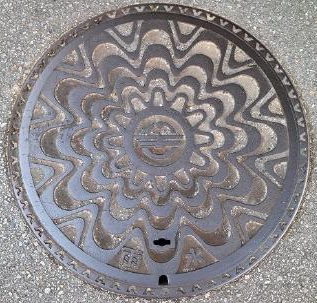
This is a cover labeled 'Rainwater.' According to the Okinawa Prefecture website, the design description is: 'Overall, it depicts an energetic image of citizens and a shining sun. The city emblem is placed at the center, and the ripples represent the celestial robes related to the city and the clear forest rivers, as well as the vitality of citizens striving for a healthy city, seeking peace and tranquility.'
Emblem
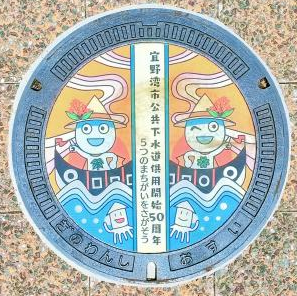
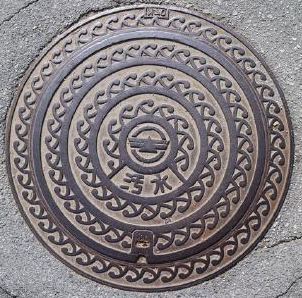
A wave pattern forms triple concentric circles, with the city emblem in the central circle and the notation 'Sewage' just below it. The receiving frame also has a wave pattern. The 'OTK' at the top is an abbreviation for the manhole cover manufacturer Okinawa Chūtetzu Kōgyō (OKINAWA TYUTETSU KOGYO).
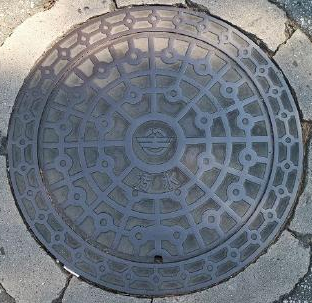
On the lid of the Tokyo city-style standard cover (derived type, divided into 8 inner and 16 outer segments), there is the city emblem in the center, and just below it is the inscription 'Sewage'.
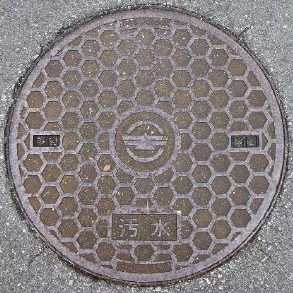
The entire surface has a tortoiseshell pattern, with the Ginowan City emblem in the center, hook holes on the left and right, and the words 'Sewage' and 'MHD-OTK' at the bottom. The vertical line in the 'Gi' character of the city emblem forms almost an equilateral triangle. OTK is the abbreviation for Okinawa Cast Iron Works, the only manhole cover manufacturer in Okinawa Prefecture.
Handhole
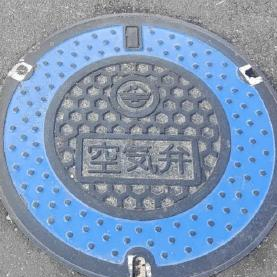
Tortoiseshell pattern, with the city emblem on top and the words 'Air Valve' below, the outer edge has a blue background with a polka dot pattern. The receiving frame has a pattern like mountains and valleys. There are lids with the same design but with different words, 'Shut-off Valve' and 'Air Valve'.
Fire Hydrant
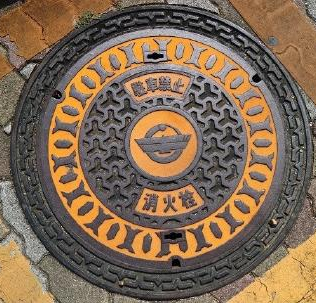
In the center of the Bishamon tortoiseshell pattern background is the city emblem, with 'No Parking' at the top and 'Fire Hydrant' at the bottom. Areas outside the Bishamon tortoiseshell pattern background are orange.
Collaboration
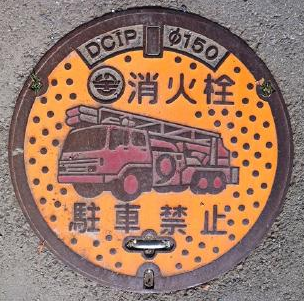
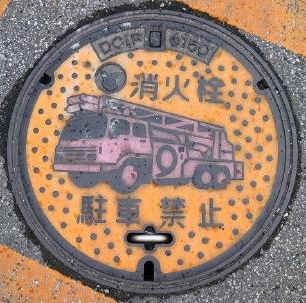
A design with a red ladder truck and dot patterns on a yellow background. The city emblem and the words 'Fire Hydrant,' 'No Parking,' and 'DCIP φ150.'
Other
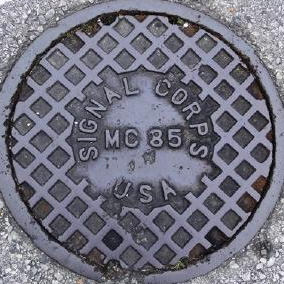
A manhole cover of the United States Army Signal Corps. MC-85 is one type of manhole cover. (MC-85 was listed on the bottom right of page 481 in the 'National Directory of Commodity Specifications.') It is probably from the period of United States administration until May 1972.

The letter 'S' is in the center of the standard cover. It's probably 'S' for sewage. This is a manhole located within the U.S. military base Camp Foster. I thought it might be American, but well, on the map it's Ginowan City lol.
Related: Chubu Basin Sewerage 中部流域下水道
 Tomigusuku 豊見城市
Designer
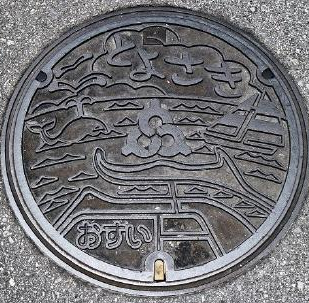
A design lid featuring the Tomigusuku City emblem at the center, with stylized representations of a whale in the East China Sea, a yacht, and a map of the Toyosaki district. It bears the inscriptions 'Toyosaki' and 'Usui'.
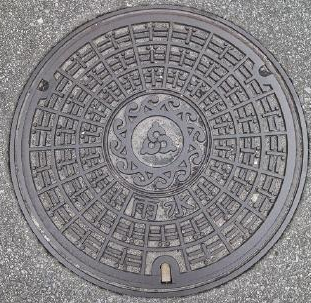
The outer pattern of "the city emblem in the center and the surrounding wave patterns" is a manhole cover design symbolizing a dragonfly taking flight in all directions, to maintain water quality where dragonfly larvae (nymphs) can survive. (From 'Thirty Years of Sewerage,' issued by the Okinawa Prefecture Sewerage Division, December 1994: from the Okinawa Prefectural Library collection) It includes the characters for 'rainwater.'
Emblem
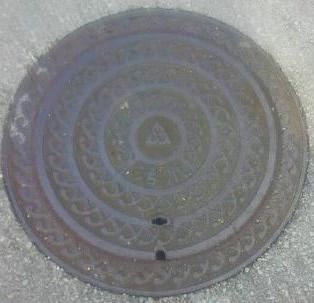
There are four rings of wave patterns around the city emblem. Just below the city emblem, the characters 'sewage' are written.
Handhole
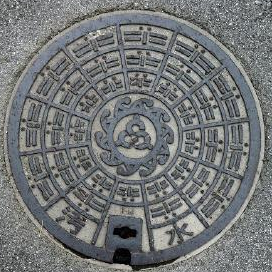
This is a small manhole cover (40 cm) with a design of a dragonfly taking off and circling three times. In the Hoei-mo district, this size of cover is installed on sewage pipes embedded in the roads, and there are even smaller covers for connections to each house, so although it is a small cover, it is probably not a public access point. The place name where it is installed is written as '保栄茂' and read as 'Bin.' Even though it is written with three kanji characters, it is only two sounds. It would likely be in the category of extremely difficult questions among place names featured in nationwide difficult place name quizzes.
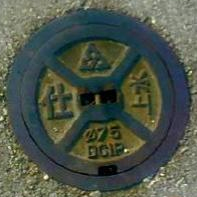
There is no city emblem, but the letters 'Seisuiban' and 'Tomishiro' are on the center of the lid. There are 10 circular rings around the edge. There is a handle on the bottom. The reading of 'Toyomijo' varies: Toyomijo (Tomishiro) Elementary School, Toyomijo (Tomigusuku) Junior High School, Toyomijo (Tomishiro) High School, and Toyomijo (Tomigusuku) City, but this is a (Tomishiro) lid. The same design also exists with the words 'Shikiriben' or 'Seisuiban'.
Fire Hydrant

A ladder truck and the city emblem, with 'No Parking' above and the characters 'Fire Hydrant' below, flanked by 'DCIP' on the left and 'Φ100' on the right. The background is orange with a pattern of concentric polka dots.

In the center, a ladder truck on a yellow background with polka dots. At the top, the city emblem and the words 'Fire hydrant,' and at the bottom, the words 'No Parking.' Above the keyhole, there is a handle.
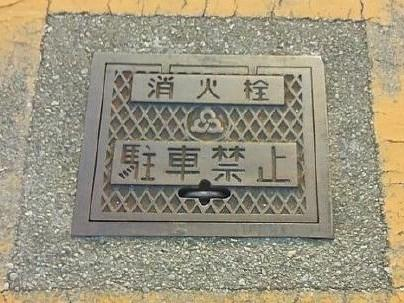
Diamond-shaped ground pattern, with the words 'Fire Hydrant' above the city emblem and 'No Parking' below it, and a single handle underneath.
Related: Chubu Basin Sewerage 中部流域下水道
 Nago 名護市
Designer

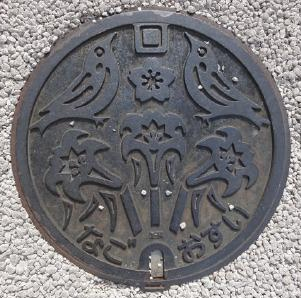
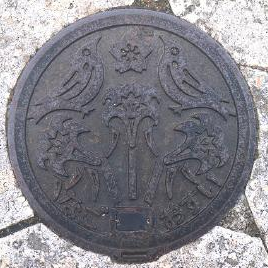
This is a manhole cover designed with Nago City's symbols: "Kanhizakura" (Kanhi cherry), "Teppou Lily," "Ryukyu White-eye," and "Himpun Gajumaru." The city emblem is in the center, the Ryukyu White-eye, a symbol of spring, at the top, and the pure white and elegant Teppou Lily at the bottom, with Kanhizakura surrounding them. The vibrant blue on the back is colored to represent the beautiful Nago Bay, symbolizing the rich nature of our city. The final piece, the Himpun Gajumaru, is a giant Gajumaru tree (an evergreen of the mulberry family) designated as a national natural monument and is hidden somewhere within the design. Can you find it? Let's go Gajumaru!!
*The 2 o'clock and 10 o'clock positions on the front and back of the card's cover are different.
There are also covers with the same design but with the words "Shikiriben" (shut-off valve) or "Kuukiben" (air valve).
Emblem
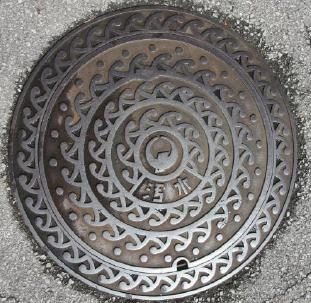
The city emblem is at the center, with the waves of the East China Sea drawn in concentric circles. The characters for 'wastewater'.
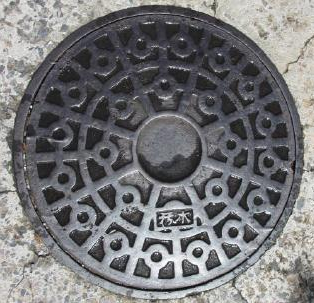
The JIS standard lid has the word 'sewage' on it.
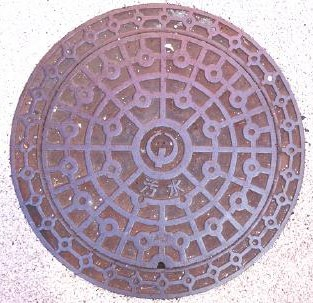
A standard-type cover with the city emblem and the word 'Sewage'. The receiving frame has the same pattern as the standard. A sewage pipe manhole cover.
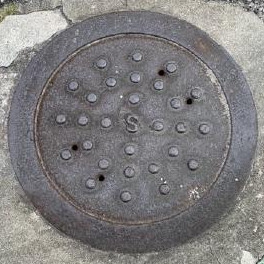
Circles are arranged concentrically, with the letter 'S' in the center. It is a sewage manhole cover. There are four holes.
Handhole
Ryukyu white-eye, Hikan cherry, trumpet lily with 'Nago' and 'Wastewater' written, and between them the characters 'T-14'.
Small sewer manhole cover.
This is a public sewage manhole cover (φ25cm). The characters 'T-8' are on the top.
Fire Hydrant
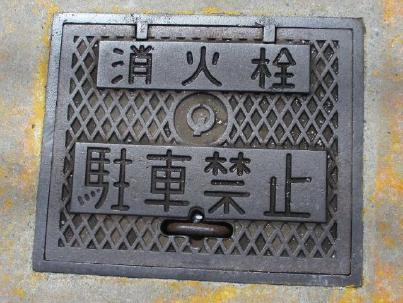
A diagonal lattice pattern with 'Fire Hydrant,' the city emblem, and 'No Parking' signs on top.

Yellow background with polka dot pattern, Nago City emblem and the characters 'Fire Hydrant.'
Square fire hydrant cover.
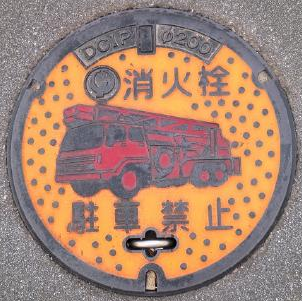
A familiar design of a red 'ladder truck' in the center of yellow polka dots. At the top, the 'city emblem,' 'fire hydrant,' 'DCIP Φ200,' and at the bottom, the words 'No Parking.'
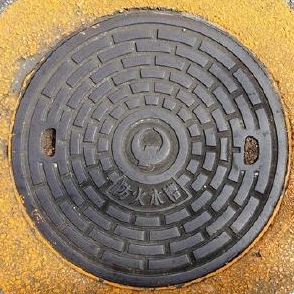
In the center of the ground pattern with squares arranged on the circumference is the Nago City emblem. Below it are the characters for fire-fighting water tank. A fire-fighting water tank cover the size of a manhole.
Collaboration
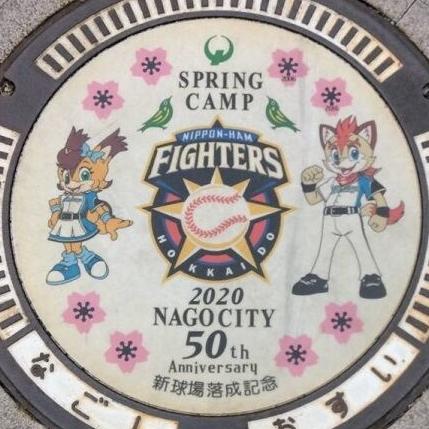
This is a specially designed manhole cover created to commemorate the renewal of Nago City-operated Stadium (Tapic Stadium Nago), where the Hokkaido Nippon-Ham Fighters hold their spring training, in collaboration with Nago City, which is celebrating its 50th anniversary as a city. The cover features the Kanhi-zakura, the earliest blooming cherry blossoms in Japan, which are at their best in late January when the spring training begins. In addition, the design includes the team mascots, Frep and Polly, expressing the excitement of the arrival of spring and the start of the training camp. During the time of the spring training games, why not explore the manhole covers while enjoying the beautiful spring scenery around the stadium, such as Nago Bay and Kanhi-zakura blooming in Nago Castle Park, and experience the spring in Nago? Acquisition date: June 19, 2020
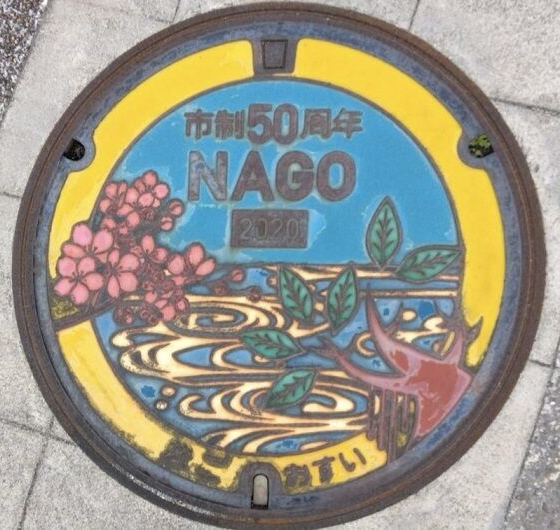
Nago City was established on August 1, 1970, through the merger of one town and four villages (Nago Town, Yabe Village, Haneji Village, Kushi Village, and Yagaji Village) and will celebrate its 50th anniversary on August 1, 2020. To commemorate this, a color-designed manhole cover was selected through a public contest. The design features 'Nago Bay and the blue sky' as the background, with the city's symbols 'Kanhizakura' and 'Himpun Gajumaru' placed on the left and right. At the top are the words '50th Anniversary of City Organization,' 'NAGO,' and '2020,' and along the lower part of the yellow outer ring are the characters 'なご おすい.' As of the time the photo was taken, only a display cover exists, and no actual installed covers appear to be in place.
 Nanjo 南城市
Designer
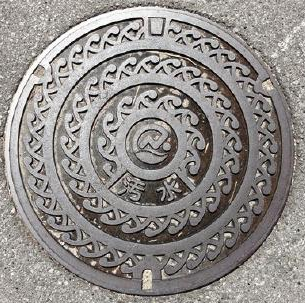
In the center of the wave crest pattern, the Nanjo City emblem. The characters for 'sewage'.
Handhole
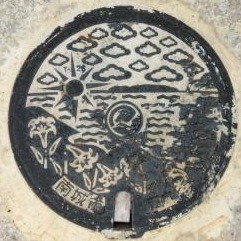
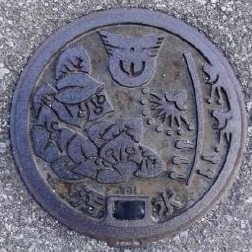
It is a small lid with the design of the former Chinen Village, which has been changed to the emblem and city name of Nanjo City. It depicts the sun, the sea, the sky, and the former Chinen Village's flower, the Easter lily.
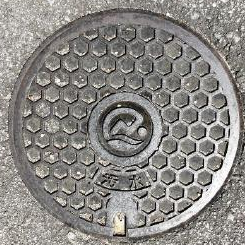
A small lid with the Nanjo City emblem in the center of the tortoiseshell pattern. The word 'sewage' and the notation 'T-25' within the tortoiseshell at 0 o'clock.
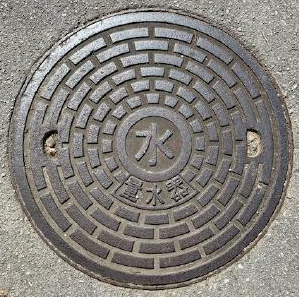
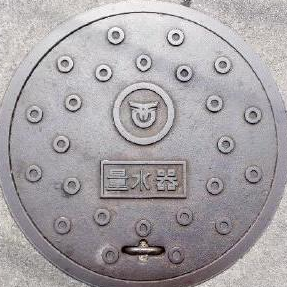
A concentric circle pattern with the character '水' in the center, and just below it, the characters '量水器'.
Fire Hydrant
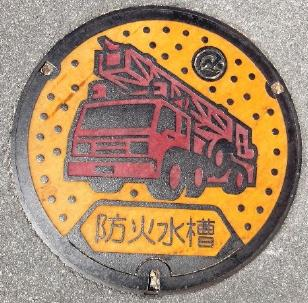
A fire water tank cover, manhole-sized, with a red ladder on a yellow polka dot background. The Nanjo City emblem is in the upper right diagonal.
Collaboration
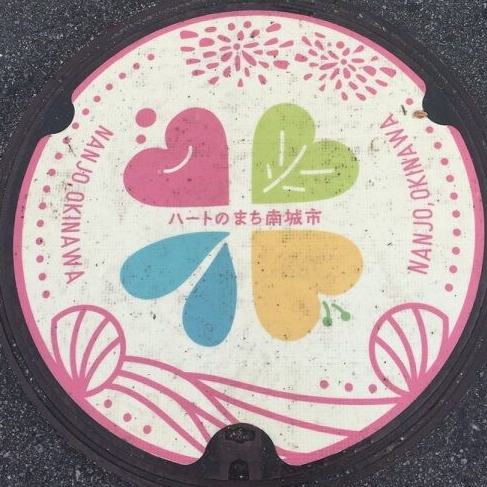
Nanjo City was established in 2006 through the merger of four towns and villages. Because the overall shape of the map after the merger resembles a heart, the city made a 'Declaration of a Heart Town' and promotes town development inspired by this. The central emblem is the logo of the 'Heartbeat Project (nickname: "Chimu Chimu Nanjo")' operated by the City Chamber of Commerce and Industry. Combining the heart made up of four elements—'lush greenery throughout the city,' 'flowers blooming in each season,' 'abundant water,' and 'the spreading heart of kindness'—forms a 'four-leaf clover of happiness.' The words read 'Heart Town Nanjo City' and 'NANJO, OKINAWA.' This is the lid of a seal.
 Former Sashiki 旧佐敷町
Emblem
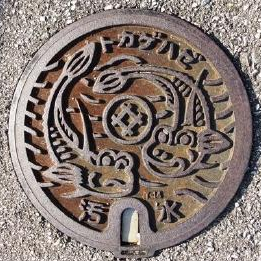
In the center, around the emblem of the former Sashiki Town, mudskippers are swimming. It's interesting that the two have different expressions. The mudskippers, which live in the muddy tidal flats like the giant mudskipper, are said to have their northernmost habitat in Sashiki.
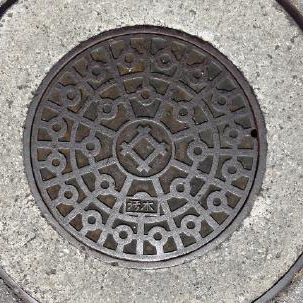
In the center, the former Sashiki Town emblem, and below it, the characters 'Wastewater.' A wastewater pipe manhole cover.
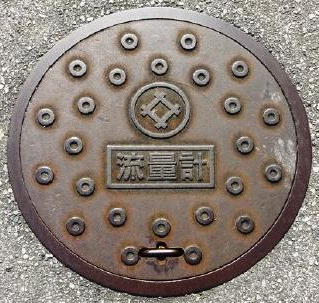
A manhole-sized flow meter cover featuring the former Sashiki Town emblem in a circular pattern.
Handhole
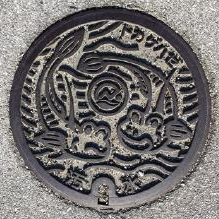
A small version with the same design as above. The characters 'Tokagehaze', 'Sewage', and 'T-25'.
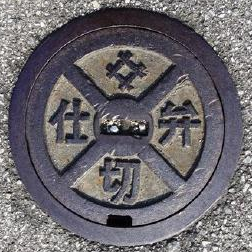
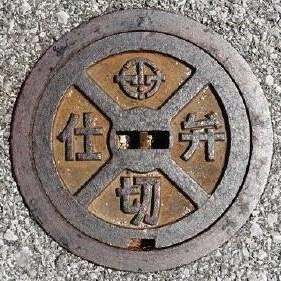
A valve cover separated into four parts by 'X', with the Sashiki Town emblem and the characters '仕', '切', '弁' on the valve cover.
Fire Hydrant
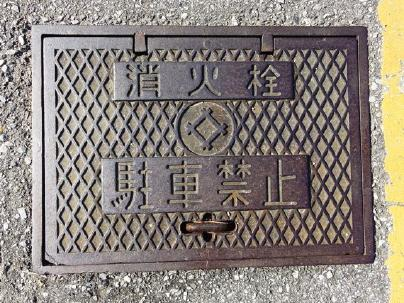
In the center of the mesh pattern is the former Sashiki Town emblem, with the words 'fire hydrant' and 'no parking.' Square fire hydrant cover.
 Former Ozato 旧大里村
Designer
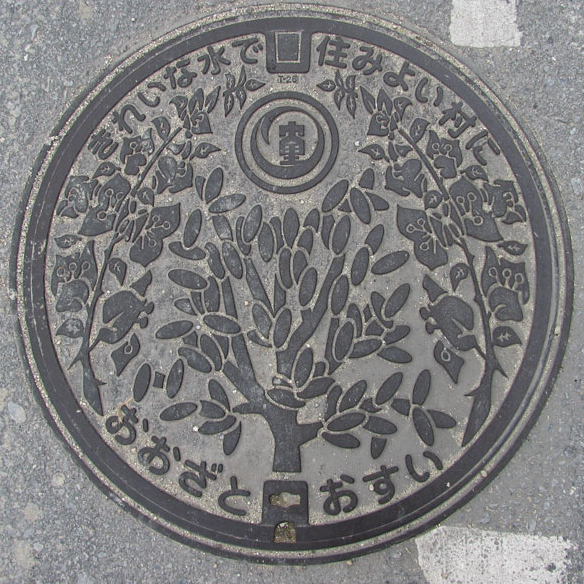
For sewage of former Ozato Village. This flower is probably 'Bougainvillea.' The tree is 'Ryukyu Kokutan'? The old village emblem is easy to understand because it uses the kanji 'Ōzato'.
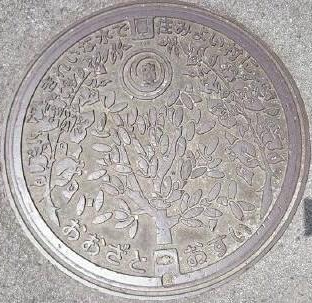
The design of the village flower bougainvillea on both sides of the village tree Ryukyu Kokutan. The village insignia and the words "Ozato" and "Osui" at the bottom of the inscription read "In a village that is livable with clean water" at the top. Ryukyu Kokutan is the finest material of the three lines.
Emblem
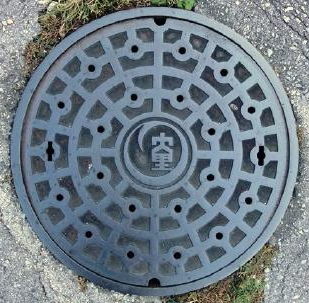
Inside the perforated JIS standard lid is the former Ozato Village emblem. A manhole-sized lid.
 Former Chinen 旧知念村
Designer
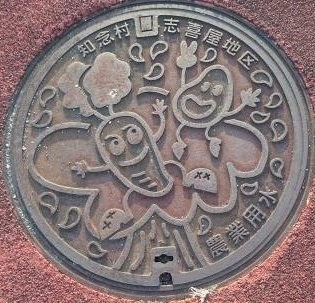
Okinawa has specialty island carrots, Kinbi carrots, and a dish called carrot shirishiri... so maybe it's carrots? It is depicted in a personified form. At the top, it says 'Chinen Village' and 'Shikiya District,' and at the bottom, 'Agricultural Water.'
Agricultural water manhole cover.
Emblem
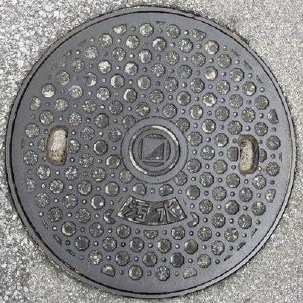
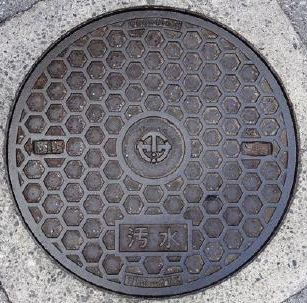
A hexagonal patterned sewage pipe manhole cover. In the center, the emblem of former Chinen Village, and below it, the characters for 'sewage'.
Handhole
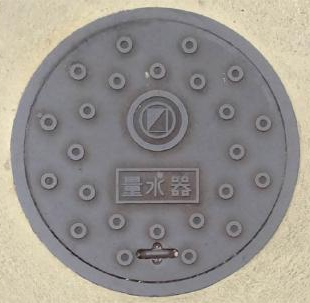
In the center is the old village emblem and the characters 'Water Meter,' surrounded by two concentric small circles. This is a water supply system design commonly seen in Okinawa.
Fire Hydrant
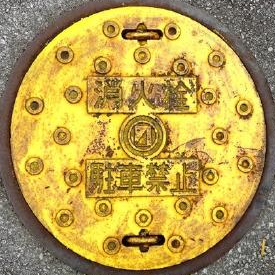
A round fire hydrant cover painted yellow. In the center of the circular pattern is the former Chinen Village emblem. The words 'Fire Hydrant' and 'No Parking'.
Other
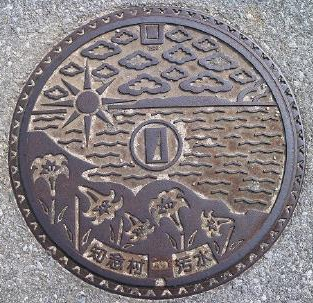
The central emblem is the emblem of former Chinen Village.
The village emblem is a design representing the symbol of 'Sefa Utaki,' one of Okinawa's World Heritage sites located in the village.
It symbolizes the blazing sun, the sea, the sky, and the Chinen Village flower, the Easter lily.
'Utaki' refers to a sacred site where rituals are conducted.
 Former Tamagusuku 旧玉城村
Designer
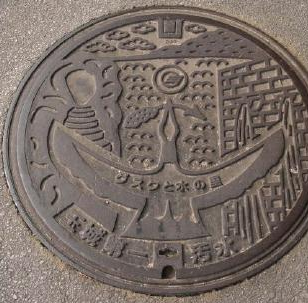
Since it has been recognized as one of the '100 Water Towns' under the theme 'Castles (Gusuku) and Water Villages,' Tamagusuku Castle and the spring-fed Kakinohana Hija are depicted. It also shows that this area became the birthplace of rice cultivation, as a crane that flew from China dropped rice ears here.
The village emblem of former Tamagusuku Village and the characters 'Tamagusuku First Sewage'.
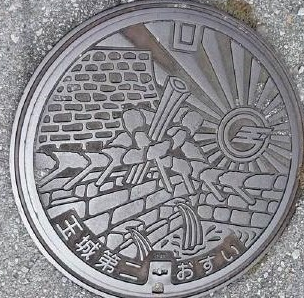
Designed with the traditional tug-of-war and a spring water site called Kakinohana Hījā. Includes the village emblem and the words 'Tamaki No. 2' and 'Osui'.
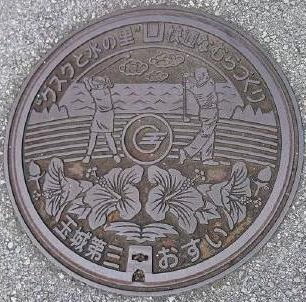
It is a design featuring the village flower, the hibiscus, and golf. There seems to be a large golf course nearby called the Ryukyu Golf Club, which is represented in the design. It includes the village emblem, with the words 'Kusu-ku and the Village of Water' and 'Comfortable Village Building' at the top, and 'Tamaki Third' and 'Sewage' at the bottom.
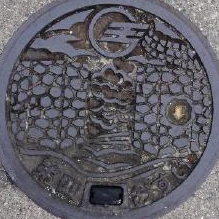
Designed with the stone walls and spring water of the gusuku (castle). The upper part features the emblem of the former Tamagusuku Village, and the lower part has the characters 'Tamagusuku Fourth' and 'Storm Drain'.
The village flower of Tamaki, the crepe myrtle, and Eisa are featured in the design. The village emblem is in the center, with the words 'Tamaki Fifth' and 'Wastewater' at the bottom.
Oku Island, famous for its tempura. In the center, there is the village emblem and 'T-25', surrounded by designs of tropical sea fish. The characters 'Tamagusuku' and 'Osui'.
Handhole

A mesh-patterned ground design with the emblem of former Tamagusuku Village and the characters for the shut-off valve. Shut-off valve cover.
Fire Hydrant

A square fire hydrant cover painted yellow. 'No Parking' is written at the four corners, and 'Water', 'Fire Hydrant', and the former Tamagusuku Village emblem are written from the top center.
Related: Chubu Basin Sewerage 中部流域下水道
 Miyakojima 宮古島市
Designer
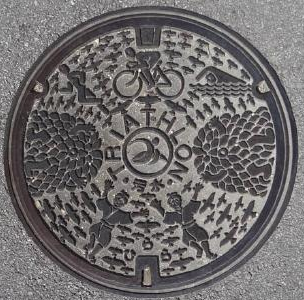
It is the same design lid as that of former Hirara City, but it has the emblem of Miyakojima City, formed after the merger, in the center.
Emblem
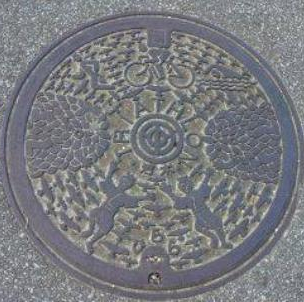
It is the Miyako Island triathlon and the island’s Pantūn and Kuichā (dance). Around, Brahmin kites are flying. Around the emblem of Hirara City are the words 'TRIATHLON' and 'sewage,' and at the bottom, the characters 'Hirara.' Pantūn is said to be a traditional event of exorcising evil spirits, where three gods—a parent, an adult, and a child—covered with mud-covered vines come to the village.
Handhole
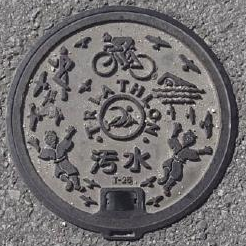
It is the same design cover as former Hirara City, but a small cover with the emblem of Miyakojima City after the merger in the center.
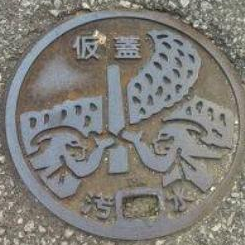
It is a design of a manhole from the Yonabaru Town Yonabaru Great Tug-of-War, with the design carved out and the words 'temporary cover' and 'sewage' added.
Generic
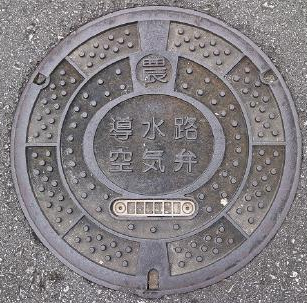
In the large oval in the center, written in two lines is 'Water Conduit Inspection Hole,' with the character 'Agriculture' at the upper part of the inner band. The outer band is divided into eight sections, and both the inner and outer bands have numerous dot-like protrusions. Because a water conduit for sending agricultural water from the underground dam in Miyakojima to Irabu Island is attached to the Irabu Bridge, there are several of these covers on the roadway of the bridge as well, but this one was taken near the bridge approach.
 Former Shimoji 旧下地町
Designer
The above parent and child. The parent lid has a tortoiseshell pattern.
Handhole
A handhole cover with a hibiscus pattern of the manhole cover design, only on the inside. The old town emblem in the upper right has been removed.
 Former Gusukube 旧城辺町
Designer
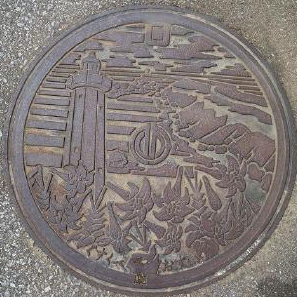
The scenic spot of Miyako Island, Higashi-Hennazaki, and the lighthouse at the tip of the cape, Hennazaki Lighthouse, feature the town's flower, the Easter lily, which blooms profusely in early summer, in their design.
 Former Irabu 旧伊良部町
Handhole
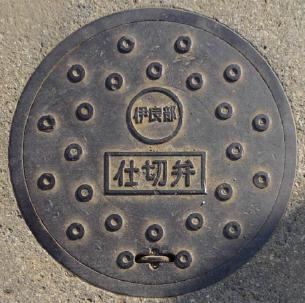
It has the same design as above, but it includes the characters 'Irabu' instead of the old town emblem and the characters 'Shikiriben'.
Related: Miyakojima Water Supply Enterprise Union 宮古島上水道企業団
 Kadena 嘉手納町
Designer
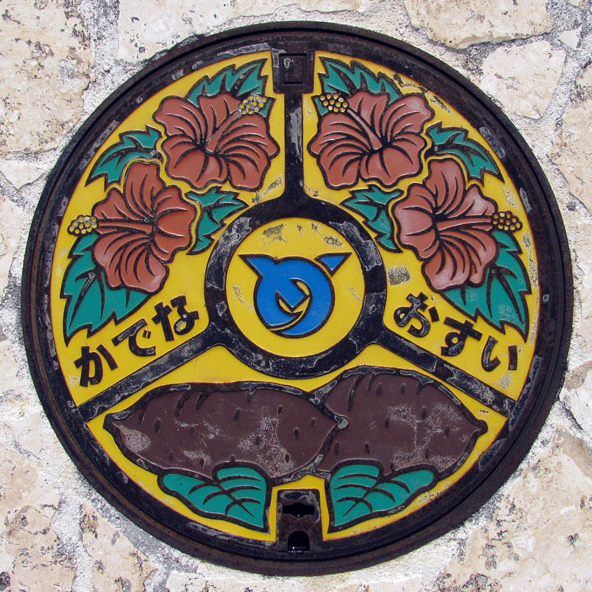
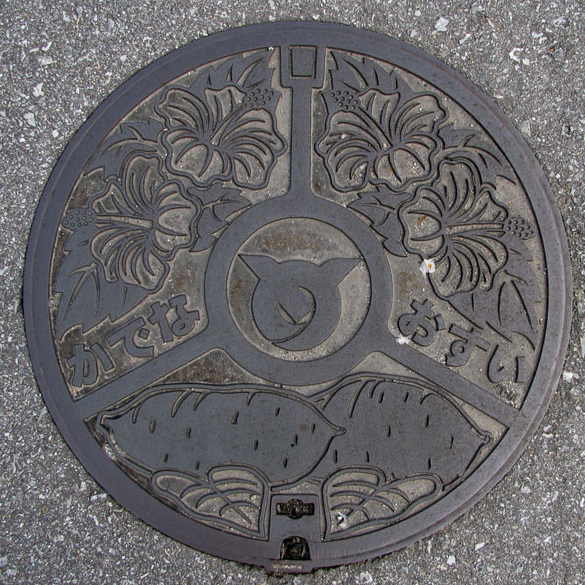
A colored manhole cover for sewage featuring the town's flower, the hibiscus, and purple sweet potato. In the center, the town emblem stylizes the 'Ka' from 'Kadena'.
Emblem
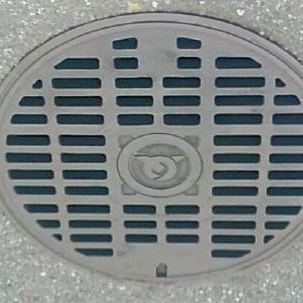
Lattice-patterned perforated lid, with the town emblem in the center.
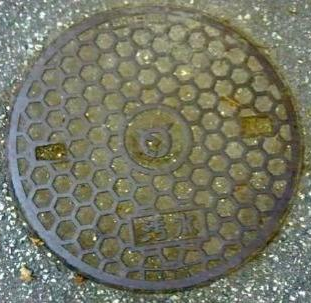
Tortoiseshell-patterned background, town emblem in the center, the word 'Wastewater' below. Hooks on both sides.
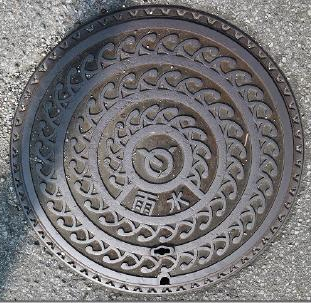
Wave crest patterns form three concentric circles. In the center, the 'town emblem,' and just below it, the notation 'rainwater.' A keyhole is at the bottom.
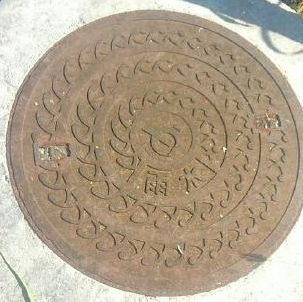
A lid with a wave-pattern design, the town emblem, and the characters 'Rainwater.' There are hooks on the left and right for opening and closing.
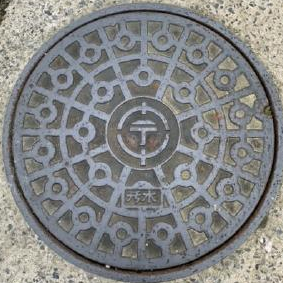
JIS cover, unknown mark in the center, with the characters 'sewage' below it.
Handhole
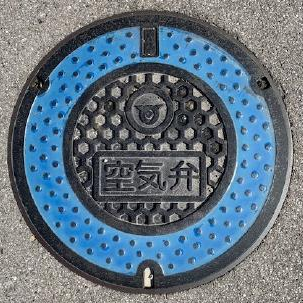
The town emblem and the words 'air valve' on a tortoiseshell-patterned background, surrounded by blue with polka dots.
Related: Chubu Basin Sewerage 中部流域下水道
 Kin 金武町
Designer
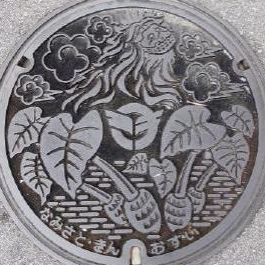
The central town emblem is a design of the katakana character 'キン' incorporated into the image of a circle and wings. At the lower part of the lid, there is taro. Kin Town is a production area for taro (in Kin Town, called 'taamu'). The upper part features the shishimai (lion dance) of Namisato District, which has a history of over 100 years. In Okinawa, the lion dance's body is not made of cloth; both the body and legs are made from banana fibers. The markings read 'Namisato Kin' and 'Osui.' 'Namisato Kin' refers to Namisato District and Kin District, the five administrative areas of Kin Town. In Kin Town, agricultural settlement drainage lids are made with different designs for each district. (Nagawa District uses purification tanks)
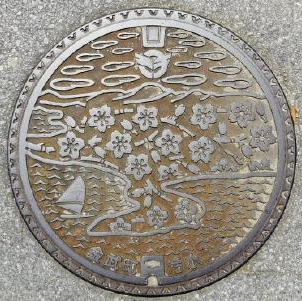
On top, the Kin Town chapter. Kin Cape and the town's flower, the cherry blossom, windsurfing in Kin Bay. And the tallest of the mountain range in the background is probably Onna-dake. However, Kin Cape has facilities like the U.S. military's Blue Beach training area, and the area around Onna-dake is also within Camp Hansen's live-fire training grounds, so the general public is prohibited from entering. The labels 'Kin Town' and 'Sewage'.
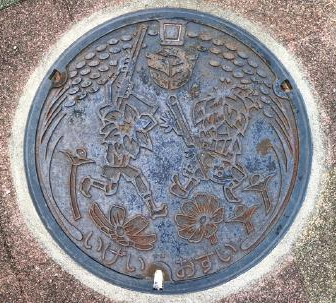
Rice ears on both the left and right sides. Cosmos flowers at the bottom. In the center, the design features the dance of 'Minami Nu Shima (Fēnushima)' of Igei, designated as an intangible folk cultural property of Kin Town. It is painted in a light blue color. The town emblem and the inscriptions 'Igei' and 'Osui' are included. Kin Town is known as a rice-producing area. There are two harvests per year: the first planting in March with harvesting in June, and the second planting in August with harvesting in November, followed by sowing cosmos seeds which bloom around February. The rice fields near the Igei district community center become a vast cosmos field. 'Minami Nu Shima' is a unique folk performing art where performers wear headdresses made of red-dyed banana fibers that cover the entire face and dance while holding sticks.
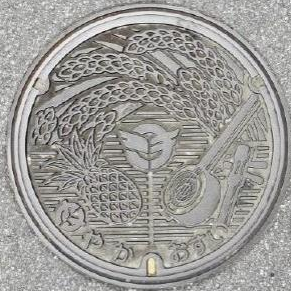
The center is the Kin Town emblem. Above is a rice ear, the lower left is a pineapple, and the lower right is a kankara sanshin. In June 1945, the U.S. military established a Japanese prisoner-of-war camp in Yaka, Kin Town. About 7,000 surrendered Japanese soldiers were detained there until it was closed in February 1946. In that camp, the kankara sanshin was made using empty cans, available wood, and parachute cords as strings. The songs created were Okinawan folk songs that expressed the futility of war, known as the "Yaka-bushi." The notation "やか" and "おすい".
Emblem
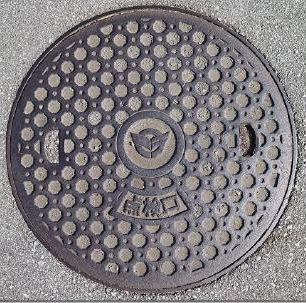
A pattern of dots in the intersections where octagons are connected in all directions. The town emblem in the center. Below it, the characters 'Inspection Port.' Handles on both sides.
Handhole
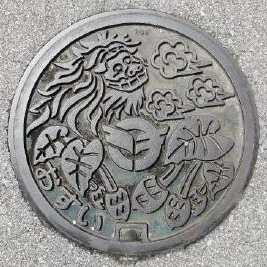
A small sewer cover designed with the town emblem, taro, and a lion dance. I'm curious about the cloud-like thing. I wonder what it is.
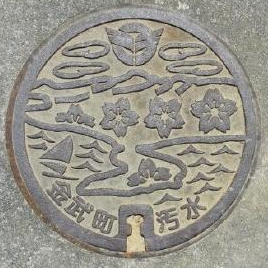
Cape Kin, cherry blossoms, windsurfing, and the Onna Mountain Range and village emblem. The words 'Kin Town' and 'sewage' are written. Small sewage cover.
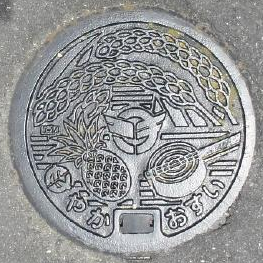
The center features the Kin Town emblem, with a pineapple and rice ears. At the lower right is a kankara sanshin. The notations 'yaka' and 'osui'. 'Yaka' refers to Yaka District, one of the five administrative districts of Kin Town. The symbol mark to the left of 'Yaka' is probably the Yaka District emblem designed based on 'Yaka'. Don’t you think the lid looks similar to a 5-yen coin? A small sewage lid.
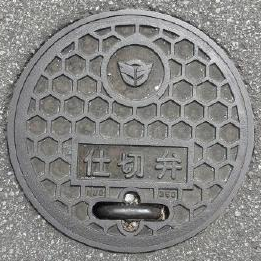
On a tortoiseshell-patterned background, the Kin Town emblem and the marking of the shut-off valve. Shut-off valve cover.
Fire Hydrant
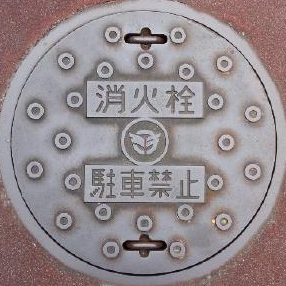
A circular ground pattern with the words 'Fire Hydrant' and 'No Parking' and the Kin Town emblem in the center.
Round fire hydrant cover.
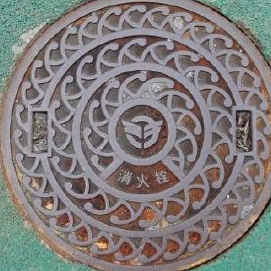
The Kin Town emblem in the center of the wave pattern. Below it, the characters 'Fire Hydrant.'
Round fire hydrant cover.
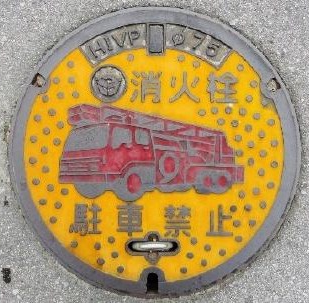
Yellow background with polka dots, red ladder truck, Kin Town emblem, the markings 'HIVP (impact-resistant rigid PVC pipe)', 'Φ75', 'fire hydrant', and 'no parking.' Round fire hydrant cover.
Collaboration
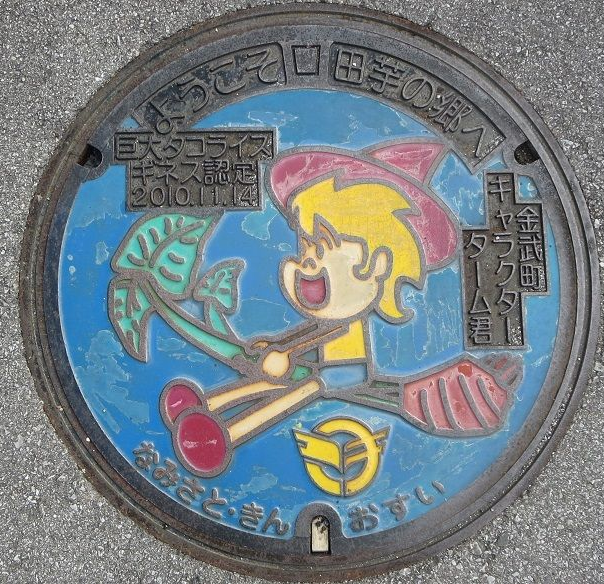
In the center is Term-kun, the wizard. If someone is feeling down, he flies over on the taro-shaped 'Term Jet' and cheers everyone up by serving taro dishes. And the yellow town emblem. 'Welcome to Taro Village,' 'Giant Taco Rice Guinness Record 2010.11.14,' 'Kin Town Character Term-kun,' 'Namisato Kin,' 'Sewage' are written. Kin Town is the birthplace of taco rice. The giant taco rice made for the Guinness record was apparently 12 meters long, 1.8 meters wide, weighed 746 kg, and was enough for 2000 servings.
 Kumejima 久米島町
Designer
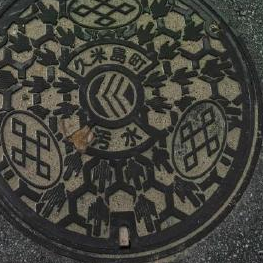
On the design of Kumejima Tsumugi are the town emblem and the words 'Kumejima Town' and 'sewage.' What appears to be a bird is a kasuri pattern woven with the traditional swallow.
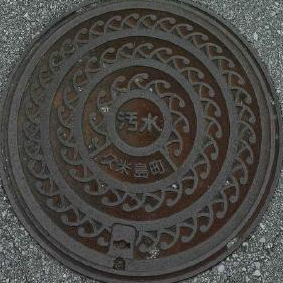
The wave pattern is drawn in three layers, with the words '汚水' (sewage) and 'Kumejima Town' included.
Fire Hydrant
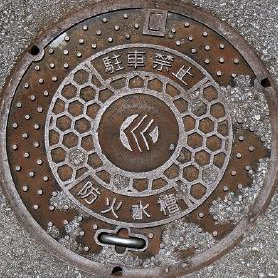
In the center is the Kumejima Town emblem. Inside the inner circle is a tortoiseshell pattern. The characters 'No Parking' and 'Fire Water Tank.' The outer perimeter has a dot pattern.
 Former Nakazato 旧仲里村
Emblem
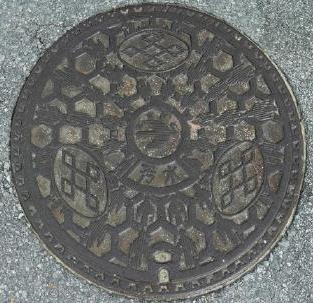
Kumejima Tsumugi and the former Nakazato Village crest with the place name 'Nakazato' included.
Rectangular
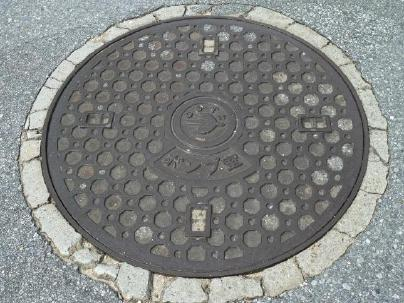
On the octagonal patterned lid, the former Nakazato Village emblem and the words 'Nakazato' and 'Pump Room'.
Fire Hydrant
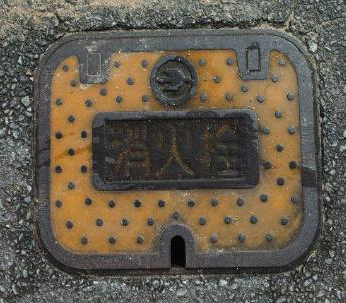
Yellow fire hydrant cover with the old village emblem.
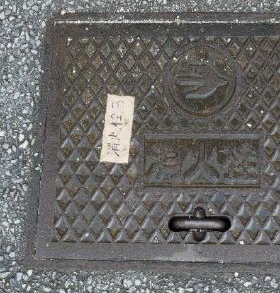
Fire hydrant cover with the old village emblem, unpainted.
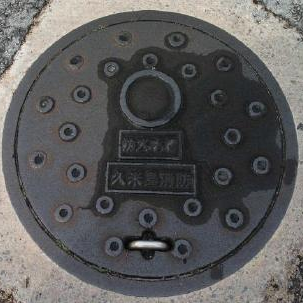
"Kumejima Fire Station" "Fire Prevention Water Tank" Lid.
 Former Gushikawa 旧具志川村
Designer
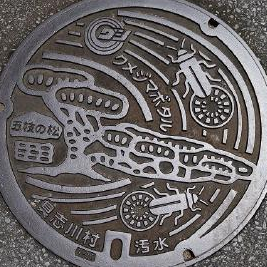
At the top is the former Gushikawa Village emblem, in the center is the 'Goe-no-Matsu (Five-Branched Pine),' and at the top right and bottom are the labels 'Kumejima Firefly,' 'Gushikawa Village,' 'Sewage,' 'Goe-no-Matsu,' 'Kumejima Firefly,' and 'T-25.' The 'Goe-no-Matsu' is a Ryukyu Pine planted in 1839 according to records and is a national natural monument. Its roots split into five branches that spread along the ground, covering an area of 250 square meters. The 'Kumejima Firefly' is one of only three species of fireflies in Japan, out of about 50 species, whose larvae live in water, like the Genji firefly and Heike firefly.
 Taketomi 竹富町
Designer
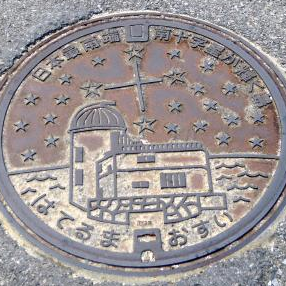
Design of the stargazing tower and the Southern Cross on Hateruma Island, the southernmost island of Japan. It has the text 'Japan's southernmost island where the Southern Cross shines.'
Handhole
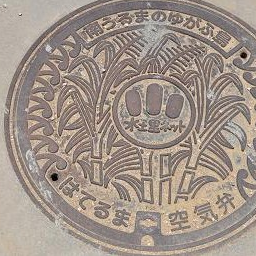
The main industry is sugarcane, and wave patterns are drawn around it. The central 'Midori Net' refers to the nickname of a farmers' organization called 'Land Improvement District,' which maintains and manages agricultural roads, waterways, and other facilities. It was chosen through a public contest in 2002. 'Yugafu Island of Southern Uruma'—the word 'yugafu' in Okinawan dialect means happiness in this world or wonderful, so it is said to mean a wonderful island located in southern Okinawa.
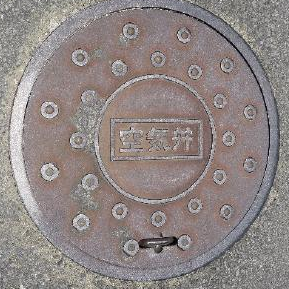
It seems that the town emblem has been scraped off, but there are the characters 'Shikiriben' on a double-circle ground pattern. There are lids with the same design but different characters: 'Shikiriben,' 'Kuukiben,' 'Seisuiben,' and 'Ben-gai.'
Fire Hydrant
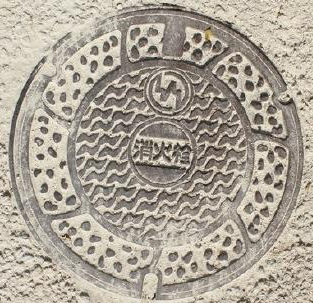
It's a fire hydrant cover, with the town emblem and the notation 'Fire Hydrant.' The surrounding area isn't yellow either!
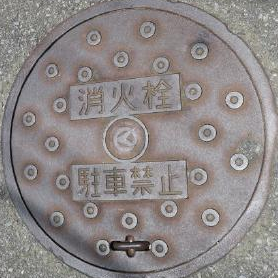
Double circle pattern, with the town emblem in the center, 'Fire Hydrant' above it, 'No Parking' below, and a handle beneath that. I have received a lid without the town emblem from a bowing old man.
Generic
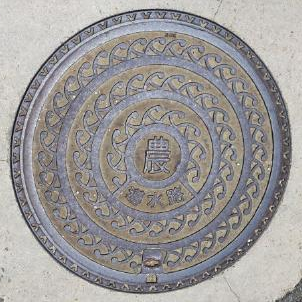
A lid with wave crest patterns arranged in concentric circles, with the character '農' in the center and the words '排泥室' just below it.
 Chatan 北谷町
Designer
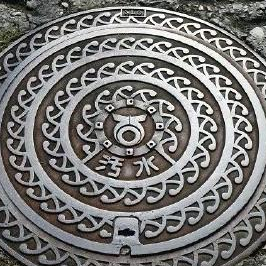
This is a lid familiar within Okinawa Prefecture, featuring a wave crest pattern forming three concentric circles. In the center is the town emblem and the inscription 'Sewage.' The receiving frame also has a wave crest pattern.
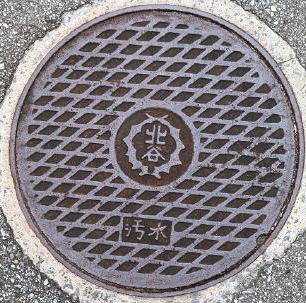
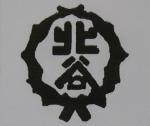
In the center of a horizontal diamond-patterned ground, the first-generation 'Kitaya Village emblem' is displayed. At the bottom, the characters for 'sewage' are written. The old Kitaya Village emblem was changed to the current design (second-generation village emblem) in 1973, and the second-generation emblem has been carried over even after the introduction of town status in 1980. This cover is believed to have been installed around 1971 (Showa 46), when the old Kitaya Village began using the public sewer system.
Emblem
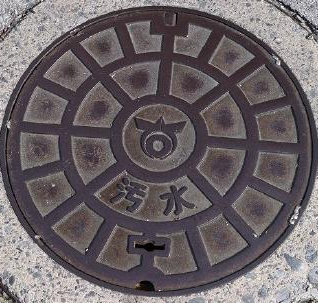
It is a derivative of the Nagoya City type, but it is the type without the circle mark. It has the town emblem in the center and the label 'Sewage'.
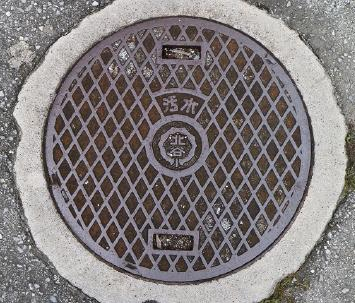
In the center circle of a vertically elongated diamond-patterned background is a simplified version of the first 'Kitaya Village emblem.' Just above it are the characters for 'wastewater.' Handles at the top and bottom. Slightly smaller size (φ55cm).
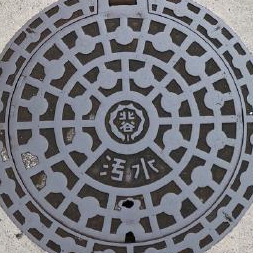
In the center of the JIS standard lid's crushed circle pattern is a simplified version of the first 'Chatan Village emblem.' Immediately below it are the characters 'sewage.'
Rectangular
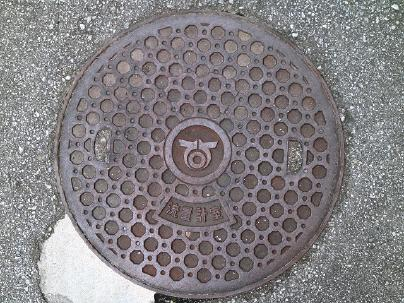
In the central circle of a background pattern composed of octagons connected vertically and horizontally, there is the 'Chatan Town emblem.' The text 'Flow Meter Room.' Handles on the left and right.
Handhole
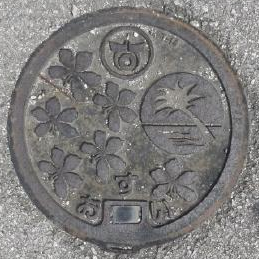
Town flower, Phyllis syncha, and palm tree at sunset. In the upper center is the Chatan Town emblem, designed in the shape of a bird representing 'Chatan'.
Small cover for a sewage manhole.
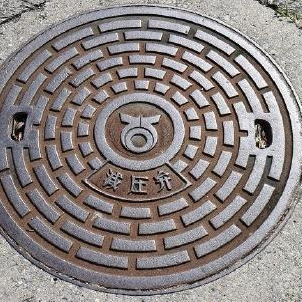
A ground pattern with three concentric circles in the shape of the character '工', with the town emblem and the notation 'Pressure Relief Valve'. The main lid has a pattern combining ' ' and a square.
Collaboration
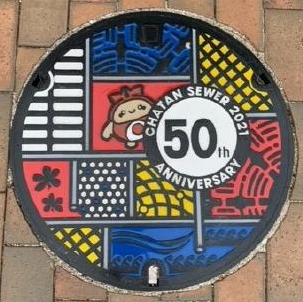
To commemorate the 50th anniversary of the public sewer system in Chatan Town, five types of color manhole covers were created and installed. The design gathers the actual manhole cover designs installed in the town like a patchwork. The changes in the patterns of the manhole covers represent the 'history' of the Chatan sewer system. This design encapsulates 50 years of history in a single piece. (From the town's website) This one uses bold colors and gives a lively image. The town's official mascot 'Chii-tan' and the mark '50th CHATAN SEWER 2021 ANNIVERSARY' are also incorporated.
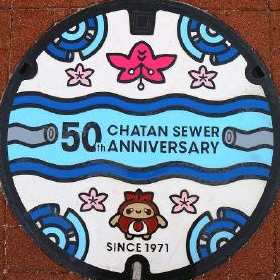
This design is inspired by sewer pipes, waves, and the town flower, Philisynka. In the center, it reads '50th CHATAN SEWER ANNIVERSARY,' and at the bottom, it includes 'Chiitan' and 'SINCE 1971.' This is one of three color variations with a sewer pipe pattern, featuring a 'white-based color that gives the feeling of strolling along the coast with a refreshing breeze.'
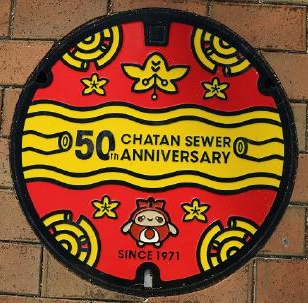
This is one of the three color variations of sewer pipes, with a color based on burgundy that evokes the red-tiled houses of Okinawa.
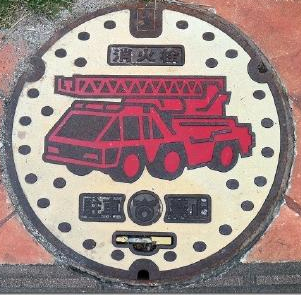
A cream-colored background with polka dot and ladder truck design. At the top, the words 'Fire Hydrant', and at the bottom, the town emblem, with the words 'No Parking' in between.
Other

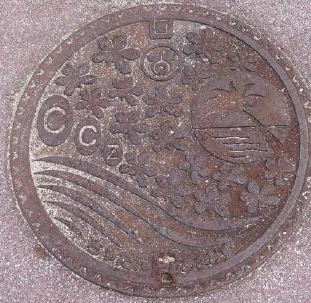
This is a color display manhole cover exhibited at the entrance hood of the Chatan Town Water and Sewage Department building. On a pink background, the town flower 'Fuiri Soshinka,' the town's official image character 'Chiitan' surfing on the waves of Miyagi Coast, and on the right circular area, the 'sunset at Sunset Beach' are designed.
Related: Chubu Basin Sewerage 中部流域下水道, Okinawa Prefecture Basin Sewerage 沖縄県流域下水道
 Nishihara 西原町
Designer
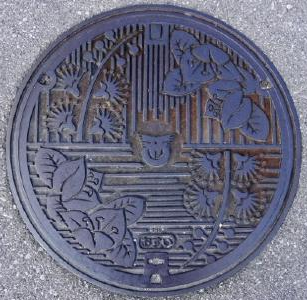
It is a design of the town flower "Bougainvillea" and the town flower tree "Sagaribana". The Uchima Palace's sagaribana is a town-designated natural monument. It blooms very beautifully from evening to night. In the center is a town seal with a design of "West". Notation of "Osui" and "T-14".
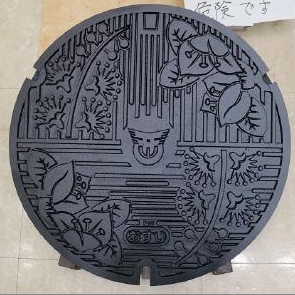
It is an exhibition lid for sewer day-related events in 2018. The shape of the keyhole is different from the above. Notation of "T-25".
Handhole
It is a design of the town flower "Bougainvillea" and the town flower tree "Sagaribana". Town seal at the top. "Sewage", "T-14" notation.

In the center, a large town seal is arranged in a blue area, and the lid is designed with a tortoise-coated pattern on the inner zone and a "..." on the outer zone in a blue area for three laps.
Water supply air valve cover.
Round water measuring device lid with town seal. Manhole size.
Fire Hydrant
"..." and "Pink Fire Truck" design on the town seal and yellow ground.The words "hydrant" and "no parking".
Round hydrant lid.
Square hydrant cover with diagonal grid. "Fire hydrant" "No parking" notation and town seal.
Related: Chubu Basin Sewerage 中部流域下水道, Nakashiro Bay Southern Basin Sewerage 中城湾南部流域下水道
 Haebaru 南風原町
Designer
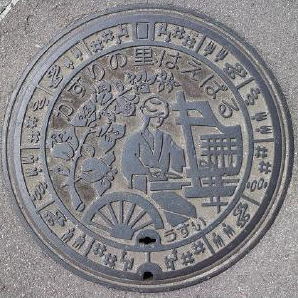
Below the words "Kasuri no Sato", it depicts a woman weaving and a town flower, Bougainvillea. The surrounding area is the pattern of the horseshoe.
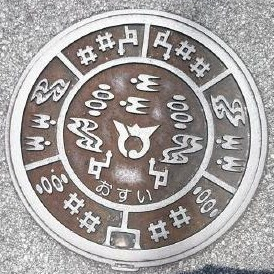
The design features the pattern of Ryukyu Kasuri centered on the emblem of Haebaru Town. Medium size for sewage pipes.
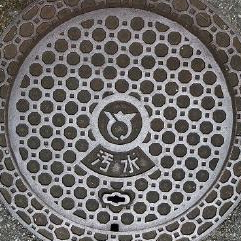
In the central circle, there is the town emblem, and just below it is the label 'Sewage.' At first glance, it looks like a tortoiseshell pattern, but on closer inspection, it is a pattern in which squares are placed at the intersections of connected octagons covering the entire lid. This design is 'an overall arrangement of the patterns of Ryukyu Kasuri, a specialty product of Haebaru Town.' (December 1994, '30 Years of Sewerage' issued by the Okinawa Prefecture Sewerage Division: according to the Okinawa Prefectural Library collection.) Nowadays, the Kasuri pattern would likely be designed more realistically, but over 30 years ago, at that time, it seems that there was not enough boldness to break away from the image of standard lids, so it can still be considered an 'early design lid' that is closer to a geometric pattern.
Related: Chubu Basin Sewerage 中部流域下水道
 Motobu 本部町
Designer
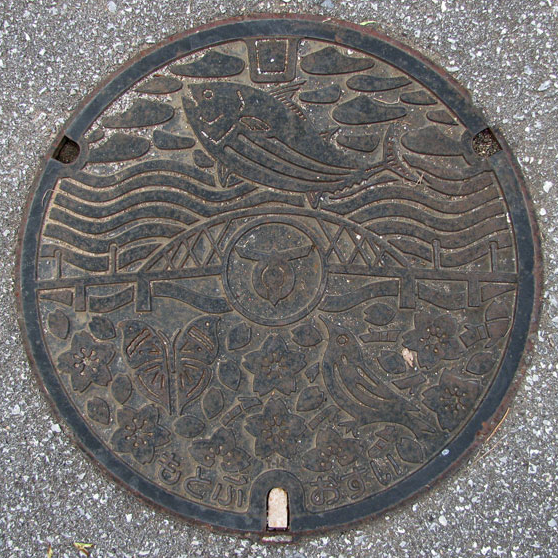
Depicted are the town's fish, the bonito; the town's flower tree, the cherry blossom; the Ryukyu white-eye; and the town's butterfly, the konoha butterfly, which is also a natural monument of the prefecture and whose wing undersides resemble dead leaves.
The bridge is the Sesoko Bridge connecting the Motobu Peninsula and Sesoko Island. In the center is the town emblem, and the surrounding frame has a wave crest pattern. The characters for 'Motobu' and 'Sewage' are also present.
Emblem
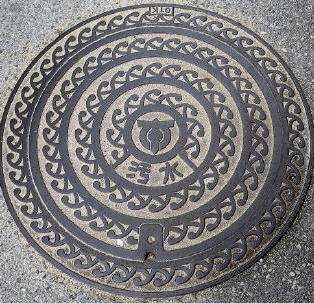
In the center of three concentric circles made with a wave crest pattern is the town emblem, and below it are the characters 'Sewage.' The receiving frame also has a wave crest pattern. 'OTK' is an abbreviation for the manhole cover manufacturer. This is a sewage pipe manhole cover for the sewer system.
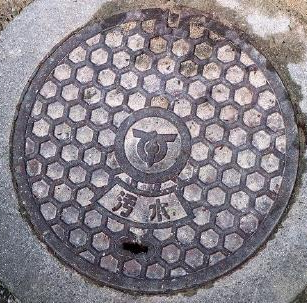
It has a tortoiseshell pattern, the town emblem, and the characters for 'sewage.'
Sewer sewage pipe manhole cover.
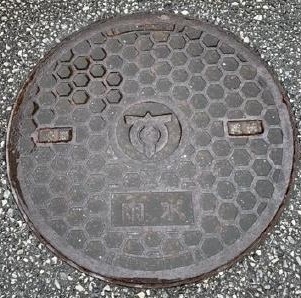
Tortoiseshell pattern, town emblem in the center, 'Rainwater' below it, vertical hooks on both sides. Rainwater manhole cover.
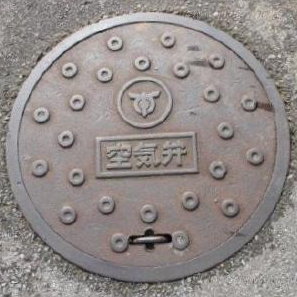
T-pattern combination, with the symbol mark of the 'Okinawa International Ocean Exposition' in the center.
Handhole
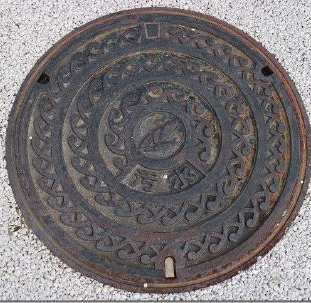
This is a cover exclusively for the state-run 'Ocean Expo Park.'
A hexagonal-patterned 'air valve' cover. The word 'seawater' is in the center. This is a cover that can truly be called a representative of the exclusive covers for Ocean Expo Park. Fresh seawater is likely pumped from the nearby sea and sent to places like the 'Churaumi Aquarium' and the 'dolphin show pool.'
There are covers with the same design but with different words, such as 'air valve' and 'pressure relief valve.'
Other
This is a lid exclusively for the nationally managed 'Ocean Expo Park.' It is a lid with a wave crest pattern commonly found in various locations throughout Okinawa Prefecture, with the Cabinet Office emblem in the center and the word 'sewage' below it.
This is a manhole cover dedicated to the national 'Ocean Expo Park.'
It has the same cresting wave pattern as above, but the inscription reads 'Tensui' instead. It's not the technical term 'rainwater,' which is unique in that it seems to say, 'It's okay because it's for the park!' It's quite old, but it's a cover that we hope will remain without being replaced forever.
This is a lid dedicated to the state-run 'Ocean Expo Park.'
It has the same wave crest pattern, but the central mark is the emblem of the Okinawa General Bureau. The characters '汚水' (sewage).

This is a lid exclusively for the state-run 'Ocean Expo Park.'
The above wave crest pattern sewer lid is part of a parent-child set. The parent lid has a hexagonal pattern.
This is a lid exclusively for the state-run 'Ocean Expo Park.'
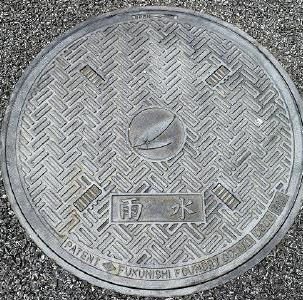
It is a lid with a U-shaped pattern (made by FUKUNISHI FOUNDRY). The emblem of the Cabinet Office is in the center. The characters 'rainwater' are on it.
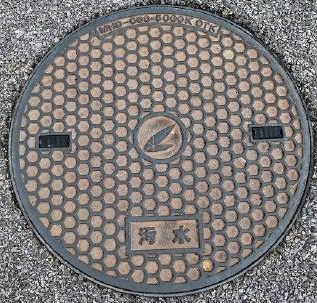
This is a lid exclusively for the state-run 'Ocean Expo Park.' It is a hexagonal-patterned lid. In the center is the Cabinet Office emblem. The word 'Sewage' is written on it.
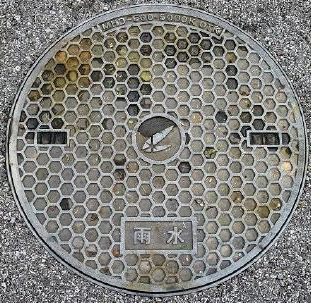
This is a lid exclusively for the state-run 'Ocean Expo Park.'
It is a 'rainwater' lid with the same hexagonal pattern as above.
 Yaese 八重瀬町
Designer
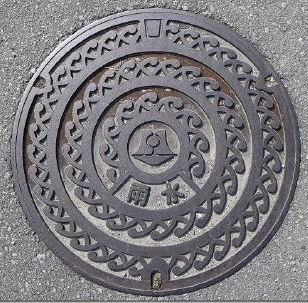
A wave pattern commonly seen in Okinawa Prefecture forming three concentric circles. The emblem of Yaese Town is in the central circle. Just below it are the characters for 'rainwater'.
Emblem
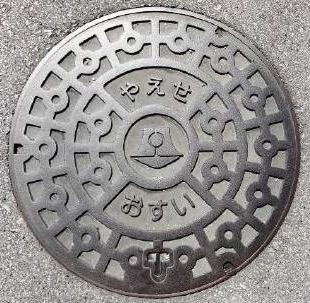
Town emblem in the center, with the notation 'Yaese' and 'Osui'. Standard type.
Handhole
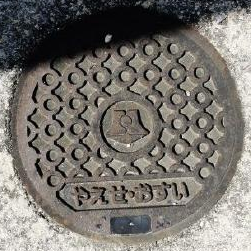
In the center of the circular pattern is the town emblem, with the inscription 'Yaese・Osui'.
 Former Gushikami 旧具志頭村
Designer
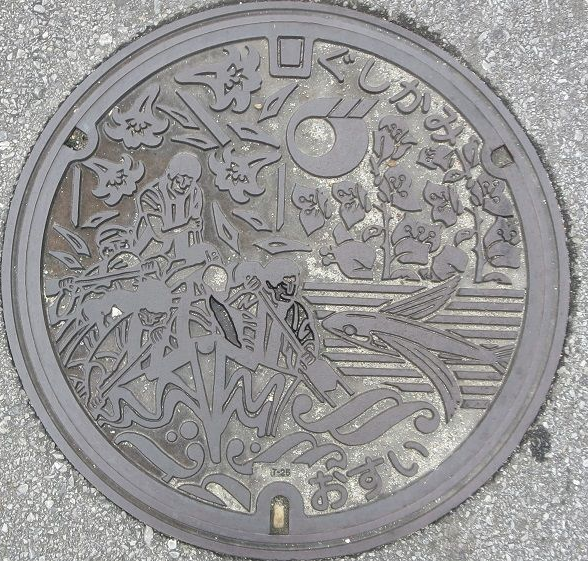
The flower of former Gushikami Village is the teppou lily, the village’s flower tree is bougainvillea, and the village's fish is the flying fish, along with the Minatogawa Haarii. Flying fish fishing is only done in Minatogawa in Okinawa. The Minatogawa Haarii is a festival held on the 4th day of the 5th month of the lunar calendar to pray for the fishermen’s (Uminchu) bountiful catch and safe voyages. Generally, it is called Haarii, but in Itoman City and Gushikami, it is called Haallee. At the top is the former Gushikami Village emblem, with the labels 'Gushikami' and 'Osui'.
For Minatogawa and Nagamou, there is wastewater treatment for fishing communities, and for Aragusuku and Koshihara, there is wastewater treatment for agricultural communities.
Handhole
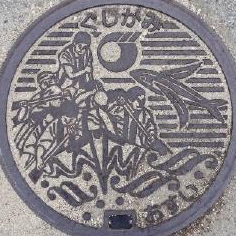
In the chapter of former Gushikami Village, designs of the Minatogawa Harley and the flying fish of former Gushikami Village. You can understand the design of Harley better here. The notations 'Gushikami' and 'Osui'.
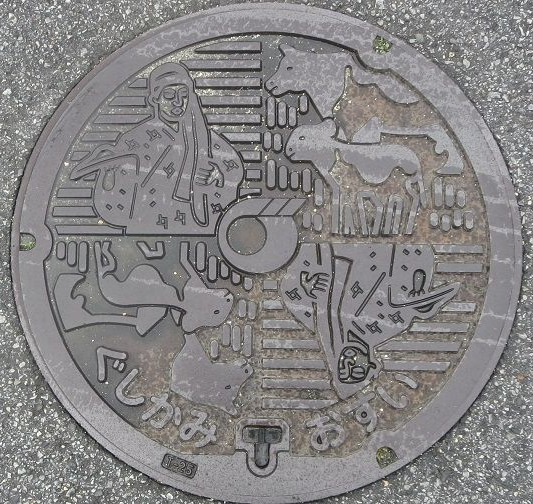
On the upper half, a design of Shinshiro Shiyamar and the emblem of former Gushikami Village, and on the lower part, a small sewer cover featuring a design of a cow and its calf. It is labeled with 'Gushikami,' 'Sewage,' and 'T-14'.
Related: Southern Waterworks Authority 南部水道企業団
 Yonaguni 与那国町
Designer
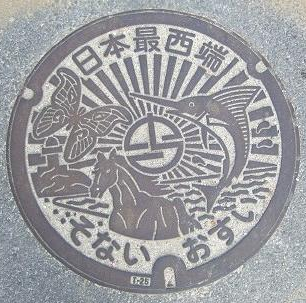
These are from when I went to Yonaguni Island (the westernmost point of Japan). The town's fish, the marlin, and the town's butterfly, the Yonaguni moth (the world's largest moth), the Yonaguni horse, and the Irizaki Lighthouse standing on the westernmost cape of Japan, 'Irizaki,' are featured. The town emblem is depicted with the last sunset in Japan. A manhole cover from the Sonai district.
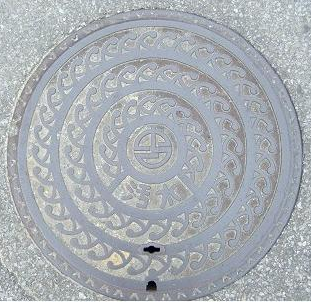
A design where the waves of the East China Sea surround the town emblem.
Emblem
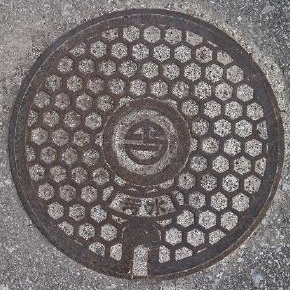
In the center of the hexagonal-patterned manhole cover is the town emblem, and just below it is the label 'Sewage.' In the Kubura area, a settlement at the western end of Yonaguni Island, there were regular-sized manhole covers with wave patterns and slightly smaller hexagonal-patterned covers. Located near the end of the road that meets the coastal levee, this cover is believed to be the westernmost manhole cover in Japan.
Handhole
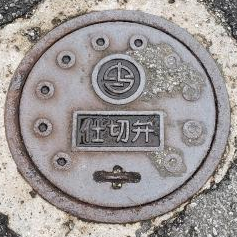
It is a square cover with a large central circle, with the town emblem on top and the characters 'Air Valve' below, surrounded by a diamond-patterned background. There are covers with the same design but with different characters, such as 'Shut-off Valve' and 'Air Valve'.
Fire Hydrant
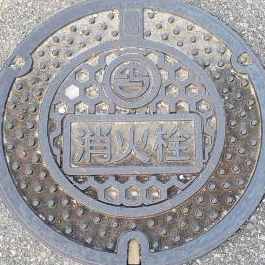
Hexagonal pattern, town emblem above, the characters 'fire hydrant' below, polka dot pattern on the outer edge.
 Yonabaru 与那原町
Designer
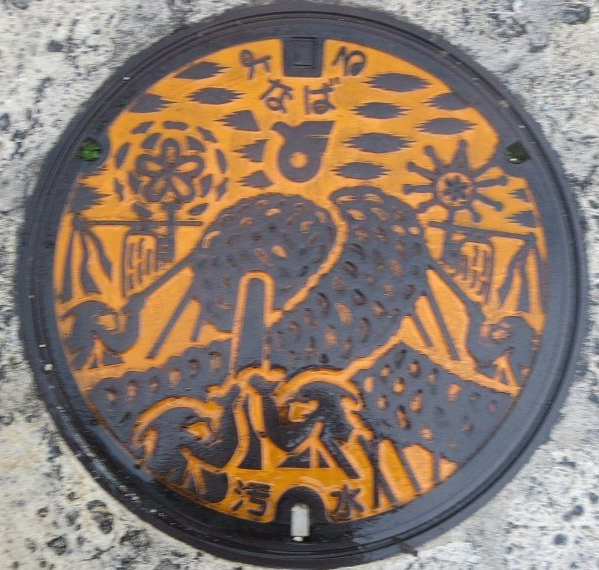
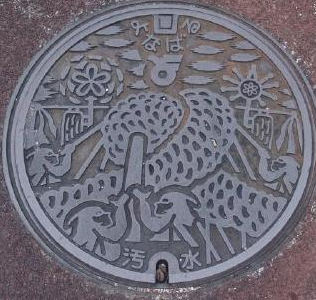
The tug-of-war in Yonabaru Town is a contest between the East (Agari) and West (Iri), with ropes about 45 meters long each, totaling up to 5 tons. The heads of the East and West ropes are circular but different in size (called 'Kanachi'), and using a six-shaku rod, the Kanachi of the East rope is passed through the Kanachi of the West rope. Then, a Kanachi rod (about 3 meters, 100 kg) is inserted into the East Kanachi to connect them. The moment the Kanachi rod is inserted, the ropes are dropped, and the tug-of-war begins. The lid design depicts exactly this scene. It shows the people supporting the Kanachi on both sides, the person inserting the Kanachi rod, and in the background to the left and right, the flag bearers of the East and West. At the top are the characters 'よなばる' (Yonabaru), and below it, the 'よ' is designed with waves and the image of a flying bird as part of the Yonabaru Town emblem. The word '汚水' (sewage).
A color (red) sewage pipe manhole cover.
Handhole
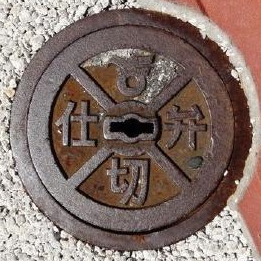
A valve cover with four sections marked with 'Yonabaru Town,' separated by 'X,' and containing the characters '仕', '切', '弁'.
Fire Hydrant

A square fire hydrant cover with a yellow polka dot background. From the top, it reads 'Waterworks,' 'Yonabaru Town emblem,' 'Fire Hydrant,' with 'No Parking' written in the four corners.
Collaboration
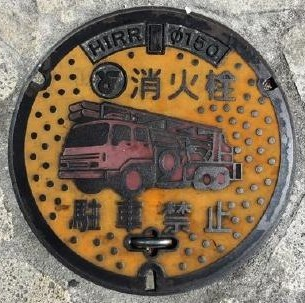
On a yellow polka-dotted background, a red ladder truck and the Yonabaru Town emblem. The text 'HIRR Φ150', 'Fire Hydrant', and 'No Parking'.
Related: Chubu Basin Sewerage 中部流域下水道
 Aguni 粟国村
Designer
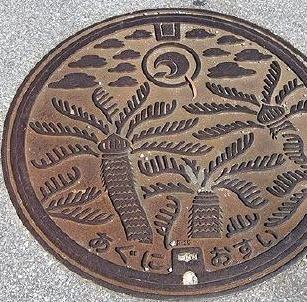
Village flower and tree: sago palm, village emblem, and 'Aguni' and 'Osui'
 Ie 伊江村
Designer
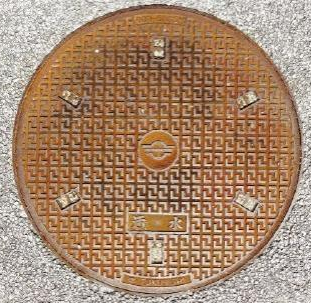
The center features the village emblem designed as the katakana character 'Ie'. There is a key-shaped ground pattern. A notation for sewage. A manhole-sized sewage cover.
*According to the minutes of the Ie Village council meeting, it seems that Ie Island does not have community drainage or sewer facilities and that domestic wastewater is treated by combined treatment septic tanks. The covers labeled 'sewage' and 'rainwater' are likely covers for the septic tanks.
Emblem
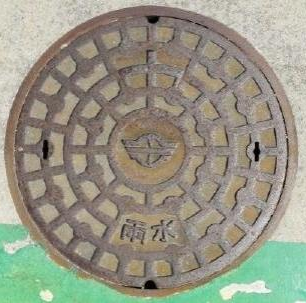
Ie Village emblem in the center. Standard type. Manhole-sized rainwater cover.
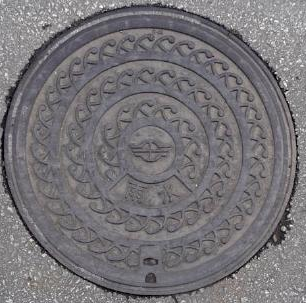
In the center of the Okinawa-style (wave-patterned concentric circles) ground design is the village emblem, and in the fan-shaped text frame below it are the characters 'Rainwater'.
Fire Hydrant
On an oval yellow area, a ladder truck, above it a fire hydrant, and below it a 'Ie Village' emblem are flanked by no parking signs.
Round fire hydrant cover.
Circular pattern with the Ie Village emblem and the characters for fire hydrant.
Round fire hydrant cover.
 Izena 伊是名村
Designer
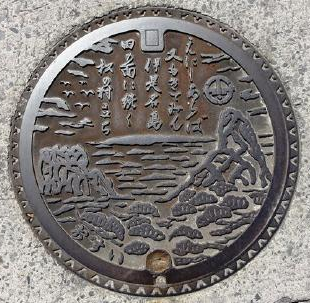
Izena Village had a lid design with a song. The song goes, 'If fate allows it, I will come again to see Izena Island, where the pines stand along the edges of the rice fields.'
On Izena Village's website, it was noted that a local official from Okinoerabu praised the village's beauty with the words, 'If fate allows it, I will come again to see Izena Island, where the pines stand along the edges of the rice fields.' While the island itself is beautiful, the song also gives the impression that the hearts of its people are equally so. To the right of the lyrics is the Izena Village emblem, stylized as 'Izena.' Below it are the sea Gitara to the south of the island, the island Gitara (Gitara meaning sheer rock), and Ryukyu pines. The characters 'おすい' appear as well.
Emblem
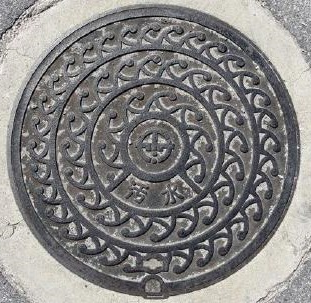
A sewage manhole cover with wave crest patterns. In the center is the Izena Village emblem. Below it are the characters 'sewage'.
Manhole cover of a sewer pipe with a tortoiseshell pattern. In the center is the Izena Village emblem. Below it are the characters for 'sewage'. Handles on both sides.
A standard-type sewer manhole cover with the characters for 'sewage' in the center.
Handhole
A diaphragm valve cover with 'Izena Village Chapter,' 'Shi,' 'Kiri,' and 'Ben' placed inside, separated by X.
Fire Hydrant
On a circular patterned surface are the words 'Izena Village Crest,' 'Firefighting Water Tank,' and 'No Parking.' Handles are at the top and bottom. A fire water tank lid the size of a manhole.
 Ogimi 大宜味村
Designer
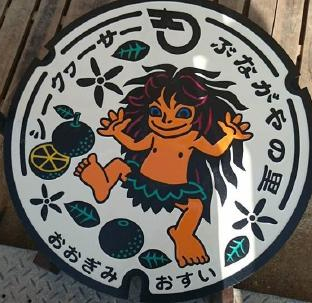
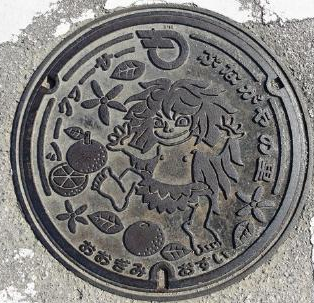
At the center is 'Bunagaya.' In Okinawa, there are yokai and spirits called 'Kijimuna,' but in Ogimi Village, it seems they call them 'Bunagaya.' At the top is the Ogimi Village emblem, designed with the character '大' (big). The words 'Shikuwasa Bunagaya no Sato,' 'Ogimi,' and 'Osui' are written. Around Bunagaya, Shikuwasa flowers, leaves, and fruits are depicted. Shikuwasa is the village's tree and flower. Above the village emblem is labeled T-14. The sewage facilities are located on a reclaimed area called Yui no Hama along the coast.
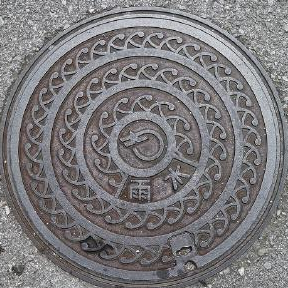
It is a design with a wave pattern commonly seen in Okinawa Prefecture, arranged in three concentric circles. Inside the central circle is the village emblem. The characters 'Rainwater'.
Handhole
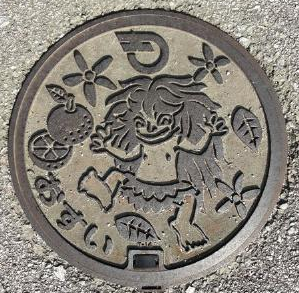
A non-colored design of the fruit, flowers, and leaves of bunagaya and shikuwasa. The character for 'osui' (sewage) is included. 'T-14' is indicated at the bottom. Small manhole cover for sewage pipes. 'Bunagaya' used to live in almost every village in Okinawa before the war, but now it only inhabits the forests and rivers of Ogimi Village, a rare species (as Ogimi Village states in its 'Declaration of the Home of Bunagaya').
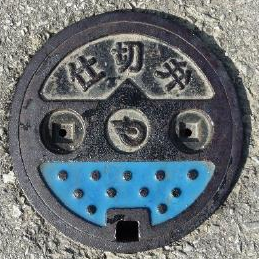
Gate valve cover. Ogimi Village emblem in the center. The words 'Gate Valve' at the top. The bottom has a polka dot pattern on a blue background.
Fire Hydrant
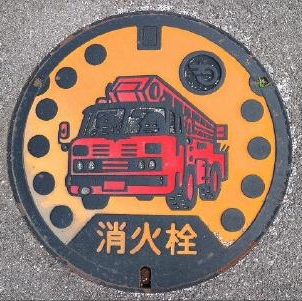
A design of a ladder truck drawn from a diagonal frontal view. The driver and the person in the passenger seat are also visible. The village emblem and the letters 'Fire Hydrant'.
 Onna 恩納村
Designer
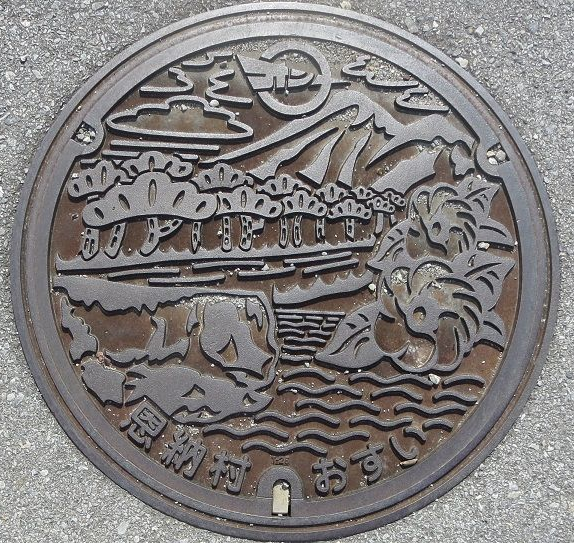
At the top, the Onna Village emblem. Mount Onna, the village flower Yuna, Ryukyu pine, and Manza Cape. The words 'Onna Village' and 'osui'.
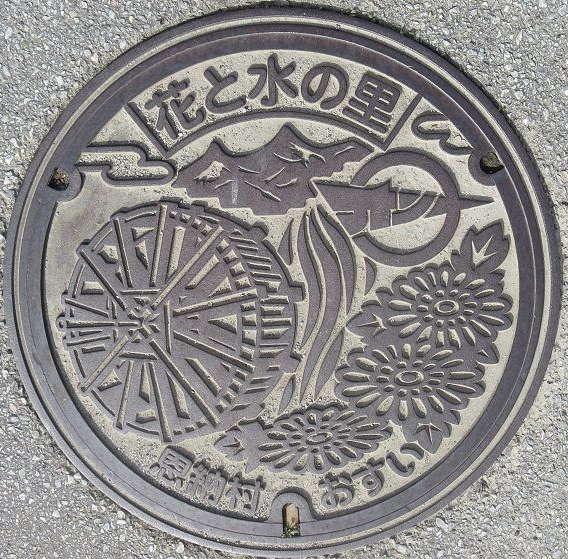
The symbol of the region, a waterwheel and small chrysanthemums, with Mount Onna in the background. In the top right is the Onna Village emblem. 'Village of Flowers and Water,' 'Onna Village,' 'Sewage.' In the Kise Takehara district, small chrysanthemums are cultivated with lights at night to delay their blooming, known as electric-light chrysanthemums. It is said that the success of flower cultivation in this area brought about a flower boom throughout Okinawa Prefecture. Nowadays, red LEDs are also used, and it seems that power consumption has been greatly reduced.
Emblem
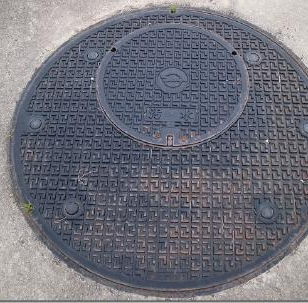
A village emblem in the center of the "ko"-shaped pattern, with the notation "汚水" (wastewater) at the bottom. The main cover also has a "ko"-shaped pattern and is an extra-large size (120 cm). The bottom of the main cover has the marking "D1200." The "ko" shape and the horizontally elongated "ko" pattern are commonly seen in products made by FUKUNISHI (Fukunishi Foundry).
Handhole
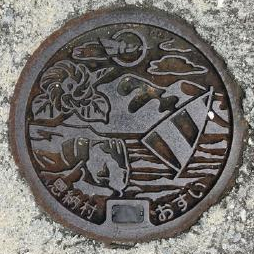
The above small lid. On the top is the village crest designed with 'Onna'. On the side, 'T-14'.
Fire Hydrant
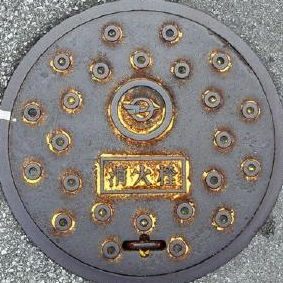
A round fire hydrant cover with a circular pattern. Manhole size. Features the Onna Village emblem and the word 'Fire Hydrant'.
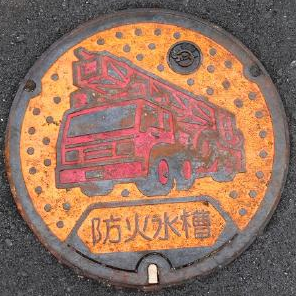
In the center of the yellow polka-dotted background is a 'ladder truck,' the village emblem is in the upper right, and the words 'firefighting water tank' are at the bottom.
Collaboration
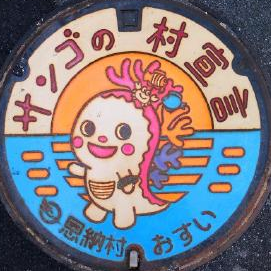
Depicted is the coral fairy 'Sunna-chan,' who, with a cute smile, promotes the importance of conserving and nurturing the natural environment against the backdrop of a sea of blue coral and the shining sun. At the top are the words 'Coral Village Declaration,' and at the bottom are 'Village Crest,' 'Onna Village,' and 'Wastewater.'
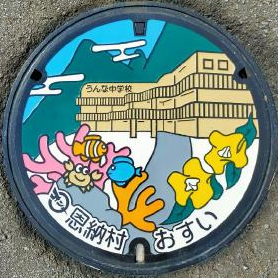
Designed by students as part of the 'UNNA Spirit Project' in Onna Village. It is designed using motifs of the beautiful sea mentioned in the school anthem's lyrics, Unna Peak, coral, Unna flowers, and the school building. At the bottom are the village emblem and the words 'Onna Village' and 'Osui'.
 Kitadaito 北大東村
Fire Hydrant
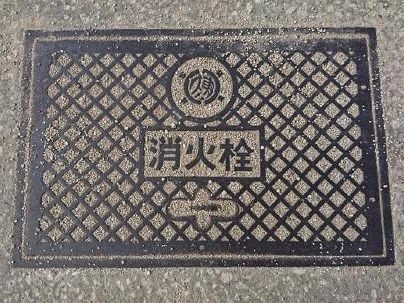
Diagonal lattice pattern, village emblem, and the characters 'fire hydrant'.
 Kitanakagusuku 北中城村
Designer
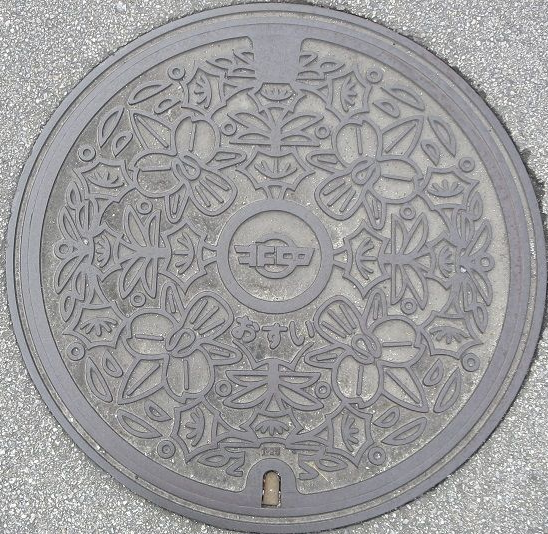
Designed with the village flower, orchid, and the village tree, bougainvillea. In the center, the emblem of Kitanakagusuku Village and the characters 'おすい'.
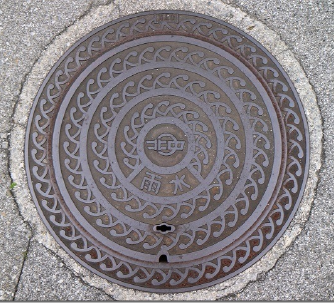
A design where wave patterns commonly seen in Okinawa Prefecture are arranged in three concentric circles. The village emblem is inside the central circle. Just below it are the characters 'Rainwater.' The surrounding frame also features wave patterns.
Emblem
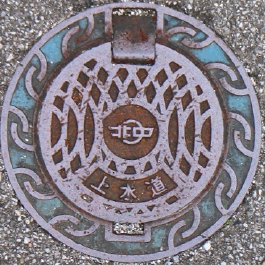
In the central circle of a pattern where circles intersect from the left and right, there is a village emblem. At the bottom, the characters 'Waterworks'. The border has a pattern that looks like a pair of parentheses '()' shifted diagonally up and down.
Related: Chubu Basin Sewerage 中部流域下水道
 Ginoza 宜野座村
Designer
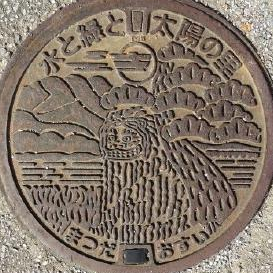
At the center top, the Ginoza Village emblem stylized with the character "ぎ", Mount Kochiya and abundant water, the village tree Ryukyu pine, and the village guardian lion-dog (Shisa). The Ginoza Village catchphrase "Village of Water, Greenery, and Sun" and the inscriptions "Matsuda", "Osui", and "T-25".
Okinawan lion dances are believed to ward off evil spirits and bring about abundant harvests, prosperity for descendants, and the development of the community, and it is said that there are about 180 of them in the prefecture. The body and legs are made of fibers such as banana, and the lion head is made from lightweight deigo wood.
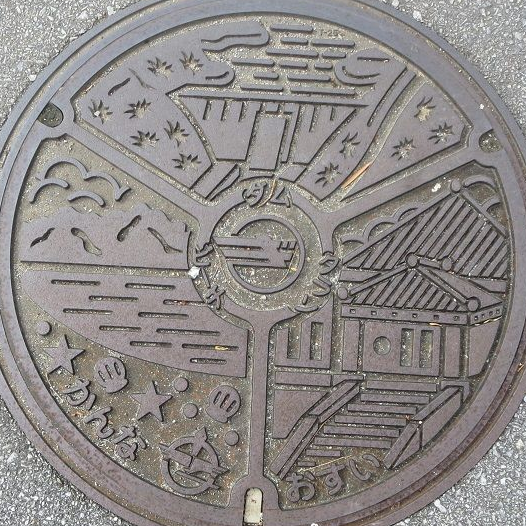
In the center is the Ginoza Village emblem. Around it are Kanna Beach, Kanna Dam, and Kanna Thalasso Laguna (marine therapy facility). The labels include "Beach," "Dam," "Thalasso," "Kanna," and "Sewage." The mark next to "Kanna" is the symbol of Kanna District. We received a manhole cover with the same design near the "Traffic Safety Monument" at the Ginoza Roadside Station from Kobachan.

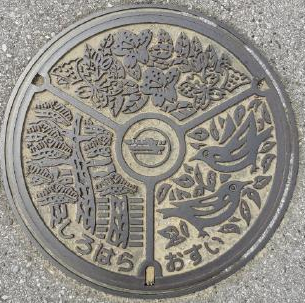
In the center, the Ginoza Village emblem. Around it are the village flower azalea, the village bird Japanese white-eye, and the village tree Ryukyu pine. The labels 'Shirohara' and 'Osui'.
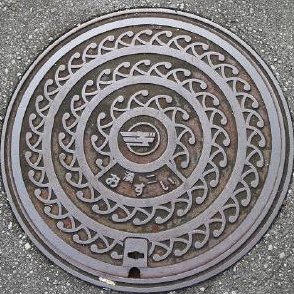
A design featuring wave patterns commonly seen in Okinawa Prefecture, arranged in three concentric circles. In the central circle, there is the emblem of Ginoza Village. Just below it are the characters 'Kanji Ni Osui'.
Emblem
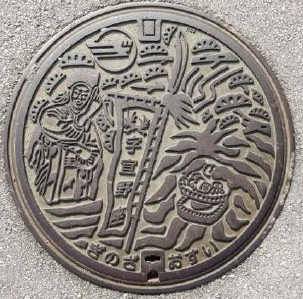
Kyotaro (Chondara), designated as an intangible folk cultural property of the prefecture. On the flagpole written with 'Ginoza,' there are a Shisa, a Ryukyu pine, the Ginoza Village emblem, and the inscriptions 'T-25,' 'Ginoza,' and 'Osui.'
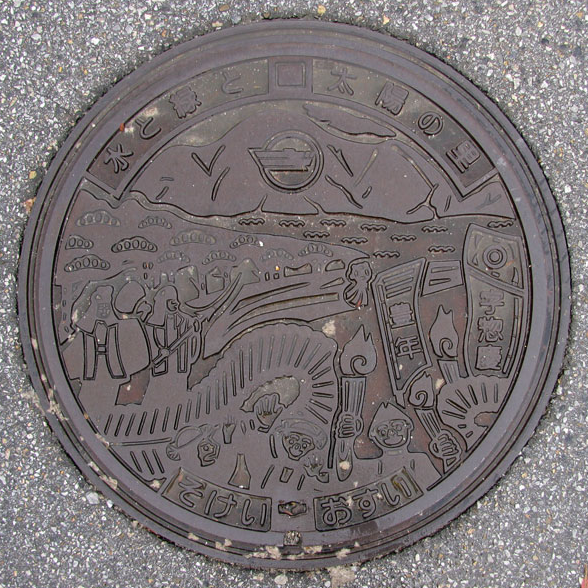
A design manhole cover for sewage, featuring the village emblem and stylized characters of 'Water, Greenery, and Sun' along with the hiragana 'ぎ'. It's wet from the rain, making the details hard to see, but it seems to depict the village tree, the Ryukyu pine. On the right, there are banners with '豊年' (Hounen) for the Harvest Festival and '字惣慶', representing the district. In the foreground, there are likely figures of the lion dance and the Eisa clown 'Chondara'.
Handhole
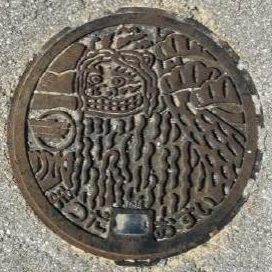
With a design featuring a lion and Ryukyu pine, the village emblem is on the left, with the inscriptions 'Matsuda' and 'Osui.' Ginoza Village has manhole covers with characters on a per-character basis.
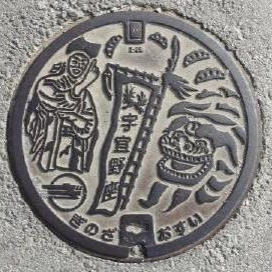
Kyotaro (Chondara), a flag with 'Jinoza' written on it, designed with a lion and Ryukyu pine, featuring the village emblem and the inscriptions 'Ginoza,' 'Osui,' and 'T-25'.
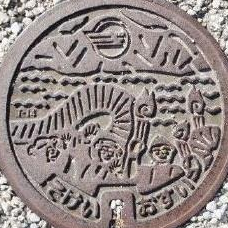
Could it be Mount Garaman and Sokei Beach? On the mountainside is the Ginoza Village emblem. Tug-of-war. At the 9 o'clock direction, 'T-14' (there was also 'T-25' on the same small cover), with the notations 'Sokei' and 'Osui'.
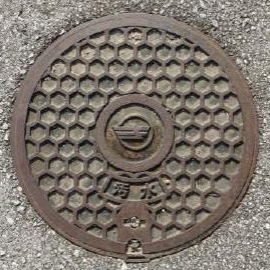
In the center of the tortoiseshell pattern is the Ginoza Village crest. The characters for 'sewage'.
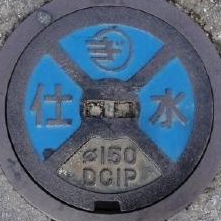
Ginoza Village emblem and circular pattern, with the words 'Air Valve.' Manhole size.
There are covers with the same design but with different words such as 'Gate Valve,' 'Stop Valve,' 'Valve,' and 'Air Valve.'
Fire Hydrant
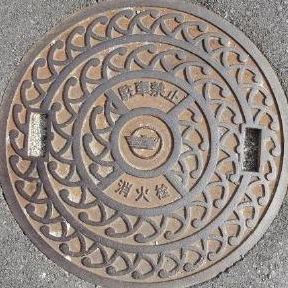
In the center of the lid, which has a concentric wave pattern, is the Ginoza Village emblem, along with the words 'No Parking' and 'Fire Hydrant'.
 Kunigami 国頭村
Designer
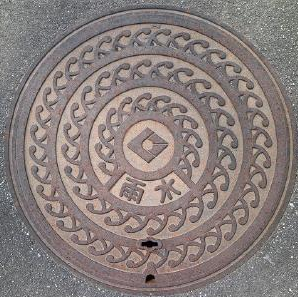
A wave pattern commonly seen in Okinawa Prefecture forms three concentric circles. Inside the central circle is the Kunigami Village emblem. Just below it are the characters for 'rainwater'.
Handhole
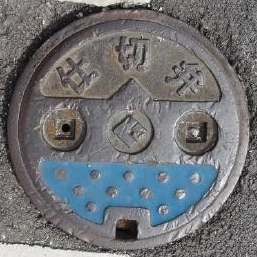
Shut-off valve cover with the Kunigami Village emblem on top. The village emblem is a stylized design of the hiragana 'くに'. There are covers with the same design but different inscriptions, such as 'shut-off valve' and 'air valve'.
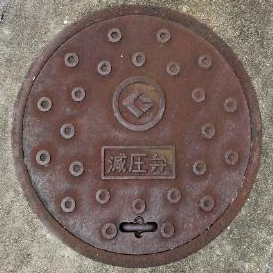
A pressure relief valve cover with a circular pattern. In the center is the Kunigami Village emblem.
On the right is the signboard of Kitakuni Elementary School, which has a design that looks very tropical (^_^). Kunigami Village is the northernmost municipality on Okinawa's main island, and the northernmost elementary school on the main island of Okinawa is this village-run Kitakuni Elementary School, where this cover was photographed. There are four students. Near the school gate, there was a notice for new student enrollment posted in the name of both the village board of education and the elementary school. It might be quite a serious issue, but thinking that even schools have to recruit students (technically, elementary school children) brings a smile to my face.
Fire Hydrant

A fire hydrant cover with red ladder truck on a yellow background with polka dots. Kunigami Village emblem and HIVP (impact-resistant vinyl chloride pipe), Φ100, fire hydrant, and 'No Parking' text.
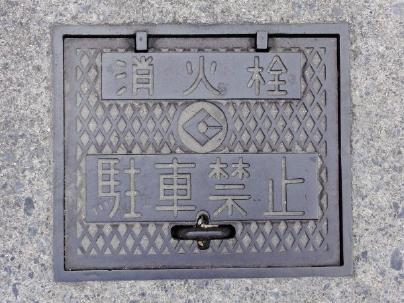
Square fire hydrant cover. The words 'fire hydrant' and 'no parking' are placed with the Kunigami Village emblem between a diagonal lattice pattern.
 Zamami 座間味村
Designer
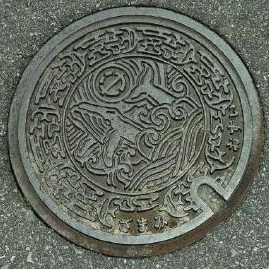
The design features the village emblem in the center and a humpback whale dynamically appearing on the sea, with tropical fish depicted around it. Apparently, humpback whales come for breeding from January to the end of March, so whale watching is possible.
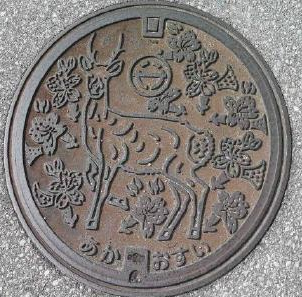
The emblem of Zamami Village features the Kerama deer that lives on Aka Island, with Kerama azaleas drawn around it. The characters 'Aka' and 'Osuo'.
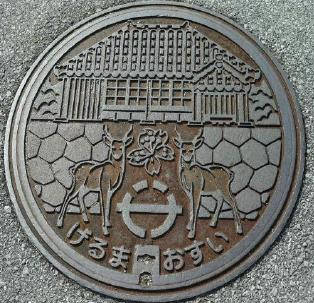
Designs of the Kerama deer and Kerama azalea, the village emblem, and the Takara family, an Important Cultural Property (an old house called a Sendō shuka, the head of navigational technicians operating the Ryukyu Kingdom's official ships, built in the latter half of the 19th century).
Handhole
A triple wave pattern is arranged around the village emblem. There are lids with the same design but different inscriptions, such as 'air valve' and 'water stop valve.'
Fire Hydrant
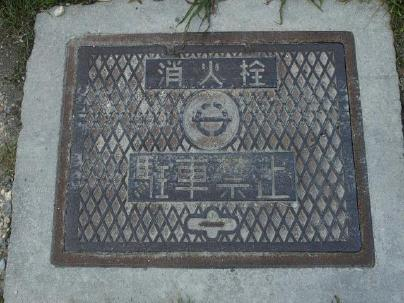
Square-shaped fire hydrant cover with the village emblem.
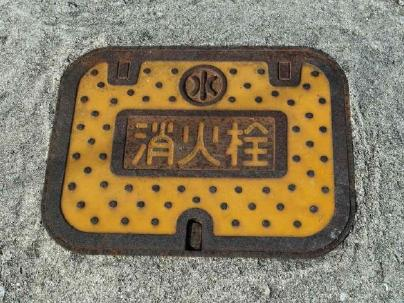
Square fire hydrant cover.
 Tarama 多良間村
Handhole
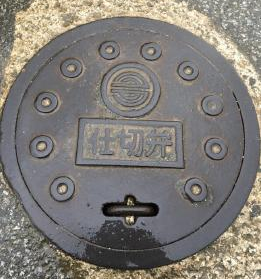
At the top is the village emblem, and below it is the word 'shut-off valve.' The perimeter is encircled with a ◎, and there is one handle at the bottom. As expected, the sewage system seems to be undeveloped, and there was nothing but a shut-off valve.
 Tokashiki 渡嘉敷村
Emblem
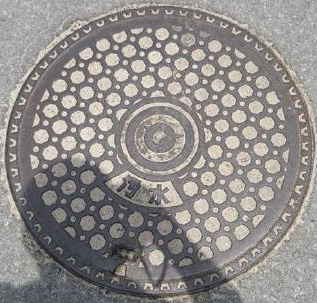
Octagonal ground pattern, village emblem, and the characters 'sewage.' V-shaped pattern on the receiving frame.
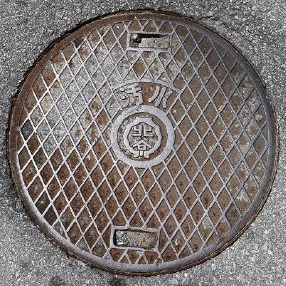
This is a manhole cover from Chatan Town. Inside the circle in the center of the vertically elongated diamond-patterned design are the characters '北谷' (Chatan), and just above it are the characters '汚水' (sewage). This type is not listed on the Chatan Town page, but it seems it could also be found if you search the early residential areas developed with sewerage facilities. Sewage pipe manhole cover.
Handhole
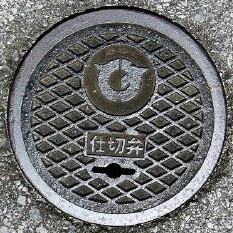
The village emblem is in the upper circle on a horizontal diamond-patterned background. The characters 'Shikiriben' are at the bottom.
Fire Hydrant
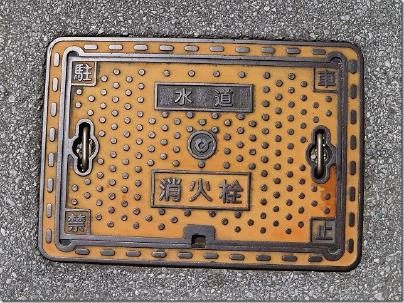
A square lid with a yellow background and polka dot pattern. The village emblem is in the center, with 'Waterworks' at the top and 'Fire Hydrant' at the bottom, and the characters 'No', 'Parking', 'Stopping', 'Prohibited' at each of the four corners. Handles on both sides.
Waterworks fire hydrant cover.
Generic
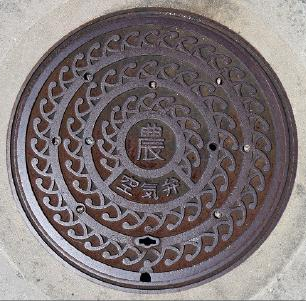
Inside the central circle are the characters '農' (agriculture), and just below it are the characters '空気弁' (air valve). There are three concentric circles of wave patterns. It is a design commonly seen in Okinawa Prefecture.
Agricultural water air valve cover.
 Tonaki 渡名喜村
Designer
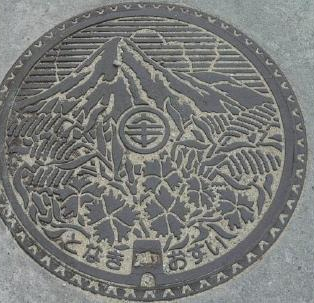
The village emblem, the village flower Kawaranadeshiko, and the design of Tonaki Island.
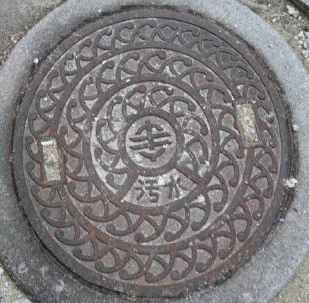
The village emblem and wave design.
 Nakagusuku 中城村
Designer
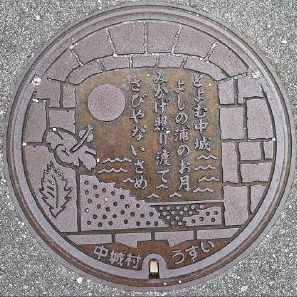
The Ryuka poem in the central part means, "When you look at Yoshi-no-ura from the famous Nakagusuku Castle, the moon is beautifully shining, and what peace this is; there is no way any calamity could occur." The lid design features the gate of Nakagusuku Castle, Yoshi-no-ura with the rising moon, and the village flower hibiscus. It has the inscriptions "Nakagusuku Village" and "Osui." Nakagusuku Castle Ruins are a World Heritage Site and have been selected as one of Japan's 100 Famous Castles.
Handhole
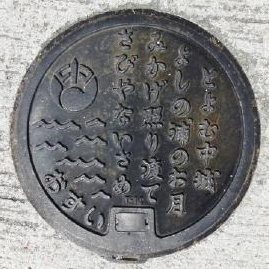
Ryuka and Yoshi no Ura, the Nakagusuku Village emblem instead of the moon.
Fire Hydrant
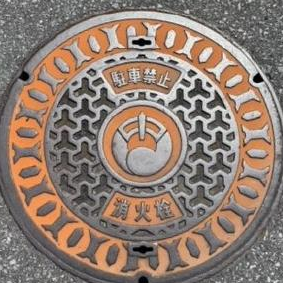
Bishamon tortoiseshell pattern, with the village emblem in the center, 'No Parking' at the top, 'Fire Hydrant' at the bottom, and a pattern arranged with the character for 'fire' around the outer circumference. The village emblem, the text, and the background color of the outer circumference are orange. There are covers with the same design but different text, 'Shut-off Valve' and 'Air Valve.'
Related: Chubu Basin Sewerage 中部流域下水道
 Nakijin 今帰仁村
Handhole
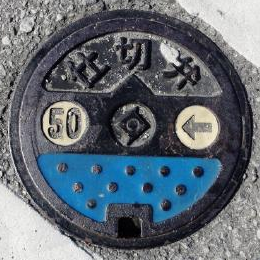
A Nakijin Village emblem designed with the character '今' in the center, with '50' and arrows on the left and right, 'Shikiriben' at the top, and a shikiri valve cover with blue polka dots at the bottom.

Nakijin Village emblem and the words 'Air Valve' in a circular pattern. Air valve cover. There are covers with the same design but different words: 'Shutoff Valve,' 'Air Valve,' and 'Valve Cover.'
Fire Hydrant
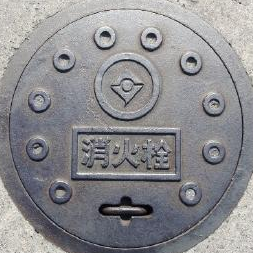
Nakijin Village emblem and the characters 'Fire Hydrant' in a circular pattern. Fire hydrant cover.
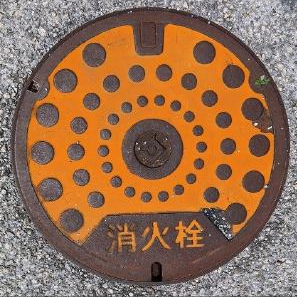
Nakijin Village emblem in the center circle on a yellow background. Around it, small, medium, and large polka dots make three circles. The characters 'Fire Hydrant' are at the bottom.
Round fire hydrant cover.
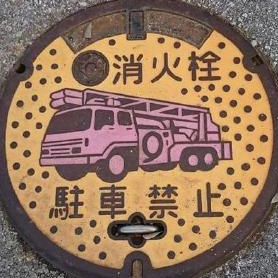
Polka dot pattern on a yellow background, with a ladder truck design, the village emblem and 'Fire Hydrant' at the top, and 'No Parking' written at the bottom. Below that, a single handle. Round fire hydrant cover.
Generic
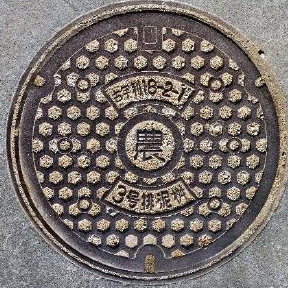
Tortoiseshell pattern, with 'Kouri 18-2-1' at the top, 'Nō' in the center, and 'No. 3 Sediment Tank' at the bottom.
 Higashi 東村
Emblem
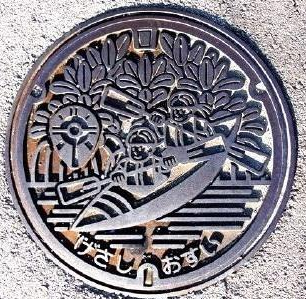
A canoe operated by Hilgirin and a boy and girl, and a village badge combining the letters "East" with the sun on the center left.The characters "Gesashi" and "Osui".
Agricultural settlement drainage sewage pipe manhole cover.
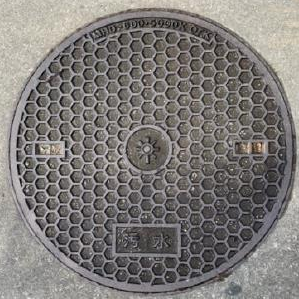
Turtle armor pattern, village badge in the center, "sewage" underneath, "MHD-600 5000K OTK" in the upper part, vertical hook in the center left and right.
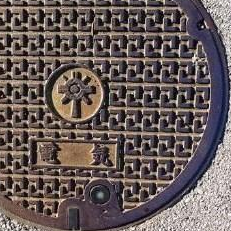
The village seal is in the center of the key-shaped ground pattern. Below is the word electricity. Manhole sized lid.
Handhole
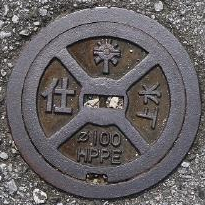
The entire lid is divided into four parts by X, and the letters "Murakaki" and "Sushi", "Shimizu", and "φ100HPPE" are respectively used. Hook in the center.
Fire Hydrant
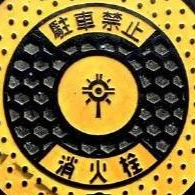
The outer yellow ground has a circle, the middle has a tortoise pattern, and the village badge is in the center. The words No Parking and Fire Hydrant.
 Minamidaito 南大東村
Designer
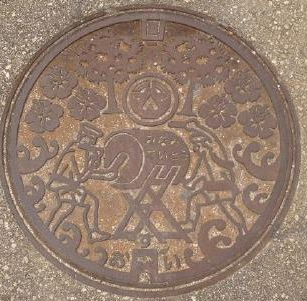
The design of the Daito drum with "Minamidaito" written on it, the village flower hibiscus and the village tree billow (coconut plant), waves, and the village badge. It contains the words "Osui".
Handhole
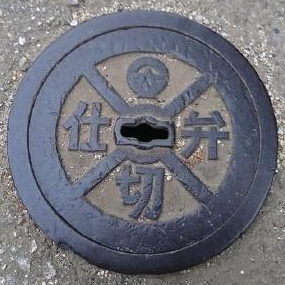
After dividing by x, the village badge is included, and the word "partition valve" is added to the rest.
Fire Hydrant
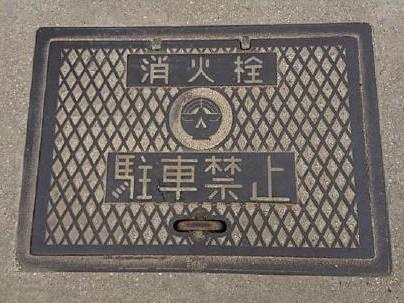
Diamond-shaped pattern, village seal in the center, "fire hydrant" on the top and "no parking" on the bottom.
 Yomitan 読谷村
Designer
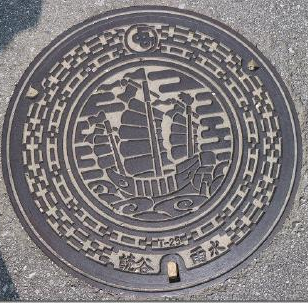
The rough waves of Cape Zanpa, the official Ryukyu Kingdom ship 'Shinkosen' used for Chinese trade and diplomatic missions, and the surrounding area are designed with Yomitan Village's pride, 'Yomitan-yama hanaori.' On the top is the village emblem with 'Yomi' shaped like a feather and encircled. The inscriptions 'Yomitan,' 'Ōsui,' and 'T-25.'
Fire Hydrant
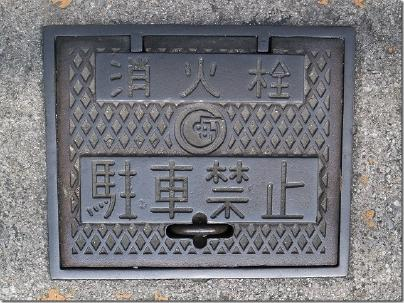
In a diamond pattern, the 'village emblem', 'fire hydrant', and 'no parking' signs are displayed.
Collaboration
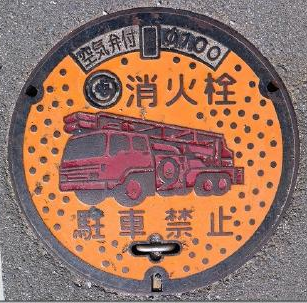
Divide the round lid into four sections with an ×, and place the characters '村章', '仕', '切', and '弁' in each section. There is a keyhole in the center. There are lids with the same design but different characters, such as '仕切弁', 'バルブ', and '空気弁'.
Related: Chubu Basin Sewerage 中部流域下水道
Okinawa Prefecture 沖縄県
Designer
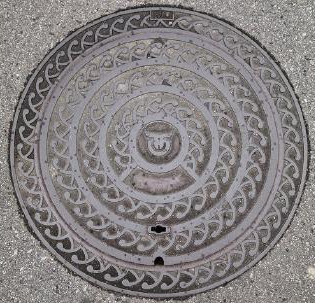
In the center, the Nishihara Town emblem. The background pattern consists of three concentric circles with a wave pattern, the same as the lid of Okinawa Prefecture. The frame also has a wave pattern.
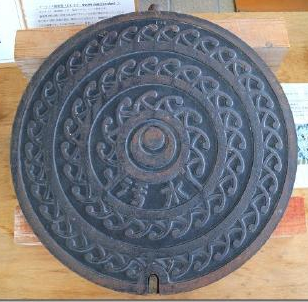
Naha Purification Center display cover. Same design as above.
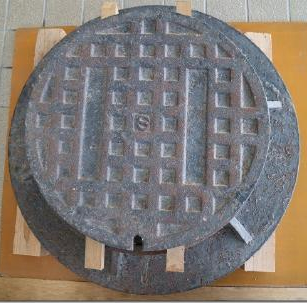
Naha Purification Center display cover. Same design as above.
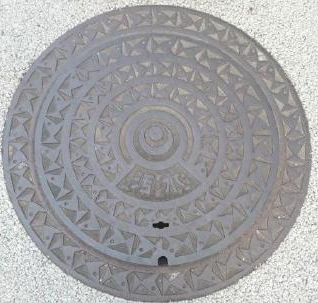
A design manhole cover in Naha City depicting fish swimming with their mouths wide open in concentric circles, with the prefectural emblem and the word 'sewage' in the center.
Emblem
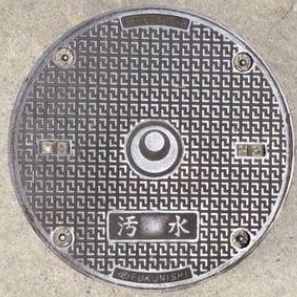
A lid with a quotation mark-style pattern made by HUKUNISHI, featuring the prefectural emblem and the characters for 'sewage'.
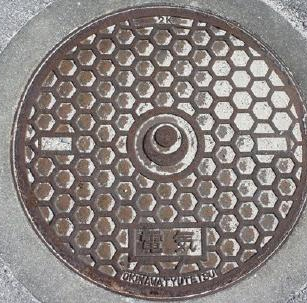
It is a tortoiseshell pattern. In the center is the emblem of Okinawa Prefecture, and at the lower part of the lid, there is an inscription that says 'Electricity.' There is also an inscription that says 'OKINAWA TYUTETSU.'
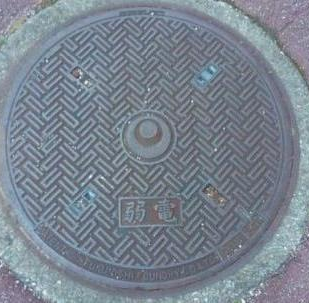
A fabric-like pattern resembling twill manufactured by Fukunishi Casting Co., Ltd., with the prefectural emblem in the center and the word 'Electric' below it.
Handhole
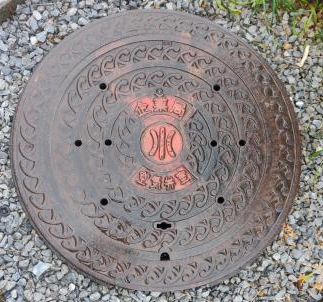
The characters "Corporate Bureau" are written above the central character for "water," and a wave crest pattern is drawn in four circles around it.
*At the Okinawa Prefectural Corporate Bureau, water from the water-rich northern part of Okinawa Island is supplied to 23 areas, which include 22 municipalities of Okinawa Island, including Naha City, and Ie Village, which is connected via an underwater water pipeline.
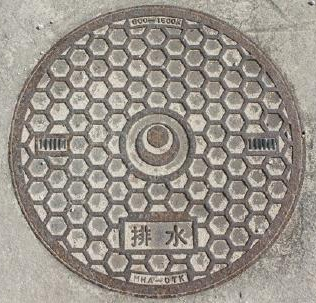
It has a hexagonal pattern. The emblem of Okinawa Prefecture is in the center, and the bottom of the lid is labeled 'Wastewater.' Taketomi Town is not part of the basin sewerage project.
Collaboration
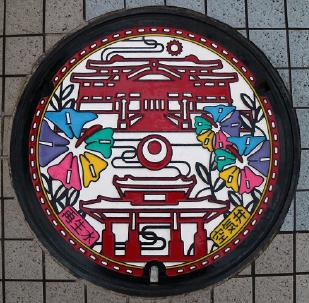
A design manhole, which was selected as the grand prize winner in last year's "Shurijo Castle Manhole Design Contest" held by Okinawa Prefecture to wish for the reconstruction of the main hall of Shurijo Castle that burned down in 2019, was actually installed on March 16. The central part features the prefectural emblem, the front shows "Shureimon Gate," the back shows "Shurijo Castle Main Hall," and hibiscus flowers are placed on the sides. The overall design has a brightly colored traditional dyed Bingata style. The words "recycled water" and "air valve" are also displayed.
Generic
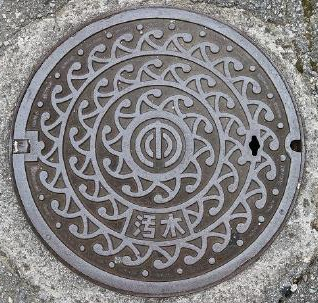
It is a design featuring three concentric circles in a wave pattern. On the outer wave crests, there are splashes (・). The city emblem is within the central circle. At the bottom, there is the notation 'Sewage.' This design is the same as the Okinawa Prefecture watershed sewer manhole cover, with the prefectural emblem replaced by the city emblem. This cover was installed around the first half of 1977, before the invention of the 'Fish School (Gara) Design Cover.' (According to '50 Years of Sewers in Naha City': Water and Sewerage Bureau website.) The waves represent the sea, and it seems to be an 'early design cover' born from the desire to keep the beach clean. However, it was not exclusive to watershed sewers and was used in various cities and towns in the prefecture with different central emblems, so it became treated as a 'general-purpose cover from the manufacturer.' Unfortunately, this cover could not become 'Japan's first design cover,' which is regrettable.
Miyakojima Water Supply Enterprise Union 宮古島上水道企業団
Handhole
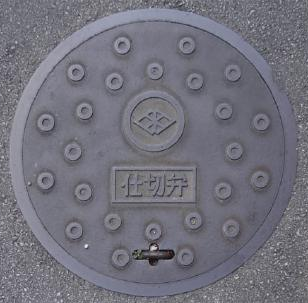
A standard type valve cover of the former Miyakojima Water Supply Enterprise Group (now Miyakojima City Water and Sewerage Department). The Miyakojima Water Supply Enterprise Group (its predecessor was the Miyakojima Water Supply Association) included former Hirara City and neighboring municipalities, but when it became Miyakojima City, the Irabu Town Waterworks Division was added, forming the new Miyakojima City Waterworks Bureau, and it was reorganized into the Miyakojima City Water and Sewerage Department. The mark at the center top is believed to be that of the former Miyakojima Water Supply Enterprise Group. Below the mark are the characters for 'valve,' and outside of them, there are two rows of small circles.
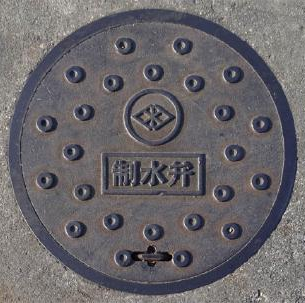
A water control valve cover with the same design as the one above, from the former Miyakojima Island Water Supply Corporation (now Miyakojima City Water and Sewer Department).
Fire Hydrant
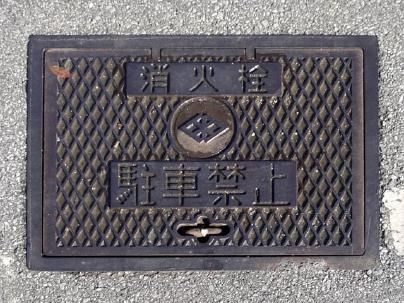
On the diagonal lattice background, there is the mark of the former Miyakojima Waterworks Enterprise, with the characters 'Fire Hydrant' above it and 'No Parking' below the mark.
Related: Miyakojima 宮古島市
Southern Waterworks Authority 南部水道企業団
Fire Hydrant
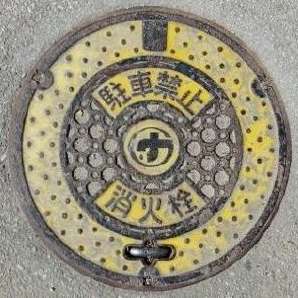
In the center, the emblem of the Southern Waterworks Enterprise, with the inscriptions 'No Parking' and 'Fire Hydrant.' Round fire hydrant cover.

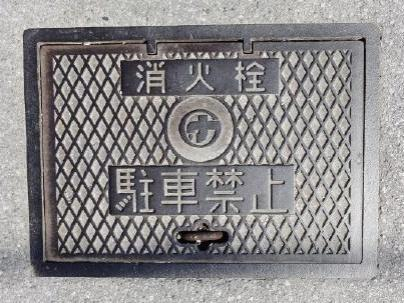
In the center of a diagonal lattice background, the emblem of the Nanbu Waterworks Enterprise Group, and the inscriptions 'No Parking' and 'Fire Hydrant.'
Square fire hydrant cover.
Collaboration
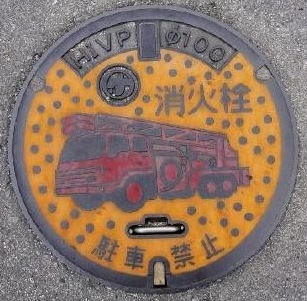
A red ladder truck on a polka-dot ground, the emblem of the Southern Waterworks Enterprise Association, the notation 'HIVP (impact-resistant rigid polyvinyl chloride pipe)' and 'Φ100', as well as 'fire hydrant' and 'no parking'.
Round fire hydrant cover.
Related: Yaese 八重瀬町
Chubu Basin Sewerage 中部流域下水道
Designer
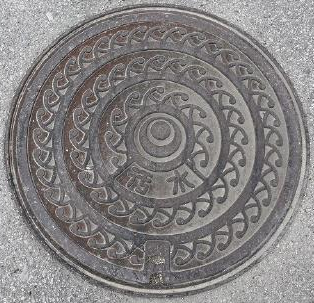
Forming three concentric circles with the same wave crest design as above, with the prefectural emblem in the center and the word 'Sewage' below it. Okinawa Prefecture implements three systems: the Central Basin Sewerage (Naha Treatment Area... Naha City, Urasoe City, Tomigusuku City, Haebaru Town; Isahama Treatment Area... Okinawa City, Urasoe City, Ginowan City, Chatan Town, Kadena Town, Yomitan Village, Kitanakagusuku Village), the Nakagusuku Bay Basin Sewerage (Gushikawa Treatment Area... Okinawa City, Uruma City, Kitanakagusuku Village), and the Southern Nakagusuku Bay Basin Sewerage (Nishihara Treatment Area... Nishihara Town, Nakagusuku Village, Yonabaru Town, Nanjo City). According to the Prefectural Sewerage Management Office, 'Since the prefectural emblem is clearly displayed on manhole covers, it might have been thought at the time of designing that there was no need to explicitly indicate it as a basin sewerage, because it could be recognized as a prefectural manhole cover. However, around Shakari Park along Prefectural Road 24 (Chatan Town, Okinawa Prefecture), there are also manhole covers labeled as basin sewerage.' Basin Sewerage Sewage Manhole Cover.
Related: Naha 那覇市, Urasoe 浦添市, Uruma うるま市, Okinawa 沖縄市, Ginowan 宜野湾市, Tomigusuku 豊見城市, Nanjo 南城市, Kadena 嘉手納町, Chatan 北谷町, Nishihara 西原町, Haebaru 南風原町, Yonabaru 与那原町, Kitanakagusuku 北中城村, Nakagusuku 中城村, Yomitan 読谷村
Nakashiro Bay Southern Basin Sewerage 中城湾南部流域下水道
Designer
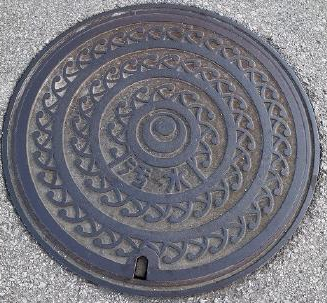
The above cover is a type with a keyhole shape that is different. During the period when municipalities within the prefecture had not created their own design covers, it seems that they reused covers by replacing the prefectural emblem with the municipal emblem. Looking at the website of the Japan Manhole Cover Society, covers with this wave pattern have been found in several municipalities. According to the prefectural sewer management office, 'The reason the design patterns are unified may be that manhole covers are produced by a limited number of companies within the prefecture (such as Okinawa Cast Iron).' South Nakagusuku Bay Basin Sewer Manhole Cover.
Related: Nishihara 西原町
Okinawa Prefecture Basin Sewerage 沖縄県流域下水道
Emblem
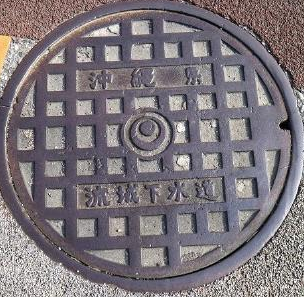
In the center of the lattice pattern is the prefectural emblem. Above it are the words 'Okinawa Prefecture,' and below, 'Watershed Sewerage.' Most prefectural watershed sewer manhole covers have wave patterns, so I think this cover is a 'super rare item.' It is quite worn, so it may no longer be seen on the streets in the future. Even if it is replaced, I hope this cover will be preserved rather than discarded.
Related: Chatan 北谷町