Fukushima 福島県
Fukushima 福島県
Fukushima 福島市
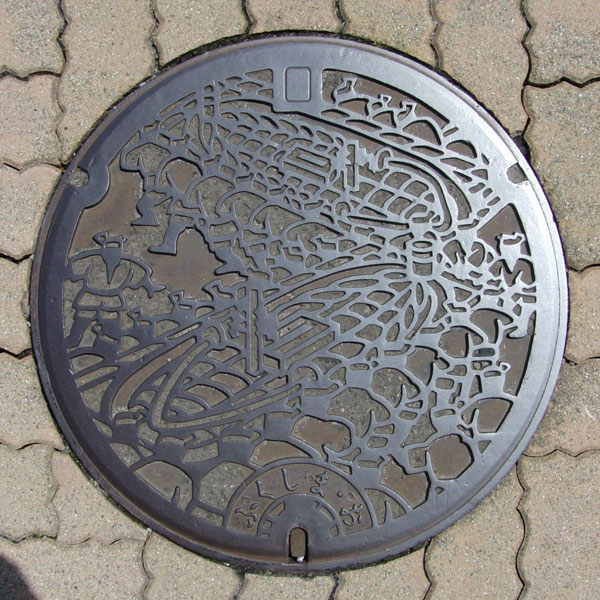
A manhole cover for sewage, depicting the dedication of large straw sandals to Haguro Shrine. The letters "Fukushima-o" are written at the bottom.
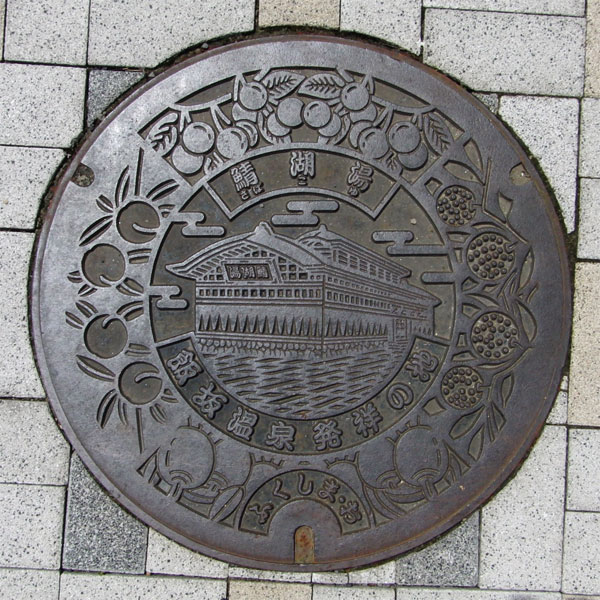
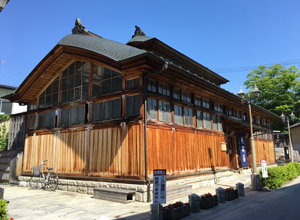
The central circle depicts the Sabakoyu building, the words "Sabakoyu (with furigana)" and "Birthplace of Iizaka Onsen," and the local specialties of Fukushima—cherries, pears, apples, and peaches—around the perimeter. The letters "Fukushima-o" are written at the bottom.
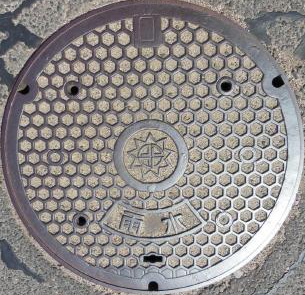
Fukushima city emblem in the center.
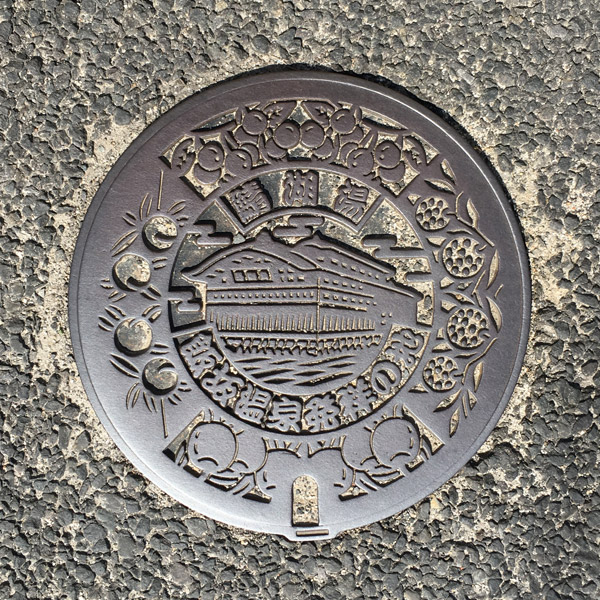
A small cover with the same design as above.
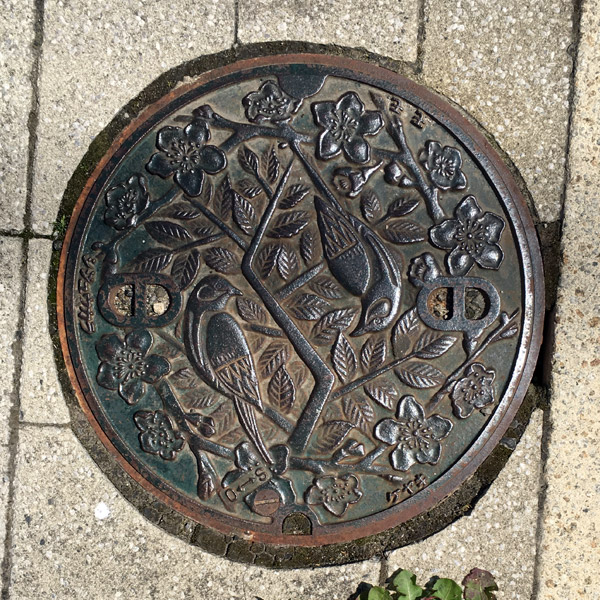
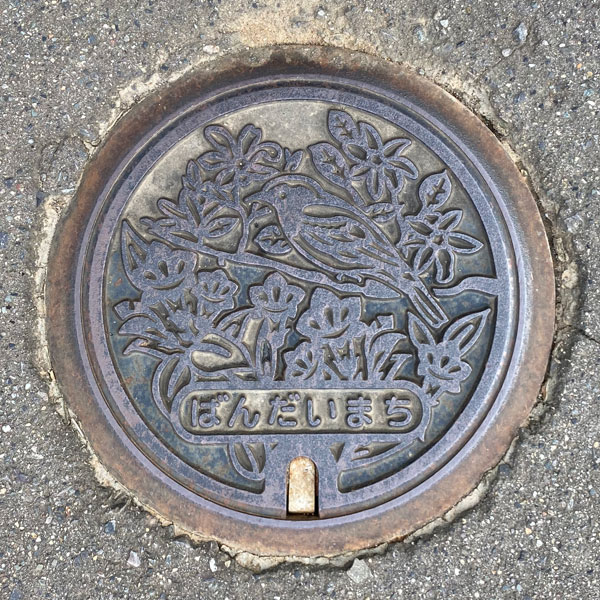
The sewage manhole cover features relief images of the city's tree, the zelkova, its flower, the peach, and its bird, the tit.
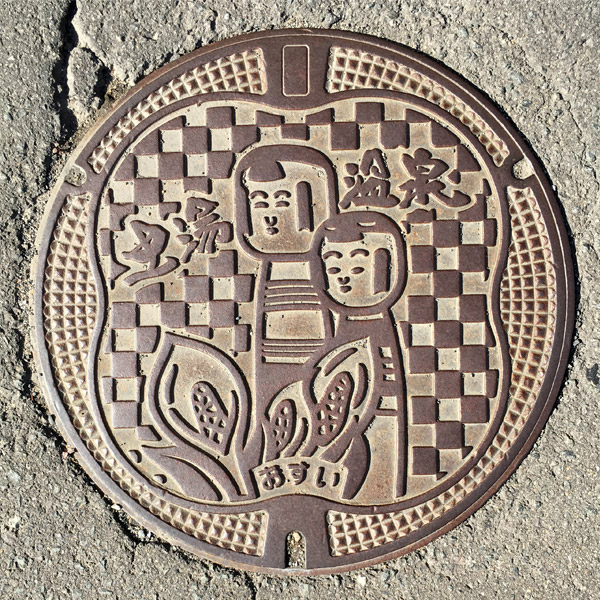
A sewage manhole cover exclusive to the Tsuchiyu Onsen area (Tsuchyu Onsen Town Specific Environmental Conservation Public Sewerage Project) featuring the Tsuchiyu Kokeshi doll and the Asian skunk cabbage.
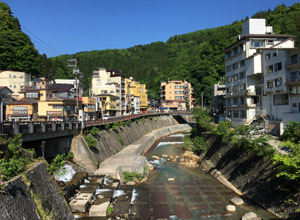
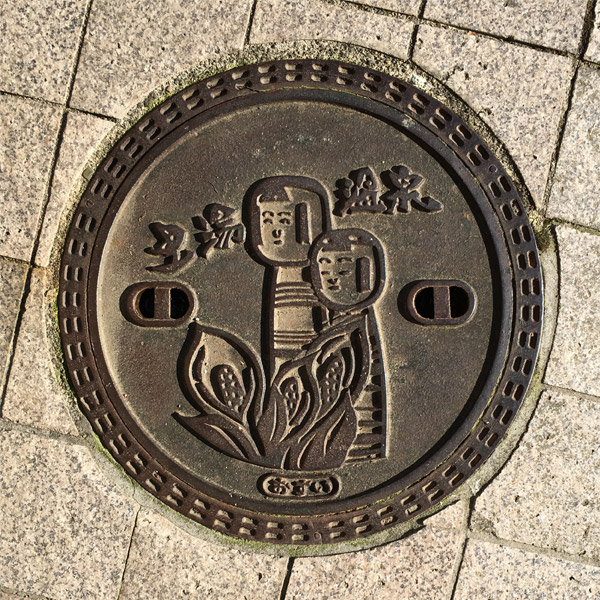
A sewage manhole cover with a picture of "Tsuchiyu Kokeshi" and "Asian skunk cabbage." There is no checkered background.
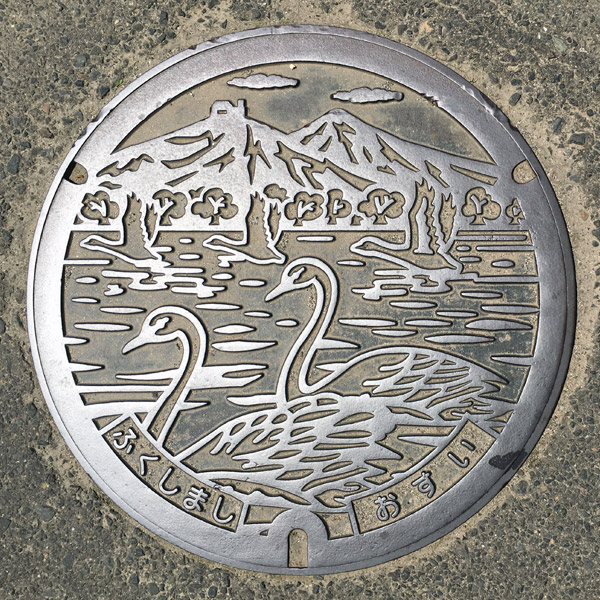
This manhole cover for agricultural collection and drainage in the Yamaguchi area depicts swans flying over the Abukuma River. The characters "Fukushima" and "Osui" are written at the bottom.
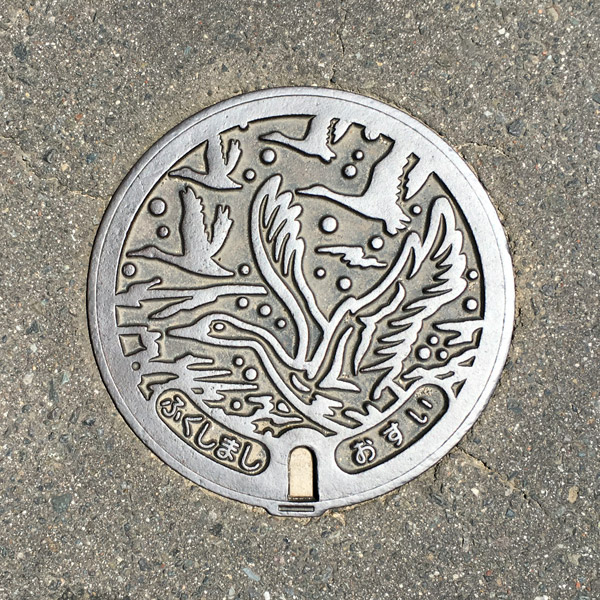
A small Yamaguchi District Agricultural Dispatch board depicting swans flying off the Abukuma River. The characters "Fukushima" and "Osui" are written at the bottom.
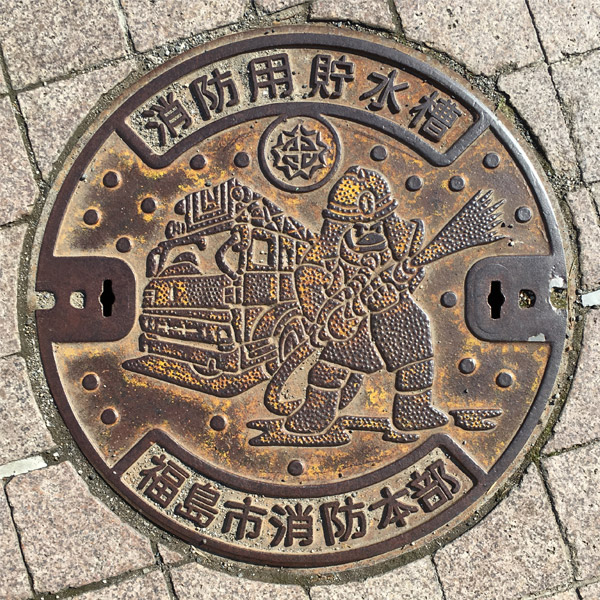
The lid of a "fire water tank" with the words "Fukushima City Fire Department" engraved on it.
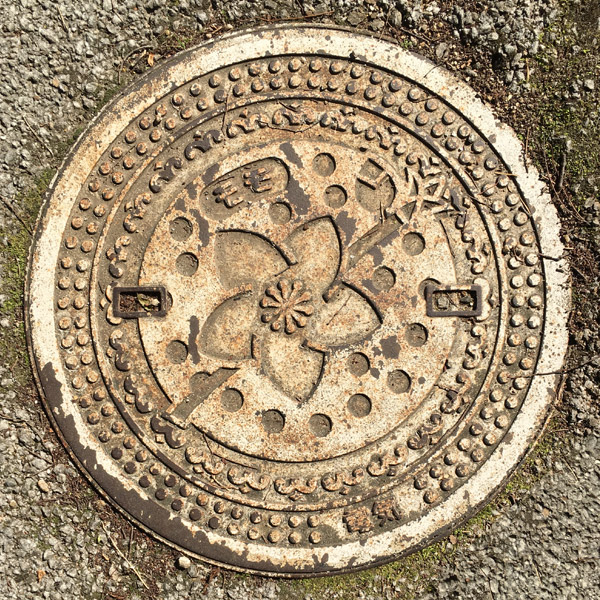
The lid is painted white and features the city's flower, the peach. The character for "electricity" is written at the bottom.
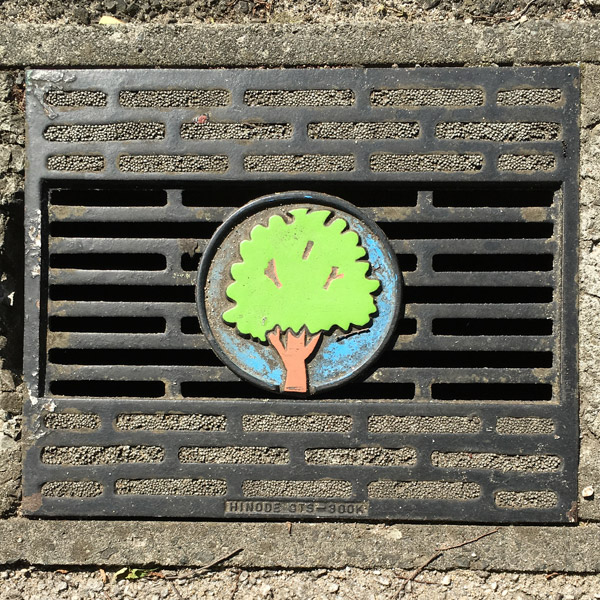
A drain cover featuring the city tree, the zelkova, of Fukushima City.
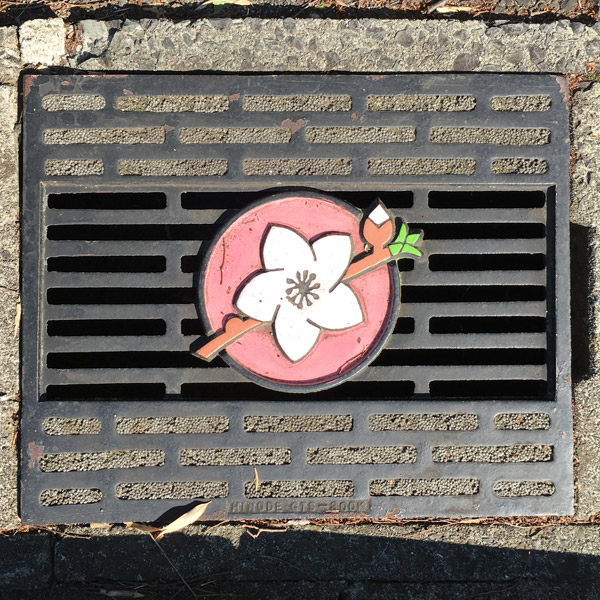
A drain cover with a peach, Fukushima City's city flower, painted on it. The peach flower design is the same as the white drain cover two levels above.
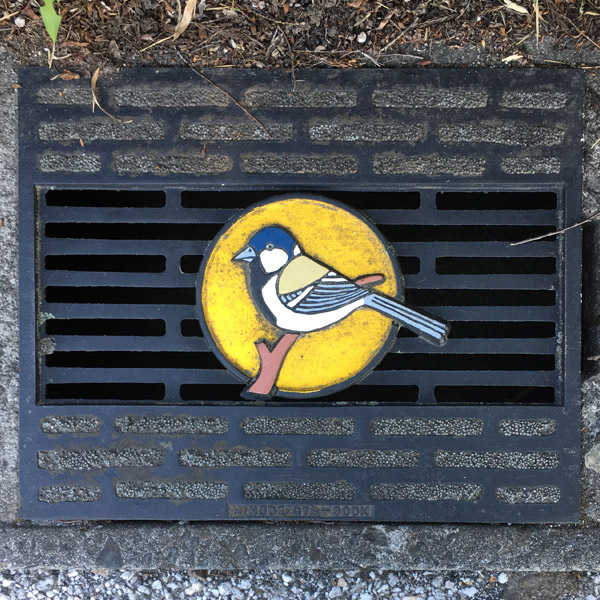
A drain cover painted with the Fukushima City bird, the titmouse.
Date 伊達市
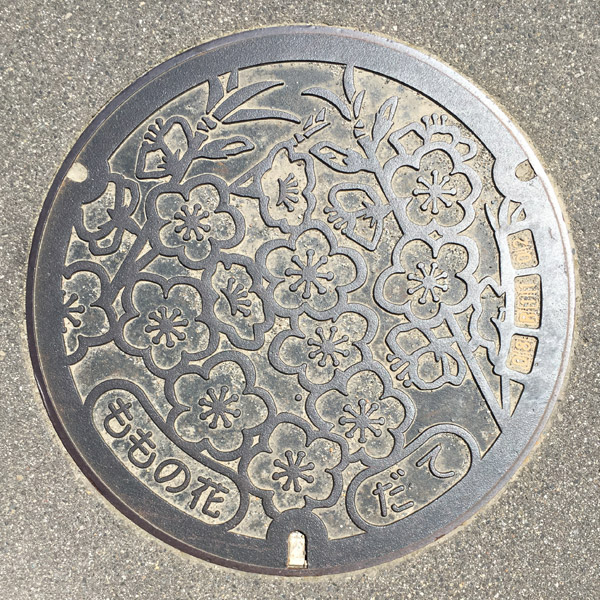
A sewage manhole cover with the city's flower, the peach, painted on it. The letters "peach flower" and "date" are written at the bottom, and the number frame is on the right.
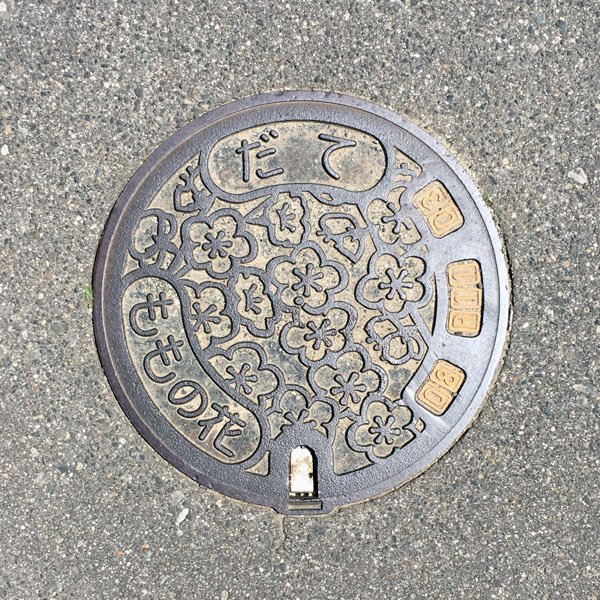
A small version with the same design as above. The characters "Date" are written at the top and "Momo no Hana" (Peach Blossom) are written at the bottom left. The number frame is on the right.
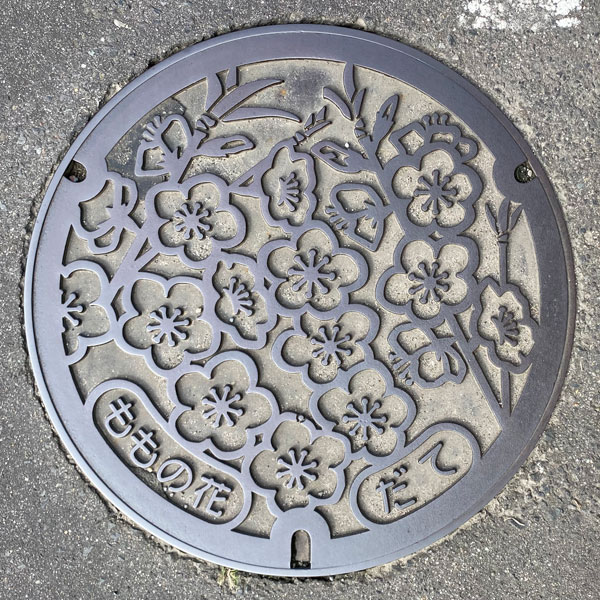
This manhole cover has the same design as above, but does not have a number frame.
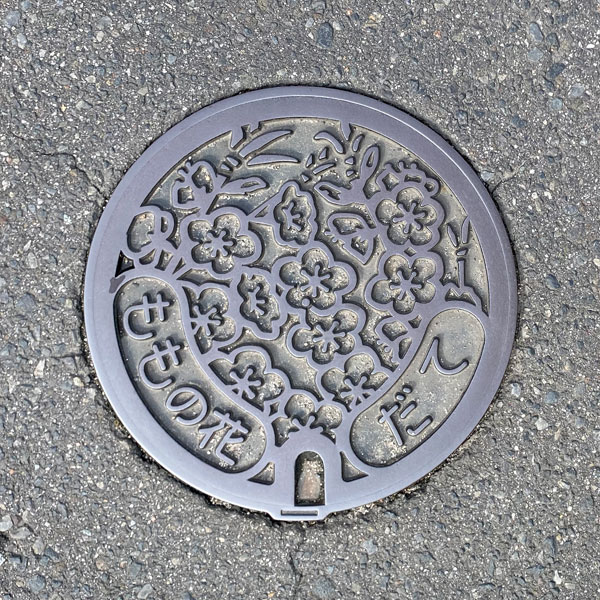
A small version with the same design as above but without the number frame.
Date 伊達町
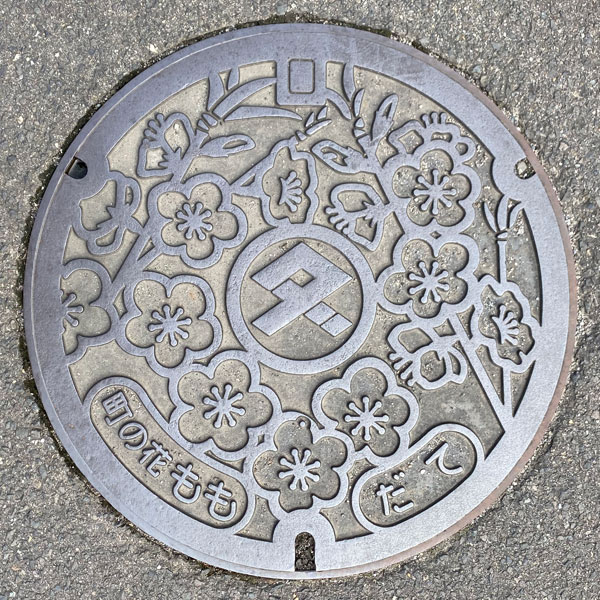
The town flower, the peach, is depicted. The former Date town emblem is in the central circle.
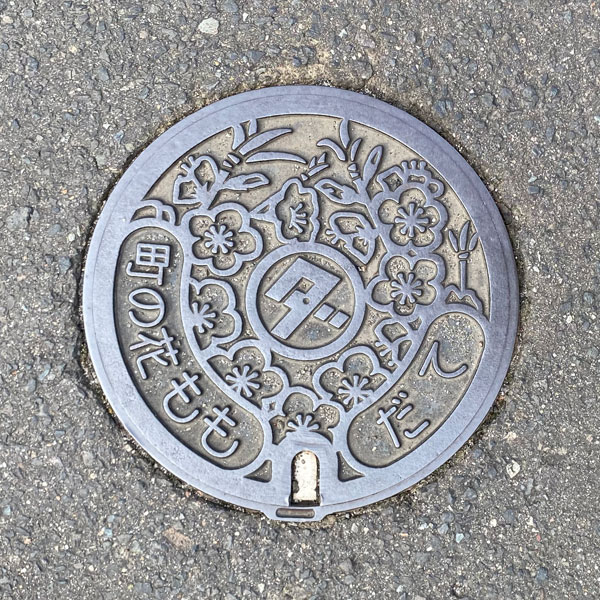
A small board depicting the town flower, the peach, and the former Date town emblem in the central circle.
Yanagawa 梁川町
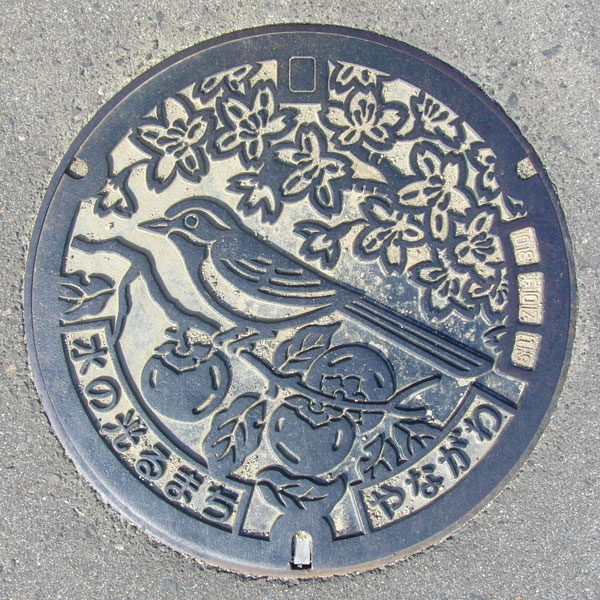
The town's bird, the wagtail, the town's tree, the persimmon, and the town's flower, the cherry blossom, are depicted. At the bottom are the words "Town of Shining Water" and "Yanagawa."
Hobara 保原町
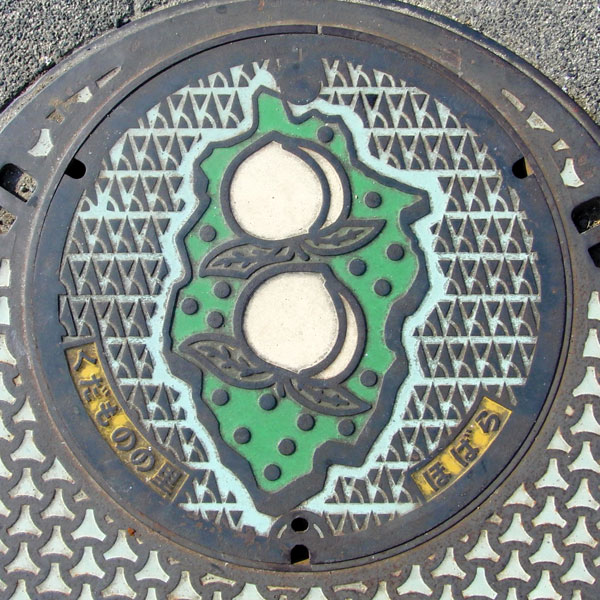
A peach is depicted in the shape of the former Hobara town.
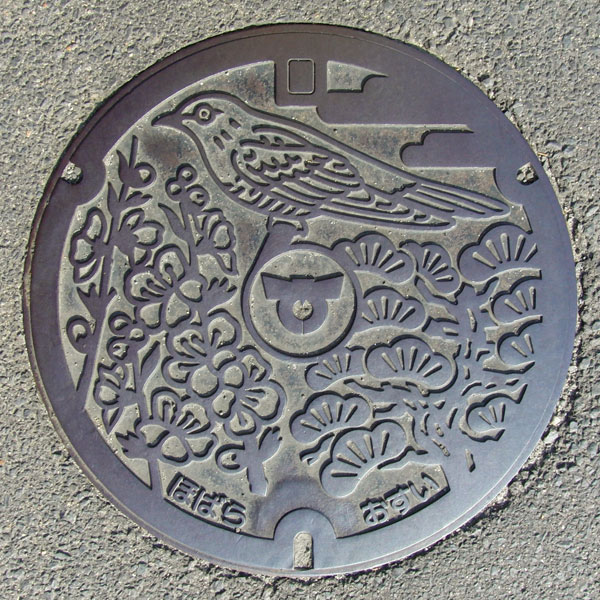
A manhole cover for sewage, depicting the town tree, the red pine, the town flower, the peach blossom, and the town bird, the cuckoo. The former Hobara Town emblem is in the center. The characters "Hobara" and "Osui" are written at the bottom
Soma 相馬市
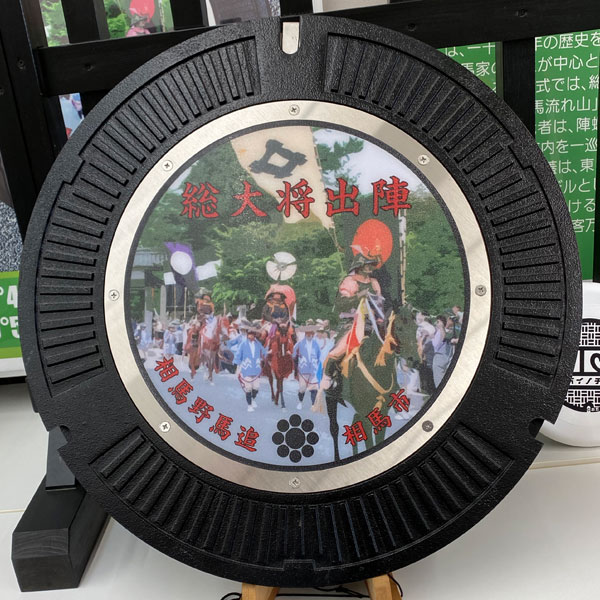
The Soma Nomaoi festival, designated as an Important Intangible Folk Cultural Property of Japan, begins with a departure ceremony at the Nakamura Castle ruins. Afterward, mounted warriors from Uta Village, accompanied by the commander-in-chief, march out of the Otemon Gate and tour the city, unfolding a Sengoku period picture scroll. The cover design is apparently modeled after the commander-in-chief march that took place in the year of the Great East Japan Earthquake. The words "Commander-in-Chief's Departure" are written at the top. Between "Soma Nomaoi" and "Soma City" at the bottom is the Soma clan crest, the "Kuyo."
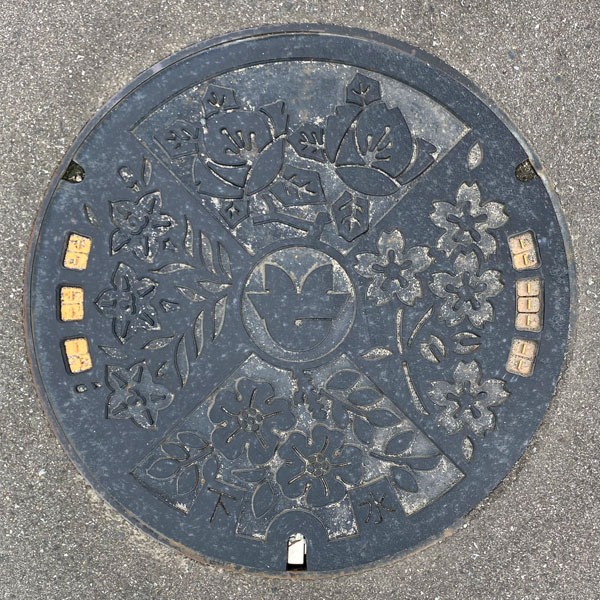
Flowers of the four seasons: cherry blossoms, roses, bellflowers, and camellia.
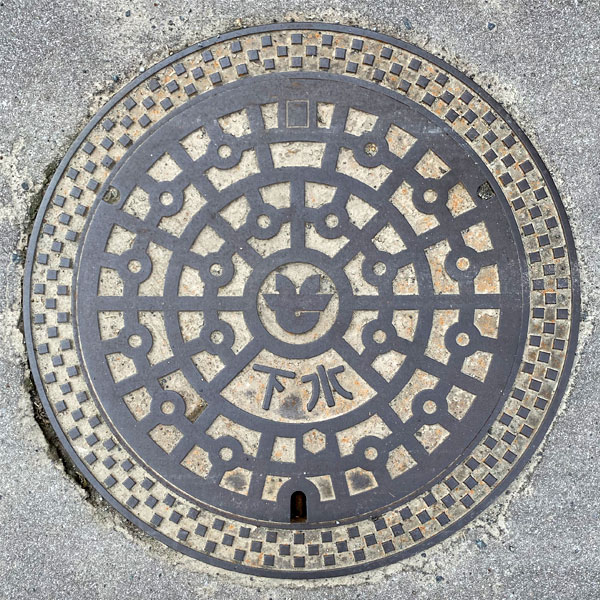
A patterned manhole cover with a wide border and the city emblem in the center.
Kitakata 喜多方市
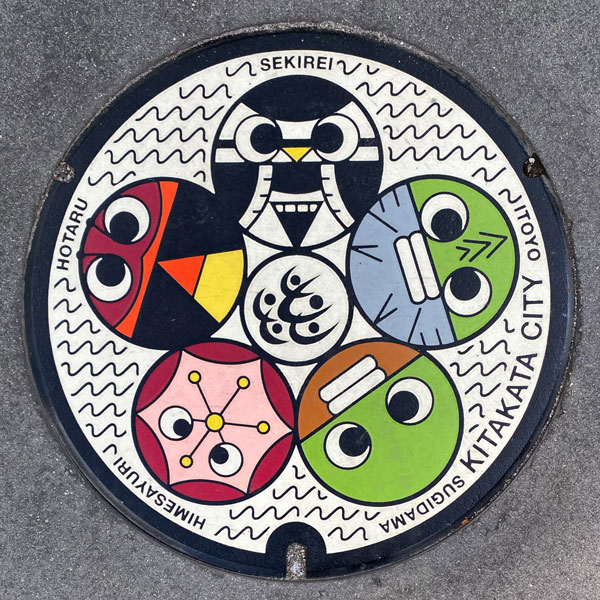
The city's bird, the Wagtail, the city's fish, the three-spined stickleback, the city's tree, the Iide cedar ball, the city's flower, the Hime-sayuri, and the city's insect, the firefly, are depicted as characters and arranged around the new city emblem.

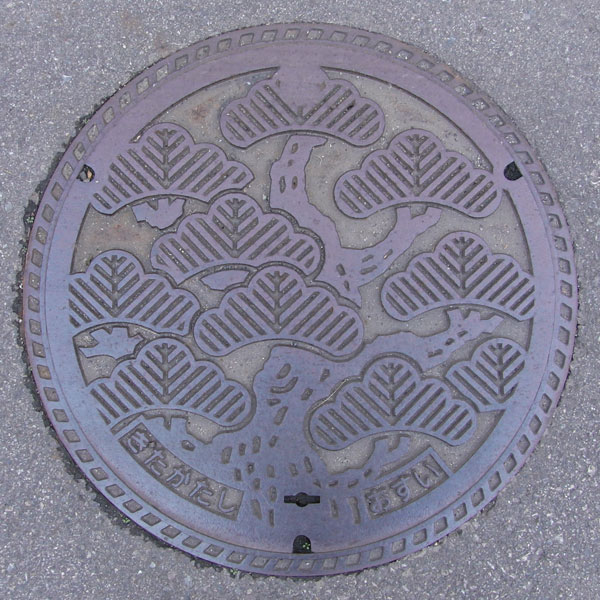
The current symbols of Kitakata City are the Iide Cedar, the Himesa Lily, the Grey Wagtail (shown in the photo on the city's website), the three-spined stickleback, and the firefly. The design on this cover clearly depicts a pine tree, suggesting it belongs to the former Kitakata City.
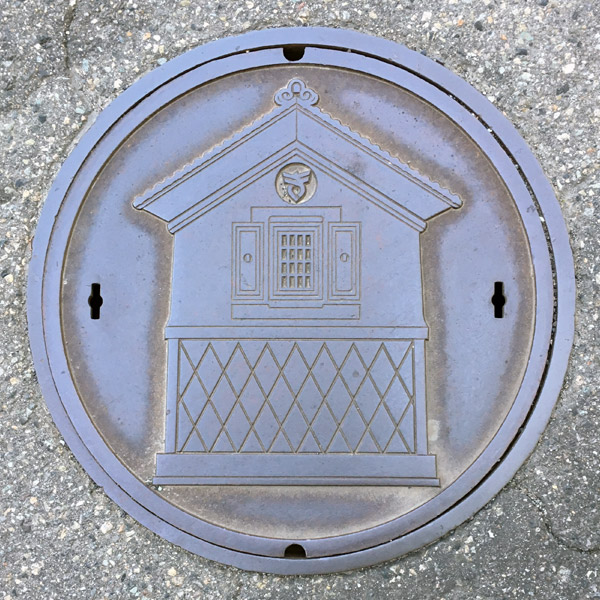
This sewage manhole cover features a storehouse, fitting for Kitakata, a town of storehouses. The family crest is replaced with the former Kitakata City emblem.
Shiokawa 塩川町
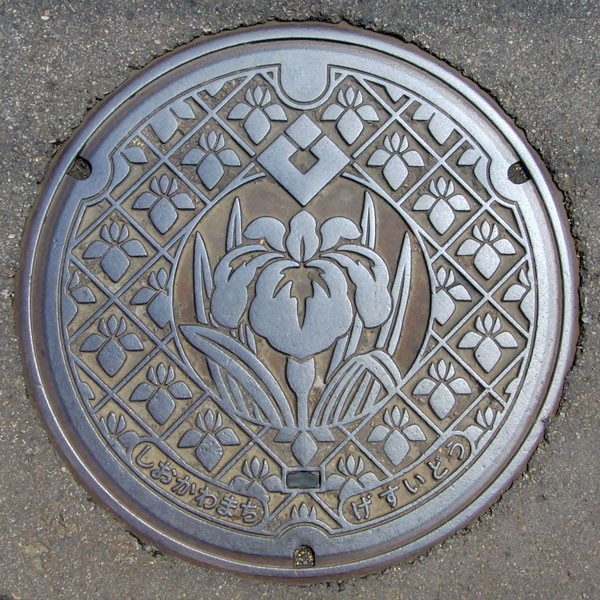
The lid features a design of the town's flower, the Japanese iris. The former Shiokawa Town emblem is placed above the iris, and the words "Shiokawamachi" and "Gesuido" are written at the bottom.
Yamato 山都町
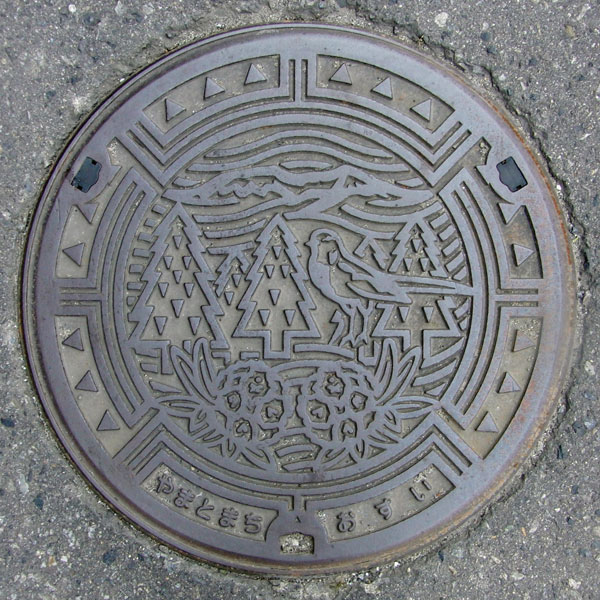
The lid features the town emblem, with the Iide mountain range in the background, depicting the town tree, the Japanese cedar, the town flower, the rhododendron, and the town bird, the wagtail.
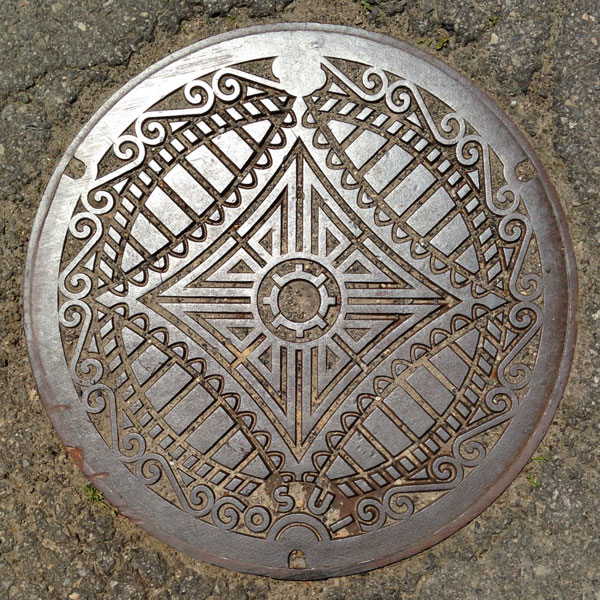
A sewage manhole cover with a geometric pattern. The former Yamato town emblem is in the center.
Atsushiokano 熱塩加納村
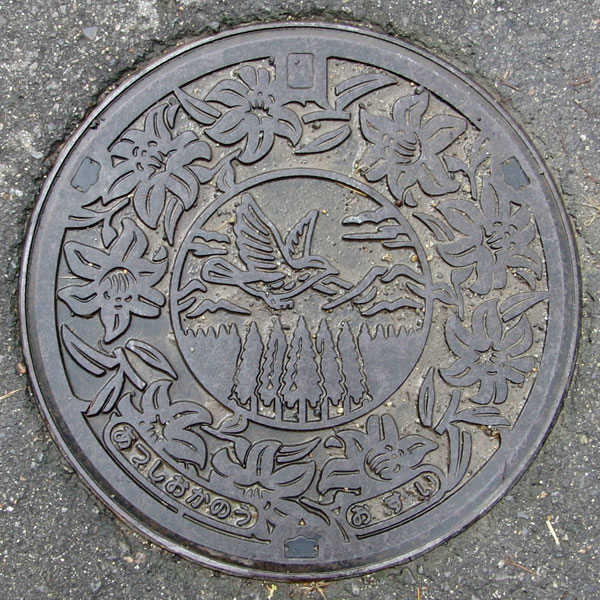
The village tree, a Japanese cedar, and the village bird, a Japanese bush warbler, are depicted in the center, surrounded by the village flower, a Himesayuri (lily family).
Takasato 高郷村
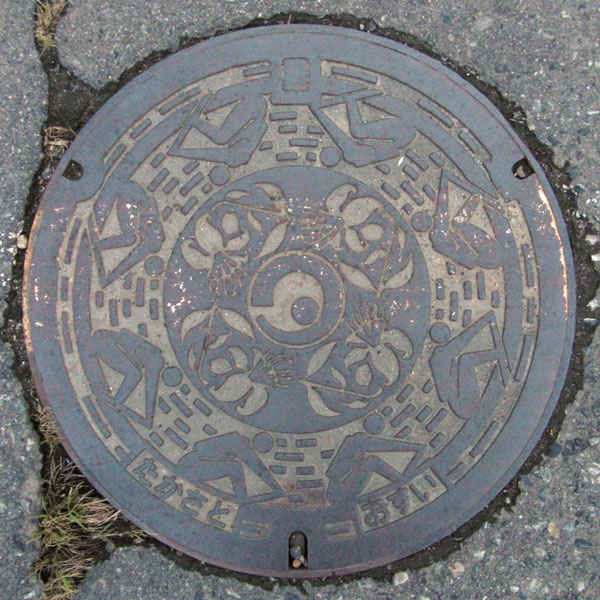
The design shows people rowing at the prefectural Ogino Rowing Course near JR Ogino Station, along with the town flower, the Hime Sayuri. In the center is the former Takasato Village emblem.
Minamisoma 南相馬市
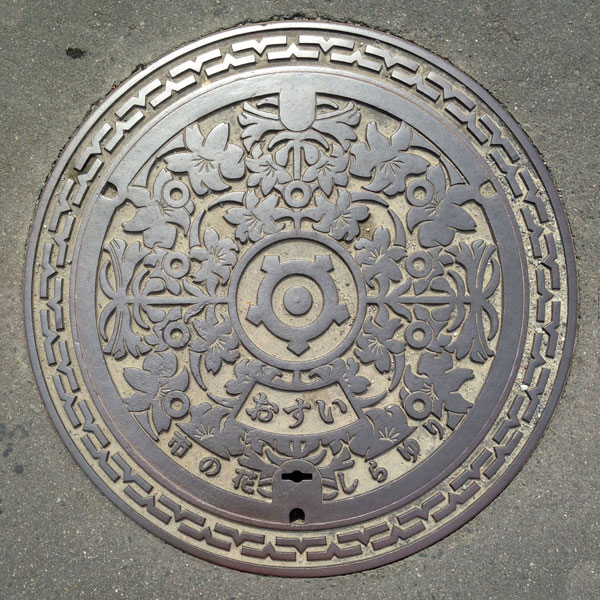
A sewage manhole cover decorated with the city's flower, the white lily.
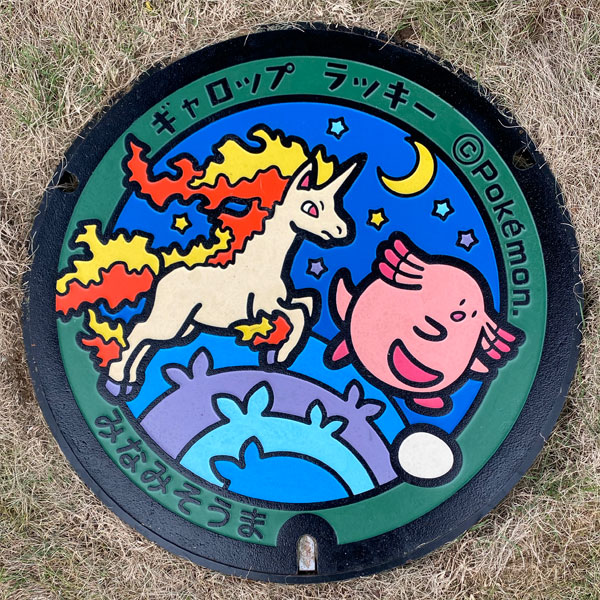
This Pokémon manhole cover, "Poke Lid," was donated by The Pokémon Company. It features Gallop and Lucky. "Minamisoma" is written in the lower left, and "ⓒPokémon." is written in the upper right.
Odaka 小高町
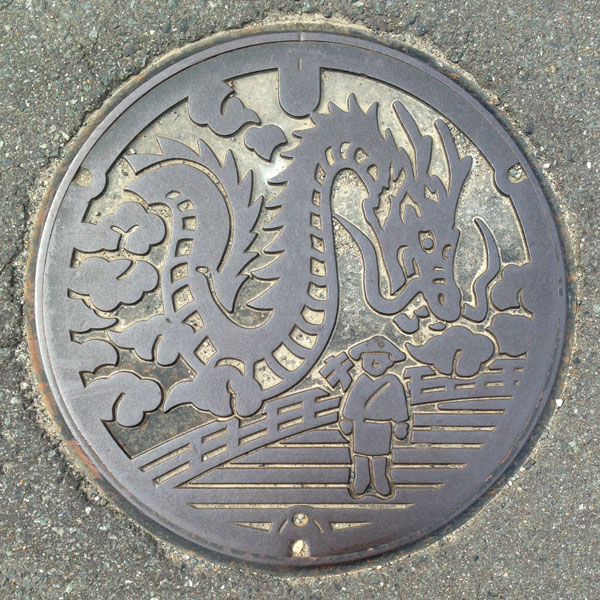
A biwa monk named Tamaichi came from Kamigata during the Nanboku-cho period. He prayed to Kannon Yakushi at Mt. Daihisa to cure his eyesight. Every night, a distinguished samurai would come to listen to him play his biwa at the Yakushido temple. One day, the samurai revealed that he was not a human, but a giant snake living in the Yakushido swamp. He had grown so large that he would turn an area around seven miles into a sea of mud, but he would spare the monk in return for the biwa. On the condition that he not tell anyone. After much deliberation, the monk finally confessed everything to Lord Soma in Odaka. However, upon leaving the castle, he was kidnapped by a giant snake. The villagers, upon learning this, drove iron nails, which are poisonous to snakes, into the mountains and valleys of Mt. Daihisa, thereby slaying the snake. It is said that place names such as Biwabashi, Mimidani, and Kakubeuchi in Odaka are based on this legend.
Kashima 鹿島町
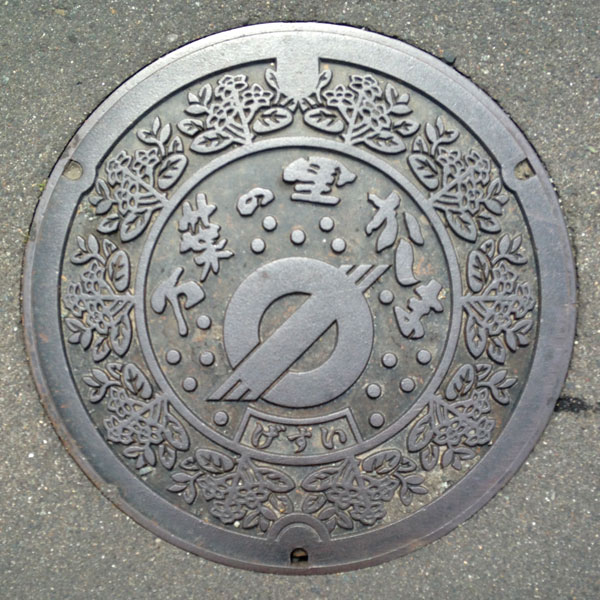
The town flower, the "Rhaphiolepis umbellata," is displayed around the perimeter, and the words "Man'yo no Sato Kashima" and the former town emblem are in the center.
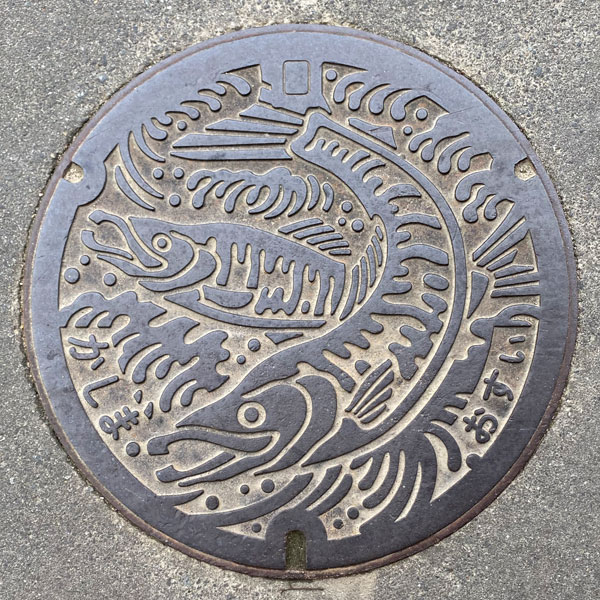
A lid for agricultural waste collection in the southern Kashima region, depicting two salmon with crooked noses.
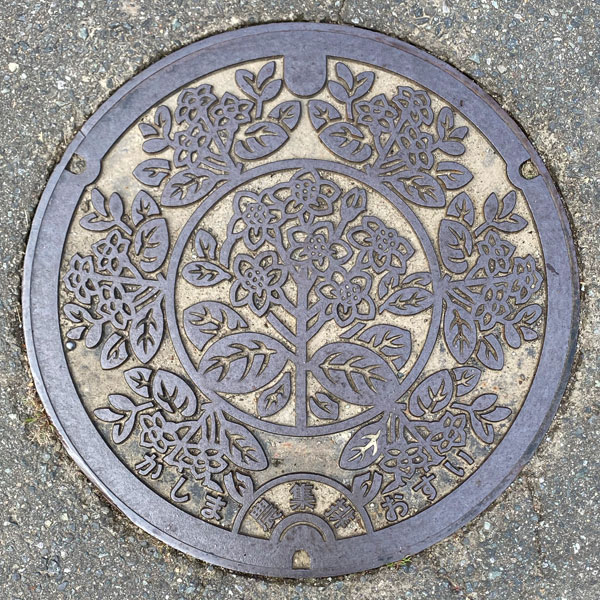
A lid for agricultural waste collection in the eastern Kashima district is decorated with the former town flower, the "Rhaphiolepis umbellata."
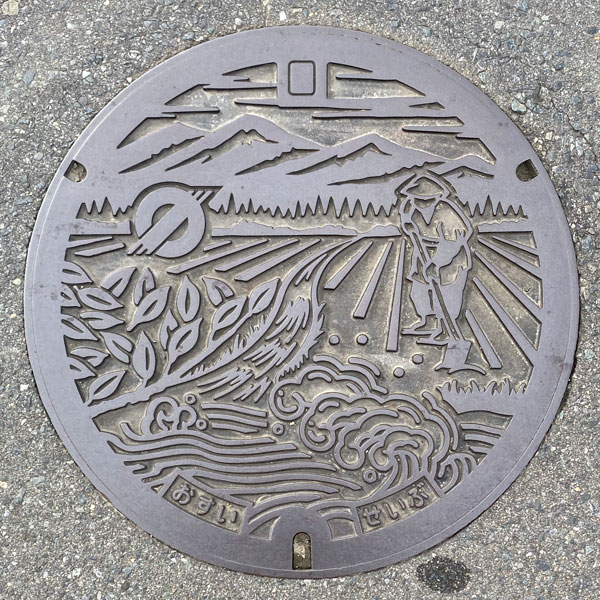
This agricultural waste collection and drainage lid from the western Kashima region depicts a farm scene. The Abukuma Highlands are in the background, and the rippling water is likely the Mano River or a tributary, the Kamimano River. The old town emblem is also depicted.
Nihonmatsu 二本松市
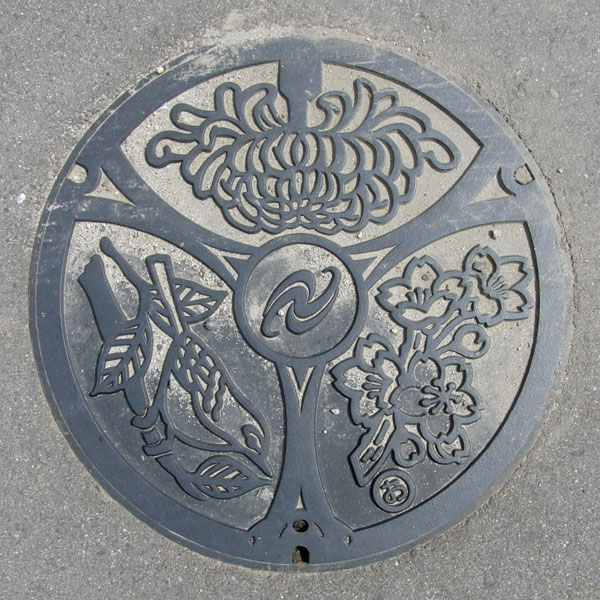
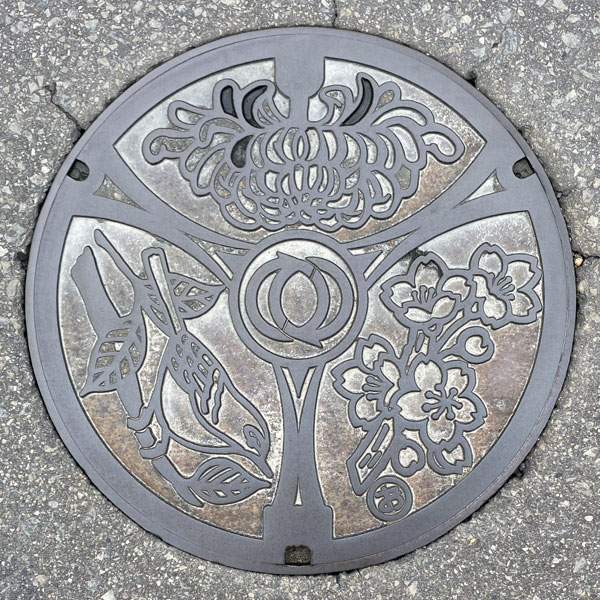
This sewage manhole cover features the city's flower, the chrysanthemum, the city's tree, the cherry blossom, and the city's bird, the Japanese bush warbler. The new Nihonmatsu City emblem is in the center.
Nihonmatsu 二本松市
Same cover as above, the old Nihonmatsu city emblem is used.
Adachi 安達町
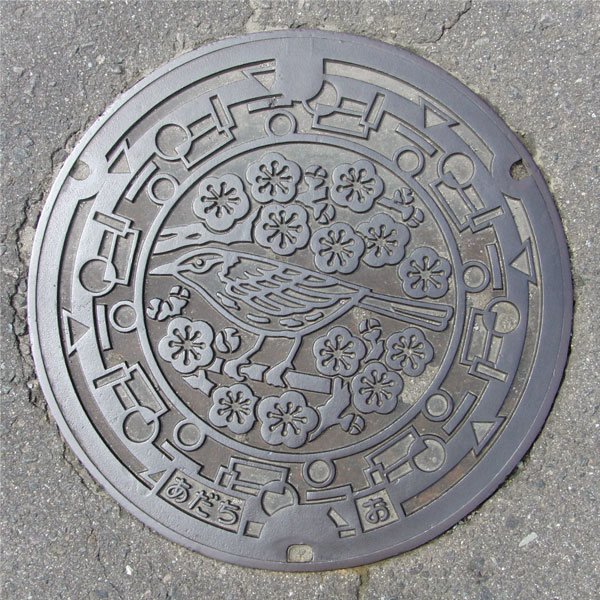
Plum blossoms and a Japanese bush warbler.
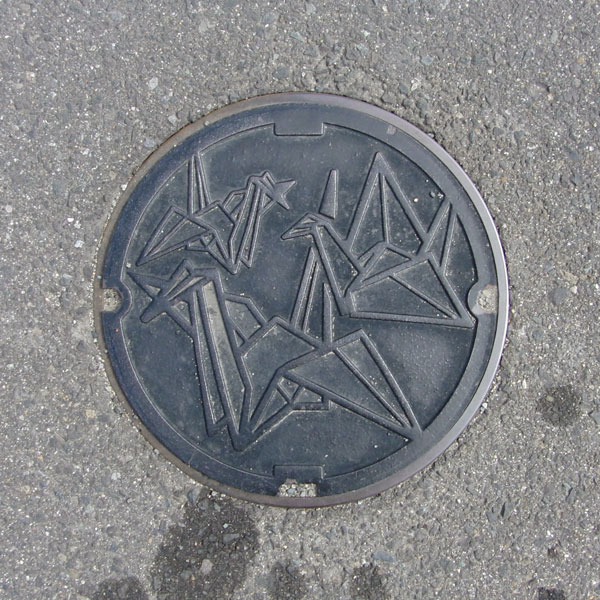
The former Adachi Town is the hometown of Chieko, the character in Kotaro Takamura's "Chieko Sho." Chieko, who was hospitalized due to mental illness, is said to have folded many paper cranes using the chiyogami paper Kotaro gave her.
Iwashiro 岩代町
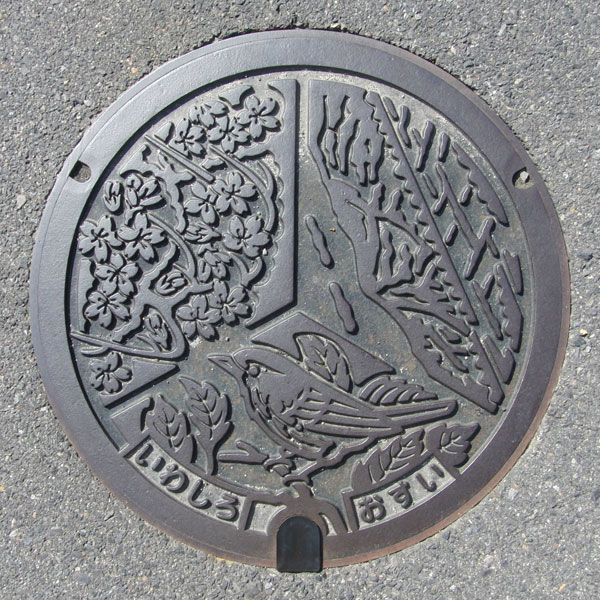
The characters at the bottom read "Iwashiro" and "Osui," but according to Wikipedia, the town's trees are "cedar" and "pine," and its flower is "mountain azalea." However, the design on the lid features a mountain, cherry blossoms, and a bird. Nihonmatsu City's tree is "cherry blossom," its flower is "chrysanthemum," and its bird is "Japanese bush warbler," so this seems more accurate.
Aizuwakamatsu 会津若松市
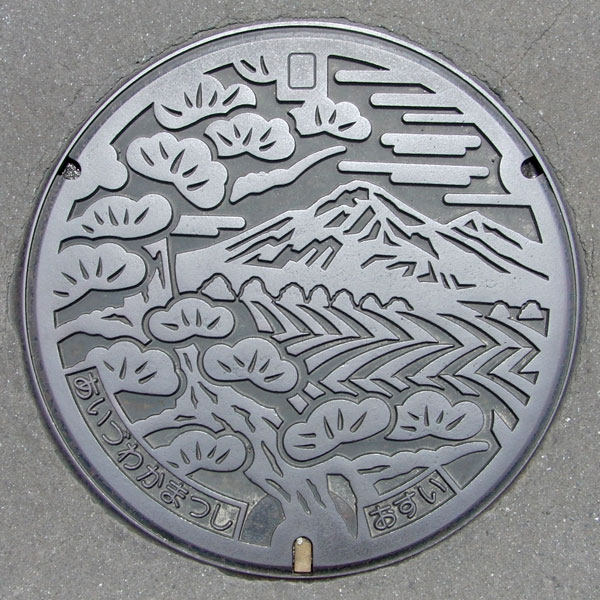
A manhole cover featuring Mount Bandai and the city's tree, the red pine.
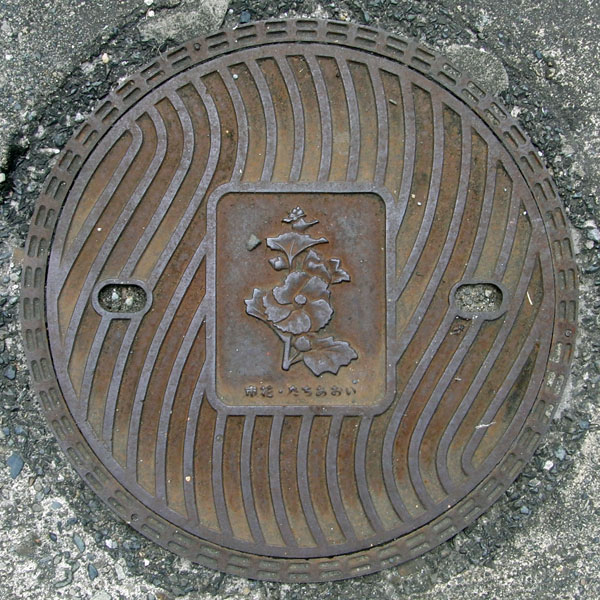
The city flower, the hollyhock, is depicted in the center.
This lid is very similar to a sewage manhole cover in Kahoku Town, Yamagata Prefecture, that features a hollyhock.
Kawahigashi 河東町
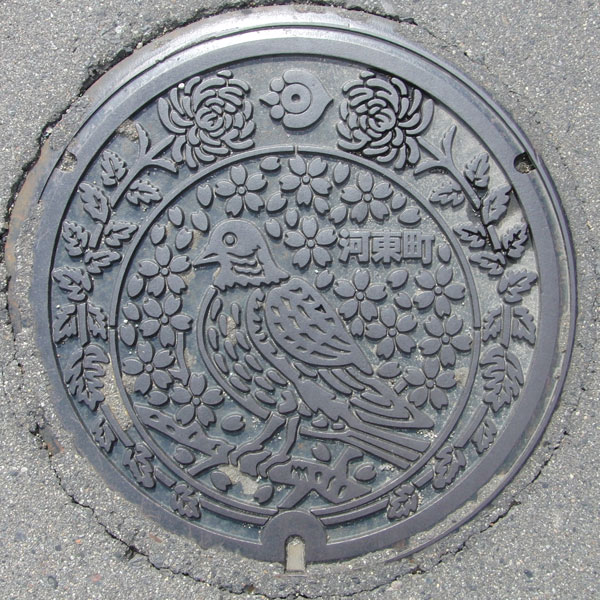
The image depicts the town's flower, the chrysanthemum, the town's tree, the cherry blossom, and the town's bird, the dove. The dove's neck pattern suggests it's a Turtle Dove.
Kitaaizu 北会津村
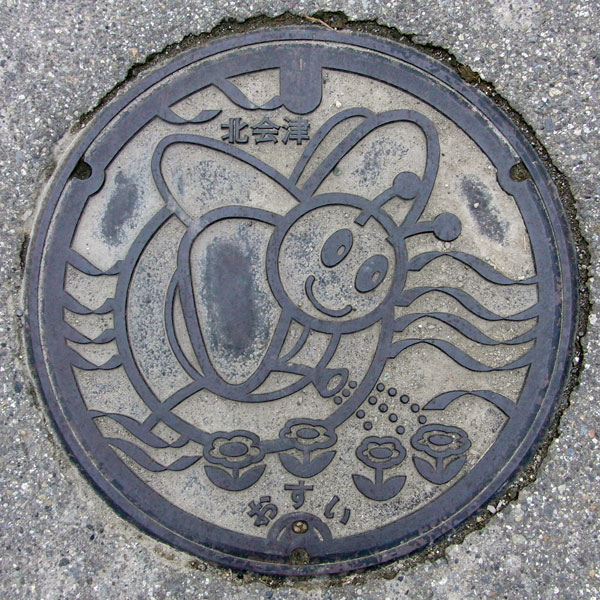
A farm waste collection and disposal lid featuring the village's mascot character, "Pikarin."
Motomiya 本宮市
Motomiya 本宮町
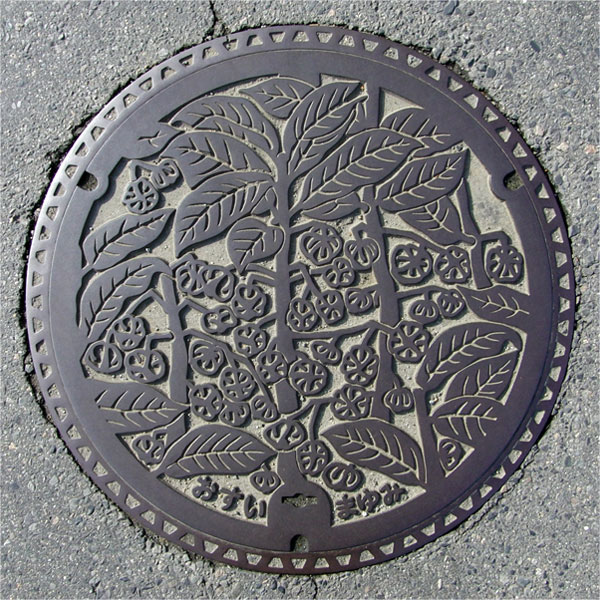
The design features the town's tree, the Mayumi tree.
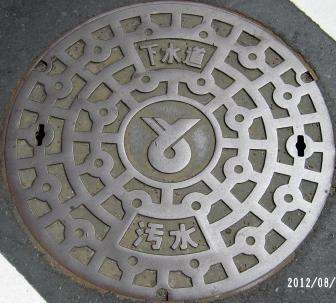
City emblem in the center.
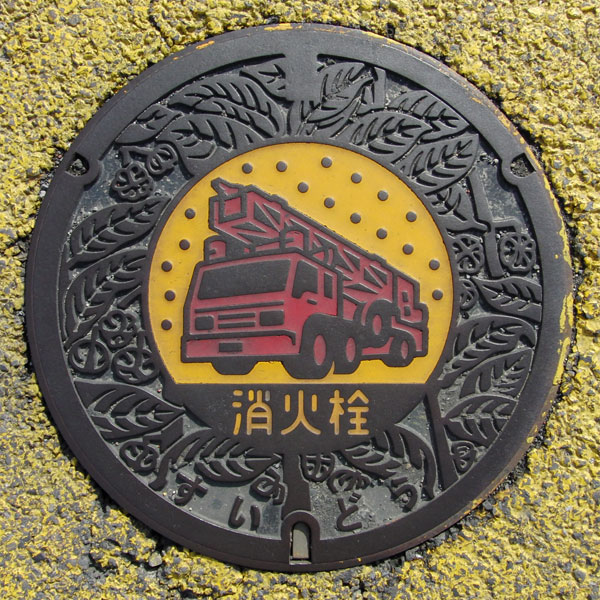
The fire hydrant cover has the same Mayumi design as the sewer manhole cover, with the fire engine background. The word "sui-do" is written at the bottom.
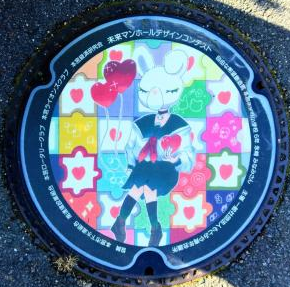
The Motomiya Junior Chamber International held the "MIRAI Manhole Design Contest" for 5th and 6th graders at local elementary schools as part of an initiative to brighten up the community from the ground up. The contest involved printing images of a future city onto manhole covers, which were then installed in six locations throughout the city. The designs feature characters in uniforms that appear to be rabbit-themed, and a background resembling a jigsaw puzzle, adorned with numerous hearts.
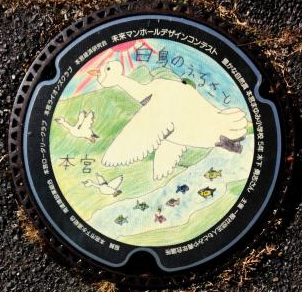
The manhole above shows a swan flying over Hongu, a place rich in nature with mountains and swimming fish, and the words "Hometown of Swans" and "Hongu" are included.
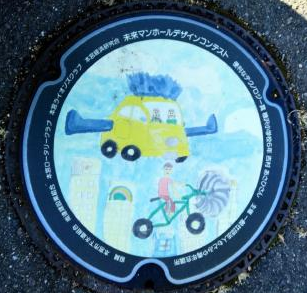
The manhole above depicts flying cars and bicycles.
Tamura 田村市
Takine 滝根町
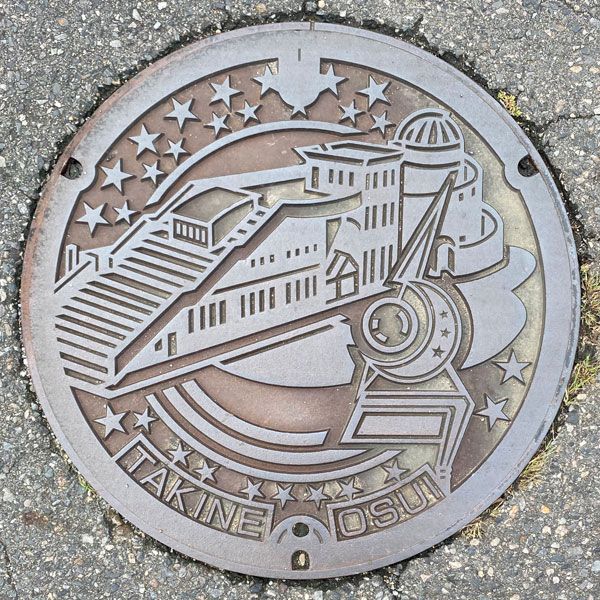
The "Hoshi-no-mura Observatory" near Abukuma Cave is depicted.
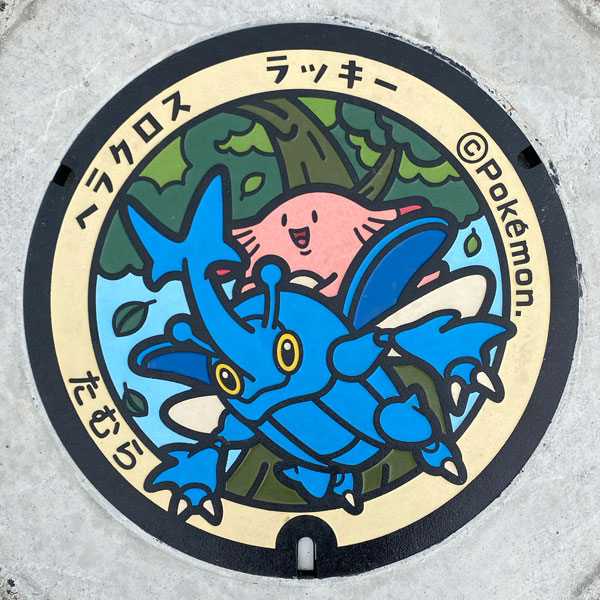
This Pokémon manhole cover, a "PokéLid," was donated by The Pokémon Company. It features "Chansey" and "Heracross." On the left is "Tamura," and on the right is "ⓒPokémon."
Oogoe 大越町
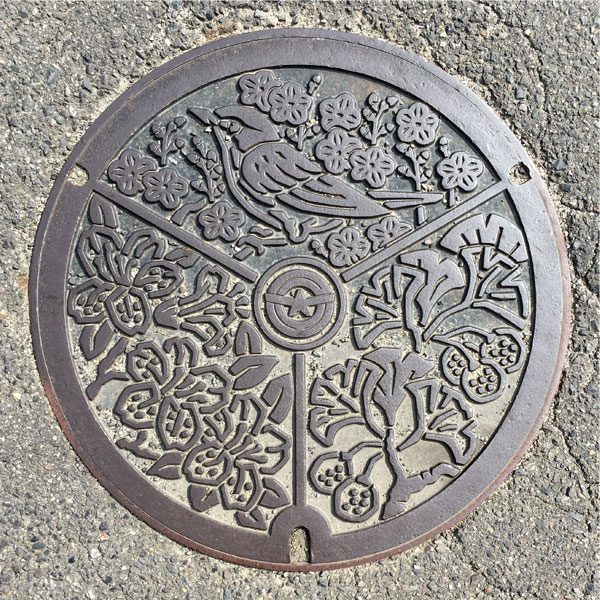
This sewage manhole cover features the former Ogoe Town emblem in the center, the town bird "uguisu" (Japanese bush warbler) at the top of the three-part section, the town flower "azalea" at the bottom left, and the town tree "ginkgo" at the bottom right.
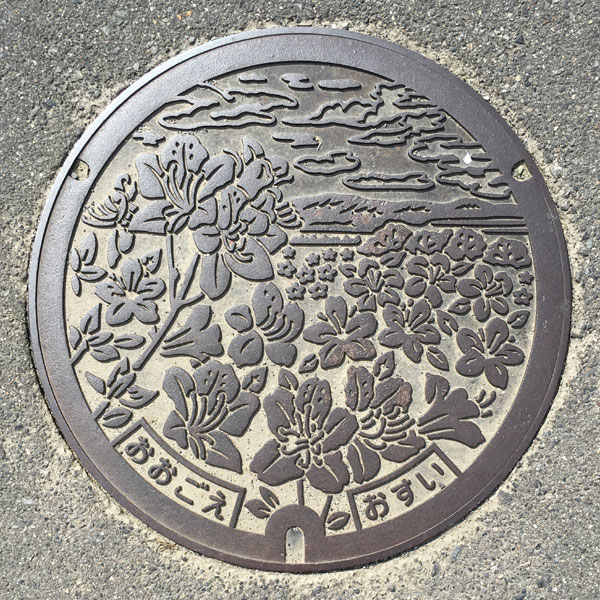
A sewage manhole cover featuring the town's flower, the azalea.
Tokiwa 常盤町
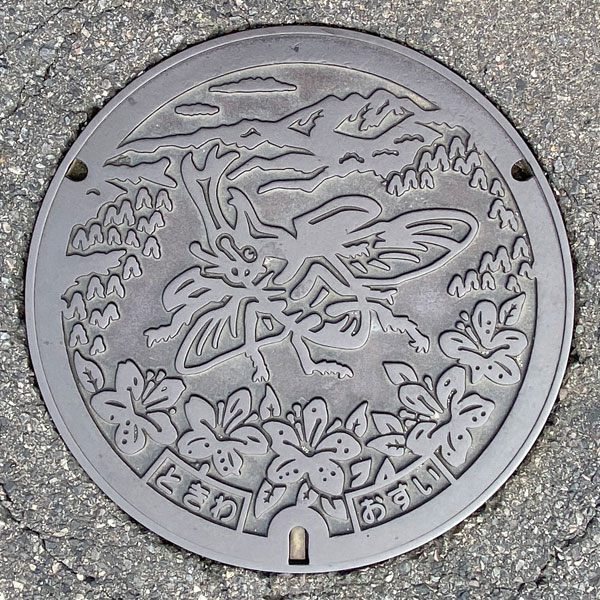
A rhinoceros beetle stands in the center with its wings spread wide. Depicted at the bottom is the mountain azalea, the flower of the former Tokoha Town. The "Rhinoceros Beetle Natural Kingdom Mushi Mushi Land" is located in Yamane, Tokoha Town. It is located at the foot of Mount Kamakura, so the mountain depicted in the background of the lid is likely Mount Kamakura.
Funehiki 船引町
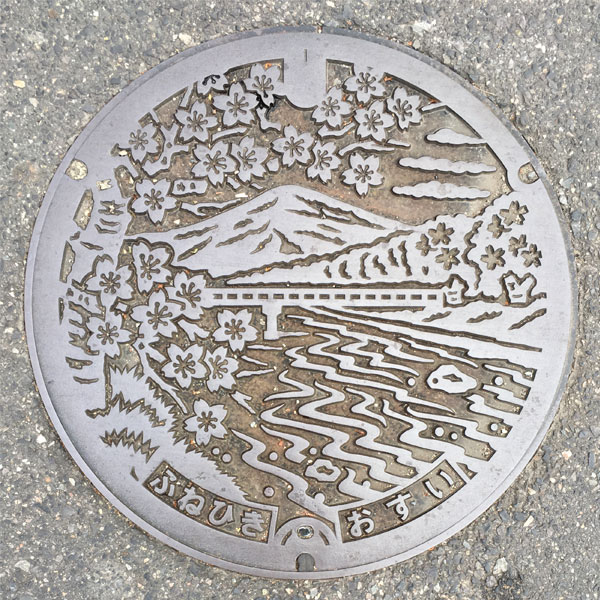
This sewage manhole cover depicts Mt. Katasone, also known as Tamura Fuji, the Otakine River that flows through the town, and the cherry blossom trees lining the river. Cherry blossoms are the tree of the former Funehiki Town.
Koriyama 郡山市
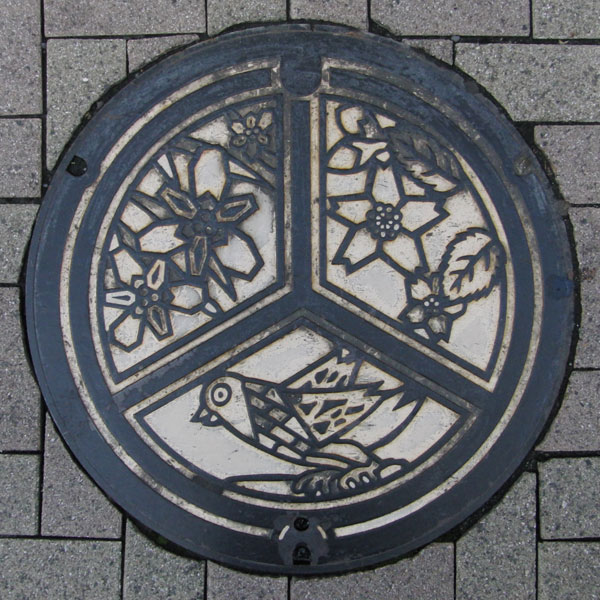
The design features the city bird "Cuckoo," the city tree "Mountain Cherry," and the city flower "Iris gracilipes (Dwarf Iris)." While the design is simple, it's a luxurious version using seven colors. The Mercedes-Benz-like mark dividing the cover into three sections is not just a divider, but the Koriyama City emblem, a stylized representation of the kanji character "山" (mountain).
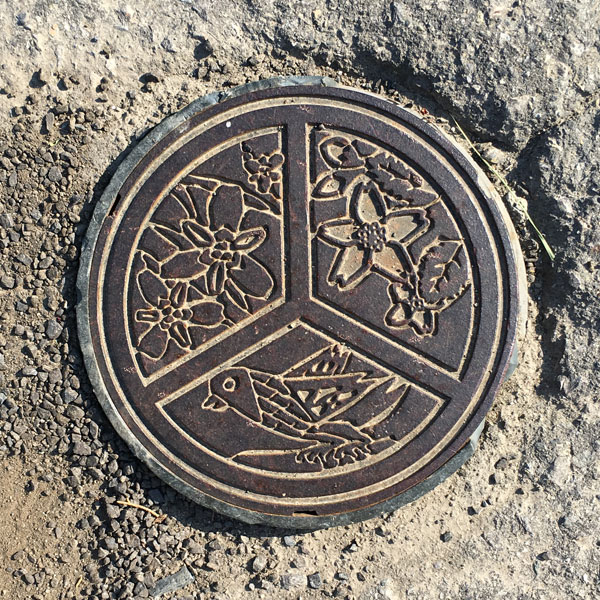
A single-color disc with the same design as above, but inverted.
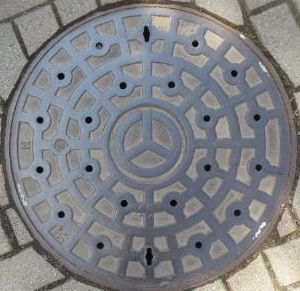
Koriyama city emblem in the center.
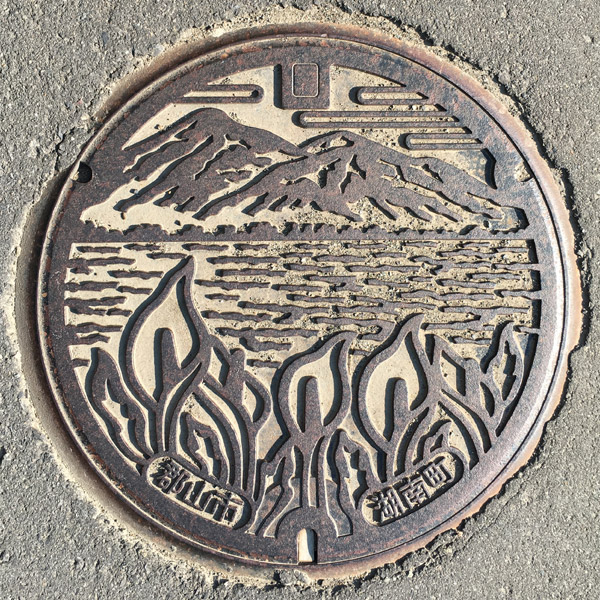
This manhole cover for the Konan Special Environmental Conservation Public Sewerage System depicts the majestic Mount Bandai and Lake Inawashiro (also known as Tenkyo-ko) in the background, with the delicate skunk cabbage (Mizubasho) flowers growing in clusters in the wetlands of Banyu Shinden (from the manhole card).
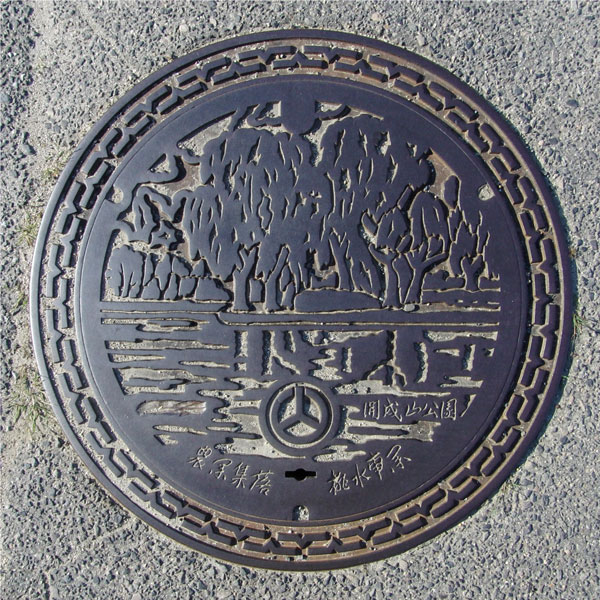
This is a manhole cover for agricultural community wastewater in Koriyama City.
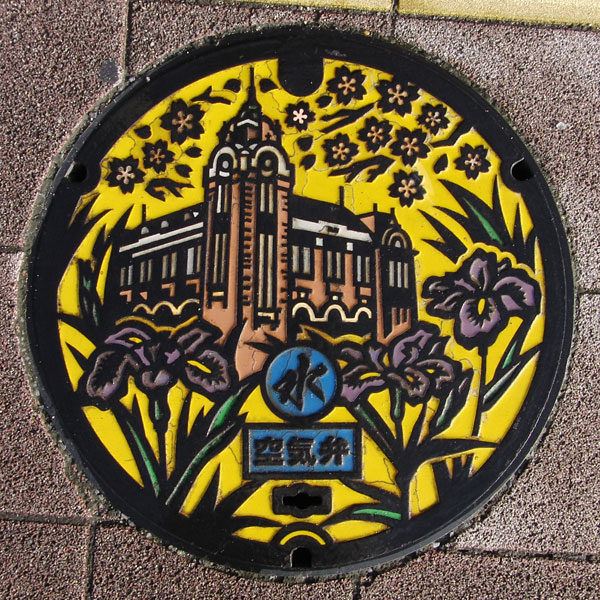
The Koriyama City Public Hall, built in 1924 to commemorate the establishment of Koriyama City, is said to be modeled after the Peace Palace in The Hague, Netherlands. The air valve features a depiction of a mountain cherry tree at the top and a Hanakatsumi flower at the bottom.
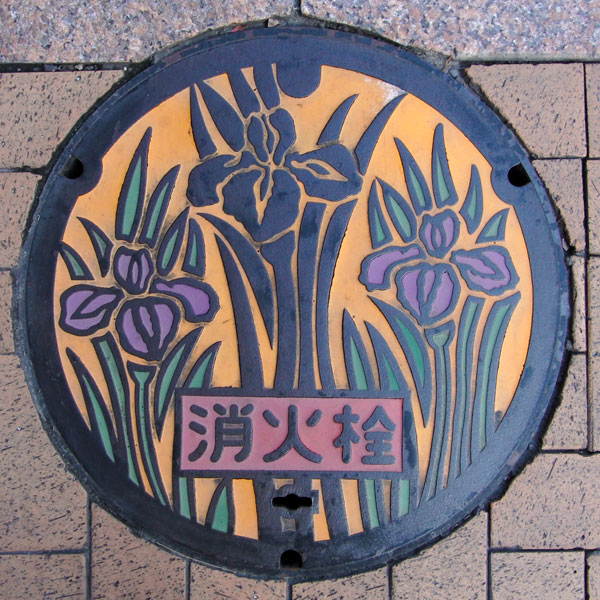
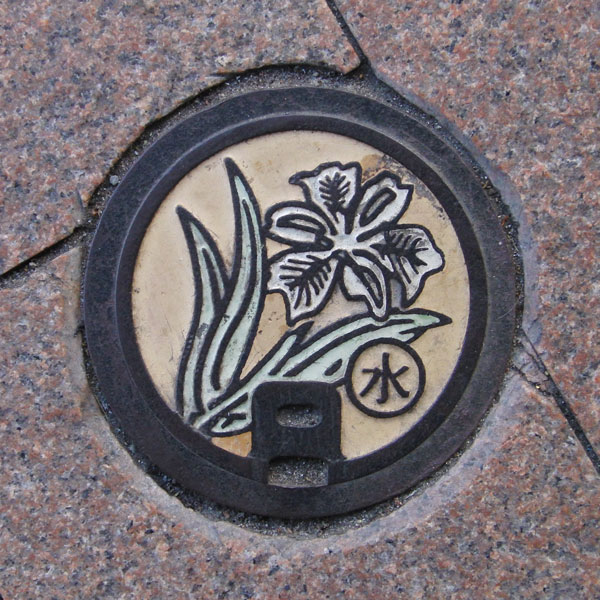
Hanakatsumi (Iris gracilipes) is a type of iris. The flower on this cover doesn't have white or yellow markings on the outer perianth segments, so it looks like an iris, but given its pale purple color and the fact that it's the city flower, it's probably "Iris gracilipes."
City tree: "Yamazakura" (mountain cherry)
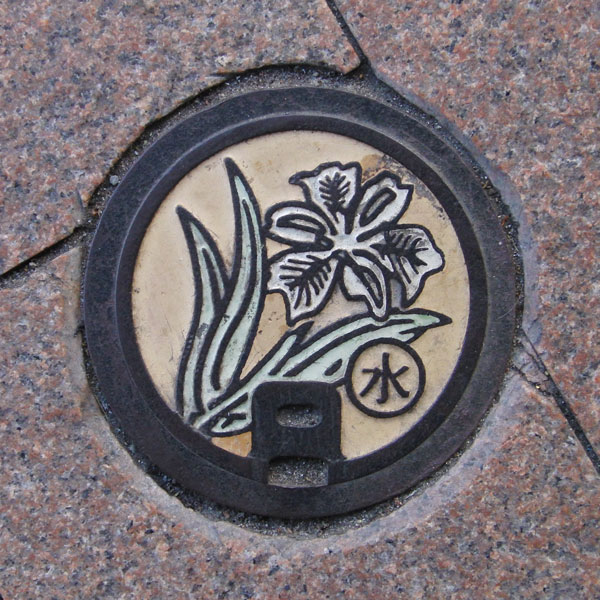
City flower: "Hanakatsumi (Dwarf Iris)"
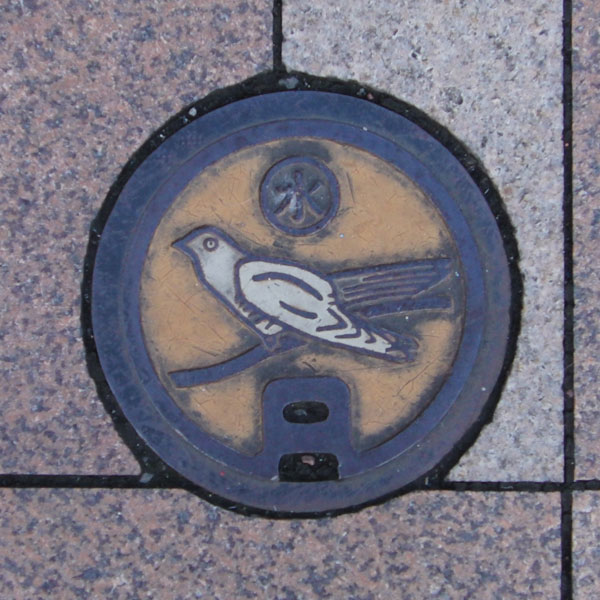
The city's bird: the cuckoo
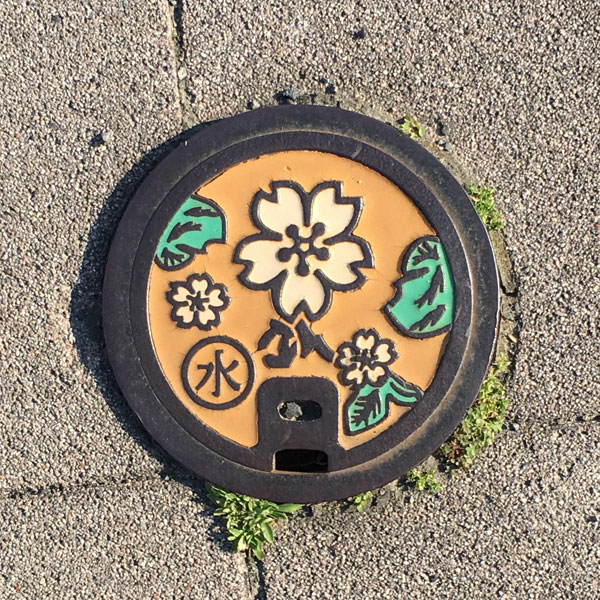
A beautiful manhole cover featuring the city's official tree, the "mountain cherry."
Sukagawa 須賀川市
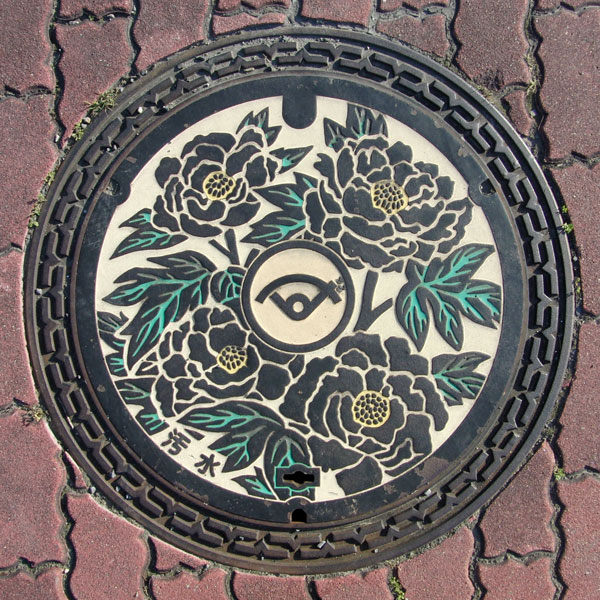
A manhole cover from Sukagawa City. It features the city flower, the peony.
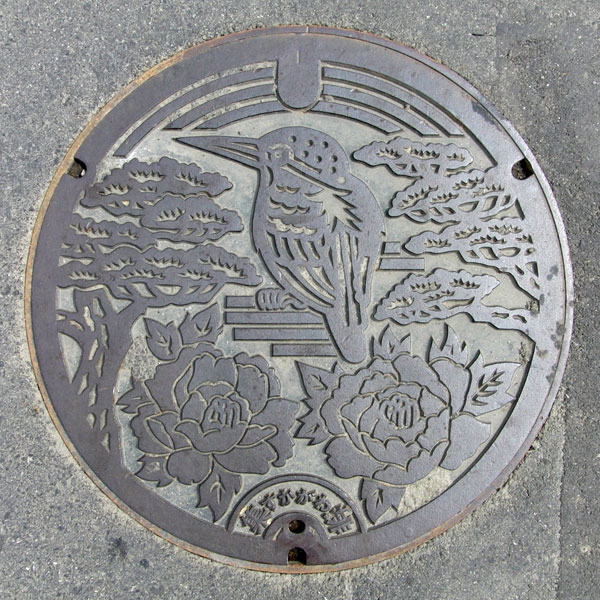
This is a manhole cover for the agricultural community drainage system in the Iwabuchi district of Sukagawa City. It depicts the city tree ("Japanese red pine"), the city flower ("peony"), and the city bird ("kingfisher").
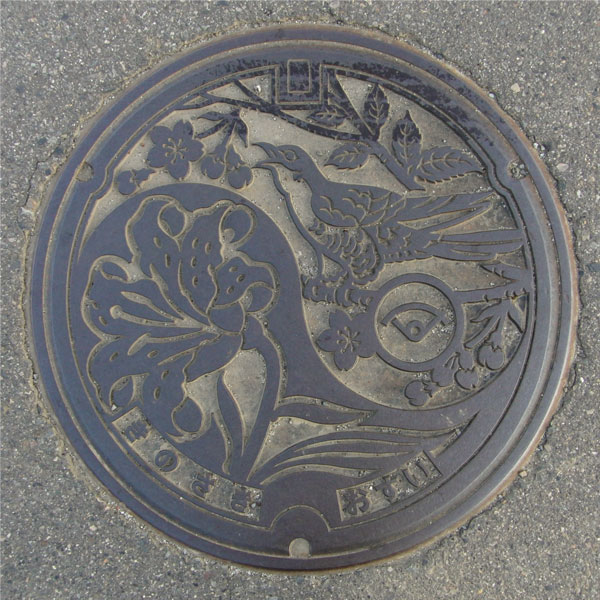
A monochrome manhole cover with the same design as those in the former Naganuma town. The word "Kinosaki" is written on the lower left. It features the city emblem of Sukagawa City, not the former Naganuma town emblem. It is believed to be a manhole cover for the agricultural community drainage system in the Kinosaki district.
Naganuma 長沼町
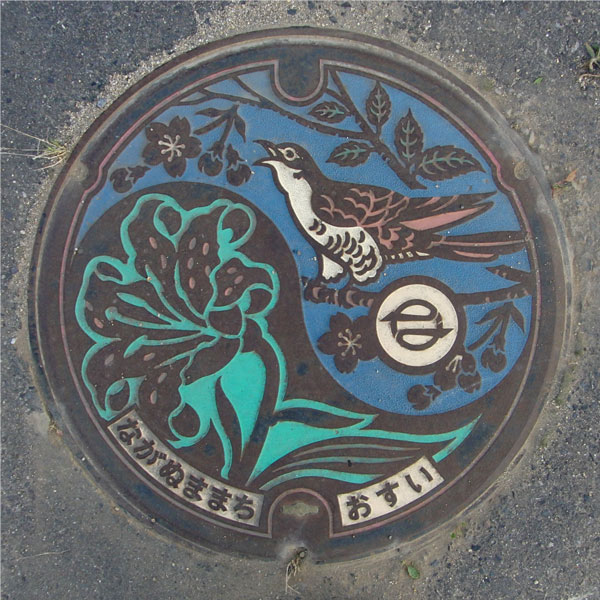
A colored manhole cover for sewage in the Naganuma district agricultural wastewater system, depicting the town's tree (cherry blossom), town flower (mountain lily), and town bird (cuckoo).
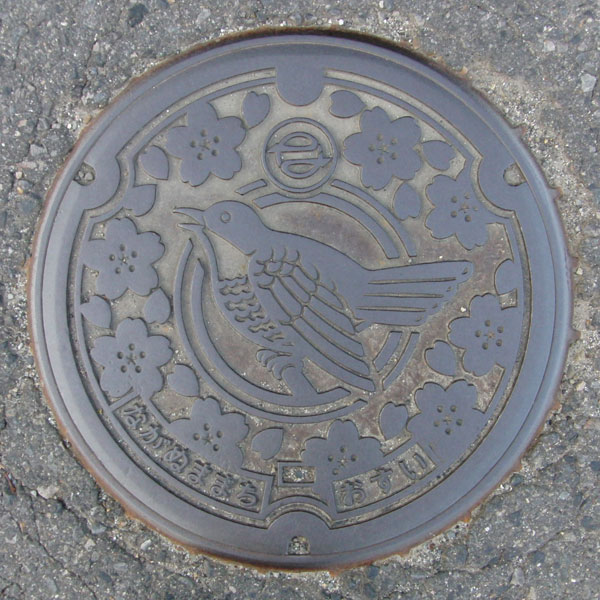
The manhole cover depicts the town's bird, the cuckoo, and the town's tree, the cherry blossom. Above the cuckoo is the former Naganuma town emblem. The words "Naganuma-machi" and "Osui" (sewage) are written at the bottom.
Iwase 岩瀬村
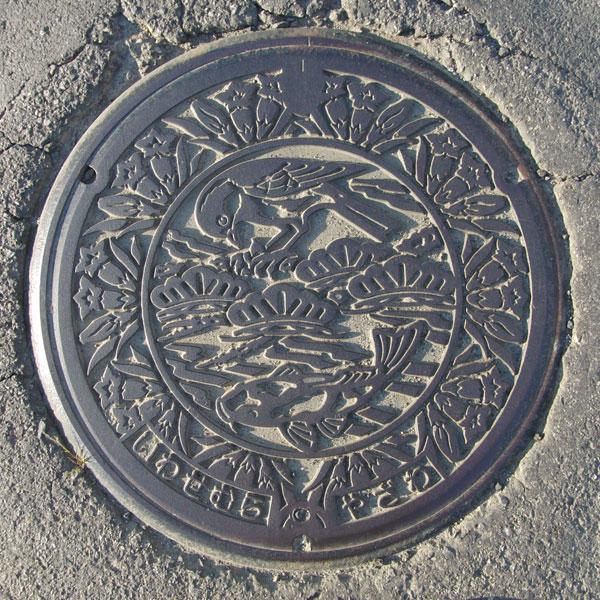
This manhole cover for agricultural sewage in the Yazawa district features the village tree, the Japanese red pine, the village bird, the Japanese tit, and the village fish, the Nishikigoi (ornamental carp), in the center circle, surrounded by the village flower, the gentian.
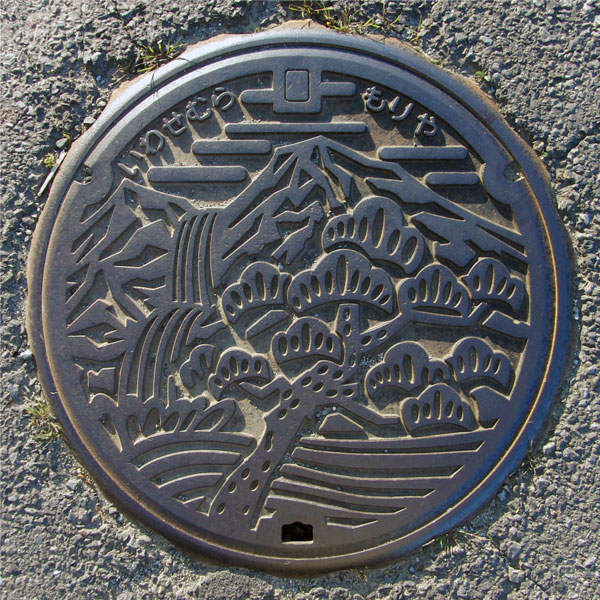
This is a manhole cover for the agricultural community drainage system in the Moriya district. The image depicts what appears to be Mount Hachiman and a waterfall called "Phantom Great Waterfall," located west of the Moriya district.
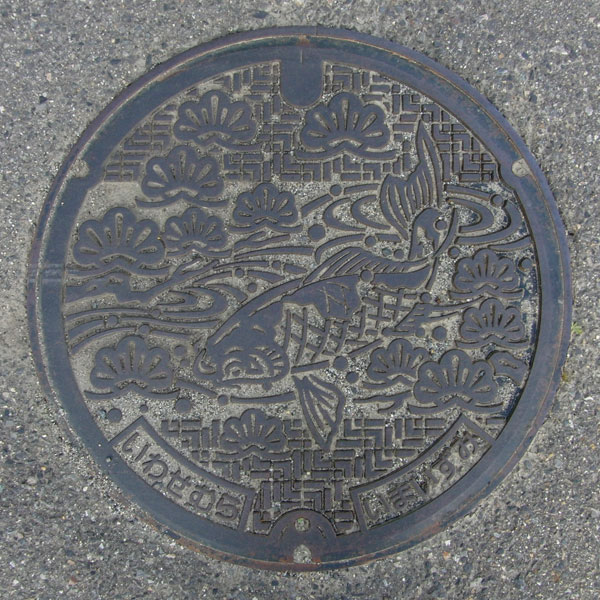
This is a manhole cover for the agricultural community drainage system in the Imaizumi district. It depicts branches of the village tree, the Japanese red pine, and a Nishikigoi (koi carp).
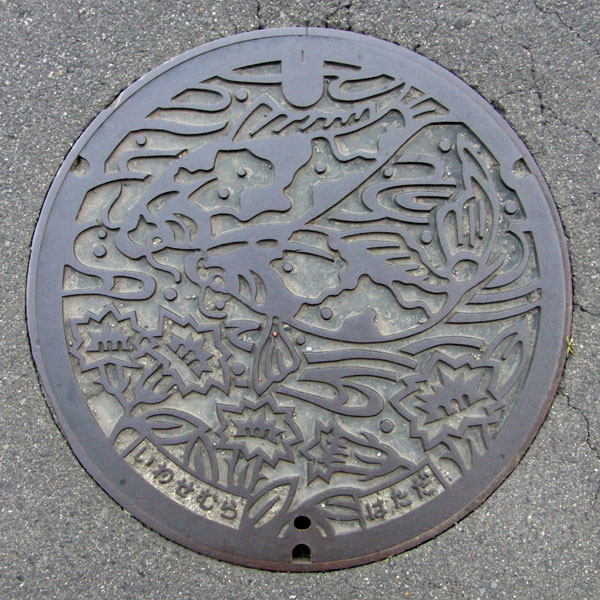
A manhole cover for agricultural community drainage in the Hatada district, featuring a "koi carp" at the top and the village flower, the "gentian," at the bottom.
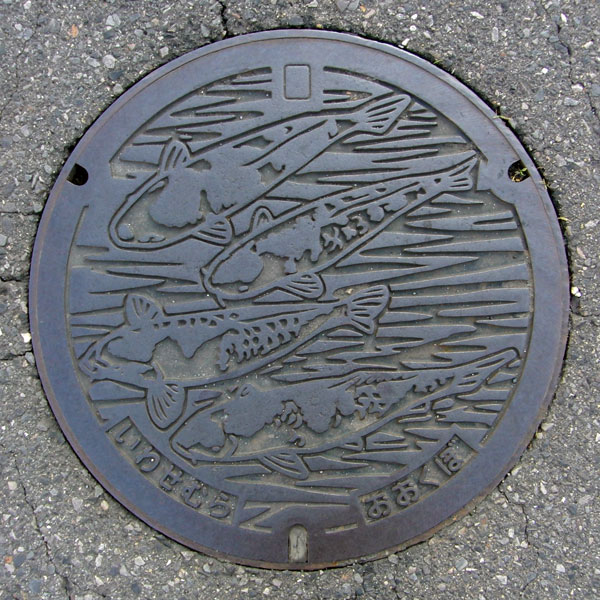
A manhole cover for the agricultural community drainage system in the Okubo district, depicting four Nishikigoi (ornamental carp).
Shirakawa 白河市
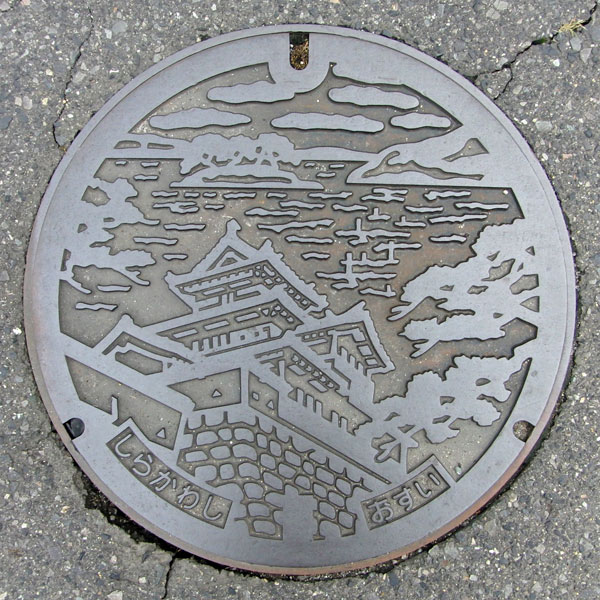
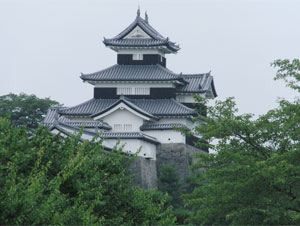
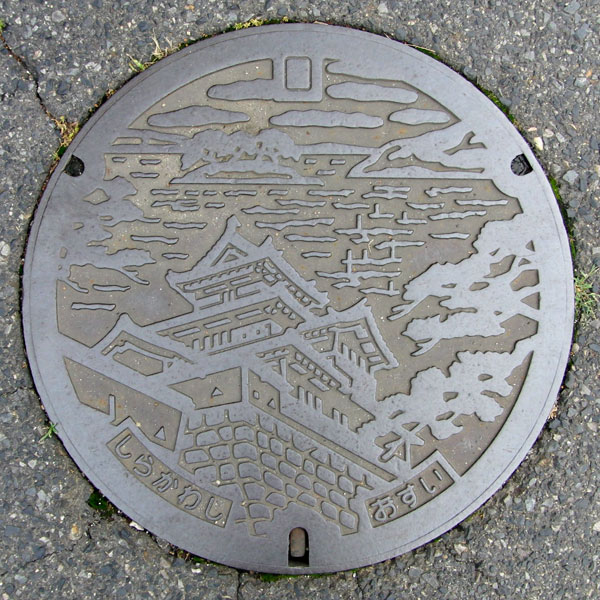
This is a manhole cover for sewage, depicting the three-story turret of the nationally designated historical site "Komine Castle Ruins" against the backdrop of the view from Chiyo Embankment in Nanko Park, a nationally designated historical site and scenic spot.
Shirakawa 白河市
The design is the same as the cover above, but the opening for opening and closing is upside down, and the shape is also different.
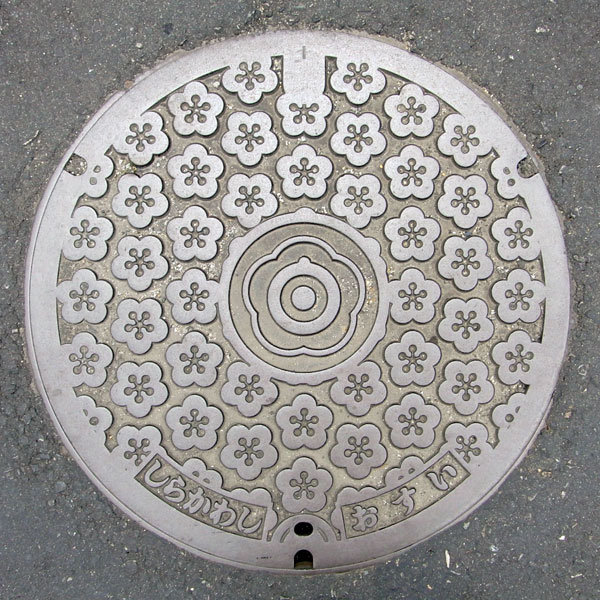
The city flower, the plum blossom, is depicted in a geometric pattern. From a distance, it looks like a JIS standard manhole cover.
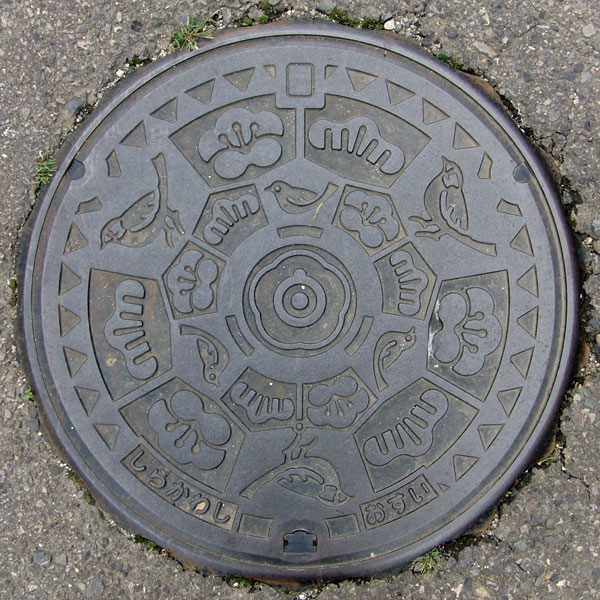
The city's official tree, the Japanese red pine, the city's official flower, the plum blossom, and the city's official bird, the Japanese bunting, are depicted.
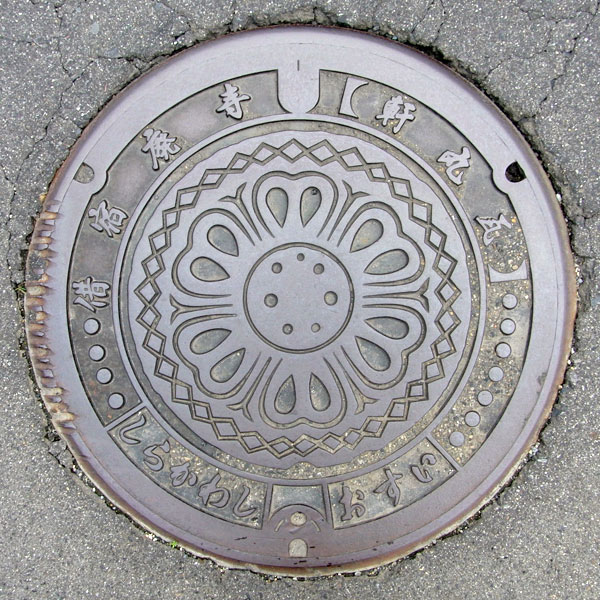
The manhole cover depicts a roof tile, specifically a "double-petaled, six-lobed lotus flower patterned eaves tile," excavated from the Kariyado Haiji Temple (a nationally designated historical site) dating back to around the 8th century.
Similar manhole covers depicting eaves tiles were found in Toyooka City, Hyogo Prefecture (formerly Hidaka Town) and Yamaga City, Kumamoto Prefecture (formerly Kikuka Town).
Omotego 表郷村
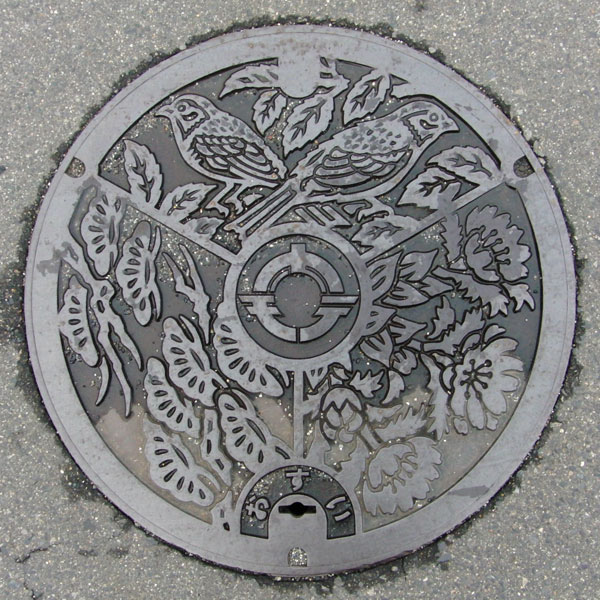
The village bird, the "Japanese White-eye," is depicted at the top, the village tree, the "Japanese Red Pine," at the bottom left, and the village flower, the "Adonis amurensis," at the bottom right. In the center is the former village emblem, a stylized version of the katakana character "Omote."
Taishin 大信村
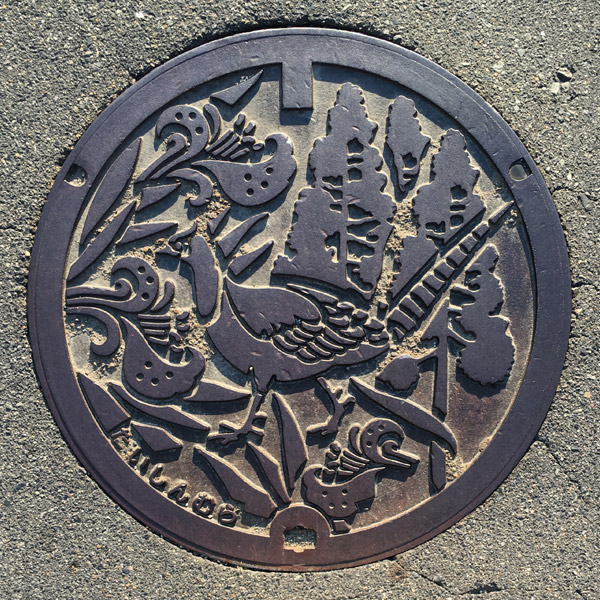
The manhole cover depicts the former village tree ("Japanese cedar"), the village flower ("mountain lily"), and the village bird ("pheasant"). The overlapping parts make it a little difficult to see, but it's an elaborate design. I had previously photographed it in July 2012, but it was difficult to see, so I retook the picture.
Higashi 東村
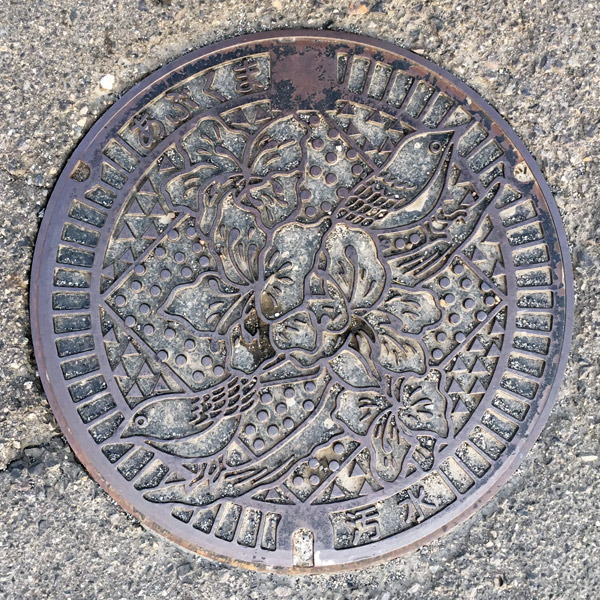
This is a manhole cover for wastewater from the Abukuma district agricultural community drainage system, depicting the village flower, the azalea, and the village bird, the Japanese bush warbler.
Iwaki いわき市
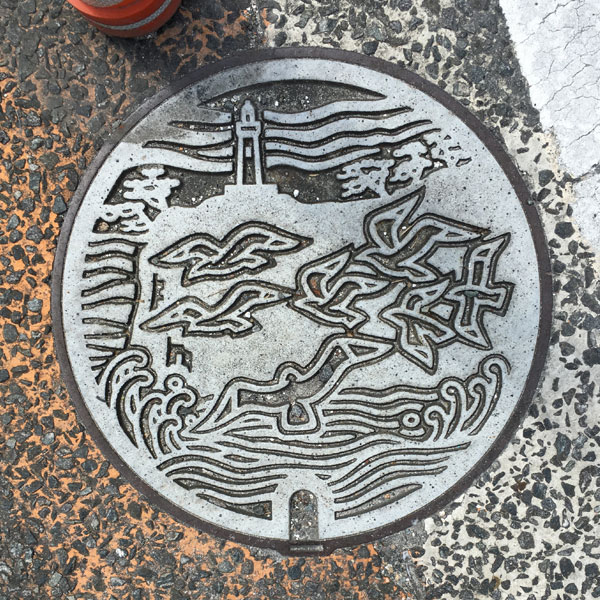
This is a manhole cover featured on the Iwaki City manhole card. "AEON Mall Iwaki Onahama," scheduled to open in the summer of 2018, was still under construction when this photo was taken in September 2017.
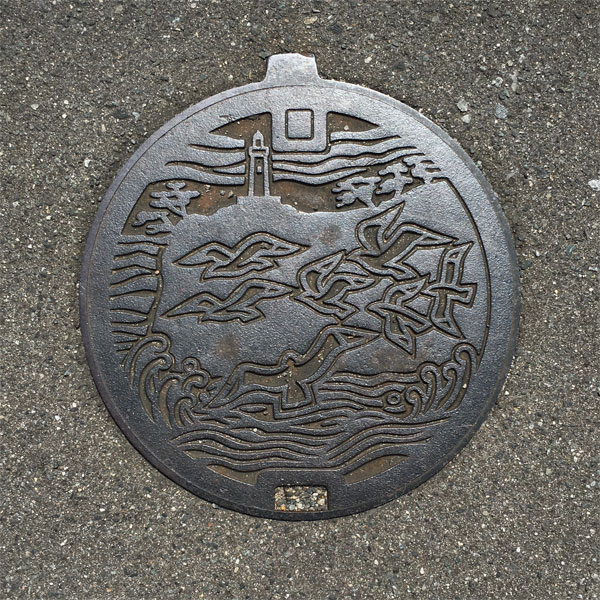
A monochrome sewage manhole cover featuring the design of Shioyazaki Lighthouse.
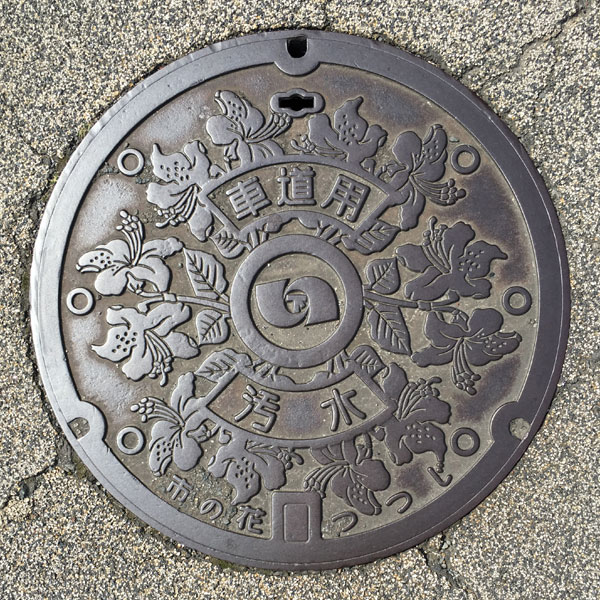
This manhole cover for sewage features the city emblem in the center and is surrounded by the city flower, the azalea. It also has the words "For Roadways" inscribed on it. The carving is shallow, suggesting it may not offer much in the way of anti-slip properties.
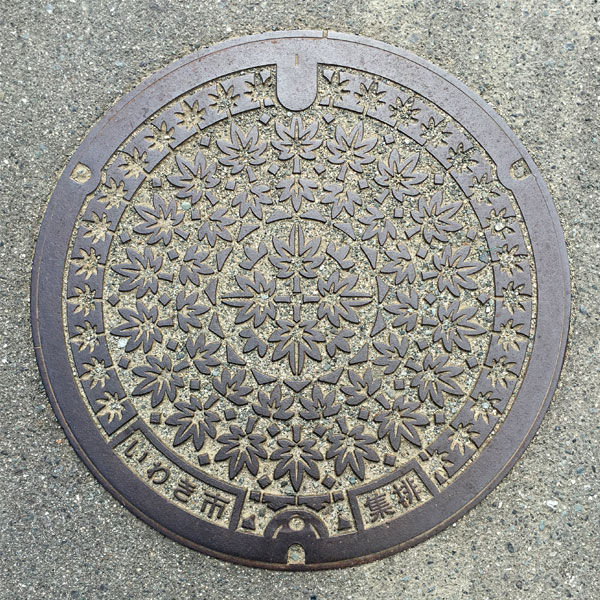
The manhole cover of the Watanabe district agricultural settlement drainage system is completely covered with concentric circles of maple leaves. This district is home to the "Nakagamado Weeping Maple," a national natural monument.
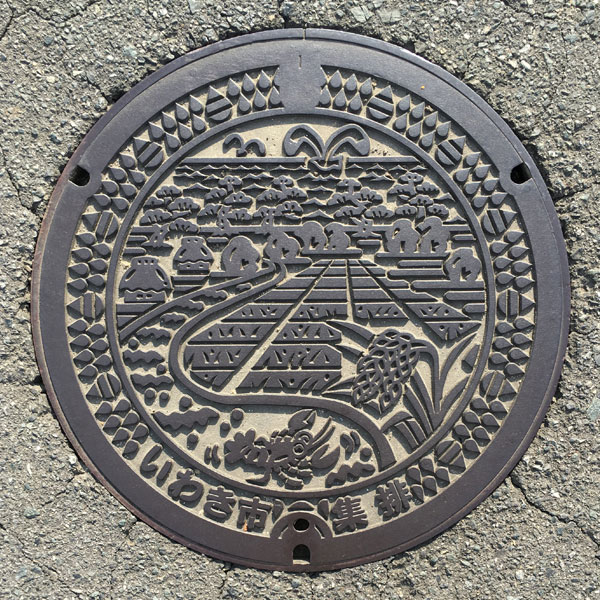
This manhole cover for the Toda district agricultural community drainage system depicts a landscape with considerable depth. In the background is the rough Pacific Ocean and the city bird, the seagull. In the foreground is the city tree, the Japanese black pine, and a river (probably the Niida River) flows between the farmhouse and rice paddies. In the foreground is a crayfish and rice stalks. Water droplets surround the rural landscape. These water droplets can also be seen on manhole covers for community drainage systems in other districts.
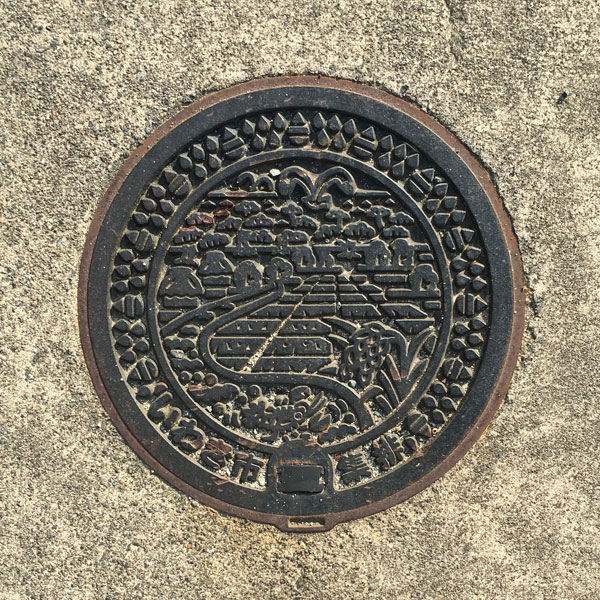
A smaller version with the same design as above.
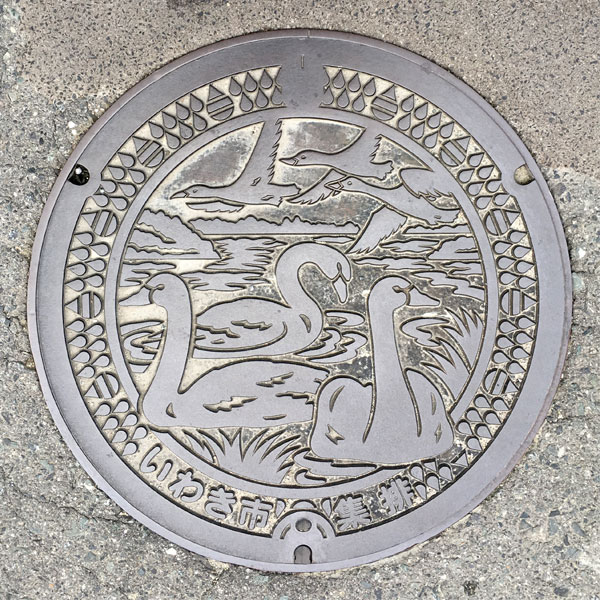
A manhole cover for the Shimo-Ogawa district agricultural community drainage system, depicting a swan.
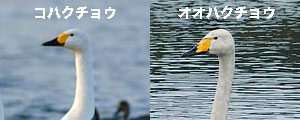
The Natsui River in the Ogawa-machi district of Iwaki City is a swan migration site, and it is said that around 600 Whooper Swans and Bewick's Swans visit every year around October. It is unclear which species the swans on this cover are, as the shape of the yellow part of their beaks is illegible. The edge of the cover has a water droplet pattern.
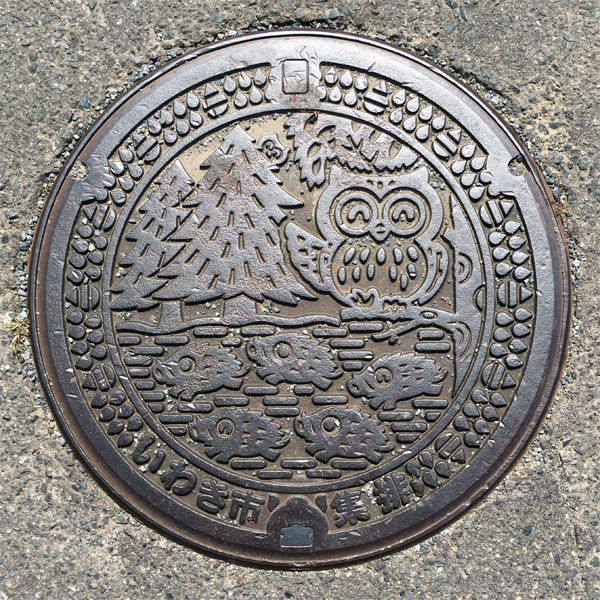
This is a manhole cover for the agricultural community drainage system in the Misaka district. A member of the owl family (likely a Japanese Scops Owl, given its forest habitat and ear tufts) is perched on a tree branch in the foreground, with five wild boars running below. Another Scops Owl's face is visible on a cedar tree in the background. Both the Scops Owls and two of the boars seem to be smiling and enjoying themselves.
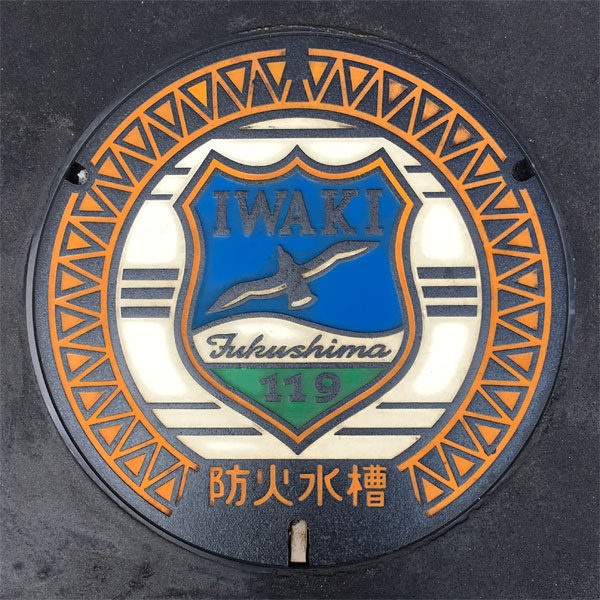
This is a manhole cover for a fire hydrant, featuring the emblem of the Iwaki City Fire Department. While manhole covers with this design seem to have been around for some time, this particular cover appears relatively new, given the surrounding pavement. (Photo taken September 2017)
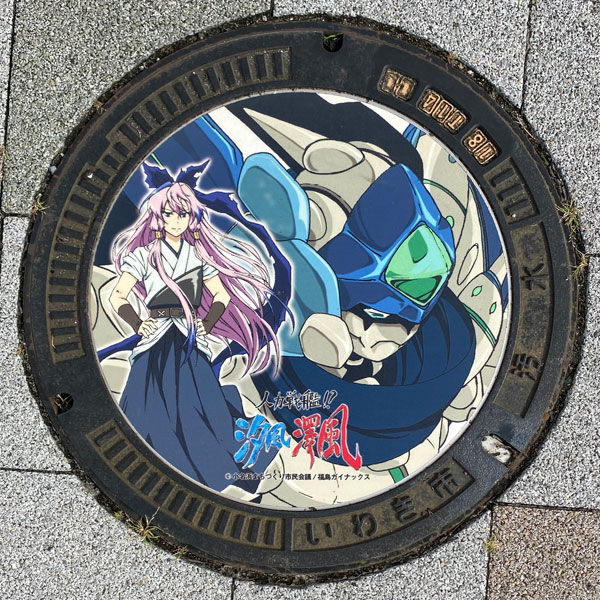
A color plate depicting the Onahama tourism PR animation "Human-Powered Battleship!? Shiokaze Sawakaze," a joint production of the Onahama Town Development Citizens' Council and Fukushima Gainax.
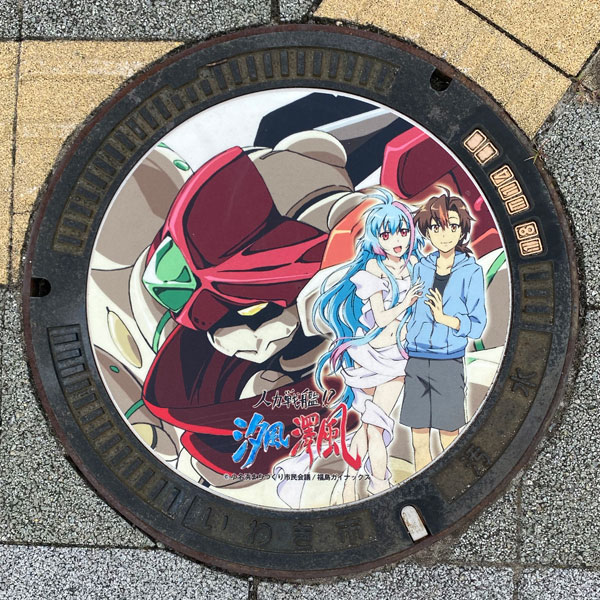
The red one is the destroyer robot "Sawakaze." The standing figure is "Sawakaze" in human form (the girl), and next to her is the protagonist, Hoshi Shinpei.
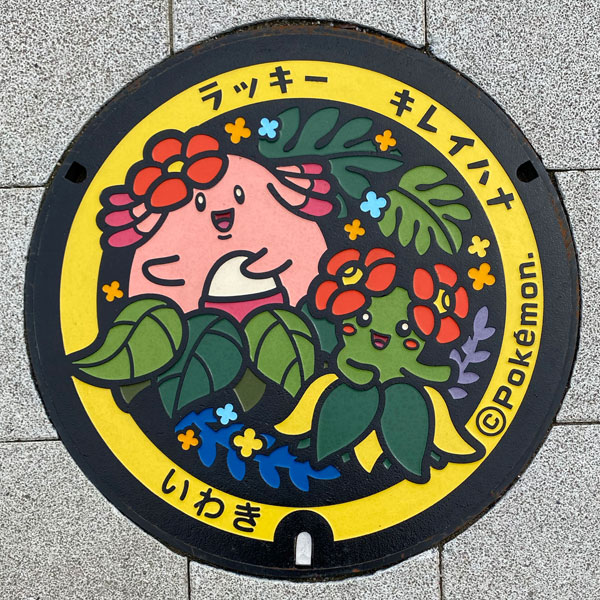
This "Pokémon manhole cover, 'Pokéfuta'," was donated by The Pokémon Company. It depicts Chansey and Bellossom doing the hula dance. The words "Iwaki" are written in the lower left corner, and "©Pokémon." is on the right.
Kunimi 国見町
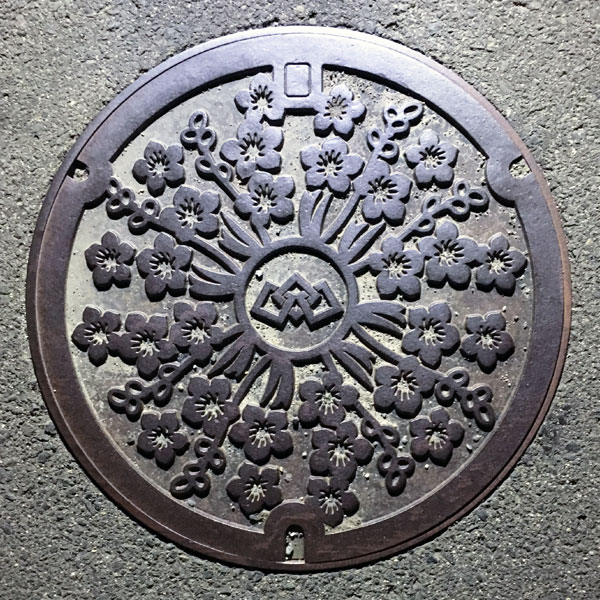
It depicts peach blossoms. The town emblem is in the center.
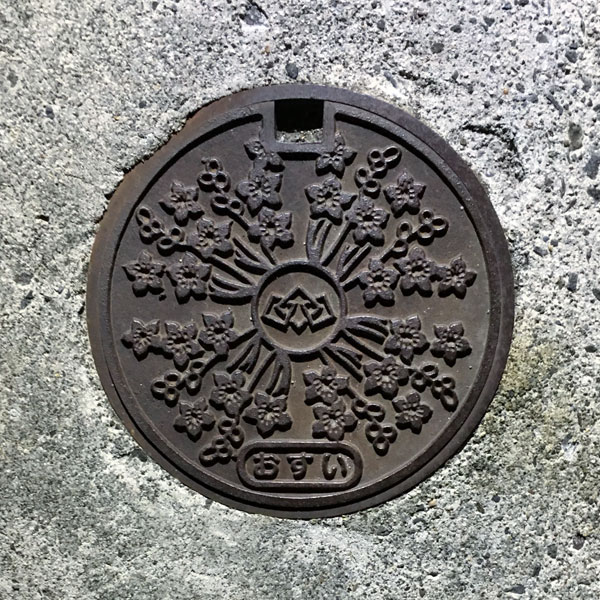
A handhole cover with the same design as above.
Shinchi 新地町
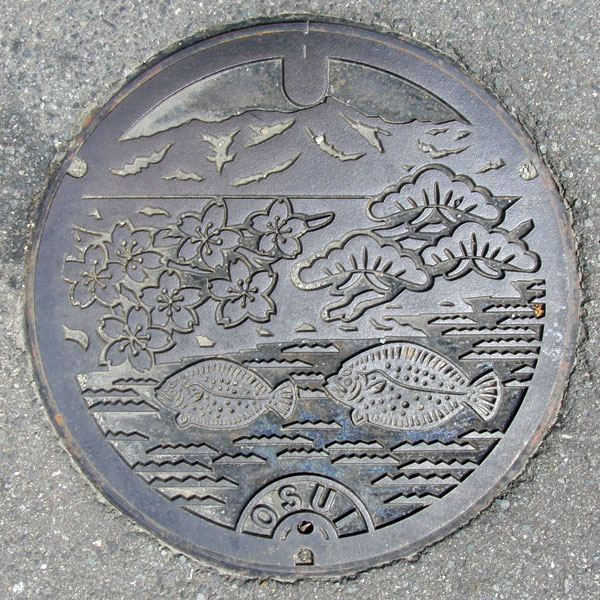
The manhole cover depicts Mt. Karō, located on the border with Marumori Town in Miyagi Prefecture, the town's tree (pine), town flower (cherry blossom), and town fish (flounder).
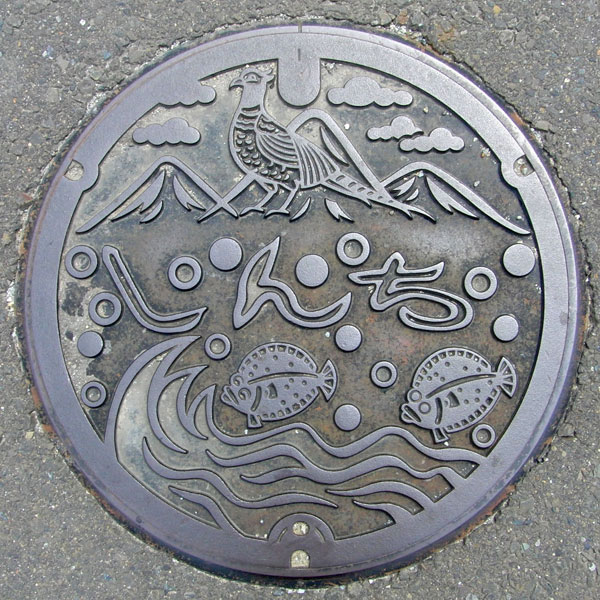
A manhole cover for agricultural wastewater in the Fukuda district, featuring the town's bird, a pheasant, against a backdrop of mountains, the town's fish, a flounder, on waves, and the name "Shinchi" in hiragana in the center.
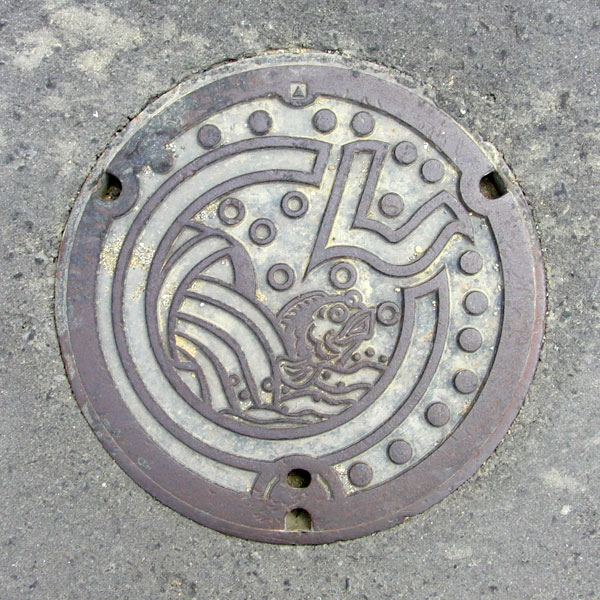
A fish being showered in sewage flowing through the town emblem...or maybe not. A small disc.
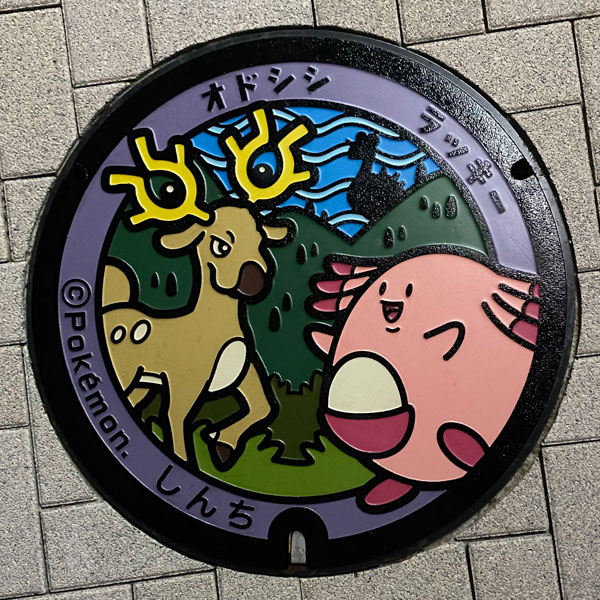
This "Pokémon manhole cover, 'Pokéfuta'," was donated by The Pokémon Company. It depicts Stantler and Chansey. The words "©Pokémon." and "Shinchi" are written in the lower left corner.
Koori 桑折町
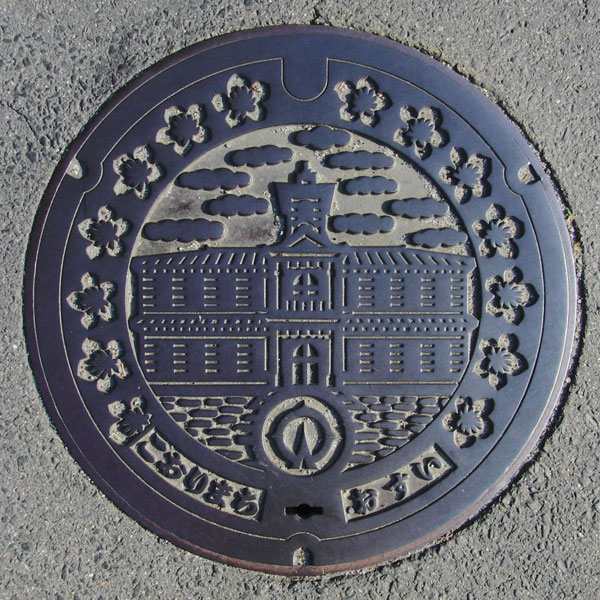
A colored manhole cover for sewage, depicting the former Date County Office (an important cultural property) and the town flower, the peach blossom. The town emblem and the words "Koori-machi" and "Osui" (sewage) are at the bottom.
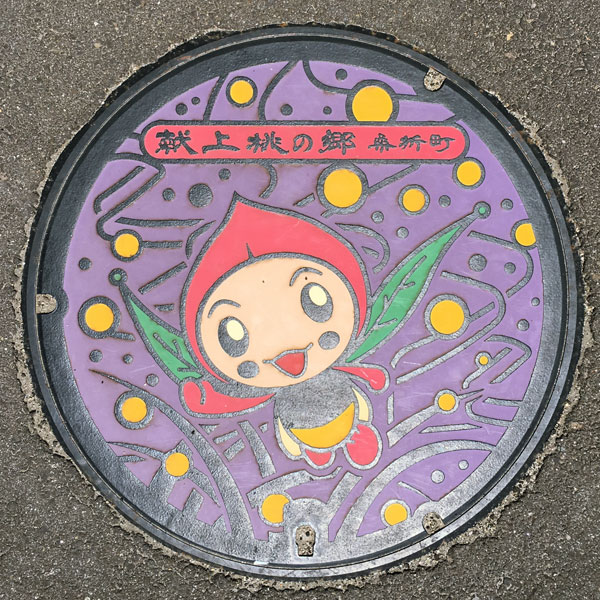
The manhole cover features Hotapi, Koori Town's tourism ambassador, with a firefly body and a peach head. The words "Koori Town, Home of the Imperial Peaches" are inscribed at the top.
Kawamata 川俣町
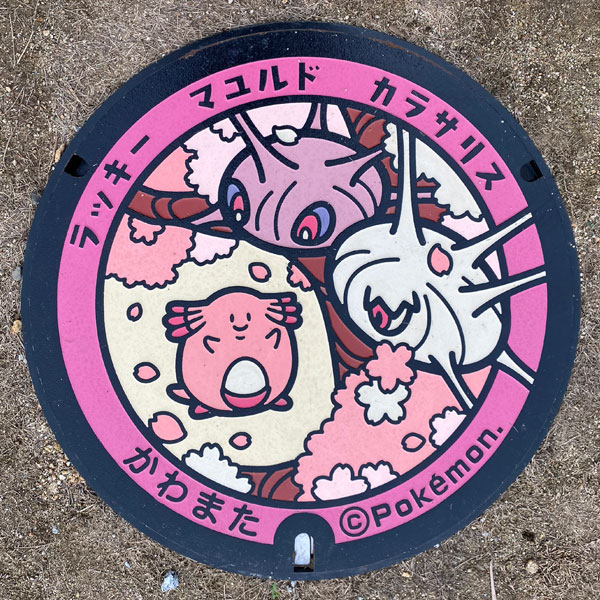
This "Pokémon Manhole Cover (Poké-lid)" was donated by The Pokémon Company. It depicts Chansey, Silcoon, and Cascoon. The words "Kawamata" and "©Pokémon." are at the bottom.
Nishiaizu 西会津町
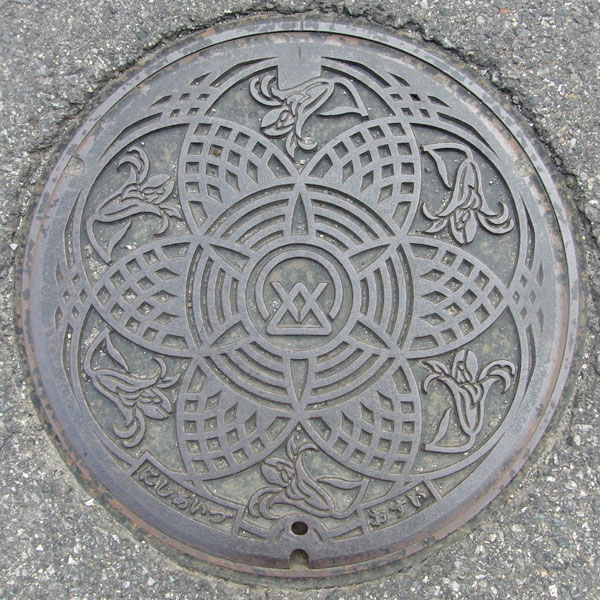
The flower depicted is the town's official flower, the "Otomeyuri" (Lilium maculatum). The Otomeyuri, also known as the "Hime-sayuri," is a rare species and is listed as near-threatened on the Ministry of the Environment's Red List.
In the center is the town emblem, a stylized representation of the character "西" (west).
Inawashiro 猪苗代町
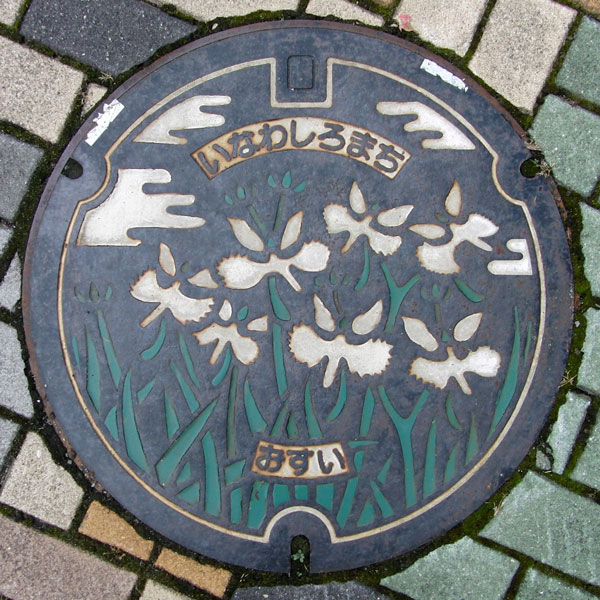
A manhole cover featuring the town's official flower, the "Sagisou" (Egret Orchid).
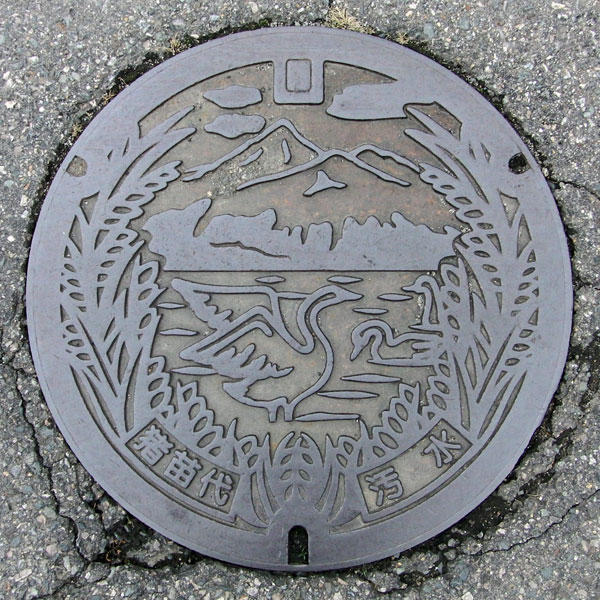
A manhole cover for sewage featuring Mount Bandai, Lake Inawashiro, and swans.
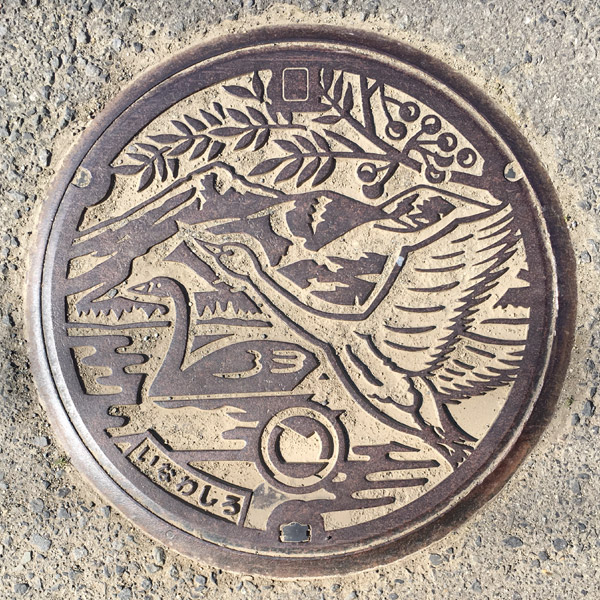
This manhole cover for agricultural wastewater in the lakeside area depicts the town's official tree, the rowan tree, along with Mount Bandai and swans on Lake Inawashiro. The town emblem and the word "Inawashiro" are at the bottom.
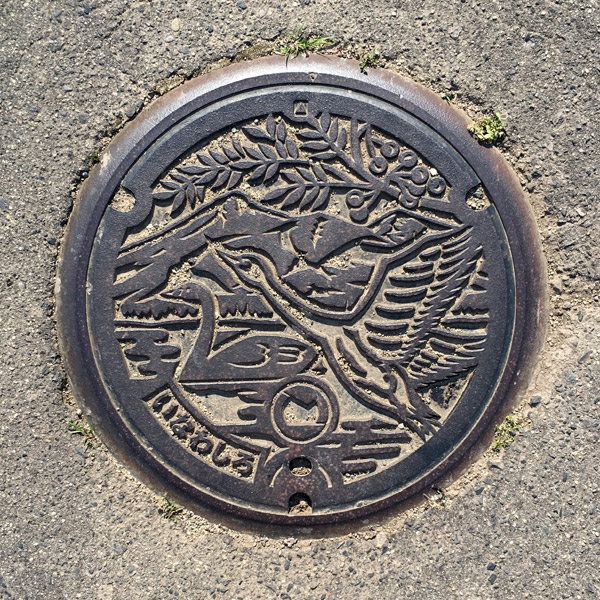
A smaller version of the drainage panel for the lakeside agricultural area, with the same design as above. The town emblem and the words "Inawashiro" are at the bottom.
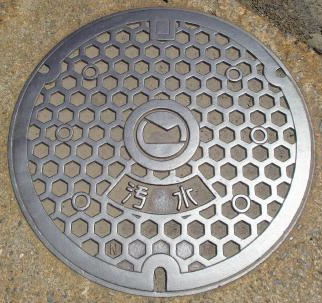
A tortoiseshell pattern, the town emblem in the center, and the word "sewage" just below it.
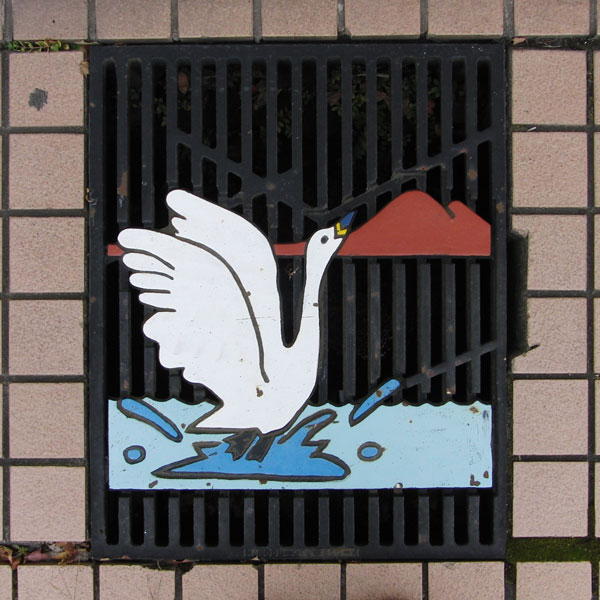
A manhole cover depicting Mount Bandai and swans.
Bandai 磐梯町
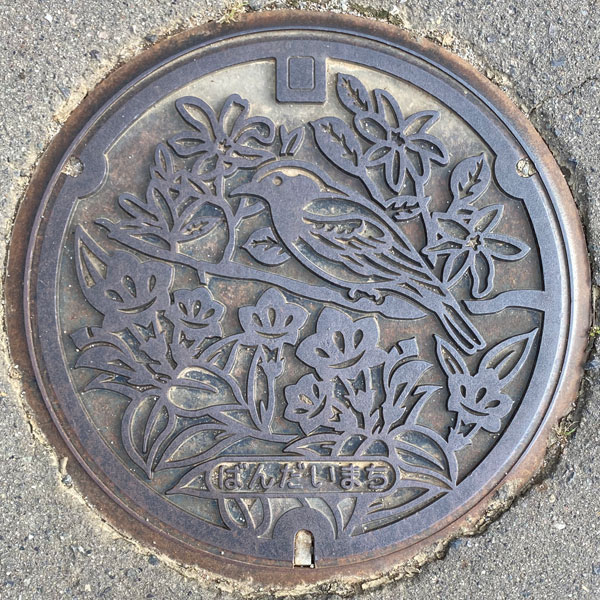
The manhole cover depicts the town's bird, the "Blue-and-white Flycatcher," the town's tree, the "Magnolia kobus," and the town's flower, the "Gentian."
A smaller version with the same design as above.
Aizubange 合図坂下町
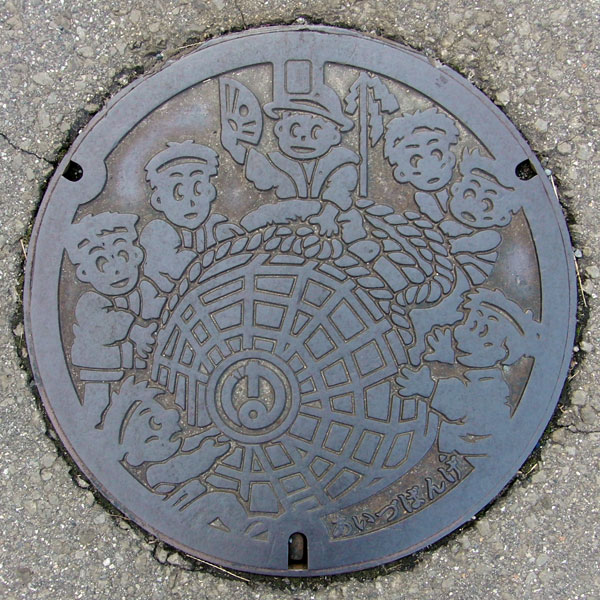
The Giant Rice Bale Pulling Festival boasts a 400-year tradition. Held in January, this unique festival features participants wearing only loincloths pulling on a giant rice bale with great force. The town emblem is attached to the bale.
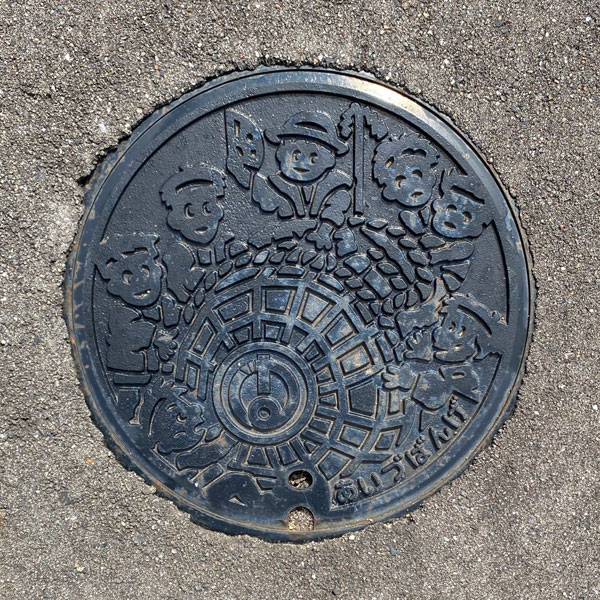
A smaller version of the same design.
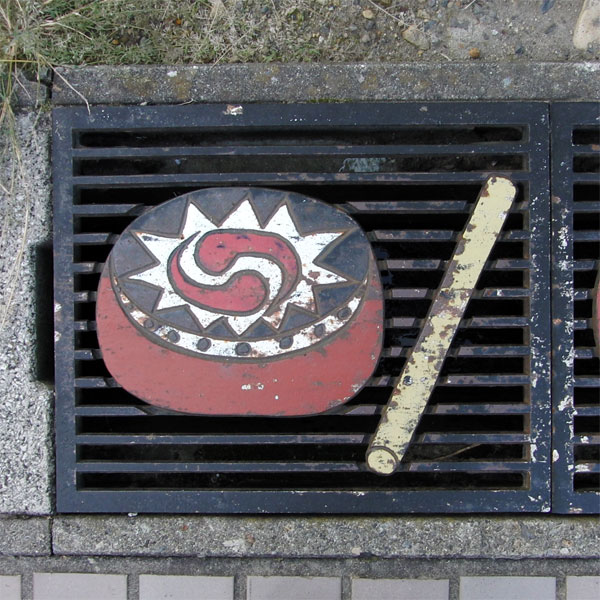
A drain cover. It has a drum painted on it.
Namie 浪江町
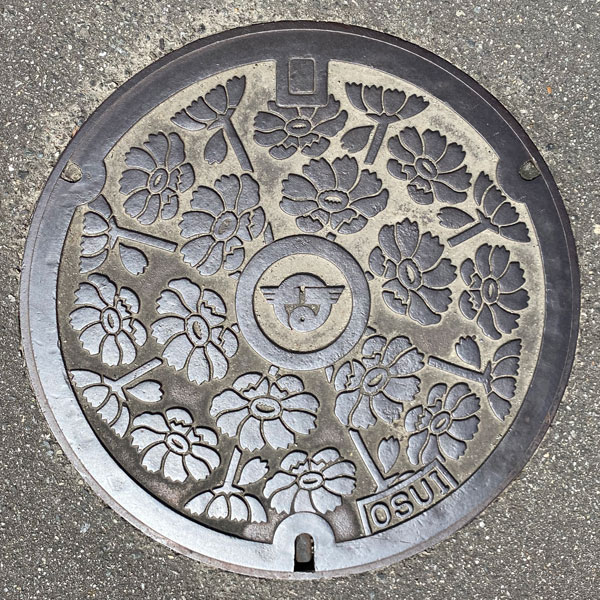
A manhole cover for sewage featuring the town's flower, the cosmos. The town emblem is in the center, and the word "OSUI" is on the lower right.
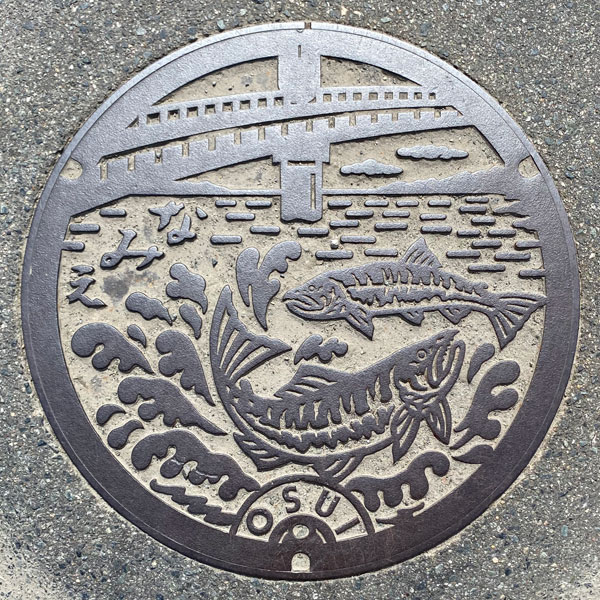
A manhole cover for sewage, depicting salmon splashing in the Ukedo River. The word "OSUI" is written at the bottom.
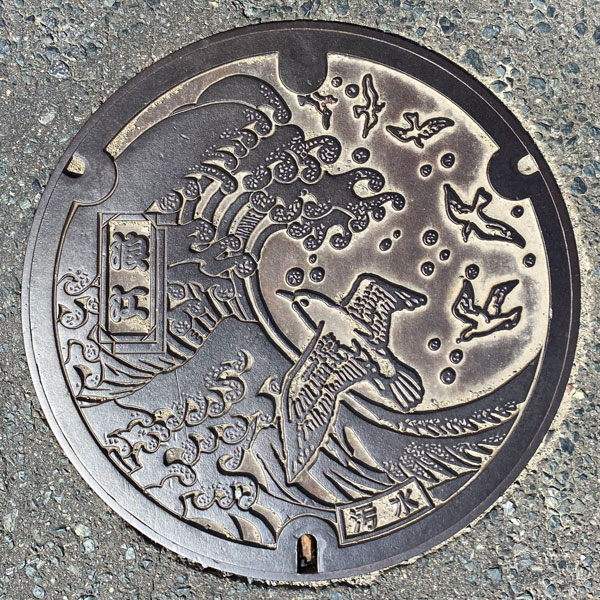
A manhole cover for sewage depicting the rough waves of the Pacific Ocean and the town's bird, the seagull. The word "Namie" is written in the Kantei-ryu style on the left side.
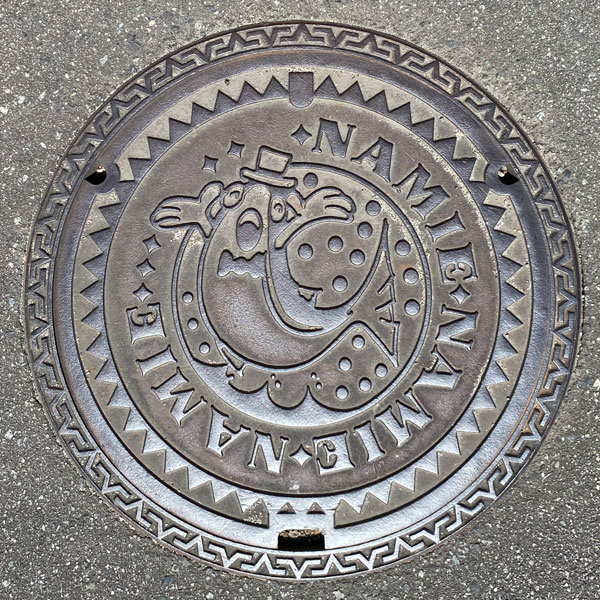
A fish, dressed in a hat and bow tie, leaps energetically with its arms outstretched, almost spilling out of the circle.
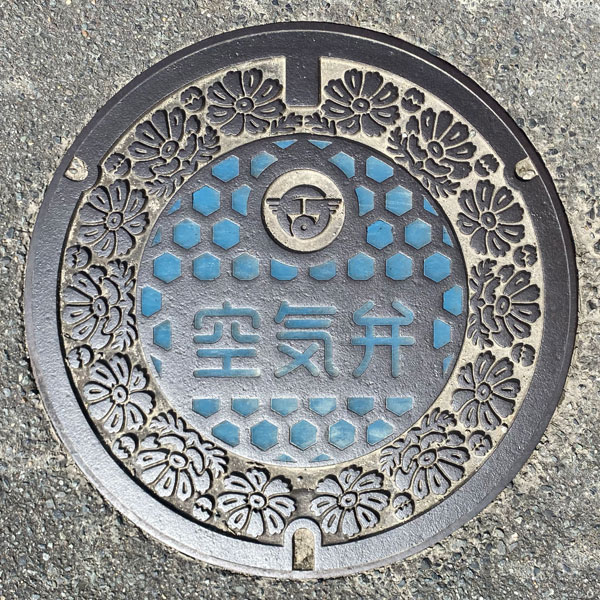
The air valve cover features the town's emblem. The town's flower, the cosmos, is depicted around it.
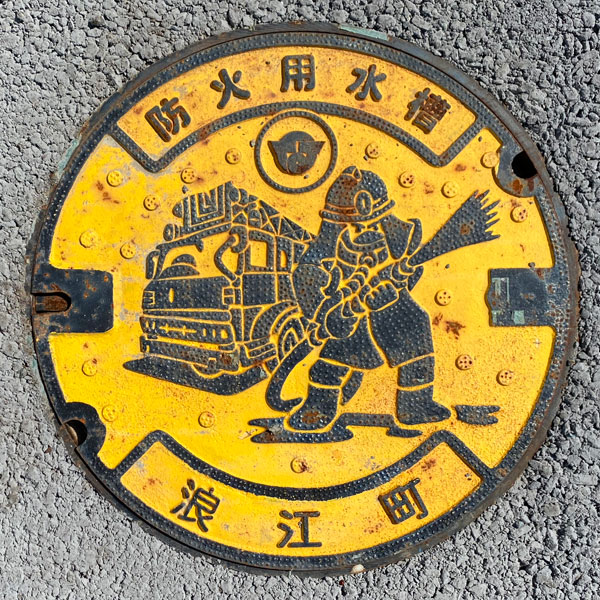
A fire-fighting water tank lid bearing the town's emblem.
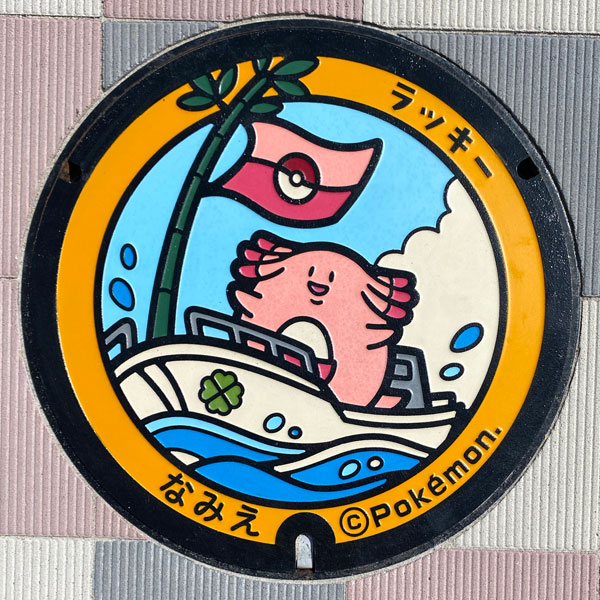
This "Pokémon manhole cover, 'Pokéfuta'," was donated by The Pokémon Company. It depicts Chansey on a boat. The words "Namie" and "©Pokémon." are written in the lower left corner.
Yanaizu 柳津町
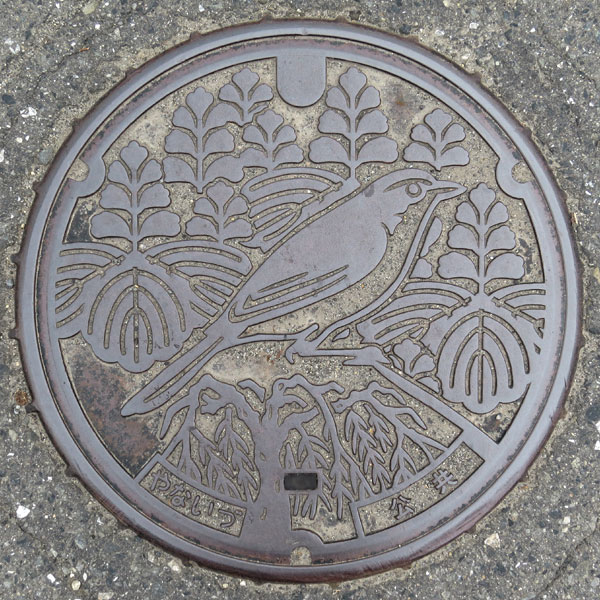
The town's bird, the Japanese bush warbler, the town's flower, the paulownia, and the town's tree, the willow, are depicted.
Kaneyama 金山町
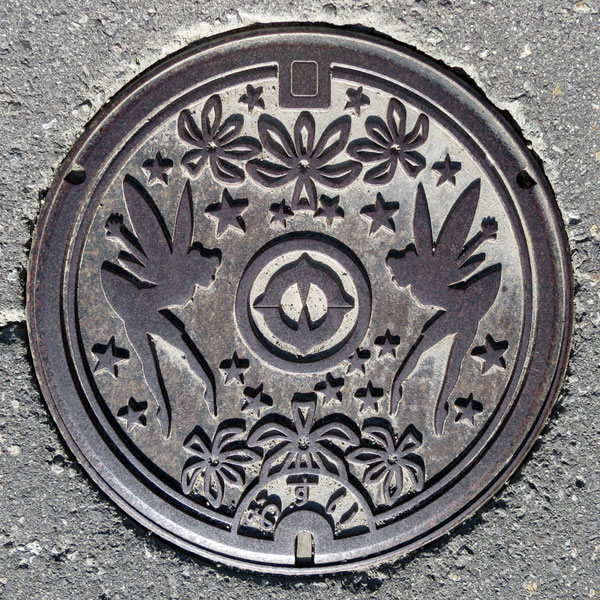
The town emblem is in the center. The flowers above and below are the town flower, the "kobushi" magnolia. Fairies are depicted on either side of the town emblem.
Mishima 三島町
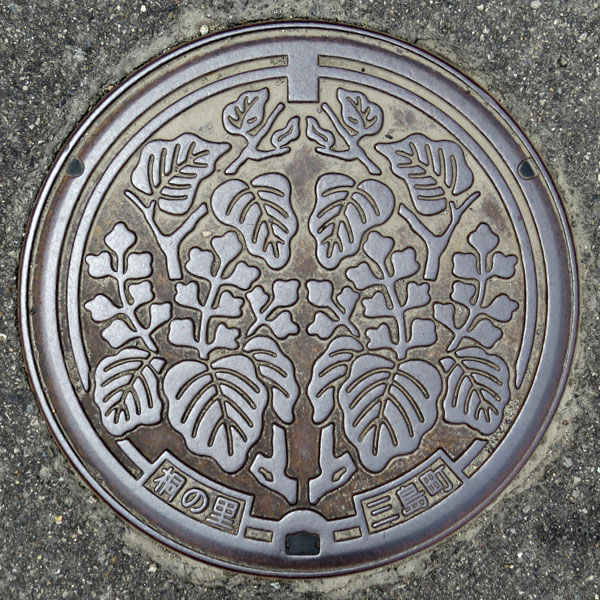
As indicated by the words "Kiri no Sato" (Paulownia Village) written in the lower left, the town's official tree, the paulownia, is depicted.
Aizumisato 会津美里町
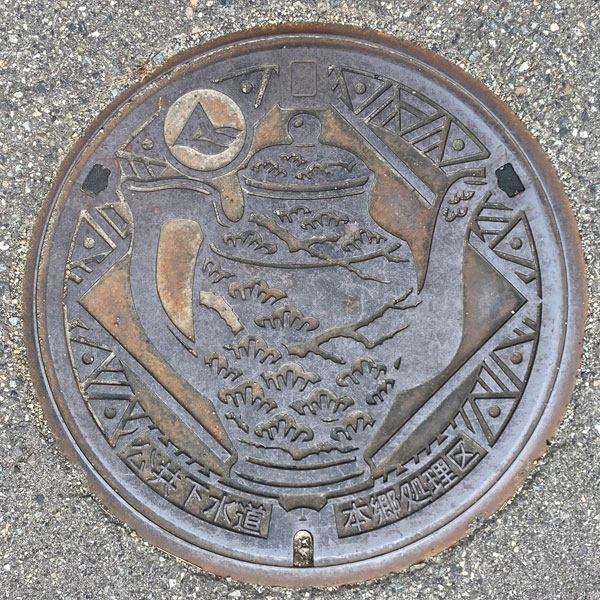
This manhole cover features a design from the former Hongō town depicting Aizu Hongō ware, with the town emblem in the upper left corner replaced by the emblem of Aimisato town. The words "Public Sewerage" and "Hongō Treatment Area" are written at the bottom.
Aizutakada 会津高田町
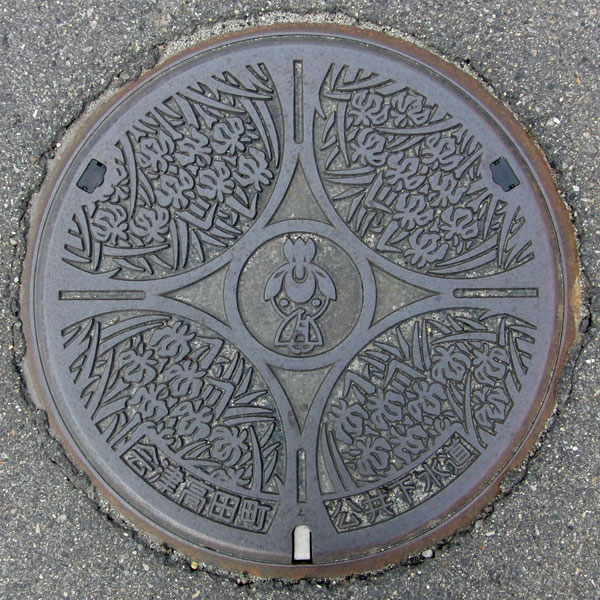
Surrounded on all four sides by the town's flower, the iris, is the character "Ayame-chan" in the center. At the bottom are the words "Aizu Takada-machi" and "Public Sewerage."
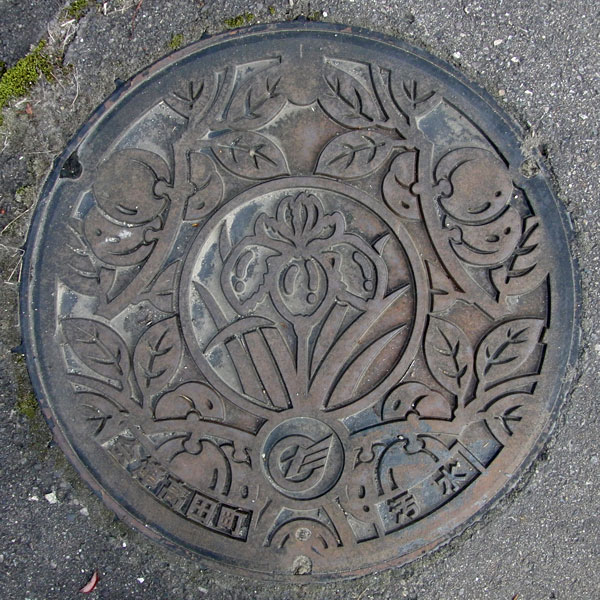
The town flower, the iris, and the town tree, the plum blossom.
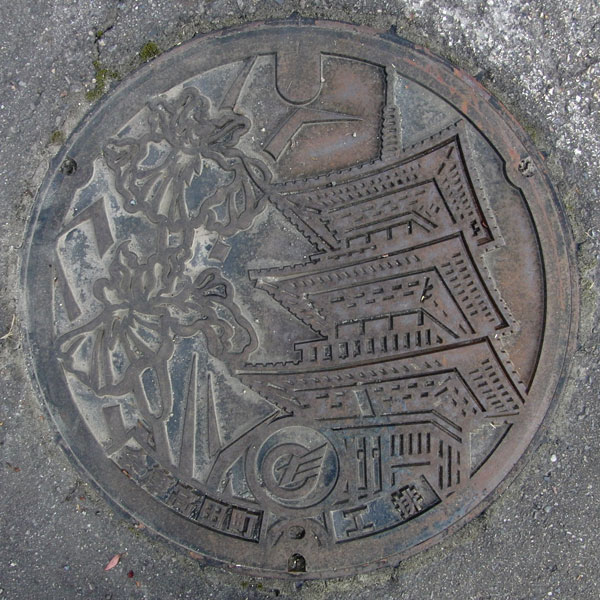
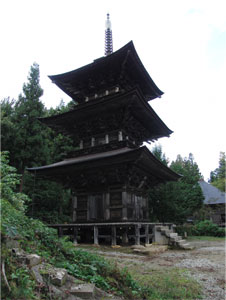
The three-story pagoda of Hōyōji Temple, the only remaining pagoda structure in the Aizu region, and the town flower, the iris. Below it is a manhole cover with the words "Industrial Drainage" written on it, indicating industrial drainage from an industrial park.
Aizuhongo 会津本郷町
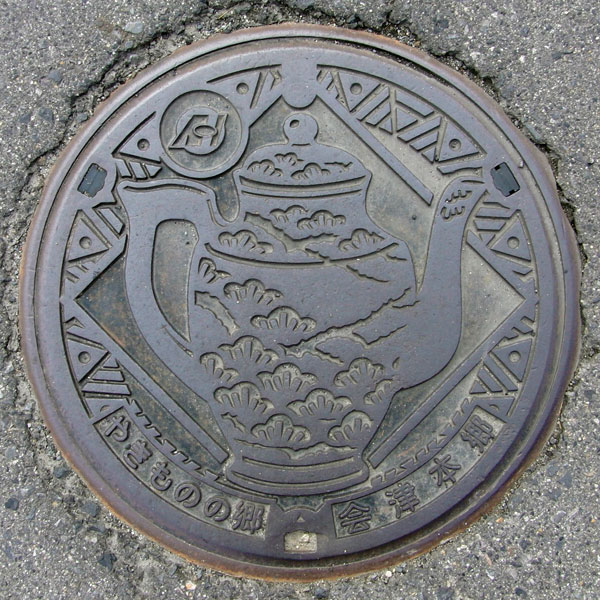
As indicated by the words "Village of Pottery" at the bottom, the lid is designed to resemble Aizu Hongo ware. The words "Village of Pottery" and "Aizu Hongo" are written at the bottom.
Niitsuru 新鶴村
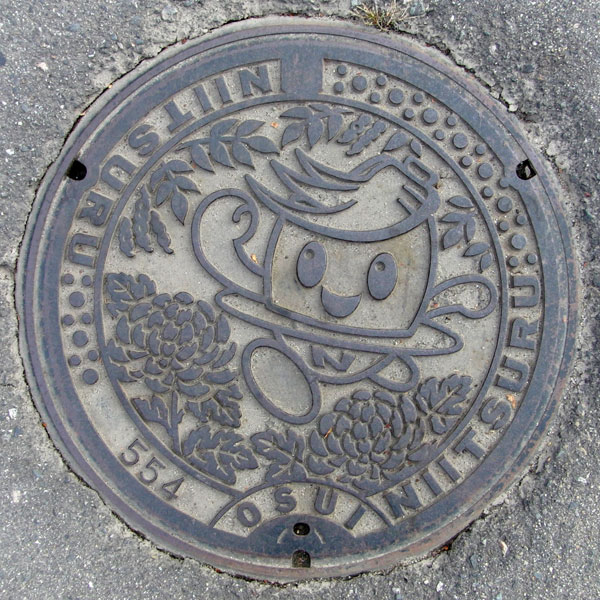
This manhole cover for sewage features the village's mascot, "Nikki," along with the village's tree, the "Sophora japonica," and its flower, the "Chrysanthemum." The word "NIITURU" is written in two places.
Miharu 三春町
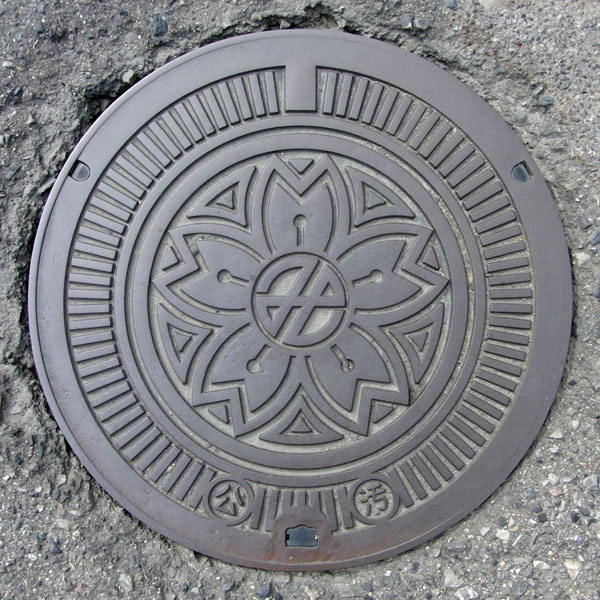
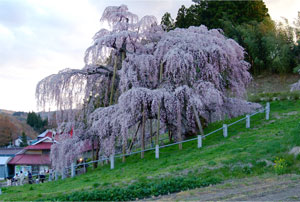
A manhole cover featuring the town's official tree, the weeping cherry tree, and the town's emblem. Of course, when you think of Miharu, you think of the Takizakura cherry tree.
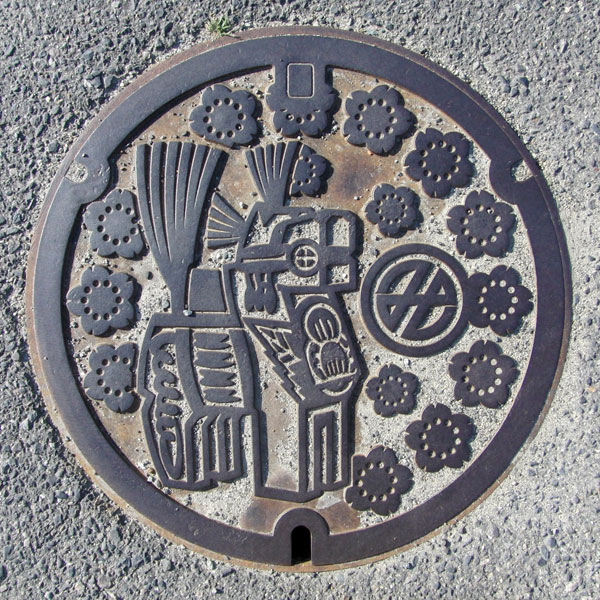
The "Miharu-goma" (Miharu Horse) is depicted on the manhole cover.
This is a manhole cover for agricultural wastewater in the Yogiashi district.
Futaba 双葉町
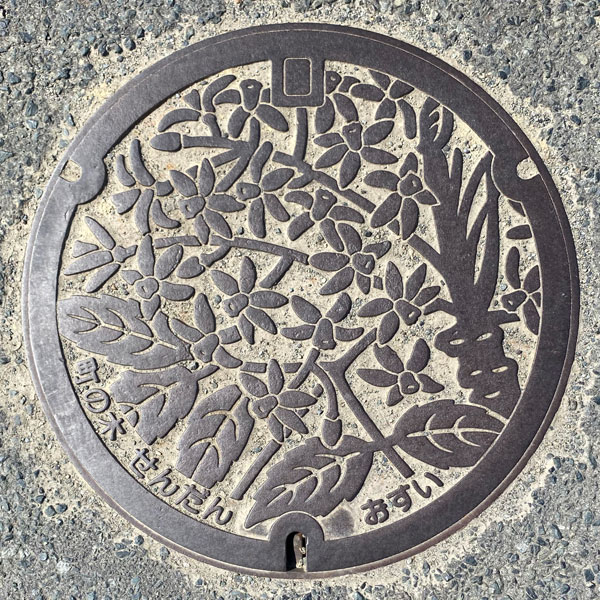
A manhole cover for sewage featuring the town's official tree, the Chinaberry tree.
Tadami 只見町
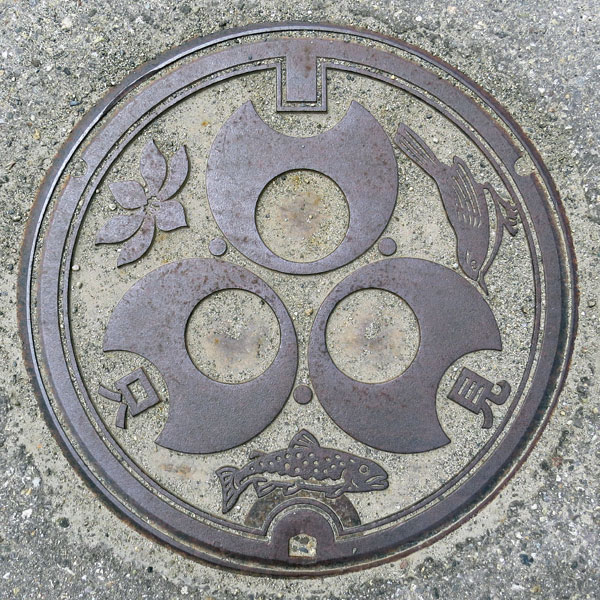
The town emblem is prominently displayed in the center. Surrounding it are illustrations of the town's bird, the Japanese bush warbler, the town's flower, the magnolia, and the town's fish, the char.
Okuma 大熊町
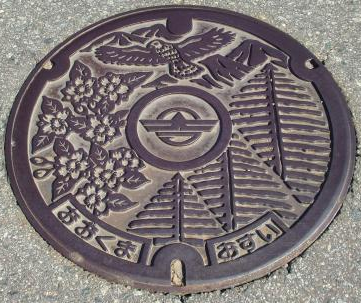
The town of Okuma, whose catchphrase is "A romantic village filled with the scent of fruit," features a design of pear blossoms (the town's flower and specialty), the town bird (the kite), and the town tree (the fir).
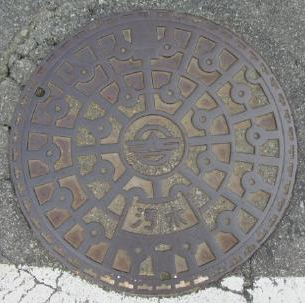
Town emblem in the center, "sewage" text at the bottom.
Tomioka 富岡町
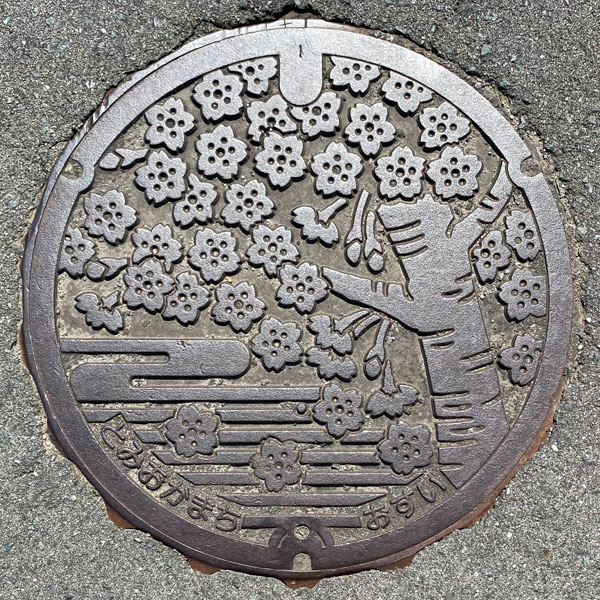
A manhole cover for sewage featuring the town's official tree, the cherry blossom.
Ono 小野町
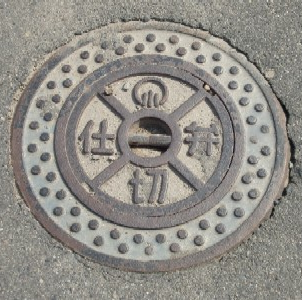
A small water shut-off valve cover featuring the town emblem, a stylized representation of the character "小" (ko) from Ono Town.
Naraha 楢葉町
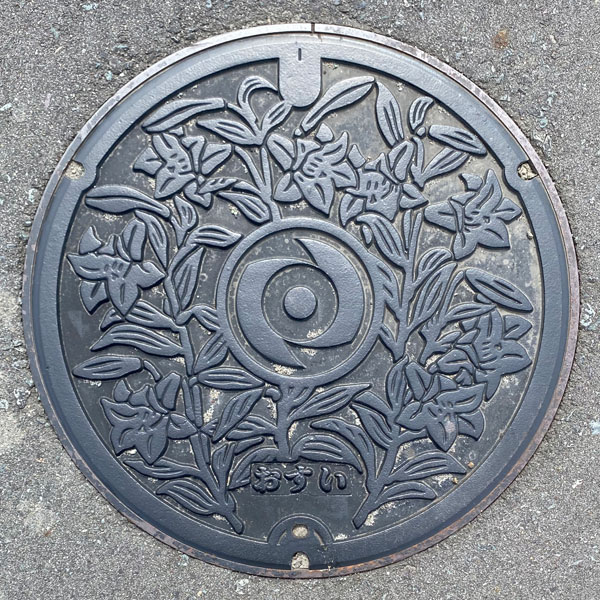
A manhole cover for sewage featuring the town's flower, the "mountain lily." The town emblem is in the center.
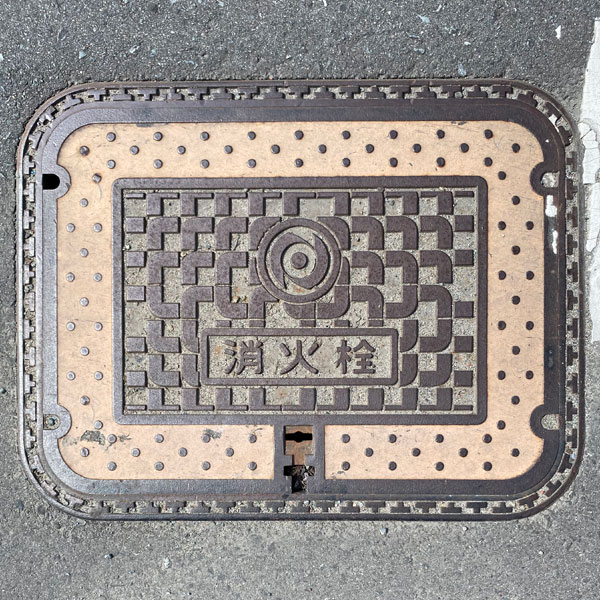
A square fire hydrant cover bearing the town's emblem.
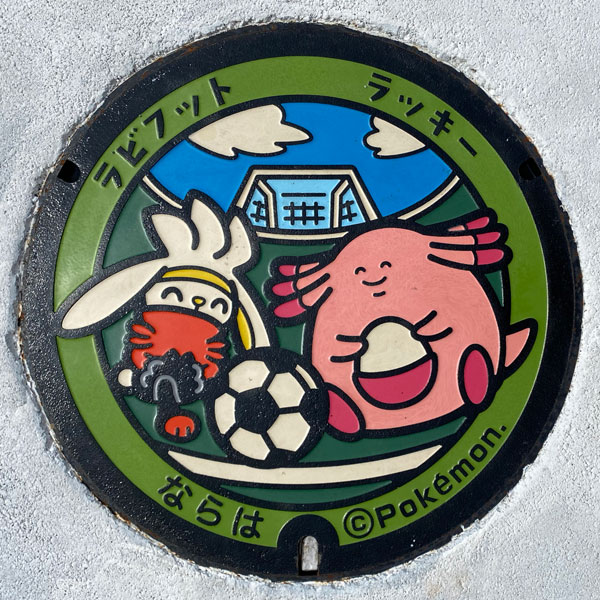
This "Pokémon manhole cover, 'Pokéfuta'," was donated by The Pokémon Company. It depicts Raboot and Chansey against a soccer goal background. The words "Naraha" and "©Pokémon." are written in the lower left corner.
Shimogo 下郷町
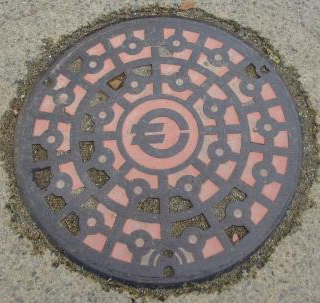
A JIS standard manhole cover with the town emblem.
Kagamiishi 鏡石町
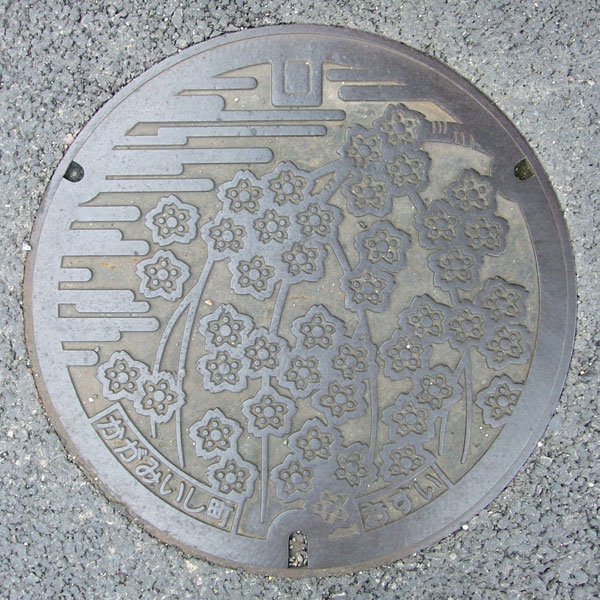
The town's official tree, the weeping cherry tree, is depicted.
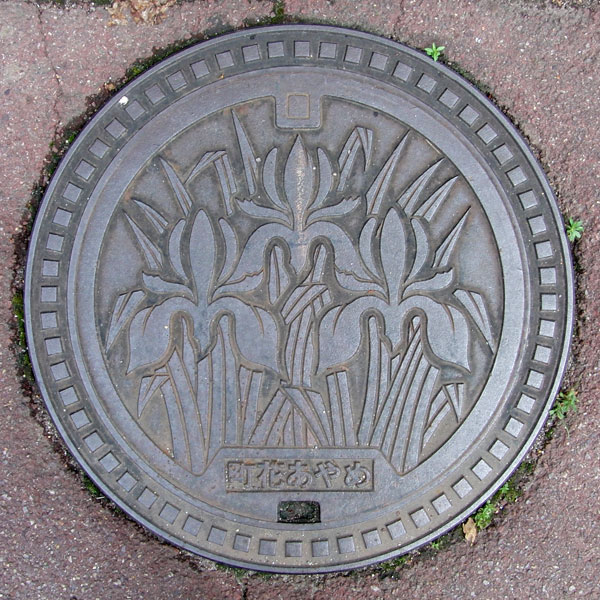
The town's official flower, the iris, is depicted on it. It has a frame with square protrusions.
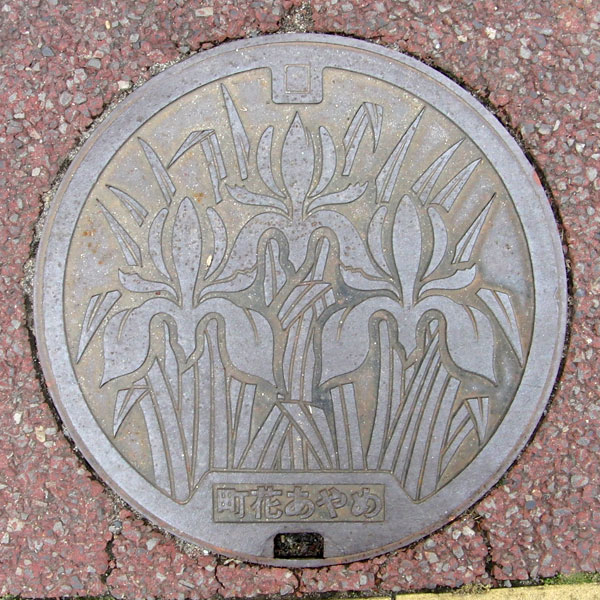
This one has the same design as above, but with a thinner frame.
Hirono 広野町
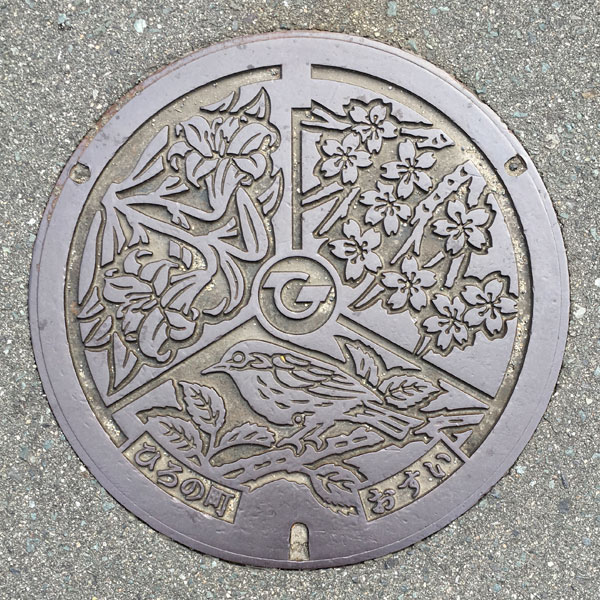
A manhole cover for sewage, featuring the town emblem in the center, the town tree "cherry blossom" in the upper right of the three-part division, the town flower "mountain lily" in the upper left, and the town bird "Japanese white-eye" at the bottom.
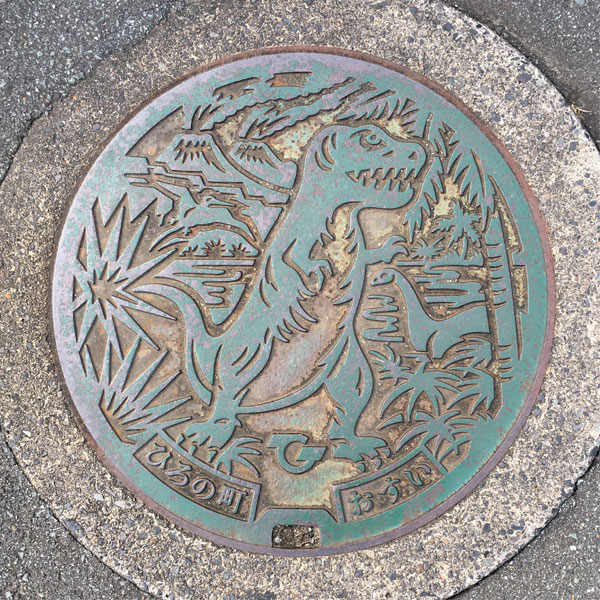
The dinosaur fossil discovered in Hirono Town in 1986 is commonly known as "Hironoryu." The manhole cover depicts a fierce dinosaur with sharp teeth, but the actual Hiroronoryu, while similar in appearance, was apparently a herbivore.
Minamiaizu 南会津町
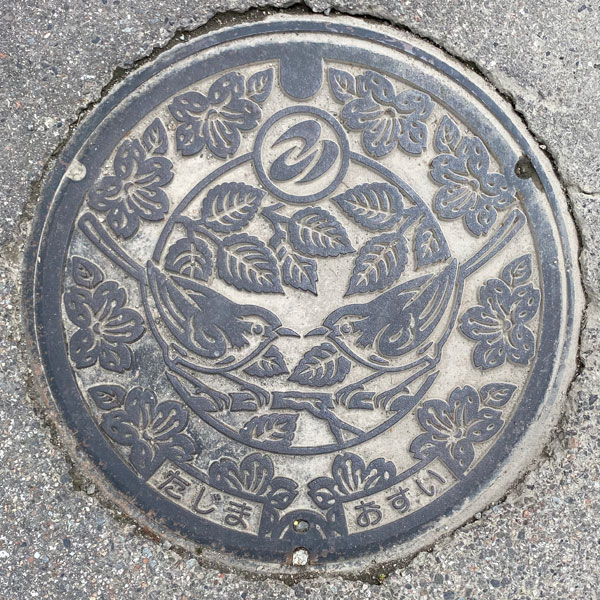
This is a manhole cover for wastewater in the Tajima treatment area's public sewer system. The cover depicts the town's tree, the beech, and two of the town's bird, the Japanese bush warbler, inside the circle, surrounded by the town's flower, the mountain azalea. The Minamiaizu town emblem is at the top.
Tajima 田島町
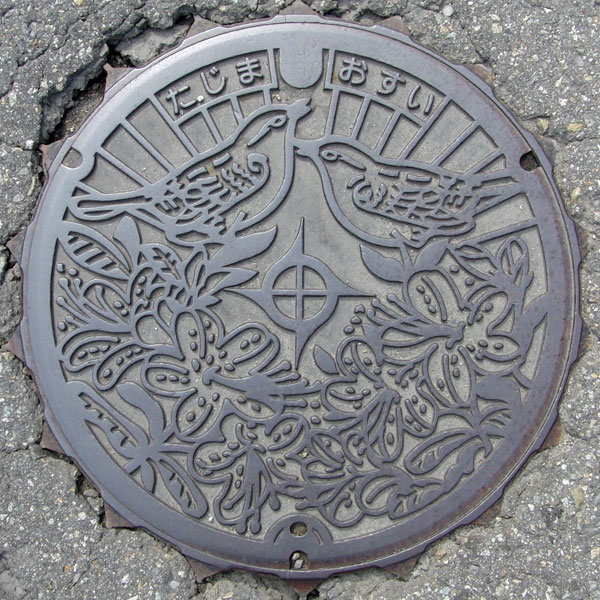
The design features the town's bird, the Japanese bush warbler, and the town's flower, the mountain azalea. The town emblem is in the center.
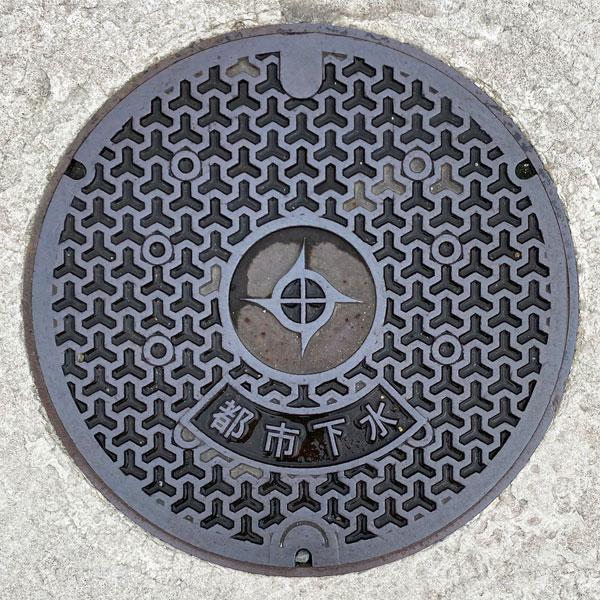
The former Tajima town emblem is in the center of the Bishamon tortoise shell pattern, with the words "Urban Sewerage" below it.
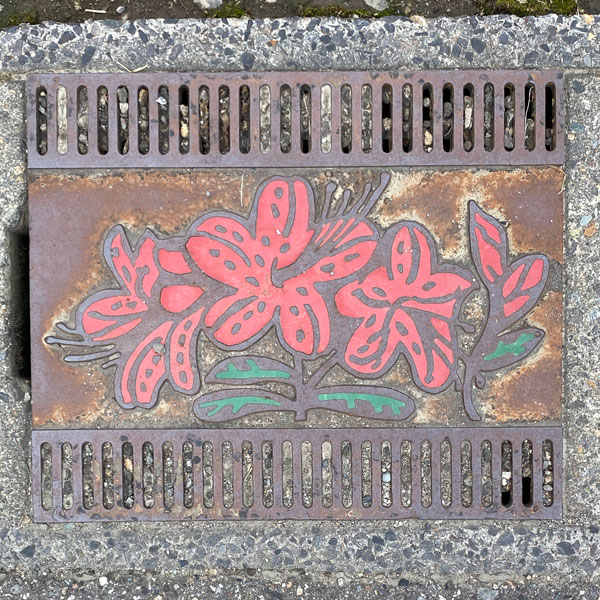
A drain cover featuring the town's official flower, the mountain azalea.
Tateiwa 舘岩村
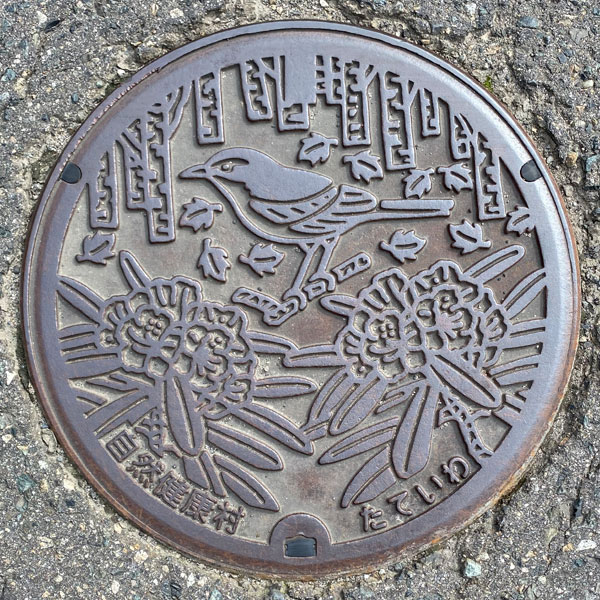
The manhole cover features the words "Tateiwa Natural Health Village," along with the village bird (Japanese bush warbler), the village flower (rhododendron), and the village tree (birch). The strips of paper at the top appear to be birch leaves. Indeed, some leaves have fallen.
Ina 伊南村
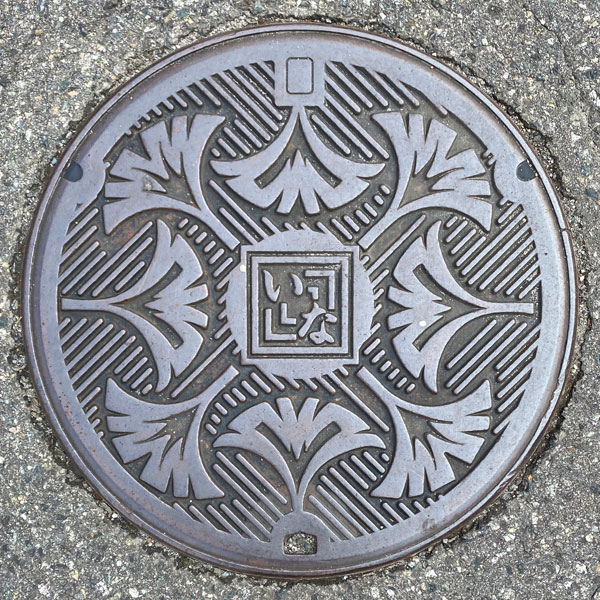
A manhole cover for agricultural wastewater in the Furumachi district, depicting the leaves of the ginkgo tree, the former tree of Ina Village.
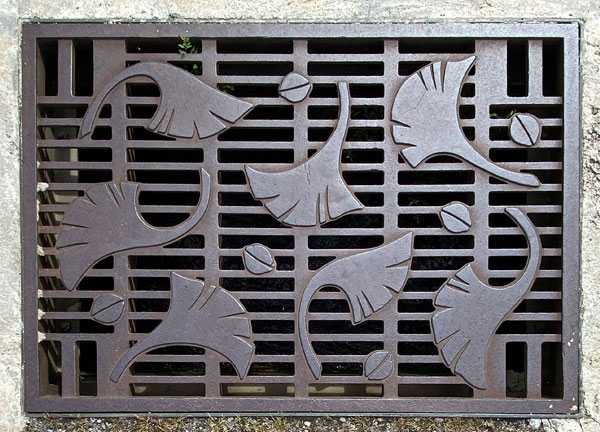
A drain cover depicting seven ginkgo leaves and six ginkgo nuts, the official tree of the former Ina Village.
Nango 南郷村
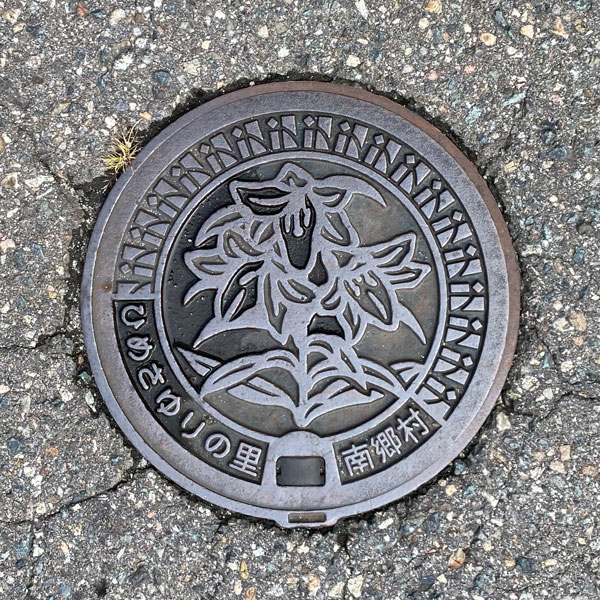
A small manhole cover for the designated environmental conservation public sewer system in the Nango treatment area, depicting the "Hime-sayuri" lily, the flower of the former Nango Village.
Yabuki 矢吹町
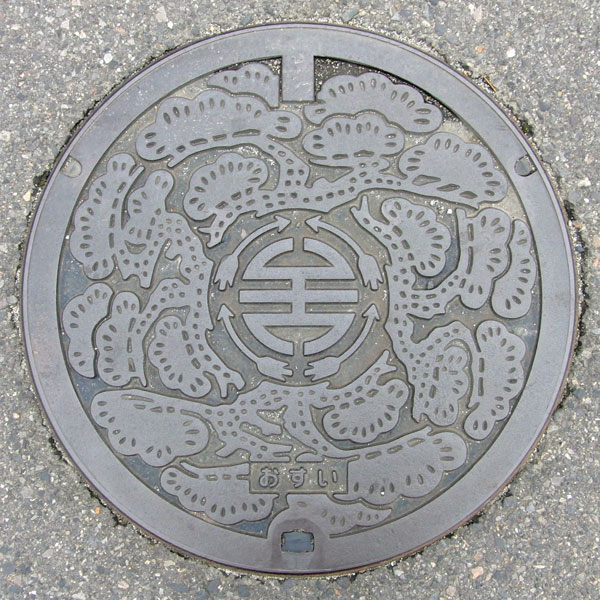
The town's official tree, the Japanese red pine, is depicted. Four arrows surround the town emblem in the center.
Ishikawa 石川町
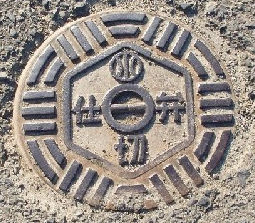
Water shut-off valve
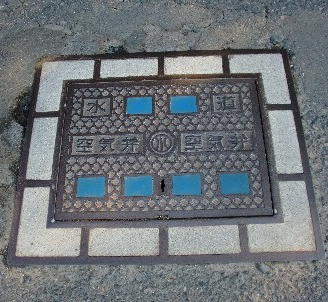
Water supply air valve
Furudono 古殿町
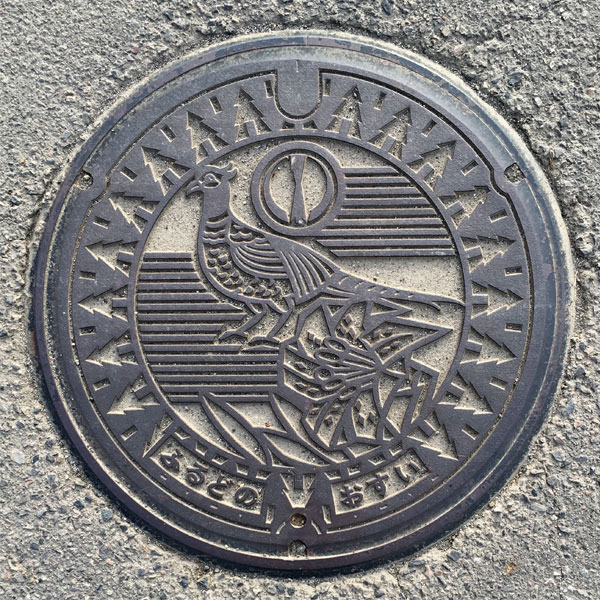
A manhole cover for sewage featuring the town's official tree, the cedar, on the outside, and the town's official flower, the mountain lily, the town's official bird, the pheasant, and the town emblem on the inside.
Asakawa 浅川町
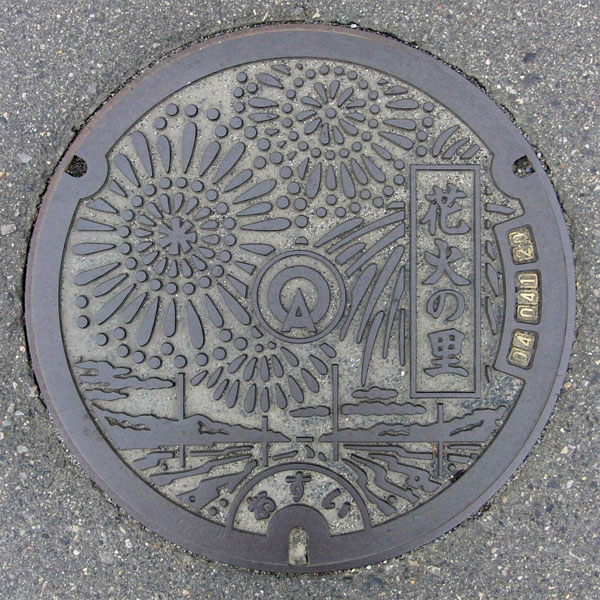
The image depicts the fireworks from the Asakawa Fireworks Festival, held every August. It also refers to a designated environmentally protected public sewer system.
Tanagura 棚倉町
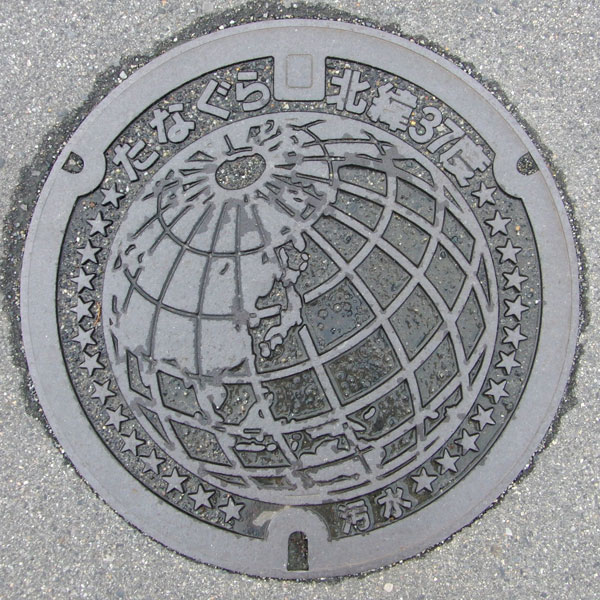
The words "Tanagura" and "37 degrees North Latitude" are written at the top. A globe centered on Tanagura Town is depicted in the center.
The 37th parallel north passes through the vicinity of Chikatsu Station, roughly midway between the Tanagura Town Hall and the Hanawa Town Hall to the south. Because of this connection, Tanagura has a sister city relationship with Sparta, Greece, which is also located on the 37th parallel north.
Hanawa 塙町
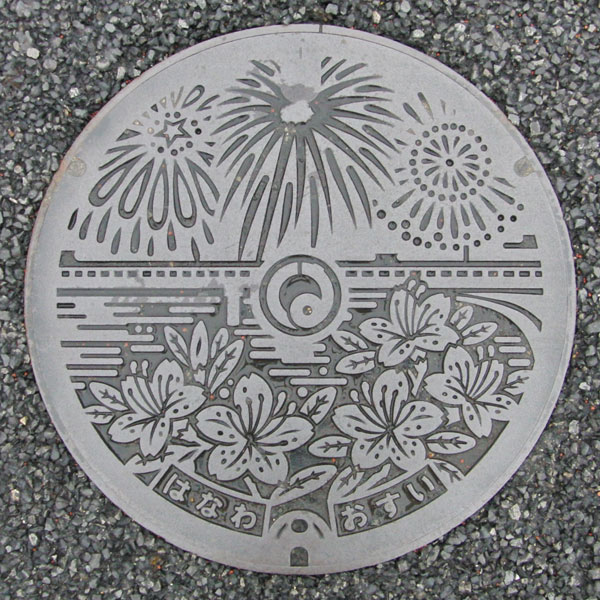
The town's flower, the mountain azalea, and the Hanawa Lantern and Fireworks Festival.
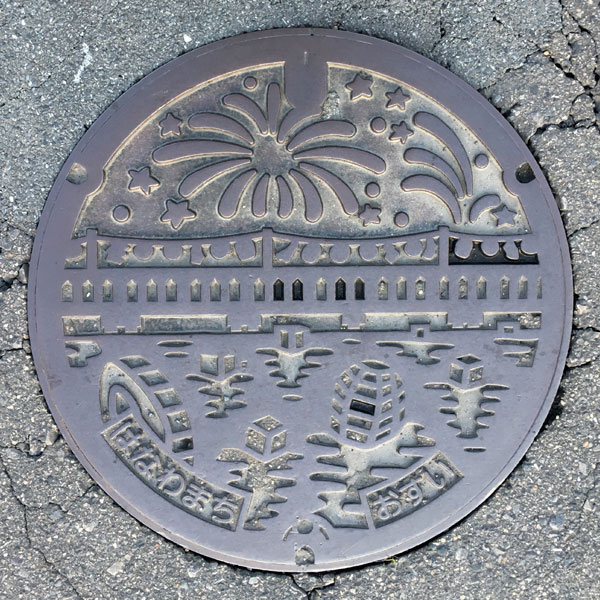
Manhole cover for the agricultural settlement drainage in the Daijuku district.
Like the cover above, it depicts the "Hanawa-ryu Lantern and Fireworks Festival," but this design, with its rows of lanterns on the bridge and floating lanterns on the river, seems to better represent the original "Hanawa-ryu Lantern and Fireworks Festival."
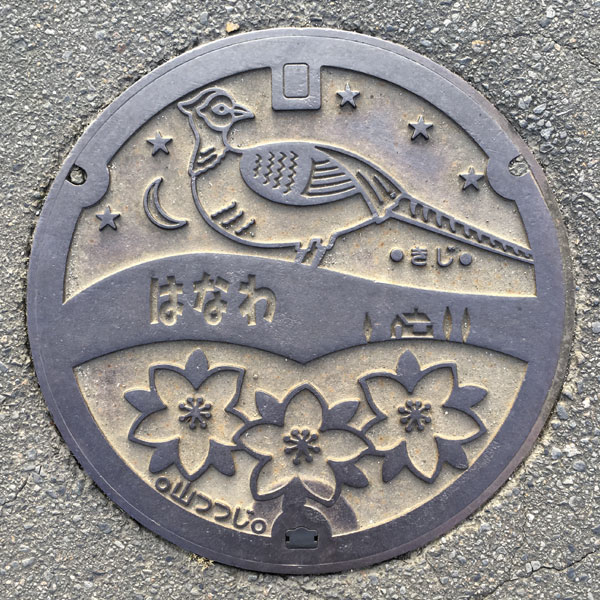
This is a manhole cover for the agricultural community drainage system in the Kitano district.
The town's bird, the pheasant, is depicted at the top, the town's flower, the mountain azalea, at the bottom, and the word "Hanawa" and a small house built on a hill-like curve are depicted in the center.
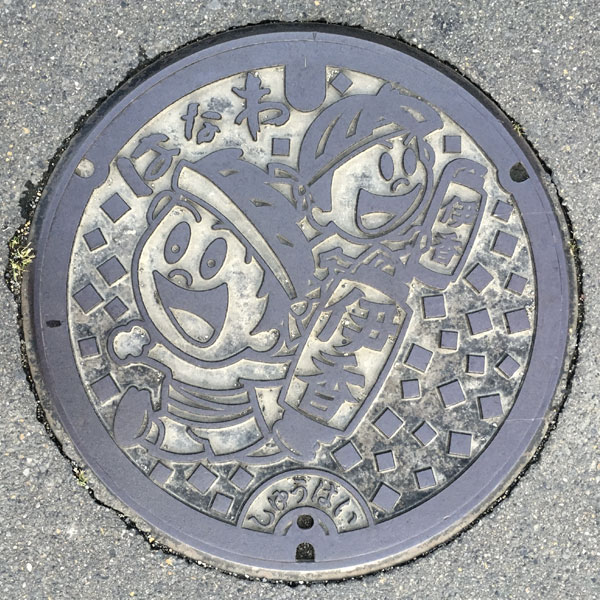
This is a manhole cover for the drainage system of the agricultural settlement in the Ika district.
It depicts the "Osuwa-sama" festival, a festival in the Ika district with a tradition of over 100 years. In the evening, young people carry lanterns and go from house to house in the district.
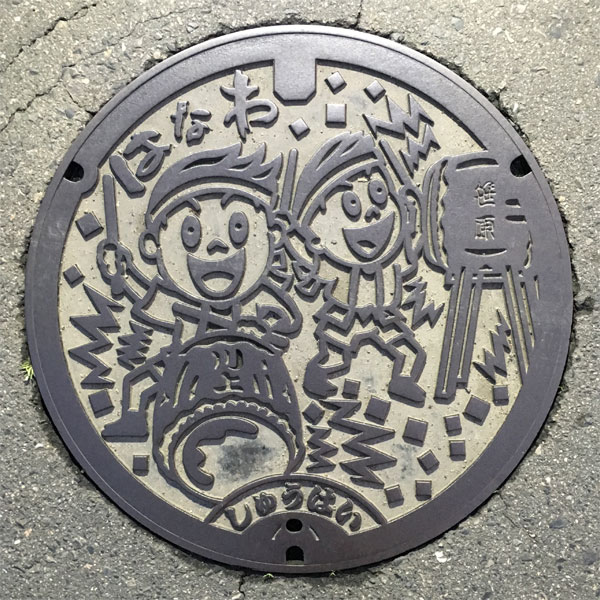
A manhole cover for the agricultural community drainage system in the Kawakami district.
Two people are shown beating drums with the names "Sasahara" and "Kawakami" written on them. Apparently, Hanawa Technical High School has a Japanese drum club.
Yamatsuri 矢祭町
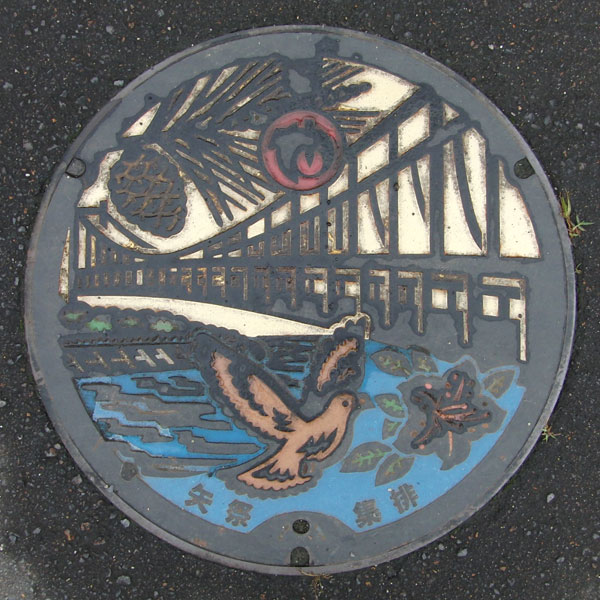
A manhole cover depicting the town's bird, the Japanese Oriental Turtle Dove, the town's flower, the Azalea, the town's tree, the Japanese Red Pine, and the Ayu Suspension Bridge (located behind Yamatsuri Station on the Suigun Line) spanning the Kuji River.
This is a manhole cover for the agricultural community drainage system in the Sekioka-kami district. It is not found in the Yamatsuri town center, but rather lined up along Prefectural Road 230 in the Sekioka district, across the Kuji River.
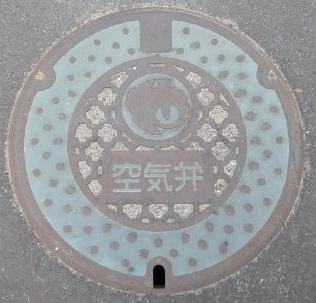
The air valve cover with the town emblem.
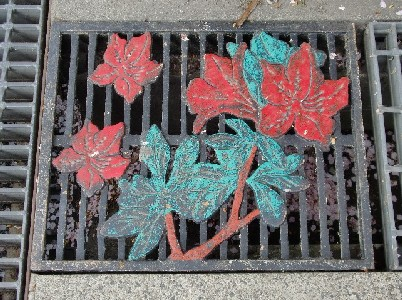
A manhole cover featuring the town flower, the azalea. It's the same design as the manhole cover on the side of Otama Junior High School in Otama Village, Adachi District.
Kitashiobara 北塩原村
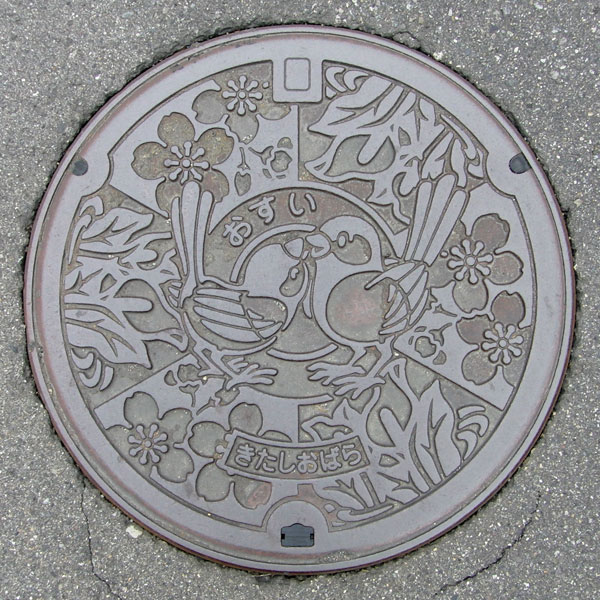
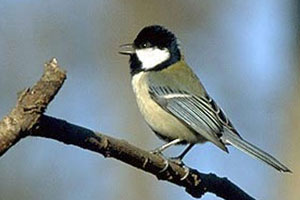
The manhole cover features the village bird, the Great Tit, along with the village tree, the Ooyamazakura, and the village flower, the Mizubasho (Skunk Cabbage).
Iitate 飯舘村
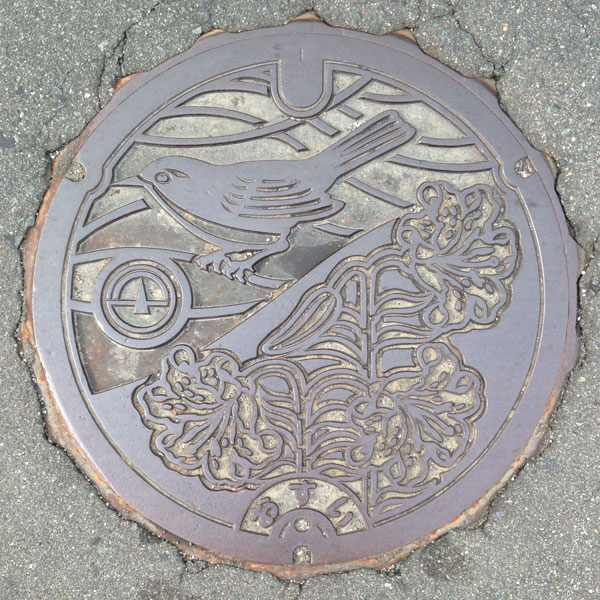
The village bird, the Japanese bush warbler, the village flower, the mountain lily, and the village emblem are depicted.
Yugawa 湯川村
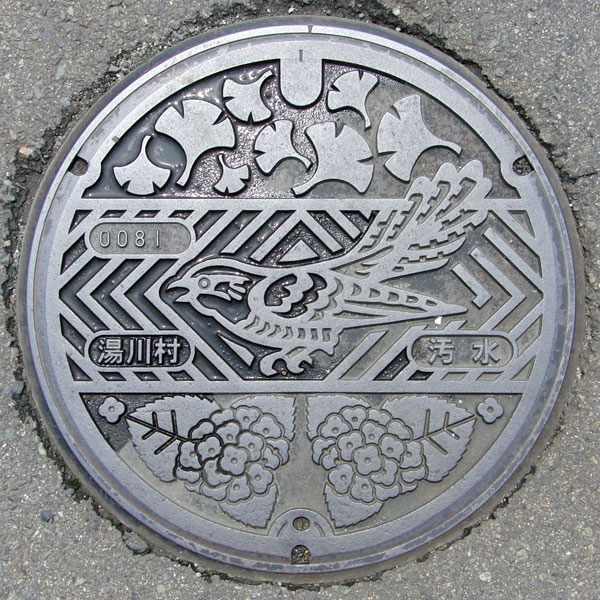
This is a manhole cover for sewage, depicting the village tree ("Ginkgo"), the village bird ("Cuckoo"), and the village flower ("Hydrangea").
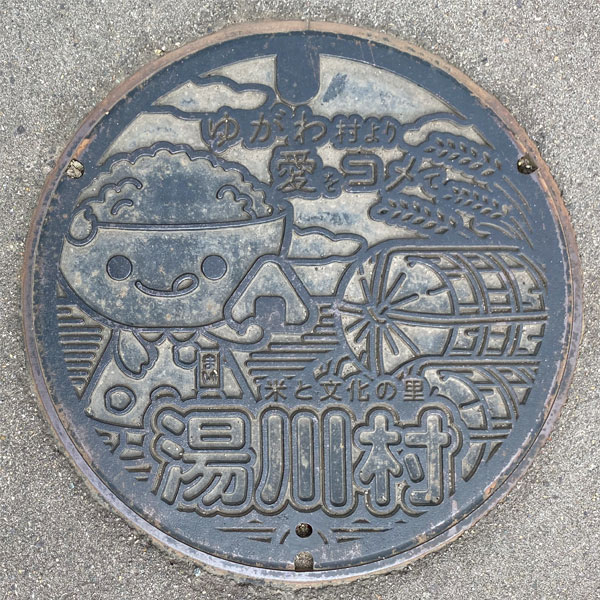
A new design lid featuring Yukawa Village's mascot, "Yugawa Mai-chan," holding a rice ball. Rice bales and rice stalks are also depicted, reflecting the village's rice-producing region.
The words "With Love from Yukawa Village" are at the top. Above the large "Yukawa Village" text at the bottom, it reads "Village of Rice and Culture."
Otama 大玉村
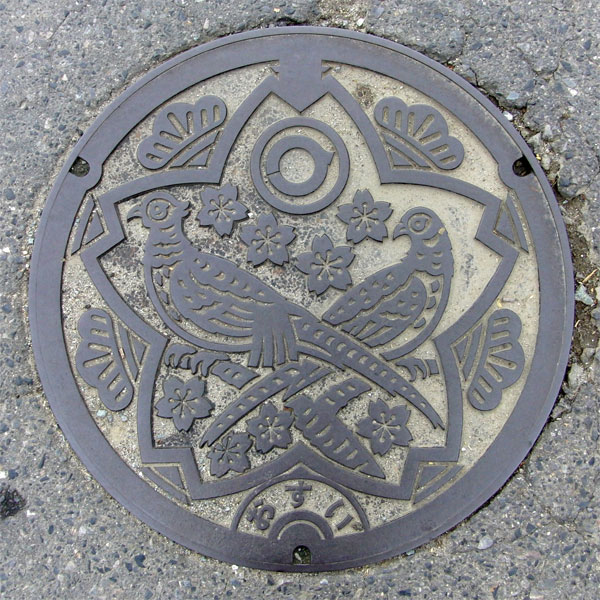
The manhole cover features a design with the village bird, the pheasant, and the village flower, the cherry blossom, within a cherry blossom-shaped frame, and the village tree, the pine, on the outside.
Katsurao 葛尾村
Water supply shut-off valve with village emblem
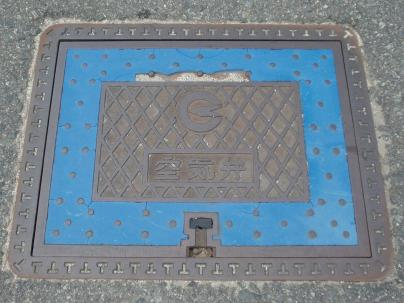
Water supply air valve with village emblem
Showa 昭和村
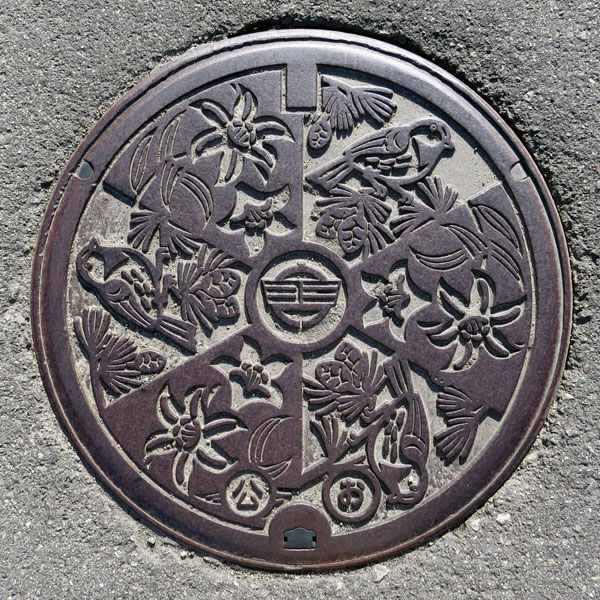
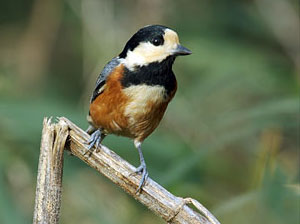
According to the Showa Village website, the village tree is the Japanese white pine (Pinus parviflora), the village flower is the Japanese lily (Lilium rubellum), and the village bird is the Japanese tit (Yamagara).
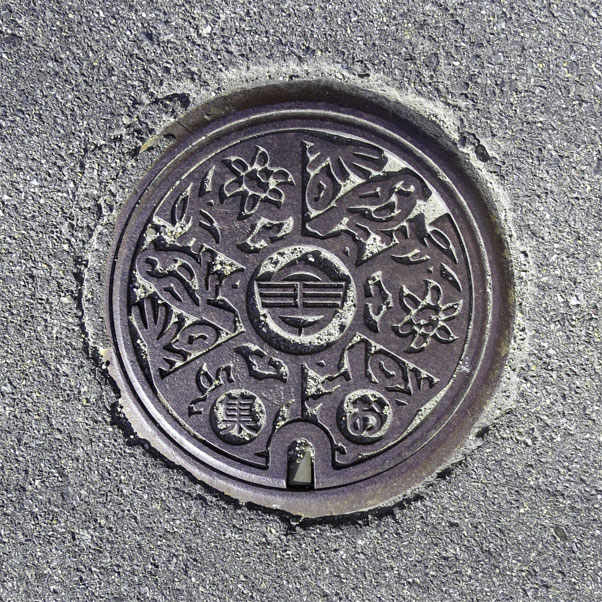
A small wastewater drain with the same design as above.
Kawauchi 河内村
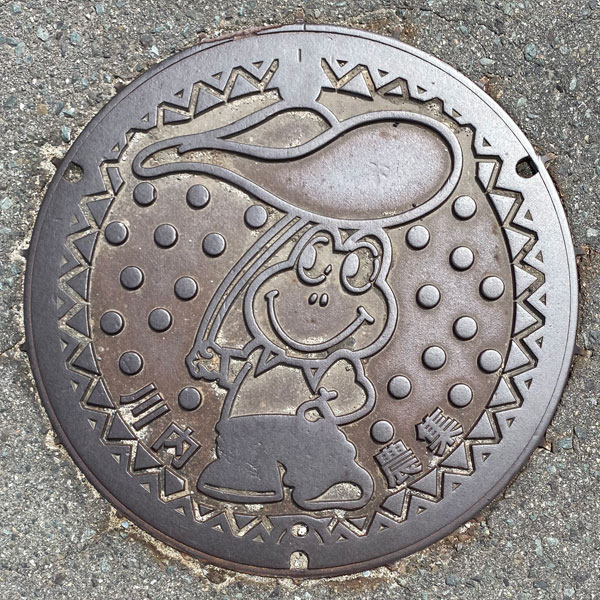
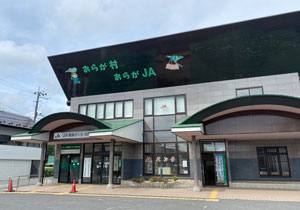
This is a manhole cover for agricultural wastewater treatment plants featuring Kawauchi Village's official character, "Moritaro, the Village Chief of Nature." He was also on the awning of the JA (Japan Agricultural Cooperatives) building.
Tenei 天栄村
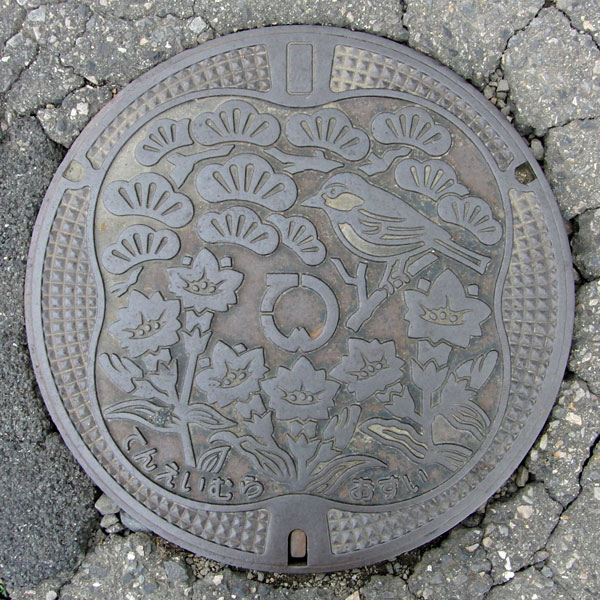
This manhole cover for agricultural wastewater in the Matsumoto district depicts the village tree "pine," the village flower "bellflower," and the village bird "Japanese bush warbler."
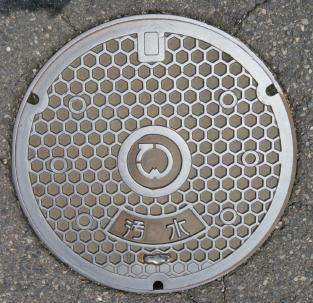
Manhole cover with a tortoiseshell pattern, village emblem, and the word "sewage."
Tamakawa 玉川村
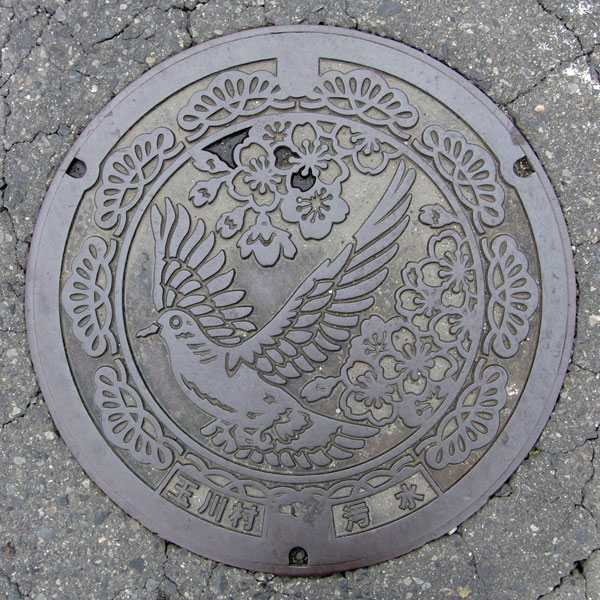
The village tree, the Japanese red pine, is depicted around the edges, while the village bird, the Japanese ornate pigeon, and the village flower, the Japanese mountain cherry blossom, are shown in the center.
Hirata 平田村
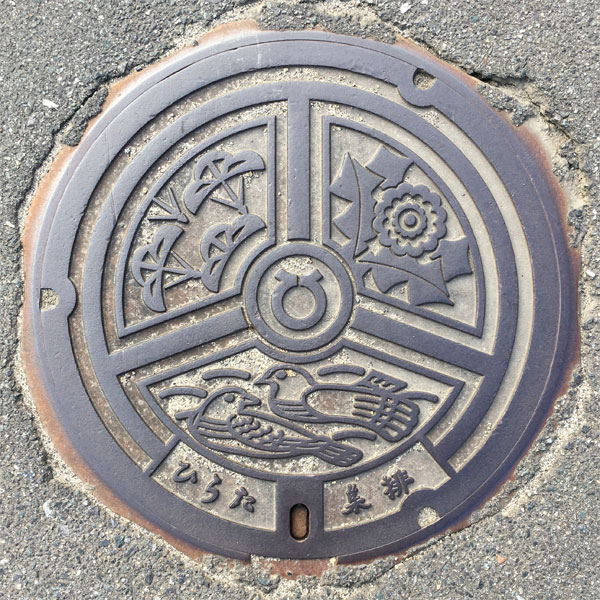
A manhole cover for village drainage, featuring the village emblem in the center, surrounded by illustrations of the village tree "Japanese red pine," the village flower "dandelion," and the village bird "mountain dove."
Nishigo 西郷村
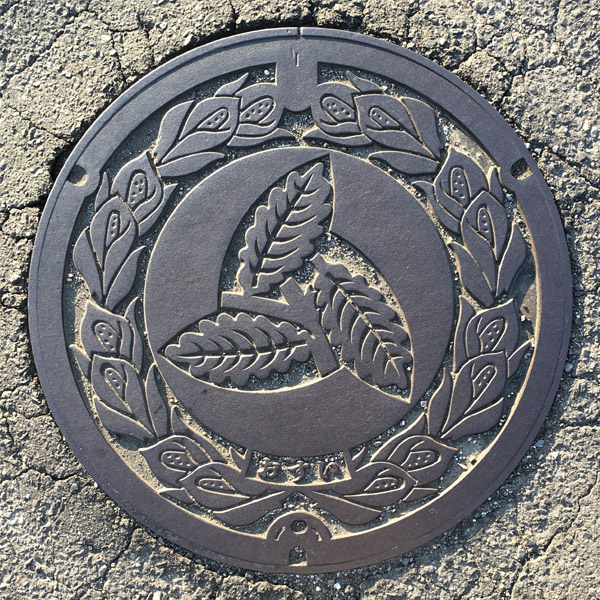
The central circle is the village emblem. A leaf of the village tree, the "oak," is embedded within it. The village flower, the "skunk cabbage," surrounds the emblem.
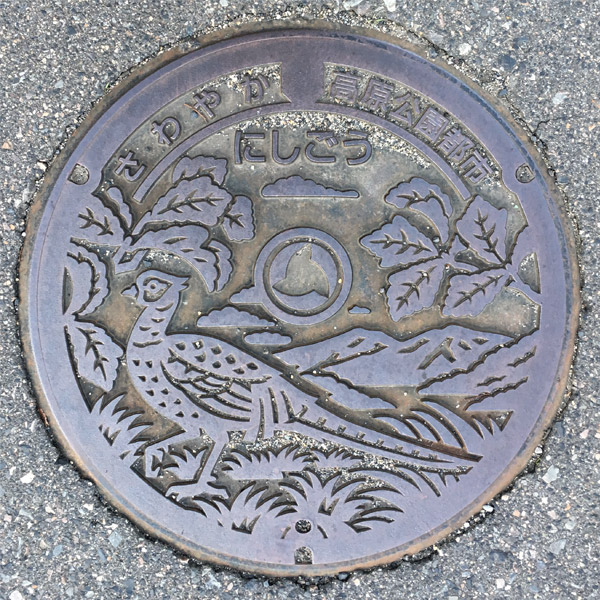
The central circle is the village emblem. The manhole cover for sewage depicts the village tree, the oak, the village bird, the pheasant, and the Nasu mountain range. The words "Sawayaka Kogen Park City" and "Nishigo" are written at the top.
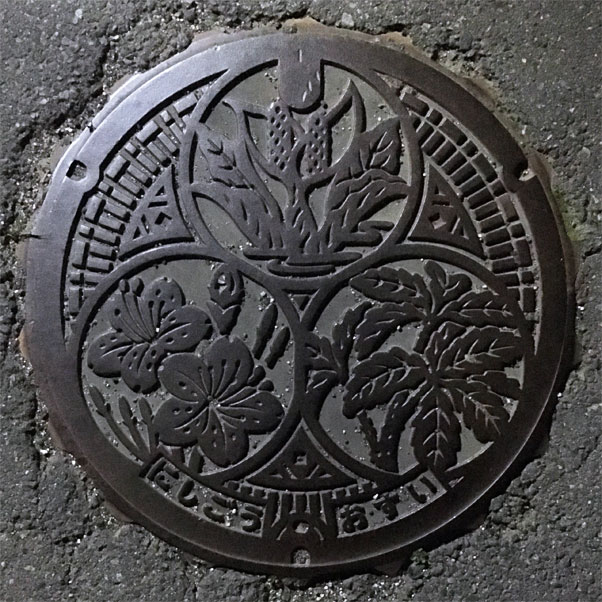
This is a manhole cover for agricultural community drainage in the Uenohara district. The upper circle depicts the village's wildflower, "Mizubasho" (skunk cabbage), the lower right circle depicts the village's tree, "Kashiwa" (oak), and the lower left circle depicts the village's tree and flower, "Yashio Azalea."
Izumizaki 泉崎村
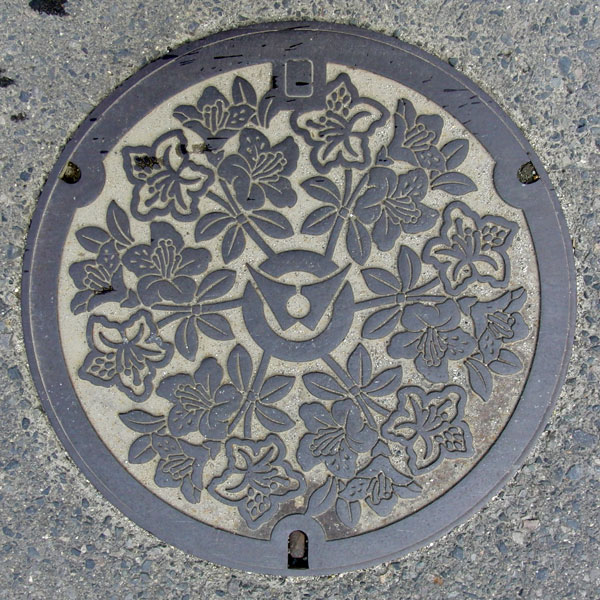
The manhole cover depicts the village flower, the azalea.
Nakajima 中島村
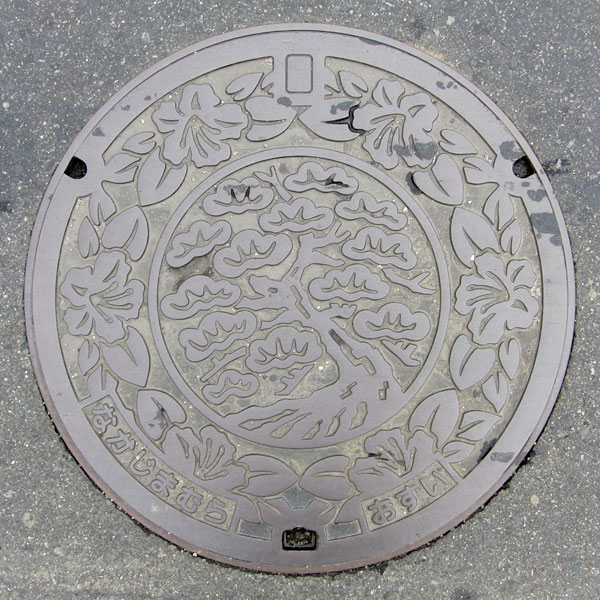
The village flower, the azalea, and the village tree, the Japanese red pine, are depicted.
Hinoemata 檜枝岐村
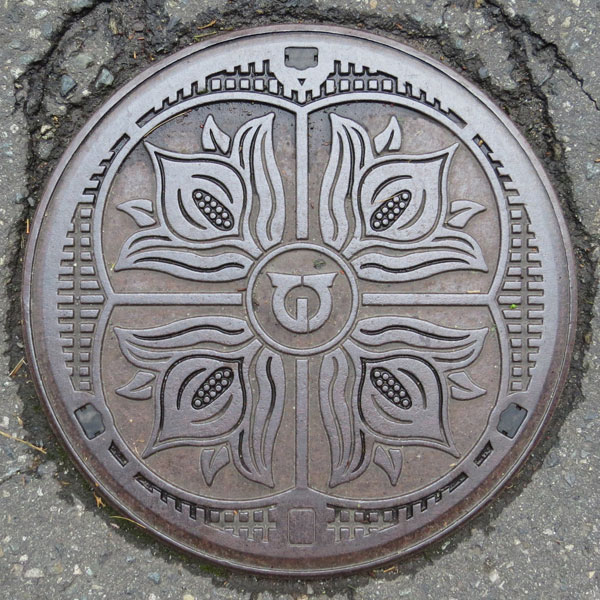
This is a manhole cover for a designated environmentally protected public sewer system, featuring the village flower, the skunk cabbage, and the village emblem.
Samegawa 鮫川村
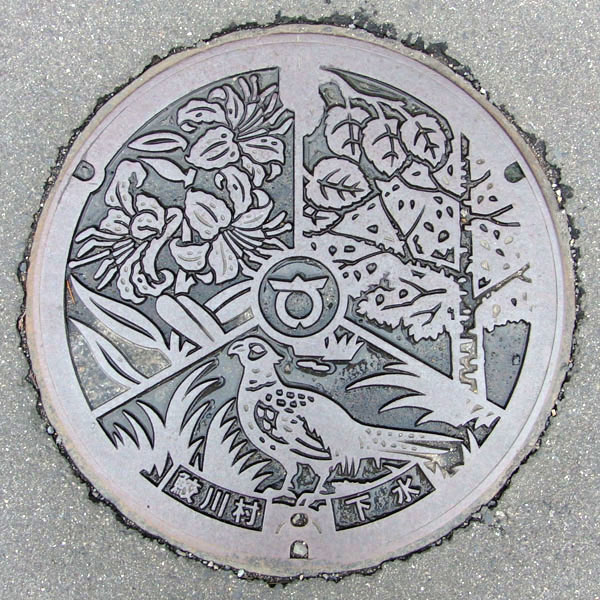
The top left shows the village flower, the "mountain lily," the top right shows the village tree, the "white birch," and the bottom shows the village bird, the "pheasant."
Fukushima Prefecture 福島県
Fukushima Prefecture Northern River Basin Sewerage System 福島県県北流域下水道
The relevant municipalities are Fukushima City, Date City, Koori Town, and Kunimi Town, and include the Left Bank Main Line, Right Bank Main Line, Hobara Main Line, Iizaka Main Line, Yanagawa Main Line, and Kunimi Main Line.
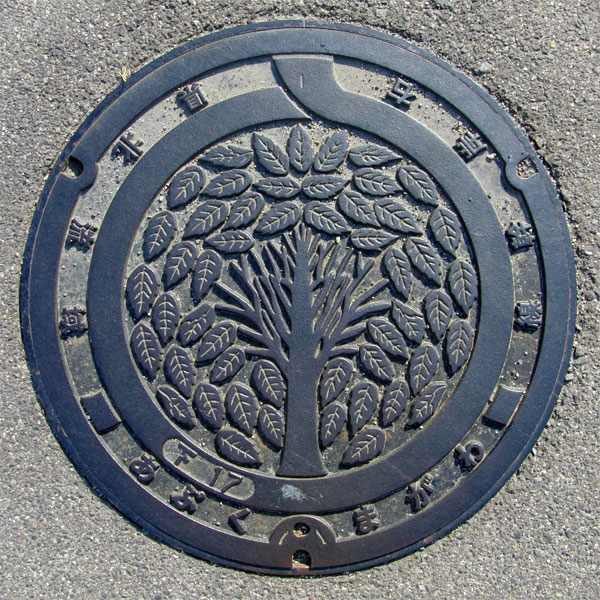
This is the cover for the Northern Basin Sewerage System (Right Bank Main Line), featuring a large prefectural emblem with the words "Abukuma River," "Northern Basin," and "Right Bank Main Line" written on the outside and a picture of the prefectural tree, the Zelkova, on the inside. Following a reorganization in December 2013, the name appears to have changed to "Upper Abukuma River Basin Sewerage System (Northern Treatment Area)."
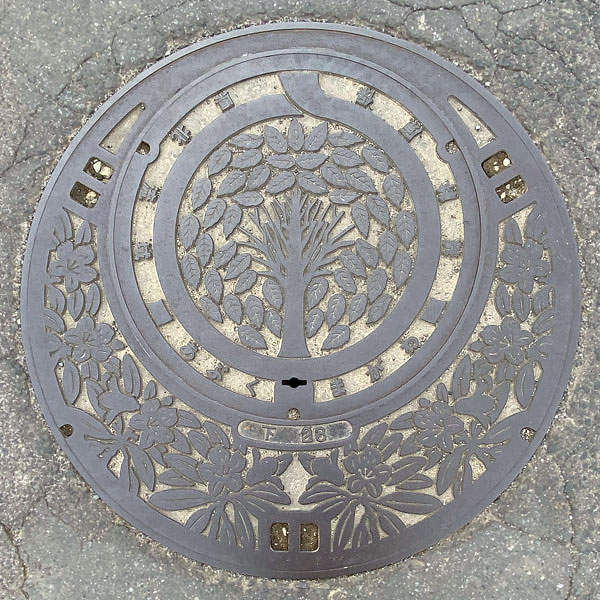
Same design as above, but it comes with a main lid featuring the prefectural flower, the Nemoto rhododendron.
Soma Regional Waterworks Corporation 相馬地方広域水道企業団
The relevant municipalities include Soma City, Kashima Ward, Minamisoma City, and Shinchi Town.
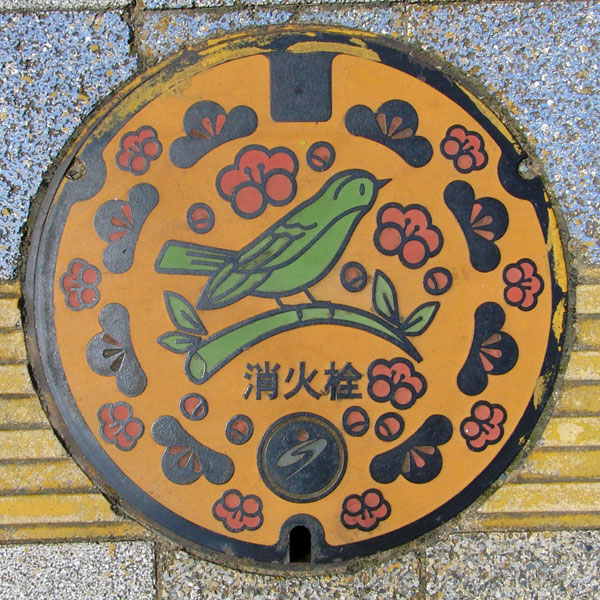
This fire hydrant cover belongs to the Soma Regional Waterworks Corporation. The image depicts what appears to be a plum tree, a pine tree, and a Japanese bush warbler. The Soma Regional Waterworks Corporation mark is at the bottom.
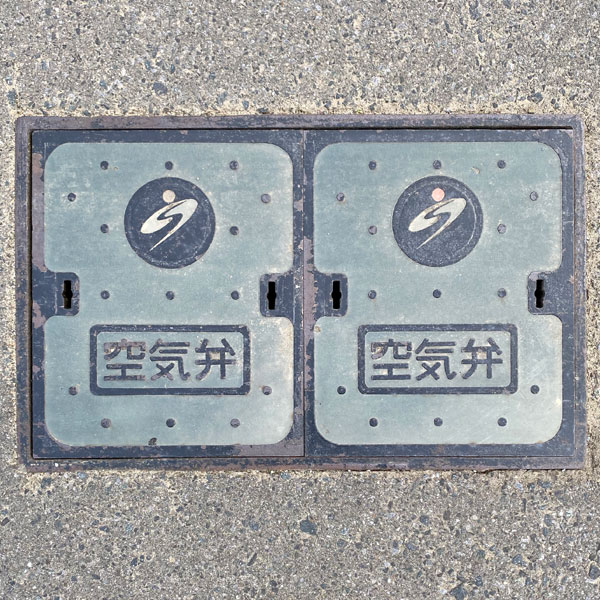
This is the cover of an air valve belonging to the Soma Regional Waterworks Corporation.
Abukuma River Adatara Basin Sewerage System 阿武隈川あだたら流域下水道
The associated municipality is Nihonmatsu City, and it consists of the Nihonmatsu Main Line and the Adatara Main Line. The total length of the Nihonmatsu Main Line and the Adatara Main Line is 4.9 km.
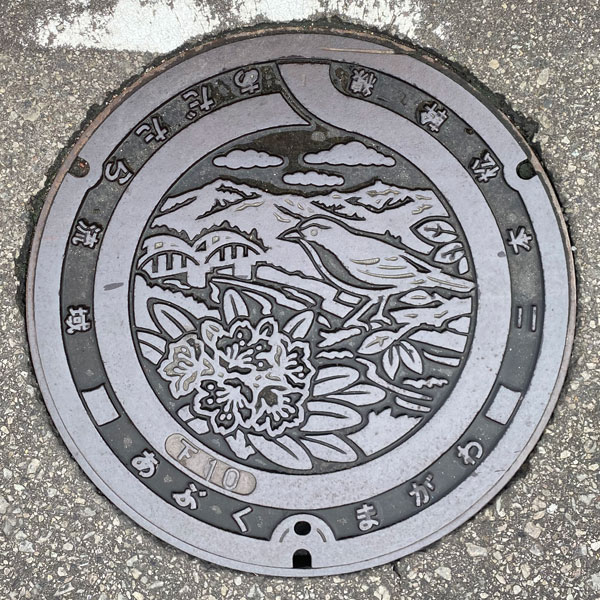
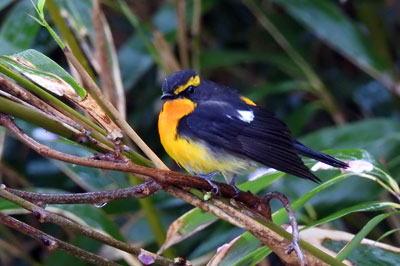
The cover for the Abukuma River Adatara Basin Sewerage Nihonmatsu Main Line features a large prefectural emblem and the words "Abukumagawa," "Adatara Basin," and "Nihonmatsu Main Line" written on the outside. Inside the prefectural emblem are images of Mount Adatara in the background, the Abukuma River flowing through the center, the Fukushima prefectural flower, the Nemoto rhododendron, and the prefectural bird, the Narcissus flycatcher.
Abukuma River Upper Basin Sewerage System 阿武隈川上流流域下水道
Relevant municipalities include Koriyama City, Motomiya City, Sukagawa City, Kagamiishi Town, and Yabuki Town, and the system includes the Prefectural Middle Line, Motomiya Main Line, and Atami Main Line.
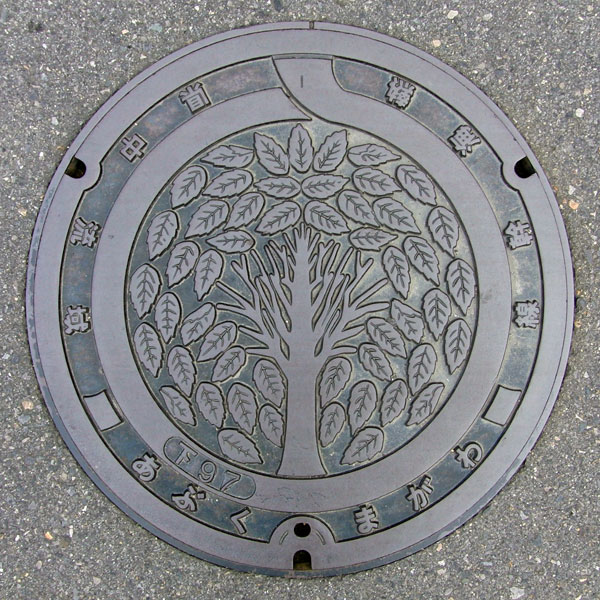
This is a manhole cover for the Koriyama Prefectural Middle Basin Sewerage System (Atami Main Line). The large prefectural emblem is surrounded by the words "Abukuma River," "Prefectural Middle Basin," and "Atami Main Line," while the prefectural tree, the zelkova, is depicted on the inside. Following a reorganization in December 2013, the name appears to have changed to "Abukuma River Upper Basin Sewerage System (Prefectural Middle Treatment Area)."
Fukushima Prefecture Midstream Sewerage System 福島県県中流域下水道
The relevant municipalities are Koriyama City, Sukagawa City, Motomiya City, Kagamiishi Town, and Yabuki Town, and the Prefectural Central Sewerage System, Motomiya Main Line, and Atami Main Line are in operation.
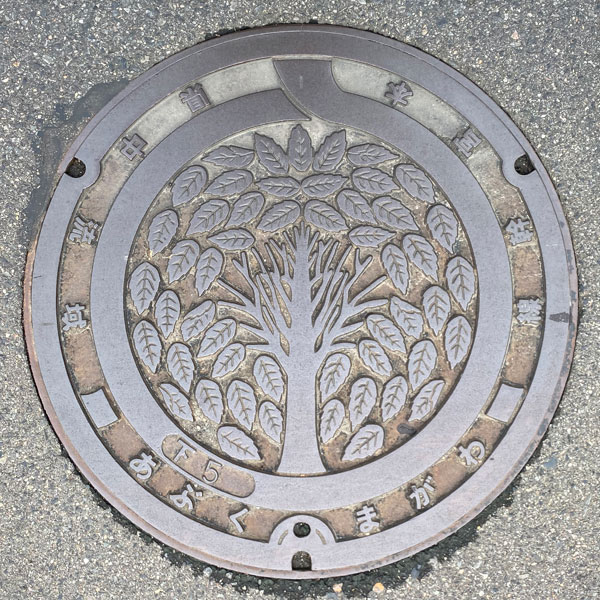
This is the cover for the Prefectural Midstream Sewerage System (Motomiya Main Line). Following a reorganization in December 2013, the name appears to have changed to the "Abukuma River Upper Basin Sewerage System (Prefectural Central Treatment Area)."
Otakine River Basin Sewerage 大滝根川流域下水道
The associated municipality is Tamura City, and includes the Otakine Main Line, Tokoha Main Line, and Shichigo Main Line.
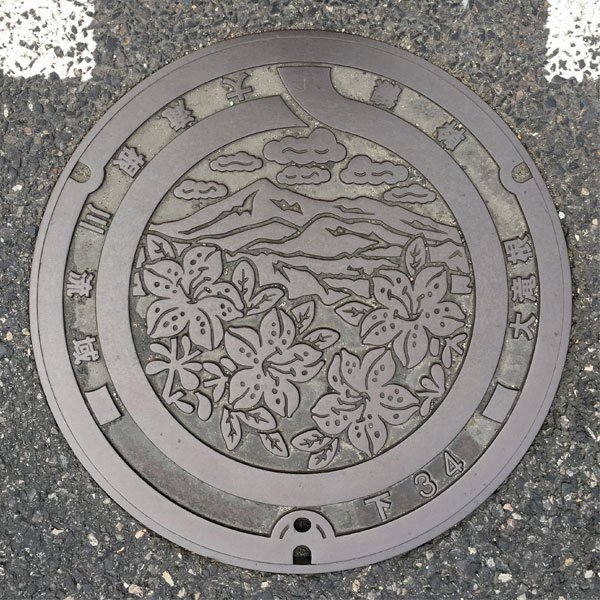
This is the cover for the "Otakine River Basin Sewerage System (Otakine Main Line)," with the words "Otakine River Basin" and "Otakine Main Line" written on the outside of a large prefectural emblem. Unlike other basin sewerage system covers, the word "Abukumagawa" is not included.
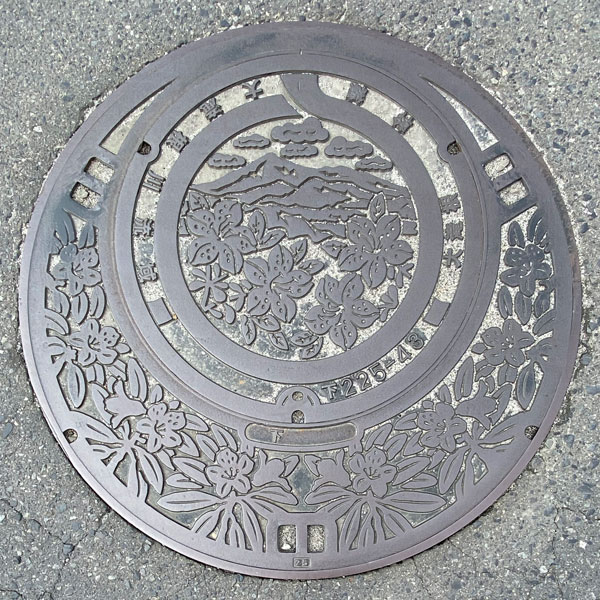
The same double-covered Otakine Main Line as above. The double-covered manhole features the prefectural flower, the Nemoto Rhododendron.