X Nagasaki 長崎県
Nagasaki 長崎県
Nagasaki 長崎市
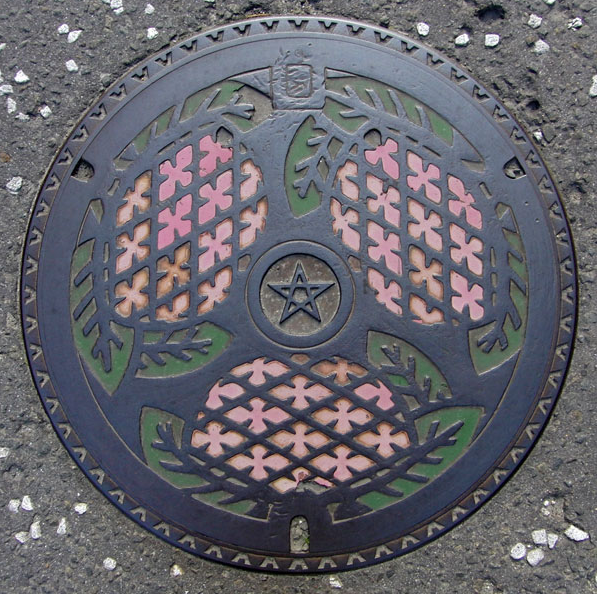
The city flower, the 'Hydrangea' color edition.
The thing I most wanted to see in Nagasaki was this color edition hydrangea. It was right near one of the most popular spots in Nagasaki city, 'Ōura Church.'
If you go up the slope to 'Ōura Church' (bottom right of the photo), there is a path on the right leading to 'Glover House,' but if you go down the opposite path, you will be in front of 'Catholic Ōura Church' (bottom left of the photo).
Since cars cannot pass through the road during the day, the preservation condition is fairly decent.
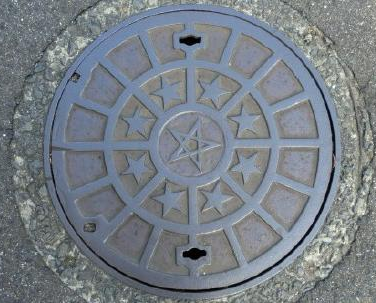
A star in the center of the standard cap. Stars around it as well. Comes with two keyholes. It is said to have been installed until around the early 1960s.
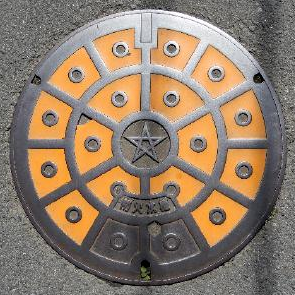
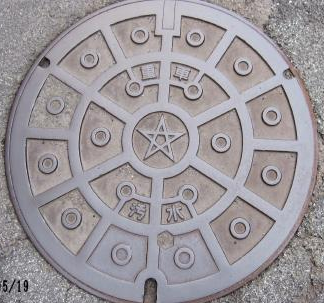
Part of the city emblem with a ☆ mark. I received a different type of the misalignment hole part from fujisanTARO.
Sewer pipe manhole cover.
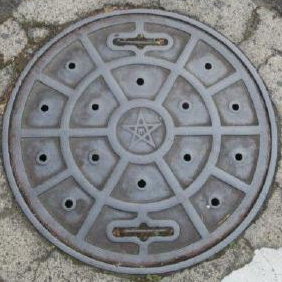
A perforated lid with two handles, one on the top and one on the bottom.
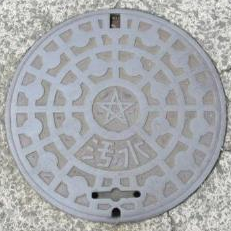
In the center of the standard lid, there is a star mark that is part of the city emblem, and just below it, the characters 'sewage' are written. The handle at the bottom seems to have come off.
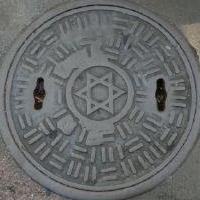
Marked with a six-pointed star. The emblem of Nagasaki City is a five-pointed star... but it seems this six-pointed star manhole is the only one in the city.
Sewage pipe manhole cover.
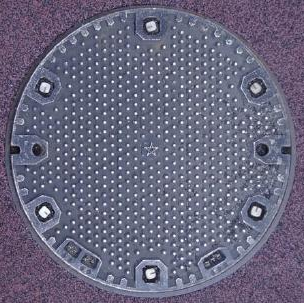
It is thought to be a manhole cover for sewage in Nagasaki City of the standard type. The surface pattern is a simple row of dots, which could be called a simple type ASD, and in the center there is a small five-pointed star, which is part of the city emblem. It seems to be attached with bolts, and the heads of six bolts can be seen.
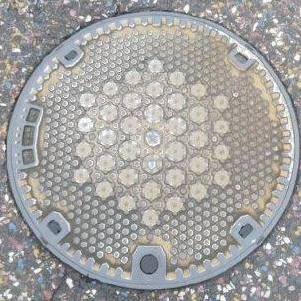
Manhole cover with part of the city emblem's five-pointed star, slip-resistant specification, and a management number frame.
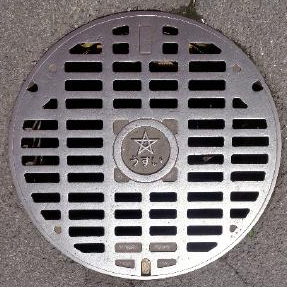
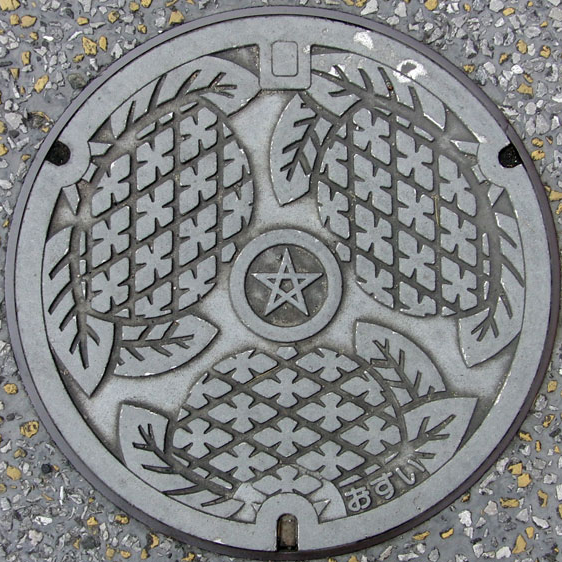
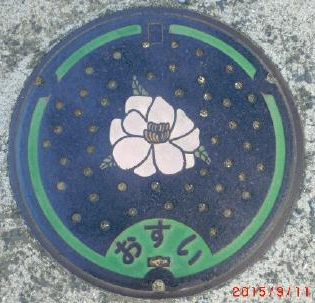
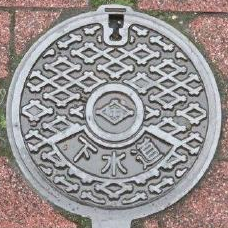
A lid with a grid-like pattern of holes, with the city emblem and the word 'Usui' inside the central circle.
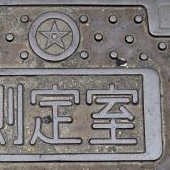
Water meter room cover with a ☆ mark, part of the city emblem.

It is a square lid with the characters 'Weak Electricity' and a small hydrangea drawn in the central circle.
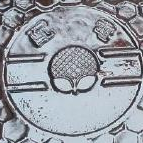
In the center is the city flower, hydrangea, above it are the characters 'haiden' (distribution), and around it is a tortoiseshell pattern.
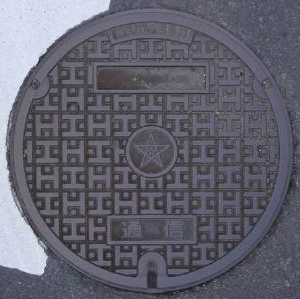
It has a ground pattern with alternating 'H + dot,' the same as the electric-type cover bearing the emblem of Nagasaki Prefecture, and the city emblem of Nagasaki City is in the center (the official city emblem, which has five folded cranes inside a five-pointed star). Unlike the prefectural one, there are two text frames above and below the city emblem, but the upper text frame is blank, while the lower text frame contains the characters '通信' (communication). 'NEW 60H' is written on the upper edge.
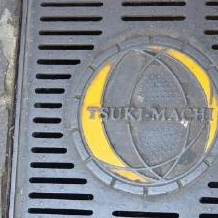
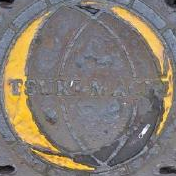
A gutter cover labeled 'TSUKI MACHI'.
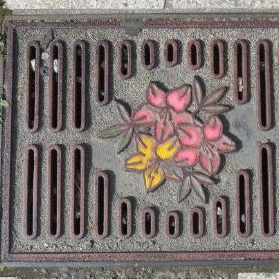
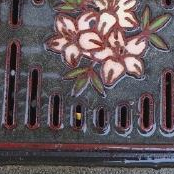
A drainage cover with a pink azalea design.
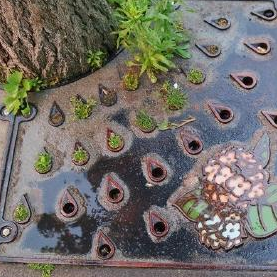
A tree cover with a hydrangea design.
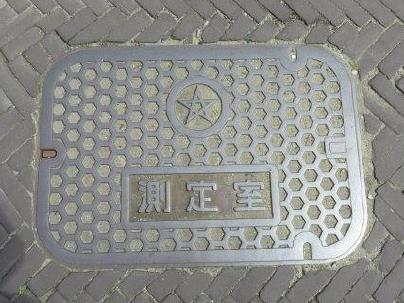
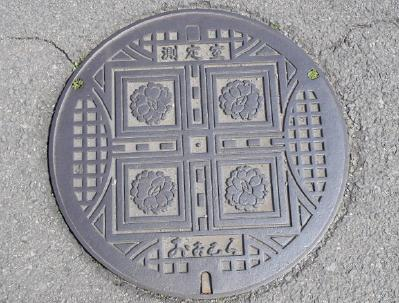
Square lid with a tortoiseshell pattern. Includes a star mark from the city emblem and the words 'Measurement Room'.
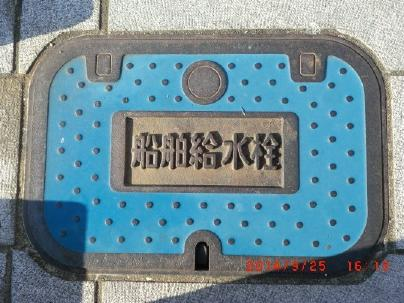
It is a square lid with a blue background and polka dot pattern, with the words 'Ship Water Supply Valve' in the center.
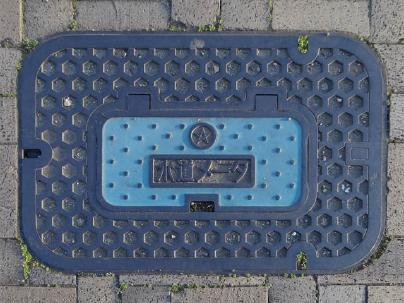
This is a rectangular water supply system cover in Nagasaki City. The inner rectangular part has a scattered dot pattern painted blue. At the top, inside a circle, a part of the city emblem, a five-pointed star, is placed. Below that, inside a rectangle, the characters 'Water Meter' are written. Outside the blue painted area, there is a hexagonal tortoise-shell pattern.
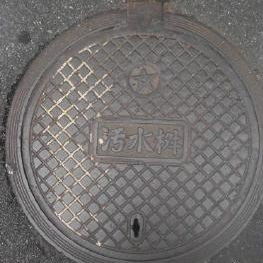
A manhole cover with an outer hinge featuring a diagonal lattice pattern, a pentagram, and the characters '汚水枡' (sewage drain). The frame has concentric circular lines.
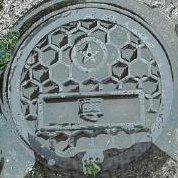
It has a tortoiseshell pattern with a part of the city emblem, a star mark, and the character '専'. It is a lid smaller than an ordinary small-sized one. What kind of lid is this?

This is a small lid painted in maroon. At the upper center, a part of the city emblem, a five-pointed star, is enclosed in a circle, and in the text frame below it, the character '專' is inscribed.

Like the one above, it is a small type with the character '専', but it is not painted and has a diagonal lattice pattern in the background. There are lids with the same design but with different characters, such as 'Shikiri Valve' and 'Air Valve'.
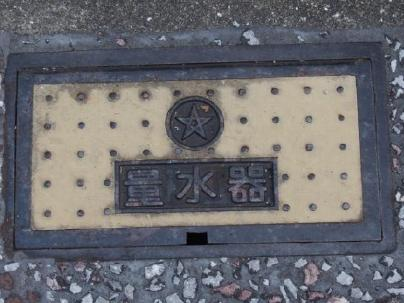
Cream-colored with polka dots, part of the pentagram from the city emblem, and the characters 'Water Meter'.
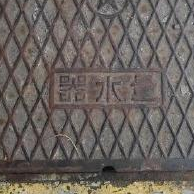
A rhombus-shaped land with a partially five-pointed star from the city emblem and the characters '量水器' written on the right side.
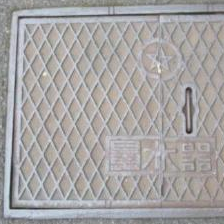
Vertically divided rectangular water meter cover, diamond-patterned background, a five-pointed star that is part of the city emblem and the characters 'Water Meter' at the central seam, with a single handle slightly to the right of center.
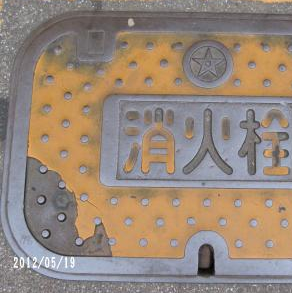
Fire hydrant cover with a star mark, part of the city emblem.
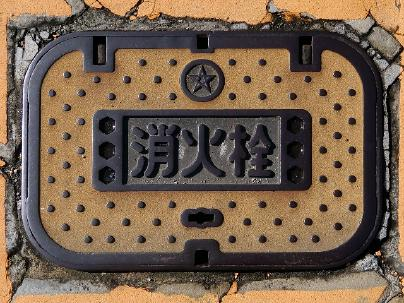
Yellow background with polka dot pattern, a star mark that is part of the city emblem, the word 'Fire Hydrant' in the center, and a keyhole at the bottom.
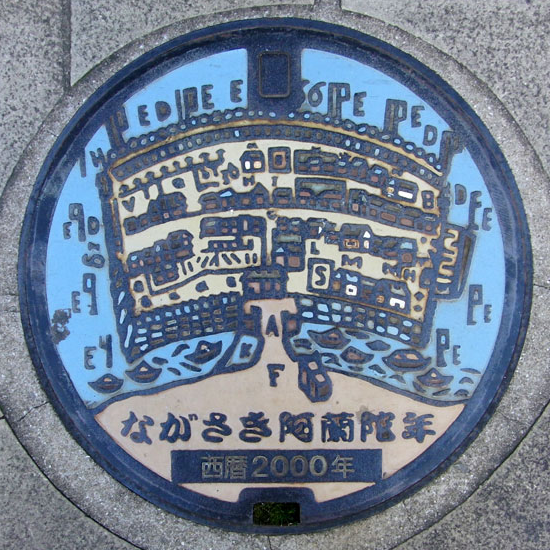
The year 2000 marked 400 years of Japan-Netherlands exchange, and this design of Dejima was created to commemorate the Nagasaki Dutch Year memorial project.
Sewage pipe manhole cover.
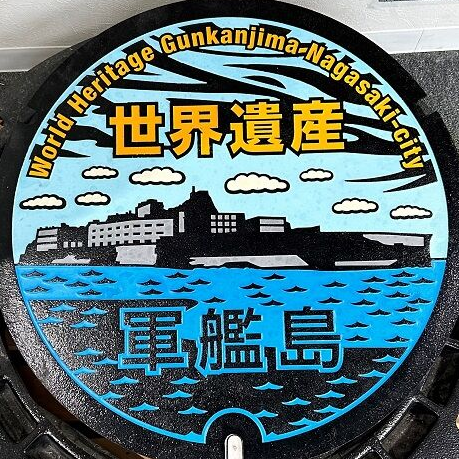
A color manhole with the design of the World Heritage site Battleship Island, exhibited at the Nagasaki City Nomozaki Battleship Island Museum. It seems that only one lid is on display. Sewage pipe manhole cover.
Former Takashima 旧高島町
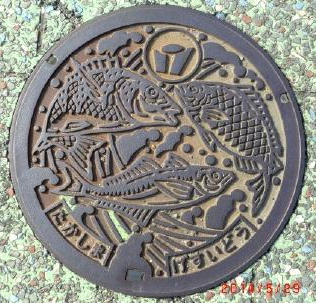
Three large, energetic fish and the town emblem of former Takashima Town. The characters 'Takashima' and 'Gesuidou'. Sewer pipe manhole cover.
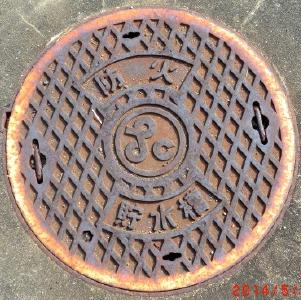
This is a 'firefighting water storage tank' cover with a rhombus ground pattern, featuring the town emblem from before the above-mentioned old town emblem.
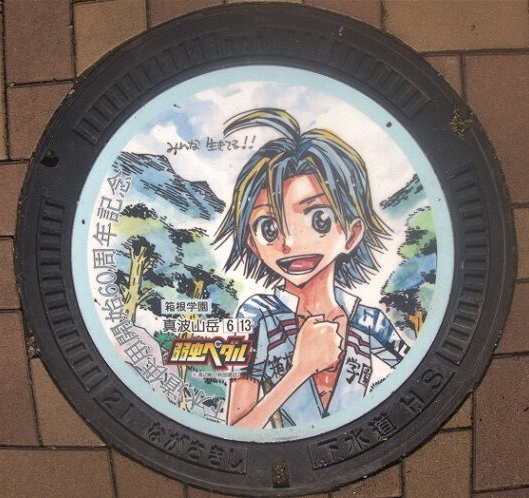
This is the 'Manami Sangaku' of the 'Yowamushi Pedal Manhole,' featuring characters from the manga 'Yowamushi Pedal,' a bicycle road race-themed work by Wataru Watanabe, a manga artist from Nagasaki City, created to commemorate the 60th anniversary of the start of sewage service in Nagasaki City. They have been installed at 27 locations within Nagasaki City, and nine types were installed on November 6.
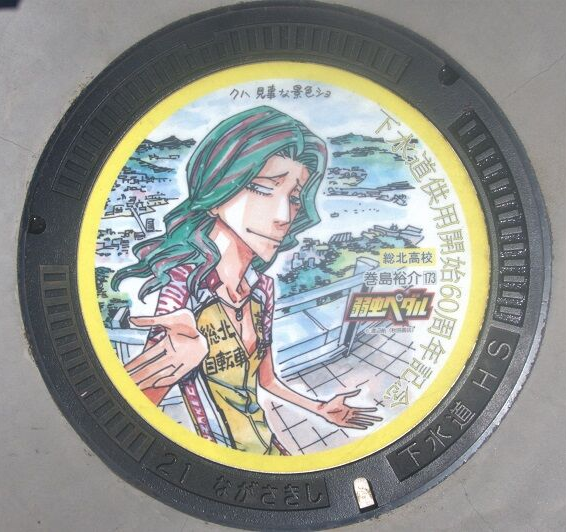
This is the cover of the card coordinates. The character is 'Onoda Sakamichi'. The background is Nagasaki Matsugae International Terminal.
Former Sanwa 旧三和町
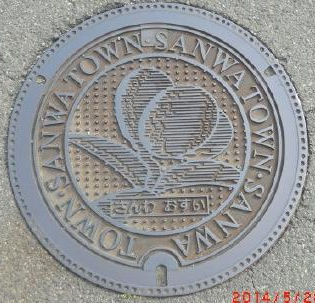
A town tree with the local specialty loquat around it, with 'SANWA TOWN' above and the characters 'さんわ' and 'おすい' at the bottom. Sewage pipe manhole cover.
Former Nomozaki 旧野母崎町
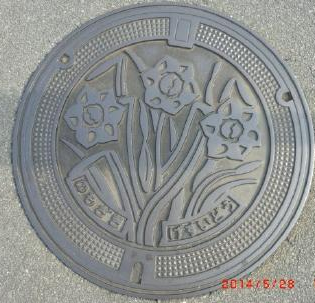
Designed with the town's flower, the daffodil, the surrounding area has a raised, slip-resistant pattern. The characters 'Nomozaki' and 'Sewer'. Sewer pipe manhole cover.
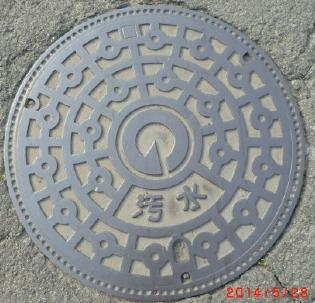
Old town emblem and the characters 'Sewage' on a JIS standard pattern.
Sewage pipe manhole cover.
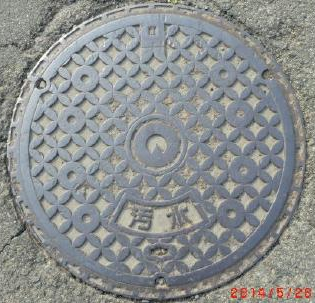
Petal pattern with the old town emblem and the characters for 'sewage.'
Sewage pipe manhole cover.
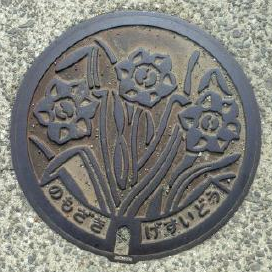
Small cover of the town's flower, daffodil.
Small cover of the sewer pipe.
Former Iojima 旧伊王島町
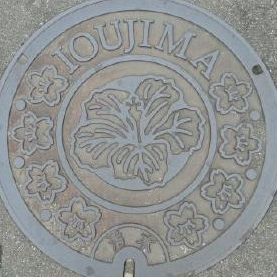
Around the hibiscus are the town's flower, cherry blossoms, and 'IOUJIMA', with the word 'sewage' at the bottom.
Sewage pipe manhole cover.
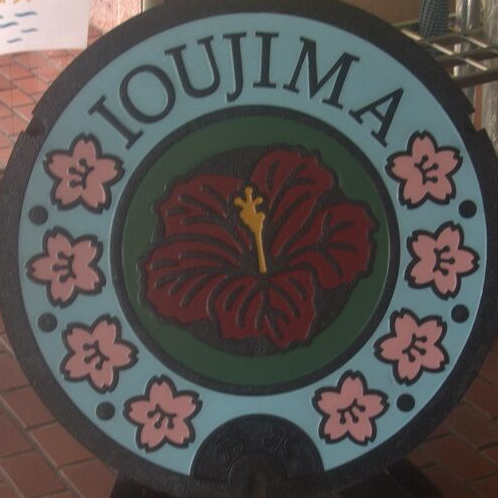
This is a display manhole cover at the Iojima Regional Center. A color manhole cover with the above design. It seems that there is only one colored display cover. Sewage pipe manhole cover.
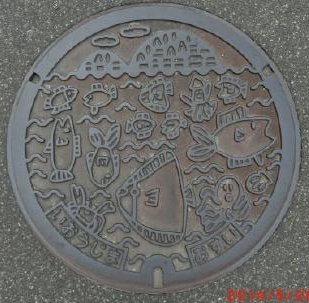
Inside the islands and the sea, many fish, octopuses, squids, crabs, and so on are depicted swimming happily. The characters 'Ioujima' and 'Osui.' A sewage pipe manhole cover.
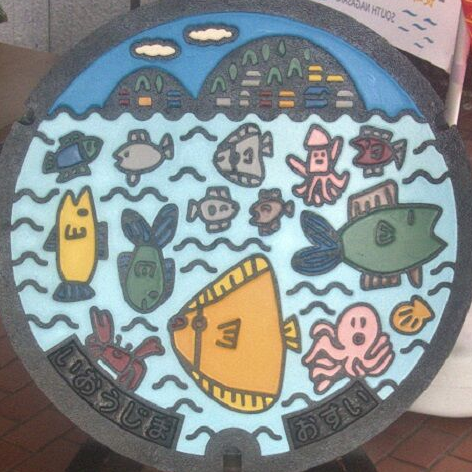
This is a display manhole cover at the Iojima Regional Center. A color manhole cover with the design shown below. It seems that only one display cover has this color. It is a sewage pipe manhole cover.
Former Sotome 旧外海町
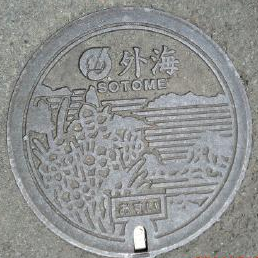
Sumo-nada off the coast of Sotome Town, the town's flower daffodil, and the town emblem. 'Sotome,' 'SOTOME,' 'Osui'
Sewage pipe manhole cover.
Former Kinkai 旧琴海町
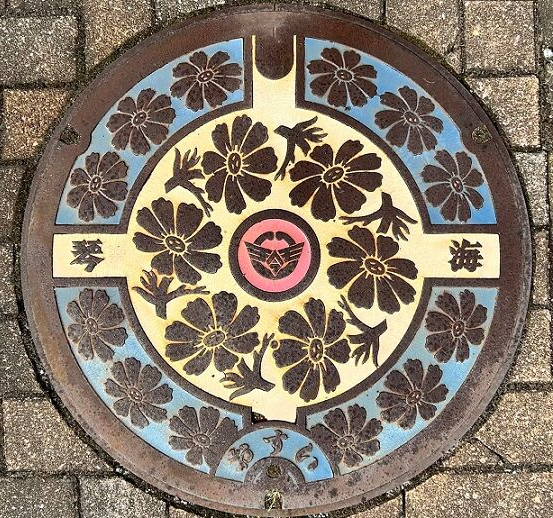
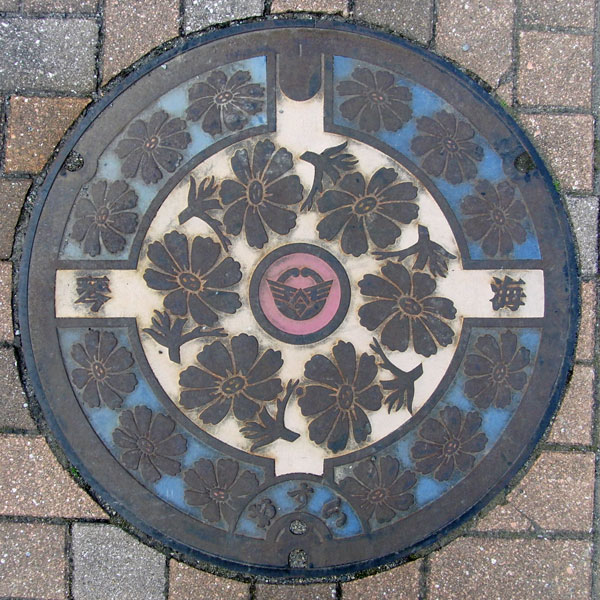
A sewage cover depicting the town's flower, the 'cosmos'.
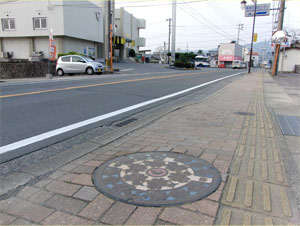
Related: Saikai 西海市, Sasebo 佐世保市, Public Corporation of Telecommunications 電電公社
Iki 壱岐市
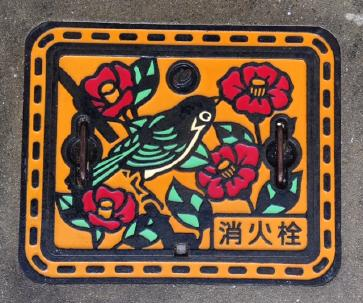
This is a color design featuring the city's flower tree, the 'Yabu Camellia,' and the city's bird, the 'Japanese White-eye.' It includes the city emblem and the words 'fire hydrant.' Provided by Mr. Mizushima.
Former Ashibe 旧芦辺町
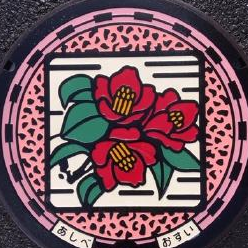
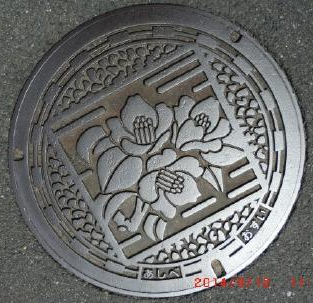
The town's flower, the camellia, is featured in the color design along with the words 'Ashibe' and 'Osui.' It seems that this year, two color designs were installed, one in Ishidamachi and one here. They are probably ultra-rare manholes, with probably only one of each. Especially this one, there is information only from the can badge design and the Iki City manhole tour, and it was not found in other locations. Provided by Mr. Mizushima.
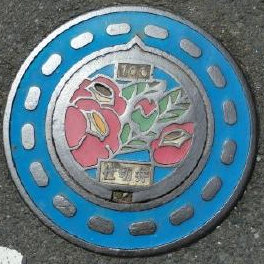
Design of the town's flower, camellia, on a blue background. The frame is also blue with a dashed pattern. The characters '100' and 'Stop Valve.' Provided by a tall man with a thin beard.
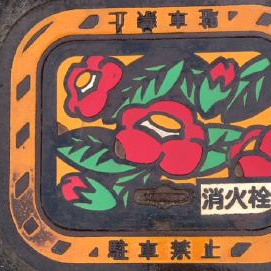
A square lid with the words 'air valve' on a blue background featuring the town's flower, the camellia. The receiving frame has diagonal lines. Provided by Mr. Mizushima.
Former Gonora 旧郷ノ浦町

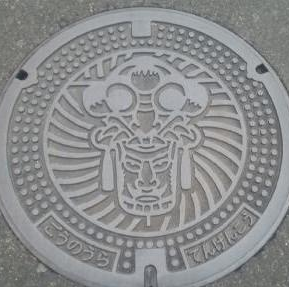
This is the cover of the card's coordinates.
Provided by Himawari Pharmacy
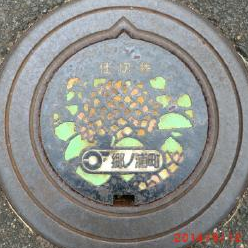
A design of hydrangeas from the old town, the town emblem, the words 'Gonoura Town' and 'Shikiriben'. Provided by a tall man with thinning hair and a beard.
Former Ishida 旧石田町
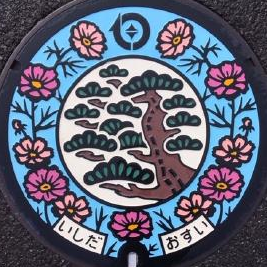
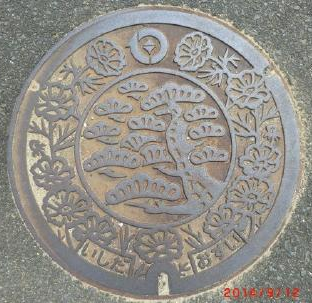
Color design of the old town's flower cosmos around the old town's tree pine. Town emblem and the characters 'Ishida' and 'Osui.'
Provided by Mr. Mizushima
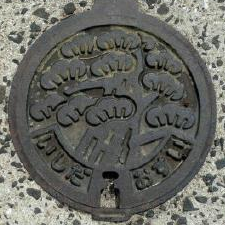
A small design featuring only pine trees of the town. The characters 'Ishida' and 'Osui.' Provided by the tall man with thin hair and a beard.
Isahaya 諫早市
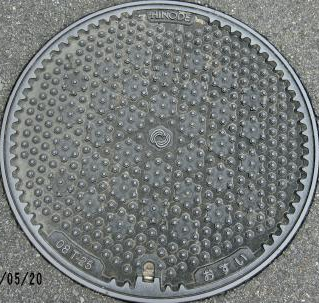
The mark is the city emblem designed with the motif of the 'i' character of Isahaya City.
ASD (Anti-Slipping Design) sewage pipe manhole cover.
Provided by Kana-chan.
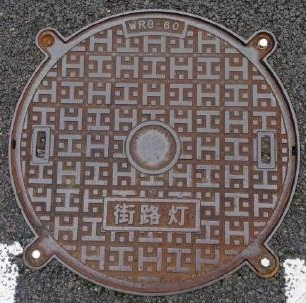
It has the characters 'Streetlight'. The background pattern combines an H and a small ■, and it is a lid fastened with bolts protruding in four places. Provided by Akira.
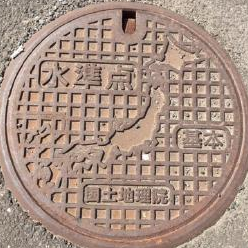
A medium-sized lid with a grid pattern depicting a map of Japan, featuring the words 'Benchmark', 'Basic', and 'Geospatial Information Authority of Japan'. Provided by Megushi.
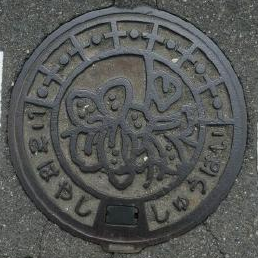
A small lid featuring the design of the city's flower, the Tsukushi rhododendron, with 'いさはやし' and 'しゅうはい' written in hiragana. A small manhole cover for village wastewater. Provided by a tall man with thin hair and a beard.

A small valve cover with a blue background featuring the city flower Tsukushi Rhododendron in color, with the words 'Shikiriben' (Gate Valve) inscribed. The receiving frame has a V-shaped pattern. Provided by a tall man with thin facial hair. There are covers with the same design that have the words 'Shikiriben' (Gate Valve) and 'Kūkiben' (Air Valve) written differently.
Former Isahaya 旧諫早市

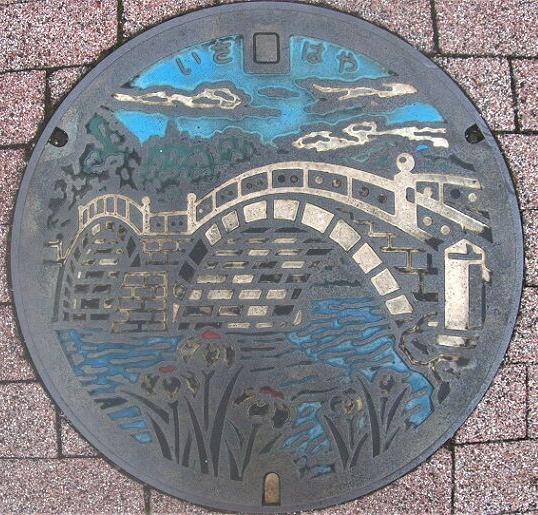
Isahaya Glass Bridge.
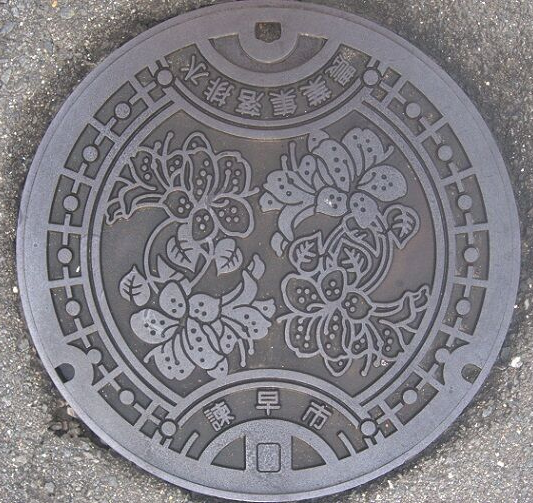
A farm drainage cover with azaleas painted on it.
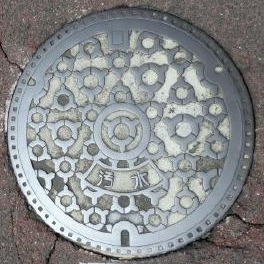
An old town emblem in the center. Around it, the entire cover is also decorated with large and small old city emblems.
Sewage manhole cover.
Provided by syuukou.
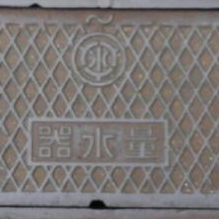
A diamond-shaped ground pattern with the old city emblem containing the character '水' inside, and below it, the characters '量水器' written from right to left. Provided by Akira.
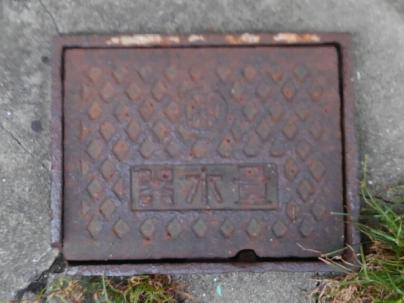
This one only has a water mark, but it is a fairly old cover with a rhombus pattern and the text 'Ryōsuiki' written from the right. Provided by Akira.
Former Tarami 旧多良見町
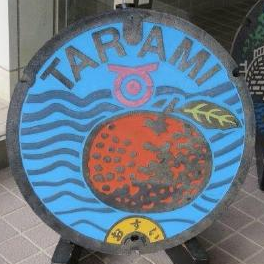
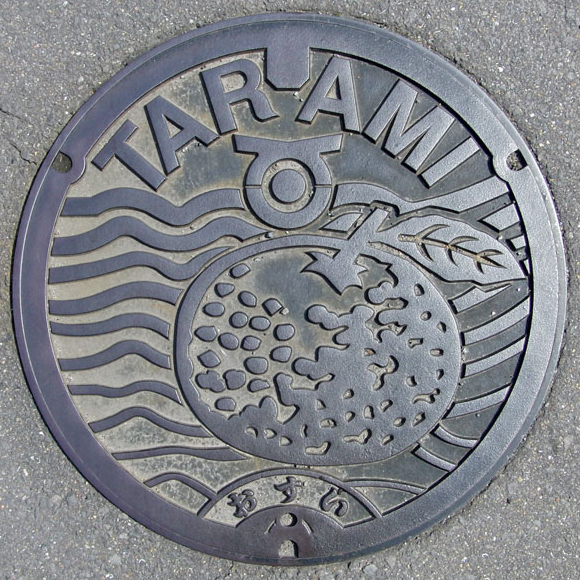
A manhole cover of the agricultural union depicting locally grown mandarin oranges.
Former Konagai 旧小長井町
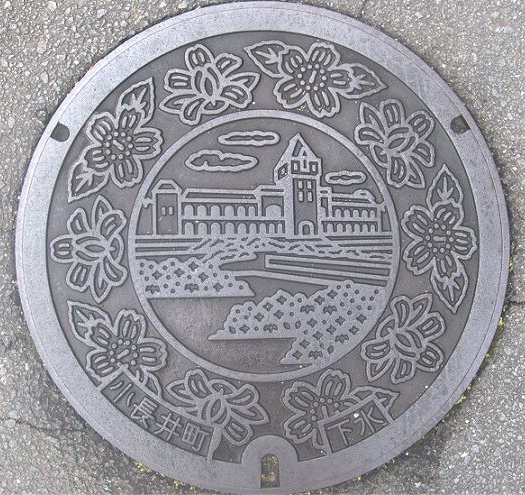
'Sazanka Highland Picnic Park & Herb Garden' Herb Museum and the old town's flower, Sazanka. The notation 'Konagai Town' and 'Sewage'. Sewage pipe manhole cover. Provided by a tall man with a thin beard.
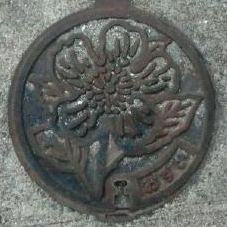
Town flower sasanqua with outer hinge small lid. The characters 'おすい' (sewage).
Small manhole cover for sewage pipes.
Provided by a tall man with thin hair and a beard.
Former Moriyama 旧森山町
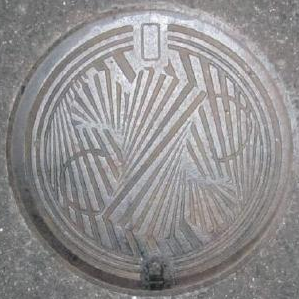
Trees of Moriyama Town: The ginkgo leaves were designed by the design department of Nichidai High School in the town. (From the Isahaya City Water and Sewerage Bureau Management Division)
Sewage pipe manhole cover.
Provided by syuukou
Former Takaki 旧高来町
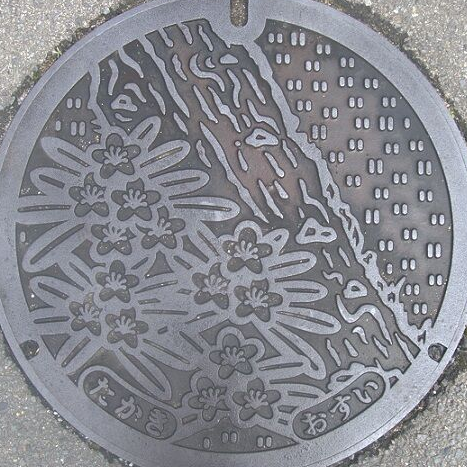
The roaring mountain stream and the town's flower, rhododendron. The notation 'takaki' and 'osui'.
Sewage pipe manhole cover.
Provided by the tall man with a thin beard.
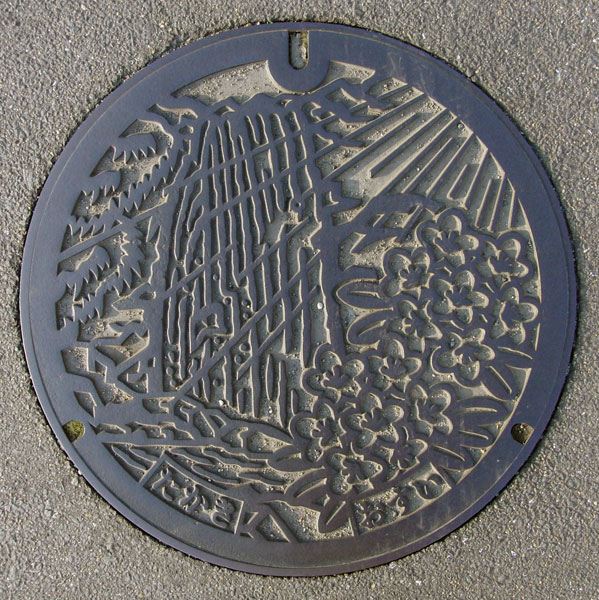
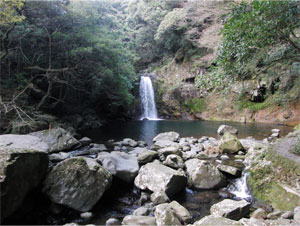
A lid depicting Todoroki Waterfall and rhododendrons in the Todoroki Gorge.
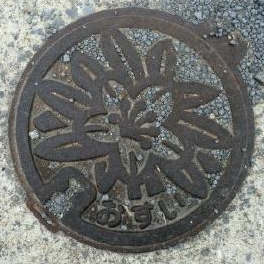
A small lid featuring only the town flower, rhododendron.
A small manhole cover for sewage pipes.
Provided by a tall man with thin hair and a beard.
Former Iimori 旧飯盛町
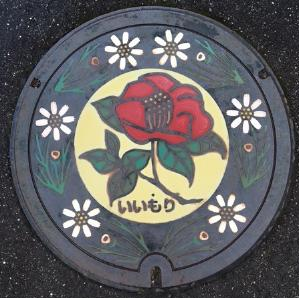
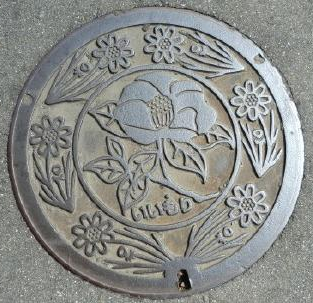
A color design with the town tree, camellia, in the center and the town flower, cosmos, around it. The characters 'Iimori.'
Sewage pipe manhole cover.
Provided by Mr. Mizushima.
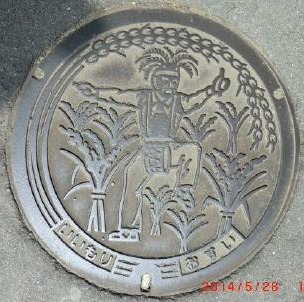
A design of Tayui Furyu, a dedicatory dance that originated from a myth dating back 1,200 years, designated as a prefectural intangible folk cultural property. The characters 'iimori' and 'osui'. Sewage pipe manhole cover. Provided by a tall man with a thin beard.
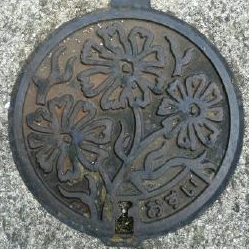
A small lid depicting the town's flower, cosmos. The characters 'おすい' (sewage). A small sewage pipe manhole cover. Provided by a tall man with thinning hair and a beard.
Related: Dai 大村
Unzen 雲仙市
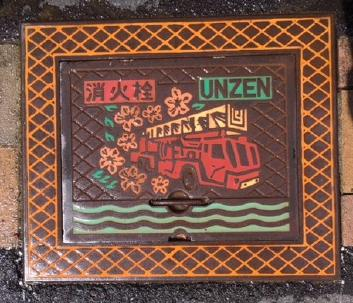
In the upper left red square is the text 'Fire Hydrant,' and in the right square with a light blue background is the text 'UNZEN.' It has a wide diagonal lattice-patterned frame. A ladder truck and flowers are depicted, and at the bottom, water flow is illustrated in light blue. This design is a general-purpose one also used in Fusō Town, Aichi Prefecture, Shingū City, Wakayama Prefecture, and Suita City, Osaka Prefecture, so I think it is not a depiction of a specific flower. However, since the names of the municipalities are written on the Suita manhole cover and this cover, Suita City may have adopted it as the city flower Satsuki, and Unzen City as the city flower Miyama Kirishima. Provided by Mr. Mizushima.
Former Chijiwa 旧千々石町
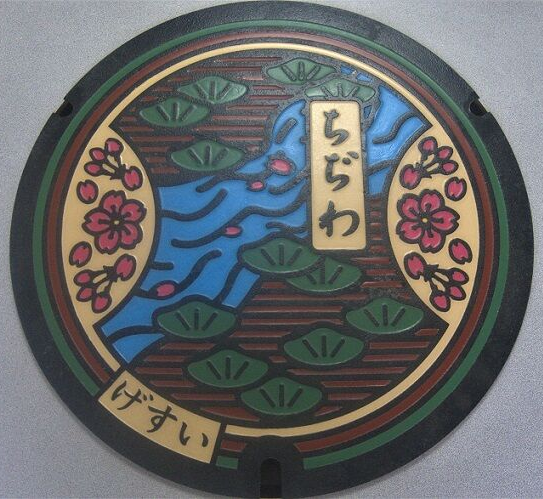
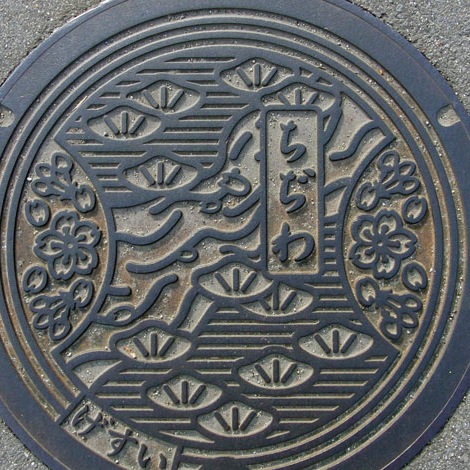
The town tree is 'Pine' and the town flower is 'Cherry Blossom'.
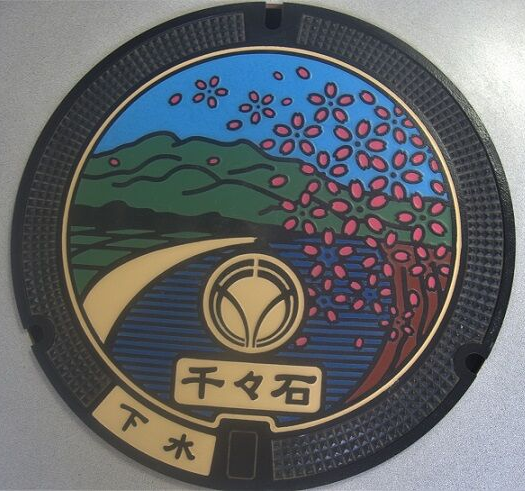
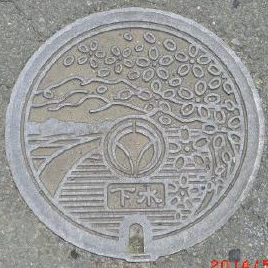
The old town emblem and the town's flower, cherry blossoms; Chijiwa Coast, selected as one of Japan's Top 100 Natural Sites and Top 100 White Sand and Green Pines; a design of Mount Unzen. The characters 'Chijiwa' are below the town emblem. Provided by Mr. Raccoon.
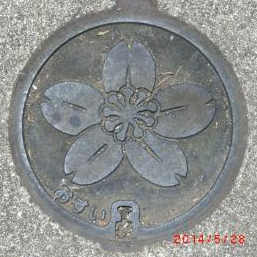
A small lid with one cherry blossom, the town's flower, drawn on it. The characters 'おすい.' Provided by a tall man with thin hair and a beard.
Former Aino 旧愛野町

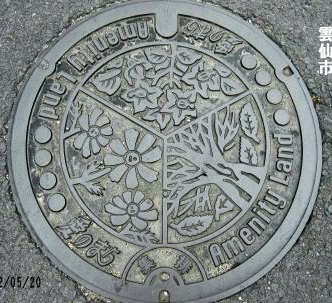
Around it are the words 'Ai no Machi' and 'Amenity Land.' I wondered if the town name wasn't included, but it seems to be encompassed within 'Ai no Machi.'
Inside, the town's flower, the cosmos, and the town's tree, the zelkova, are depicted, along with another flower, which is that of the locally produced potato. It is said that red soil was deliberately brought from Konagai Town to improve the taste of the potatoes.
Long ago, there was a boom around Kōfuku Station in Hokkaido, and looking at this manhole cover and the station building here, you can sense the enthusiasm to also use the name 'Ai no Machi' for tourism. While many towns in Nagasaki Prefecture are read as 'chō,' having it read as 'machi' may also be due to the rhythm of the name.
Former Azuma 旧吾妻町
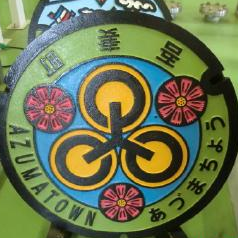
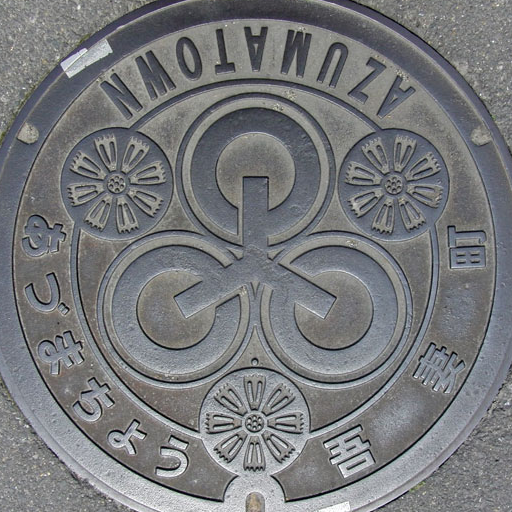
A lid with the former Azuma Town emblem in the center, depicting cosmos flowers inside three circles. Around it, the town's name is displayed in three different forms: 'AZUMATOWN,' 'あづまちょう,' and '吾妻町.'
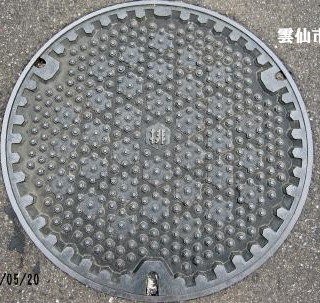
ASD (Slip-resistant structure)
Drainage pipe manhole cover.
Provided by Kana-chan
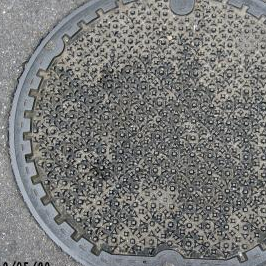
ASD (Slip-Resistant Structure)
Sewage Pipe Manhole Cover.
Provided by Kana-chan
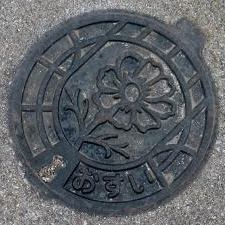
Designed with the cosmos flowers of the former Agatsuma Town.
Mini-size version of the sewage pipe.
Provided by Kana-chan.
Former Mizuho 旧瑞穂町
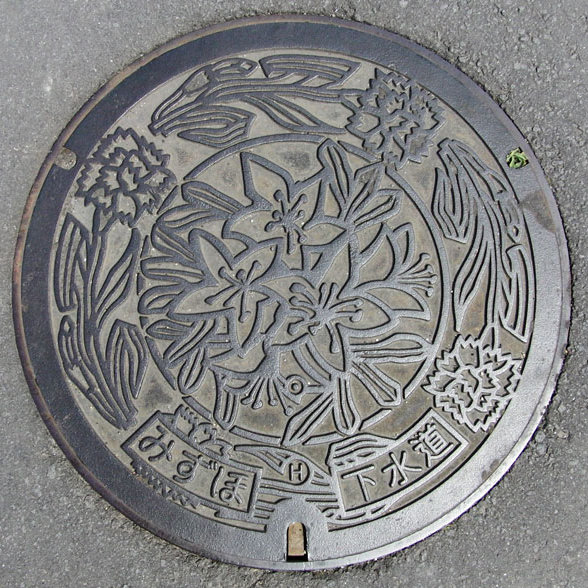
Azaleas and carnations.
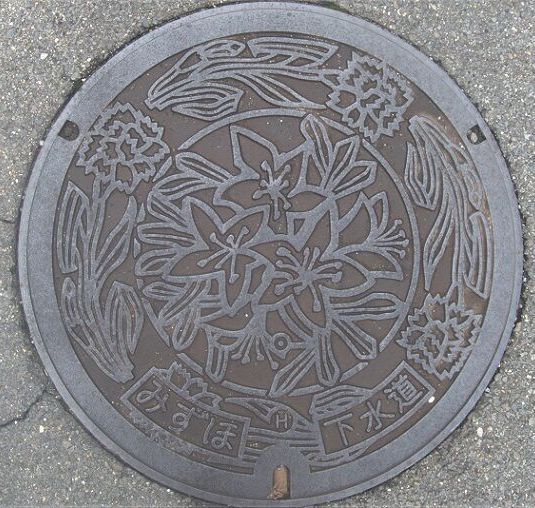
There is a design of the town flower, azalea, with the letter 'H' and the words 'Mizuho' and 'Sewerage' displayed at the bottom. Provided by syuukou.
Former Obama 旧小浜町
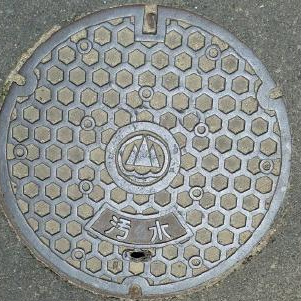
Kohama Town emblem and a hexagonal pattern with the word 'sewage.'
Sewage pipe manhole cover.
Provided by a tall man with thin hair and a beard.
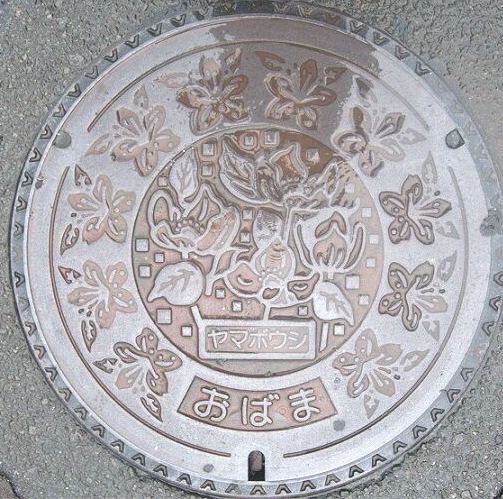
A manhole cover limited to the Marine District. In the center is the town's tree, a Cornus kousa, and around it is the town's flower, Rhododendron brachycarpum (locally called Unzen azalea).
Provided by Thin-haired Beard Tall Guy.
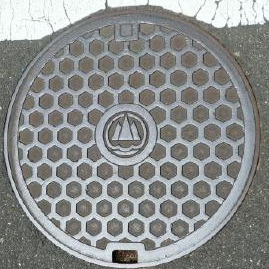
Small type with Ohama Town crest hexagonal pattern. Small sewage pipe cover. Provided by the tall man with thin hair and beard.
Omura 大村市
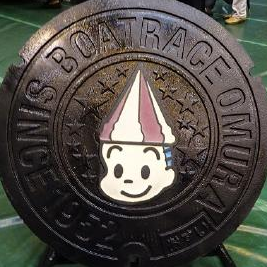
Exhibited manhole cover at the 9th Manhole Summit held in Ikeda City, Osaka Prefecture. Around the edge, it says "BOATRACE OMURA SINCE 1952," with a turn-mark boy drawn by Osamu Harada in the center. Omura City Motorboat Racing Stadium is the place where motorboat racing officially began for the first time. Sewage pipe manhole cover.
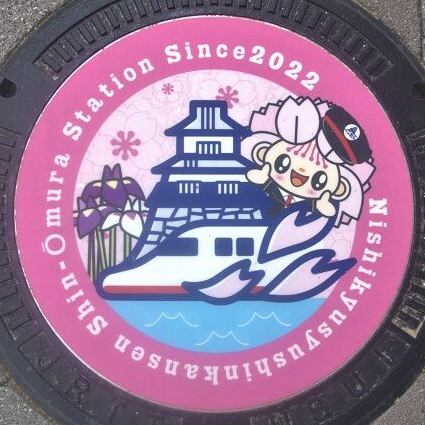
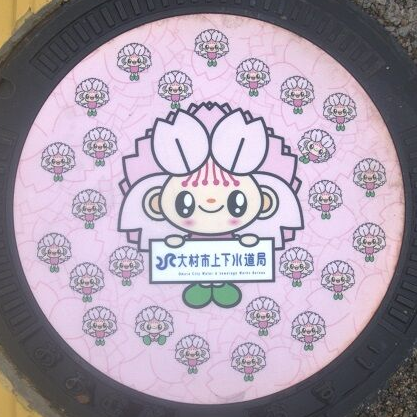
This is a design manhole cover by the Railway and Transportation Organization. In the center, there is a PR logo mark for the Shinkansen opening (the Shinkansen and the turret of Kushima Castle ruins), and it is a collaborative design with Omura. The Omura Cherry Blossoms and Iris, which are symbols of Omura City, as well as Omura Bay, are also depicted, expressing the charm of Omura City. This is a sewage pipe manhole cover.
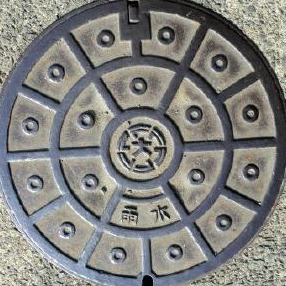
A standard lid with the city emblem and the characters 'Rainwater'. Provided by the tall guy with a thin beard.
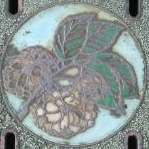
A manhole cover with a design of the city's flower, the Oomurazakura (Omura cherry).
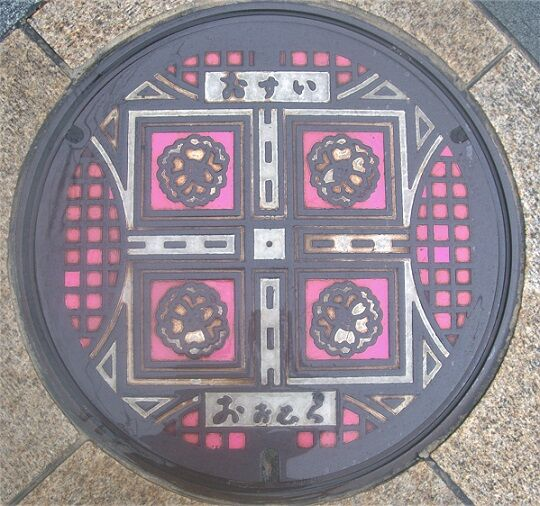
Each of the four squares contains one of the city flowers, the Ōmura cherry blossom, and their top, bottom, left, and right have a lattice pattern like a racket. The display reads 'Ōmura' and 'Osui'.
Related: Dai 大村
Goto 五島市
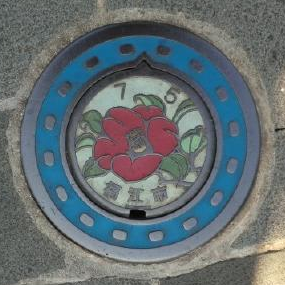
A color design of the old city's tree, Camellia, on a light blue background. The frame is blue with a dashed pattern. Markings of pipe diameter '75' and 'Fukue City'. We have also received the same design in sizes 150 and 200. Provided by Mr. Tall with sparse hair and a beard.
Former Miiraku 旧三井楽町
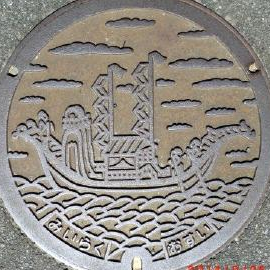
Design of the Kentoshi ship. The characters 'Miiraku' and 'Osui'. It is said that Miiraku Town was the last stop for the Kentoshi ships. Provided by Tall Man with Thin Hair and Beard.
Saikai 西海市
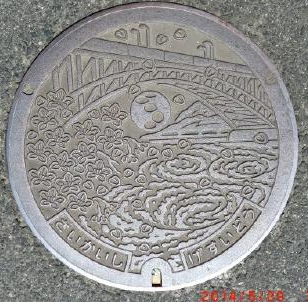
Saikai Bridge and whirlpools, cherry blossom design at the famous cherry blossom spot Saikai Bridge Park, city emblem, and the notation of 'Saikaishi' and 'Gesuidou'. Provided by the thin-haired, bearded tall man.
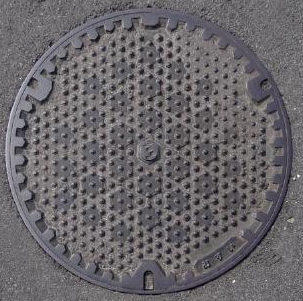
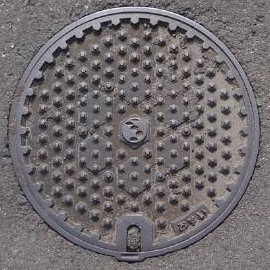
Manufactured by Hinode Suido Kiki with an ASD (Anti-Slipping Design) type, the center of the textured pattern contains a small new Saikai City emblem after the merger. The characters 'おすい' (sewage) are on the right side of the lower edge. Provided by kanata.
It is similar to the one above but slightly smaller. Provided by kanata.
Former Saikai 旧西海町
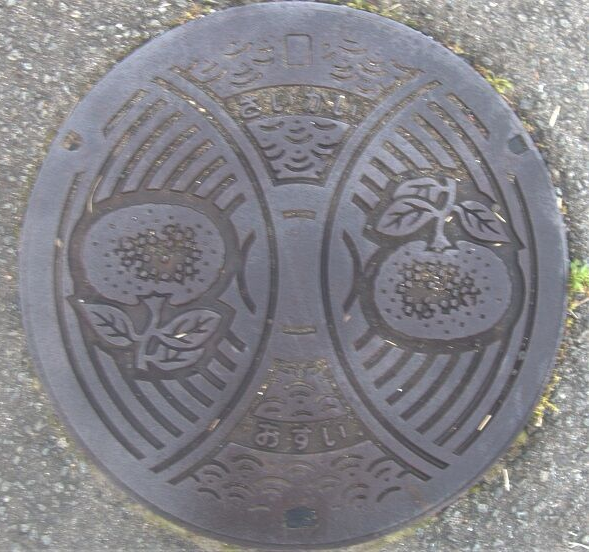
Explanation from the Sewerage Division, Waterworks Department, Saikai City
"It was installed before the merger and illustrated the 'mandarin,' a specialty product of the former Saikai Town." The characters "Saikai" and "Osui" are used.
Provided by Nopppo, the bearded man with thinning hair
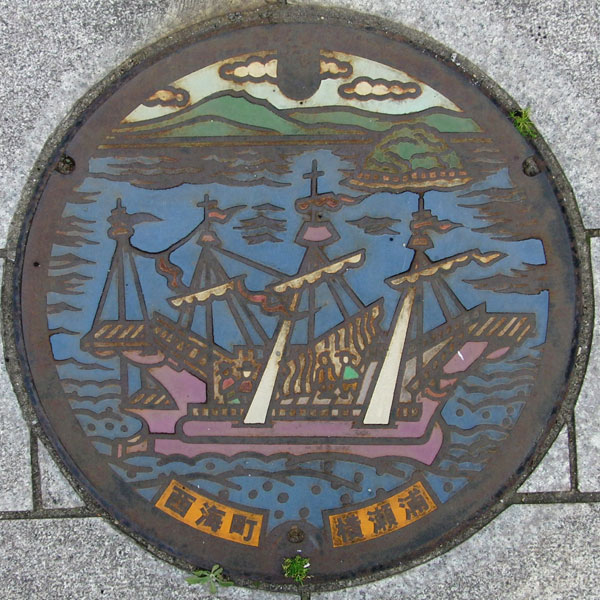
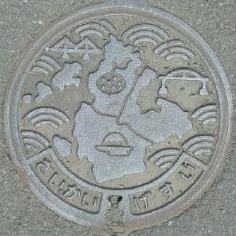
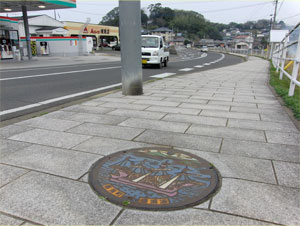
A cover from the Yokoseura area depicting a Nanban ship.
Former Seihi 旧西彼町
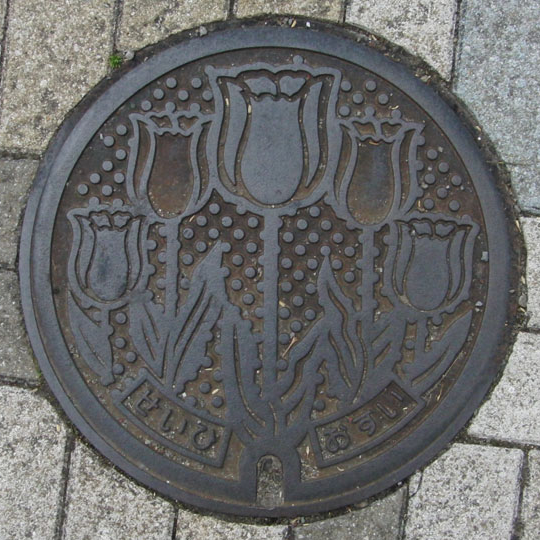
Small lid for only the tulip part above. Provided by Mr. Yoshida Takunami.
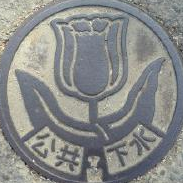
A single tulip, a small cover with the words 'public sewer'. Provided by a tall man with thin hair and a beard.
Former Oseto 旧大瀬戸町
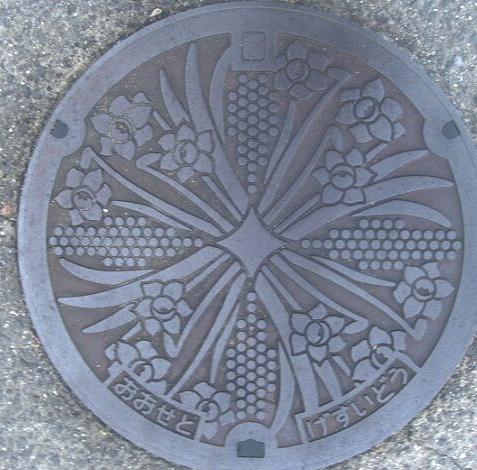
The town's flower, the daffodil, is drawn in a radial pattern, with anti-slip raised patterns in between. The characters 'Ooseto' and 'Gesuidou.' Provided by a tall man with thinning beard.
Former Sakito 旧崎戸町
The above blue version. The bumpy polka dot pattern is the opposite of the above. Provided by Tall Guy with thin beard
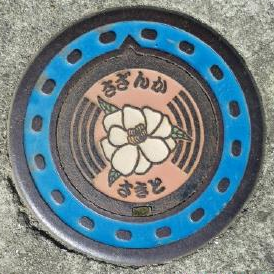
On a pink background, white flowers of the town's flower, sasanqua, are depicted with the characters 'さざんか' and 'さきと'. The blue receiving frame has a dashed line pattern. Provided by a tall man with light hair and a beard.
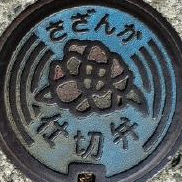
On a blue background, the pink flowers of the town's flower, sasanqua, are depicted, with the words 'Sasanqua' and 'Shikiriben' included. Provided by a tall man with a thin beard.
Related: Nagasaki 長崎市
Sasebo 佐世保市
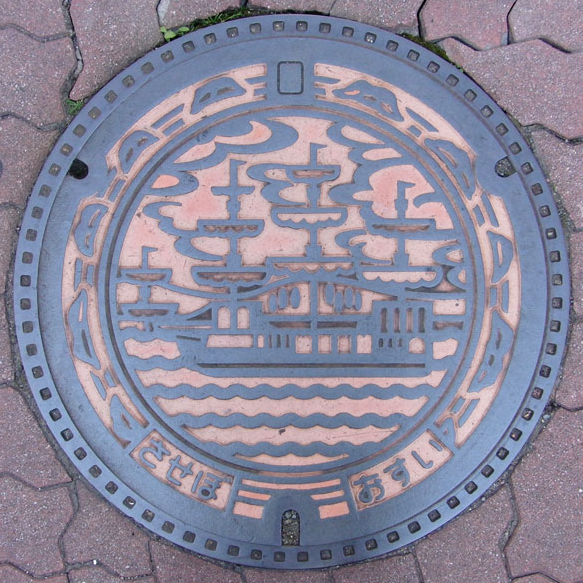
The interior features the Kujukushima sightseeing cruise of Saikai Pearl Sea Resort. The surrounding area depicts the Kujukushima islands.
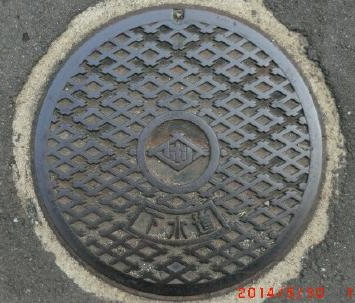
Includes the city emblem. The city emblem is a design based on 'Saseho'.
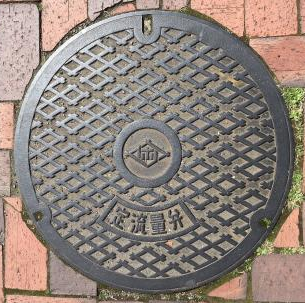
Manhole cover with a grid pattern, the city emblem in the center, and the characters 'Constant Flow Valve' below.
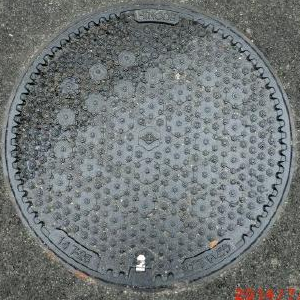
In the central area, the city emblem and the character 'げ' can be seen. ASD (Anti-Slipping Design) manhole cover.
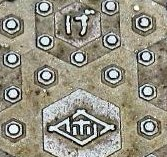
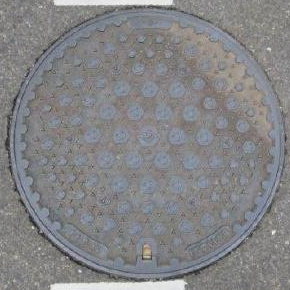
A slip-resistant lid made by Kōgi, with the city emblem and the characters '14T-25' and 'gesuidō' (sewer).
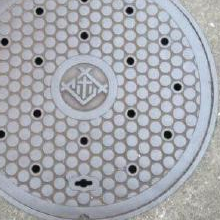
Manhole cover with a tortoiseshell pattern and the city emblem.
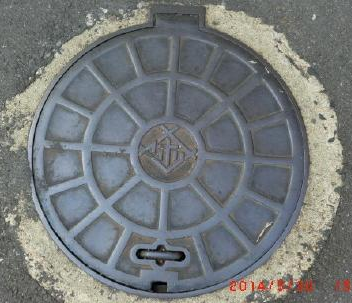
A manhole cover with the city emblem in the center, concentric circles around it divided into 8 sections with stars, and the outer perimeter divided into 16 sections.
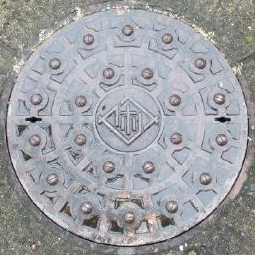
A manhole cover with the city emblem in the center, concentric circles around it divided into 8 sections and the outer ring divided into 14 sections, with screws or rivets in the holes.
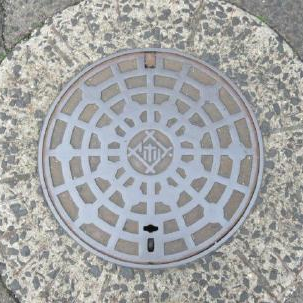
A perforated standard lid with a manhole cover featuring the city emblem.
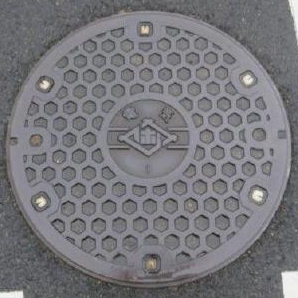
A hexagonal-patterned square lid with 'CCB' and the city emblem.
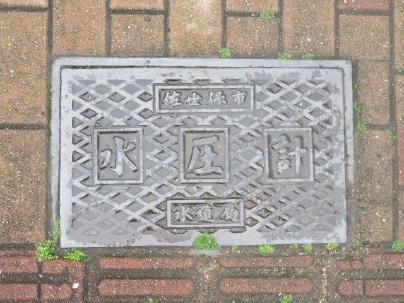
Diamond mesh pattern, with a 'water pressure gauge' in the center, 'Sasebo City' above, and 'Waterworks Bureau' below.
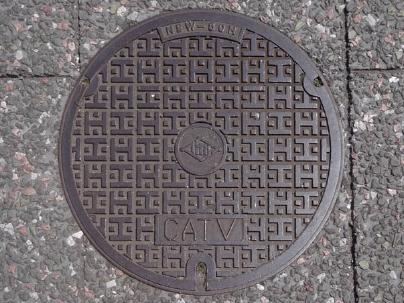
The manhole cover of the CATV in Sasebo City has a background pattern that is the same as that of the electricity systems in Nagasaki Prefecture and Nagasaki City, consisting of the letter 'H' with two dots arranged alternately. In the center is the emblem of Sasebo City, below it is 'CATV' enclosed in a square, and at the top is the text 'NEW-60H'.
Smaller than the above, with a lattice pattern, the city emblem, and the characters 'Sewer'.
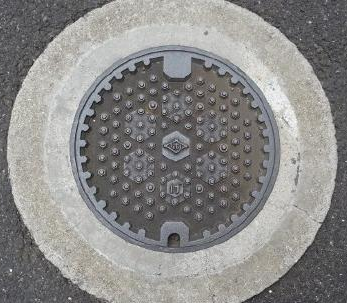
This is a small ASD (Anti-Slipping Design) cover. The city emblem is in the center, with the character 'げ' indicated at the bottom.
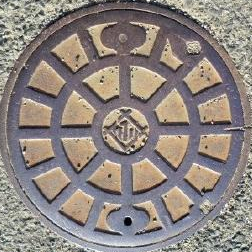
Small standard lid with city emblem. Provided by a thin-haired, tall-bearded person.
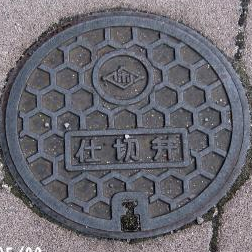
Small water valve cover with city emblem.
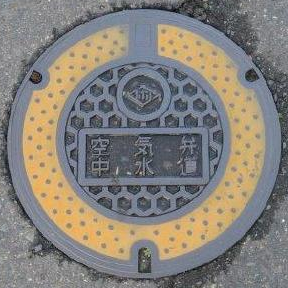
It is an octagonal cover with a diamond-shaped ground pattern, the city emblem, and a 'shut-off valve' water mark. Diameter 325 mm. There are covers with the same design but with different text such as 'shut-off valve,' 'air valve,' and 'valve'.
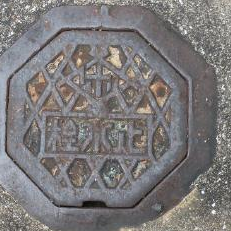
A small octagonal cover with a diamond-shaped ground pattern, featuring the city emblem and the characters '止水栓' (stopcock) written from right to left.
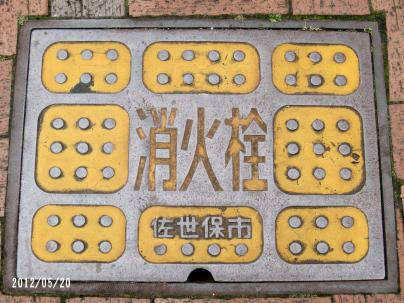
A pattern resembling tactile paving with the words 'Fire Hydrant' and 'Sasebo City'.
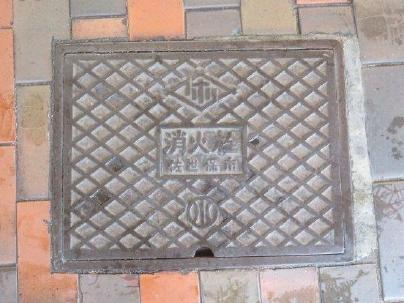
Square lid with a diagonal lattice pattern, city emblem on top, in the center within a square the characters 'Fire Hydrant and Sasebo City,' water mark at the bottom.
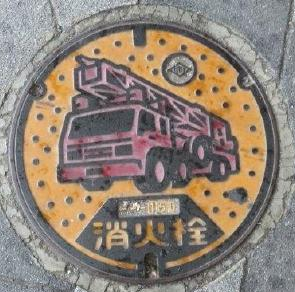
Polka dots on a yellow background, a ladder truck and the city emblem, with the words 'fire hydrant'.
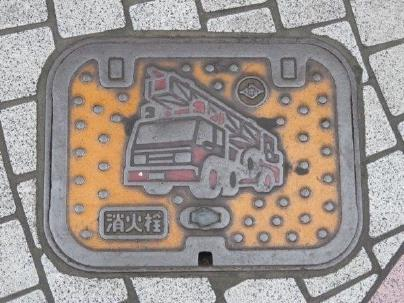
Polka dots on a yellow background, a ladder truck and the city emblem, with the words 'fire hydrant'.
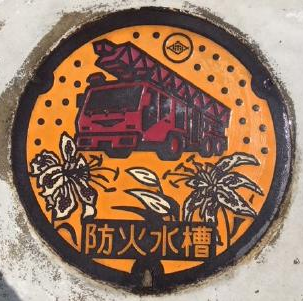
About the upper half of the lid is depicted a fire truck, and about the lower half is the city's flower, the Kanoko lily. The city emblem is at the top, and the words 'Firefighting Water Tank' are at the bottom.
Former Emukae 旧江迎町
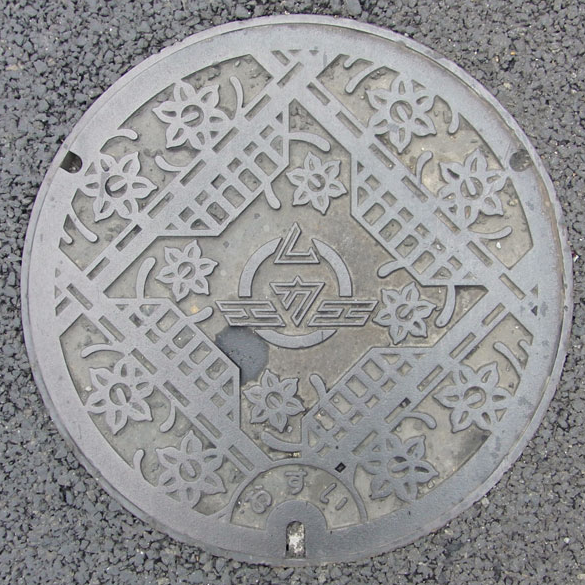
The design features the town's flower, the daffodil. It is currently unknown what the part that looks like a bridge represents. In the center is the town emblem, a direct stylization of 'Emukae'.
Former Uku 旧宇久町
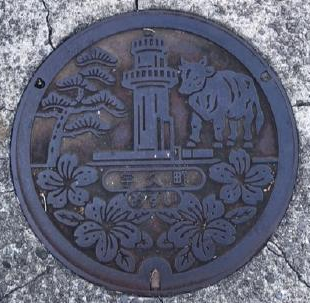
Tsushima-se Lighthouse, the local specialty Uku beef, the old Uku Town's black pine, and the town flower azalea design. The characters 'Uku Town' and 'Osui'.
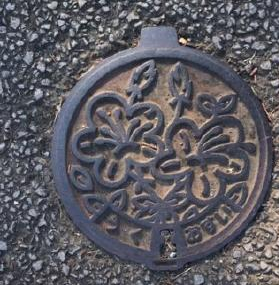
A small lid with the town's flower, yamatsutsuji, design, with the characters 'uku' and 'osui'.
Related: Nagasaki 長崎市, Saza 佐々町
Shimabara 島原市
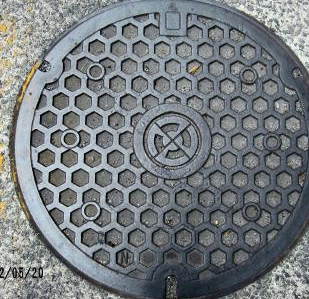
In the center, the emblem of Shimabara City: four 'Ma' characters representing 'Shima' (island). Hexagonal pattern. Provided by Kana-chan.
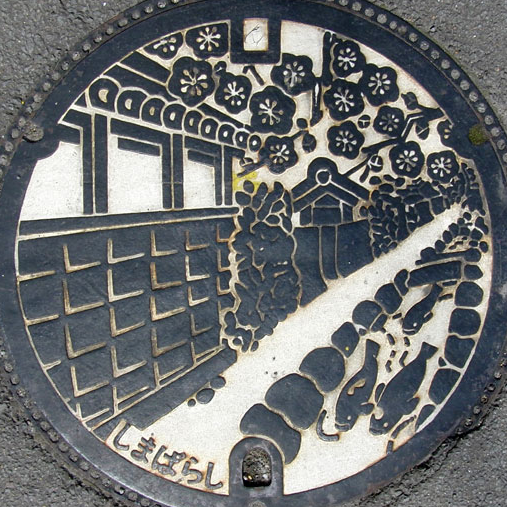
The scenery around the samurai residences and the city's flower, the 'plum.'
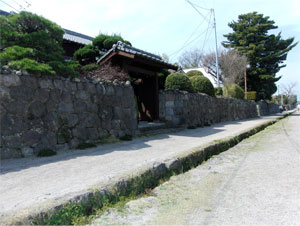

A small one about 10 cm with the city emblem.
Provided by Megushi-san
Related: Minamishimabara 南島原市
Tsushima 対馬市
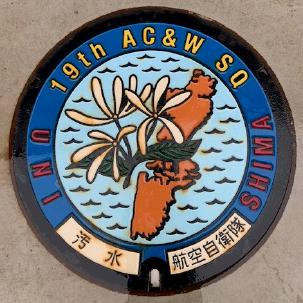
This is a manhole cover from the Air Self-Defense Force's Unijima Detachment Base. It is a colored design cover featuring the flowers of the fringe tree, which grows abundantly in Tsushima and Waniura areas. Around the edge, it has the inscriptions "19th AC&W SQ" and "UNI SHIMA," with "Sewage" and "Japan Air Self-Defense Force" at the bottom. Please also take a look at other Ministry of Defense and Self-Defense Force covers. Provided by Mizushima.
Former Izuhara 旧厳原町
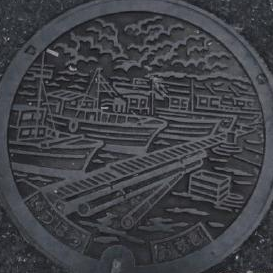
The characters 'Izuhara' and 'Osui' appear in the scenery of Aren Fishing Port. Provided by Tall guy with a thin beard.
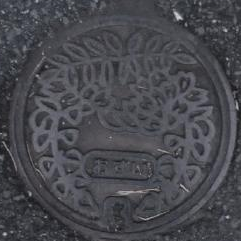
The following is from the Tsushima City Infrastructure Development Division.
Since the town flower during the old town era was the wisteria flower, it is said that the design was made using the wisteria flower. (Confirmed with the person in charge at the time.)
Provided by a tall man with thinning hair and a beard.
Hirado 平戸市
Manhole cover of the shared cable duct (CCB) with a tortoiseshell pattern featuring the Hirado city emblem. Provided by Kana-chan
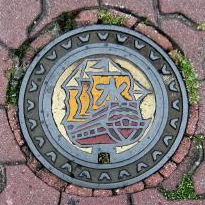
Hirado and Nagasaki, since the early Edo period, had active Nanban trade, which is reflected in the design of the Nanban ships.
Small cover for the water supply shut-off valve. We received a response from the Hirado City Waterworks Bureau (Y) that it is a 'shut-off valve.'
Provided by Kana-chan.
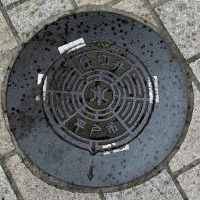
Provided by Kana-chan

Provided by Kana-chan
Former Ikitsuki 旧生月町
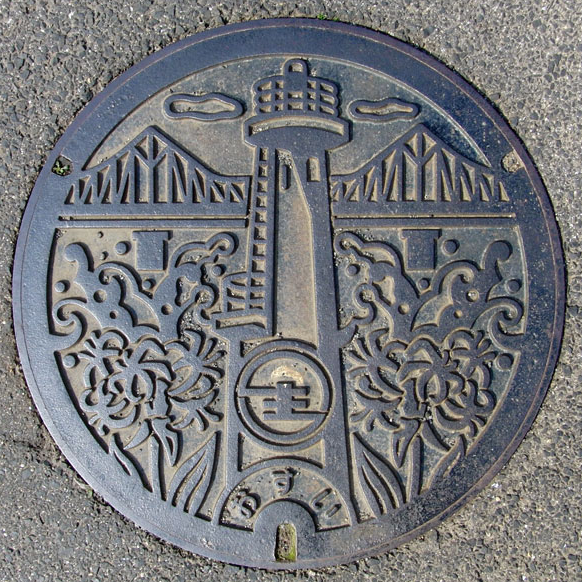
In the background, with the "Ikitsuki Ohashi Bridge" connecting Hirado Island and Ikitsuki Island, there is the "Ohbae Lighthouse" and a flower (which is unclear but might be Nishinohamakanzou) depicted.
The photo on the lower left is the "Ohbae Lighthouse," and the photo below that is the "Ikitsuki Ohashi Bridge" in the background.
The "Ikitsuki Ohashi Bridge" was opened for public toll use on July 31, 1991, but on April 1, 2010, it was made free along with the Hirado Bridge.
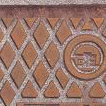
A square cover with a diamond-shaped ground pattern featuring the town emblem on top and the characters '量水器' in the center. Provided by Akira.
Matsura 松浦市
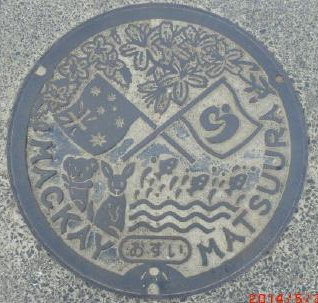
Explanation by Matsuura City Hall, Water and Sewerage Division:
"In our city, there is a coal-fired power plant (Kyushu Electric Power / Electric Power Development Co., Ltd.), and because coal is shipped from the vicinity of Mackay City in Australia, we have a sister city exchange with Mackay City, and the design is meant to represent the friendship between Mackay City and Matsuura City."
The flag depicts the Matsuura City emblem, the flag of Australia, a koala and a kangaroo, the sea and fish of Matsuura City, and azaleas. It also has the words 'MACKAY,' 'おすい' (sewage), and 'MATSUURA'.
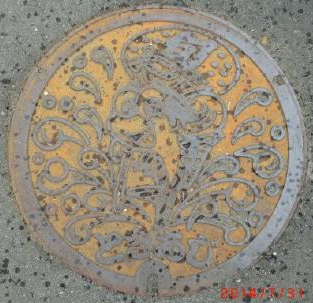
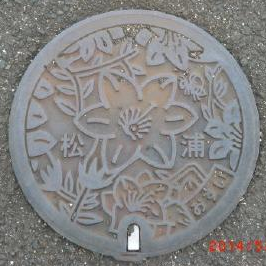
Explanation from Matsuura City Hall, Water and Sewage Division:
"Our city has a famous azalea spot called Furouzan Park, and the design is inspired by azaleas." *Explanation about the three types of designs mentioned above.
In Matsuura City, we have been undertaking public sewerage projects since fiscal year 2004. When we solicited designs from fifth graders at eight elementary schools in the city at the start of the project, we received 210 entries and decided on three types of designs. "Each design has some parts that differ from the original design in order to meet the standards for the lid's raised and recessed portions."
Former Matsura 旧松浦市
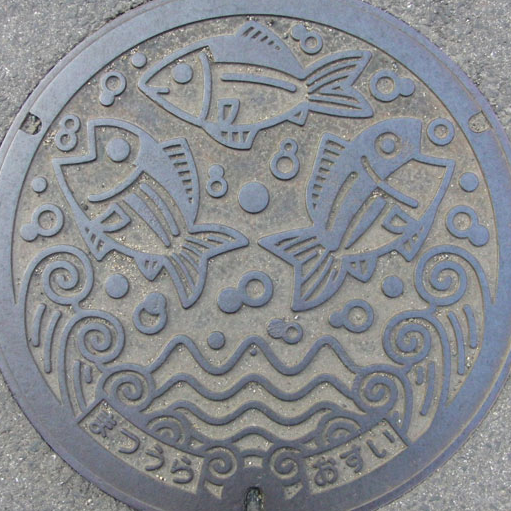
Three fish. The patterns are slightly different.
Former Takashima 旧鷹島町
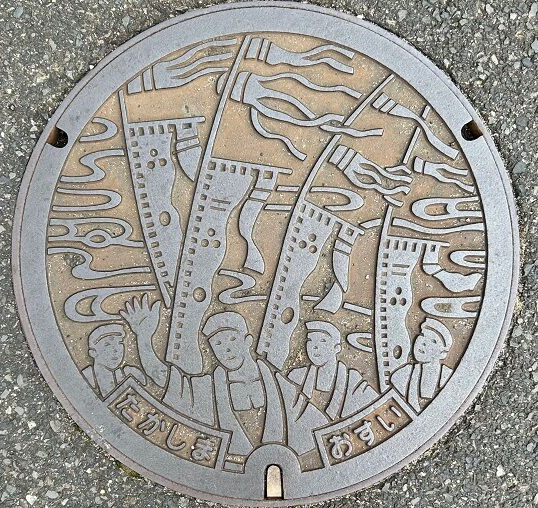
The Takashima Island Dance was designated as an Intangible Folk Cultural Property by Nagasaki Prefecture in March 1988. It consisted of four performing arts—large banners (six banners), Suko dance, Nyo dance, and Furaku dance—used in events such as rain-making rituals. This depicts one of them, the magnificent six banners, along with the men supporting them, in a realistic manner. (From Matsuura City Hall, Takashima Branch, Regional Promotion Division)
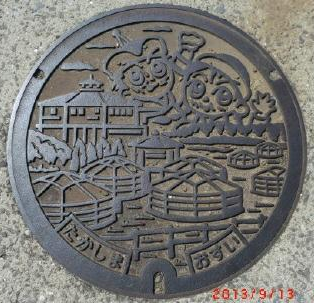
A Mongolian village and two children are depicted on Takashima.
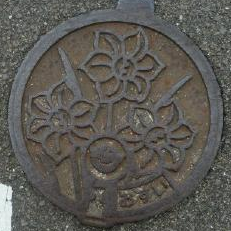
It was designed in the fiscal year 2000, before the merger of municipalities, during the era of the former Takashima Town. It features the town flower (daffodil) and the town emblem in the center.
Former Fukushima 旧福島町
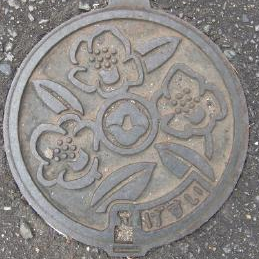
The old town emblem and the flower of the old town, the 'Tsubaki', also known as the Fukushima Lily, are designed. The characters 'gesui'.
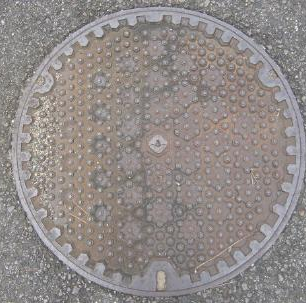
Non-slip patterned manhole. In the center, there is the old town emblem designed with a Fukushima lily and the character 'ge'.
Minamishimabara 南島原市
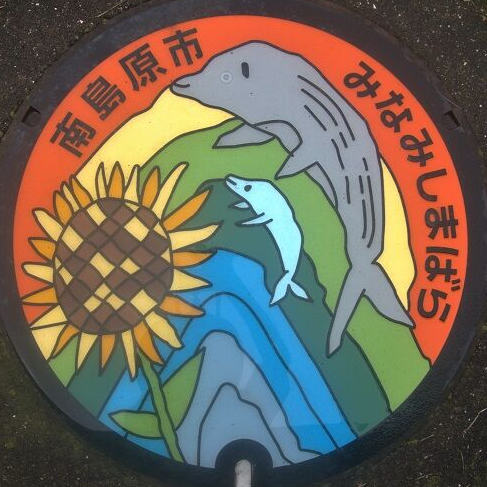
We held a contest for the "Sewer Manhole Cover Design" targeting elementary and junior high school students in the city. The grand prize in the lower grades category was won by a first grader. Since the city is famous for its flower, the sunflower, and dolphin watching, the design reflects that.
Thoughts put into the design: "I drew a dolphin and a sunflower, imagining a lively and energetic Minamishimabara."
Provided by Mr. Mizushima.
Former Minamiarima 旧南有馬町
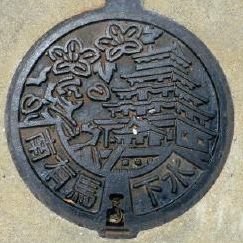
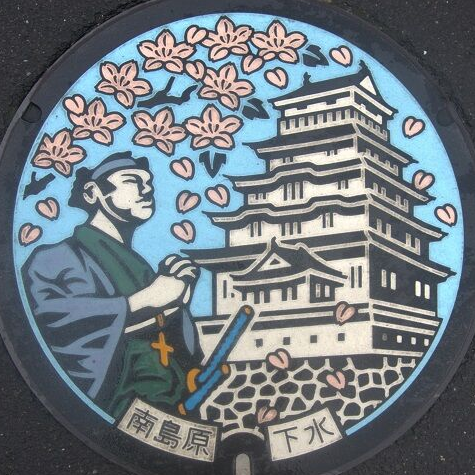
Haramachi Honmaru and Amakusa Shirō Tokisada (a Christian of the early Edo period and leader of the Shimabara Rebellion). The characters 'Minami Arima' and 'Geshui.' Provided by Tall Guy with thinning hair and a beard.
Card coordinates manhole cover. I thought they had the cover on display at the Minami-Arima Purification Center, but the location indicated changed from Minami-Arima to Minami-Shimabara, so it was certainly newly made. Provided by Mr. Mizushima.
Former Nishiarie 旧西有家町
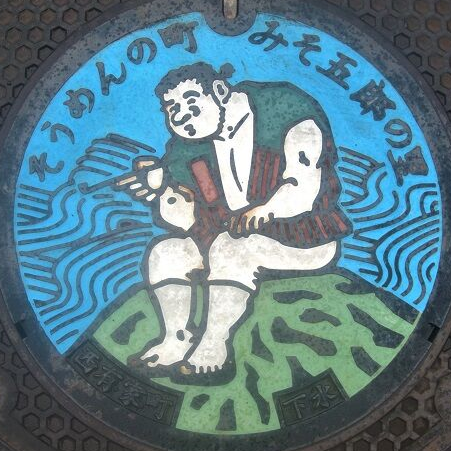
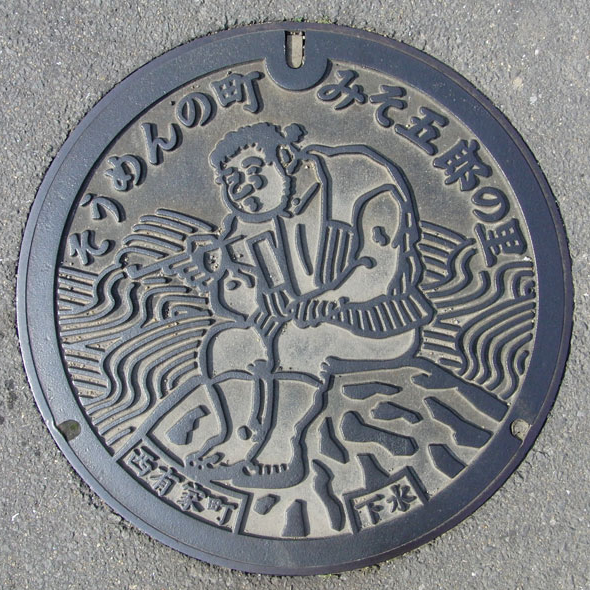
Once upon a time, on the tallest mountain, Takaiwayama, in Nishi-Arie, there lived a big man named 'Miso-Goro.' This giant was kind, strong, and liked by everyone. ......
A legendary giant from Shimabara, 'Miso-Goro,' who loved miso. Sitting on the scene is Mount Unzen.
Bottom left shows the area near Midake Elementary School with a lid.
Bottom right shows a statue of Miso-Goro along the town's national highway. Unlike the one with the lid, this one is wearing only a red loincloth. If you don’t know Miso-Goro, you would surely wonder, 'What is that?'
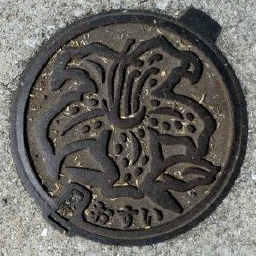
Town flower: Small design of yamazutsuji (Japanese azalea). Indicates "osui". Provided by a tall man with thin hair and a beard.
Former Kuchinotsu 旧口之津町
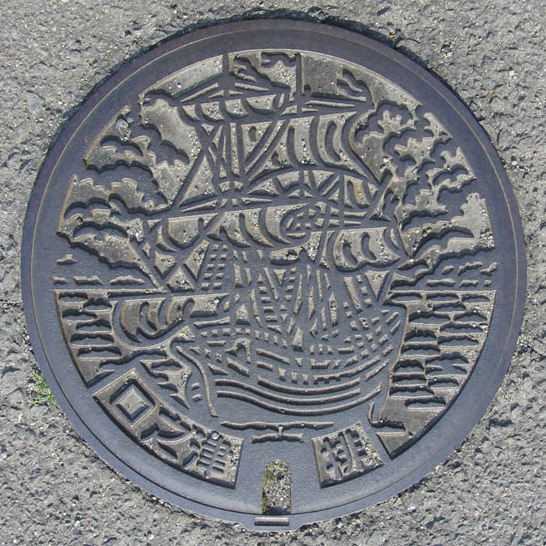
The design of the Nanban ships that had been arriving since 1567. The characters 'Kuchinotsu' and 'Hai.' Provided by a tall man with thinning hair and a beard.
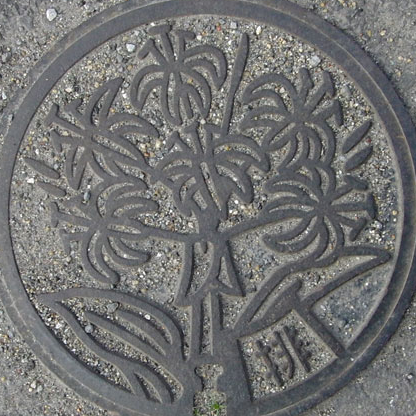
A hand-hall depicting the town's flower, 'Hamayuu'.
Related: Shimabara 島原市
Ojika 小値賀町
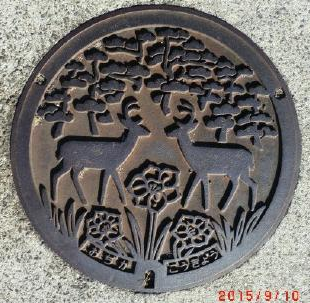
Two male Kyushu deer of the town are facing each other. Above them, the town tree, black pine, is drawn, and below them, the town flower, daffodil. The characters 'Ojika' and 'Kokyo'. Provided by a tall person with thin hair and a beard.
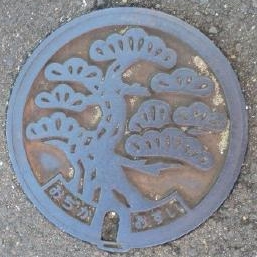
Design of the town's tree, black pine. Hand holes with the words 'Ojika' and 'Osui'. Provided by the tall man with a thin beard.
Kawatana 川棚町
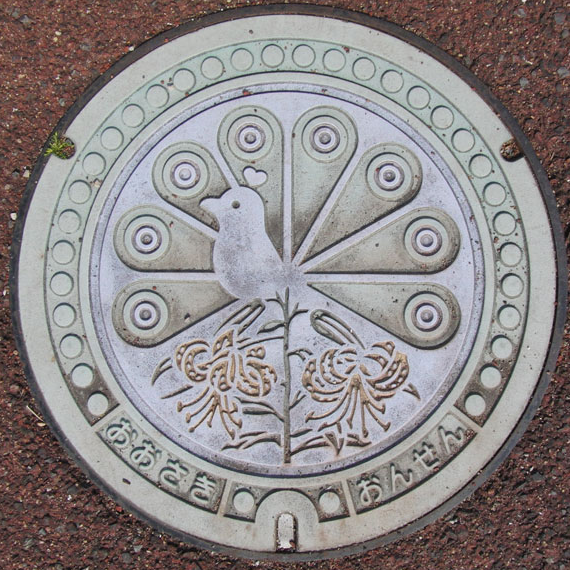
Here are an Indian peafowl and the town's flower, the 'Oniyuri' (Tiger Lily).
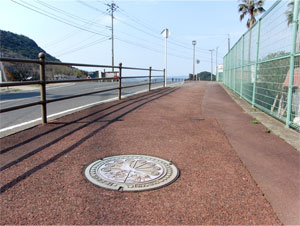
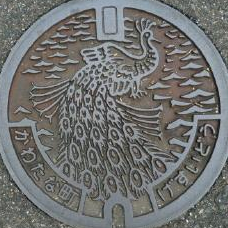
Small lid with the above Indian peacock design.
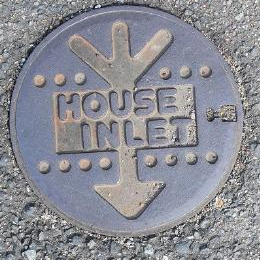
Inside the central square, there is the text 'HOUSE INLET (sewage manhole)'. An arrow pointing down passes through it. The same type was also found in Sakai City, Fukui Prefecture, so it is a standard cover.
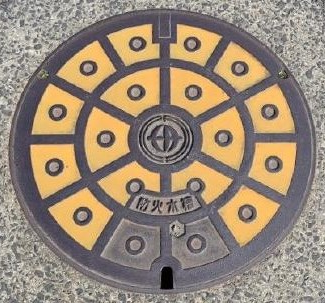
It has a yellow lid like the Nagoya City type, with the town emblem in the center and the words 'Fire Protection Water Tank' written in small letters below it.
Saza 佐々町
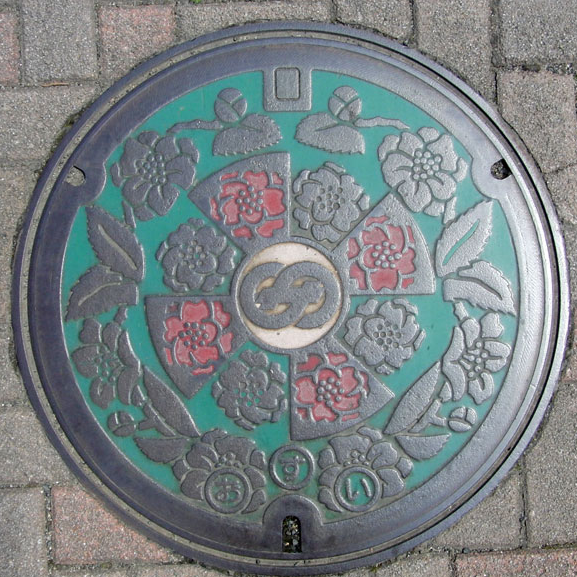
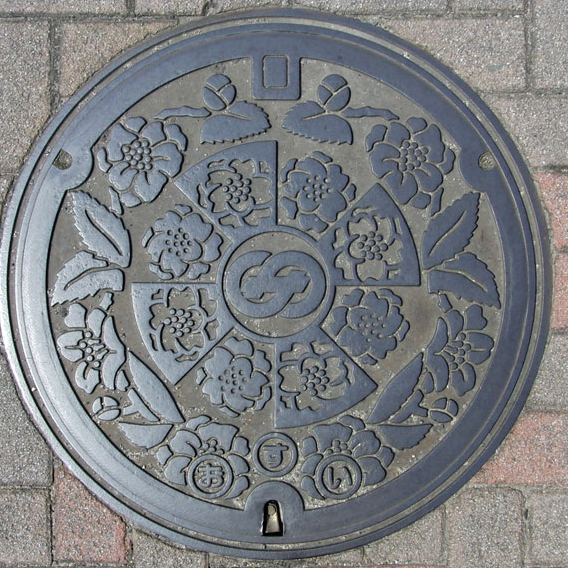
The design features the town's flower, the 'Sasanqua'. Since Sasamachi was incorporated into Sasebo City along with the surrounding towns, it is surrounded by Sasebo City except for the coastal area.
Related: Sasebo 佐世保市
Shinkamigoto 新上五島町
Former Arikawa 旧有川町
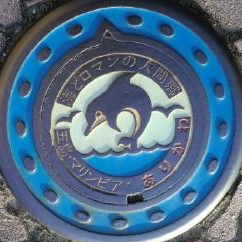
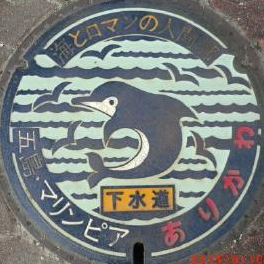
On the dolphin's color design, the words the town was aiming for, 'A Human Village of the Sea and Romance,' 'Goto Marinepia,' and 'Arikawa,' along with the word 'Sewerage.' Provided by the tall, thin man with thinning hair and a beard.
Former Narao 旧奈良尾町
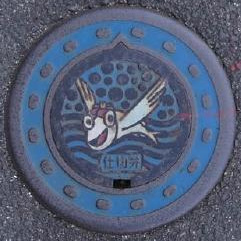
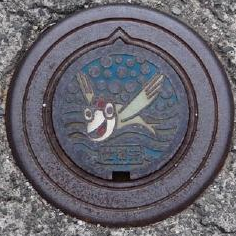
In the center is the colored mascot character of the former Shin-Uomecho, 'Toppy'; below it, the word 'Shikiriben' is written in small letters, and the background features simplified drawings of waves and polka dots. The entire piece is painted in blue, and the receiving frame section has dashed lines. Provided by kanata.
Togitsu 時津町
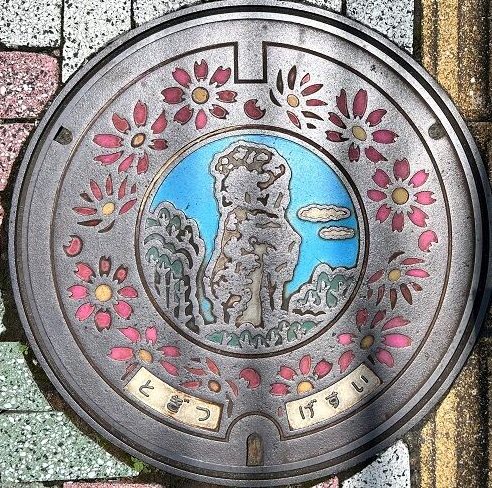
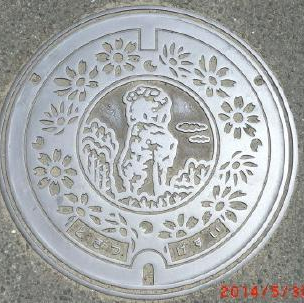
The name 'Saba Kusarakashi Iwa' comes from a story about a fish seller who waited to pass a rock that seemed about to tumble, and in the meantime, the mackerel he was carrying went bad. The design also features cosmos, the town's flower, and the characters for 'Togitsu' and 'Gesui.' Provided by the tall man with a thin beard.
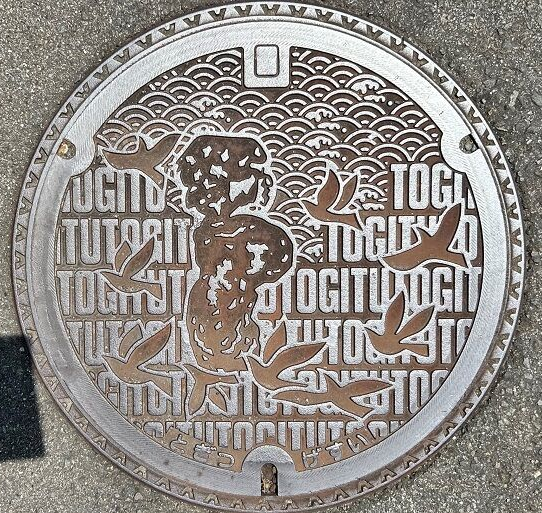
Against a background of the letters TOGITU, Saba-kusara-shi Rock and nine seagulls, with a seigaiha pattern at the top, and the words 'Togitsu' and 'Gesui' at the bottom. Provided by a tall, thin man with thin hair and a beard.
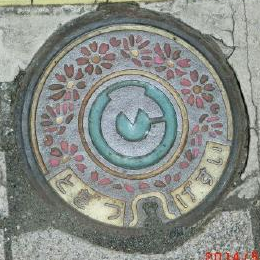
A handhole around the town emblem with a color design of the town's flower, cosmos. The characters 'Togitsu' and 'Gesui.' Provided by a tall man with thin hair and a beard.
Nagayo 長与町
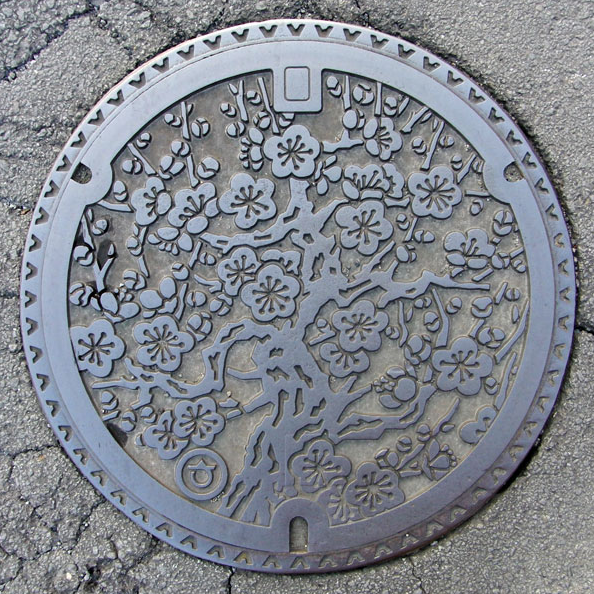
The symbol of Nagayo Town is the 'plum' tree and flower.
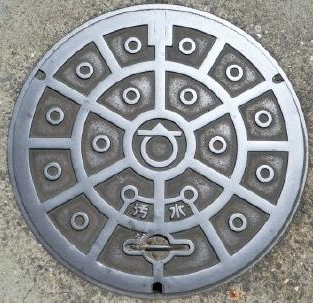
A standard lid with the town emblem, the characters 'Sewage,' and one handle. Provided by Tall Man with thin beard.
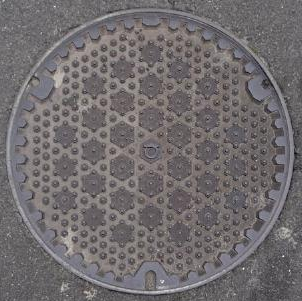
Manufactured by Hinode Suido Kiki, it features an ASD (Anti-Slipping Design) type pattern with a small town emblem in the center. It appears to be for sewage use, but unlike the commonly seen characters such as the 'o' under the emblem or the words 'osui' along with the municipality name on the lower edge, it does not have any such inscriptions. Provided by kanata.
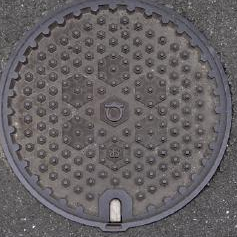
It is a small sewage cover of the ASD type manufactured by Hinode Waterworks on the same day as above. Unlike the one above, it has the character 'O' under the town emblem. Provided by kanata.
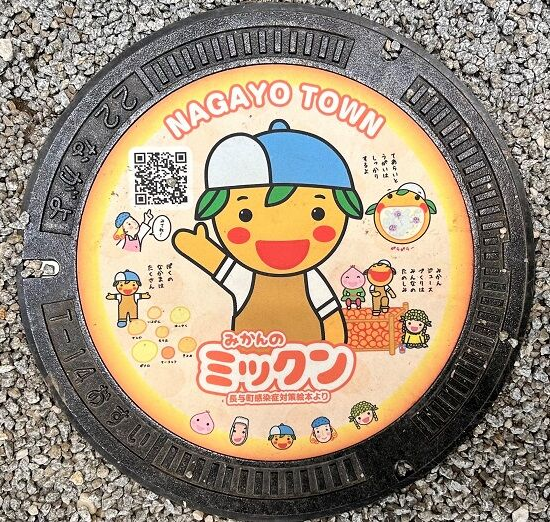
In February, five design manholes were installed. From March 1 to March 31, the event "Let's Walk and Find the Original Designed Manholes of Nagayo Town" was held, where participants answered quizzes while walking to find them. The characters represent specialties of Nagayo Town. This one is Mikan's 'Mikkun.'
Supplied by Mr. Mizushima
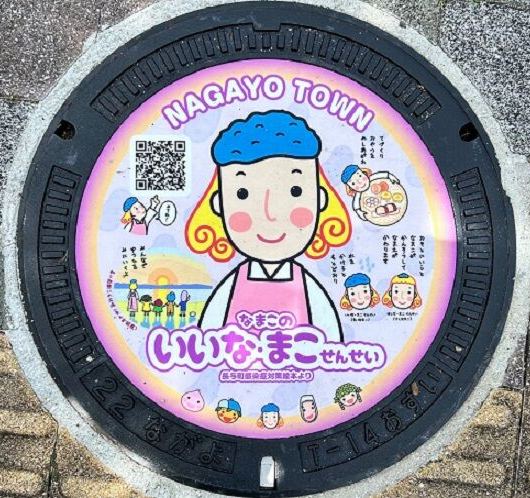
It seems that sea cucumbers can also be caught in Omura Bay, and its character is 'Iina Mako Sensei.' Provided by Mr. Mizushima.
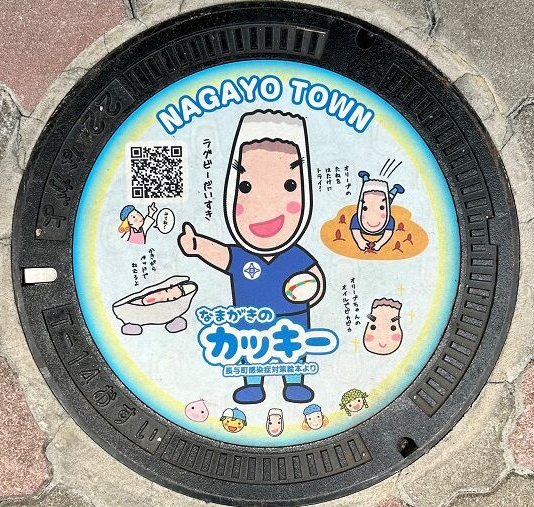
Nagayo Town is able to harvest raw oysters in Omura Bay, so the character is Namagaki's 'Kakki'. For Mr. Mizushima
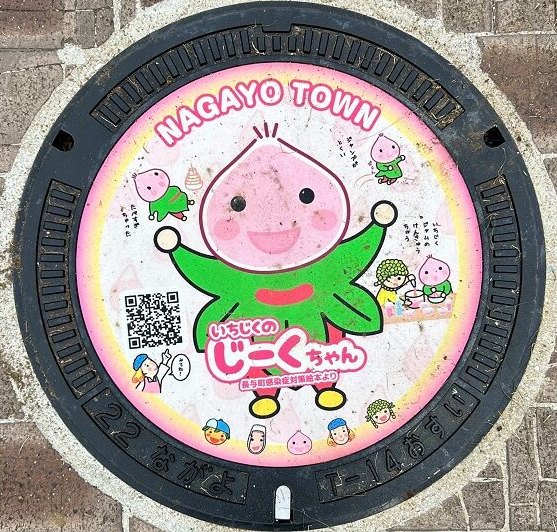
It seems that Nagayo Town is a production area for figs, and they have a character called 'Jīku-chan.' The character is cute. From Mr. Mizushima.
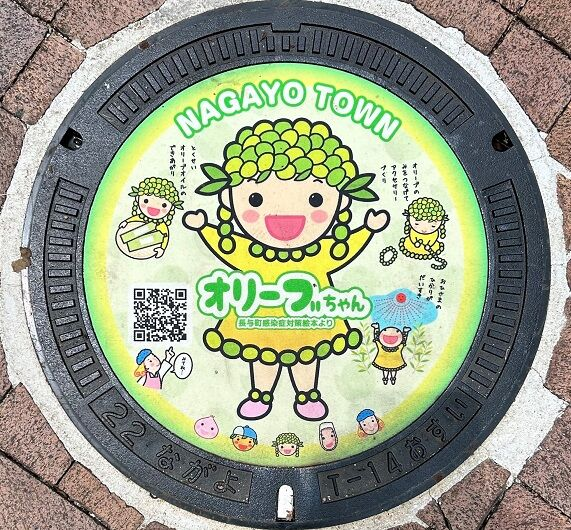
It seems that Nagayo Town is a place that produces olives. The character is 'Olive-chan'. Provided by Mr. Mizushima.
Related: Dai 大村
Hasami 波佐見町
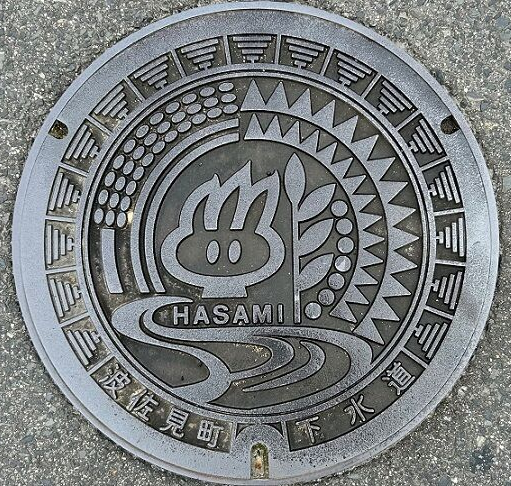
Design of Hasamic and the town's tree, the Japanese Holly (Mochinoki). The words 'Hasami Town' and 'Sewage'.
*Explanation about Hasamic from Higashisonogi Chamber of Commerce, Hasami Branch:
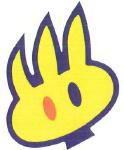
"The nickname is Hasamic. The three lines at the top represent the steam of the hot springs. The lower part is the right eye in the pottery of Hasami ware (originally red) representing the 'kiln fire,' and the left eye (originally blue) represents 'the color of agriculture?' It seems this logo was created about 30 years ago to represent the image of Hasami Town."
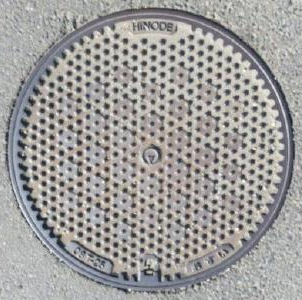
"HINODE" slip resistance, town emblem, 08T-25, sewage.
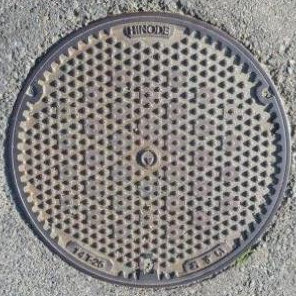
"HINODE" slip resistance, town emblem, '14T-25', 'sewage', the above and 2 o'clock and 10 o'clock are different.
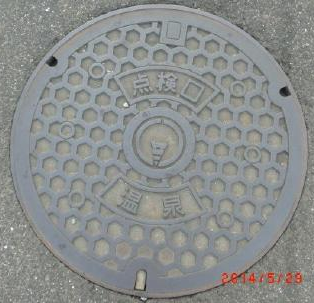
A tortoiseshell pattern with the town emblem, with the words 'inspection port' and 'hot spring'.
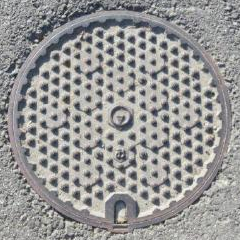
Slip-resistant, town emblem, 'O', small size.
Higashisonogi 東彼杵町
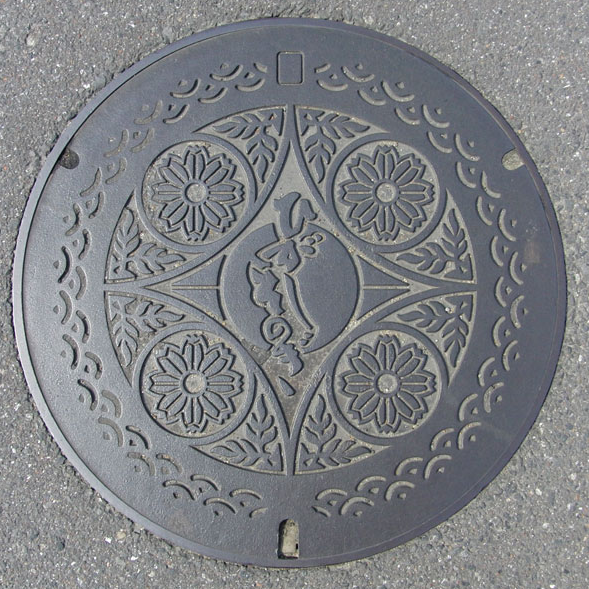
The design is the town's flower, the cosmos.
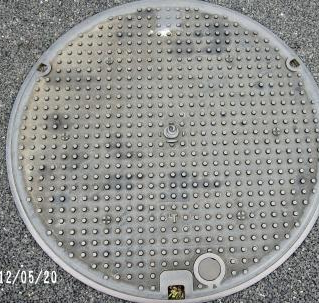
A slip-resistant design with the Ministry of Land, Infrastructure, Transport and Tourism emblem in the center.
Provided by Kana.
Dai 大村

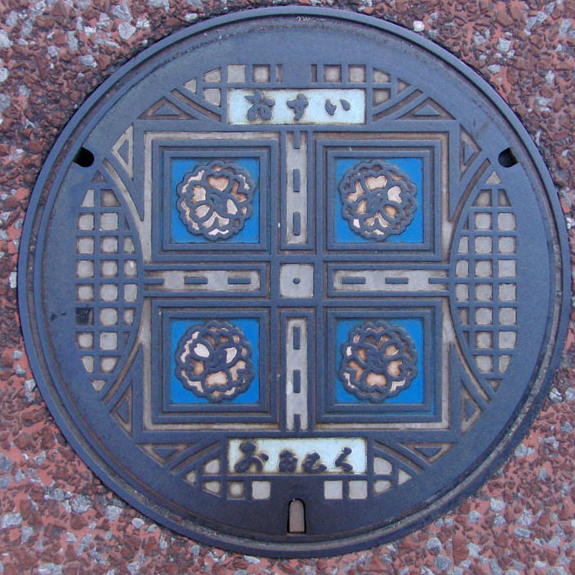
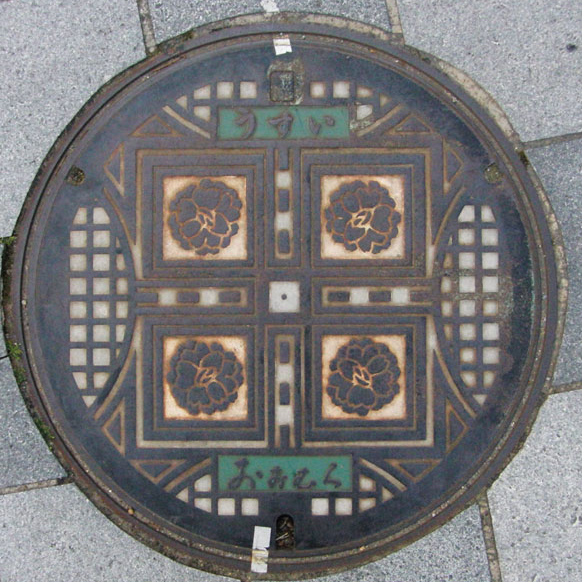
A colored manhole cover with the city's flower, the 'Ōmurazakura,' depicted on the lid. This lid, mainly pink in color, was placed on the sidewalk. There were three color variations of this lid just around Ōmura Station.
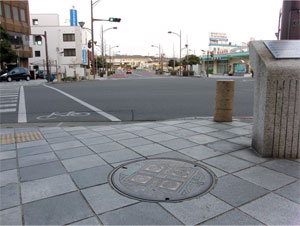
This is the sidewalk on the corner of the intersection in front of the station.
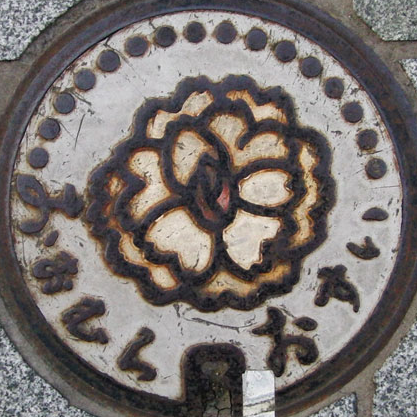
Hand hole with a whitish base. /2011.3
Related: Isahaya 諫早市, Omura 大村市, Nagayo 長与町
Nagasaki Prefecture 長崎県
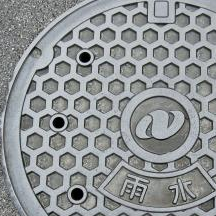
In the center, the emblem of Nagasaki Prefecture (the initial 'N' of the prefecture and a stylized dove, symbol of peace).
A hexagonal-patterned rainwater pipe manhole cover.
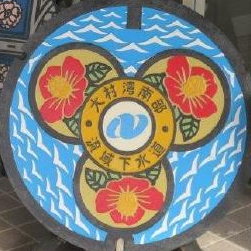
This is the manhole cover whose coordinates are on the manhole card, displayed at the Omura Bay Southern Purification Center. Provided by fujisanTARO.
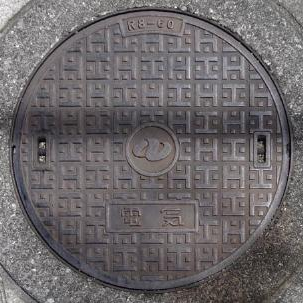
This is a standard type of electric cover featuring the emblem of Nagasaki Prefecture. The background pattern consists of a repeated design resembling the letter 'H' with two dots. The prefectural emblem is in the center, the model number 'R8-60' is on the upper edge, and the word 'Electric' is written in the square character frame below the emblem. Provided by kanata.
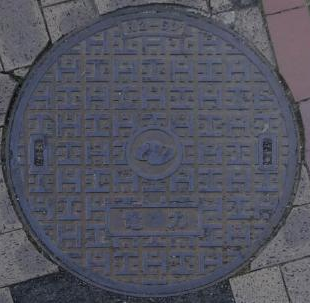
The same ground pattern and design as above, with the text on the upper edge reading 'R2-60' and the text frame below the prefectural emblem reading 'Electric Power'. Provided by kanata.
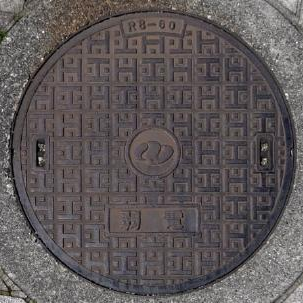
The same background pattern and design as above, with the text on the upper edge reading 'R8-60' and the text frame below the prefectural emblem reading 'Weak Electricity'. Provided by kanata.
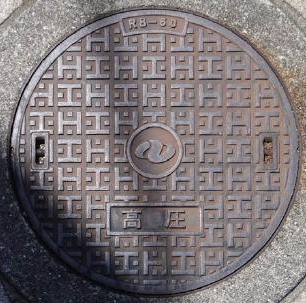
The same background pattern and design as above, with the characters on the upper edge reading 'R8-60', and the text frame below the prefectural emblem reading 'High Voltage'. Provided by kanata.
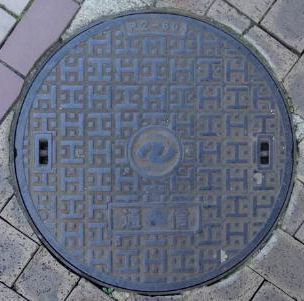
The same background pattern and design as above, with the text on the upper edge reading 'R2-60' and the text frame below the prefectural emblem reading 'Communication'. Provided by kanata.
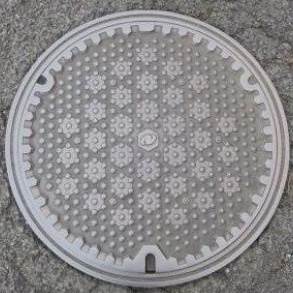
A slip-resistant lid, with a small prefectural emblem in the center of the manhole cover. Provided by fujisanTARO
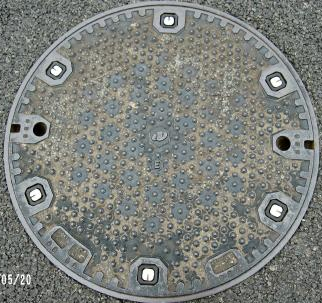
In the center, a small Nagasaki prefectural emblem, and below it, a small letter 'E'.
A manhole cover for distribution pipes with an anti-slip pattern.
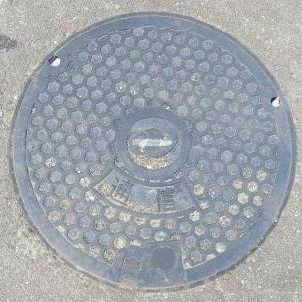
This is a hexagonal-patterned manhole cover with the prefectural emblem and the word 'Tsūshin' (communication). Provided by fujisanTARO.

A hexagonal-patterned distribution pipe manhole cover with the prefectural emblem.
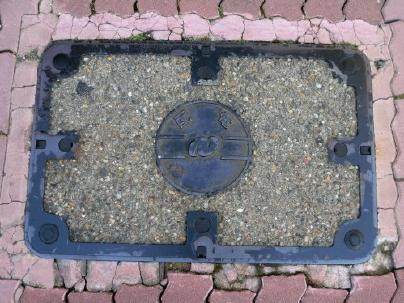
Prefectural emblem attached square cover for power distribution. Provided by Tall Man with thin hair and a beard.
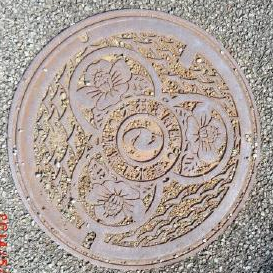
From the center, the emblem of Nagasaki Prefecture, with the words 'Ōmura Bay South Basin Sewerage' around it, and designs of the prefectural tree camellia and waves. Small cover of the Ōmura Bay South Basin Sewerage. The target area includes Isahaya City in the inner part of Ōmura Bay (the western part of former Isahaya City and the area of former Tarami Town) and Ōmura City.
Public Corporation of Telecommunications 電電公社
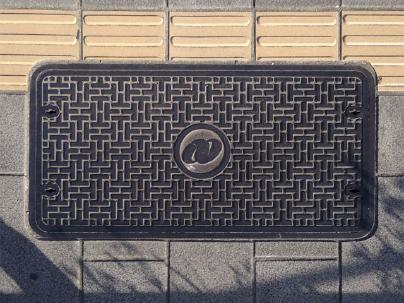
The emblem of Nagasaki Prefecture is in the center. It appears to be a rectangular cover for communication purposes. The background pattern is the 'TT' type used by the Japan Telegraph and Telephone Public Corporation / NTT. Other than the prefectural emblem, there are no characters or other markings. Provided by kanata.
Related: Nagasaki 長崎市