X Miyazaki 宮崎県
Miyazaki 宮崎県
Miyazaki 宮崎市
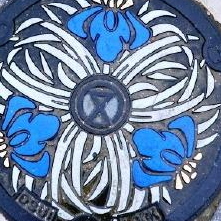
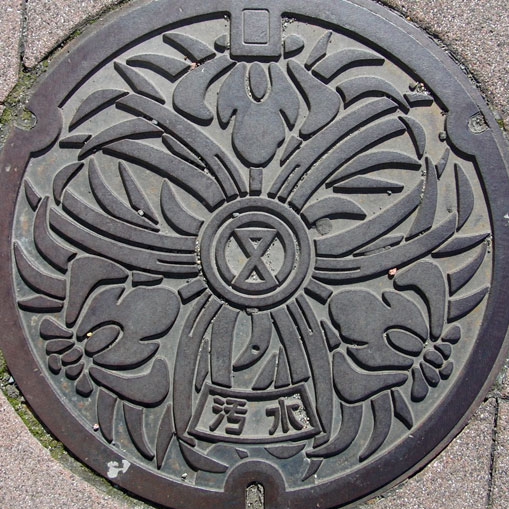
A sewer cover depicting only the city's flower, the 'Hanashōbu' (Japanese iris).
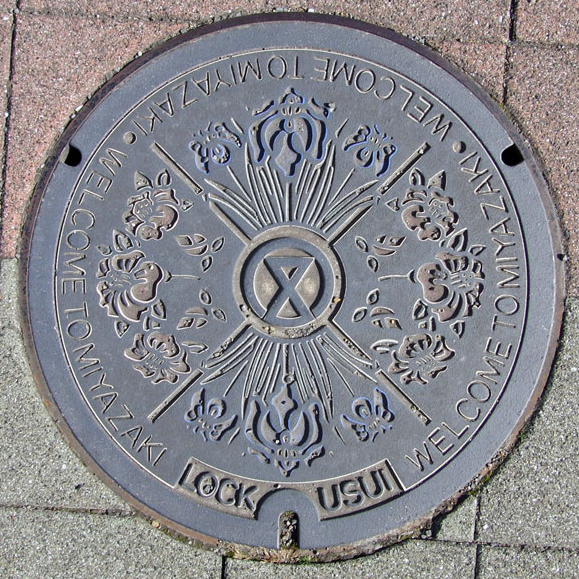
A rainwater cover depicting the city's flower 'iris' and the city's flowering tree 'camellia.' The words 'WELCOME TO MIYAZAKI' are around the edge, possibly for tourists? The colored parts seem to have faded, with purple and red faintly visible.
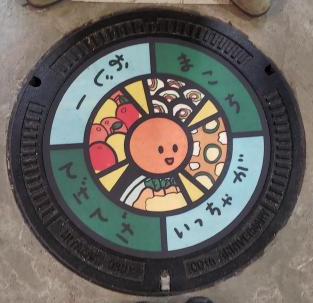
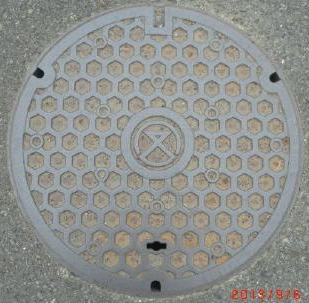
In addition to specialties such as chicken nanban, it expresses the Miyazaki dialect and the sun. The green on the rim represents nature, and the light blue represents the expansive sky. It is one of the 10 works that won an award in the manhole cover design contest held in fiscal 2023. まこち = really, いっちゃが = it's okay, it's fine, てげてげ = appropriate, half-hearted, without too much effort, おじー = scary
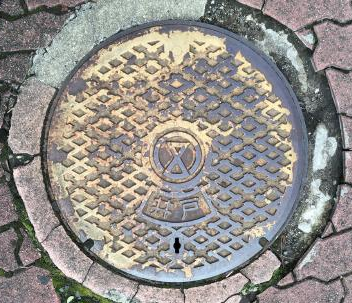
Checkered pattern, city emblem in the center, with the characters '井戸' below it.
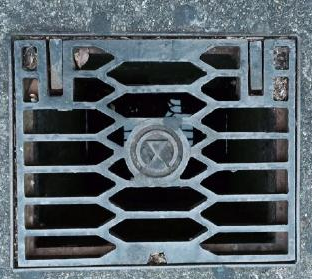
A long, rectangular grid-style gutter cover with the city emblem.
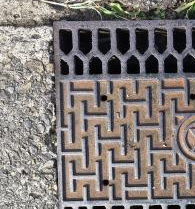
The central part is a steel plate with an H-pattern, and it is a gutter cover with the city emblem.
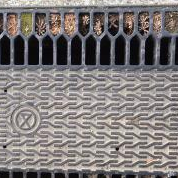
A wide-type drainage cover with the city emblem, featuring a central pattern resembling an electric plug connection.
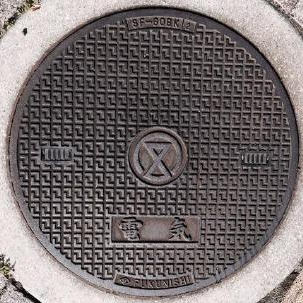
L-shaped ground pattern made by FUKUNISHI, city emblem in the center, 'Electricity' written below.
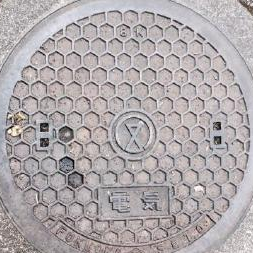
Hexagonal pattern made by FUKUOKA SETO, city emblem in the center, the word 'Electricity' at the bottom.
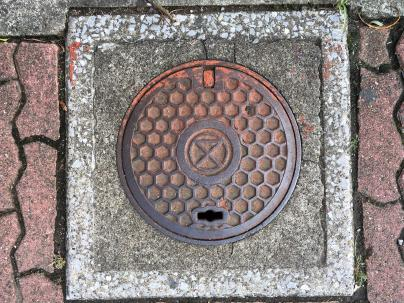
Tortoiseshell pattern, with the city emblem in the center. Three concentric oval patterns on the receiving frame.
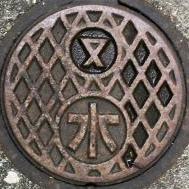
It is a small lid with external hinges and a diamond-shaped ground pattern, with the city emblem on top and the character '水' (water) below.
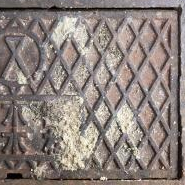
It is a square cover with a diamond-patterned background, featuring the city emblem and the characters 'Water Meter Stop Valve'.
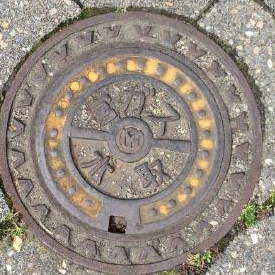
In the center, the Miyazaki Gas company emblem, with the words 'Miyazaki Gas' and 'Water Intake' around it.
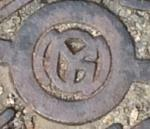
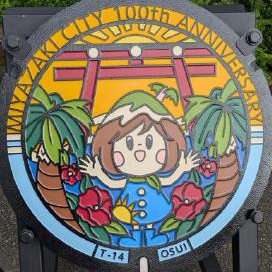
On April 1, we celebrated the 100th anniversary of the city system. In commemoration, this work won the Grand Prize in the general category of the 'Sewer Manhole Cover Design Contest.' It was exhibited at Phoenix Nature Zoo. The theme is 'The charms of Miyazaki City that we want to pass on to the next generation,' and it appears to feature the torii gate and sunrise of Aoshima Shrine, the Phoenix tree which is the prefectural tree, the city's tourism mascot 'Missi-chan,' and the city flower, the camellia. The top edge has the words 'MIYAZAKI CITY 100TH ANNIVERSARY,' and the bottom edge has 'T-14 OSUI.'
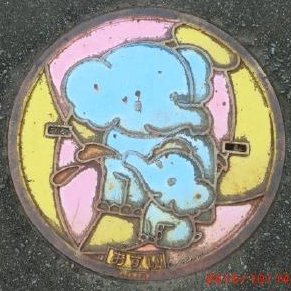
Color design of an elephant parent and child. Includes the characters 'おすい'.
Former Sadowara 旧佐土原町
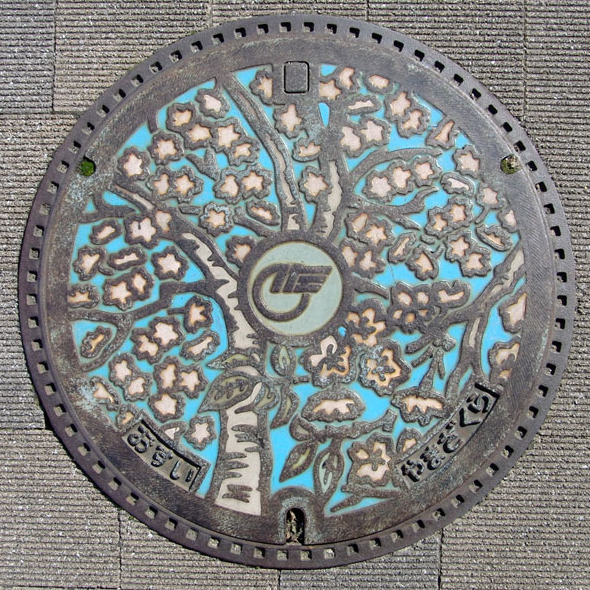
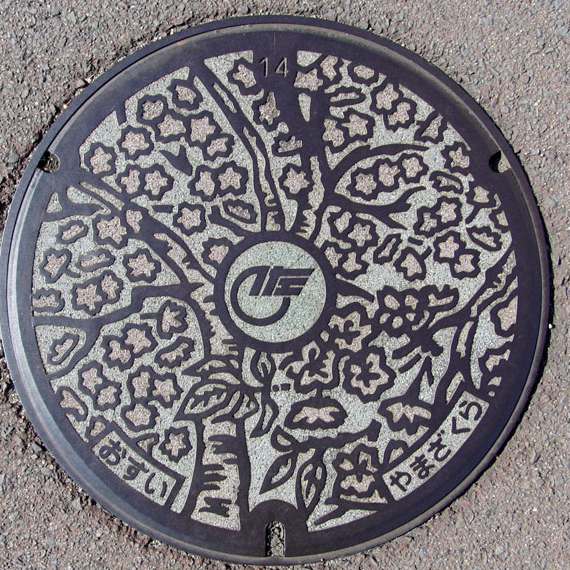
A colored manhole cover depicting the town tree, 'Yamazakura'.
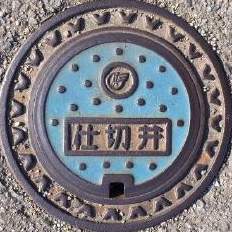
A small lid with the town emblem and the characters 'Shikiriben,' featuring a polka dot pattern on a blue background. The receiving frame has a V-shaped pattern.
Former Kiyotake 旧清武町
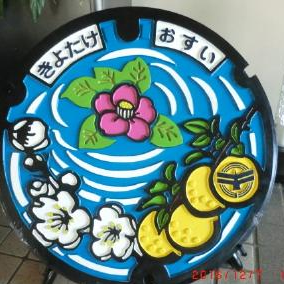
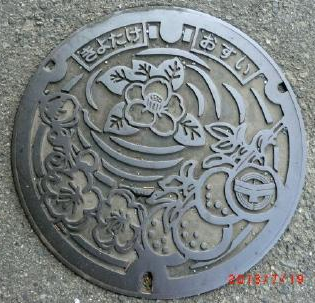
Town flower: ume (plum), locally specialty Hyuganatsu oranges, camellia design with the town emblem.
The following is from the town office:
The lower right side is 'Hyuganatsu,' a local specialty of the town.
The emblem depicted on the far right 'Hyuganatsu' is the emblem of Kiyotake Town.
The lower left side is the town flower, the 'plum blossom.'
The central flower is a 'camellia.' It depicts a camellia flower floating on the water surface, creating ripples.
It is depicted because when developing Kiyotake Town General Sports Park, there was a plan to plant camellias in part of the park.
On the upper right, it says 'Usui,' but there is also a cover that says 'Osui.'
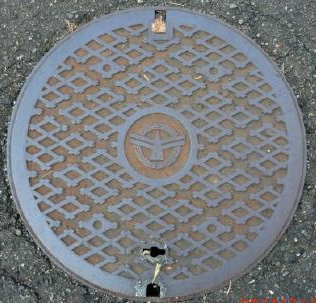
A lid with a lattice pattern, featuring the town emblem.
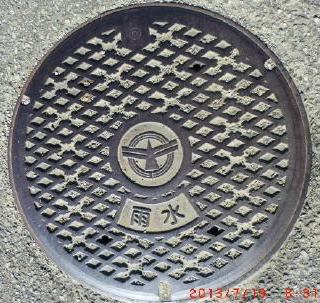
A lid with a lattice pattern, featuring the town emblem and the characters for 'rainwater'.
Former Tano 旧田野町
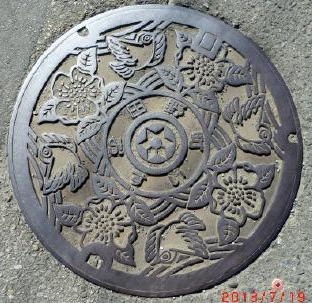
Around the town emblem, the town's flower, sasanqua, and the town's bird, the Japanese white-eye, are depicted.
Former Takaoka 旧高岡町
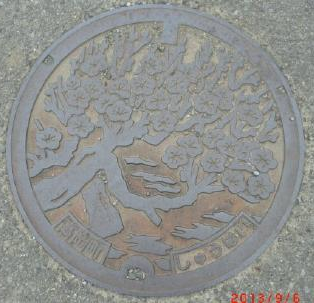
In the design of the town's flower, the plum, are the characters 'Takaoka Town' and 'Shuhai'.
Kushima 串間市
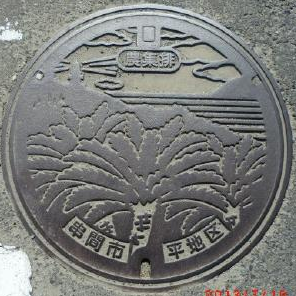
The city's tree, the sago palm, and the Toi Misaki Lighthouse at Cape Toi are depicted. The words 'Kushima City,' 'Hira District,' and 'Nōshū' are written.
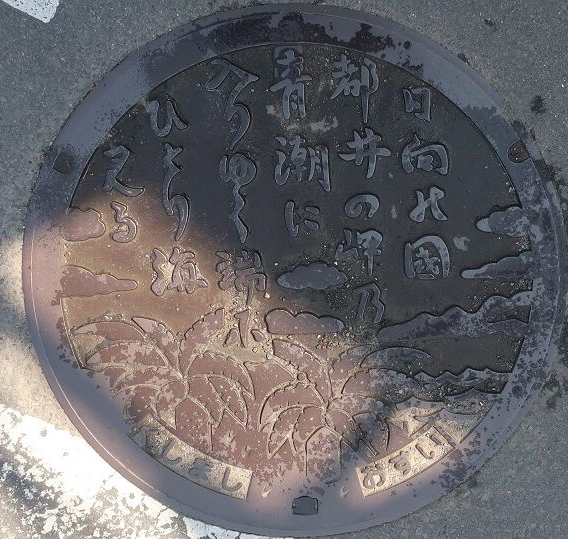
It is written with the sago palms of Toi Cape and the poem by Bokusui Wakayama, which has a monument in Kushima City: 'In the land of Hyuga, at the blue tide of Toi Cape, at the edge where it enters, I watch the sea alone.' The characters 'くしまし' and 'おすい'.
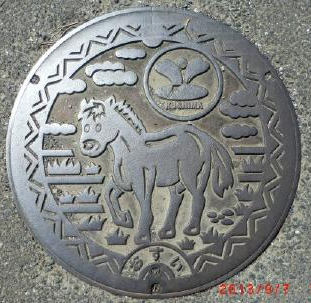
The native Japanese wild horse 'Misaki Pony,' which inhabits Cape Toi, is adorably designed. The mark is a symbol mark that was publicly solicited to commemorate the 40th anniversary of the implementation of the city system. It is based on the city's flower, the 'Canna,' and is designed with the image of the city making further leaps and development toward the 21st century on the occasion of its 40th anniversary, using the first letter 'K' of the city's name. (From the City Hall)
Kobayashi 小林市
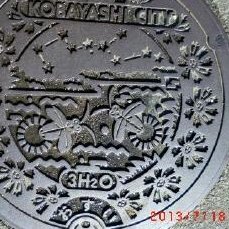
The following is from the city hall.
This is a manhole cover for the sewer system, representing 'flowers' with the cosmos and rapeseed flowers of Hana no Sato Ikoma Highlands, 'stars' shining in the town recognized as having the most beautiful starry sky in Japan, and 'fireflies' of Denoyama, certified by the Environment Agency as a hometown of living creatures. It also represents 'water,' including the Denoyama spring water group selected as one of Japan's top 100 water sources. It combines the initials of flowers, stars, and fireflies, 'H,' with the chemical symbol for water, 'H2O,' to represent '3H2O.'
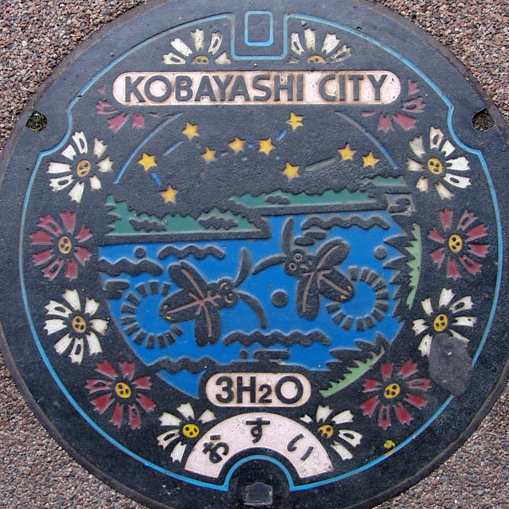
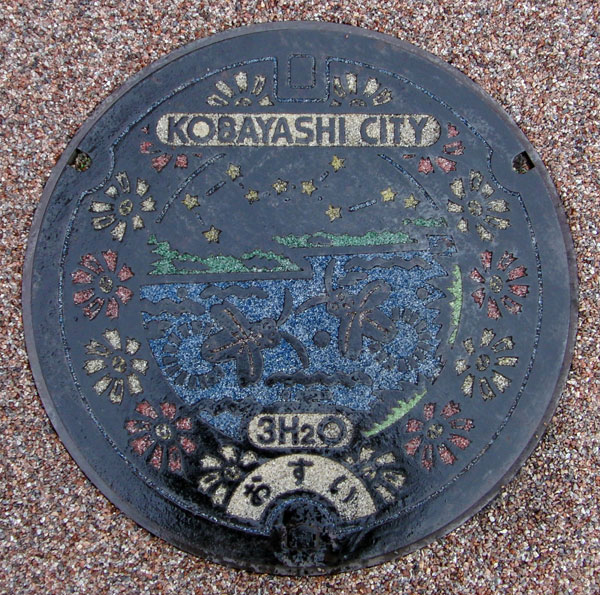
Located to the west of Kobayashi city center, near the Kobayashi I.C. on the Miyazaki Expressway, 'Deno-yama Park' is said to be known for its spring water and fireflies, with 'fireflies' flying over the 'clear stream.' In addition, Kobayashi City was selected five times as 'Japan's No.1 Hometown for Stars' in the Environment Agency's star-watching contest, and built an astronomical observation facility called the 'North Kirishima Cosmo Dome,' so constellations are also depicted. The area is surrounded by the city's flower, the 'cosmos,' making this wastewater color manhole cover richly detailed. This cover was located under the eaves of a supermarket.
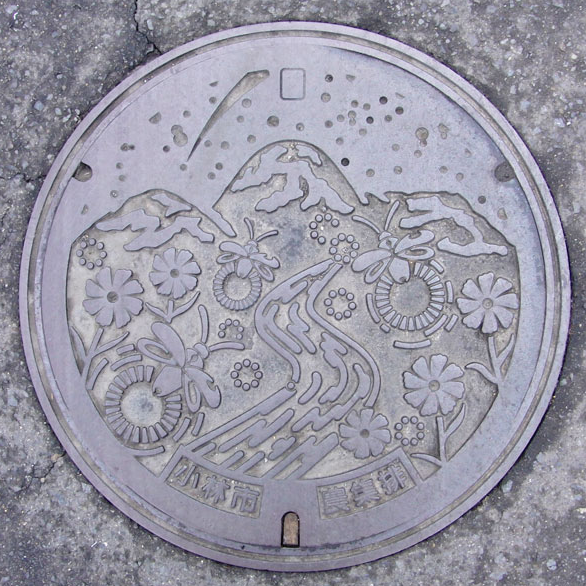
It represents the 'flowers,' such as the cosmos and rapeseed flowers of Ikoma Plateau in Hananosato; the 'stars' that shone in the town recognized as having the most beautiful starry sky in Japan; the 'fireflies' of Dennoyama, certified by the Environment Agency as a hometown habitat for living creatures; and the 'water,' including the Dennoyama spring water group selected as one of Japan's Top 100 Famous Waters. (Explanation from Kobayashi City Waterworks Department) It is labeled as 'Kobayashi City' and 'Nou Shuu Hai'.
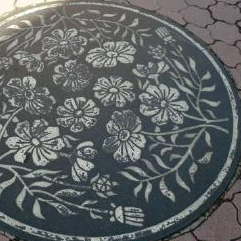
A huge object of unknown purpose found in Kobayashi City. It has a design of the city flower, cosmos. In the upper left, you can see a lid with a diameter of 600 mm, which is an ordinary lid.
According to the city hall:
It was installed to improve the image of Kobayashi City and to promote the city flower. It is like an interior piece and is simply embedded in the ground.
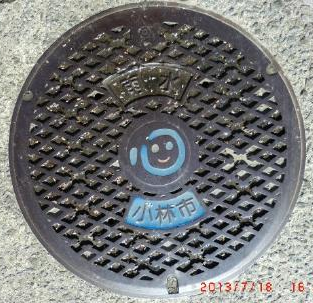
The following is from the city hall.
This is a manhole cover for rainwater, featuring the logo of Kobayashi City before the merger, and it represents the catchphrase of Kobayashi City at that time: 'Wa Denshin Kobayashi, good people, good town, good nature.'
Former Kobayashi 旧小林市
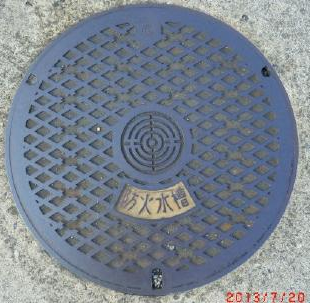
Former Nojiri 旧野尻町
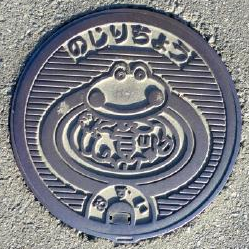
The mascot 'U-turn Frog' of the leisure land 'Nojirikopia' located on the shores of Lake Nojiri.
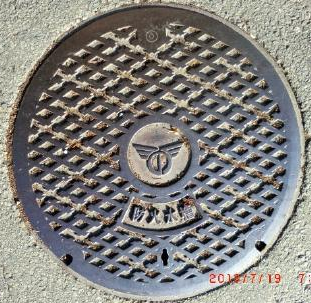
Firewater tank cover with a town emblem in a lattice pattern.
Former Suki 旧須木村
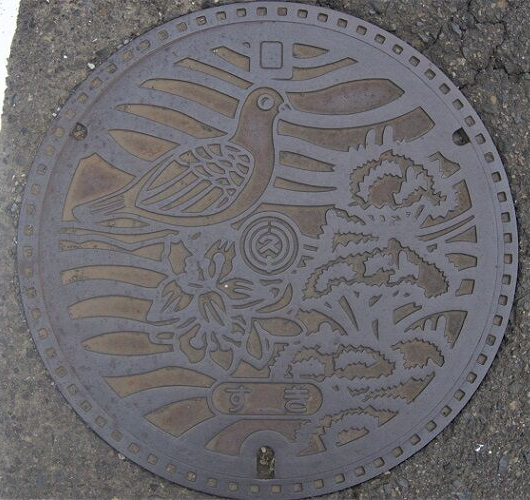
The village tree: Five-needle pine, the village flower: Renge azalea, the village bird: Blue pigeon
Saito 西都市
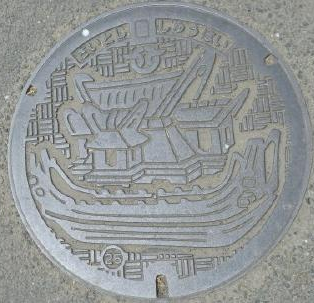
Design of the 'komochi-iekata' haniwa and boat-shaped haniwa excavated from the Saitobaru Kofun Cluster. Includes the city emblem.
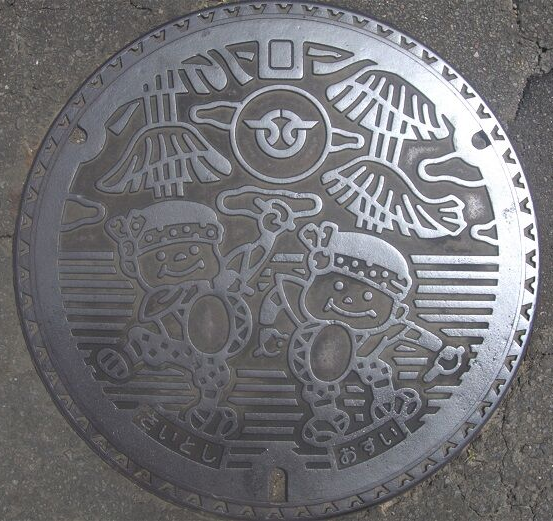
Design of the Shimoduru Usudaiko (drum) dance, an intangible folk cultural property. Includes the city emblem and the characters 'Saito City' and 'Sewage'.
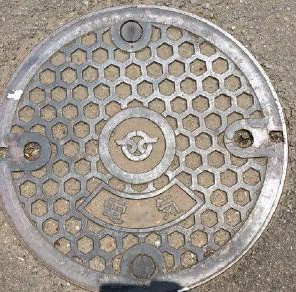
Tortoiseshell pattern, city emblem in the center, with the word 'Electric' below it.
Nichinan 日南市
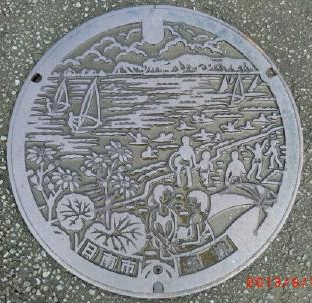
The one drawn at the top is the island called 'Nanatsubae,' and the exact location of the seaside bathing area in the middle is unknown. The flowers at the bottom are 'tsubaki,' the flower of Nichinan City. (Explanation from the Construction Department of Nichinan City Hall)
The characters 'Nichinan City' and 'Shūhai'.

Town emblem and the characters 'Sewage' on a Bishamon tortoiseshell pattern.
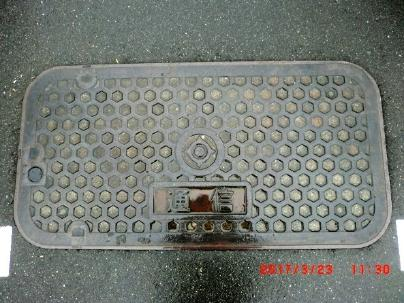
Turtle shell-patterned square lid, with the word 'Communication' below the city emblem in the center.
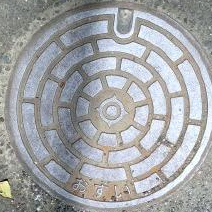
Small sewage manhole cover with city emblem.
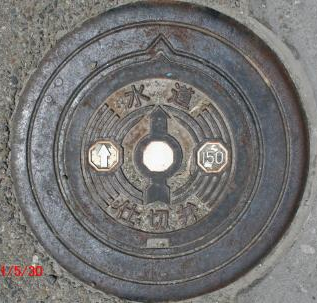


Designed a bird, the Japanese White-eye, for the new 'Nichinan City' (merged in '09).
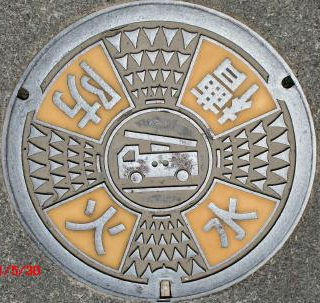
A fire water tank designed with a motif of the tree of Nichinan City, the 'Obi Cedar,' and made slip-resistant.
Former Nichinan 旧日南市
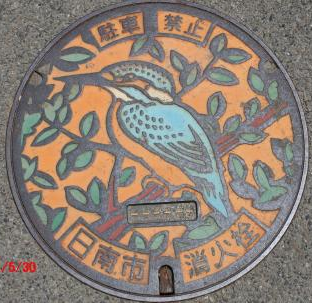
A fire hydrant cover depicting the city's bird, the kingfisher.
Former Kitago 旧北郷町
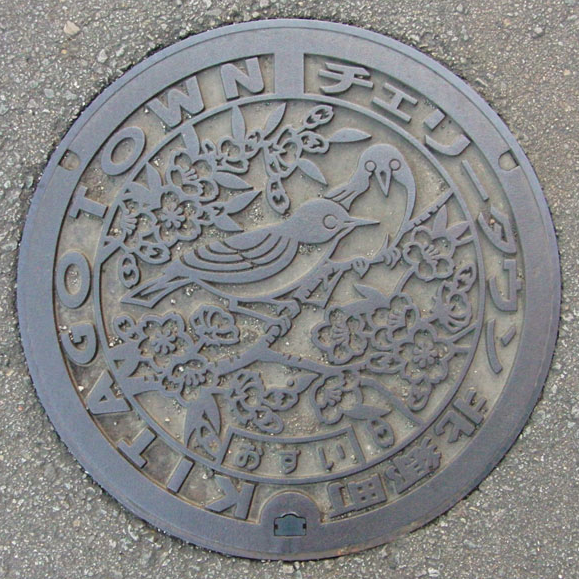
The former Kitagō Town had most of its area covered with Obisugi cedar forests, and the town tree was 'cedar,' but it depicts the 'cherry blossoms' planted in pursuit of becoming a village of cherry trees and the town bird, the 'bush warbler'.
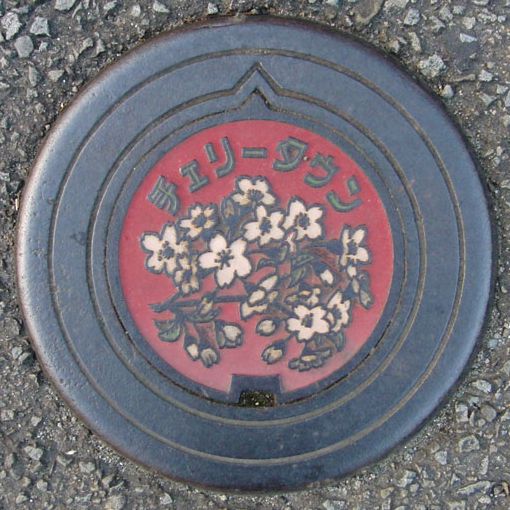
A lid with the letters of Cherry Town and 'Sakura' drawn on it.
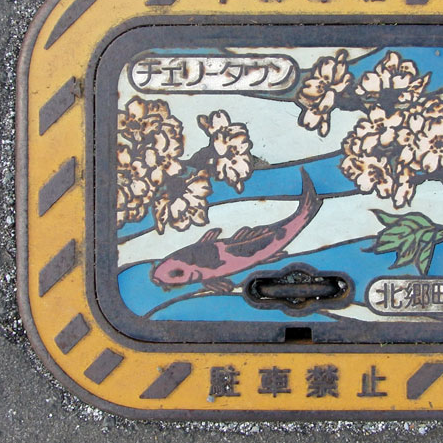
Probably a fire hydrant cover. 'Sakura' and 'Koi' are depicted on it.
Former Nango 旧南郷町
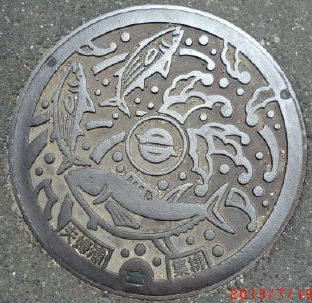
Around the town emblem, waves of the Pacific Ocean (Hyuga-nada) and bonito (the town's fish) and tuna, which are central to fishing, are depicted. It is said that the catch of nearshore single-hook bonito fishing is the largest in Japan. The characters 'Fufuura' and 'Shuuhai' are also included.
Nobeoka 延岡市
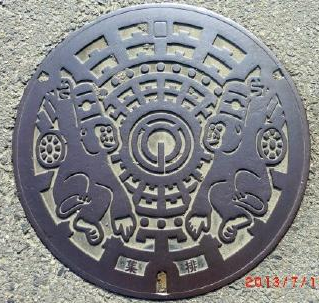
On both sides of the city emblem, 'Nobori-zaru,' a local toy from Miyazaki Prefecture that has been made since the Edo period, is depicted. It is said that the Nobori-zaru was first made by the wives of samurai of the Nobeoka domain as a home-based craft. The mechanism is such that when a banner depicting irises catches the wind, the papier-mâché monkey goes up and down. It is said that, in May during the seasonal festival, it is placed in the garden together with carp streamers to pray for the healthy growth of children and a rich harvest. The inscription reads 'Shu-pai.'
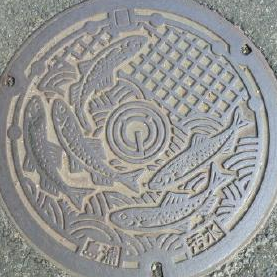
Around the city emblem, based on the high catch of sardines in Shimaura, a design imagining a school of sardines (according to an explanation from the Nobeoka City Water and Sewerage Bureau). The words 'Shimaura' and 'sewage.' When I landed, they were also in the middle of unloading sardines.
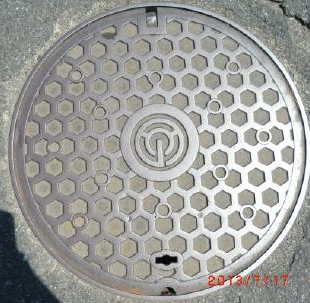
Tortoise shell pattern with the city emblem.
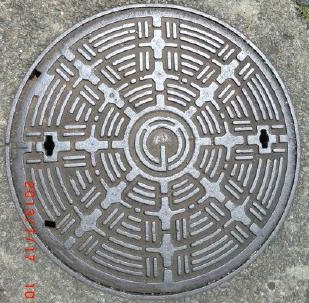
With the city emblem.
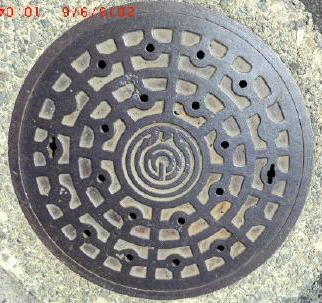
JIS standard lid with the city emblem inside the sewage mark.
Former Kitakata 旧北方町
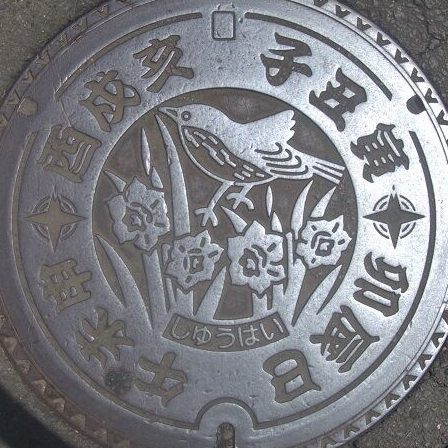
Depicting the town's flower, the daffodil, and the town's bird, the Japanese white-eye, in the center, with the town emblem and the characters of the twelve zodiac signs and the word 'Shūhai' around it. Until it merged with Nobeoka City, it was uniquely the only place in the country with address notation based on the zodiac signs, and in the postal code list, the order was not according to the Japanese syllabary, but listed in the order of the zodiac signs: Ne, U, To, Ta, Mi, Hi, Sa, I. by Wikipedia
Hyuga 日向市
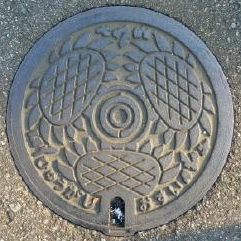
Three sunflowers, the city's flower, are drawn around the city emblem. It is labeled 'Hyūgashi Osui.'
Sewage manhole cover.
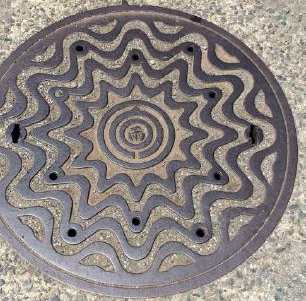
A perforated lid with a ground pattern that looks like ripples spreading, with the single character '雨' (rain) inside the city emblem. Rainwater pipe manhole cover.
Former Togo 旧東郷町

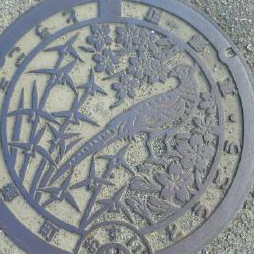
Town tree: Yamazakura, town flower: Osuzukamuran (Osuzu cold orchid), town bird: Pheasant design.
Sewage manhole cover.
Miyakonojo 都城市

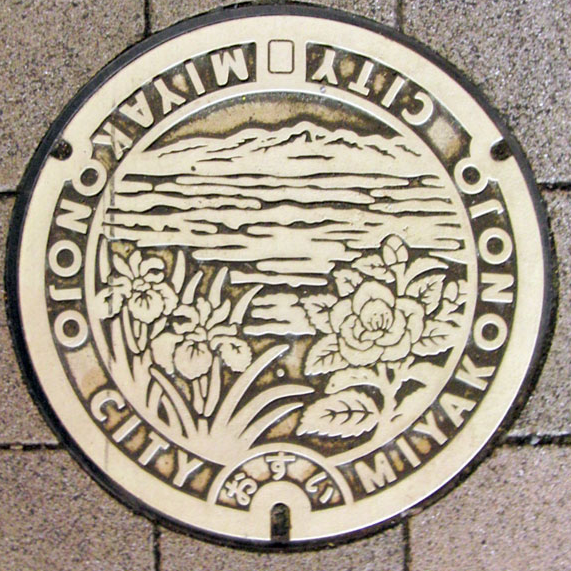
A single-color ceramic sand-coated panel depicting the city flower 'Iris' and the city flowering tree 'Sasanqua' with the Kirishima mountain range in the background.
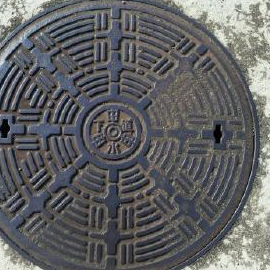
The city emblem and the characters for 'sewer' are together inside the central circle.
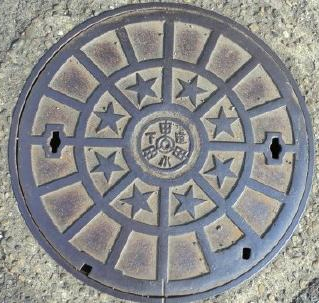
The pattern of stars and, inside the circle, both the city emblem and the characters for sewerage are included together.
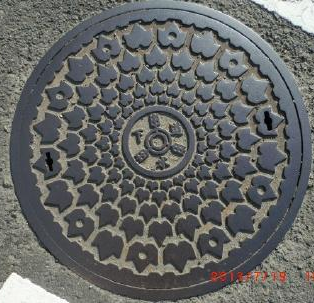
A pattern resembling ivy leaves is drawn across the entire lid, and the city emblem along with the word 'sewer' is included together in the central circle.
According to the city hall:
It was installed after Showa 47 (1972), but the details are unknown. Even the manufacturer currently in business could not identify it.
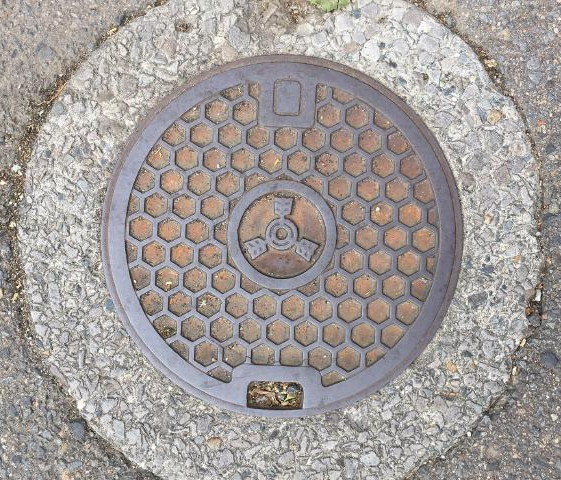
This is a small lid with a hexagonal tortoise shell pattern featuring the city emblem.
Former Takazaki 旧高崎町

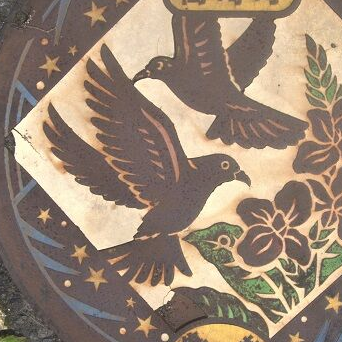
In the central part, there are two town birds, yakimatsumoto, and the town flower, canna; around them are the town tree, camphor, and stars from a town so beautiful that it has won the 'town where the stars can be seen most beautifully in Japan' award 10 times. Installed after fiscal year 1995. The characters 'Takasaki Town' and 'Shūhai'.
The following is from the city hall:
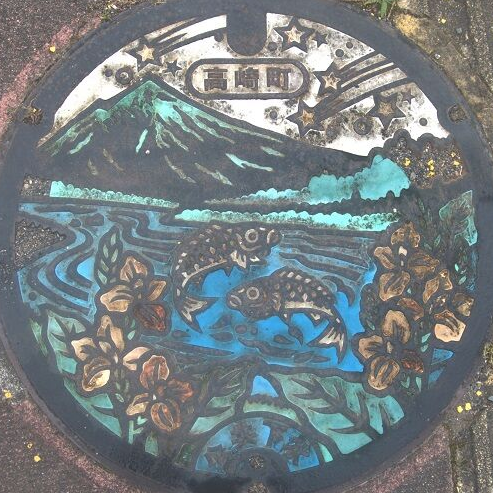
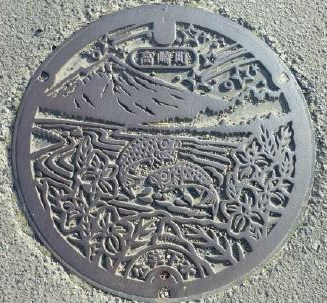
Imagining a rich and clean river flowing at the foot of Mount Kirishima, stars are placed at the top as 'Starry Town Takasaki.' The flowers at the bottom left and right are the town flower 'Canna' from the former Takasaki Town era. The words 'Takasaki Town' and 'Public Sewer'.
Former Takajo 旧高城町
The following is from the Miyakonojo City Sewerage Division.
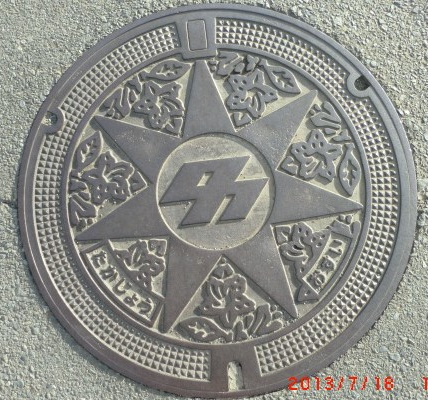
In the center, the design is based on the former Takajo Town emblem and town flag.
Former Takajo Town Emblem: On February 11, 1954 (Showa 29), to commemorate the 20th anniversary of the town system enforcement, the town emblem was established. It represents the seven large districts of Takajo Town: Takajo, Hommabou, Ooide, Sakuragi, Ishiyama, Arimizu, and Shike.
Former Town Flag: The design combines the characters "Ta" and "Ka" from Takajo. The flowers in the surrounding area are designed based on the flower of the former Takajo Town, the azalea.
The characters "Takajo" and "Osui".
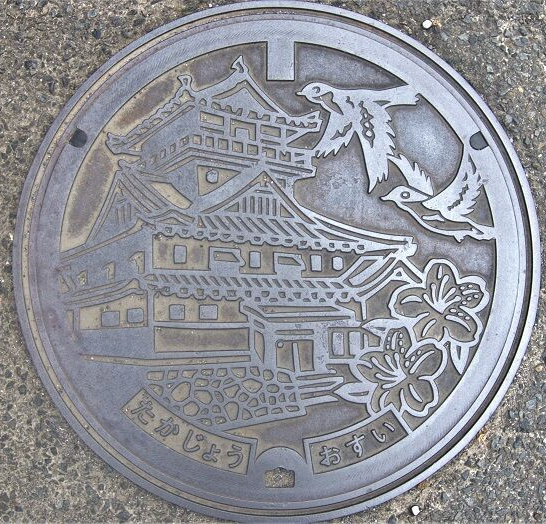
The following is from the city hall: It features designs of the Takagi Local History Museum, the flower of former Takagi Town, the azalea, and the bird of former Takagi Town, the Japanese white-eye. Takagi Local History Museum: It was planned as a project to commemorate the 50th anniversary of the town's establishment and was built in 1992 as a hub for Takagi Town's initiative, the 'Ancient and Romantic Village Development Concept.'
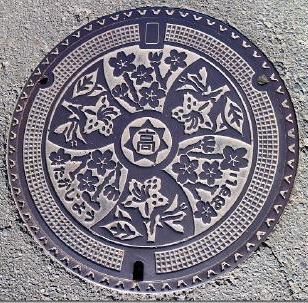
Inside the central circle is a seven-pointed star with the old Takajo Town emblem '高'. Around it, the space is divided into six sections like fan blades, with the town flower 'azalea' and the town tree 'osmanthus' drawn alternately. At the lower left are the characters 'たかじょう' and at the right 'おすい'. The outer band has four rows of small squares.
Former Yamada 旧山田町
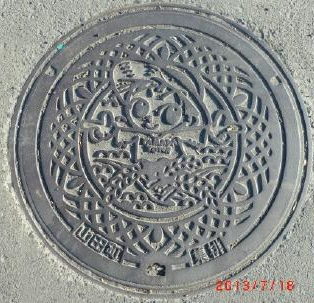
The design of 'Yutaka-chan' standing in a richly ripened rice field. On Yutaka-chan's chest is written 'YAMADA TOWN.' The characters 'Yamada Town' and 'Shūhai' are included.
The following is from the Sewage Department of Miyakonojo City:
Scarecrow Village Development Plan (Fiscal Year 1992)
The Scarecrow Village Development Plan is named after the children's song 'The One-Legged Scarecrow in Yamada.' Since ancient times, 'scarecrows' have been active and loved as a means of protecting rice fields and crops from birds and wild animals. In Chinese characters, it is written as '案山子' (scarecrow), and it is also considered something that protects the rice fields nestled among the gentle mountains of Yamada. In the former Yamada Town, where agriculture was the main industry, the town entrusted its development toward the 21st century to this 'scarecrow' and adopted it as a symbol of the town's revitalization plan and as a mascot representing the townspeople's love for their hometown.
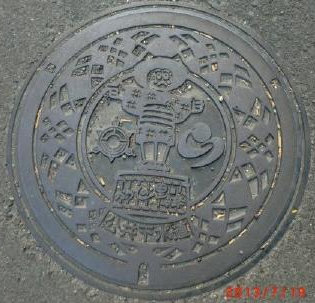
On a pedestal that says 'Scarecrow Village Yamada Town,' stands Daichi-kun in a kimono, a scarecrow, with the town emblem on the left and the character '山' designed on the right. The words 'Public Sewage'.
Former Yamanokuchi 旧山之口町
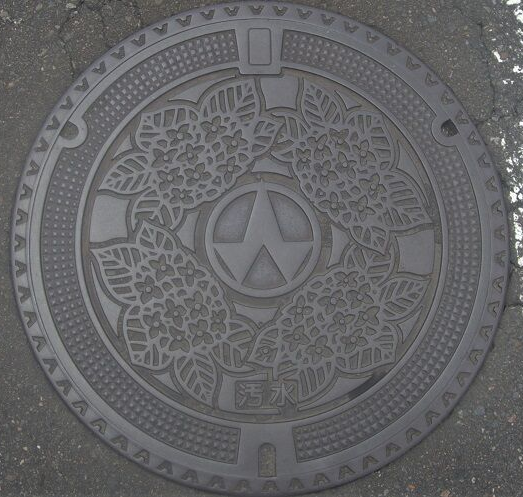
The town's flower, hydrangea, is designed around the town emblem. Includes the characters for 'sewage'.
Ebino えびの市
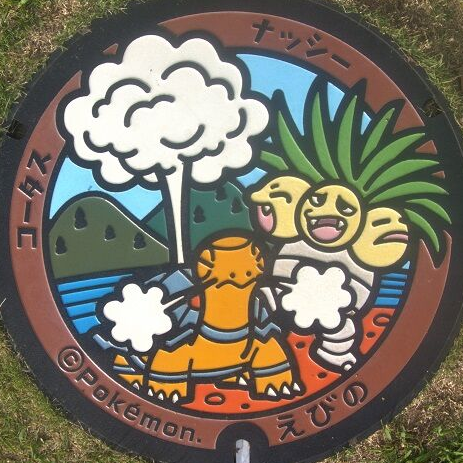
It's a Pokéfuta.
Aya 綾町
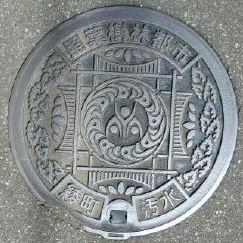
There are four Aya Teruha Suspension Bridges. In the center is the town flag, which was designed and established in 1979 with the motif "AYA." Setting it separately from the town emblem might be rare... Around it is a design based on "Aya." It is labeled as a "Broadleaf Evergreen Forest City." The following is from the town office:
This town has the largest broadleaf evergreen forest area in Japan, and town planning is carried out in a way that makes use of this feature. The design places the leaves of the broadleaf evergreen trees, which symbolize the town, on the outer circle, and inside that, a design of the world's largest suspension bridge that spans the area is placed, with the town flag in the center. The town was registered as a UNESCO Ecopark last year.
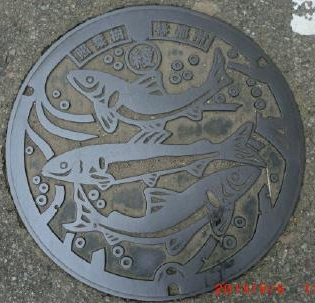
It has long been famous for its ayu (sweetfish), so it seems that, based on that image, a design featuring ayu swimming in the river was adopted. (Explanation from Aya Town Hall Construction Division)
The word 'Aya' appears inside a circle with 'Evergreen Broadleaf Forest City.'
Kadogawa 門川町
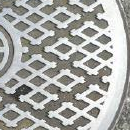
The lid has an igeta-patterned background with the town emblem.
Kawaminami 川南町
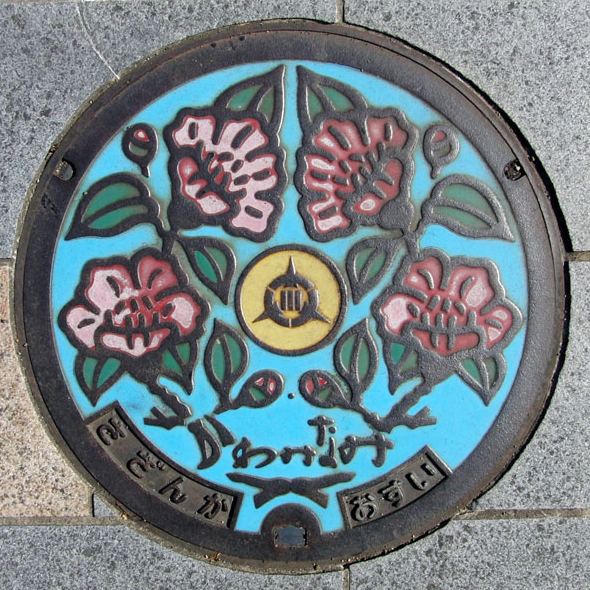
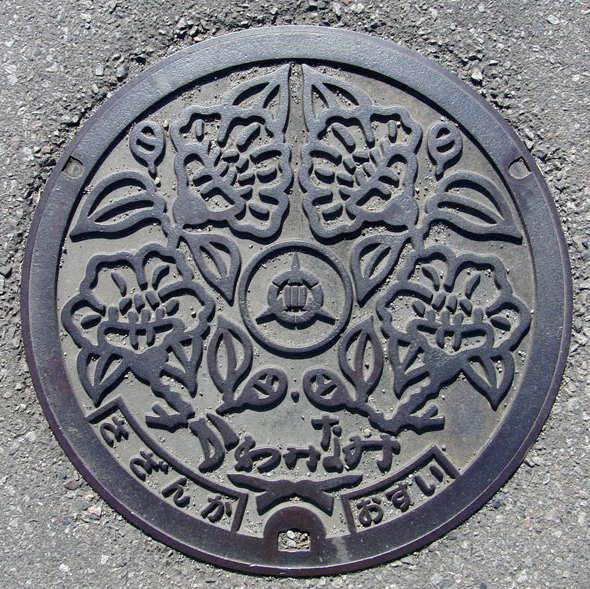
A manhole cover for sewage depicting the town's tree, the 'Sasanqua.' Kawaminami Station on the JR Nippo Main Line is near the coast, but the town center is about 3 km inland, near National Route 10. The colorful covers were lined up in the center of the roadway on the main street. The cover in the photo was on the sidewalk along the road leading to the town's cultural facility, the 'Torontoron Dome.'
Kunitomi 国富町
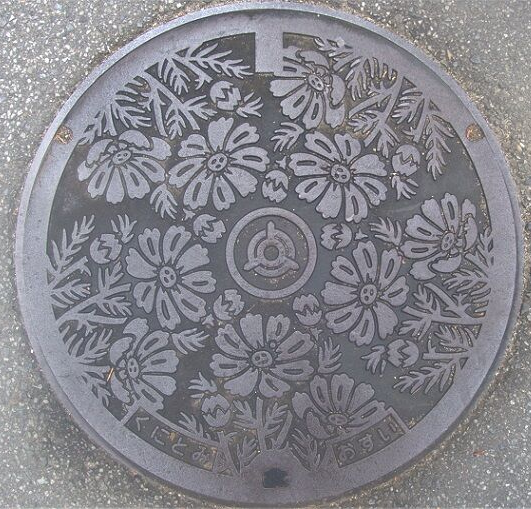
A design of the town's flower, cosmos, around the town emblem.
Kijo 木城町
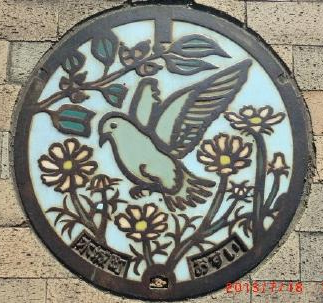
Color version of the design featuring the town tree Kashi, the town flower Cosmos, and the town bird Blue Dove.
Gokase 五ヶ瀬町
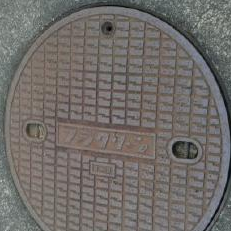
It is a manhole cover on the town hall premises due to unmaintained sewer systems. The cover has a U-shaped ground pattern and is labeled 'Fuji Clean.'
Shintomi 新富町
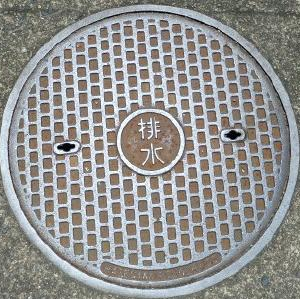
Drainage manhole cover on the town hall premises.
Takachiho 高千穂町
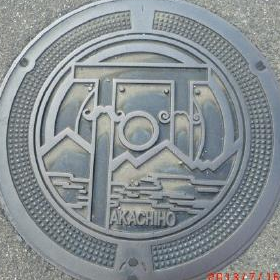
The letter 'T' in TAKACHIHO is made into a torii gate, spanning across the mountains of Takachiho, which are said to be the landing site of Ninigi (the grandson of Amaterasu), the Heavenly Grandchild. Behind it, the sun is shining. According to the response from Takachiho Town, it was a collaborative work selected from 24 entries submitted through a public call in June of Heisei 10 (1998). There are no remaining explanations or records of the design. It appears to have been inspired by the torii gates of Takachiho Shrine and Ama-no-Iwato Shrine. The 'mustache-like?' feature in the middle of the torii is also unclear in meaning (the interpretation of a thin, tall mustache might be a reference to the wooden statue of Mikenu-no-Mikoto, who defeated the demon Hachi, located at the far end of the corridor on the east side of the main hall of Takachiho Shrine).
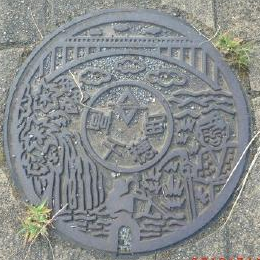
Around the central town emblem, a man in work clothes holding a large sickle is depicted, reflecting the fact that it is the birthplace of the Kariboseribiki song, along with scenes of people riding boats near Takachiho Gorge and Manai Falls, and the Takachiho Bridge.
Takaharu 高原町
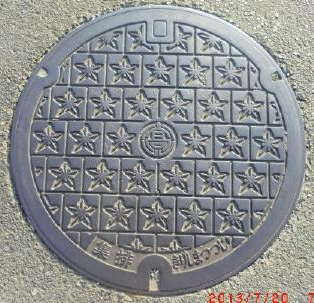
In the center, the town emblem. The entire lid features a design of the town's flower, Kirishima azalea. The characters 'Shūhai' and 'Kirishima Tsutsuji'.
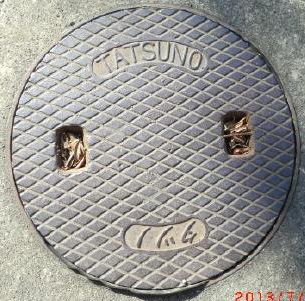
"The characters 'TATSUNO タツノ'. A manhole of Tatsuno Mechatronics Co., Ltd., a manufacturer of gasoline dispensers. It seems to be a manhole for refueling."
Takanabe 高鍋町
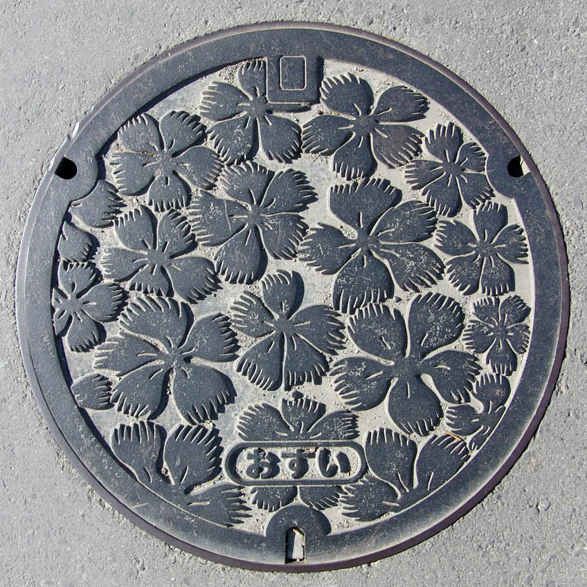
A sewage manhole cover featuring a drawing of the town's flower, 'Nadeshiko'.
Hinokage 日之影町
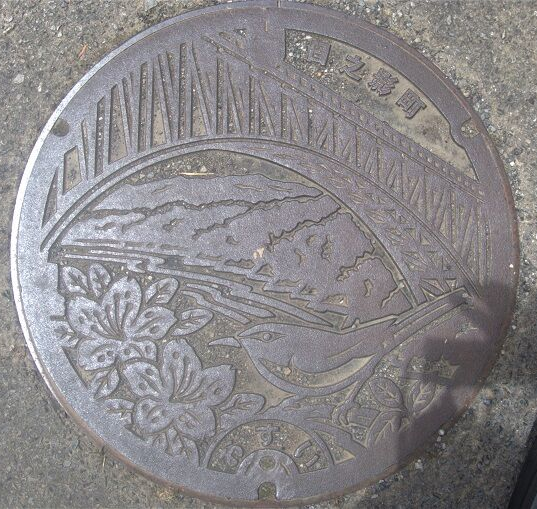
The design of Ryuten Bridge, a long bridge spanning the Gokase River in the adult district, featuring the town's bird, the bush warbler, and the town's flower, the azalea. (Explanation from Hinokage Town Hall) Listed as 'Hinokage Town' and 'Sewage'.
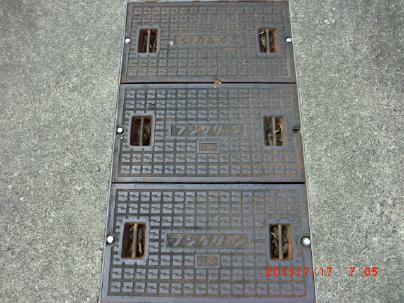
It is a three-connected set of square lids with a U-shaped ground pattern, labeled 'Fujiclean' and '2500k'.
Misato 美郷町
Former Kitago 旧北郷村
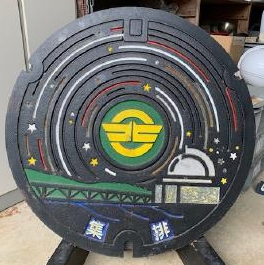
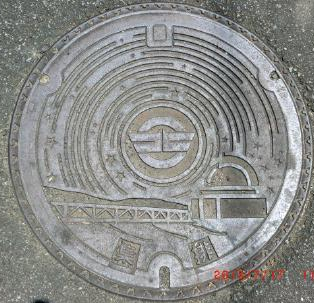
A manhole cover displayed at the Misato Town Hall. It features a color design depicting the starry sky spreading around the village emblem in the center and the Nakagoya Observatory Subaru Dome, completed in 1988 on a hill with an elevation of 902 meters. The characters "Shuuhai" are at the bottom.
Former Saigo 旧西郷村
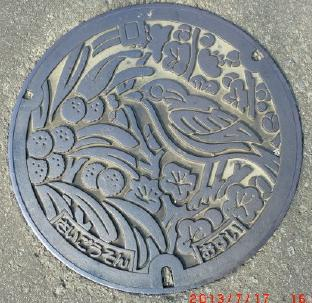
The design of the village tree, the yambomomo; the village flower, the plum; and the village bird, the Japanese white-eye.
Mimata 三股町
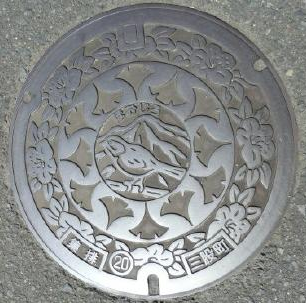
In the center, the town bird, the Japanese bush warbler; around it, the town tree, ginkgo; around that, the town flower, satsuki azalea design. At the bottom, the characters 'Shuhai', '20', 'Mimata Town'.
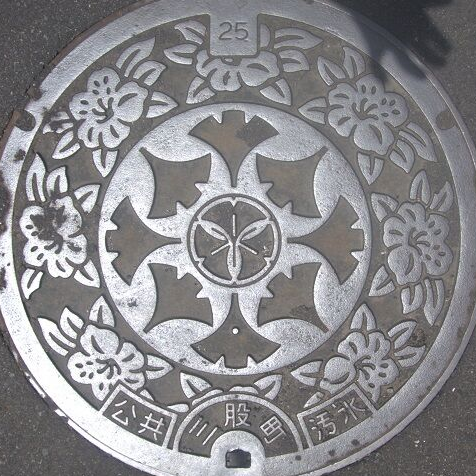
From the center, there is a design of the town emblem, the town tree ginkgo, and the town flower satsuki, with the words 'Public Sewage' and 'Mimata Town', and the number '25' at the top.
Shiiba 椎葉村
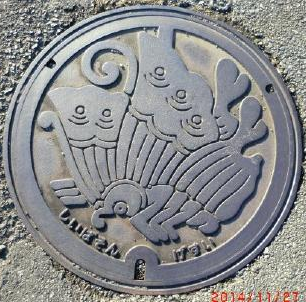
The crest of the Heike family features a butterfly design with the characters "Shiiba-son" and "Gesui." It is a manhole cover for drainage in a very small-scale agricultural settlement.
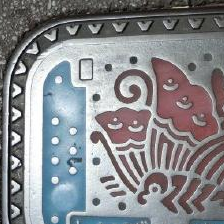
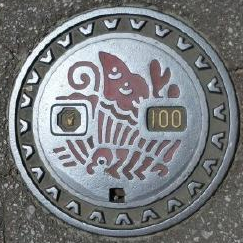
A size 100 partition valve handhole cover painted red with the Heike family crest 'Swallowtail Butterfly.' Shiiba Village is considered one of the places where the remnants of the Heike clan, who were destroyed in the Battle of Dan-no-ura, hid. It is slightly different from the 'Swallowtail Butterfly' in Izumi Town, Yatsushiro City, Kumamoto Prefecture.
Nishimera 西米良村
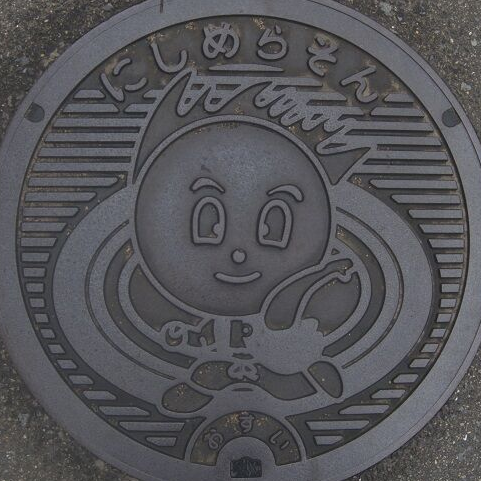
The village's official character 'Karikobōzu' Hoihoi-kun = the village's guardian deity. About Karikobōzu
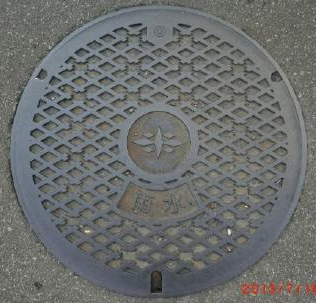
A lid with a raised grid pattern featuring the village emblem and the characters 'Rainwater'.
Morotsuka 諸塚村
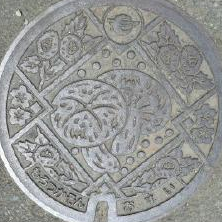
Specialty shiitake mushrooms, Muraki's oak trees, the village flower yamazakura, and the design of the village emblem.
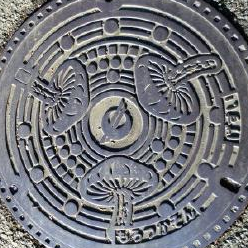
Around the village emblem, the local specialty shiitake mushrooms are depicted. The characters 'Morotsuka-son' and 'Gesui'.
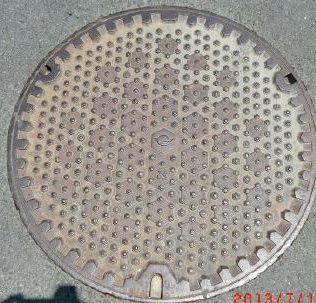
A lid with a slip-resistant design featuring the village emblem.
Miyazaki Prefecture 宮崎県
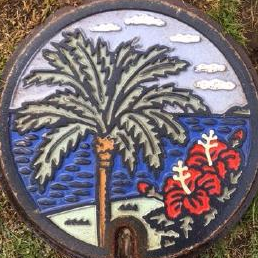
A color design of a palm tree and hibiscus, with clouds floating in the background of the Pacific Ocean and the sky. According to the designated administrator of the Michi-no-Eki Nangō, 'Specified Nonprofit Corporation Heartpia Nangō,' this manhole cover is managed by 'Miyazaki Prefecture'.
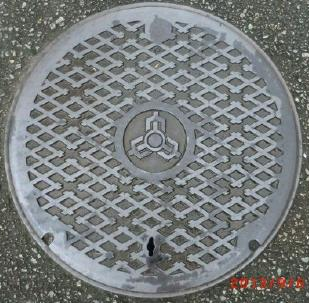
Features the prefectural emblem in a lattice pattern.
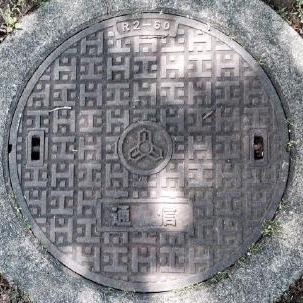
A ground pattern combining H and ・, with the prefectural emblem in the center, and the word 'Communication' just below it.
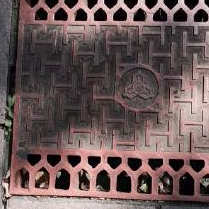
H-shaped ground pattern, side ditch cover with the prefectural emblem.