X Kagoshima 鹿児島県
Kagoshima 鹿児島県
 Kagoshima 鹿児島市
Designer

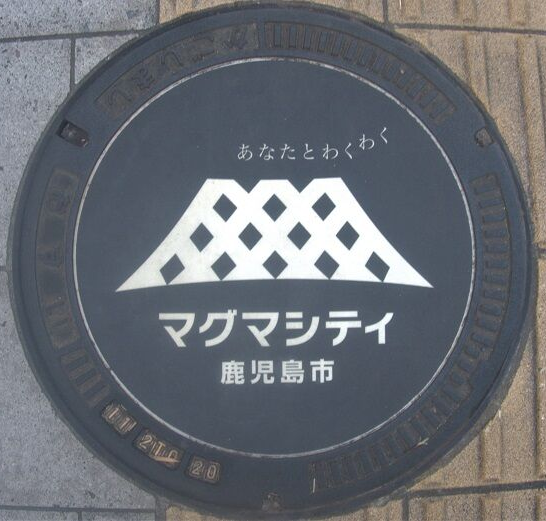
A printed seal design of the city's symbol mark 'Magma City.' This is the type with a white background. On the 28th, it will be installed in four locations: the west and east exits of Kagoshima-Chuo Station, near Kagoshima Aquarium, and in front of the city hall. The letters 'かごしまし' and 'おすい' are included.
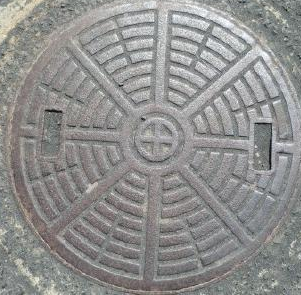
A design with concentric circles divided diagonally into eight parts, with the Shimazu family crest in the center.
Emblem
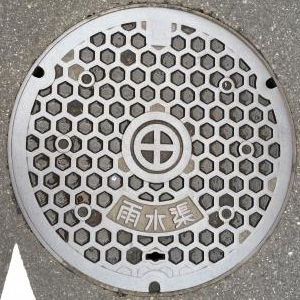
In the center of the tortoiseshell pattern is the Shimazu family crest, and below it are the characters 'Rainwater Drain.' This is a sewer manhole cover for collecting rainwater and discharging it into rivers and other waterways.
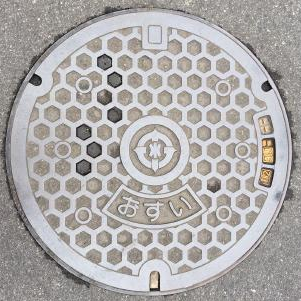
ASD (Anti-Slipping Design) type. It is a manhole cover with a small Shimazu family crest in the center. On the top, it has "11T-25 Hinode Waterworks Equipment Mark," and on the bottom, it has the characters "Kagoshimashi" and "Usuikyo" (rainwater channel).
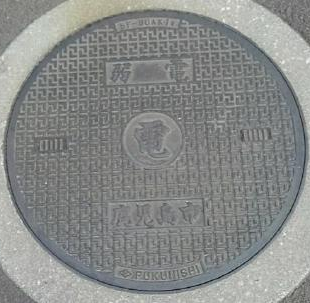
Quotation mark pattern made by HUKUNISHI, with the characters 'Weak Electric,' 'Electric,' and 'Kagoshima City' from top to bottom.
Other
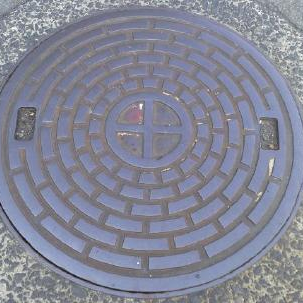
Concentric circle pattern, Shimazu family crest in the center, opening and closing hooks on the left and right.
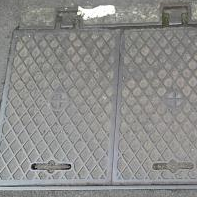
Diamond-shaped ground pattern, three connected lids (30 cm x 50 cm). In the center of each, the family crest of the Satsuma feudal lord 'Shimazu family,' a circle with a cross inside.
Handhole
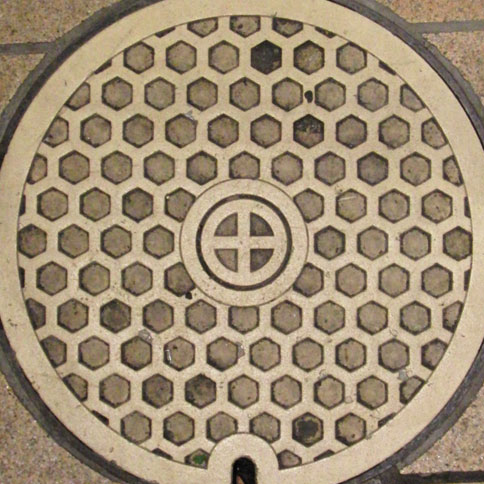
I thought the cross in the central circle was the emblem of Kagoshima City, but it turns out that it is actually the family crest of the Satsuma Shimazu clan.
It had been raining all day, and I couldn't even take photos of the unpainted manholes, but after having dinner at a shop in the city, I found this cover while wandering around.
Below is a mini version and the "Tenmonkan Street" with an arcade.
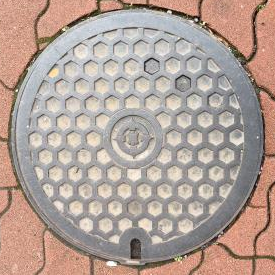
A small cover with the Kagoshima City Waterworks Bureau emblem in the center.
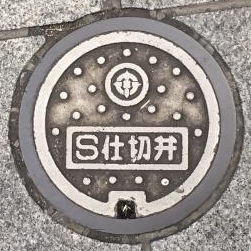
It is a small white cover with the Kagoshima City Waterworks Bureau emblem in the center and the letters 'S Shutoff Valve'.
Fire Hydrant
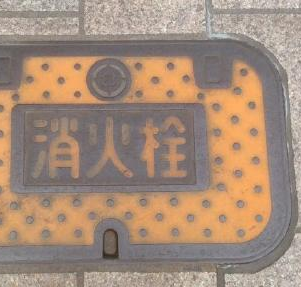
Yellow background with polka dot pattern, the crest of the Shimazu family 'Maru ni Ju no Ji' and the character 'Ichi' stylized within the outline of the city emblem, with the character for water inside, Kagoshima City Waterworks Bureau emblem and the words 'Fire Hydrant'. Fire hydrant cover with rounded corners.
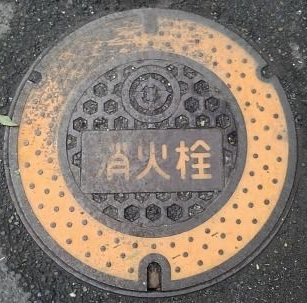
A tortoiseshell pattern with the Kagoshima City Waterworks Bureau emblem and the characters 'Fire Hydrant', with the outer edge in yellow featuring a polka dot pattern.
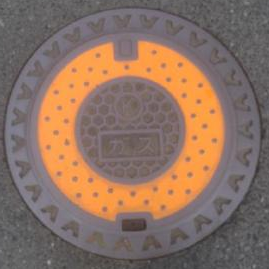
A tortoiseshell pattern with 'K' and 'Gas', surrounded by a yellow background with polka dots, V-shaped pattern on the receiving frame. Gas lid.
Generic (also used elsewhere)
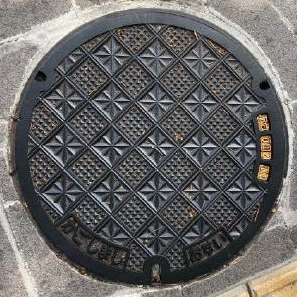
The Satsuma Kiriko, which serves as the motif for the design, is a glass craft that was primarily created as a trade item for overseas under the Shuseikan enterprise initiated by Shimazu Nariakira, the 28th head of the Shimazu family. The manufacturing method involves etching the surface of thickly overlaid colored glass on the outside of transparent glass at varying depths, resulting in delicate and beautiful patterns. This manhole cover represents the intricate and beautiful patterns of Satsuma Kiriko by processing the uneven surface of the cover at an angle, a method that is rare throughout Japan. In addition, Satsuma Kiriko was produced around the time of the Meiji Restoration, and the year 2018, when this cover was created, marked the 150th anniversary of the Meiji Restoration.
Collaboration
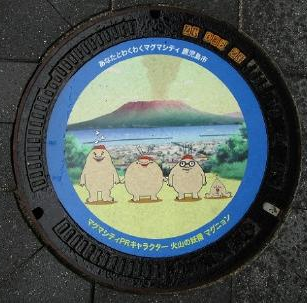
Printed seal design of Sakurajima and Magma City PR character, the volcano fairy 'Magnyon.' From left: 'Rikinyon, Marunyon, Meganyon, Bebinyon.' On the upper part of the outer perimeter: 'Exciting Magma City with You, Kagoshima City,' and on the lower part of the outer perimeter: 'Magma City PR Character Volcano Fairy Magnyon.'
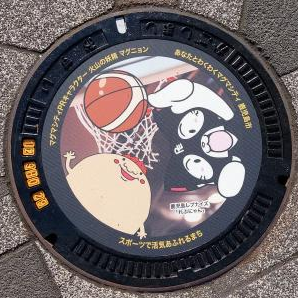
Designs of Marnyon, the fairy of Magma City Volcano, and Revnyan of the Kagoshima basketball team 'Rebnize.' Promotes a 'city full of sports and vitality.'
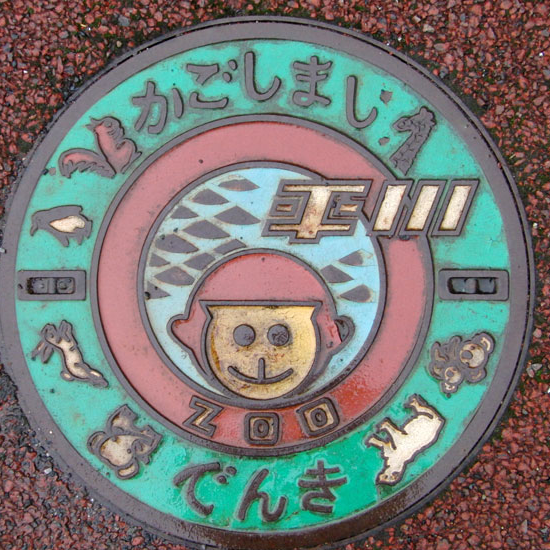
A manhole cover at the municipal Hirakawa Zoo in Hirakawa-cho, Kagoshima City. From the characters 'でんき' (denki, meaning electricity), it is clear that this is related to electrical work rather than the sewage system.
The central monkey and the characters '平川' (Hirakawa) and 'ZOO' appear to be the symbol mark of Hirakawa Zoo.
 Former Matsumoto 旧松元町
Designer
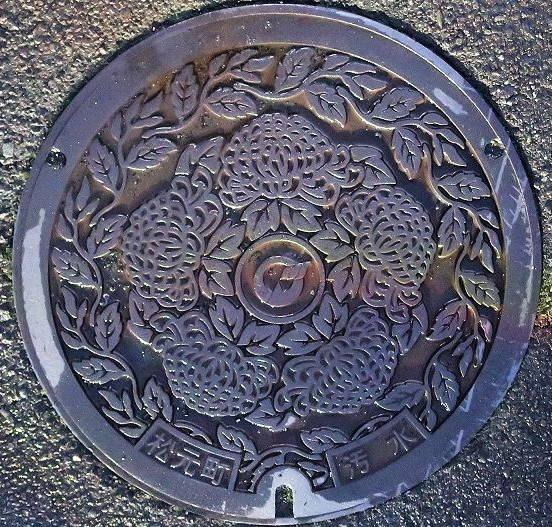
The town emblem is in the center. Around it are the town's flowers, chrysanthemums, and on the outer edge, chrysanthemum leaves are designed.
 Aira 姶良市
Other
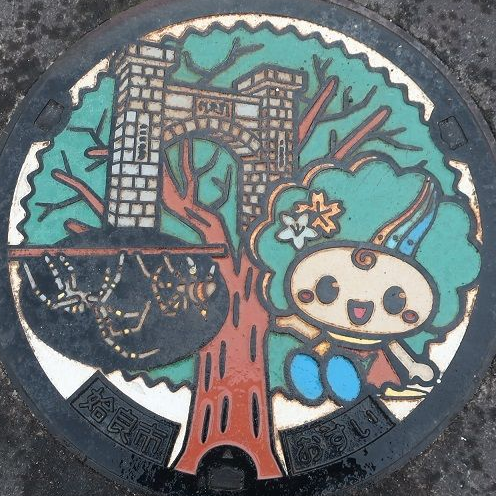
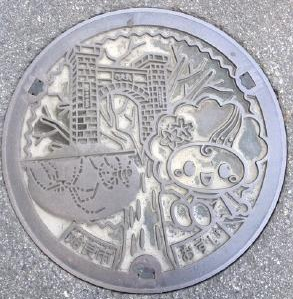
This is a colored manhole cover featuring the city's image character 'Kusumin,' the Yamada Triumphal Arch, and the Spider Battle. Kusumin is the fairy of 'Gamo no Kusu,' Japan's largest tree. The Yamada Triumphal Arch was built to commemorate the safe return of people from Yamada Village (at the time) who participated in the Russo-Japanese War, and the Spider Battle has been passed down for over 400 years and is recognized as an intangible folk cultural asset of the country. It also includes the words 'Aira City' and 'Osui.'
Collaboration
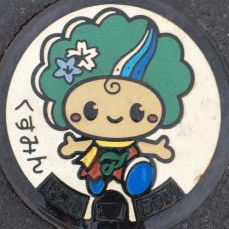
A small model with a color design featuring only 'Kusumin.' Includes the words 'Kusumin,' 'Aira City,' and 'Osui.'
 Former Aira 旧姶良町
Designer
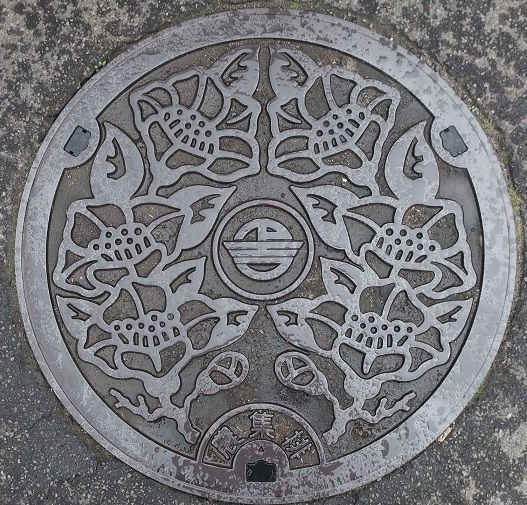
Former Aira Town emblem and the old town's flower, sasanqua camellia. The notation 'Nōshūhai'.
 Former Kajiki 旧加治木町
Designer
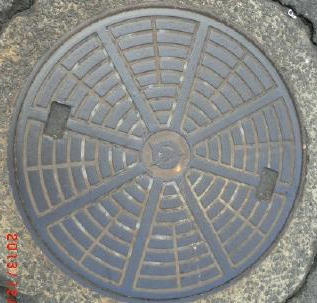
A design that divides the concentric circle pattern diagonally into eight parts, with the town emblem in the center. Manhole cover for community plants.
 Amami 奄美市
Designer
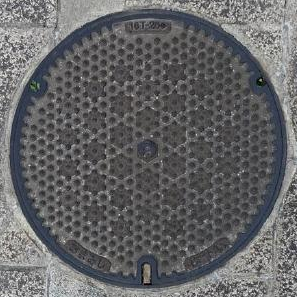
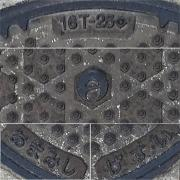
It is a slip-resistant design made by Hinode Suido Kiki, with the emblem of Amami City in the center, the model number '16T-25' and the manufacturer's logo at the top, and the characters 'あまみし' and 'げすい' at the bottom.
 Former Naze 旧名瀬市
Designer
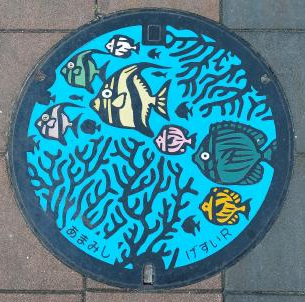
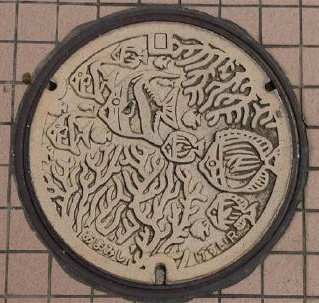
In the design of the manhole card, it has 'Amamishi' at the bottom. However, it is colored in a single beige tone, and the text at the bottom right reads 'Gesui R,' so it might be for rainwater.
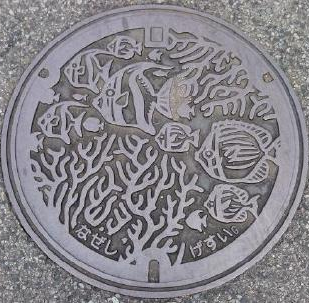
"The words 'Naze Shi' and 'Gesui G' on a design of coral reefs and tropical fish."
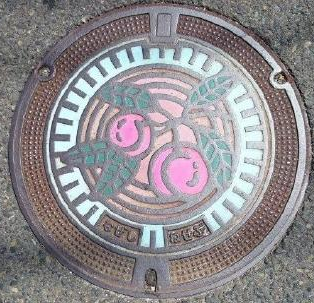
A design featuring the locally produced plum (from the Sewerage Division, City Water and Sewer Department). A color version with the characters 'Naze-shi' and 'Nese-bu'.
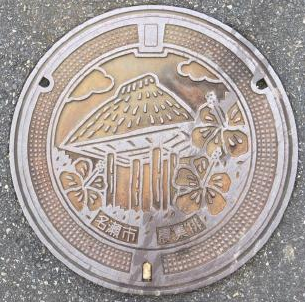
Takakura, a representative raised-floor granary of Amami, and the design of the city flower, hibiscus. The characters 'Naze City' and '農集排'.
Other
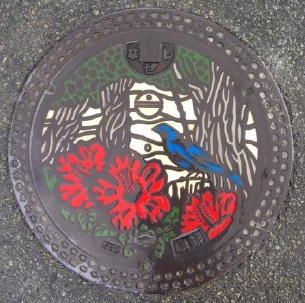
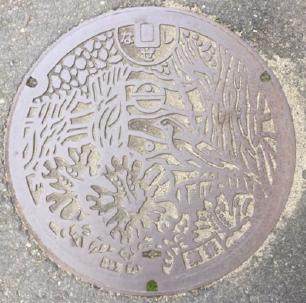
From the front, the city flower hibiscus, the Ryukyu jay, and the city tree mangrove are depicted. The city emblem is at the top with 'Naze-shi' above it, '1201' below it, and the characters for 'Nōshū'. This was the only colored manhole in front of Kominato Elementary School. The Ryukyu jay is the only wild bird in the world that exists only on Amami Oshima in Kagoshima Prefecture, is a national natural monument, and is the bird of Kagoshima Prefecture.
 Former Kasari 旧笠利町
Designer
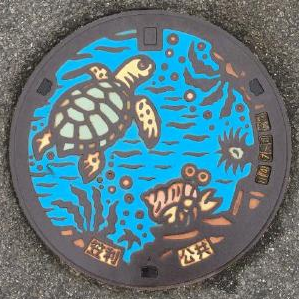
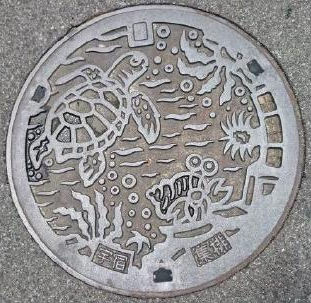
Color design of a sea turtle and a hermit crab swimming in the ocean. The characters 'Kasari' and 'Koukyou'
 Former Sumiyo 旧住用村
Designer
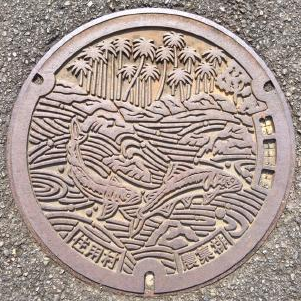
It looks like the design of Sumiyo River, where Ryukyu ayu live, and the mangrove national park. The characters 'Sumiyo Village' and '農集排'.
 Isa 伊佐市
 Former Okuchi 旧大口市
Designer
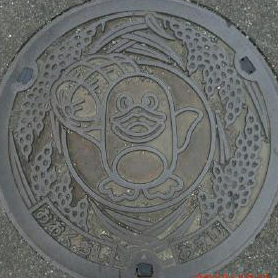
A character resembling Q-taro, a ghost with a big mouth, is carrying a rice bale. Rice ears surround it. There is the notation "おおくちし" and "おすい".
The following is from the Ministry of Land, Infrastructure, Transport and Tourism, Kyushu Regional Development Bureau, Sendai River Office Management Division.
① Design: It seems to be the mascot "Kūri" of former Okuchi City. Around the design are rice ears, and Kūri is carrying a rice bale.
② Reason for use: The agricultural village sewage project began operation in fiscal year 2004. At that time, it was popular to include each municipality's mascot in the manholes installed for this project.
 Former Hishikari 旧菱刈町
Designer
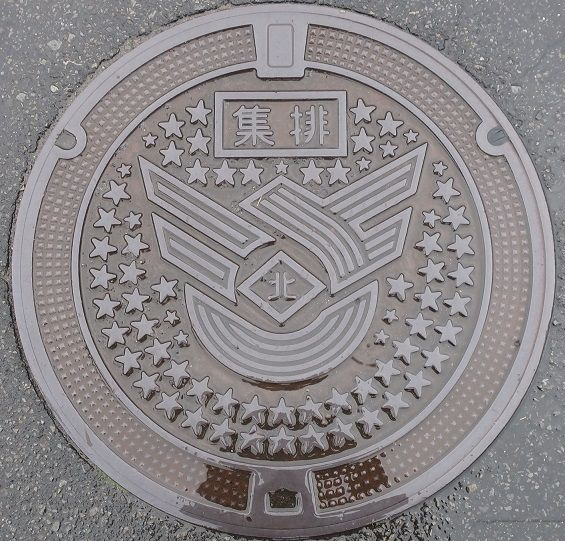
The old town emblem, featuring a mark with the character '北' (North) inside a rhombus, is prominently depicted in the center, with stars scattered around it and four layers of indents and protrusions drawn on the outer edge. It displays '集排'.
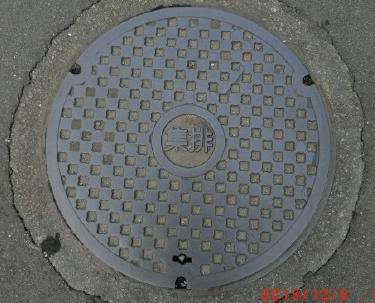
In the center of a square pattern with rounded corners, the characters 'Shūhai' are written.
 Ichikikushikino いちき串木野市
Handhole
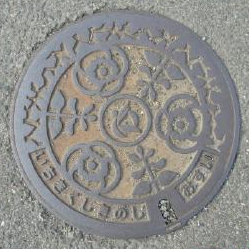
A design of a small lid from the time of former Kushikino City, featuring the emblem of Ichikikushikino City and the new display of 'いちきくしきのし'.
 Former Kushikino 旧串木野市
Designer
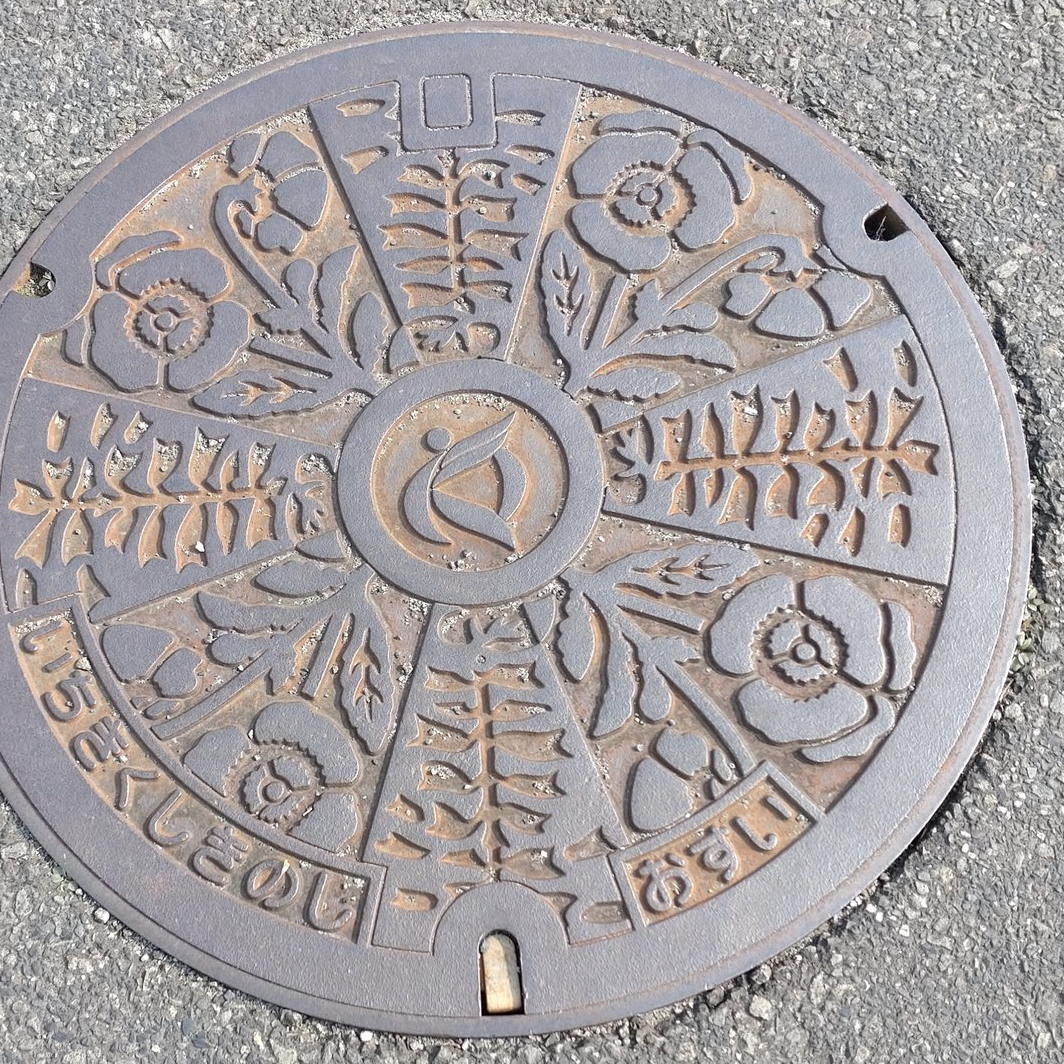
The spring flower 'pansy' and the autumn flower 'salvia' are depicted.

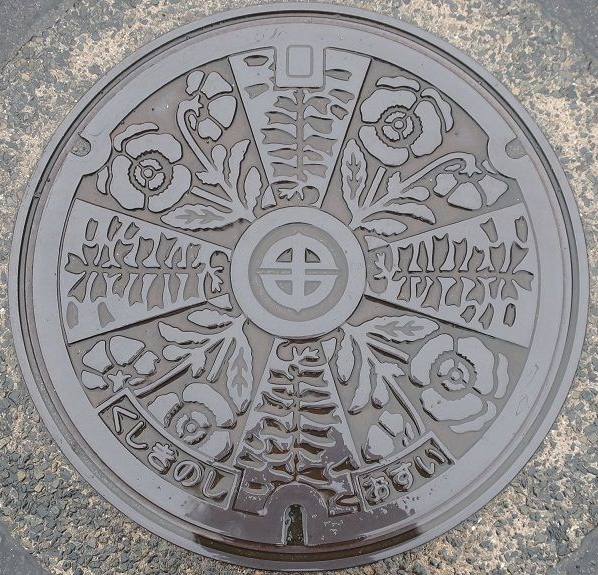
The emblem of the former Kushikino City and the city's spring flower, the pansy, and autumn flower, the salvia. Displays of 'Kushikino-shi' and 'Osui'.
Handhole
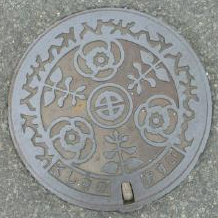
A small lid with a simplified design of the city emblem, the city's spring flower pansy, and autumn flower salvia.
 Former Ichiki 旧市来町
Designer
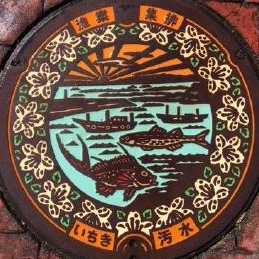
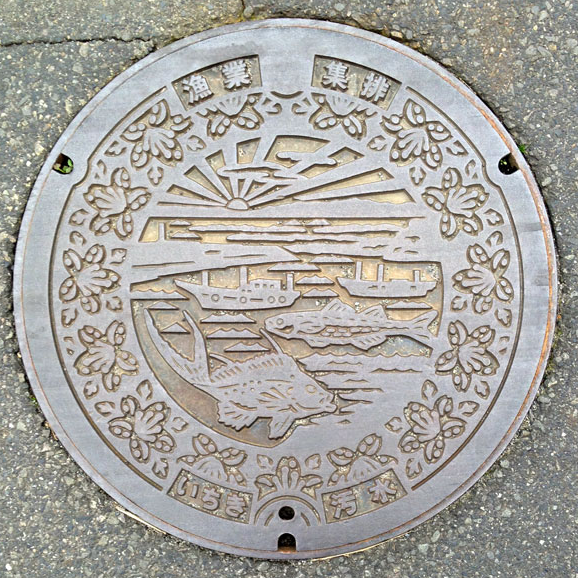
Manhole covers for the fishing village sewage in the Tozaki and Sakino districts. The surrounding flowers appear to be the town's flower, the 'azalea.' In the center, a fishing port scene and two types of fish are depicted.
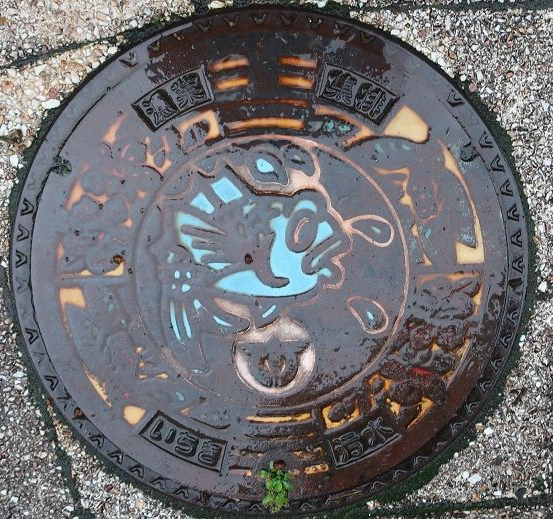
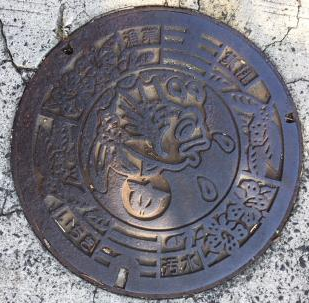
It is a color design with a sea bream and the town emblem in the center, surrounded by the town's flower azalea and the town tree Chinese photinia. It includes the words 'Fisheries Collection and Drainage' and 'Ichiki Sewage'.
Emblem
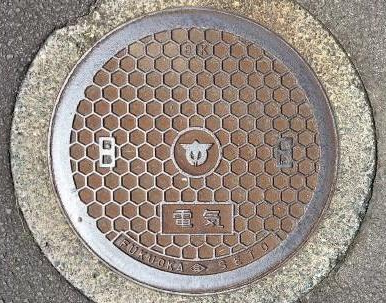
Tortoise shell pattern, the character 'Electricity' under the town emblem.
 Ibusuki 指宿市
Designer
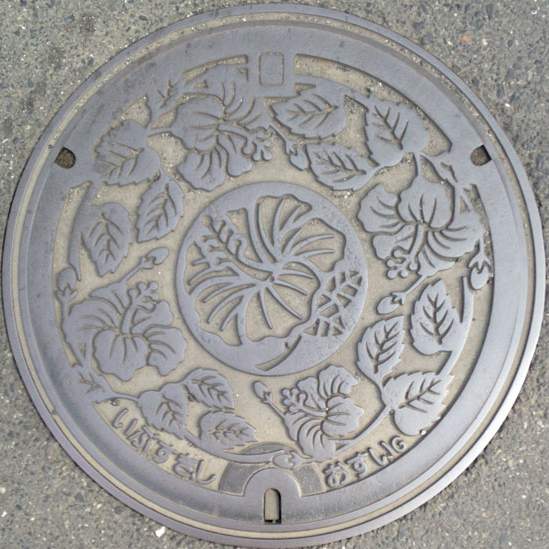
A sewage manhole cover depicting the city's flower, the 'hibiscus'.
Handhole
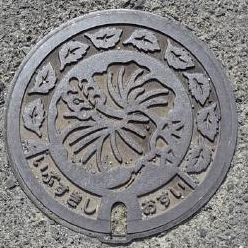
A large hibiscus flower is placed in the center, with only leaves arranged around it. Along the bottom edge, the characters 'Ibusuki City' and 'Sewage' are included.
Collaboration
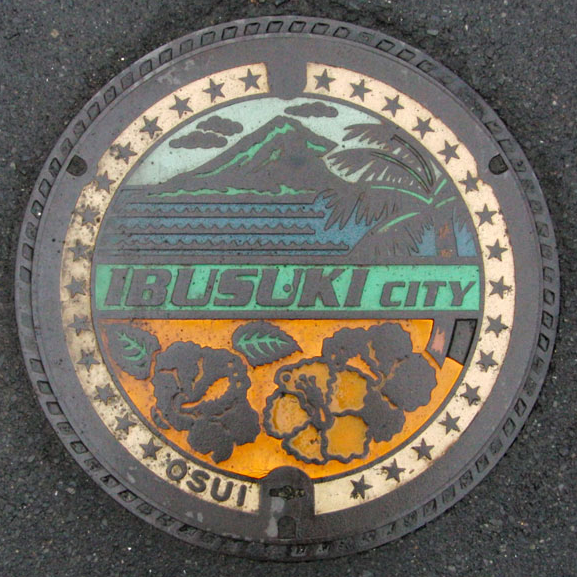
The lower half is undoubtedly the city's flower, the 'hibiscus,' but the upper half of the scenery looks like Mount Kaimon as seen from around Nagasakibana in the former Kaimon Town, so this lid might be from after it became the new Ibusuki City.
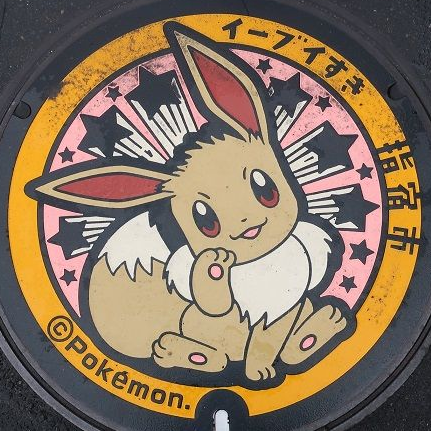
This is a color design featuring Eevee from Pokémon GO and the text 'I Love Eevee Ibusuki City.' It was created and installed on December 20 because the name plays on the similarity of sounds between 'I love Eevee' (Iibusuki) and 'Ibusuki,' leading to Eevee being appointed as the sports and cultural exchange ambassador of Ibusuki City. On February 22, 2019, eight of Eevee's evolved form manhole designs (out of a total of nine types) will also be installed.
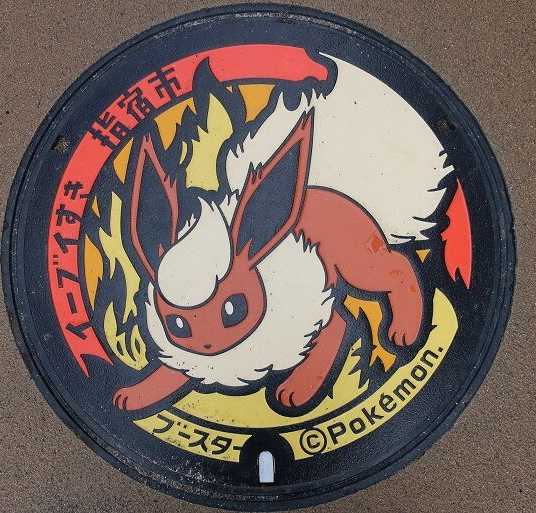
This is one card of the nine in the Eevee series, 'Flareon'.
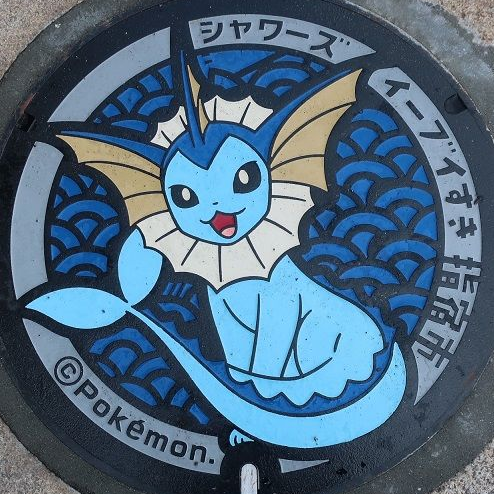
This is 'Vaporeon'.
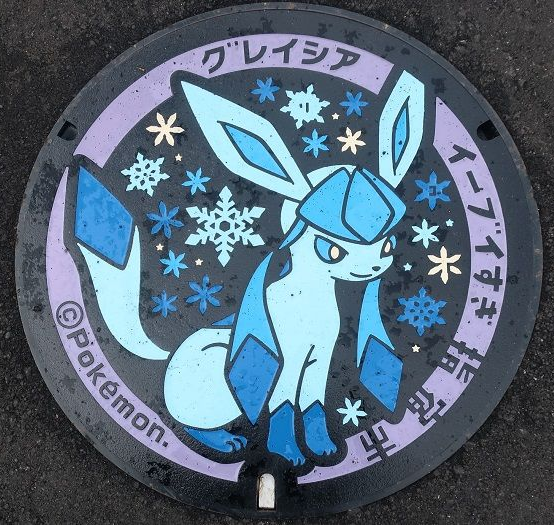
This is 'Glaceon'.
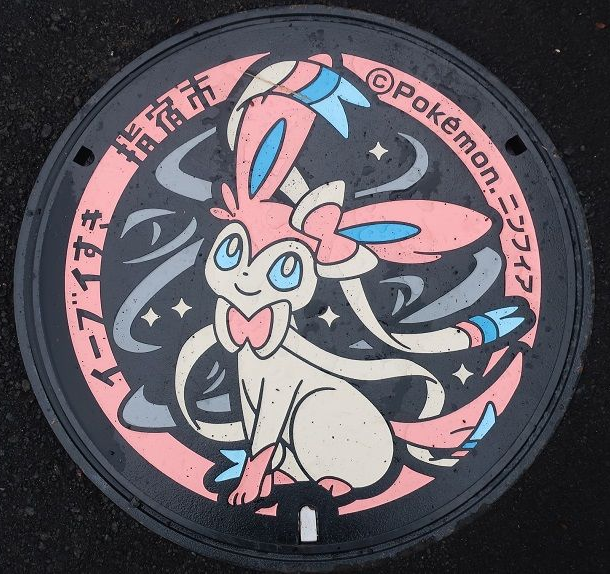
This is 'Sylveon'.
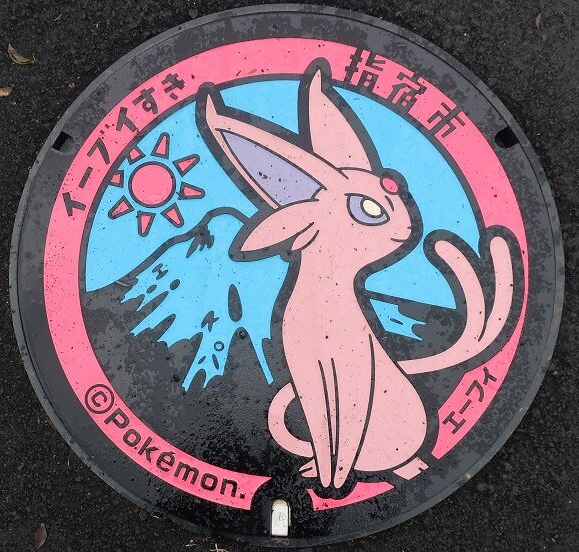
This is 'Espeon'.
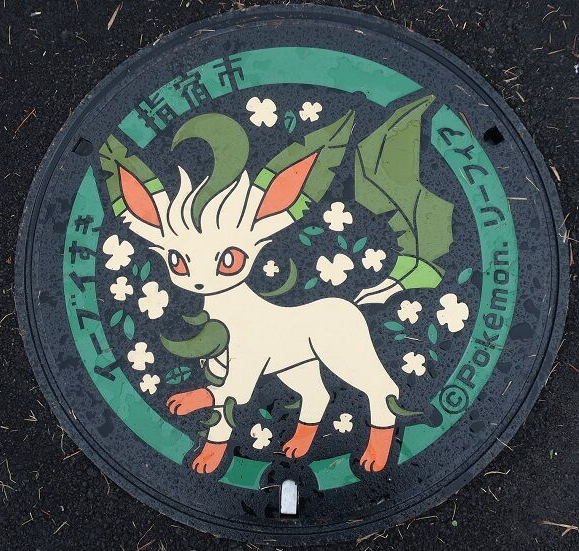
This is 'Leafeon'.
 Izumi 出水市
Designer
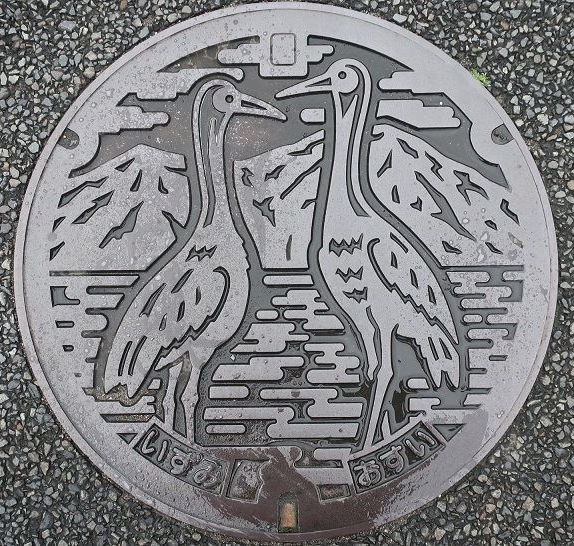
The Izumi crane migration site and two cranes are depicted in the design.
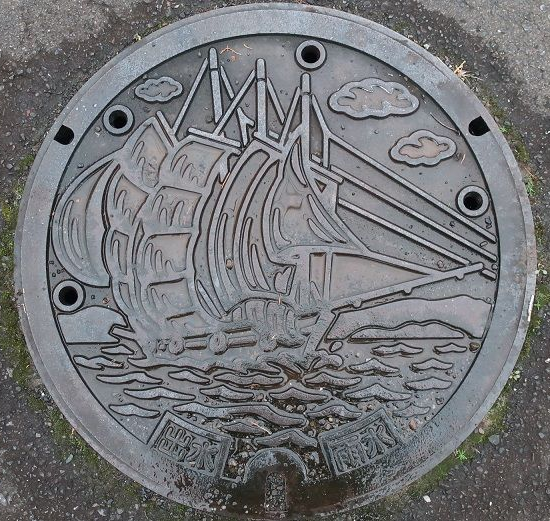
The illustration of the 'Keta Utasebune' shows the characters 'Izumi' and 'Rainwater.' There are holes in the upper half of the outer edge.
'Keta Utasebune fishing is a method in which iron claws and nets are attached to a wooden frame and dragged along the seabed. Initially, it was a method for harvesting 'tori-gai' (ark shell), but as shrimp began to mix in, the fishing gear was improved, and currently it is a method for harvesting particularly 'Kuma shrimp.' As of fiscal year 2005, the number of vessels has decreased to five. Keta Utase fishing operates every year from November to March of the following year, coinciding with the arrival of cranes, and during this season, it has become a tourist attraction as a 'winter tradition' of Izumi.' (From Izumi City Sewerage Division)
Handhole
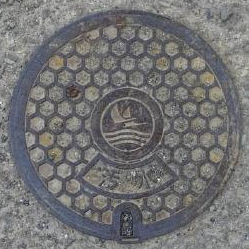
In the center of the tortoiseshell pattern, there is the new city emblem after the merger, and below it are the characters 'sewage'.
Fire Hydrant

A lid with a yellow background and polka dot pattern, featuring a water symbol, and large characters 'Fire Hydrant' below a red ladder truck.
Collaboration
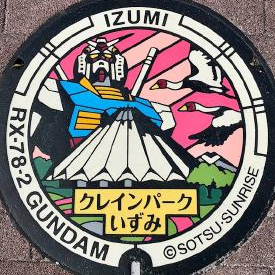
It was donated through the 'Gundam Manhole Project.' The design features the 'RX-78-2 Gundam,' cranes flying over Izumi Plain, and the Tsuru Museum in the city, 'Crane Park Izumi.' After being displayed in the city hall first-floor lobby until mid-May, they will be installed at 'Crane Park Izumi' and 'Izumi Fumoto History Museum,' respectively.
 Former Izumi 旧出水市
Designer

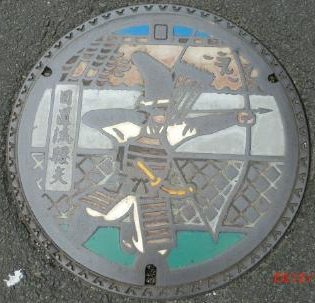
The archery method "Heki-ryu Koshiya," in which one kneels on the left knee, lowers the hips, and raises the right knee in the folding posture, is a practical style of archery transmitted in the Izumi region, advancing while shooting arrows alternately in two rows. The "Bukeyashiki-gun" in the foothill area of Izumi City was one of the outer fortresses established for the defense against Higo and served as both the residence and military post for the Satsuma clan officers assigned there. Izumi Elementary School is located on the site of the former government lodging, with the old lodging gate being used as the school gate. These colored manhole covers could be seen throughout the roads of the "Bukeyashiki-gun".
 Former Takaono 旧高尾野町
Designer
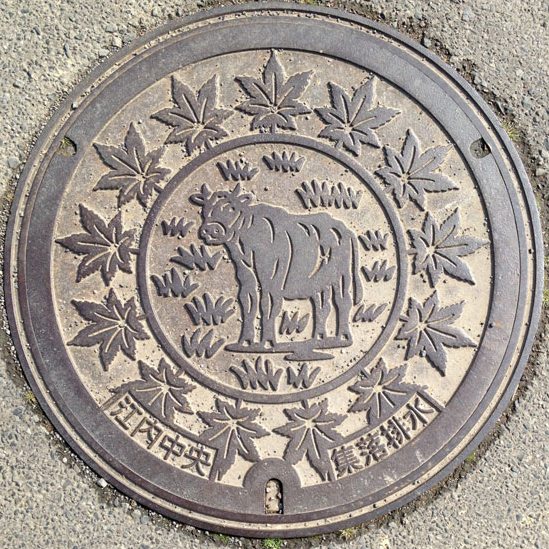
A manhole cover for agricultural village drainage in the central area of Takaono Town. It depicts the town tree, the maple, and a cow.
Handhole
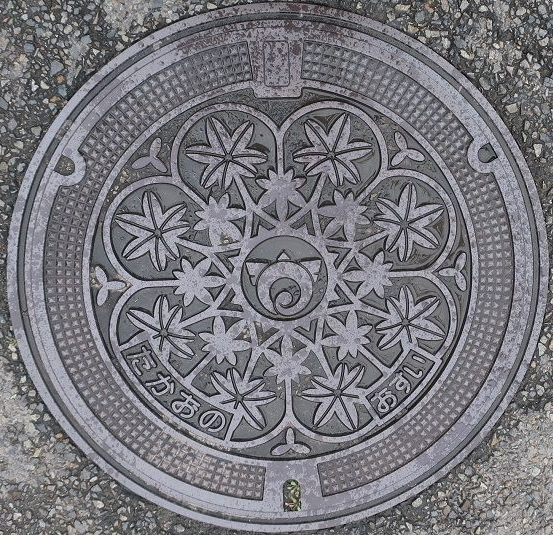
The design of the town emblem and the town tree, the maple, includes the characters 'たかおの おすい'.
 Former Noda 旧野田町
Emblem
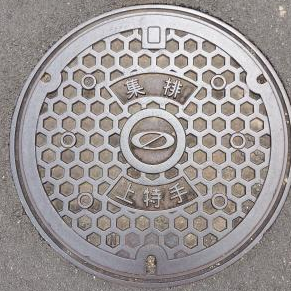
A tortoiseshell pattern, with the town emblem in the center, the characters '農集' above and '上特手' below.
 Kanoya 鹿屋市
Designer
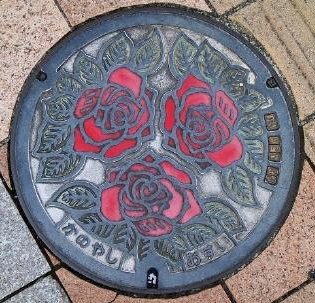
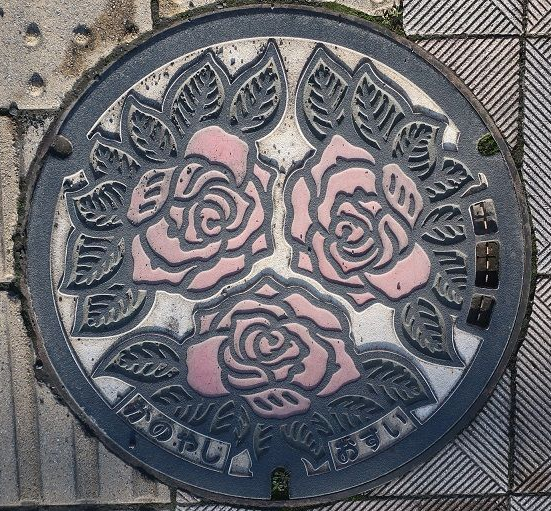
This is a color manhole cover designed vividly and gorgeously with the red 'roses' of 'Kanoya Rose Garden,' a tourist attraction in Kanoya City. From the roses blooming on the streets that harmonize with the city, it feels as if a sweet and rich fragrance spreads in the breeze... Kanoya Rose Garden boasts the largest rose garden in Japan, with 35,000 rose bushes planted across its vast grounds. During the best viewing seasons in spring and autumn, the 'Kanoya Rose Festival' is held. The spring blooming season, in particular, reaches full bloom around Golden Week, ahead of the rest of Japan. While enjoying delicious local gourmet foods such as Kagoshima black beef and Kanoya amberjack, please come to Kanoya City and look for the rose manholes blooming at your feet. Acquisition Date: July 28, 2023
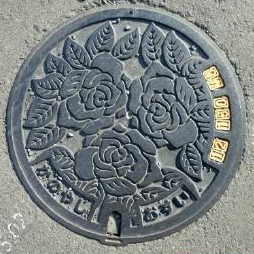
The city's flower: a non-colored rose design.
Fire Hydrant
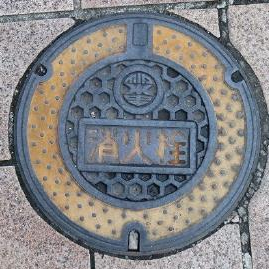
The mark in the center is a combination of 'Kanoya,' 'Water,' and 'Kushi' from the top. It is a manhole cover for the Kanoya-Kushira regional water supply project, one of the four districts of the Kanoya City waterworks. Fire hydrant handhole cover.
 Former Kihoku 旧輝北町
Designer
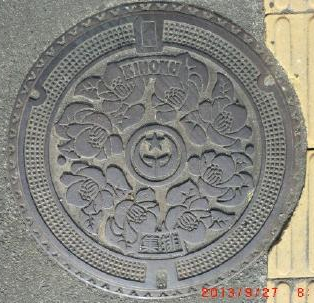
A design of the town's flower, the camellia, around the town emblem. The characters 'KIHOKU' and 'Shuhai'.
 Kirishima 霧島市
Designer
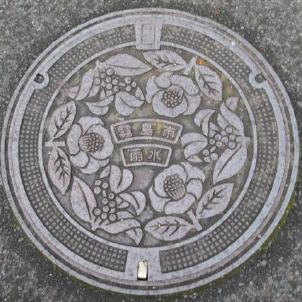
The design is the same as that of former Kokubu City, which depicted former Kokubu City (Ichiki Kuromanemochi) and former Hayato Town (Town Flower Camellia), but it is labeled 'Kirishima City' and 'Rainwater'.
 Former Kokubu 旧国分市
Designer
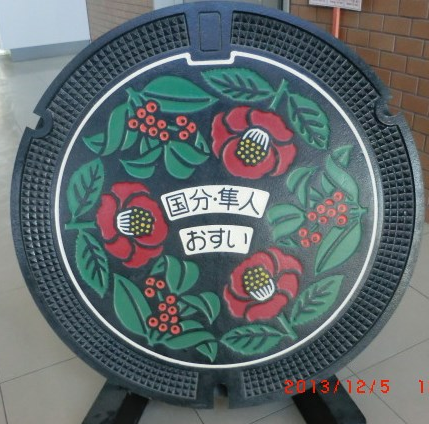
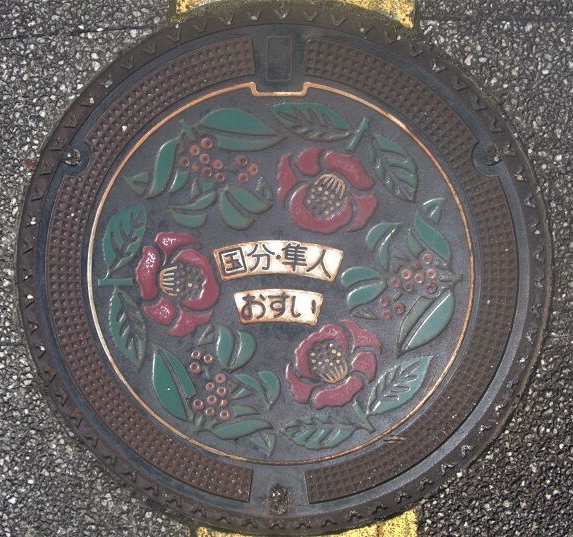
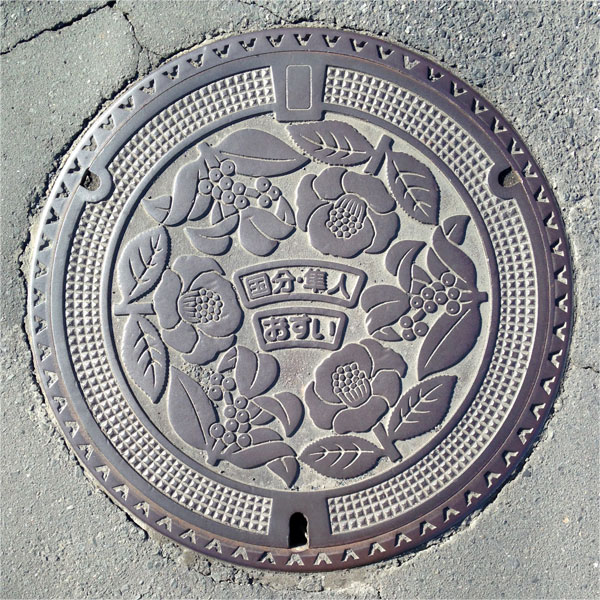
It is a shared lid of former Kokubu City and former Hayato Town, featuring Kokubu City's tree, the black Chinese holly, and Hayato Town's flower, the camellia, in the design.
 Former Hayato 旧隼人町
Other
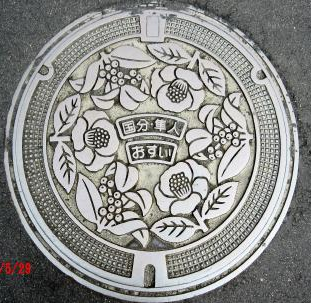
Joint name of sewer manhole covers of former Kokubu City (City Tree: Japanese Holly) and former Hayato Town (Town Flower: Camellia).
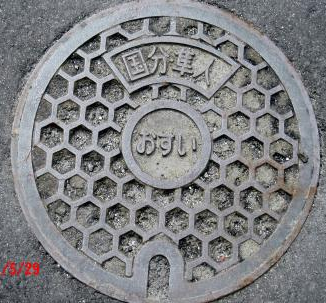
Hexagonal pattern jointly displayed by Hayato Town and Kokubu City.
Collaboration
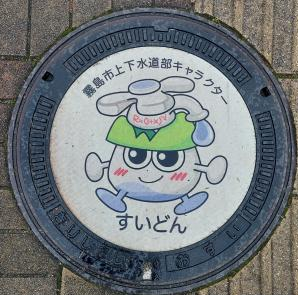
The 'Suidon' depicted on this manhole cover was created in August 2022 as a character for the Kirishima City Water and Sewer Department. The name 'Suidon,' which combines the 'sui' from water and 'don' from the Kagoshima dialect, was selected through a public naming contest among elementary, junior high, and high school students in the city. The character was designed by Ryuhiko Kuramaro, a manga artist from Kirishima City. The water supply is sourced from the water that springs from the Kirishima mountain range, which resembles a hat, and the sewage is purified and returned to the Kinko Bay at your feet, representing the water cycle throughout the character's entire body. Water is essential for life, and Suidon works hard to encourage people to be interested in and feel familiar with water and sewer systems, which are not usually visible.
Date obtained: April 26, 2024
 Former Makizono 旧牧園町
Designer
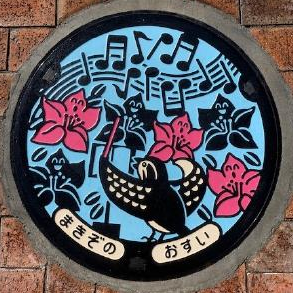
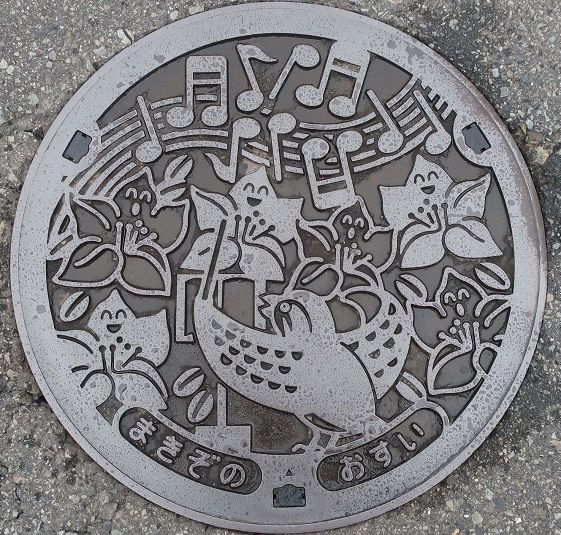
The following is an explanation from the Sewerage Division of the Construction Department of Kirishima City:
"This is the town bird, the Yellow-throated Bunting, the town flower, the Miyama Kirishima azalea, and a musical score of the former Makizono Town. In the Takachiho area, where the sewerage has been developed, there is the Miyama Concert Hall, a music-specific hall managed by Kagoshima Prefecture, where the Kirishima International Music Festival is held every year. The design depicts 'the Yellow-throated Bunting holding a conductor's baton, playing music with the flowers.' It is said that if you listen closely, you can hear the musicians performing, as well as the voices and whispers of birds, insects, and flowers."
Handhole
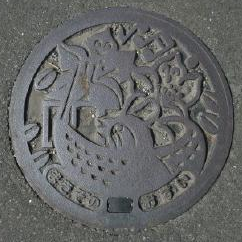
A small cover with a simplified design of a non-colored manhole.
Related: Hayato Public Sewerage Association 隼人公共下水道組合, Kokubun Hayato Public Sewerage Association 国分隼人公共下水道組合
 Satsumasendai 薩摩川内市
Handhole
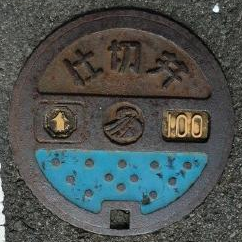
Small water valve cover with the city emblem.
 Former Sendai 旧川内市
Designer
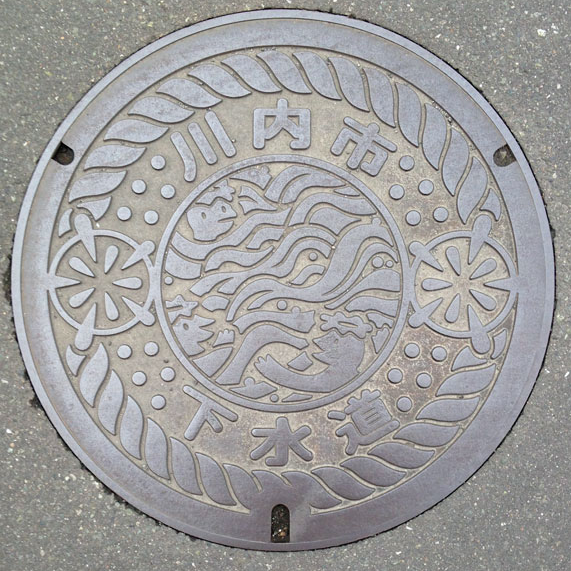
It depicts a kappa playing in the Sendai River and fireworks from the Sendai River Fireworks Festival, but can you find the kappa? There's also one in the upper left of the central part, but they are easier to spot at the bottom and lower left. In Kagoshima, kappas are called 'Garappa', and with the motto 'Water is life, kappa is heart', they established the 'Sendai Garappa Republic' to work towards making the Sendai River a clean river where kappas can live again. Surrounding it is the rope from the Sendai Ōtsunahiki (great tug-of-war).
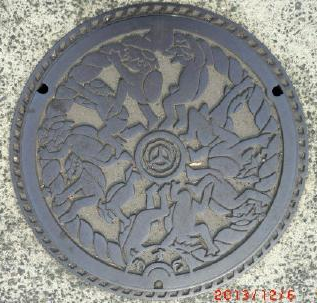
Explanation from the Sewer Department of Satsumasendai City Waterworks Bureau.
"Kappa and the Kawauchi Great Tug-of-War. The image is of the 'kappa,' a creature traditionally associated with the Kawauchi River, participating in the Kawauchi Great Tug-of-War held every year on September 22nd (said to be the largest tug-of-war in Japan)." Display with the old city emblem and 'Usui' marked.
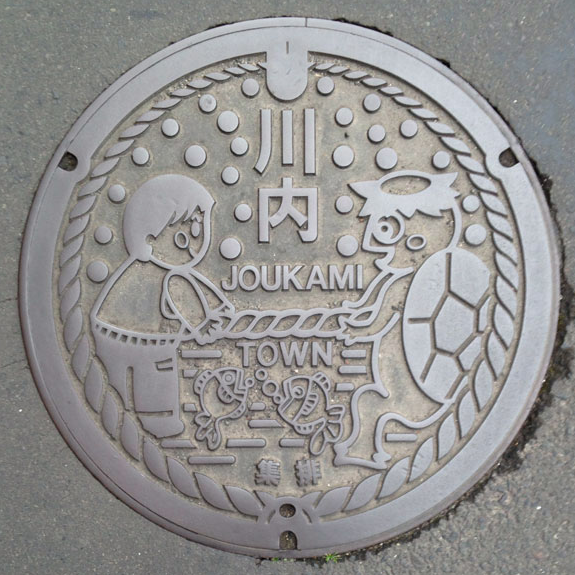
Cover for the agricultural settlement drainage in the Jōjō processing area. Children and Gyarappa playing tug-of-war.
Emblem

Standard manhole with the old city emblem. Has two keyholes.
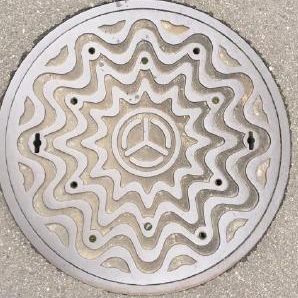
A perforated lid with a wavy pattern that spreads out like ripples, with the old Sendai City emblem in the center and keyholes on the left and right.
Handhole
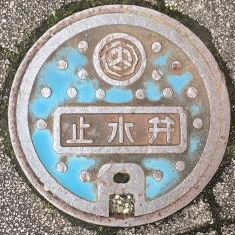
Sendai City's old city emblem and the characters 'Shisuiben' (stop valve). It has a blue background with a polka dot pattern.
 Former Sato 旧里村
Designer
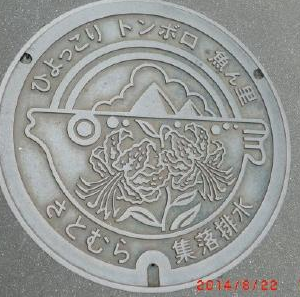
On the symbol mark of Sato Village before the merger, the village flower, the Kanoko lily, is depicted on the belly of a fish. The text reads: "Hyokkori Tombolo Fish Village Sato Village Sewage System." A tombolo is a land-connected sandbank, referring to an island that is connected to the continent or a large island by a sandbank.
 Former Kamikoshiki 旧上甑村
Designer
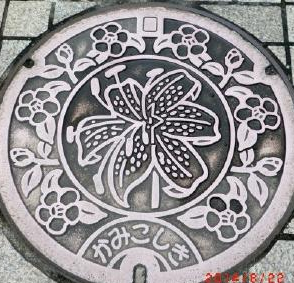
In the center, the village flower, Kanoko lily, and around it, the village tree, camellia. The characters 'Kamikosiki'.
Handhole
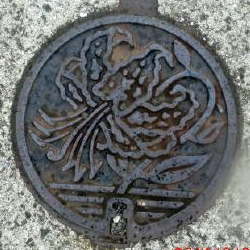
A small type with three horizontal lines under the Kanoko lily.
 Former Shimokoshiki 旧下甑村
Designer
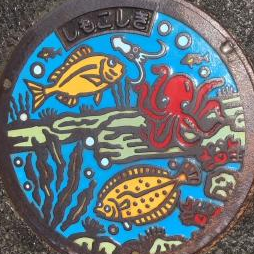
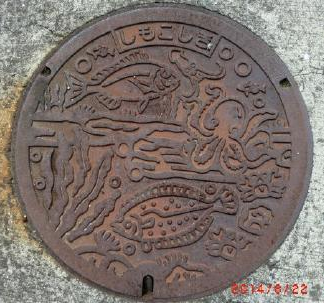
Fish, octopuses, squids, and other creatures of the sea are depicted colorfully. I could only find one. According to the Satsumasendai City Waterworks Bureau Sewerage Division, it is said to represent the 'image of the Koshiki Islands.' The characters 'Shimo-Koshiki' are written.
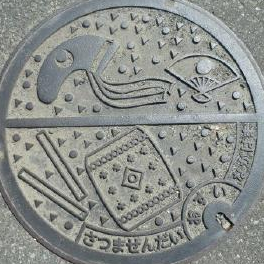
Designs for manhole covers with a rich local character representing Nagahama were solicited from the students of Nagahama Elementary School and Kaisei Junior High School, and two works were selected from the entries. "The hat and fan at the upper right represent ‘Dewa Odori,’ a traditional performing art of Nagahama, and the drum at the lower left was drawn with the image of the ‘Hato Drum,’" explained the author (from Satsumasendai City Office). The text at the bottom reads 'Satsumasendai,' 'Osui,' and 'Nagahama.' The text for Osui is oriented correctly at the bottom. Specific Environmental Conservation Public Sewerage Project, Nagahama Area, Sewage Manhole Cover.
Handhole
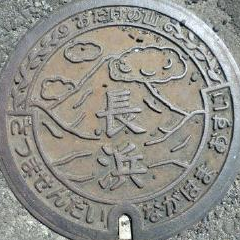
"On a sunny day, I drew the scenery where the otake looks very beautiful together with the vine" (author's explanation) (from Satsumasendai City Office).
A small cover featuring the words 'Nagahama' against the background of 'Otake Mountain,' with the words 'Satsumasendai' and 'Nagahama Sewer' at the bottom.
Specific Environmental Conservation Public Sewerage Project, Nagahama District, Small Sewage Cover
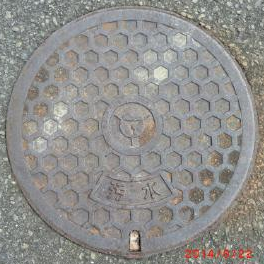
A small lid with a tortoiseshell pattern in the center bearing the village emblem, and below it the characters for 'sewage'.
Related: Hayato Public Sewerage Association 隼人公共下水道組合
 Shibushi 志布志市
 Former Matsuyama 旧松山町
Designer
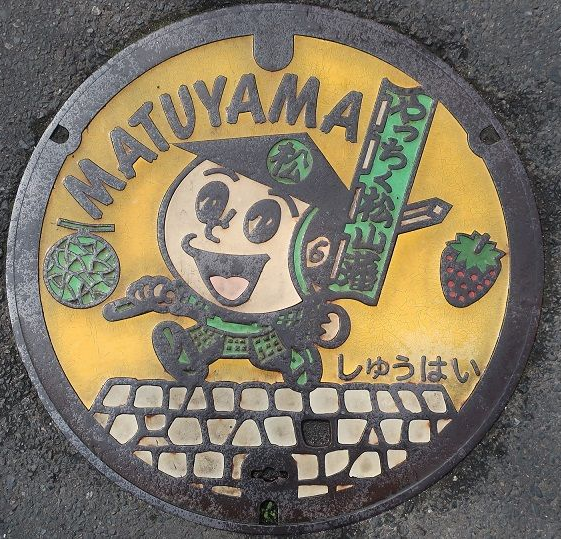
This is a color design depicting melons and strawberries, local specialties, around the mascot 'Yacchiku-kun,' who carries a banner saying 'Yacchiku Matsuyama Domain' on top of a stone wall. It includes the words 'MATUYAMA' and 'ShuPai.'
*Explanation by Shibushi City, Citizen Environment Division, Environmental Policy Office.
This was installed as part of the Agricultural Community Wastewater Project (sewerage) to handle sewage treatment in the Shinbashi district of Matsuyama Town. In Matsuyama Town, various town revitalization efforts are carried out under the theme of the Osumi province Yacchiku Matsuyama Domain, and the mascot character is used as the design for manhole covers. The mascot's name is 'Yacchiku-kun.' Regarding 'Yacchiku,' Matsuyama Town is a town where vegetable cultivation and livestock farming are thriving, and 'Yacchiku' connects 'Ya' from vegetables and 'Chiku' from livestock.
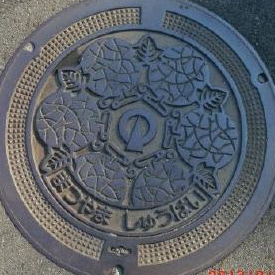
Melons are depicted around the town emblem.
*Explanation from Shibushi City Citizens' Environmental Department, Environmental Policy Office: 'Matsuyama Town adopts melons as a design because melon production is thriving. In addition, horticulture for crops such as strawberries is also flourishing.'
 So 曽於市
 Former Sueyoshi 旧末吉町
Designer
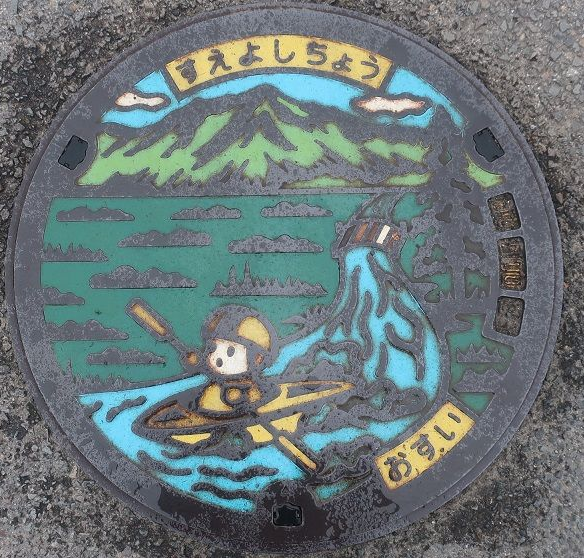
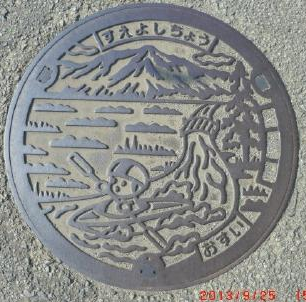
The following is an explanation from the So City Waterworks Department:
"A design of canoeing on the Oyodo River with the Kirishima Mountain Range in the background. This was a proposal by an elementary school student through a public contest." Includes the words "Sueyoshi Town" and "Sewage".
 Tarumizu 垂水市
Designer
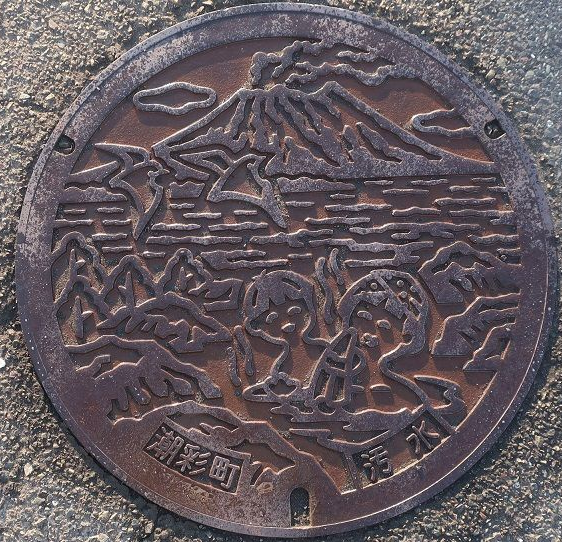
A design featuring Sakurajima and a hot spring (outdoor bath). Seagulls are also flying.
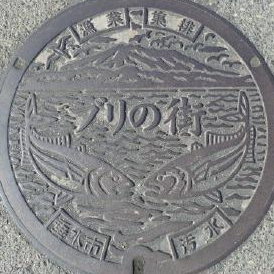
It is written 'Town of Yellowtail' and depicts two lively yellowtail and Sakurajima. The words 'Fishing Village,' 'Tarumizu City,' and 'Sewage.'
*Ash from Sakurajima's volcanic smoke has accumulated in the depressions. According to the local radio, the number of volcanic smoke emissions this year has exceeded 800 times. It seems that Tarumizu City receives the heaviest ashfall.
Fire Hydrant
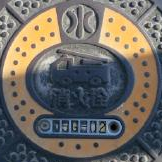
A small fire truck in the center, surrounded by a yellow background with polka dots, and around that, a fire hydrant cover with polka dots. There is a license plate frame.
 Hioki 日置市
Designer
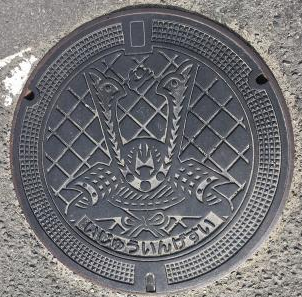
The helmet prominently depicted in the center is modeled after the armor of Lord Yoshihiro Shimazu, who broke through enemy lines in the Battle of Sekigahara and returned to his hometown of Kagoshima. Lord Yoshihiro's courageous actions eventually led to the "Myoenji Pilgrimage," counted among the three major events of Kagoshima Prefecture. The Myoenji Pilgrimage is an event where participants clad in armor and helmets visit Myoenji, the temple dedicated to Lord Yoshihiro’s memory, attracting many visitors every year. On the other hand, the emblem engraved on top of the helmet is the Hioki City crest. This combines the initial 'Hi' of Hioki City with the southern sun. It symbolizes the dynamic spirit of advancing into the future while aiming to create a city that harmonizes history and nature.
 Former Ijuin 旧伊集院町
Designer
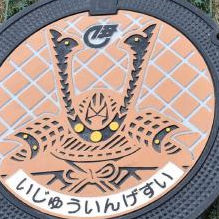
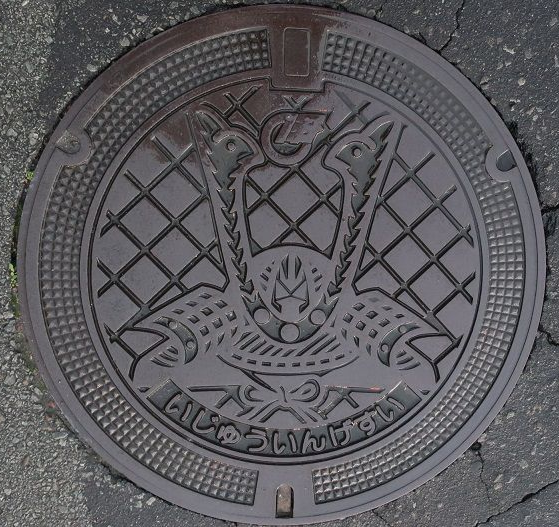
The manhole cover of the former Ijuin Town is designed with the town emblem and Lord Yoshihiro Shimazu's helmet.
The design of the helmet of Yoshihiro Shimazu, the 17th head of the Shimazu family. Includes the old town emblem and the characters 'Ijuin Gesui'.
Emblem
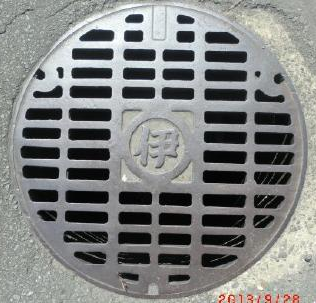
The lid has a grid of holes across its surface, and in the center, there is the character '伊' inside a circle.
 Former Fukiage 旧吹上町
Designer
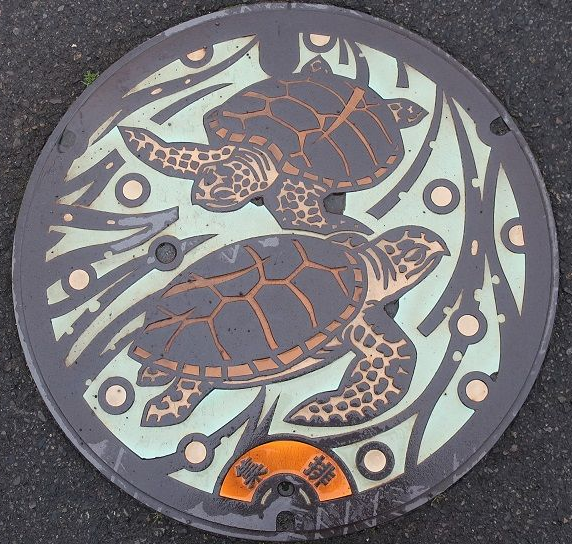
A turtle is designed on the manhole cover in the former Fukiage Town. Thank you for visiting A-Mart in Nagayoshi, Fukiage Town over the past year. Wishing you a bright New Year.
 Makurazaki 枕崎市
Collaboration
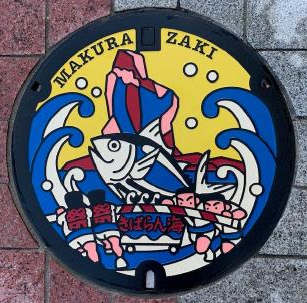
This is the cover of a card coordinate. It was submitted to a public contest for the 70th anniversary of the enforcement of Makurazaki City and won the Grand Prize. It features the city's symbol, 'Tategami Rock,' and the 'Katsuo Mikoshi' from the Makurazaki Port Festival, the city's largest event, Satsuma Kuroshio 'Kibaran Kai'.
 Minamikyushu 南九州市
 Former Kawanabe 旧川辺町
Designer
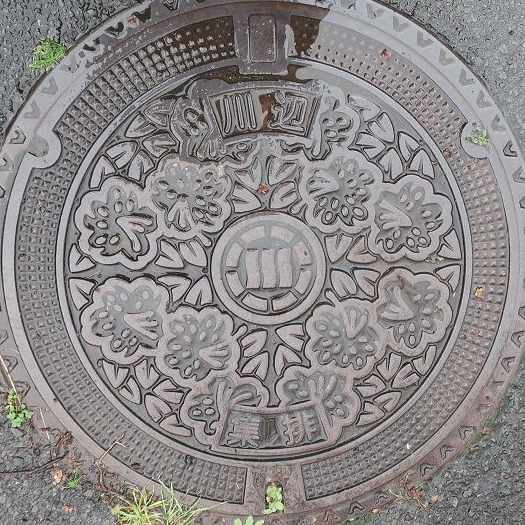
The following is an explanation from Minamikyushu City Hall, Construction Department, Waterworks Section. The emblem in the center is the town crest. Scattered around it are the town's flowers, azaleas. It includes the characters for 'Kawabe' and 'Shuhai'.
 Former Chiran 旧知覧町
Rectangular
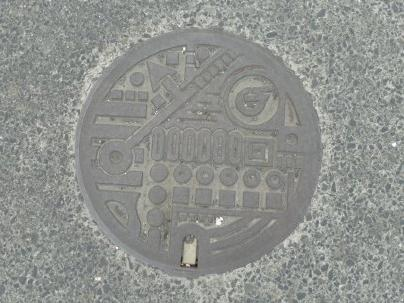
The following is an explanation from the Minamikyushu City Hall, Construction Department, Waterworks Section.
It abstractly depicts the history and industry of the town.
1. It can be geographically divided into the fertile land of the northern part of the town represented by 'Chi (地)', the vast plains of the central area represented by 'Ra (原)', and the sea of the southern area represented by 'Mi (海)'. Therefore, the lid is divided into three sections: the upper section represents 'Chi (地)', the middle section 'Ra (原)', and the lower section 'Mi (海)'.
2. Also, there was a special attack base during World War II, and currently the Tokko Peace Kannon Hall has been built to enshrine the spirits, along with the construction of the memorial hall called 'Chiran Tokko Peace Museum'. Since it is a town that disseminates peace information, the ◎ design (middle section, left) and the arrow pointing diagonally upward to the right represent the transmission of peace information.
3. The orderly townscape of the samurai residences (three squares to the left of the upper arrow), the central elongated circle represents a livestock barn (a key industry), the circle below it represents industrial development, and the circle below that represents a tea factory. The outer squares represent tea fields (a key crop representing Chiran Town), which surround the entire town. Additionally, the town emblem, Mount Onnai, the coastline, and Takatsuka Hill are also depicted.
 Former Ei 旧頴娃町
Collaboration
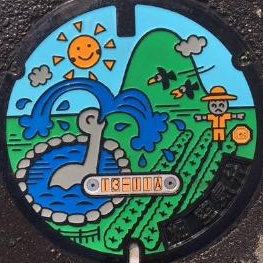
There is the legend of Issie of Lake Ikeda nearby, and this is a manhole cover with that design. Issie, tea fields, and scarecrows are depicted, and it includes "H29" and a management number. It is still a new cover. I didn't think it would be on a road in the tea fields. It is the cover of an air valve for irrigation water in the tea fields.
 Minamisatsuma 南さつま市
Other
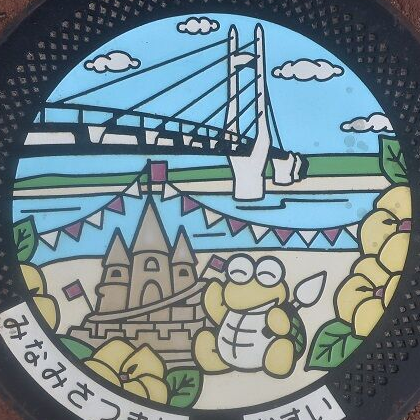
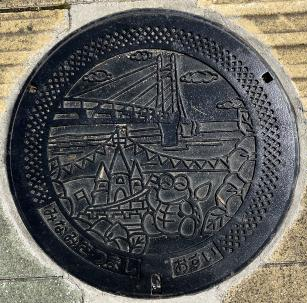
The image character for the 'Fukiagehama Sand Festival,' 'Sandy-kun,' along with hamabou (a deciduous shrub of the mallow family) and the 'Sunset Bridge' spanning the Manose River, are featured in the design.
 Former Kasasa 旧笠沙町
Designer
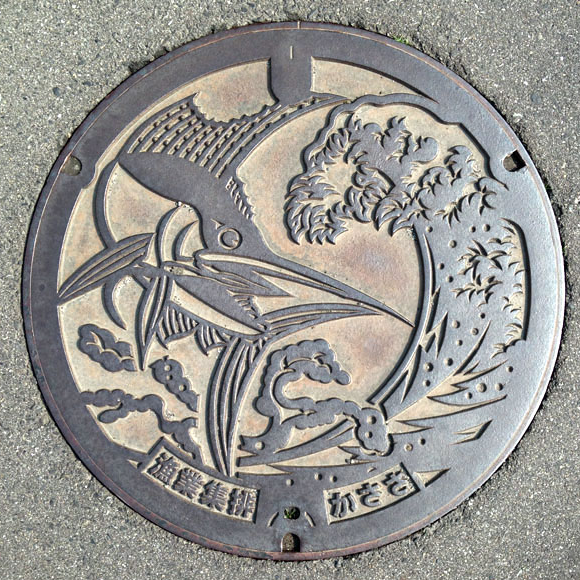
A cover for the Kasasa Town Nomaike District fishing village drainage, depicting the local specialty 'swordfish'.
 Former Bonotsu 旧坊津町
Designer
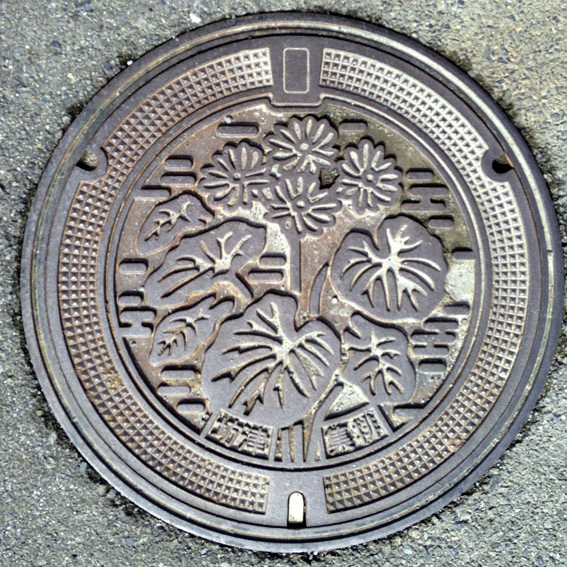
A cover for the drainage of the fishing village in the Bonotsu Town Bōhaku District, depicting the town's flower, 'Tsuwabuki'.
 Amagi 天城町
Designer
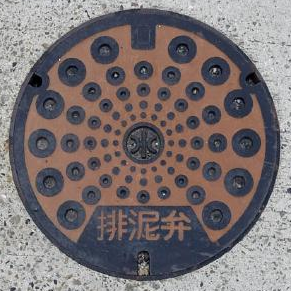
In the center is the character for 'water,' and from there, circles gradually increasing in size are arranged radially outward. In the trapezoidal text frame at the bottom are the characters 'sludge discharge valve.' The entire area excluding the text frame is colored yellow.
Handhole
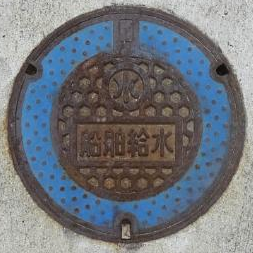
The outer circumference is decorated with blue dots, and on the upper part of the hexagonal pattern inside it is the word 'Water', while on the lower part is the phrase 'Ship Water Supply'. Since it was located at a port quay, I think it was literally a water faucet for supplying water to ships.
Generic (also used elsewhere)
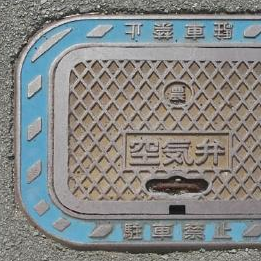
In the center upper part of the rounded rectangular shape with a diagonal lattice pattern is the character '農', and in the lower part is the text '空気弁', with a handle attached below it. The outer frame is painted blue, with the words '駐車禁止' at the top and bottom, and diagonal lines in between them.
 Isen 伊仙町
Handhole

Since it does not include the town emblem, I don't think it is unique to Isen Town, but I think it is rare to have a cover with the character for 'field' on it. The entire cover has a dot pattern painted green, with the character 'field' at the top and the characters 'sludge discharge valve' at the bottom. There are other covers with the same design but different characters, such as 'drainage valve,' 'air valve,' 'stop valve,' and 'valve cover.'
Generic (also used elsewhere)
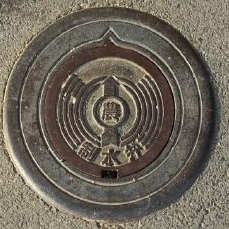
I often see ones with "water" written in the center, but in this case, the center has "agriculture" written on it with an upward-pointing arrow below it. The outer part consists of thin concentric circles with text frames at the top and bottom; the top frame has no text, but the bottom frame says "water control valve." There is a triangular protrusion at the top edge, and the receiving frame has a corresponding indentation, so overall, along with the central arrow, it seems to indicate the direction of flowing water. A small agricultural water control valve cover.
 Osaki 大崎町
Designer
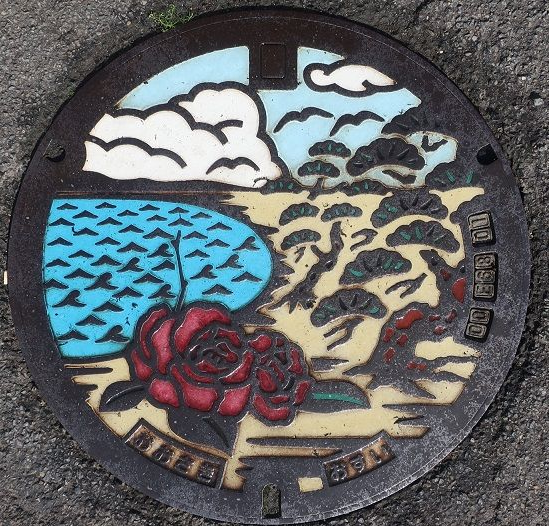
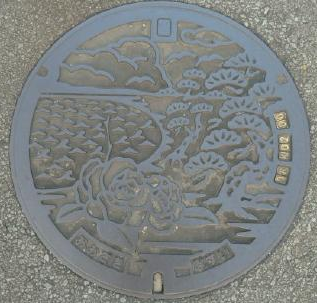
A colored manhole cover designed after the town flower sasanqua and the 7 km stretch of white sandy beaches with green pines (Kuni (Kujin) Pine Grove). The characters 'Ōsaki' and 'Osui'.
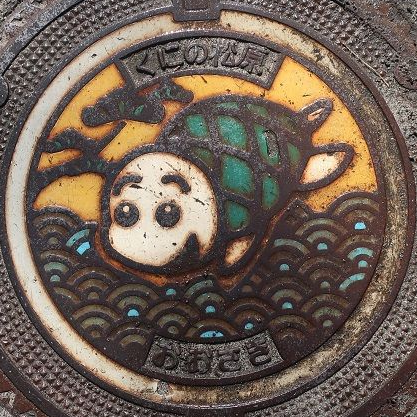
It seems that sea turtles come to this coast to lay their eggs, and this is a manhole with a sea turtle color design. The waves are in a blue seigaiha pattern, and pine trees are also depicted. The words 'Kunino Matsubara' are at the top, and 'Ōsaki' at the bottom.
 Kikai 喜界町
Designer
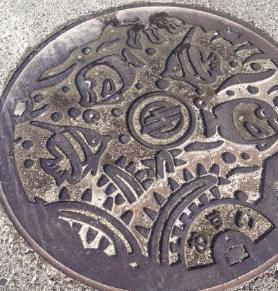
Tropical fish are swimming around the emblem of Kikai Town. Since Kikaijima is an island of an uplifted coral reef, I think what is depicted at the bottom is coral.
Handhole
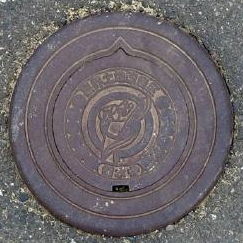
It is a small lid with the same characters 'Kikai Land Improvement District' as above on the top. The words 'Water Control Valve' are written at the bottom, and in the center, there is a design showing a single sugarcane drinking water from a cup.
Generic (also used elsewhere)
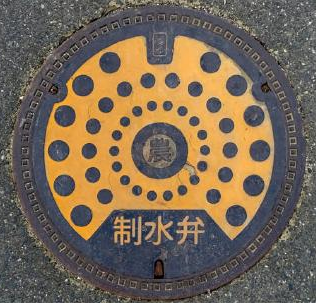
In the center is the character '農' (agriculture), surrounded by concentric circles of dots that increase in size from the inside out. At the bottom are the characters '制水弁' (water control valve), and the entire cover is painted yellow. I saw it in the same place as the cover labeled '喜界土地改良区' (Kikai Land Improvement District), so I think it was installed by the same provider, but there is no textual information to confirm that. It is a standard type of water control valve cover for agricultural use.
 Kimotsuki 肝付町
 Former Uchinora 旧内之浦町
Designer
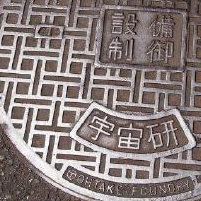
On the lid of 'OHTATE FOUNDRY' with a ground pattern combining T's, there are markings of 'Facility Control' and 'Space Research Institute.'
It is a lid of the Japan Aerospace Exploration Agency (JAXA).
 Kinko 錦江町
 Former Tashiro 旧田代町
Generic (also used elsewhere)
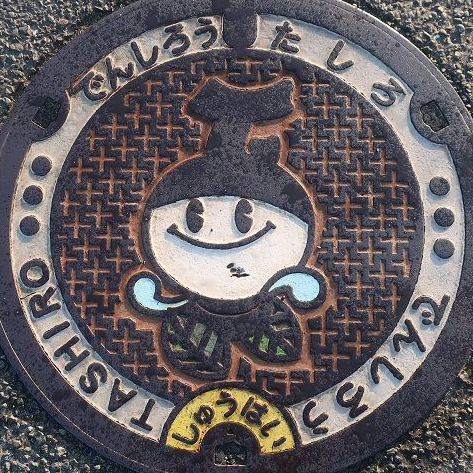
The design of Tashiro Town's image character 'Denshirou,' featuring the text 'Tashiro,' 'Denshirou,' 'TASHIRO,' and 'Shuuhai.'
The following information is from the Kinko Town Office, Tashiro Branch, Regional Promotion Division.
1. Birth of Denshirou: As published in the 'New Edition Tashiro Town Local History,' a contest for the town's image character design was held with a deadline of August 30, Heisei 8 (1996). The requirements and theme were that it should be appropriate as a symbol for the whole town, expressing town development full of vigor for the 21st century utilizing great nature, in a refreshing manner, and with an idea that would be familiar and appealing to the general public. There were 270 entries from all over Japan. Five were selected through judging, and the one that received the highest votes from the townspeople, a work that 'used a rhinoceros beetle as the motif, imagined the water and greenery of nature, and expressed a bright figure running toward the 21st century,' was chosen as the best and decided as Tashiro Town's image character. The character's name was determined in February, Heisei 9 (1997) as 'Denshirou.'
2. Origin of the name: Named 'Denshirou' because the character '田' (rice field) in Tashiro Town is pronounced 'den.' Age: eternally 15 years old. Status: student preparing for exams. Personality: mischievous, playful. Hobby: rainbow trout fishing. Favorite food: air fresheners (Febreze). Catchphrase: ends sentences with 'rou.' Example: 'Otsukarerou.' 'Shitarou.' Charm point: Two horns that can pinch various things. One-line PR / introduction: A big rhinoceros beetle raised in the middle of Kinko Town. Travels all over Japan to promote Kinko Town. Also looking for friends on Facebook.
 Satsuma さつま町
 Former Miyanojo 旧宮之城町
Designer
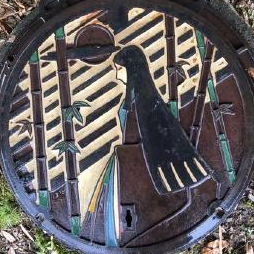
Kaguya-hime and bamboo color design. Various types of bamboo are planted in the park. It is thought that the design was based on Kaguya-hime because of the bamboo. The person who planned this manhole design is no longer around, so the municipal office staff also do not know the intention behind the design.
Collaboration
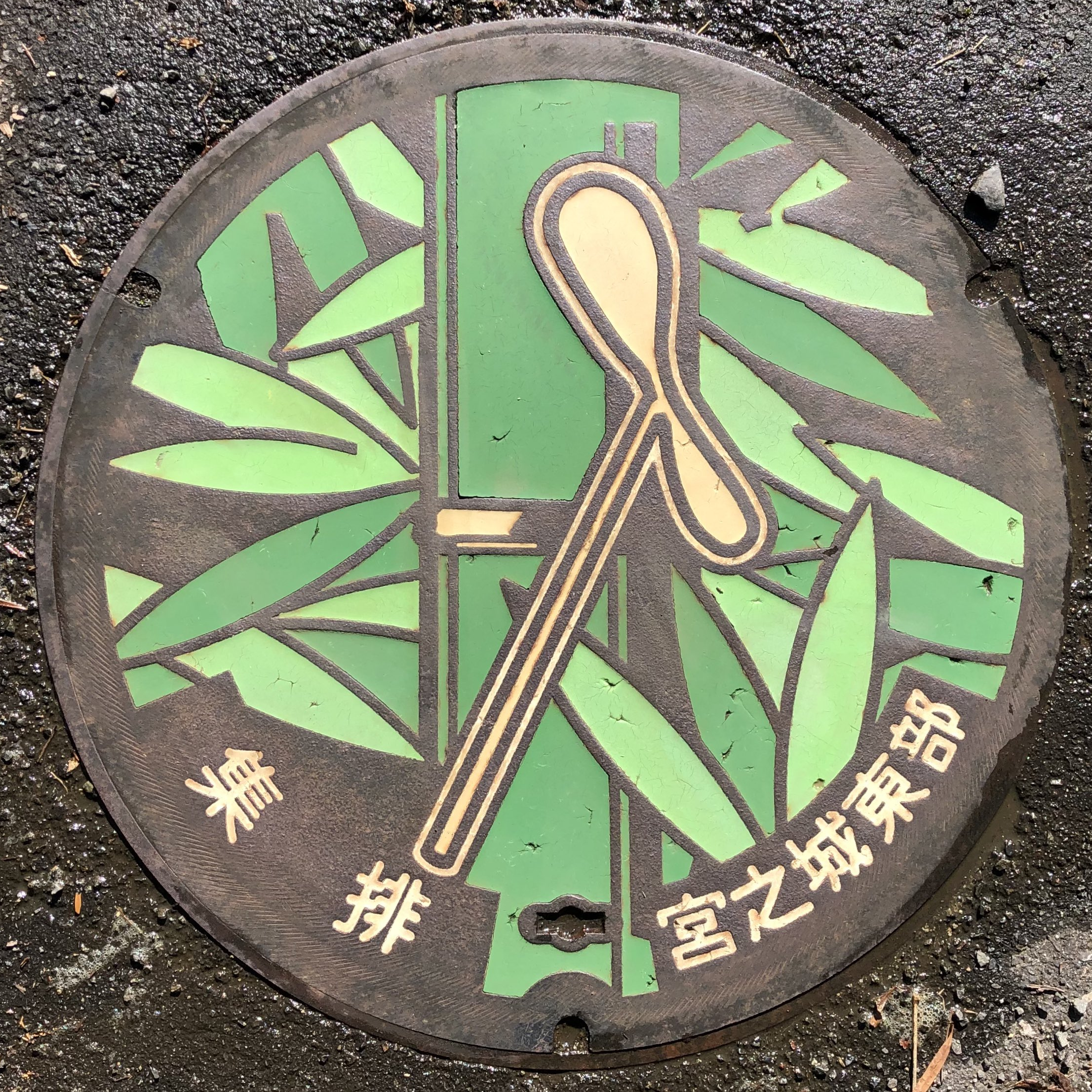
This region is known for bamboo shoots as a specialty, so 'take-tombo' (bamboo-copter) and Moso bamboo are depicted. Many municipalities have designated trees, flowers, and birds as symbols of the town, but in the current 'Satsuma Town,' it is unusual and interesting that the town's bamboo, Moso bamboo, is designated as a symbol. The town also has bamboo-related facilities such as the 'Village of Princess Kaguya' and the 'Chikurin Hall.'
 Setochi 瀬戸内町
Handhole
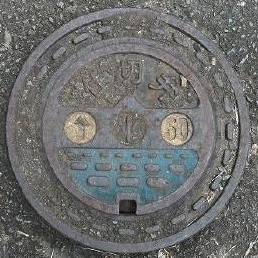
On the upper section, there is 'shut-off valve'; in the middle section, there is ↑ 'water' '50'; on the lower section with a blue background, there are three rows of dashed patterns of different thicknesses. The receiving frame also has a dashed pattern running all around.
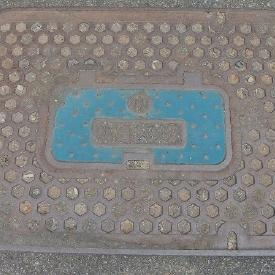
Polka dots on a blue background, a water mark, and the label 'Water Meter.' The surrounding pattern is a tortoiseshell design featuring a parent and child. This is a large cover that was on a village farm road. It is said that they store mountain water in a tank in the mountains and distribute it to each household.
Fire Hydrant

Yellow background with polka dot pattern, water mark, and the large characters 'Fire Hydrant' in the center. V-shaped pattern on the receiving frame.
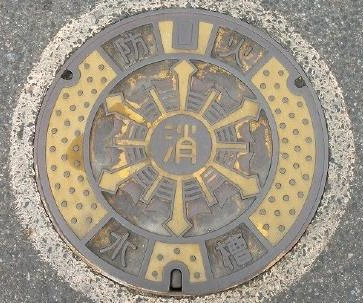
Design of a fire brigade badge with the character '消' on a yellow background. The words 'firefighting water tank' around the perimeter.
 Tatsugo 龍郷町
Handhole
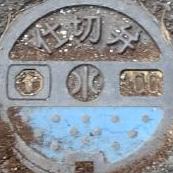
This is a small cover for water supply. The top has the characters 'Shikiriben' (shut-off valve), the left side of the central band has an arrow indicating the flow direction, the center has the character 'Water,' and the right side has the number '100' indicating the pipe diameter. The bottom is painted blue with a dot pattern.
 China 知名町
Designer
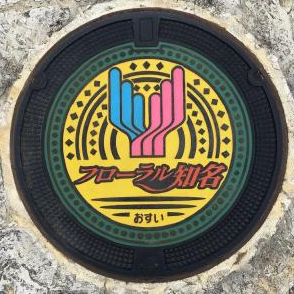
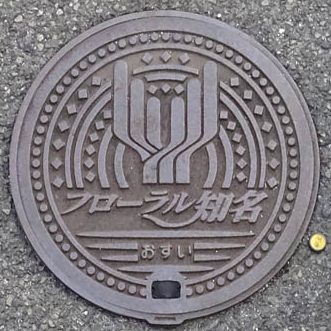
"Floral Chimei" is the nickname for the development plan formulated by China Town to achieve the goals of 21st-century urban development. The design depicted on this manhole cover is inspired by human hands, expressing the image of town residents, symbolized by pink, and abundant nature, symbolized by blue, supporting the town hand in hand. The FLORAL logo contains five elements (keywords): 'Flower,' 'Resort' (comfort and relaxation), 'AGELESS Community' (interaction), 'Coral,' and 'Life' (housing). China Town is steadily promoting urban development, including the sewer system, to preserve the town's proud nature and resources for the next generation.
Handhole
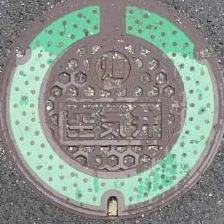
The outer perimeter is painted with a green dot pattern, with the word 'Field' at the top and 'Air Valve' at the bottom on the hexagonal pattern inside. A small cover for an agricultural water air valve.
 Tokunoshima 徳之島町
Designer
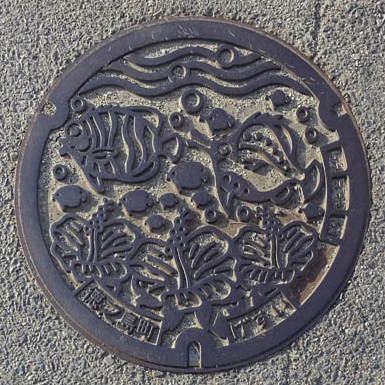
On the upper half, two large fish along with small fish, bubbles, and waves are depicted, and on the lower half, hibiscus is depicted (the flower of Tokunoshima Town is not hibiscus, but Yoona [Hibiscus tiliaceus]). At the bottom edge, the words 'Tokunoshima Town' and 'gesui' are included.
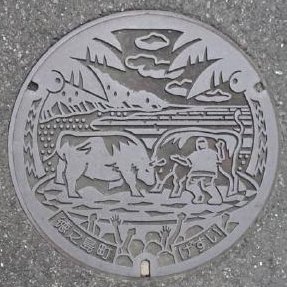
Against the backdrop of the sea, a cape, and clouds, a scene of the island's famous bullfighting is depicted. Palm trees bearing fruit are on the left and right, and along the lower edge, spectators frenziedly cheering for the bullfight are briefly shown raising their hands and dancing wildly. The words 'Tokunoshima Town' and 'げすい' appear along the lower edge.
Handhole

On the left side of the central band is the town emblem (colored blue), in the center there is an arrow above the character for 'water' (not colored), and on the right side is the number '50' (colored blue). At the top is the text 'control valve' (not colored). At the bottom, in the area colored blue, three horizontal chain lines (thin, medium, thick) are arranged. The receiving frame is slightly thick with chain lines in the center of concentric circles.
 Nagashima 長島町
Designer
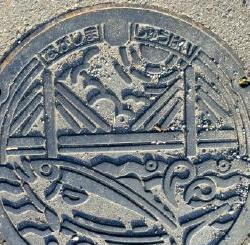
Ikara Ohashi Bridge and a design featuring lively yellowtail. There were many yellowtail farming nets. The words 'Nagashima' and 'Shuhai'.
 Former Nagashima 旧長島町
Designer
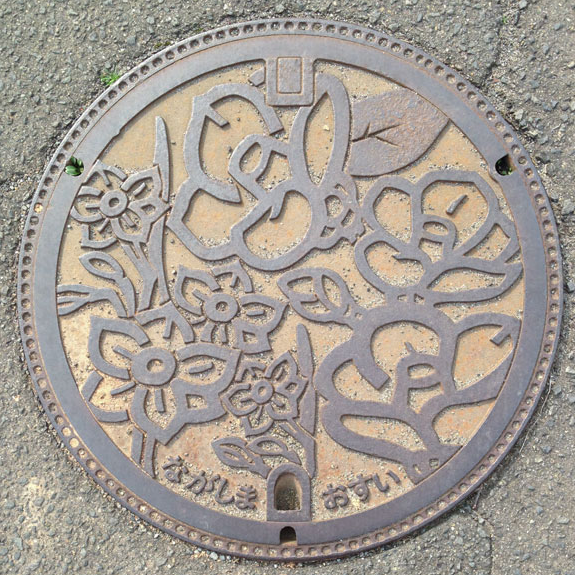
A manhole cover for the fishing village drainage in the Shimoyamato District, depicting the town tree 'Camellia' and the town flower 'Daffodil.' At first, I thought there were only monochrome versions, but since there was a maintained paved path, I went in and found this color version. However, it was severely damaged, and this cover had the most vibrant color. It was so tragic that I tried to make a correction imagining what it would look like if the colors had remained. You can see the result by hovering the pointer over the image.
 Former Azuma 旧東町
Designer
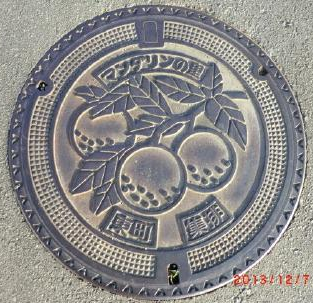
Mandarins grown on the branches are depicted, with the labels "Mandarin Village" and "Azuma Town Collection." The Satsuma mandarin (Unshū mikan) is a type of mandarin that was introduced to Japan via China, and Azuma Town is said to be the birthplace of the Satsuma mandarin, which originated from chance seedlings.
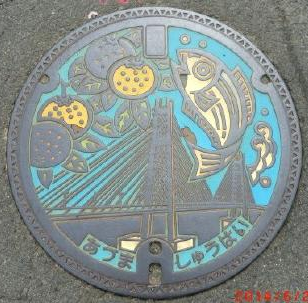
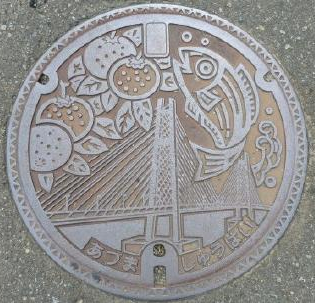
Yellowtail, which is actively farmed, specialty mandarins, and a bridge of dreams that has not yet been built. The characters 'Azuma' and 'Shūhai.' Triangular patterns on the receiving frame. It's 'Azumachō,' but in the town's public relations magazine, it seems to be written as 'Azuma,' and the lid is also labeled that way.
 Minamiosumi 南大隅町
 Former Sata 旧佐多町
Designer
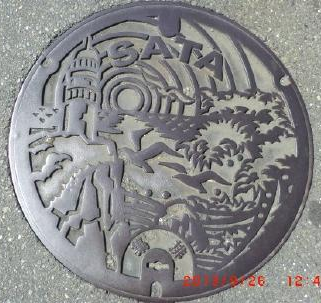
Design of Cape Sata Lighthouse, the rough waves of the Pacific Ocean, seagulls, and the sunset. The characters 'SATA' and 'Shūhai'.
Below is the explanation from the Minamiosumi Town Sata Branch Office:
'It depicts the sun setting over the rough Pacific Ocean surrounding Cape Sata.'
Handhole
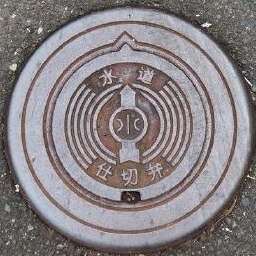
Since it is located on the road in front of the southernmost house in Sata Magome (Tajiri), the southernmost settlement of the Osumi Peninsula, this is thought to be the 'Southernmost Water Supply Valve Cover on the Japanese Mainland.'
 Minamitane 南種子町
Designer
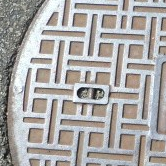
On the lid of 'OHTATE FOUNDRY' with a ground pattern combining Ts, the words 'Facility Control' and 'Space Research'.
 Yakushima 屋久島町
Former Yaku 旧屋久町
Designer
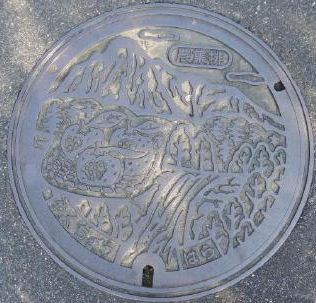
The forest and Mount Mocchom (979 meters), along with the local specialty ponkan oranges and waterfalls, are depicted, but the famous waterfalls are Okonotaki and Senpiro Falls. I wonder which of these waterfalls is depicted on the manhole. The words 'Okuchou,' 'Hara,' and 'Noushuu Hai' are written.
Handhole
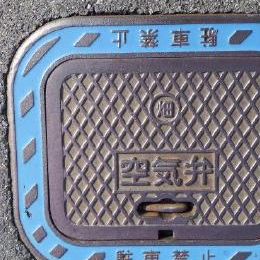
A diagonal lattice pattern with the words 'Field' and 'Air Valve' inscribed. The receiving frame is a square-shaped air valve cover with a blue background, diagonal lines, and a 'No Parking' inscription. There are covers with the same design but different inscriptions, such as 'Control Valve' and 'Air Valve'.
 Yusui 湧水町
Handhole
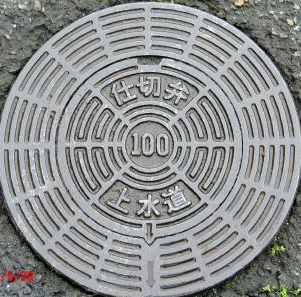
Small cover for the water supply shut-off valve.
Collaboration
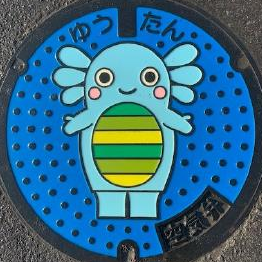
Design of the Yusui Town character 'Yutan'. The word 'Yutan' is at the top, and 'fire hydrant' is at the bottom.
* 'Born on March 22, 2015. Age is 1,132 years old (1,132 = iimizu). Being a fairy, the gender is unknown. Has a laid-back personality. Enjoys drinking springwater shochu while watching the cherry blossoms in spring, making them quite the drinker.' It is said that the body is inspired by a water droplet and has wings shaped like the kanji for water on its back. (From the National Association of Towns and Villages website)
 Yoron 与論町
Emblem
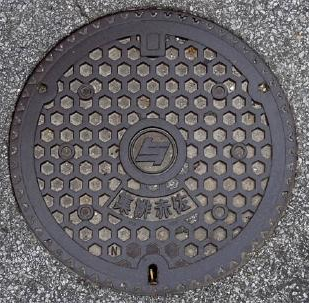
In the center of the tortoiseshell pattern is the Yoron Town emblem, and below it are the characters 'Shūhai Akasa.' It seems that Yoron Town has a tea flower, and the Akasa district of Yoron Town has an agricultural settlement drainage treatment facility.
 Wadomari 和泊町
Designer
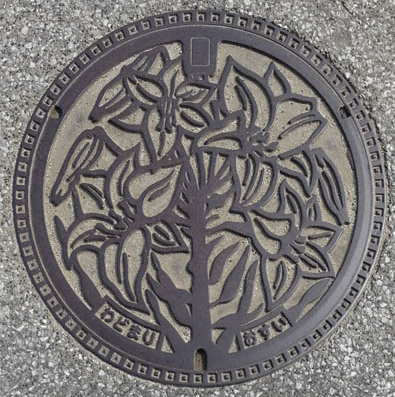
A splendid town flower, the Easter lily, with many blooms is depicted. The characters 'wadomari' and 'osui'. The receiving frame has a pattern with a dot inside a square.
 Uken 宇検村
Designer
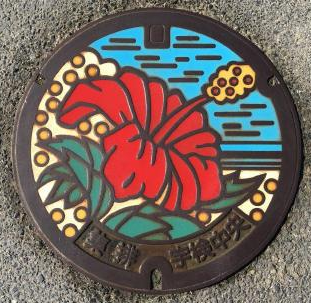
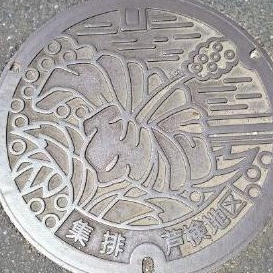
This is a colored lid with a large illustration of the village's flower, the hibiscus. At the bottom, the characters 'Shūhai' and 'Uken Chūō' are written.
 Toshima 十島村
Handhole
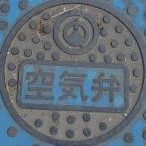
Polka dot pattern with the Toshima Village emblem and the words 'Air Valve.' The outer edge and the text are blue.
Hayato Public Sewerage Association 隼人公共下水道組合
Handhole
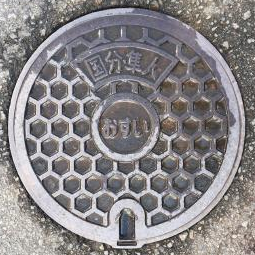
A small cover of the former Kokubu-Hayato Public Sewerage Association (now Kirishima City, Kagoshima Prefecture). Features a hexagonal pattern with the words 'Kokubu-Hayato' and 'Sewage'.
Collaboration
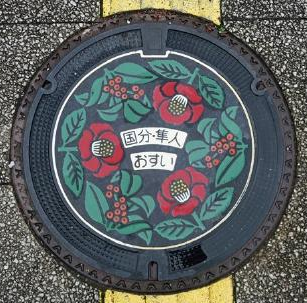
This was designed by Kirishima City (formerly the Kokubu-Hayato Public Sewerage Association) in 1990. The trees and flowers depicted in the design are from the current Kirishima City, which was formed in 2005 through the merger of one city and six towns, and from the former Kokubu City, which had previously been part of the sewerage project association. Because the trees bear fruit throughout the year, they are also called "trees whose descendants never die out" and "trees of prosperous business," and are considered auspicious. The design alternates branches and fruits of the Japanese holly (Kurogane-mochi), and the bright flowers of the Yamatsubaki, which bloom from autumn to winter and were from former Hayato Town, another member of the association. This design represents the unity of the municipalities in carrying out the project together.
Related: Kirishima 霧島市, Satsumasendai 薩摩川内市
Kokubun Hayato Public Sewerage Association 国分隼人公共下水道組合
Designer
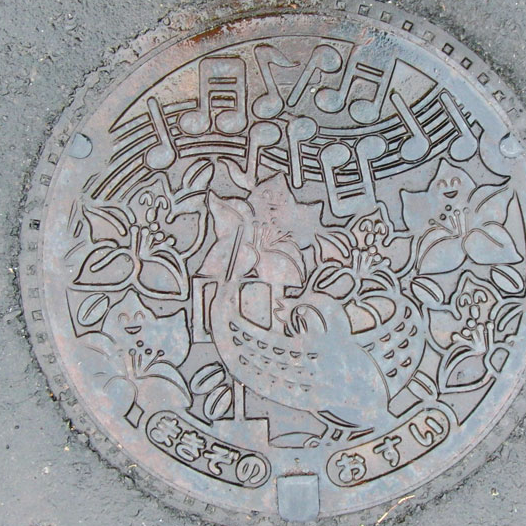
The conductor of the concert is the town's bird, the Emberiza cioides (Meadow Bunting). The singers are the town's flower, the Miyama Kirishima (Azalea). Near the Makiba Clean Center is the Kirishima International Music Hall (nicknamed 'Miyama Concert Hall', opened in 1994), and the design is inspired by it.
When you hover over the image, a picture of the manhole cover displayed in front of the entrance to the 'Makiba Clean Center' appears. (Display original image)
Former Kokubu-Hayato Public Sewerage Association
A manhole cover from the former Kokubu-Hayato Public Sewerage Association combining the tree of Kokubu City, the Ilex rotunda (Kurogane mochi), and the tree of Hayato Town, the Camellia.
Related: Kirishima 霧島市