Ibaraki 茨城県
Ibaraki 茨城県
Mito 水戸市
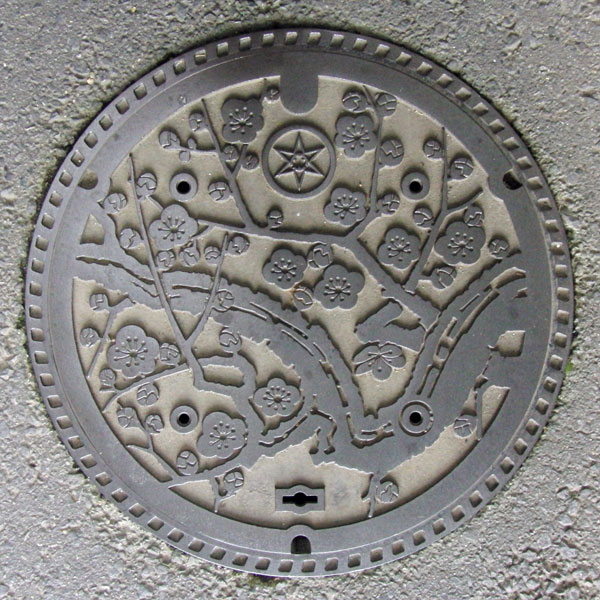
The design features the city's official tree, the plum blossom.
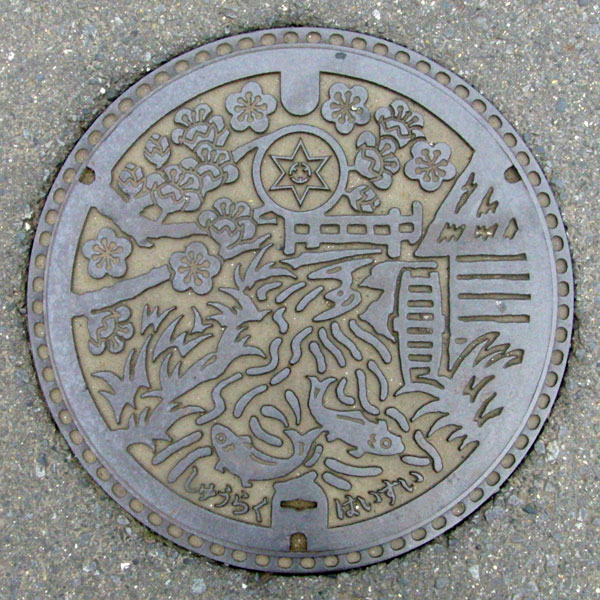
A small stream with a wooden bridge. A watermill by the riverbank. Fish swimming energetically in the river.
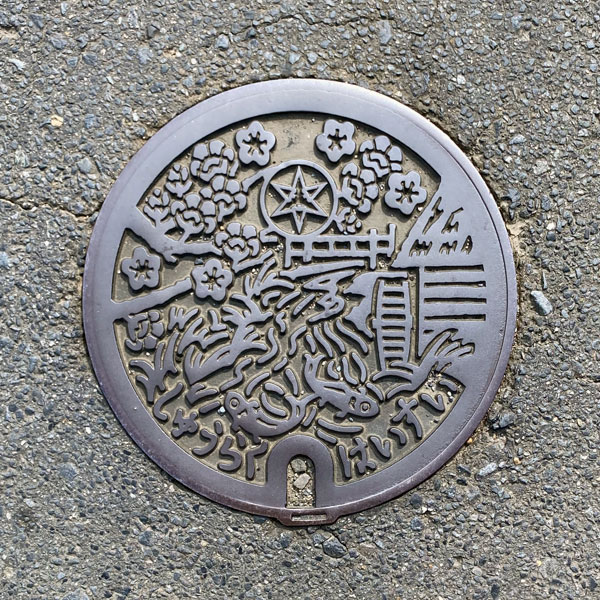
A smaller version of the agricultural wastewater treatment panel in the Oashi district, with the same design as above.
City emblem in the center.
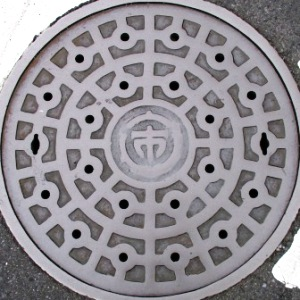
市 in the center.
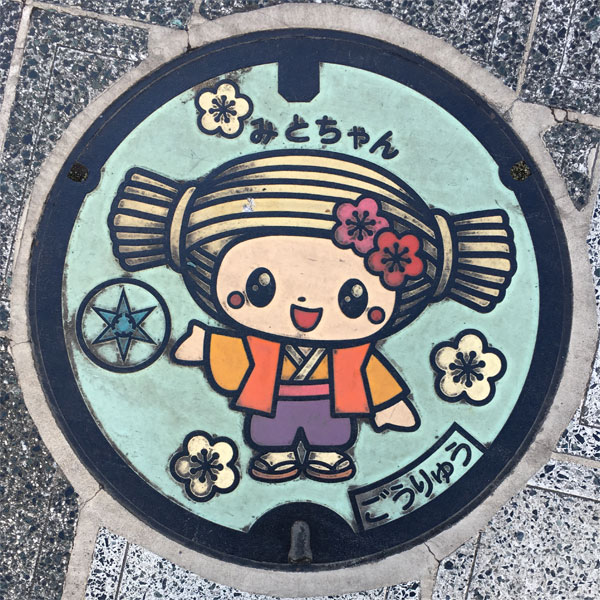
The design features "Mito-chan" wearing an outfit resembling that of Lord Mito Mitsukuni, with a straw bundle of natto (fermented soybeans) adorned with plum blossoms on her head, and plum blossoms.
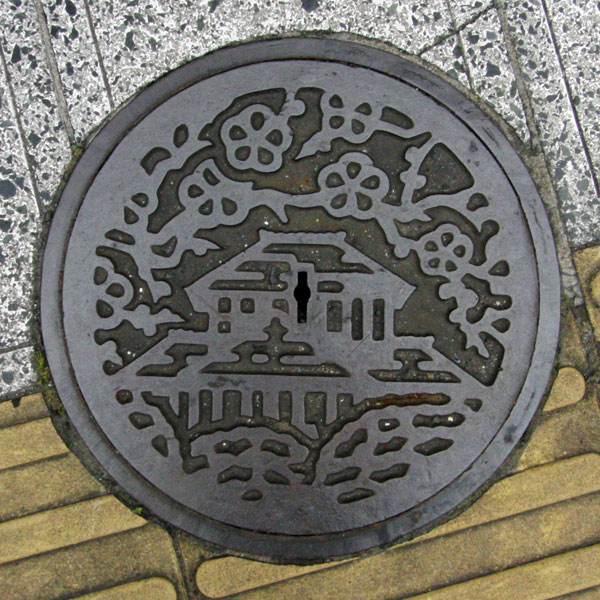
The painting depicts Kōbuntei, a rest area in Kairakuen Garden, which is considered one of Japan's three most famous gardens.
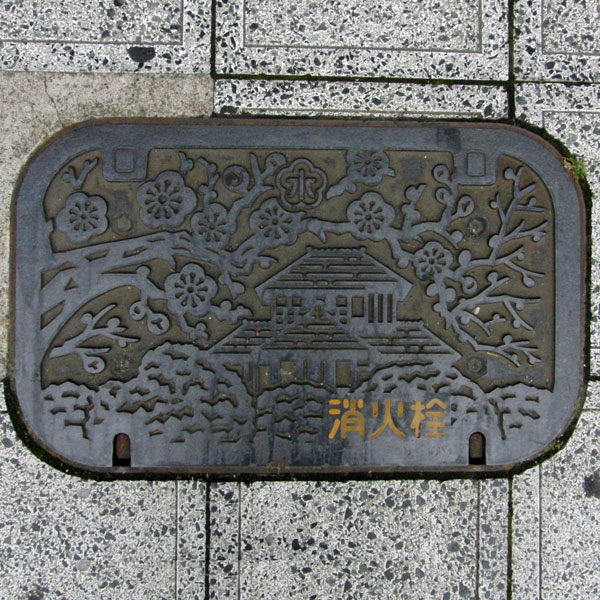
A fire hydrant cover depicting the "Kōbuntei" pavilion in Kairakuen Garden.
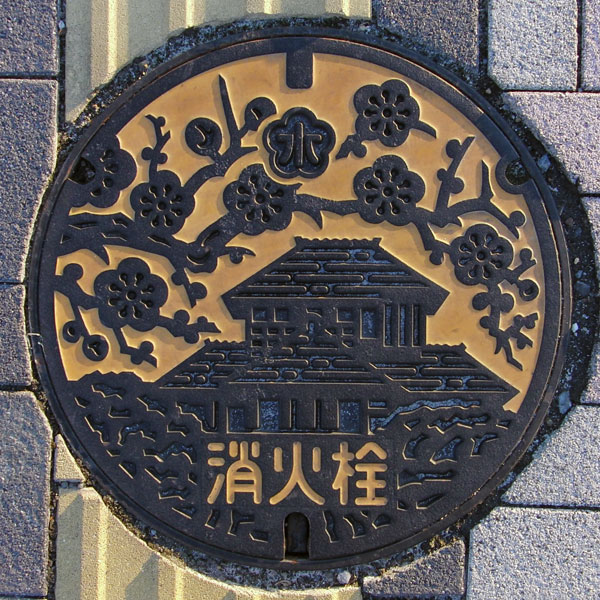
A round fire hydrant cover depicting the "Kōbuntei" pavilion in Kairakuen Garden.
Uchihara 内原町
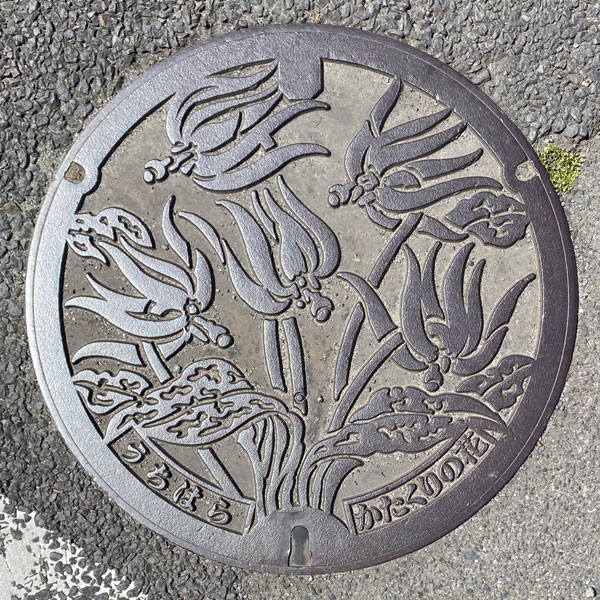
A manhole featuring a picture of a dogtooth violet. The words "Uchihara" and "Katakuri no Hana" (dogtooth violet flower) are printed on it.
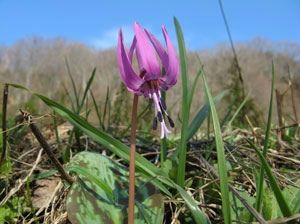
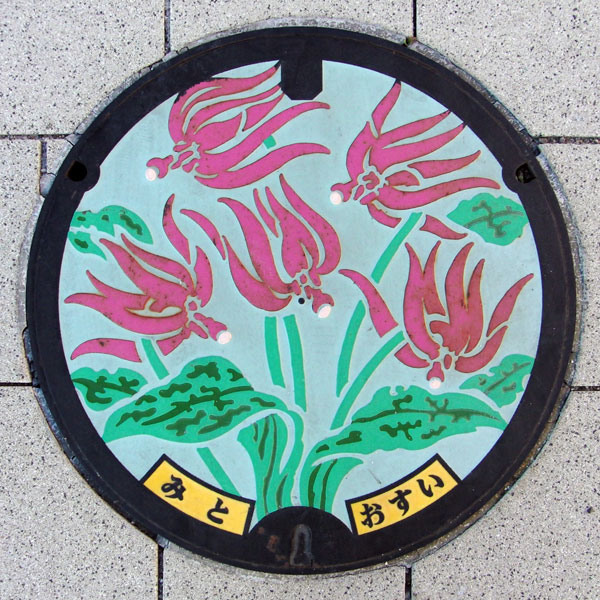
The design is based on the former Uchihara town flower, the "dogtooth violet." The design remains the same, but the name of Mito City has been added.
Kitaibaraki 北茨城市
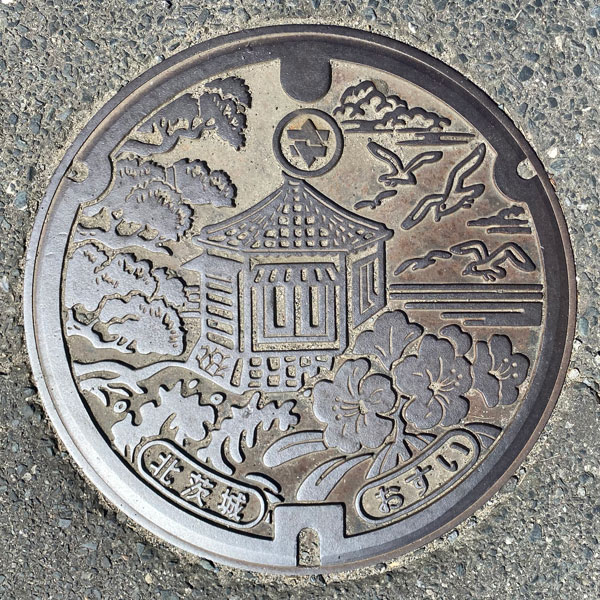
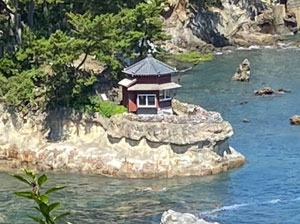
The design is based on the hexagonal pavilion located on the grounds of the residence of Okakura Tenshin, a painter and thinker of the Meiji era. It is located in Izura, Kitaibaraki City.
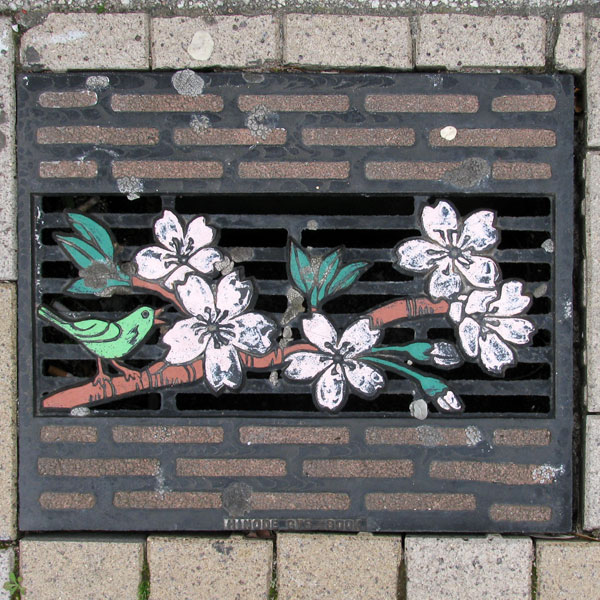
In front of Isohara Station, there is a clock tower that plays children's songs with lyrics by Ujo Noguchi. Apparently, the top part opens up like a picture story at intervals of about two hours, but unfortunately, I couldn't wait until that time. To the left is a drain cover.
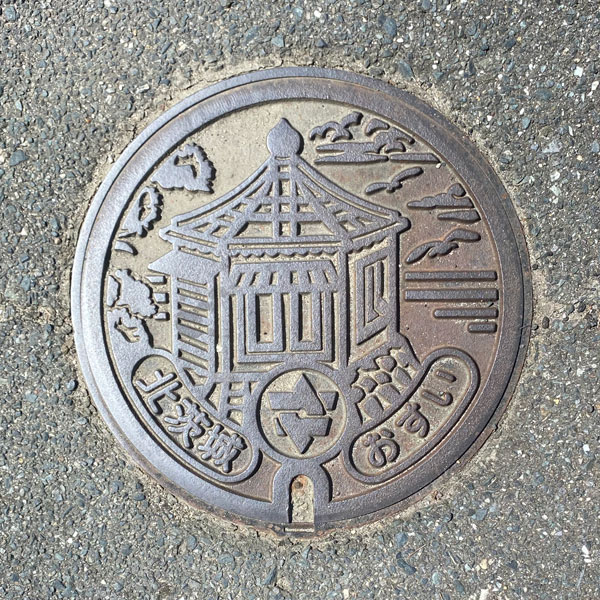
A smaller cover with the same design as above, but without the rhododendron.
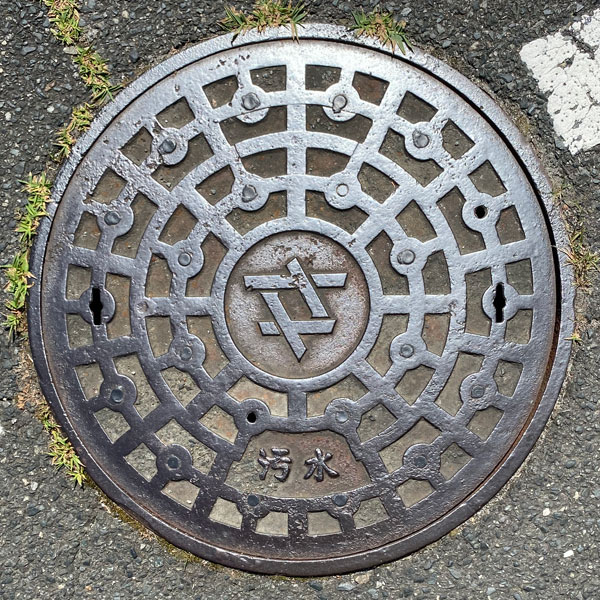
A manhole cover for sewage with a patterned design. The city emblem in the center is not the original shape.
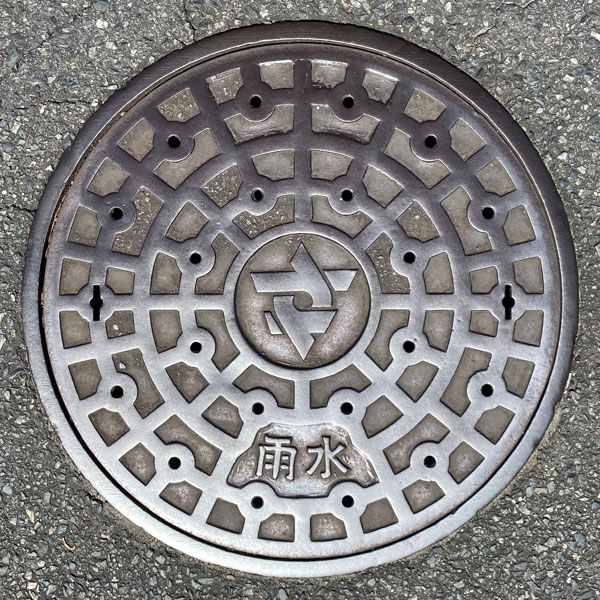
A patterned manhole cover for rainwater. The city emblem is in the center.
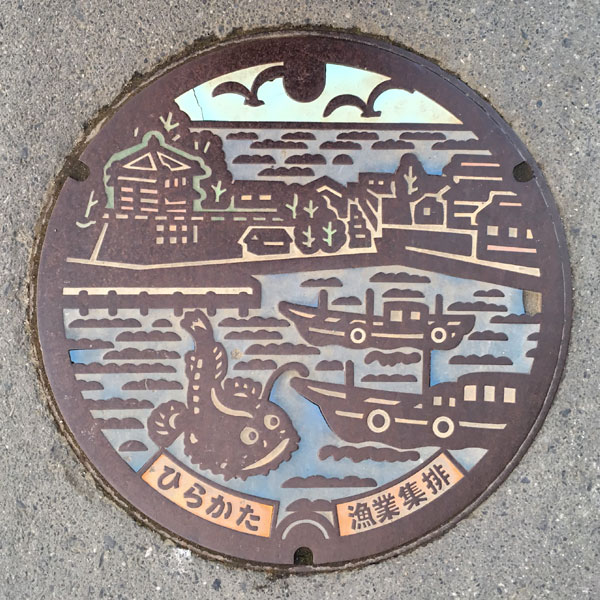
A color drainage manhole cover depicting the scenery of Hirakata Fishing Port in the Hirakata district. As befits a fishing area known for anglerfish, the manhole cover also features an image of anglerfish.
Hirakata Fishing Port is the northernmost port in Ibaraki Prefecture. Looking at the scenery on this manhole cover, the Nakoso Fishing Port, located on the opposite side of Unoko Cape in the background, is already in Fukushima Prefecture.
Takahagi 高萩市
The city emblem in the center.
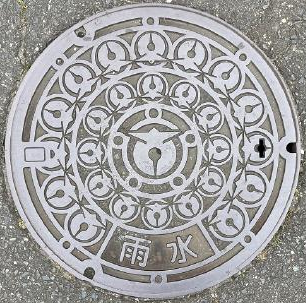
The design features the city emblem in the center, surrounded by numerous other city emblems in a double layer, but the original design intent is unclear.
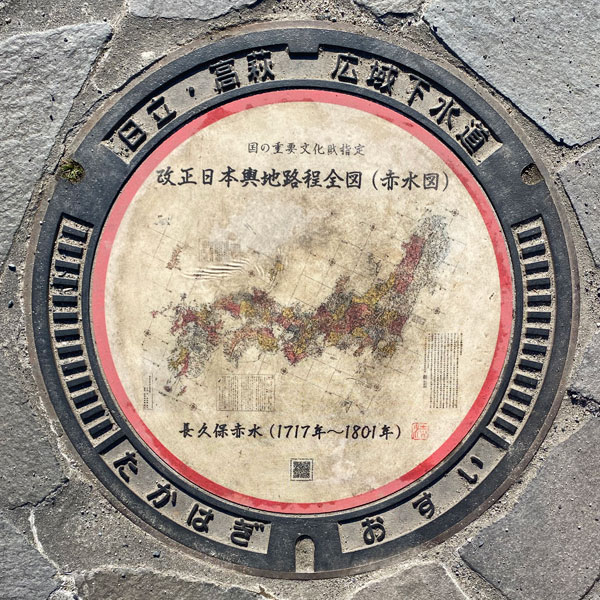
This is a sticker-type manhole cover for sewage, depicting the "Revised Complete Map of Japan's Topography and Roads," a nationally designated Important Cultural Property. It's a manhole cover with coordinates listed on a manhole card.
While it's not strictly a Takahagi City-specific cover, as it says "Hitachi/Takahagi Wide Area Sewerage" at the top, the word "Takahagi" is at the bottom, and the manhole card also lists it as "Takahagi City," so it's included under the Takahagi City section.
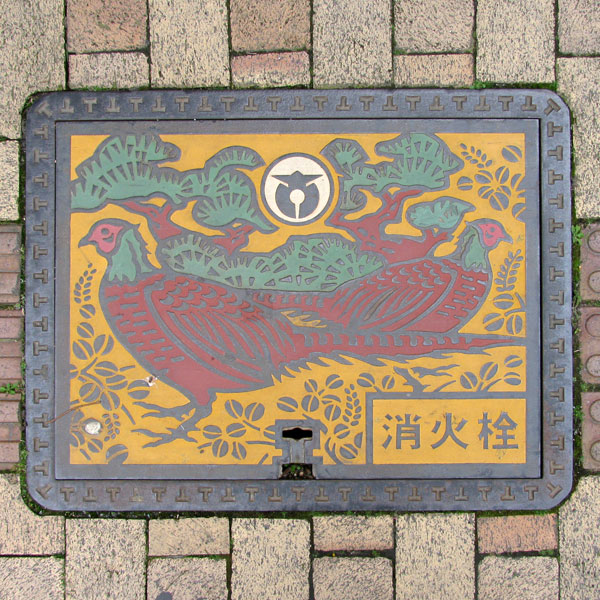
A fire hydrant incorporating the city tree "pine," the city flower "bush clover," and the city bird "pheasant." The city emblem, a simplified version of the character "高," is placed at the top.
Hitachiomiya 常陸大宮市
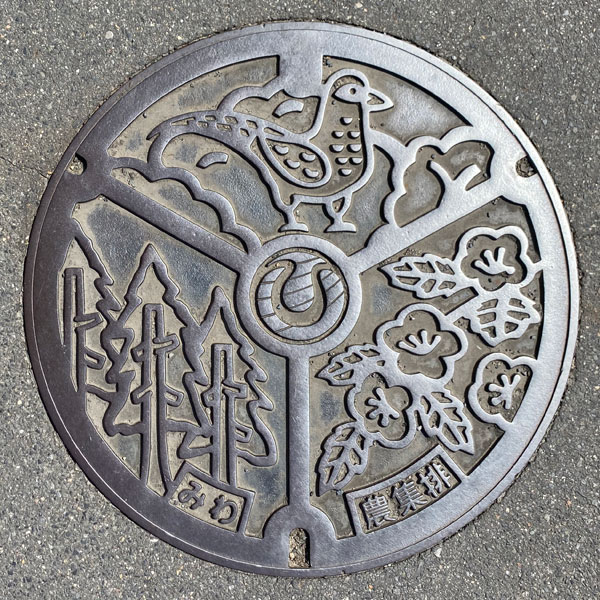
A manhole cover for agricultural wastewater in the Miwa Chubu district. It features the design of the former Miwa Village with the Hitachiomiya City emblem in the center.
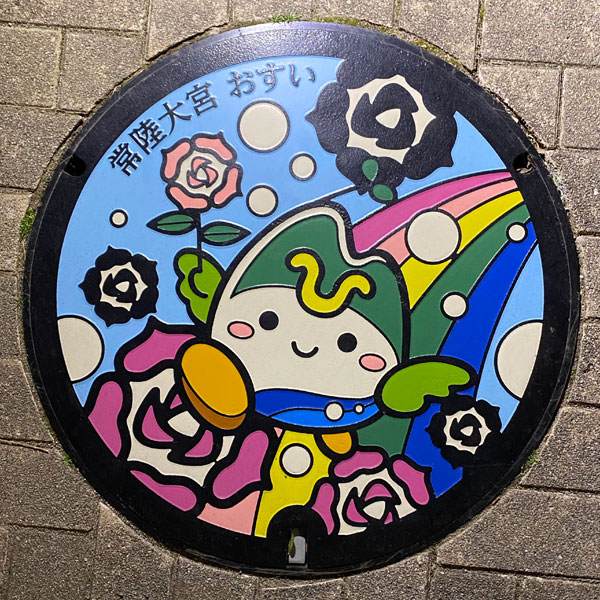
A new design of sewage manhole cover, "Hitamaru and Rose," featuring Hitachiomiya City's mascot character "Hitamaru," the city flower "rose," and the rainbow-colored Kuji River and Naka River. This is the manhole cover with the coordinates shown on the manhole card.
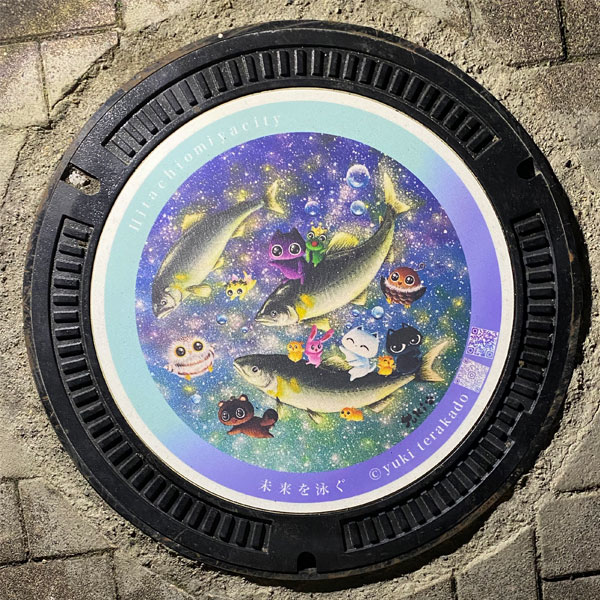
The ayu (sweetfish), the city's official fish and a specialty of Hitachiomiya, is known as the "Queen of Clear Streams" for its beautiful, radiant appearance.
The design depicts animals gathering with ayu to forge a path to the future against a backdrop of dreams, hopes, and the infinite possibilities of the universe. It also portrays the ayu, known as an "auspicious fish that brings good fortune," radiating light and guiding us towards a bright future.
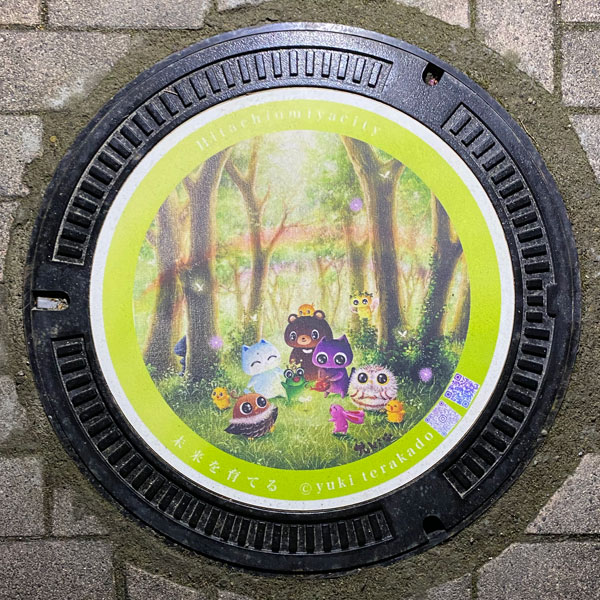
"Like the city's motto, 'A City Built on Local Education,' this design depicts how we, living today, cherish and nurture the irreplaceable assets of our hometown—the nature, history, culture, wisdom, and community bonds—created by our ancestors, and how we pass on those aspirations to the next generation and the future.
In the rich forests of Hitachiomiya City, a rainbow appears, symbolizing a bright future, and animals warmly watch over and nurture the newly emerging life. This scene conveys the spirit of 'local education,' loving and cherishing one's hometown."
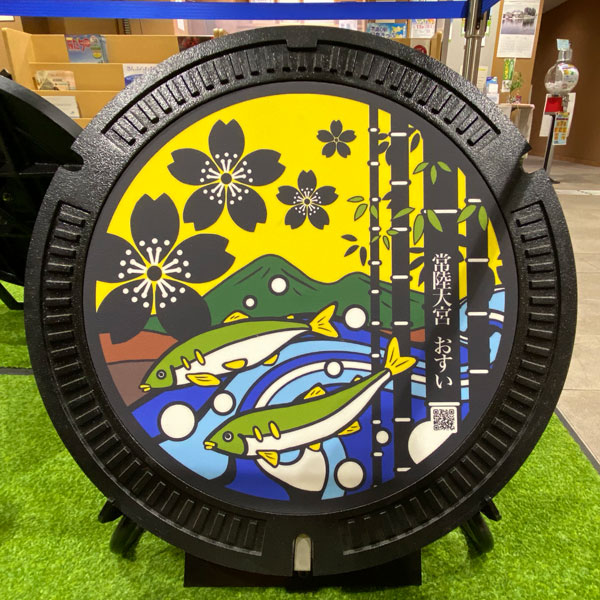
The city offers views of the two clear streams, the Kuji River and the Naka River, and the bamboo forests in their basins. It boasts an exceptionally vast and high-quality bamboo area, unparalleled in Japan, and the city's specialty, ayu (sweetfish), which are among the largest catches in the country and beloved by its residents.
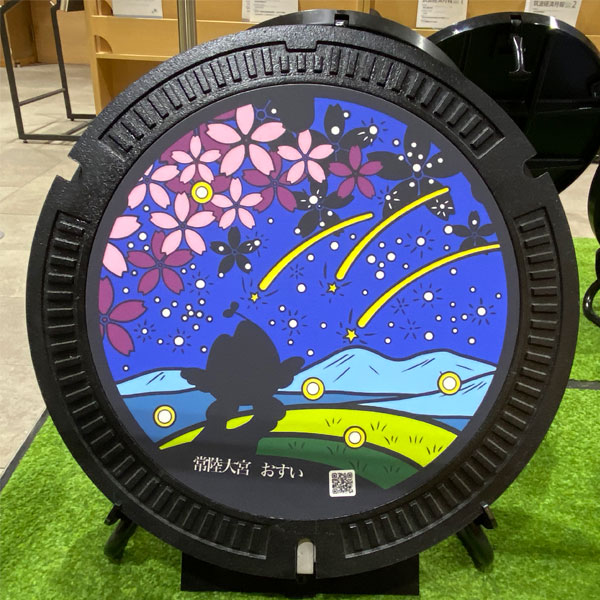
"There are many stargazing spots in the city, and in particular, Hanatate Nature Park has an observatory called "Bi-Star." The design depicts the city's official tree, the 'cherry blossom,' as a symbol of the kind hearts of the citizens and the bright future filled with hope, allowing visitors to enjoy the beautiful starry sky in the naturally rich mountain village.
Omiya 大宮町
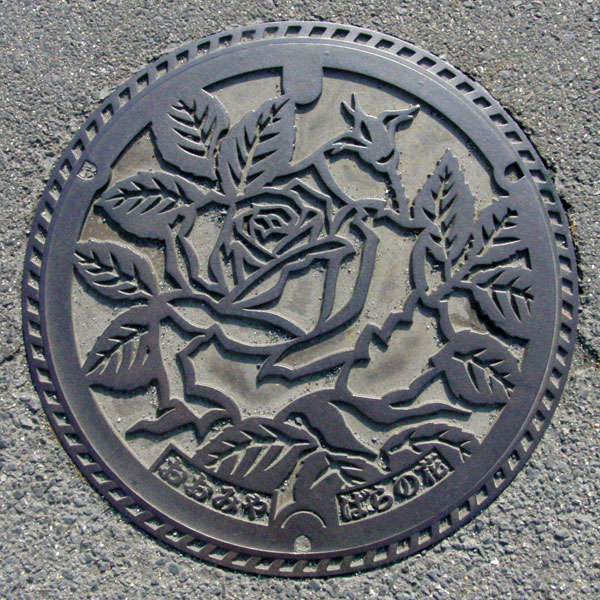
The design features the rose, the former town flower of Omiya.
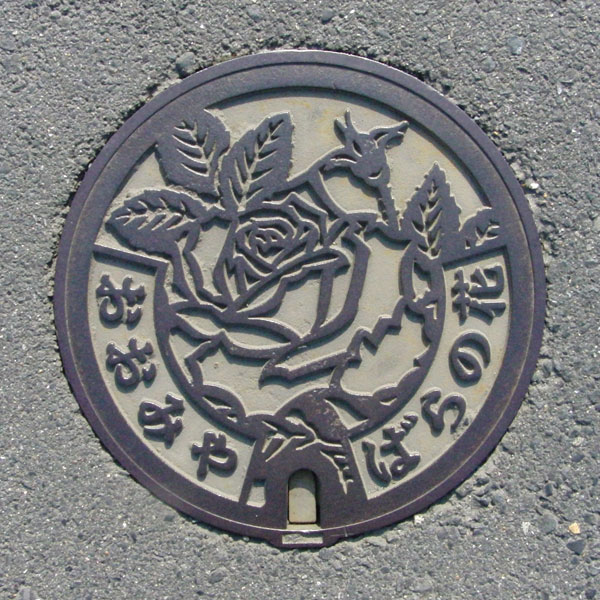
A smaller, handhole-sized panel with the same design as above.
Yamagata 山方町
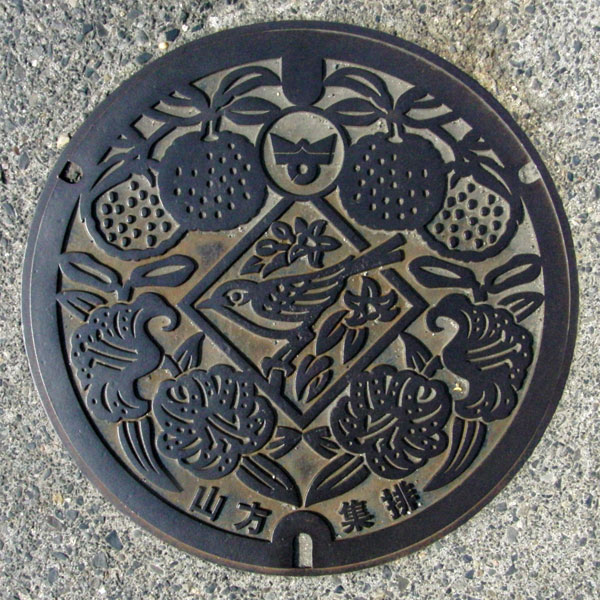
A manhole cover for agricultural wastewater in the Nishinouchi district. The design features the former Yamagata town tree "Yuzu," town flower "Yamayuri," and town bird "Uguisu" (Japanese bush warbler).
Miwa 美和町
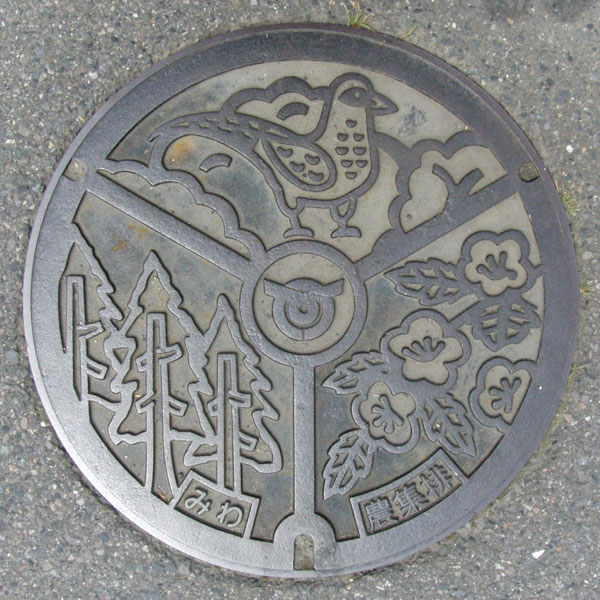
The design features the former Miwa Village's village bird, the Japanese pheasant, the village tree, the Japanese cedar, and the village flower, the Japanese kerria. The former Miwa Village emblem is in the center.
Ogawa 緒川村
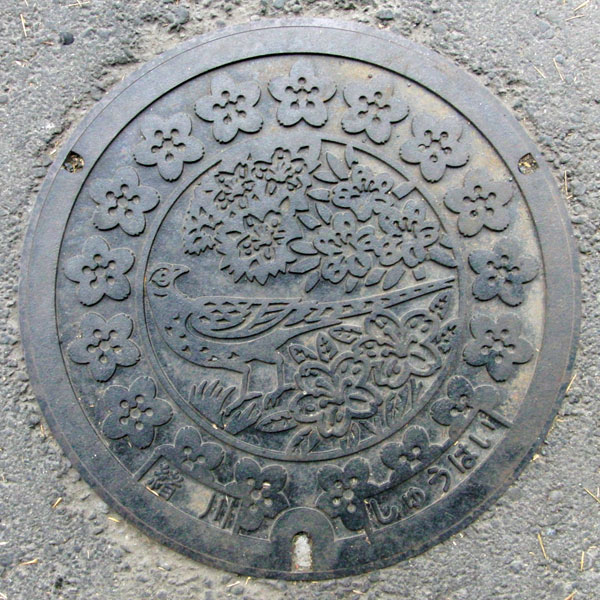
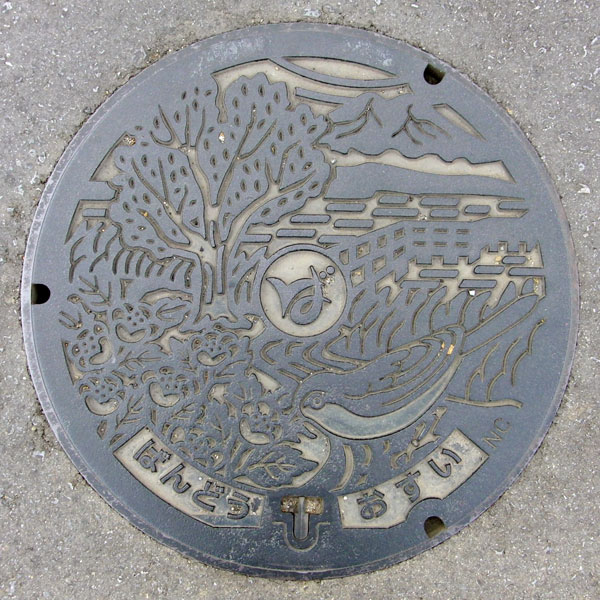
The design features the former Ogawa Village's tree ("Sakura"), village flower ("Azalea"), and village bird ("Yamadori"). This is a manhole cover for agricultural wastewater in the Kose district.
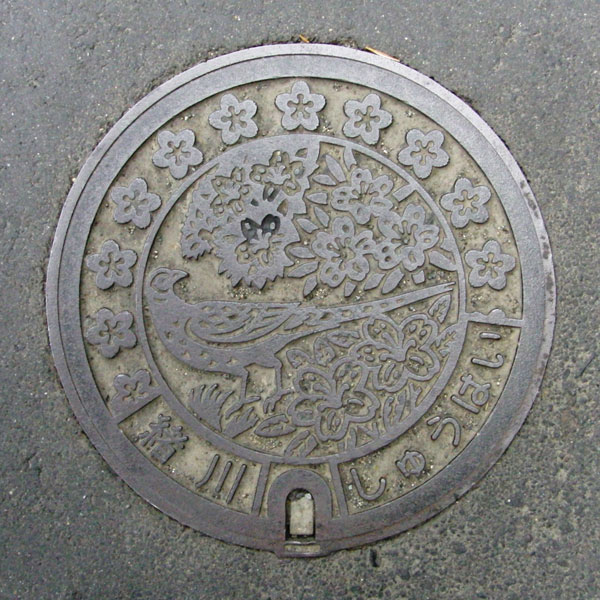
The mini size shown above.
Gozenyama 御前山町
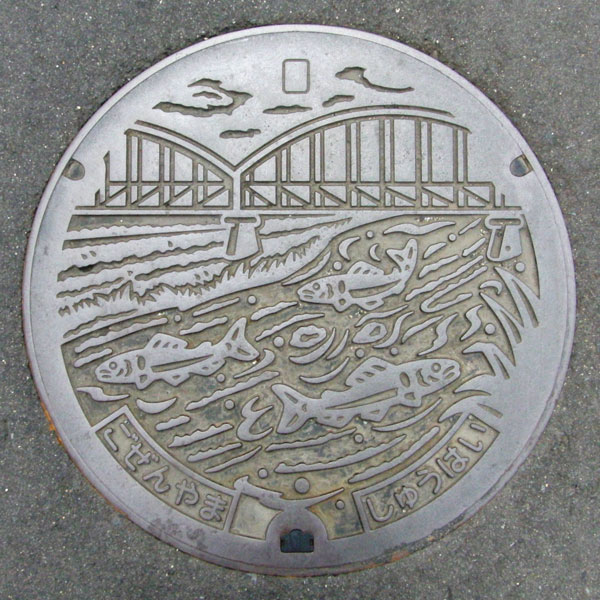
The design features ayu (sweetfish) swimming in the Nakagawa River that flows through the village, and the Nakagawa Ohashi Bridge spanning the Nakagawa River. This is a manhole cover for agricultural wastewater in the Noguchi area.
Hitachiota 常陸太田市
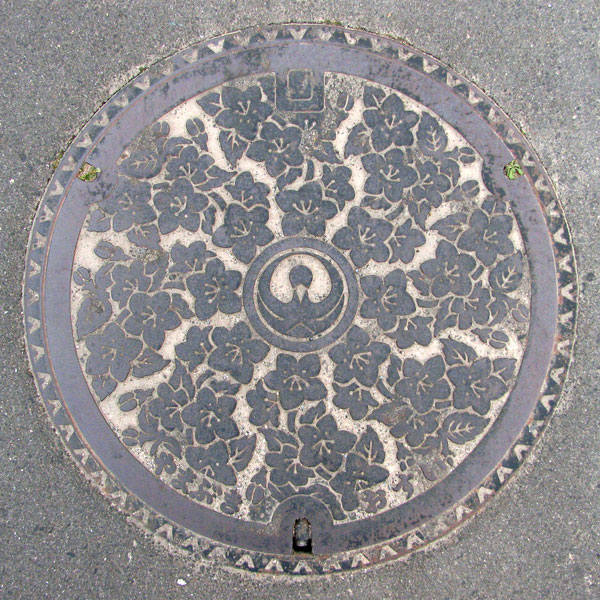
A manhole cover for sewage featuring the city flower, the Japanese kerria (Yamabuki).
The city emblem in the center is based on a legend from the Sengoku period, when the Satake clan entered Ota Castle. A crane flew overhead on the day the castle was named Maizuru Castle (Dancing Crane Castle), and the crane's shape represents the character "太" (Tai).
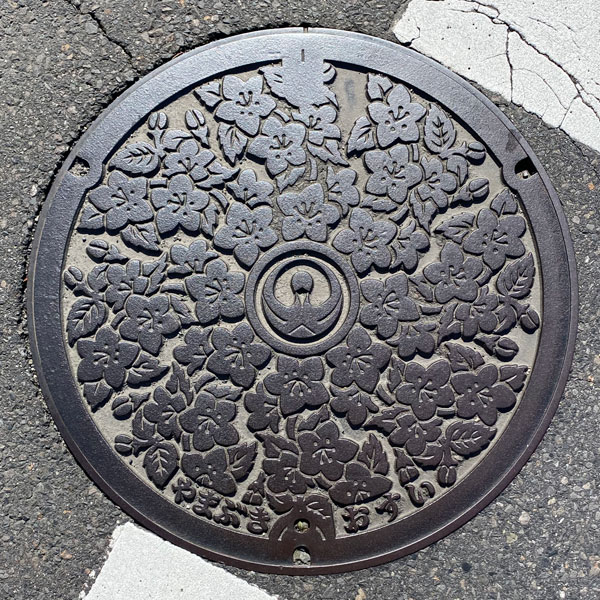
The texture is different.
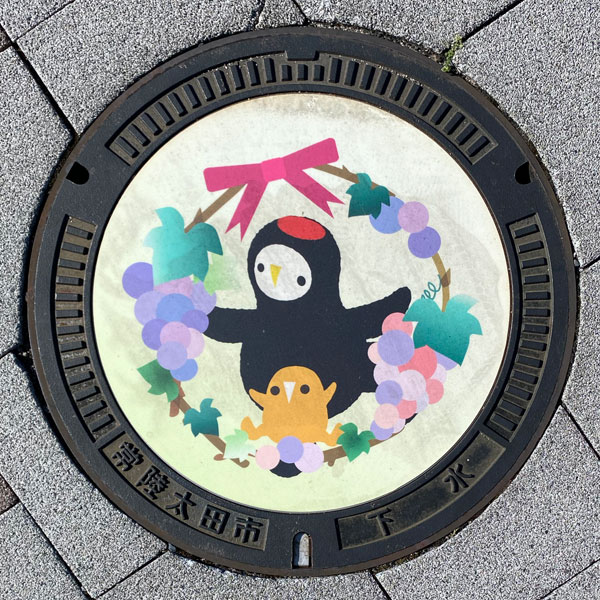
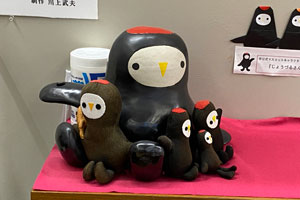
A manhole cover featuring the design of Hitachiota City's official mascot character, "Jozuru-san."
It depicts "Jozuru-san" and the city's specialty, Kyoho grapes.
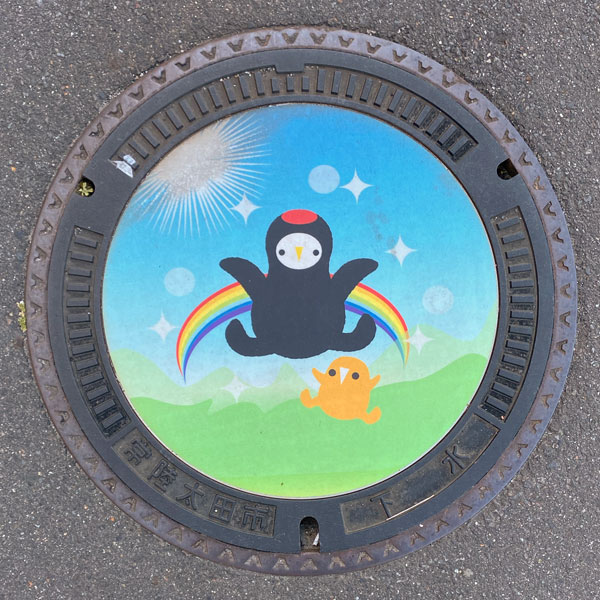
A manhole cover featuring the design of Hitachiota City's official mascot character, "Jozuru-san."
Jozuru-san is shown jumping into a sky with a rainbow. Perhaps the baby crane is there because Jozuru-san is the "Hitachiota City's Ambassador for Child-Rearing Expertise."
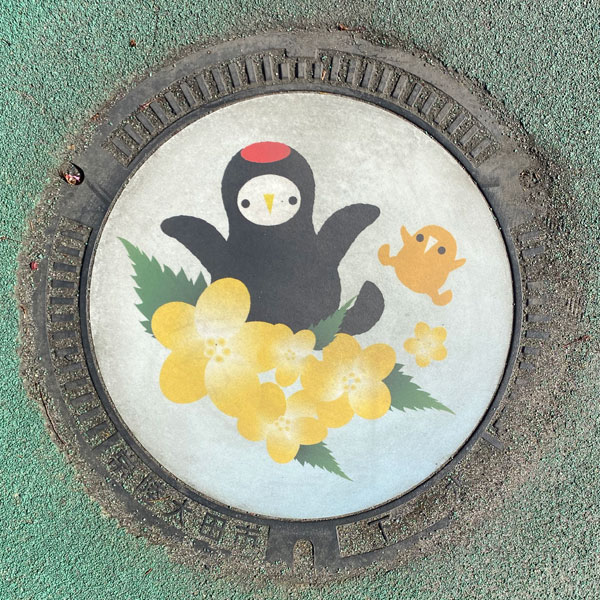
A manhole cover featuring the design of Hitachiota City's official mascot character, "Jozuru-san."
The city flower, "Yamabuki" (Japanese kerria), and "Jozuru-san."
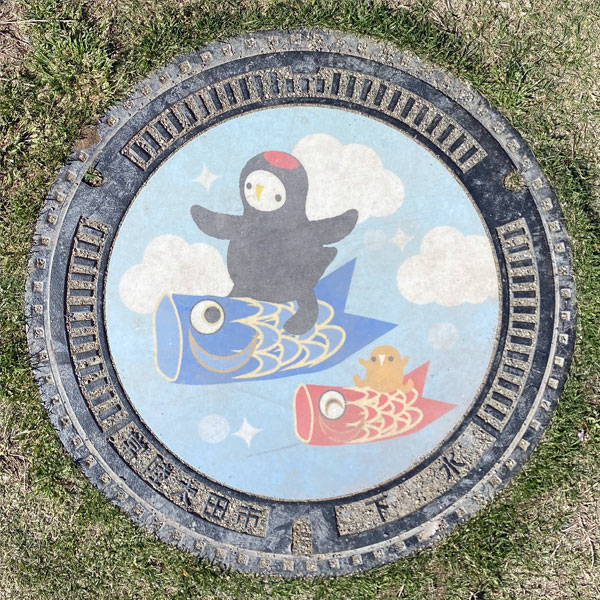
A manhole cover featuring the design of "Jozuru-san," the official mascot character of Hitachiota City.
"Jozuru-san" is depicted flying through the sky, riding on a carp streamer.
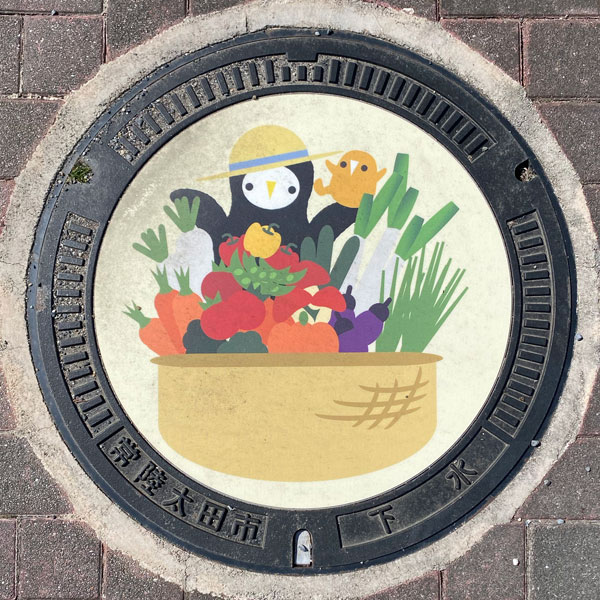
A manhole cover featuring the design of Hitachiota City's official mascot character, "Jozuru-san."
Features local agricultural products and "Jozuru-san."
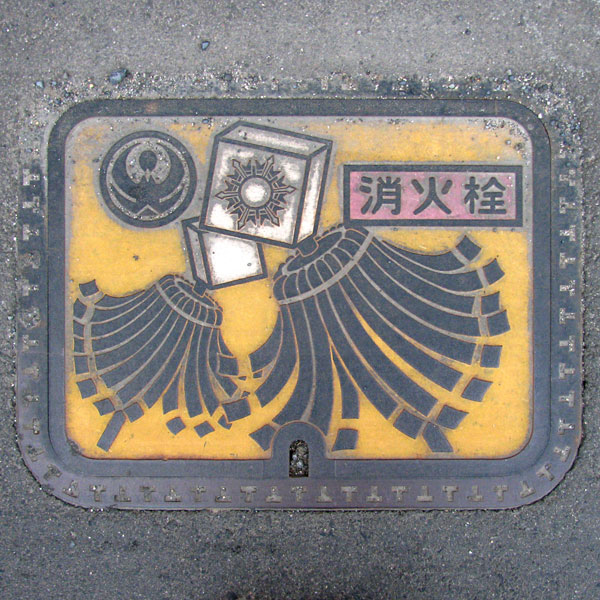
Fire hydrant.
Kanasagou 金砂郷町
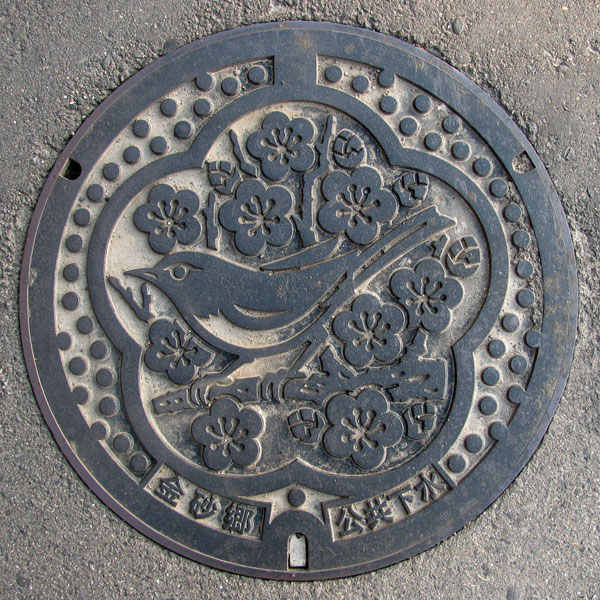
Town flower: "Plum blossom" and town bird: "Japanese bush warbler".
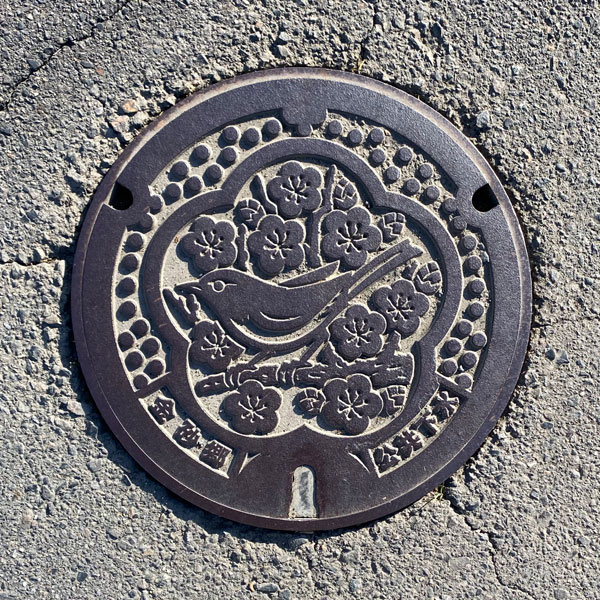
A small public sewer panel with the same design as above.
Satomi 里美村
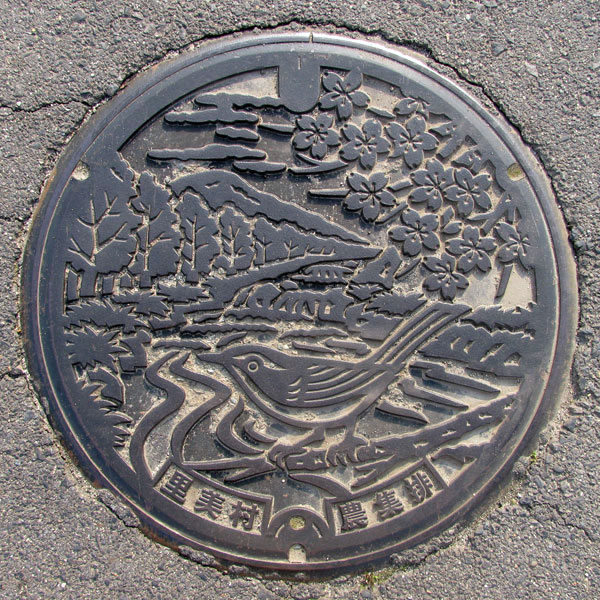
A manhole cover for the agricultural community drainage system in the central Satomi district. The scenery of Satomi Village features the village tree (Japanese cedar), the village flower (mountain cherry blossom), and the village bird (Japanese bush warbler). The bush warbler and cherry blossoms are a bit of a mismatch, but the atmosphere is very nice.
Suifu 水府町
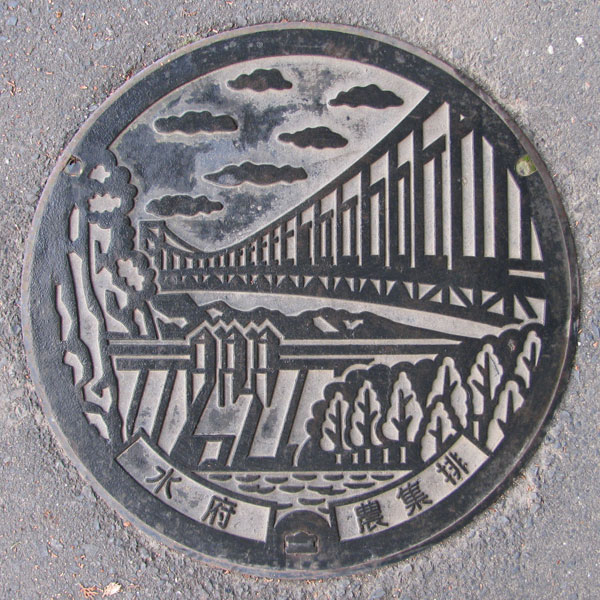
Agricultural wastewater treatment plant designed after the Ryujin Suspension Bridge, a pedestrian-only bridge spanning the Ryujin Dam.
Hitachi 日立市
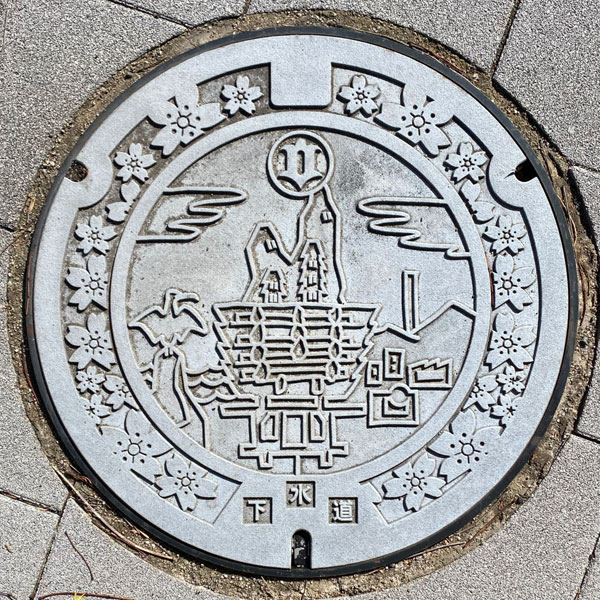
A manhole cover featuring the city flower, "Sakura," on the outside, and depicting "Hitachi Furyumono," a UNESCO Intangible Cultural Heritage, and the city bird, "Japanese Cormorant," on the inside. The large chimney and factories of the Hitachi Mine are also visible. Featured on manhole cards.
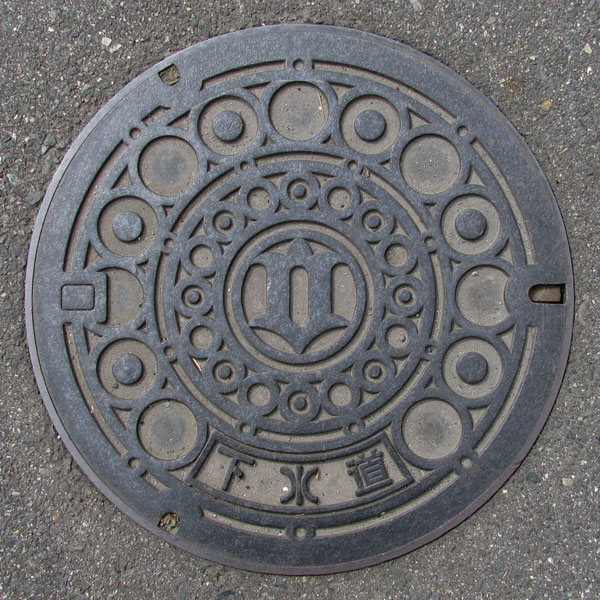
It looks like a simple pattern of circles, but it seems to be made up of the characters "日" (sun) and "立" (standing). The city emblem is in the center, and the word "sewerage" (sewerage system) is written at the bottom.
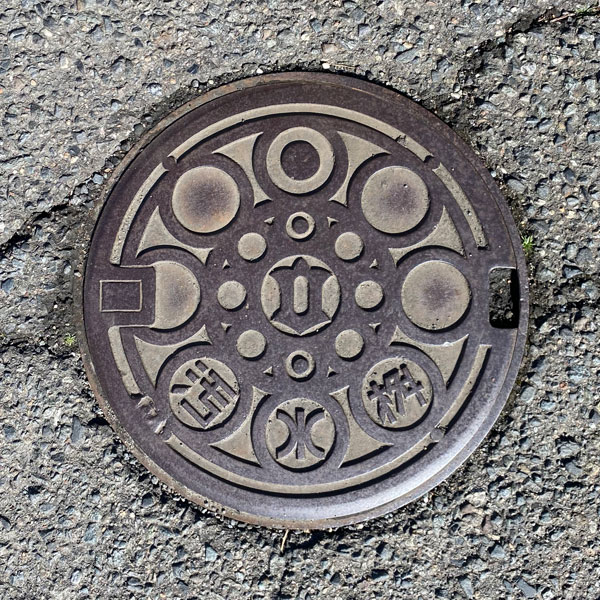
A smaller sewage manhole panel.
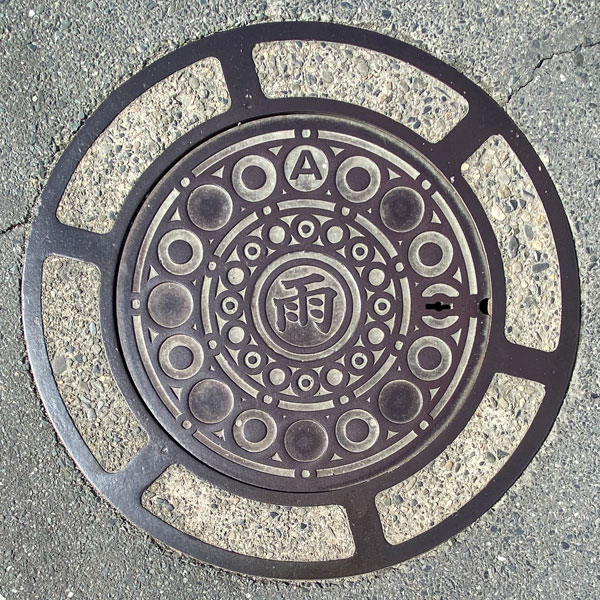
A manhole cover for rainwater, featuring the character for "rain" instead of the city emblem in the center.
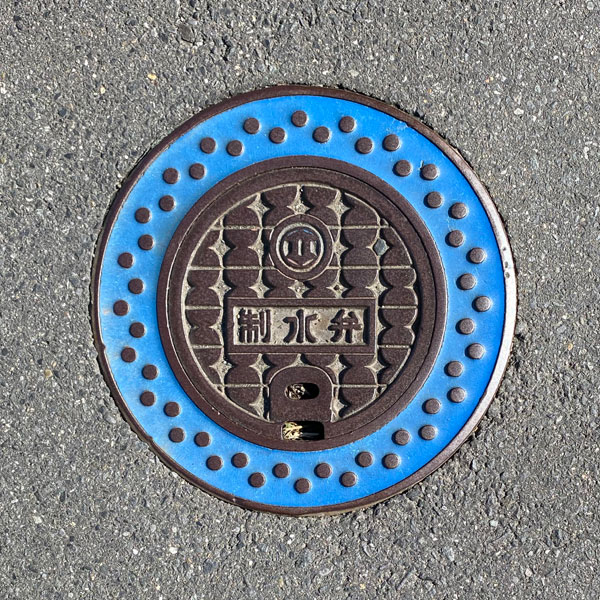
A water control valve cover with a blue frame.
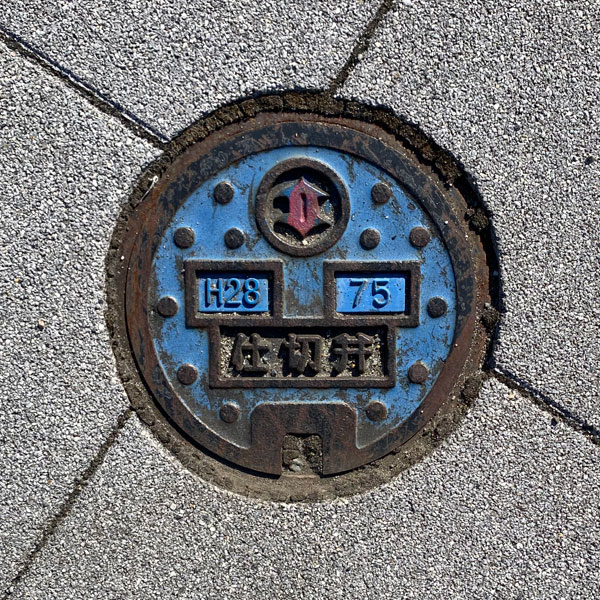
A gate valve cover with a blue background and a polka-dot pattern.
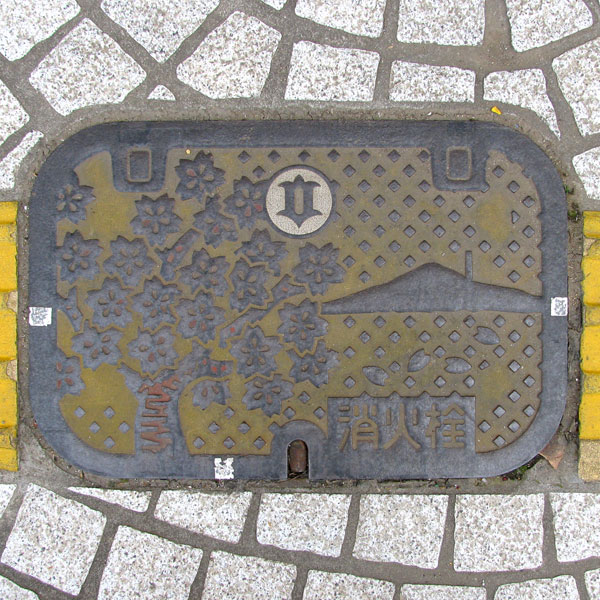
A fire hydrant decorated with the city flower, the cherry blossom. To the right appears to be the large chimney of the Hitachi Mine (which was 155.7m tall before its collapse) that toppled due to strong winds on February 19, 1993.
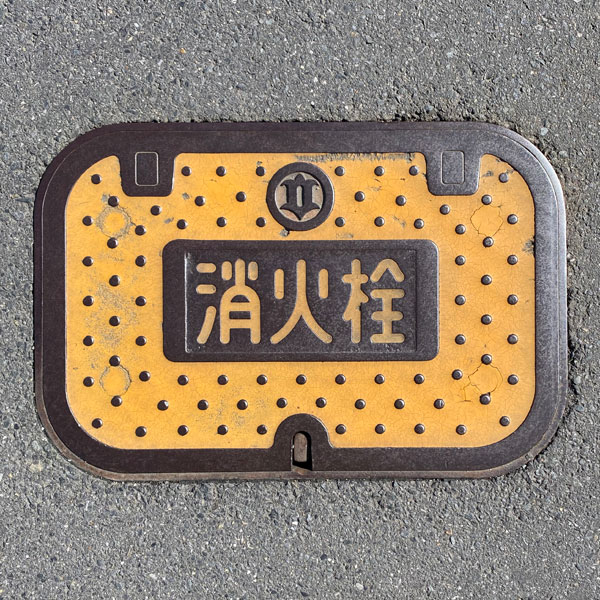
A fire hydrant cover that is somewhat small.
Naka 那珂市
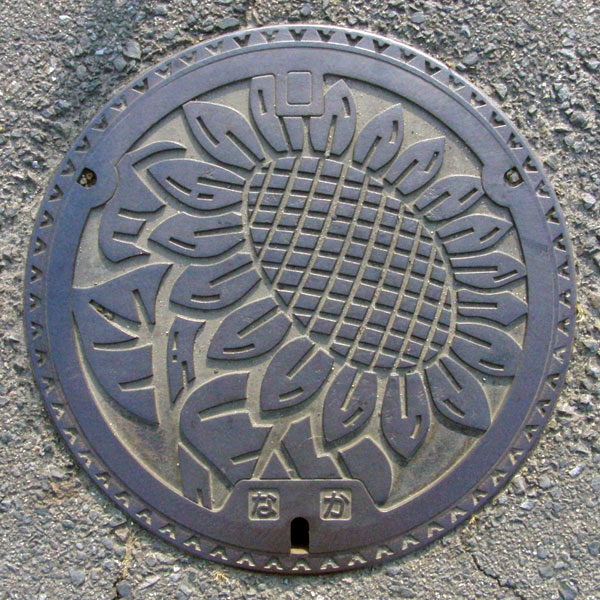
A somewhat small fire hydrant cover. The design features the city flower, the sunflower. Below is a photo taken in front of Naka General Park.
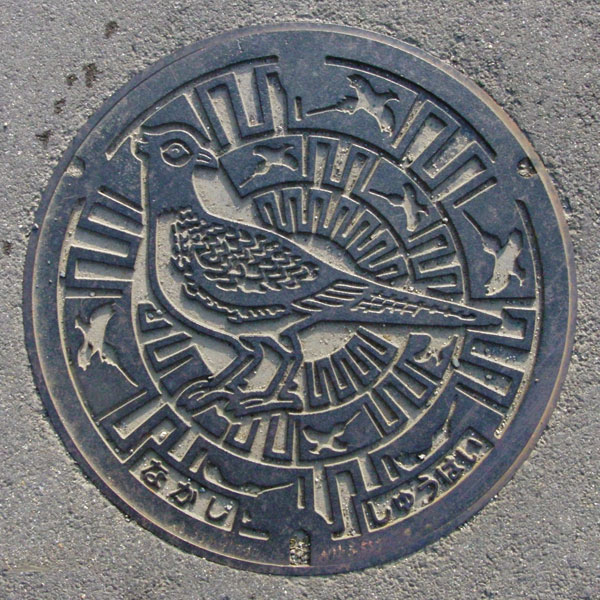
A manhole cover for agricultural wastewater treatment plants, depicting a pheasant. The words "Nakashi" and "Shuhai" are written at the bottom.
Naka 那珂町
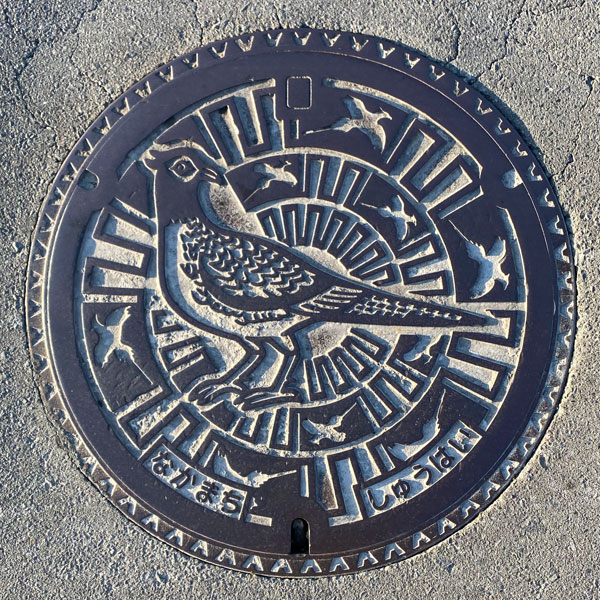
This is a manhole cover depicting a pheasant, embedded in front of a shop selling agricultural products. The cover is clearly new, but the lettering reads "Nakamachi," so it's identified as a manhole cover for Nakamachi.
Urizura 瓜連町
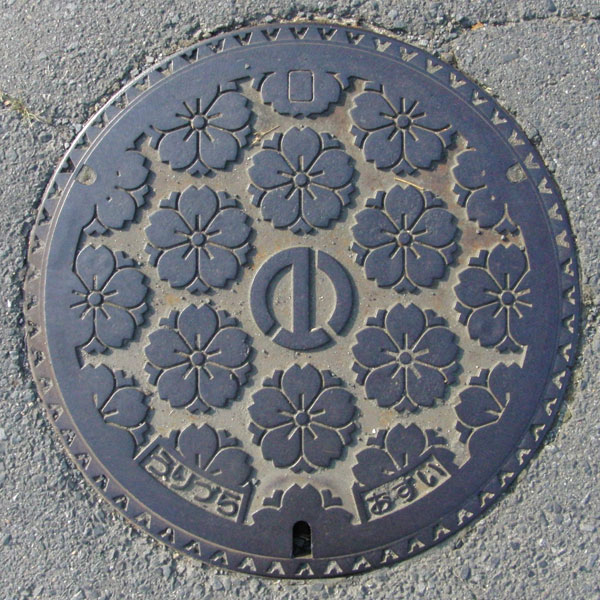
The design features the town's official flower, the double-flowered cherry blossom, with the town emblem in the center, which is a stylized representation of the character for "melon."
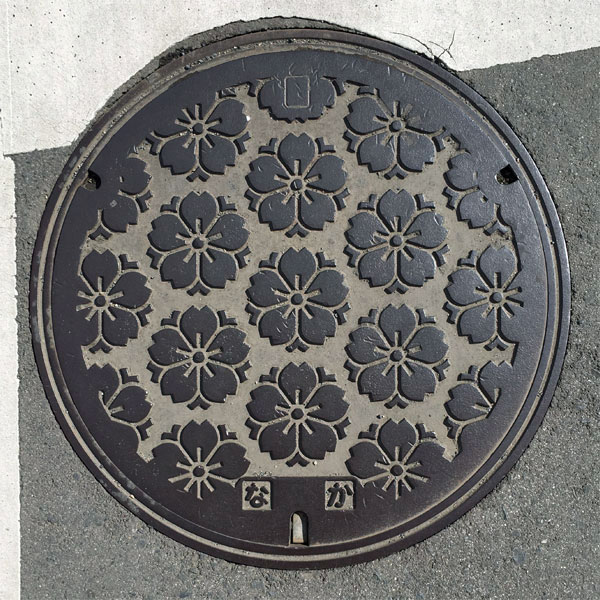
This is a manhole cover for sewage, based on the design of the former Urizura Town flower, the "Yaezakura" (double-flowered cherry blossom). The town emblem that was in the center during the Urizura Town era has been removed, and the characters that read "Urizura" have been changed to "Naka".
Hitachinaka ひたちなか市
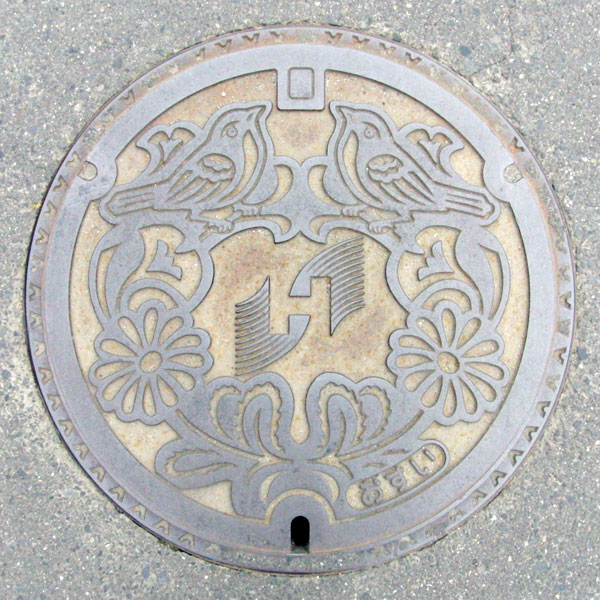
The design features the city bird, the Japanese bush warbler, the city tree, the ginkgo, and the city flower, the seaside daisy, depicted symmetrically, with the city emblem placed in the center.
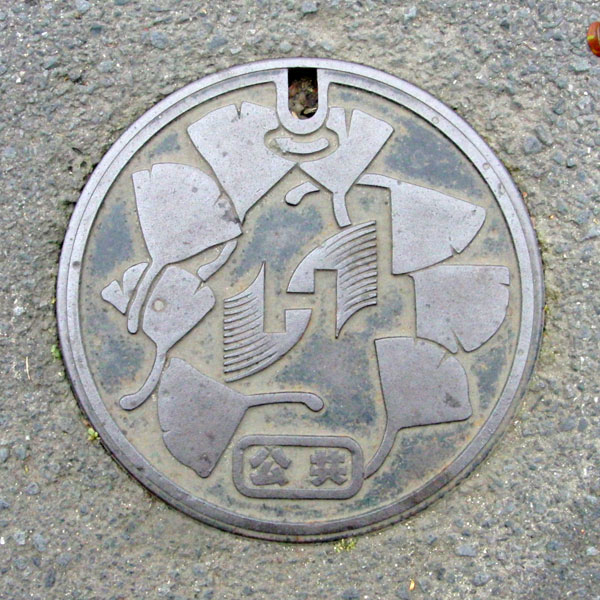
Miniature size. The design features the leaves of the city's official tree, the ginkgo. The city emblem is in the center.
Katsuta 勝田市
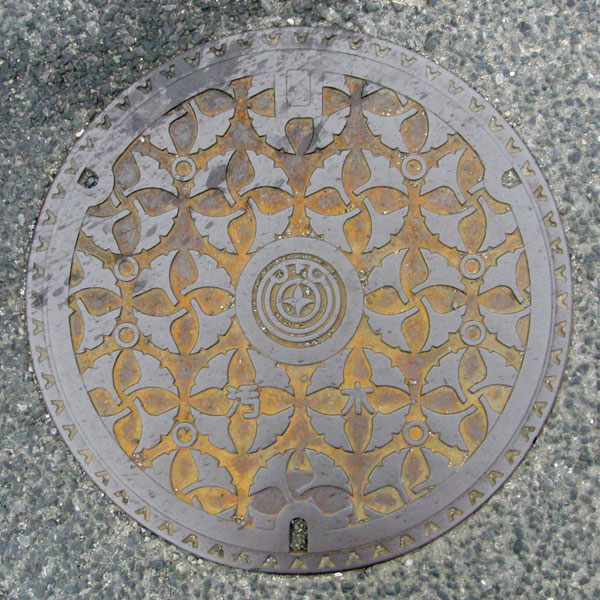
The city emblem in the center indicates that it dates back to the time when it was Katsuta City. The design is a ginkgo leaf.
Nakaminato 那珂湊市
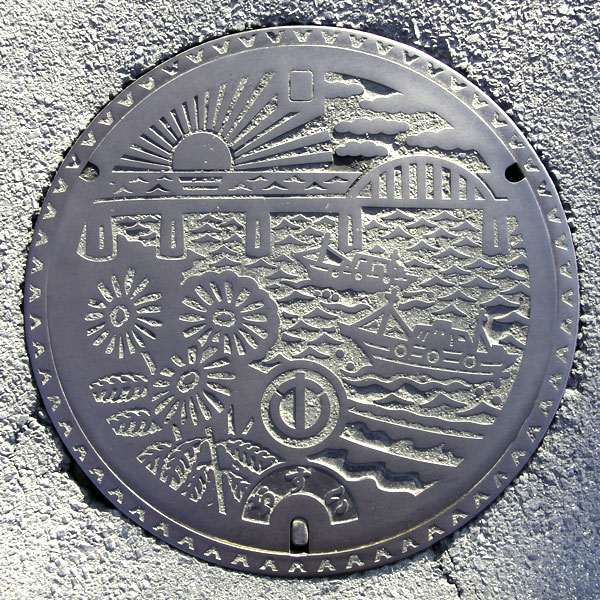
The design features the Kaimon Bridge spanning the Nakagawa River, the rising sun, and the city flower, the Hamagiku (Chrysanthemum pacificum). The Nakaminato city emblem and the word "osui" (sewage) are at the bottom.
Kasama 笠間市
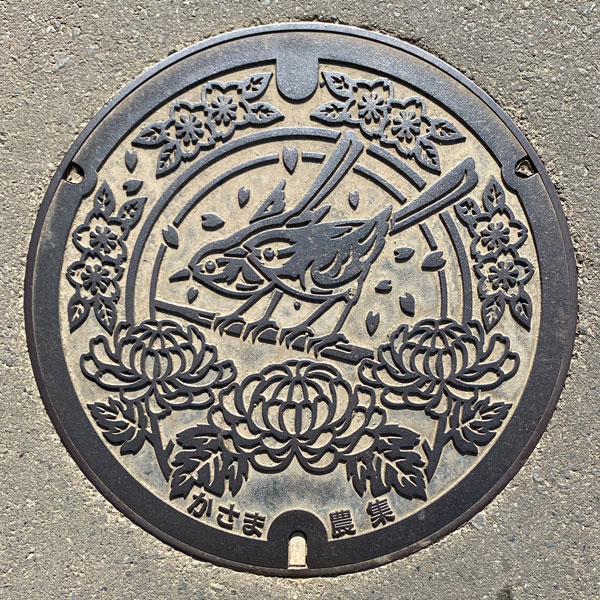
A colorful manhole cover for sewage featuring illustrations of Kasama City's official tree, the cherry blossom; its official flower, the chrysanthemum; and its official bird, the Japanese bush warbler.
Kasama 笠間市
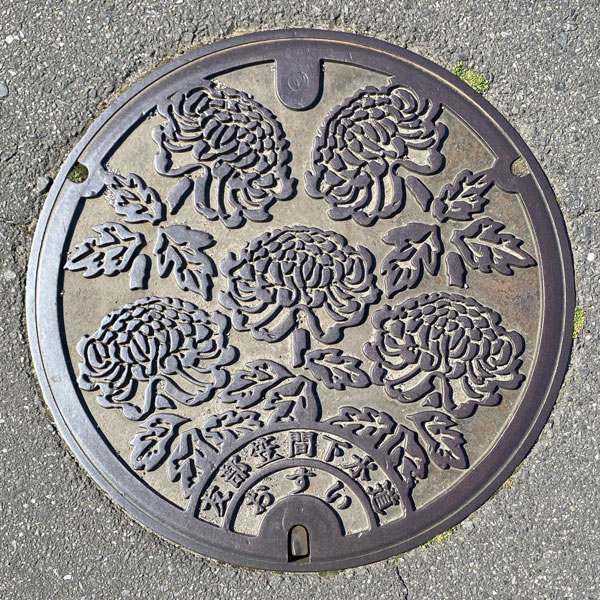
A manhole cover from the Tomobe-Kasama Regional Sewerage Association, depicting the town flower, the chrysanthemum.
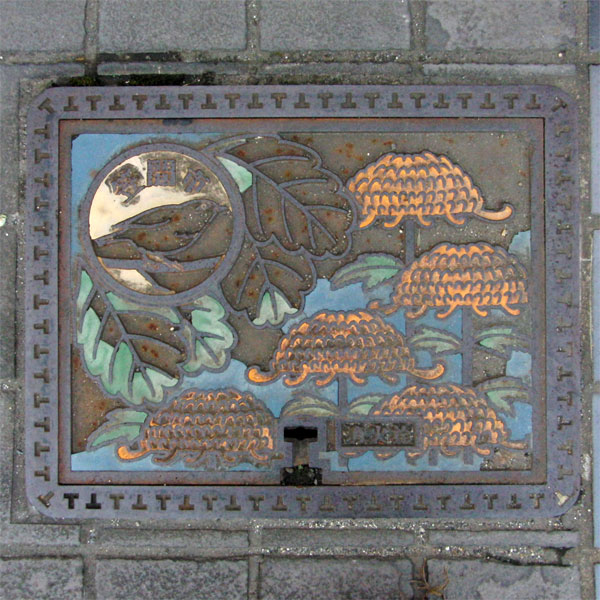
The fire hydrant, which is decorated with the town's flower "chrysanthemum," the town's bird "Japanese bush warbler," and the leaves of the town's tree "oak," is severely damaged.
Tomobe 友部町
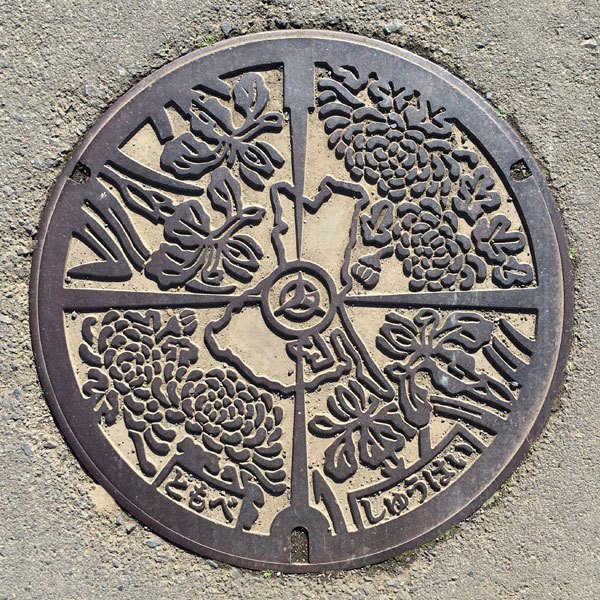
The cover is divided into four sections, with a map of Ibaraki Prefecture centered around the town emblem of Tomobe Town in the center. Outside of this, chrysanthemums and irises are arranged symmetrically. The chrysanthemum was the former flower of Tomobe Town.
Iwama 岩間町
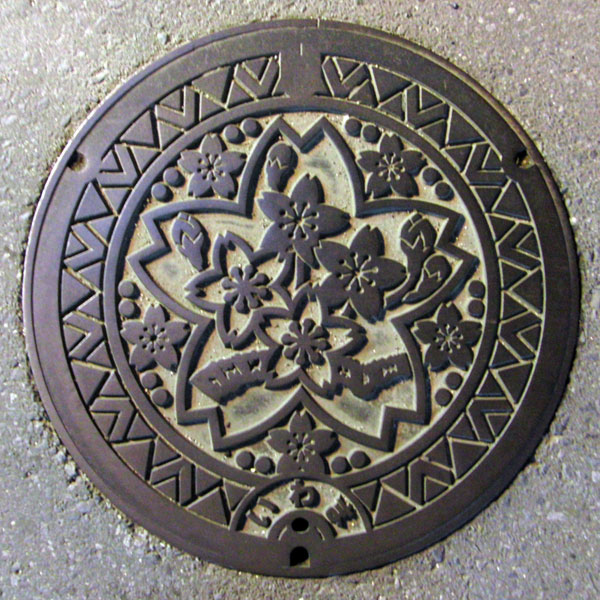
The design is based on the town's official flower, the cherry blossom.
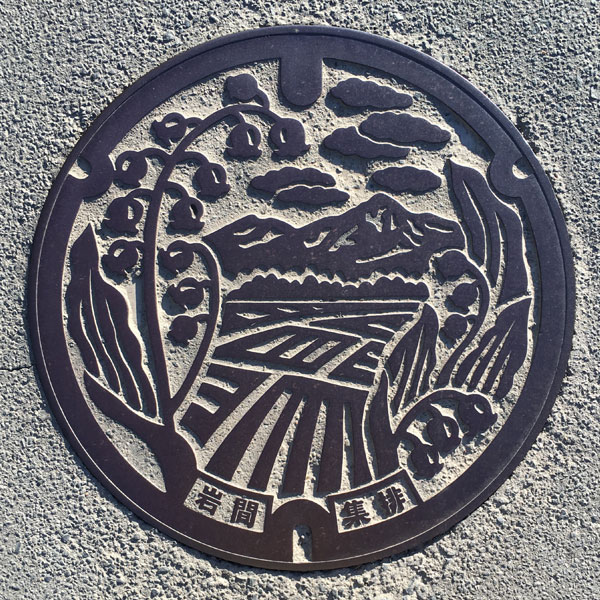
A manhole cover for agricultural sewage in the Ago district, depicting the town flower, the lily of the valley, against a rural landscape with mountains in the background.
Izumo Grand Shrine 常陸国出雲大社
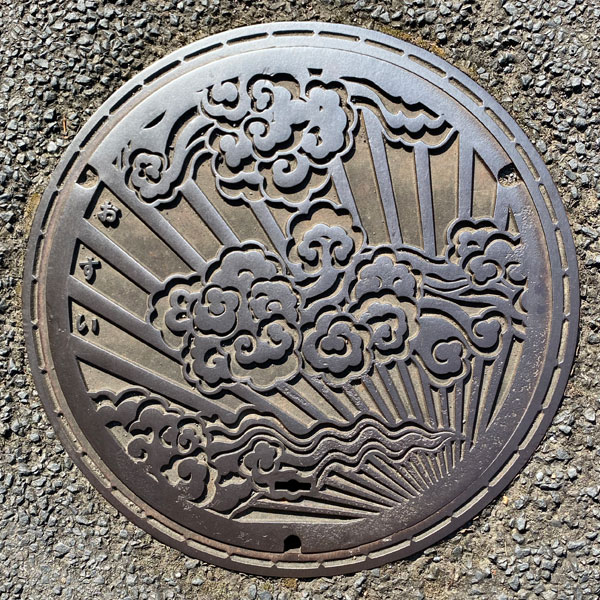
A manhole cover for sewage at Hitachi-no-Kuni Izumo Taisha Shrine, depicting clouds that look like they could be the appearance of Yamata no Orochi (a mythical eight-headed serpent). The design may be derived from the poetic epithet "Yakumo Tatsu → Izumo" (meaning "eight clouds rising").
Sakuragawa 桜川市
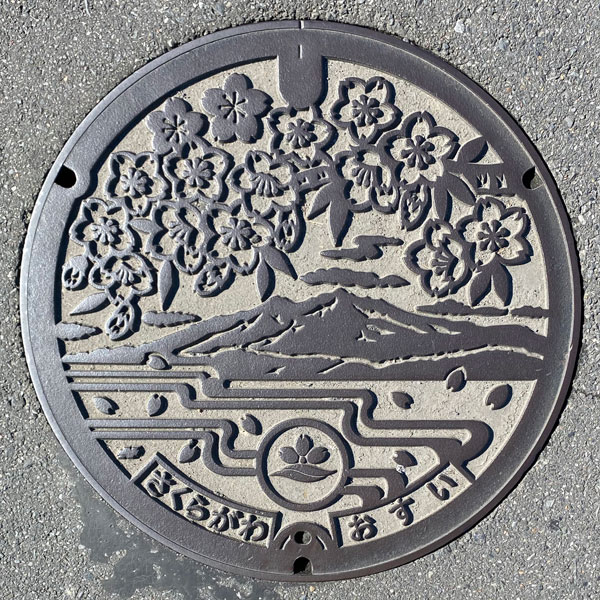
A manhole cover for sewage depicting Mount Tsukuba in the background of the Sakuragawa River, and the city's official tree, the cherry blossom.
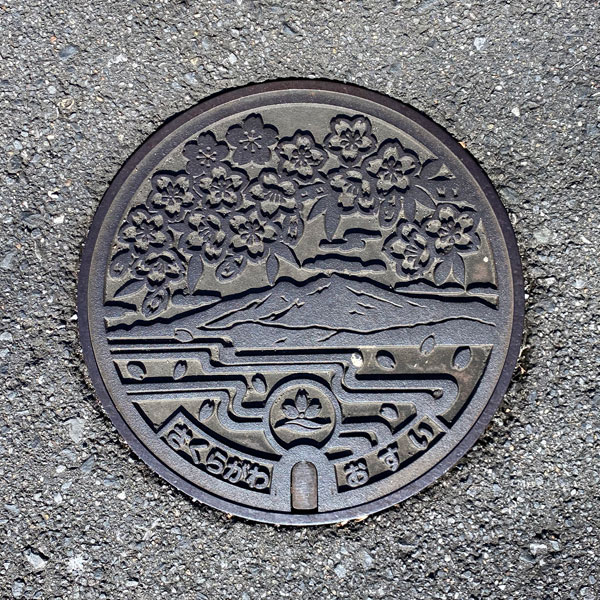
A smaller version with the same design as above.
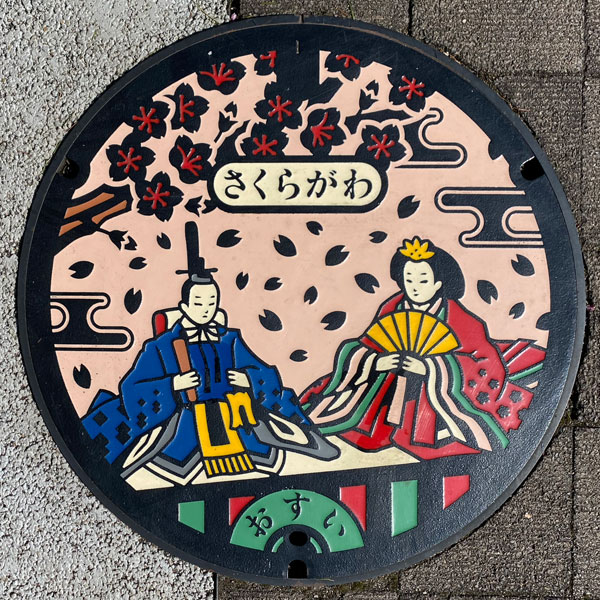
Sakuragawa City is a village of cherry blossoms with approximately 550,000 wild cherry trees, and has been known since ancient times as "Yoshino in the west, Sakuragawa in the east." This is a colored manhole cover for sewage, depicting the Emperor and Empress dolls of the "Makabe Hina Matsuri" (Doll Festival) against a backdrop of these wild cherry blossoms.
Iwase 岩瀬町
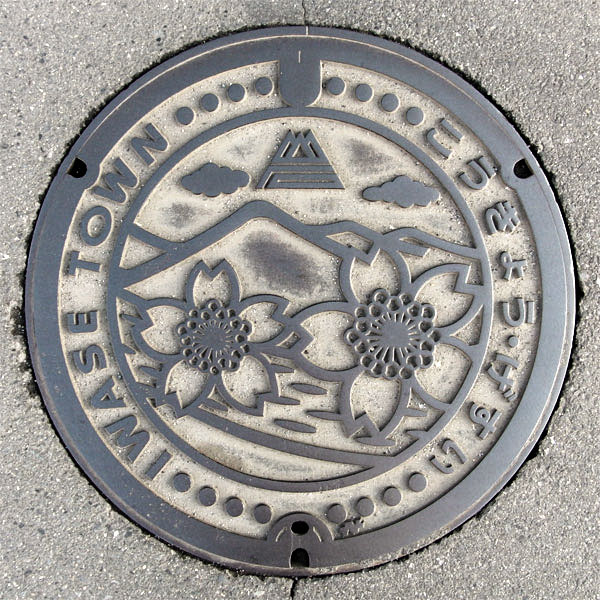
The design features the town flower "Sakura" (cherry blossom), a mountain, and a river. The town emblem, a "rock," is designed at the top.
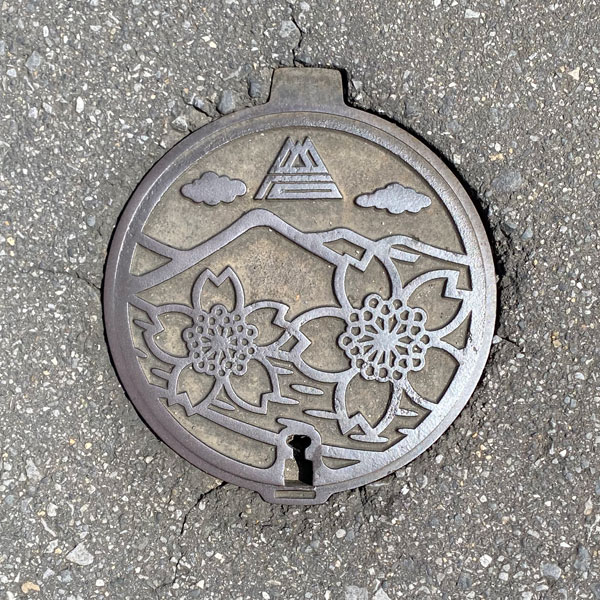
A handhole cover depicting only the inner part of the design shown above.
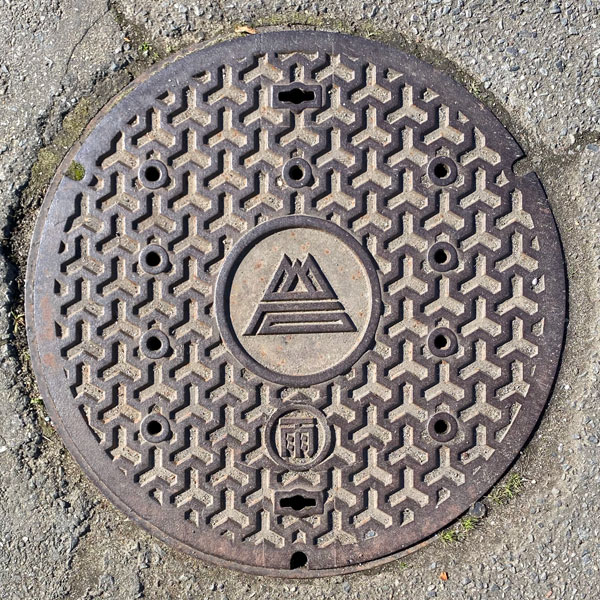
A manhole cover for rainwater with a Bishamon tortoise shell pattern.
Makabe 真壁町
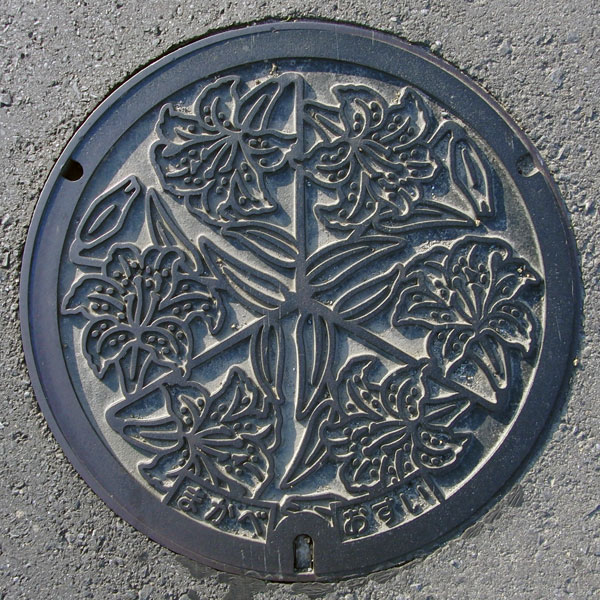
The design features the buds and flowers of the town's official flower, the "mountain lily."
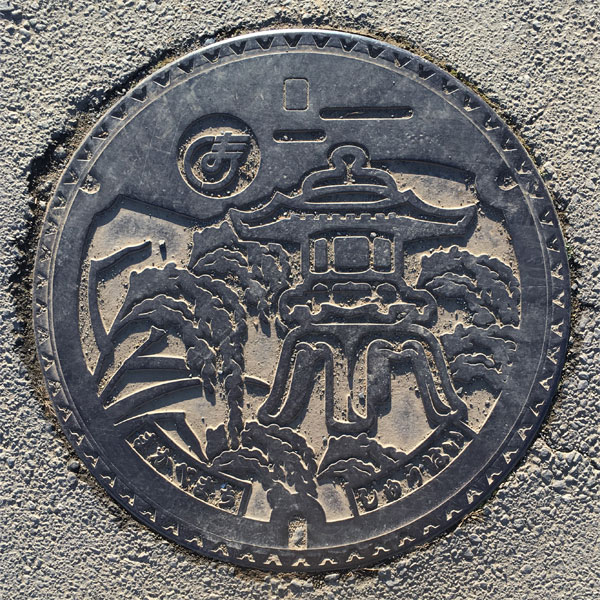
A manhole cover for the agricultural community drainage system in the Genbōji Suzuga district. It depicts rice stalks and stone lanterns, a specialty of the Makabe district. The town emblem is in the upper left corner.
The Makabe district is considered one of Japan's three major stone-producing areas, and the "Makabe stone lanterns," made from Makabe granite produced there, are designated as a national traditional craft.
Yamato 大和村
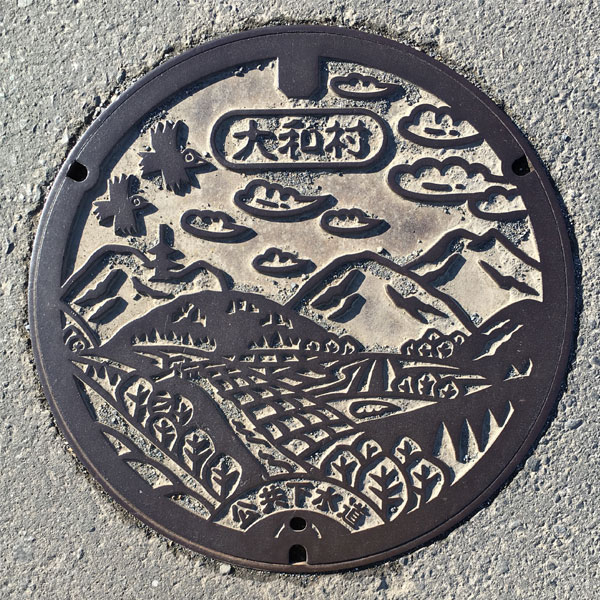
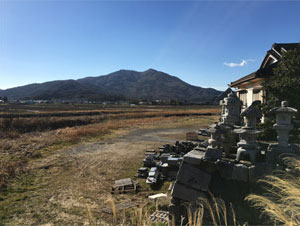
Is the mountain on the right Mount Tsukuba? A temple pagoda is visible on the mountain on the left; could it be Amabiki Kannon? A river is visible, but it seems too narrow for the Sakuragawa River; perhaps it's the Okawa River, a tributary? A bird is flying in the sky; since the village doesn't have a designated bird, it's probably a crow.
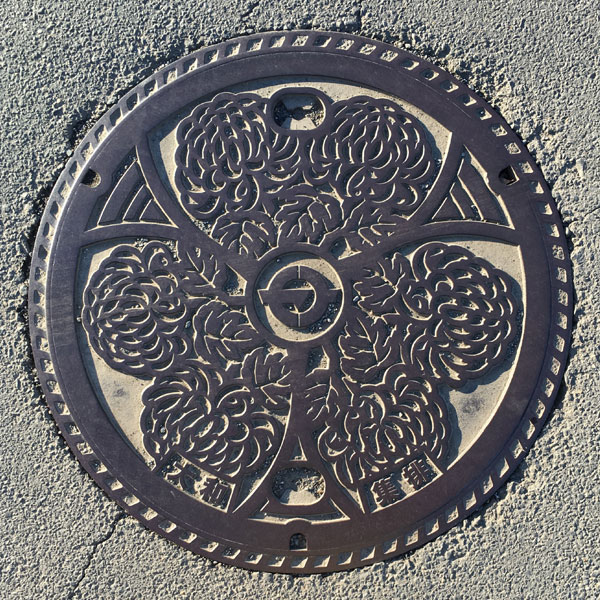
A manhole cover for agricultural settlements in the Takaku district, depicting the chrysanthemum, the former flower of Yamato Village.
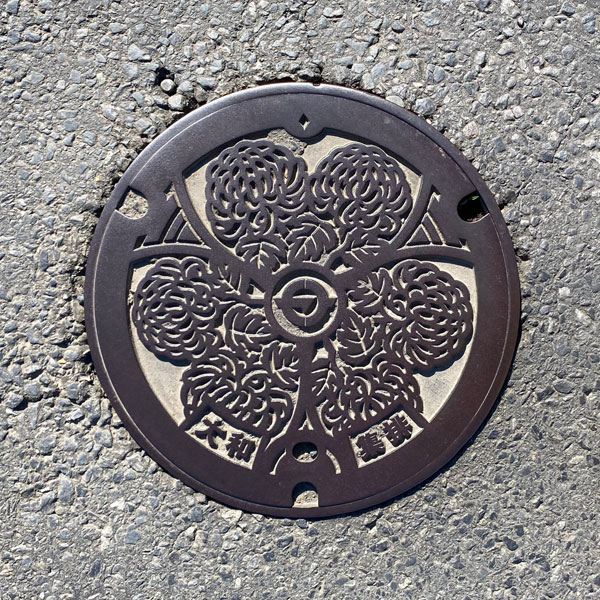
A smaller version with the same design as above.
Chikusei 筑西市
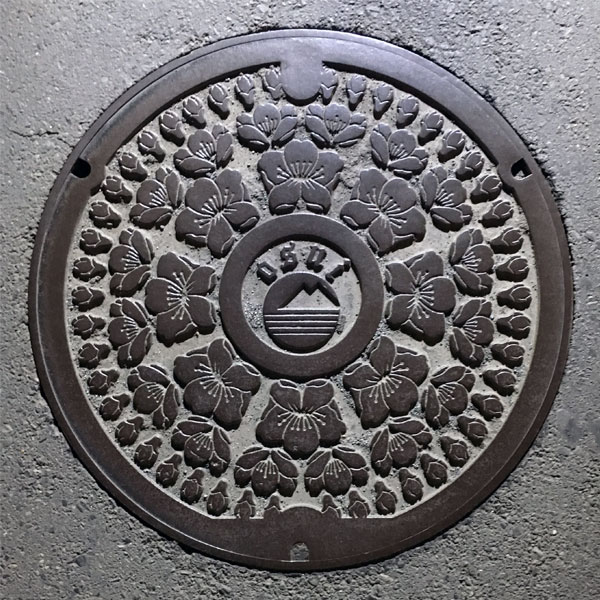
The design features the city's official tree, the cherry blossom. It uses the design of the former Shimodate City, with buds surrounding it and the city emblem and the word "OSUI" in the center.
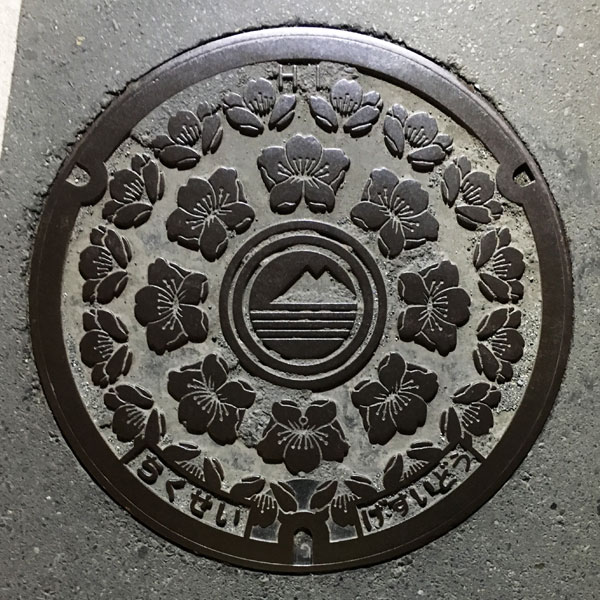
The design is based on the city's official tree, the cherry blossom. There are no buds around it. The words "Chikusei" and "Gesui-do" are written at the bottom.
Shimodate 下館市
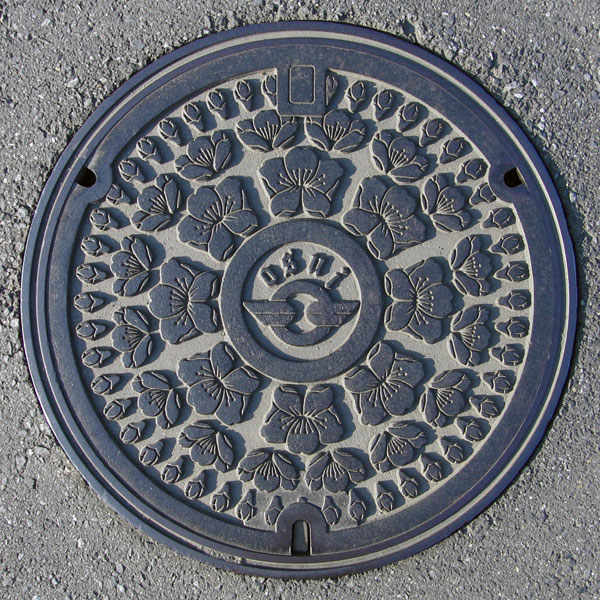
The design features the city's official tree, the cherry blossom. In the center are the Shimodate city emblem and the word "OSUI".
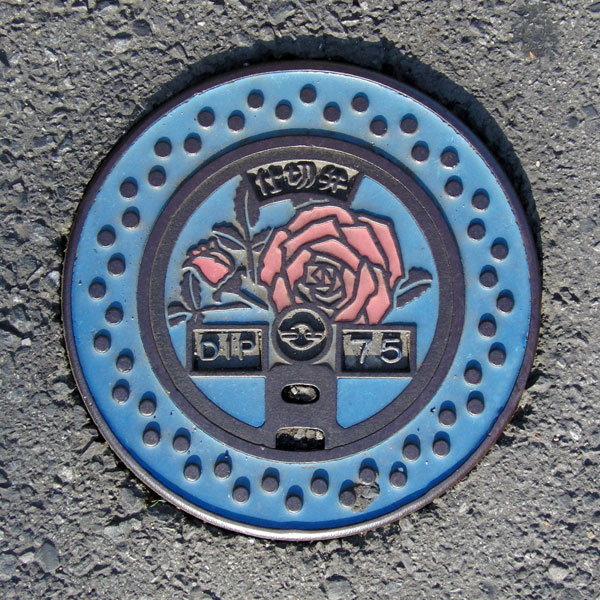
A gate valve featuring the city flower, the rose.
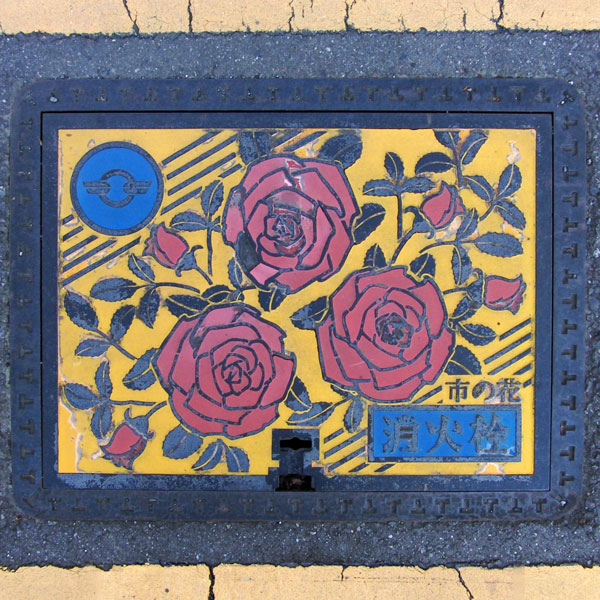
A fire hydrant cover featuring the city flower, the rose.
Sekijo 関城町
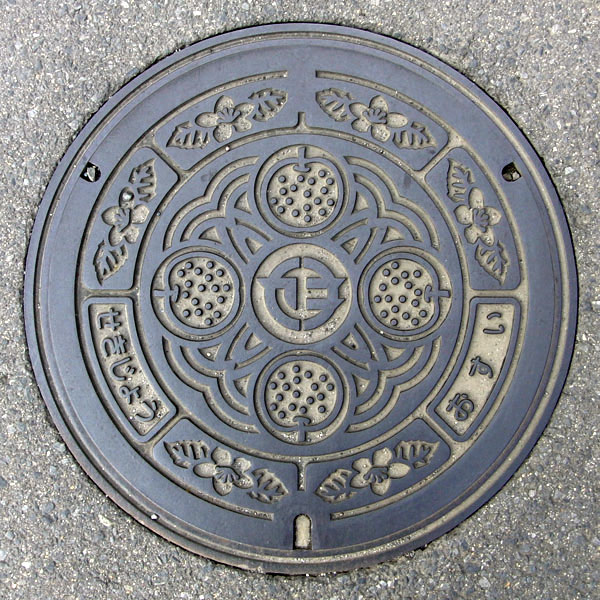
The design features the town's official flower, the pear, along with its fruit and blossoms, and the town emblem in the center.
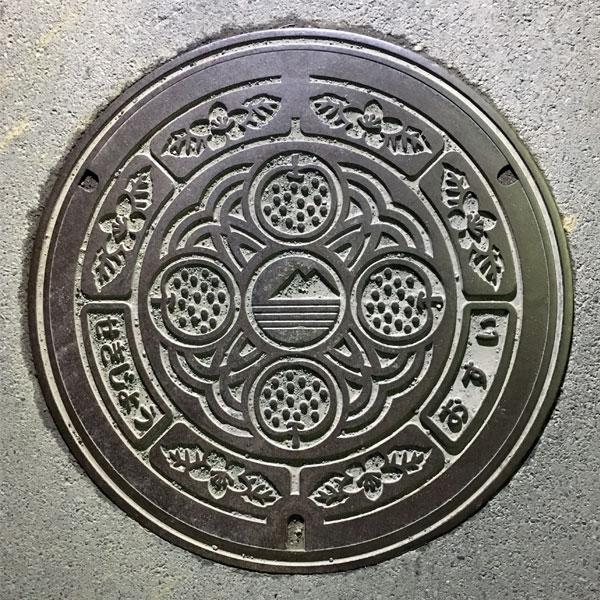
This design is based on the former Sekijo Town design, with the characters for "Sekijo" remaining the same, but the center replaced with the city emblem of Chikusei City.
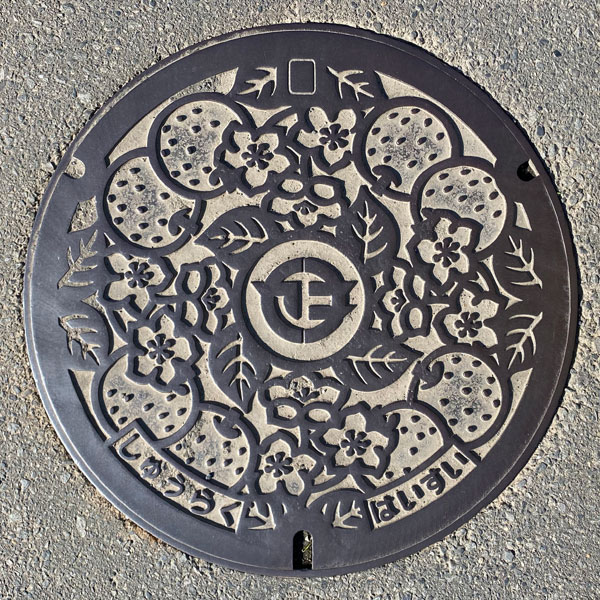
A manhole cover for agricultural wastewater in the Sekijo-Higashi district, featuring separate designs of the town's flower, the pear, and its fruit and blossom.
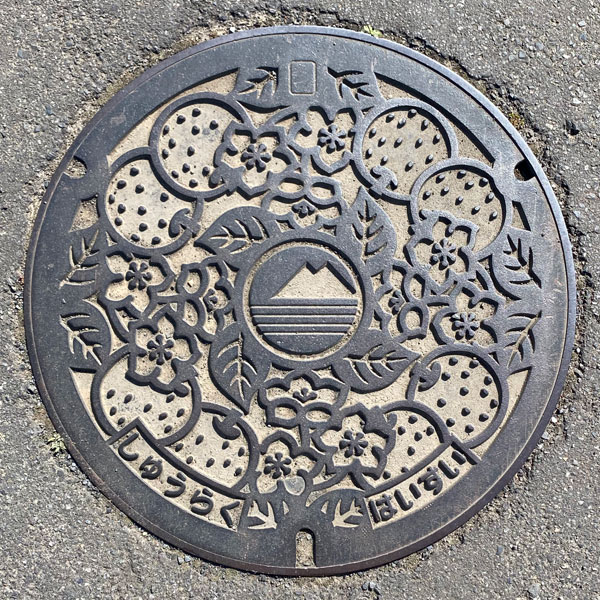
The manhole cover for agricultural wastewater treatment plants in the Sekijo-Higashi district features separate designs of the pear fruit and flowers, the town's official flower, with the Chikusei City emblem in the center.
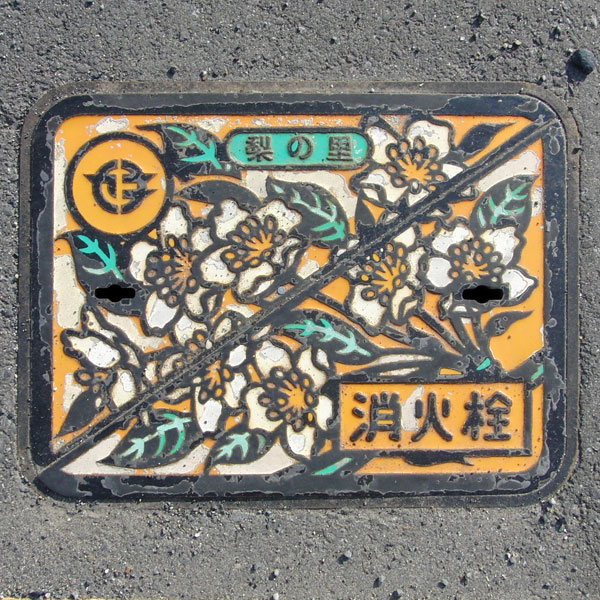
A fire hydrant cover featuring the town's official flower, the pear.
Akeno 明野町
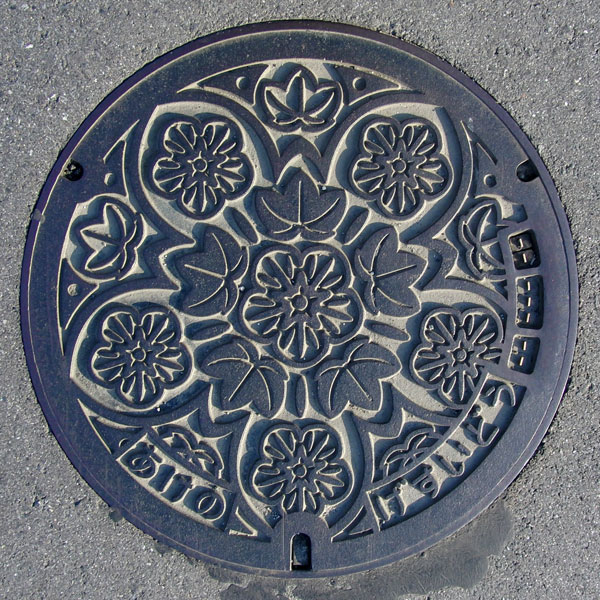
A manhole cover featuring the town flower, the hibiscus.
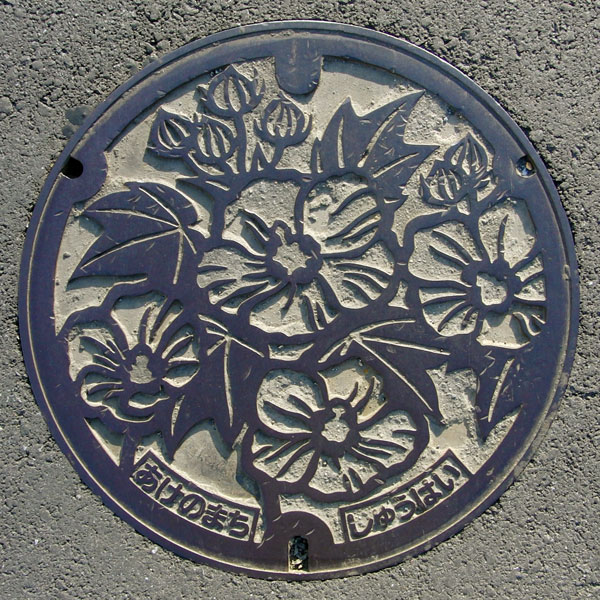
A manhole cover for the agricultural community drainage system in the Miyago district, featuring the town flower "Hibiscus" in a different design.
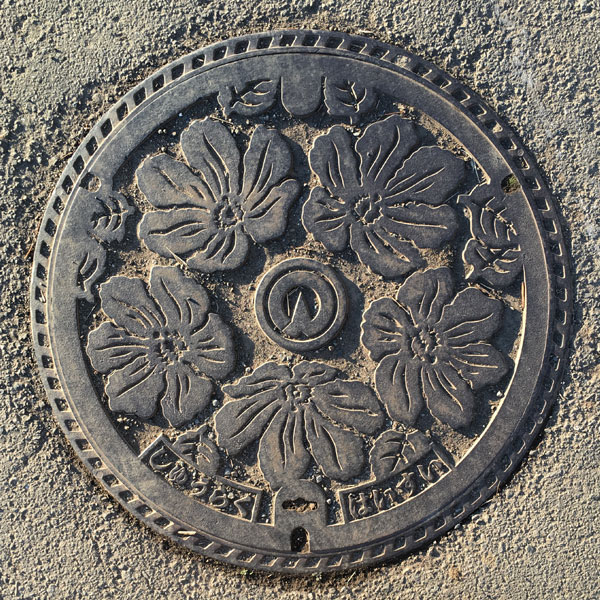
A manhole cover for the Higashi-Ishida agricultural community drainage system, featuring the town flower "Hibiscus" in a different design. The town emblem is in the center.
Kyowa 協和町
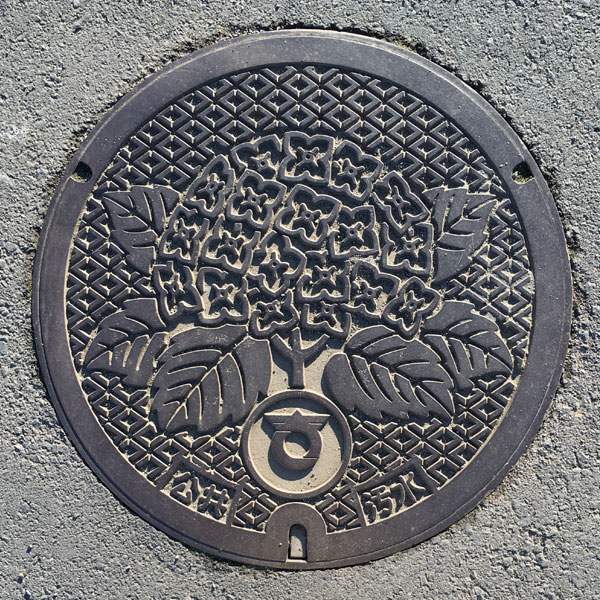
A manhole cover for sewage depicting the hydrangea, the former flower of Kyowa Town.
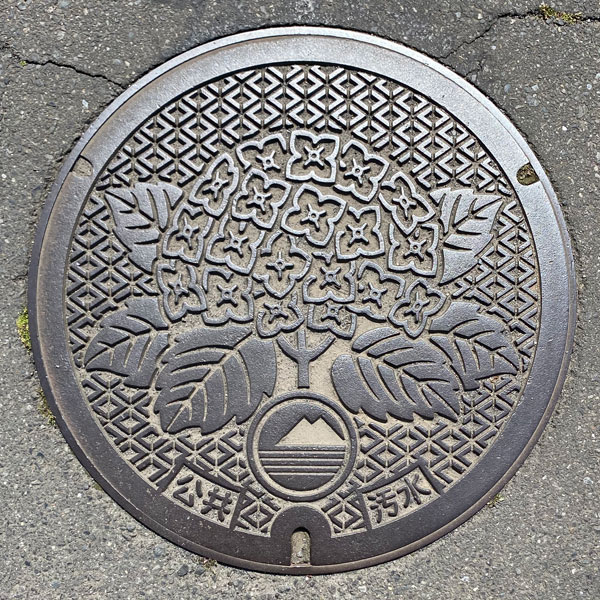
This manhole cover for sewage features a design of hydrangeas from the former Kyowa Town, with the town emblem replaced by the Chikusei City emblem.
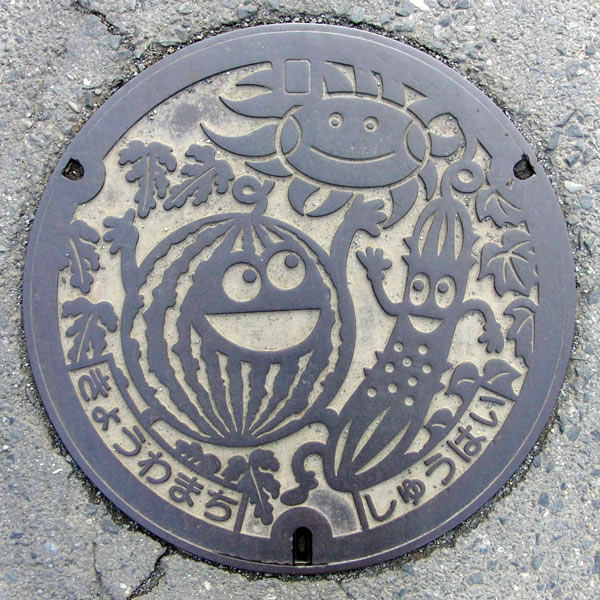
A manhole cover with a fun design featuring watermelons, cucumbers, and the sun. It's probably a manhole cover for the agricultural settlement drainage system in the northern part of Kyowa District 1.
Yuki 結城市
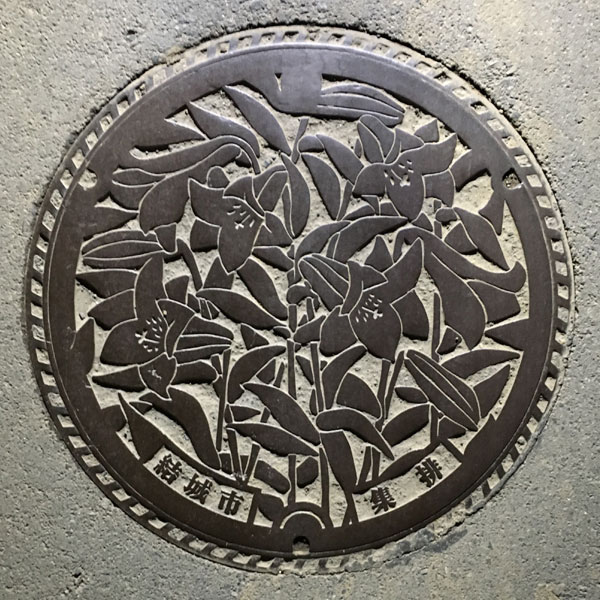
A manhole cover for sewage, featuring the city flower, the lily.
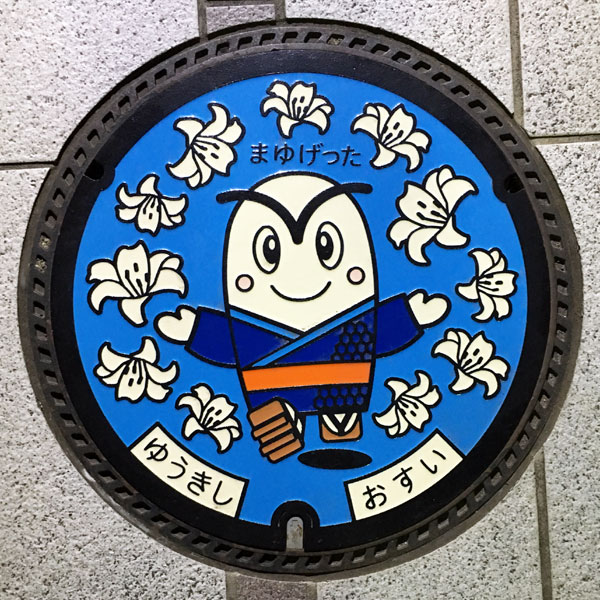
This is a manhole cover for sewage featuring "Mayugetta," the mascot character of Yuki City, who was appointed on March 15, 2012. The flower depicted is the city flower, the lily. The words "Yuki City" and "Sewage" are written at the bottom.
"Mayugetta" has a white body made of silkworm cocoons and is characterized by its long, connected eyebrows. It wears Yuki Tsumugi silk and paulownia wood clogs. Like the traditional Yuki Tsumugi silk, paulownia wood crafts are also a specialty of Yuki City.
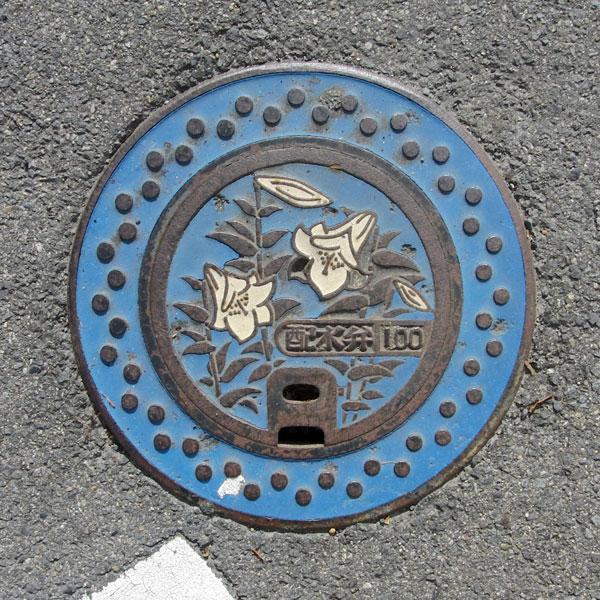
A water valve cover designed with the city flower, the lily.
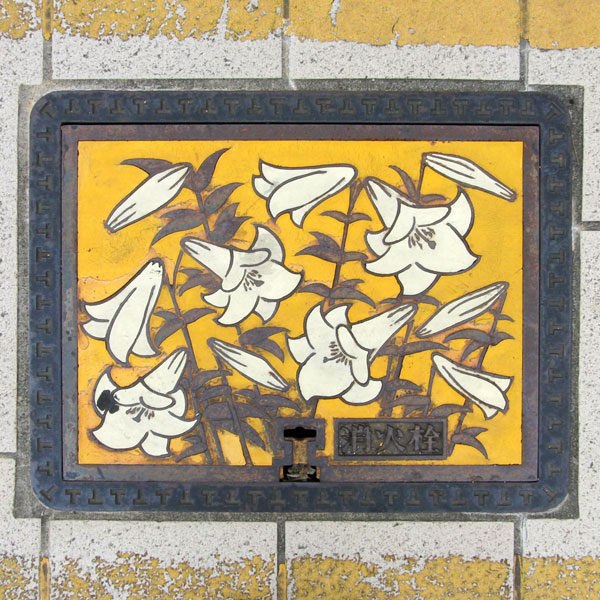
A fire hydrant cover designed with the city flower, the lily.
Ishioka 石岡市
Ishioka 石岡市
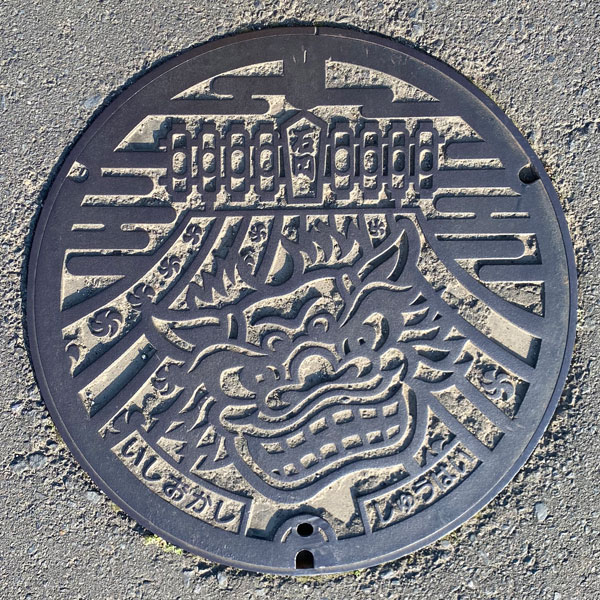
The design features the lion dance from the "Hitachi no Kuni Soja-gu Grand Festival."
Yasato 八郷町
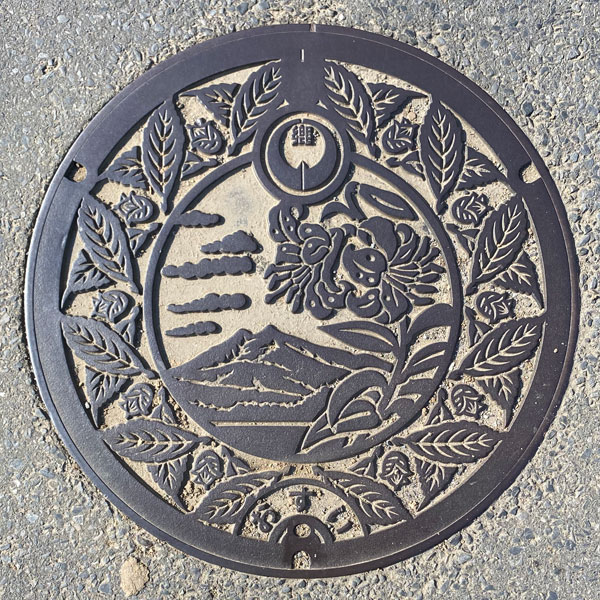
This is a manhole cover for public sewage systems, featuring a design with Mount Tsukuba and the town flower "lily" within the inner circle, and the leaves and fruits of the town tree "shiitake" (Castanopsis) on the outer circle. The former Yasato town emblem is at the top.
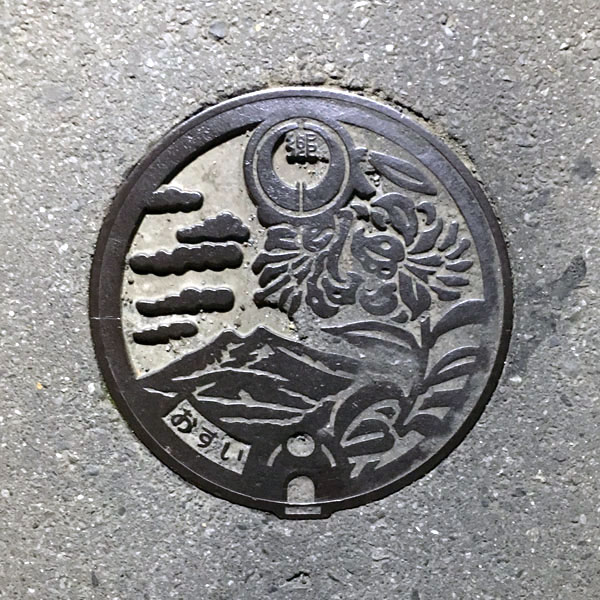
A sewage handhole cover that uses only the inner part of the design of the top lid.
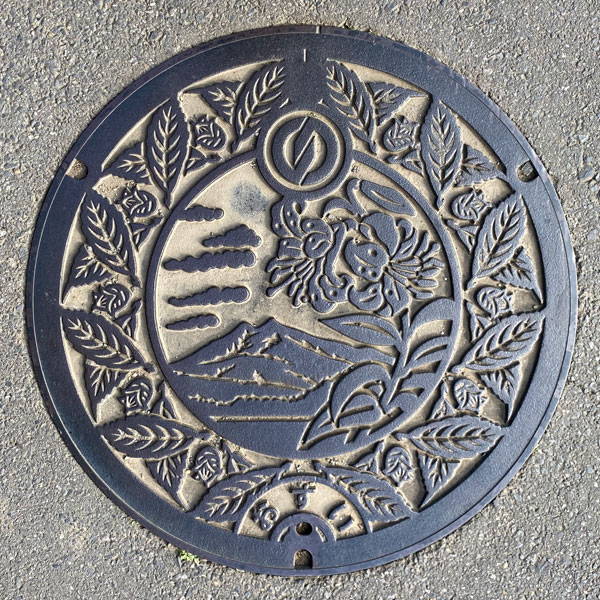
This is a manhole cover for sewage, with the town emblem of the former Yasato town replaced by the Ishioka City emblem. Mount Tsukuba and the town flower, the lily, are depicted within the inner circle, while the leaves and fruits of the town tree, the chinquapin, are depicted on the outer circle.
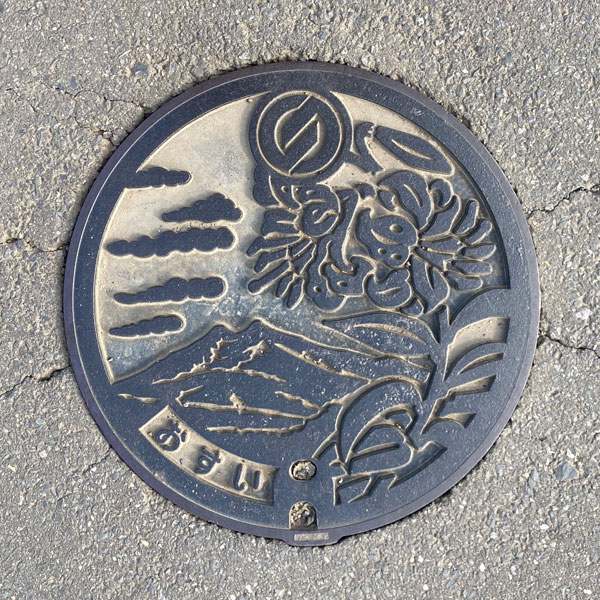
A smaller version of the design above, with the surrounding oak leaves removed.
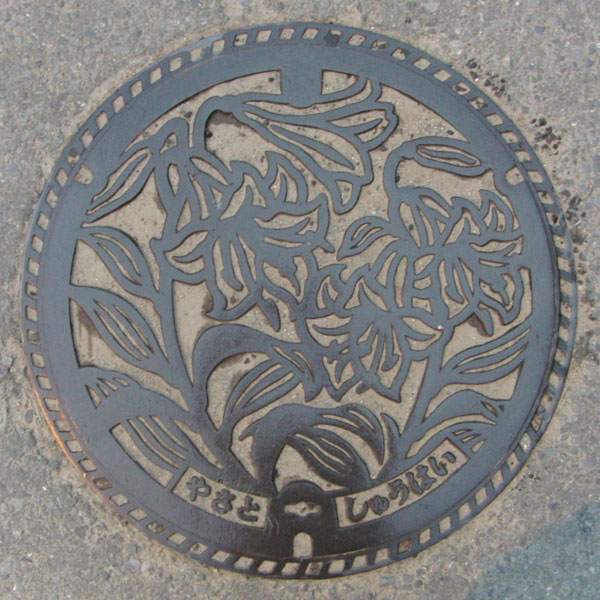
Manhole cover for the agricultural drainage system in Higashinarai 1st District. The design features the town's official flower, the lily.
Omitama 小美玉市
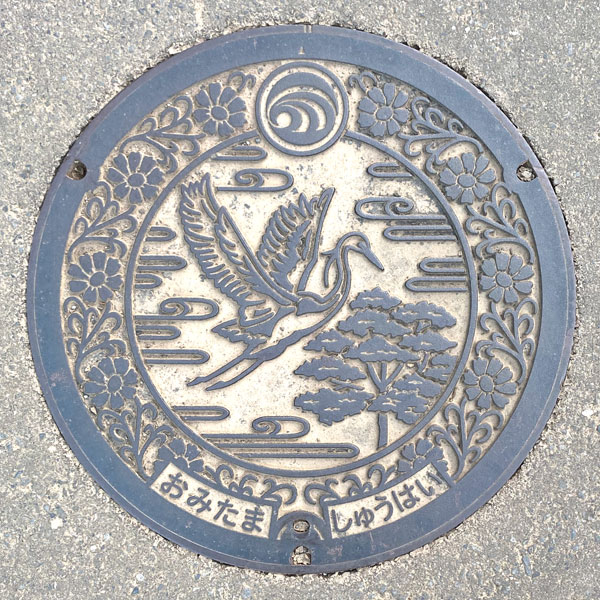
A manhole cover for sewage, depicting the city tree ("Zelkova"), the city flower ("Cosmos"), and the city bird ("Egret").
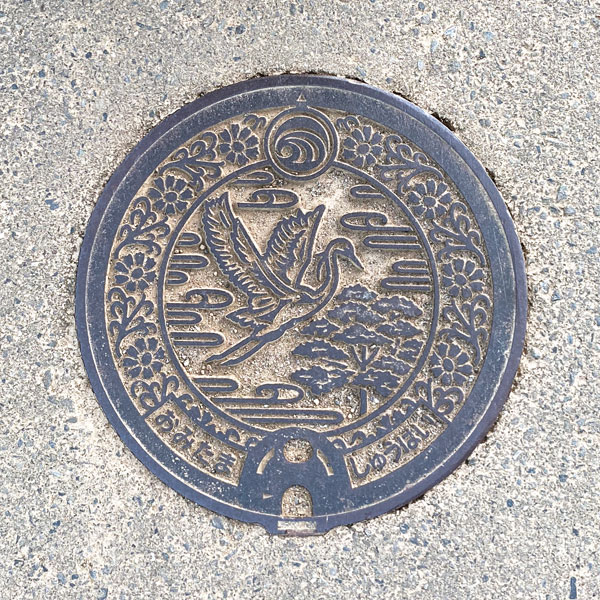
A smaller version of the agricultural wastewater treatment system for the central Tomo district, with the same design as above.
Ogawa 小川町
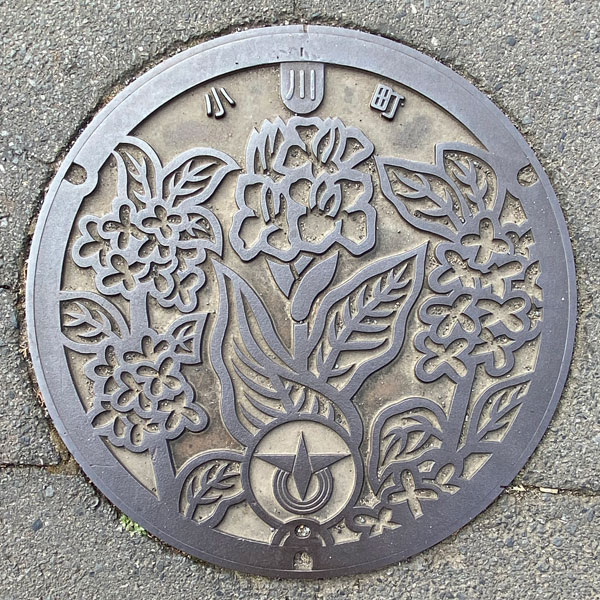
The design features the town flower, the canna, and the town tree, the osmanthus. The town emblem is at the bottom.
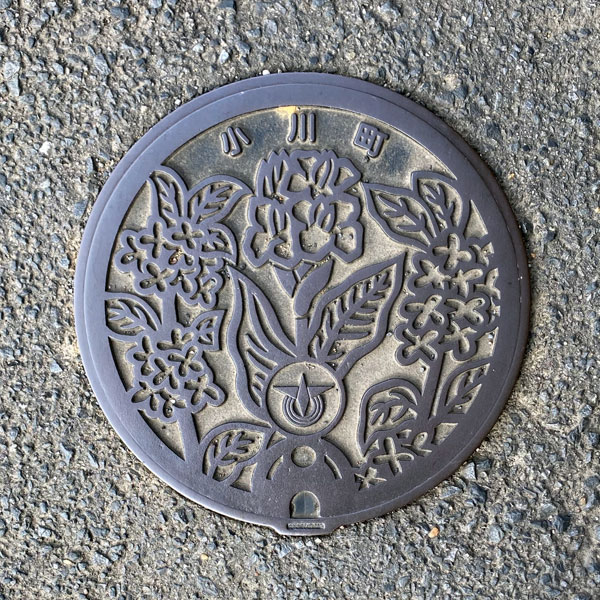
A smaller version with the same design as above.
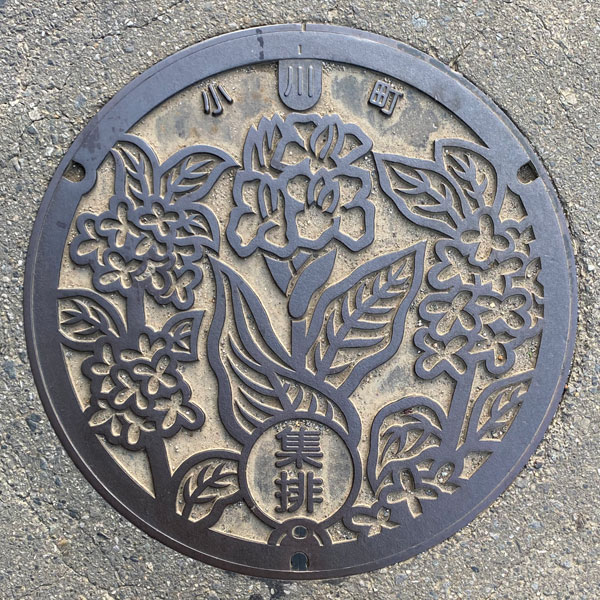
A manhole cover from the southern district of Tomoe, with the same design as above. The town emblem on the manhole cover above has been replaced with the characters for "agricultural wastewater collection."
Minori 美野里町
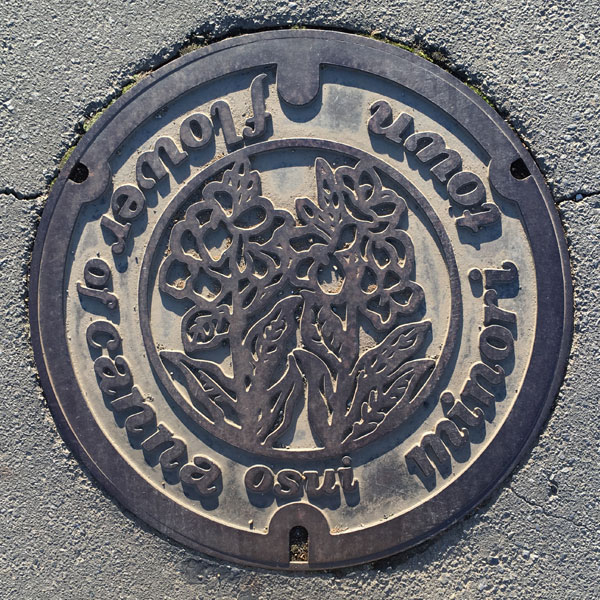
The design features the town's flower, the canna, surrounded by the words "flower of canna," "osui," and "minori town."
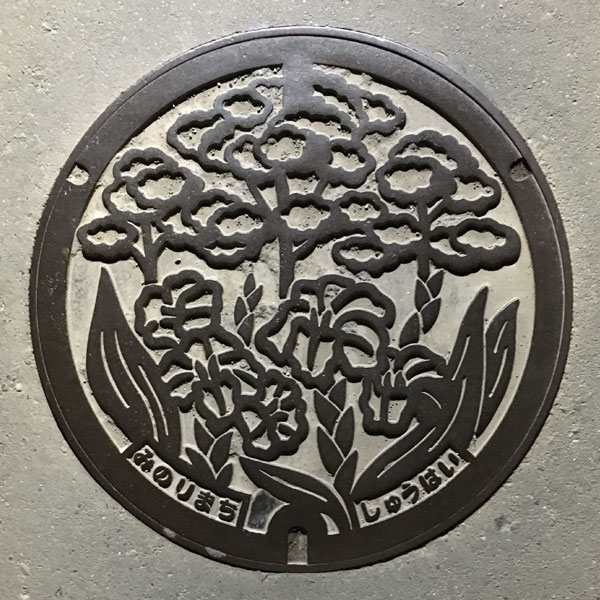
A manhole cover for agricultural village wastewater. The design features the town's tree, the zelkova, and the town's flower, the canna. The words "Minorimachi" and "Shuhai" are written at the bottom. The treatment area after the merger is the "Katakura South District".
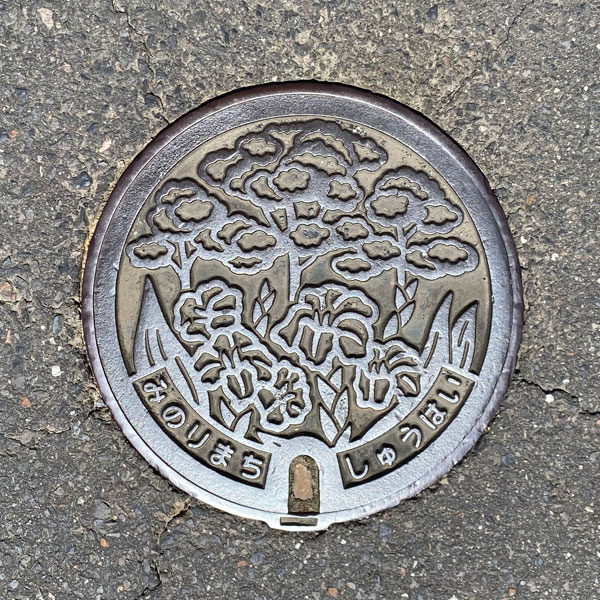
A smaller version of the agricultural wastewater distribution system in the southern district of Katakura, with the same design as above.
Tamari 玉里村
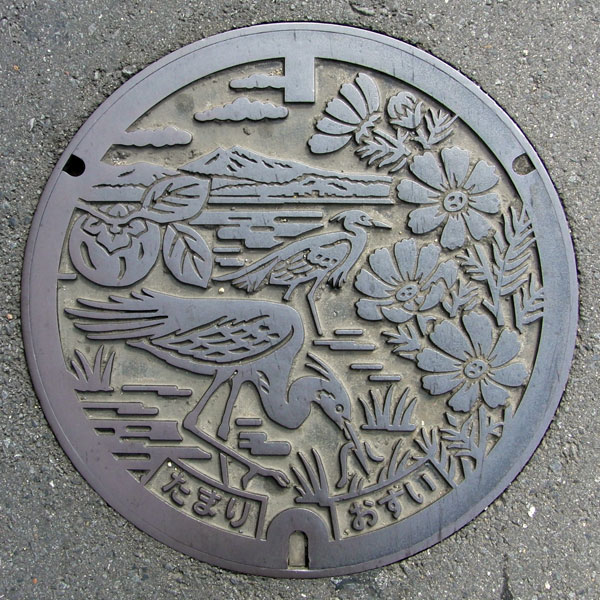
The design features Lake Kasumigaura and Mount Tsukuba in the background, with the village tree "persimmon" and the village flower "cosmos." The "white heron" is also the new official bird of Omitama City.
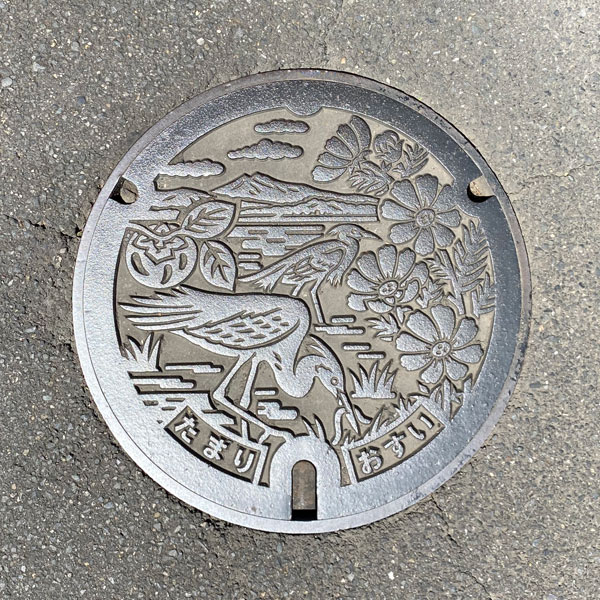
A smaller version with the same design as above.
Koga 古河市
Koga 古河市
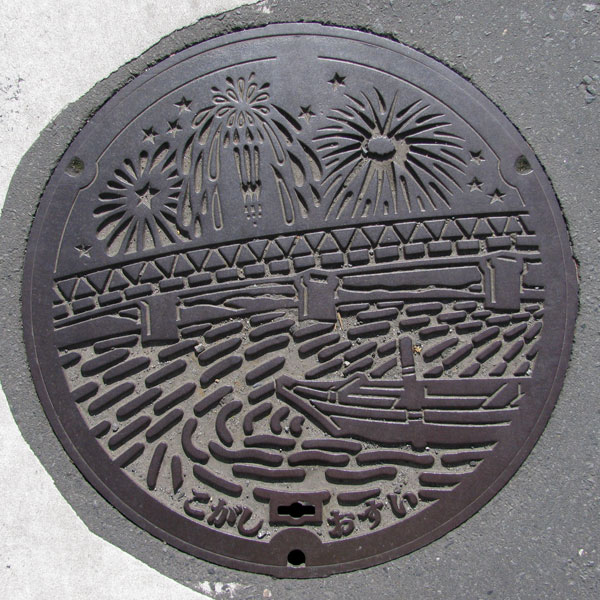
The design depicts the Watarase Floodplain Fireworks Festival. It shows the fireworks launched from Nakanoshima Island in Yanaka Lake (Watarase Floodplain), viewed from across the Mikuni Bridge over the Watarase River.
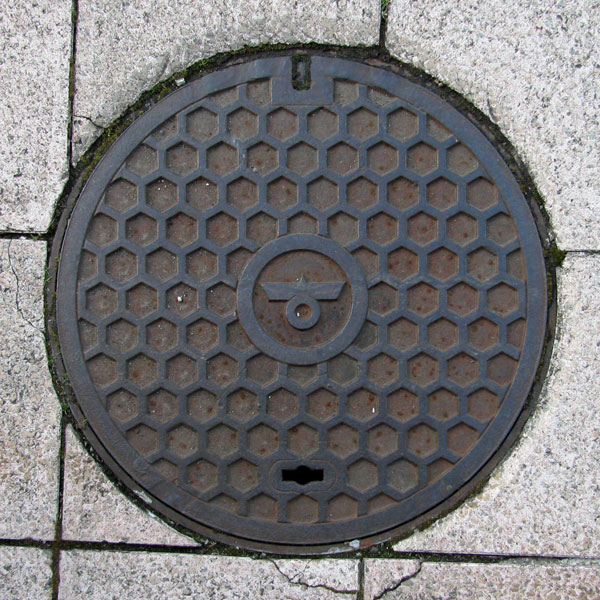
A miniature manhole cover on the sidewalk featuring the old city emblem, which is a stylized representation of the character "古" (ko, meaning "old" or "ancient"). A new city emblem, also based on the character "古," was established in January 2006.
Souwa 総和町
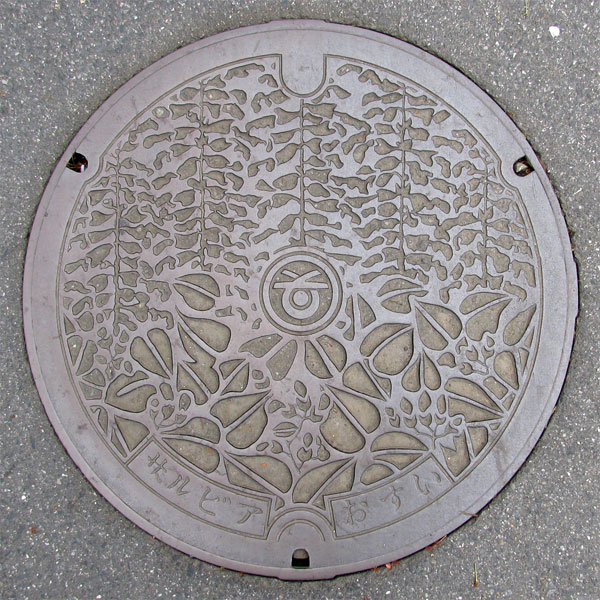
A manhole cover for sewage, depicting the town flower, "salvia."
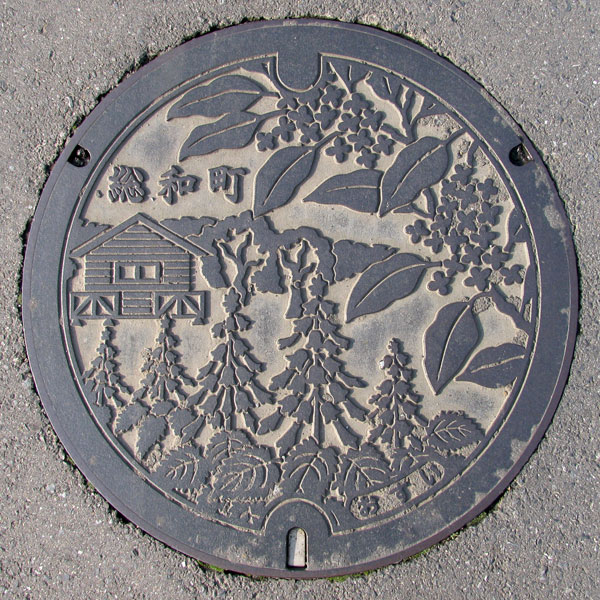
The painting depicts the town's tree, the osmanthus, and the town's flower, the salvia. The building in the background is apparently a cabin at "Navel Park," a leisure facility in Komahane, Koga City.
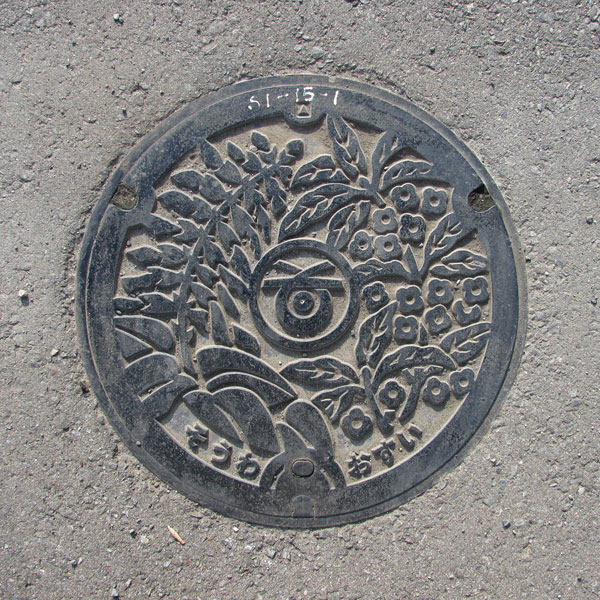
A small sewage drain basin featuring the town's tree, the osmanthus, and its flower, the salvia. The town emblem, a stylized representation of the characters "so" and "u" within a circle, is located in the center.
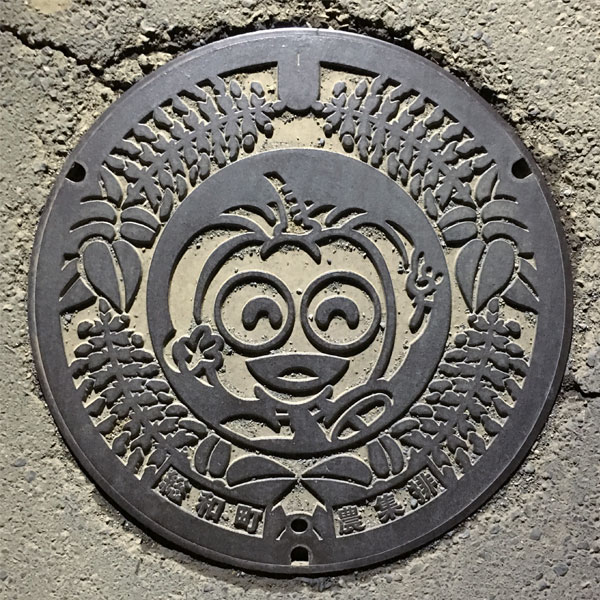
This manhole cover for agricultural community drainage in the Takano district features the local specialty "Miyako pumpkin" in the center and the town flower "salvia" around it. The words "Sowa Town" and "Agricultural Community Drainage" are inscribed at the bottom.
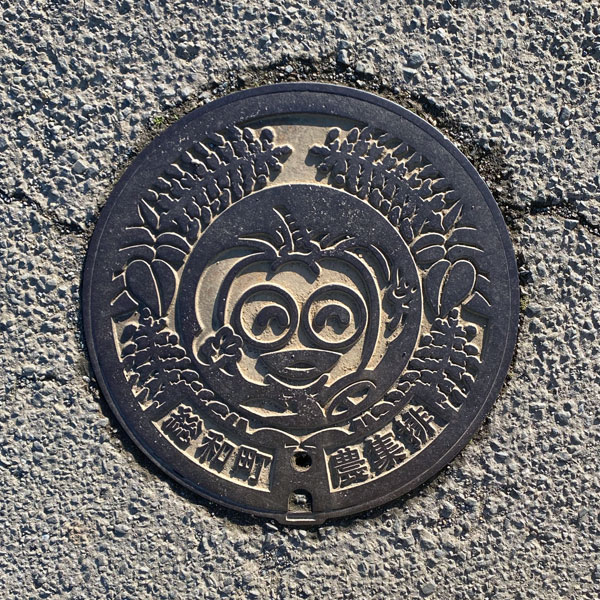
A smaller version of the agricultural wastewater treatment panel for the Kami-Ono and Inamiya districts, with the same design as above.
Sanwa 三和町
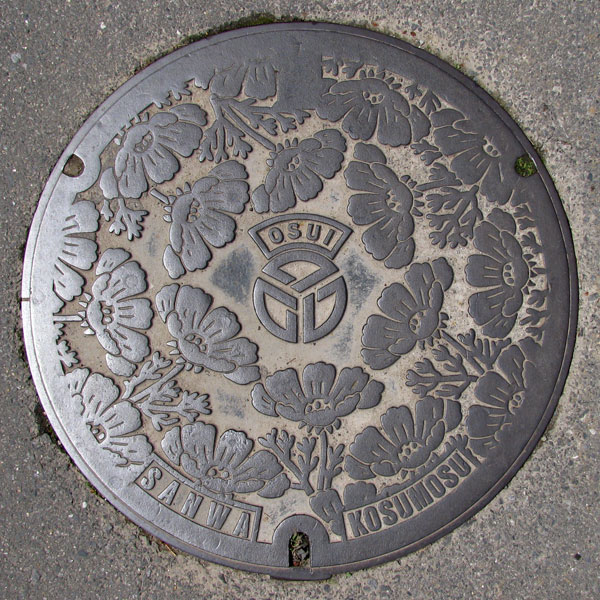
A manhole cover for sewage, depicting the town flower, the cosmos. The town emblem, consisting of three "Wa" characters, is in the center.
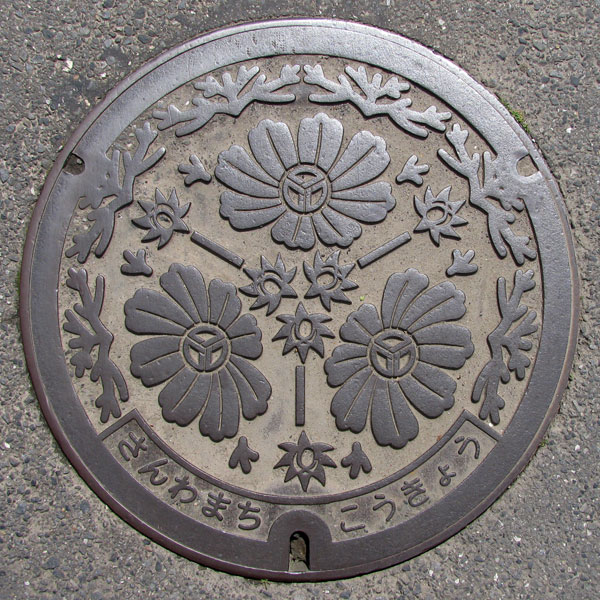
Another version of the cosmos design. What's interesting is that each cosmos flower has the town's emblem inside.
Shimotsuma 下妻市
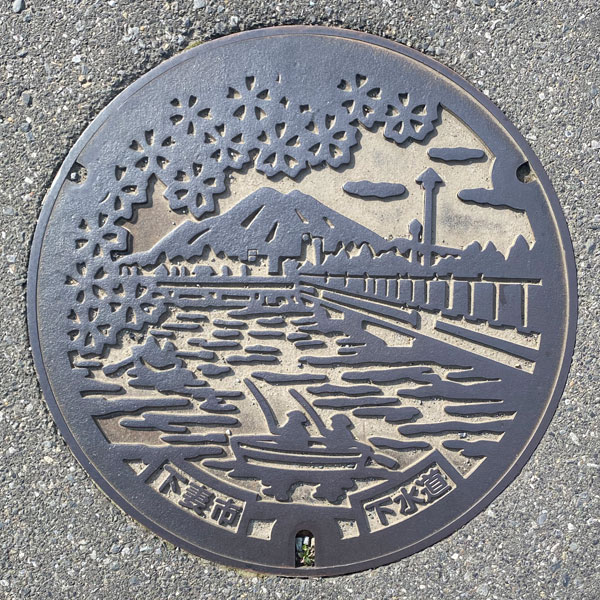
The design features the Sunanuma Ohashi Bridge spanning Sunanuma Lake in Sunanuma Wide Area Park, and the cherry blossoms of the Kan'oen Garden. Mount Tsukuba is in the background.
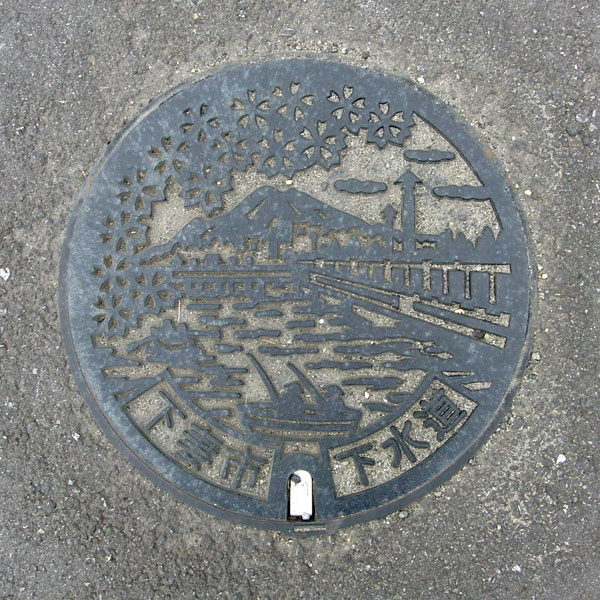
Small cover.
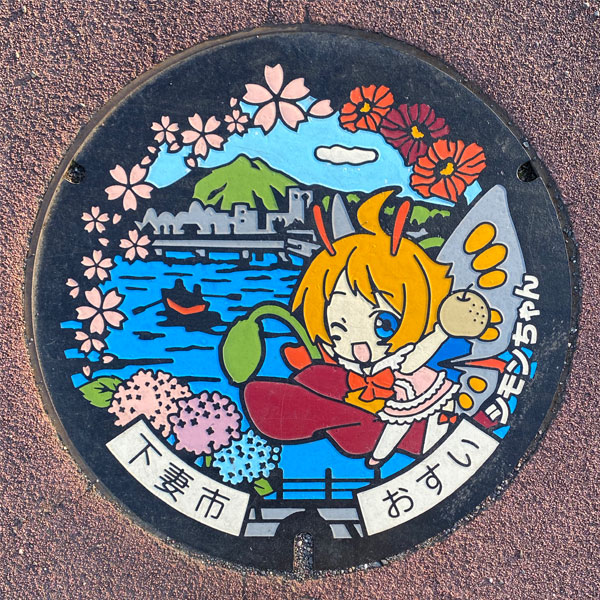
This manhole cover is based on the traditional design (Sunuma Lake and Mt. Tsukuba), and features Shimotsuma City's mascot, "Shimon-chan," holding a local specialty, "Shimotsuma Sweet Ripe Pear," along with cherry blossoms, hydrangeas, and poppies. "Shimon-chan" is inspired by the Japanese Emperor butterfly, the national butterfly for which conservation efforts are underway. This is apparently the third design after several design changes.
Chiyokawa 千代川村
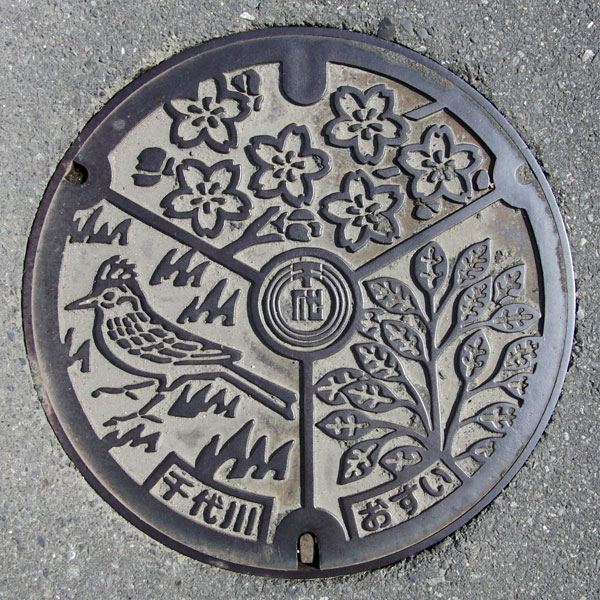
The design features the village flower, the cherry blossom; the village tree, the zelkova; and the village bird, the skylark.
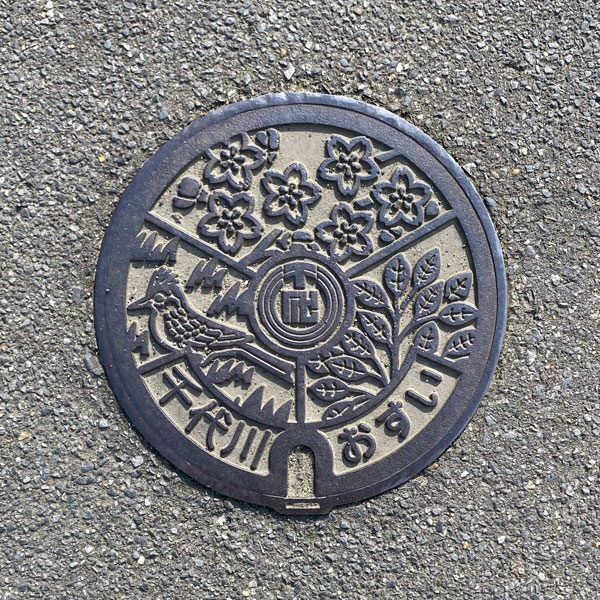
A smaller version with the same design as above.
Hokota 鉾田市
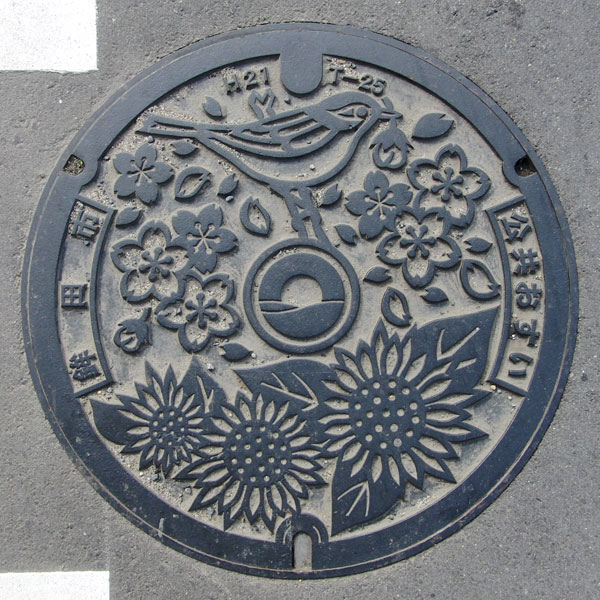
A manhole cover for sewage featuring the city tree ("cherry blossom"), the city flower ("sunflower"), and the city bird ("Japanese bush warbler"). Featured on manhole cards.
The Hokota City emblem is in the center. The words "Hokota City" are on the left, and "Public Sewage" are on the right.
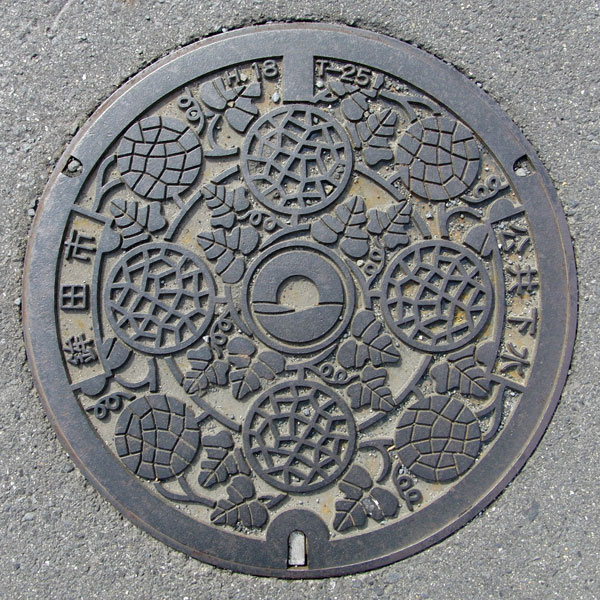
Hokota is known for having the highest production and shipment volume of melons in Japan. Now that I think about it, I seem to recall seeing "Ibaraki" written on many melon boxes in supermarkets.
The Hokota City emblem is in the center. "Hokota City" is on the left, and "Public Sewerage" is on the right.
Hokota 鉾田町
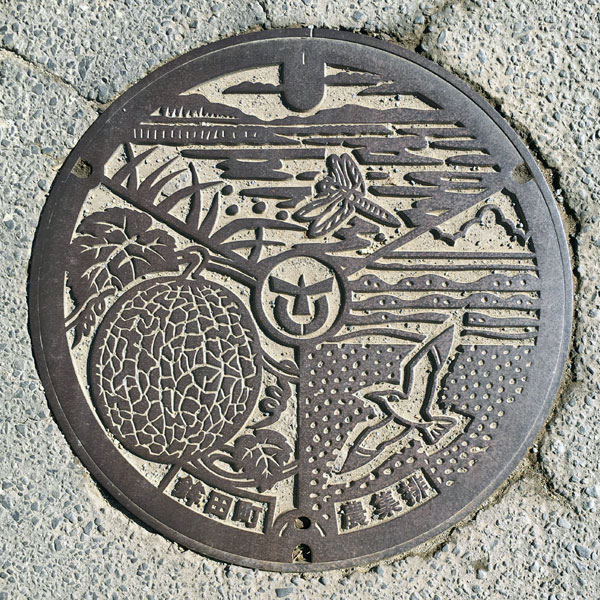
A manhole cover from the Hokota Town era. The Hokota Town emblem is in the center. The surface is divided into three sections: the top depicts a landscape of Kitaura with dragonflies, the bottom right shows a landscape of Kashima-nada with seagulls, and the bottom left depicts the town's specialty, melons.
The words "Hokota Town" and "Agricultural Drainage" are written at the bottom.
Tsukuba つくば市
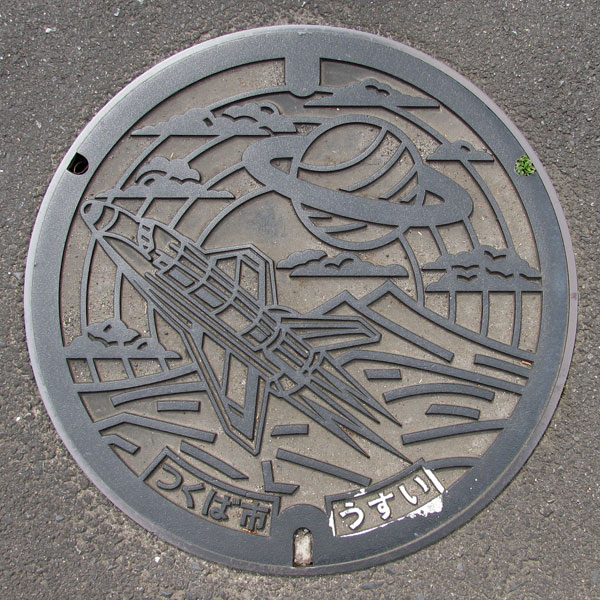
Since this is Tsukuba City, home to the Tsukuba Space Center, the image features a spaceship against the backdrop of Mount Tsukuba. While it might look like Saturn floating above Mount Tsukuba, according to the manhole cover card's explanation, it represents the Earth and the orbit of a spaceship.
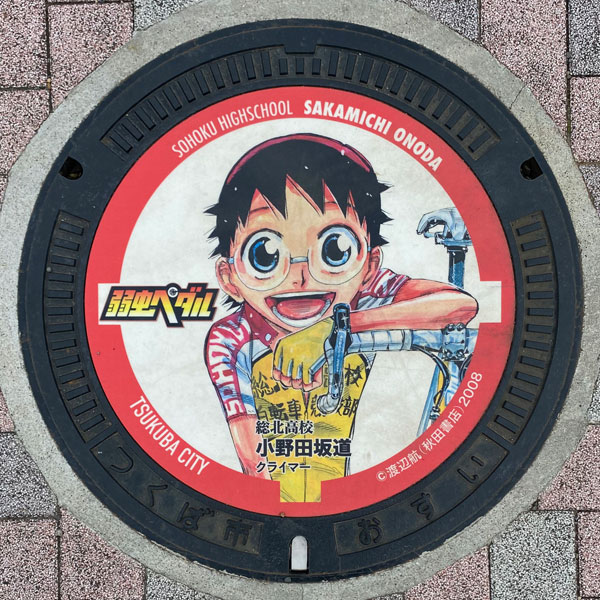
A sticker-type manhole cover featuring Sakamichi Onoda, the protagonist of "Yowamushi Pedal." The words "Tsukuba City" and "Sewage" are inscribed on either side of the opening/closing mechanism at the bottom.
The manhole cover itself features Sakamichi Onoda wearing the jersey of the Sohoku High School cycling club, the "Yowamushi Pedal" title logo, and the words "Sohoku High School," "Sakamichi Onoda," and "Climber." Around the top are the words "SOHOKU HIGHSCHOOL" and "SAKAMICHI ONODA," while the bottom has "TSUKUBA CITY" and "© Wataru Watanabe (Akita Shoten) 2008."
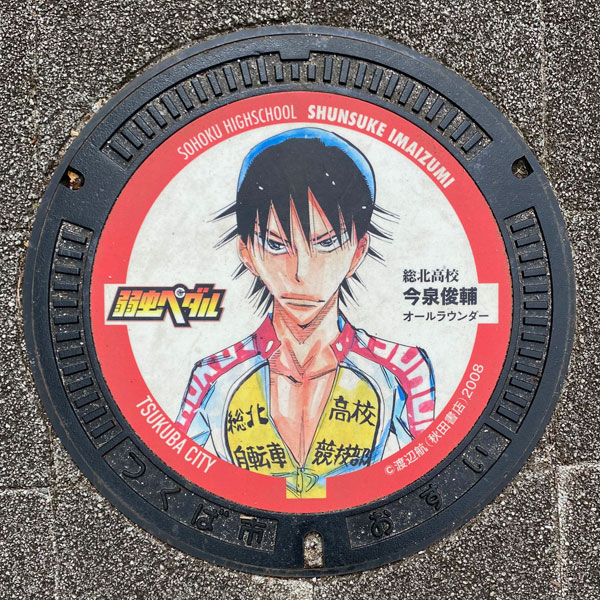
A sticker-type manhole cover featuring the protagonist's teammate, Shunsuke Imaizumi. The words "Tsukuba City" and "Sewage" are inscribed on either side of the opening/closing mechanism at the bottom.
The manhole cover itself features Shunsuke Imaizumi wearing the jersey of the Sohoku High School cycling club, the title logo of "Yowamushi Pedal," and the words "Sohoku High School," "Shunsuke Imaizumi," and "All-Rounder." Around the top are the words "SOHOKU HIGHSCHOOL" and "SHUNSUKE IMAIZUMI," while the bottom has "TSUKUBA CITY" and "© Wataru Watanabe (Akita Shoten) 2008."
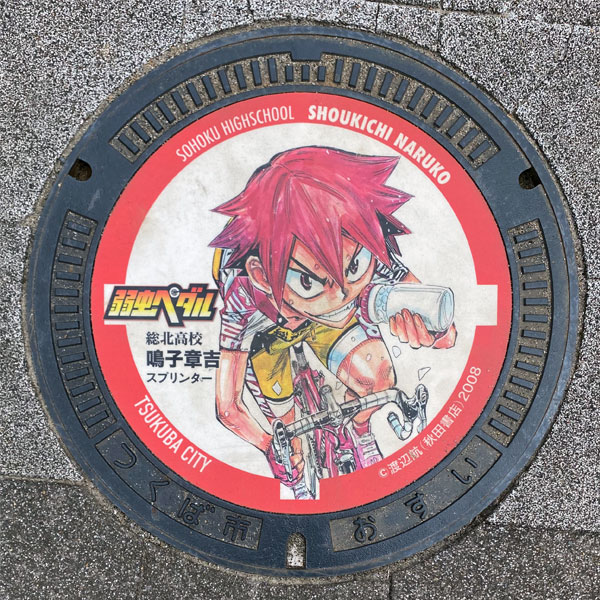
A sticker-type manhole cover featuring the protagonist's teammate, Naruko Shokichi. The words "Tsukuba City" and "Sewage" are inscribed to the left and right of the opening/closing mechanism at the bottom.
The manhole cover itself features Naruko Shokichi wearing the jersey of the Sohoku High School cycling club, the title logo of "Yowamushi Pedal," and the words "Sohoku High School," "Naruko Shokichi," and "Sprinter." Around the top are the words "SOHOKU HIGHSCHOOL" and "SHOUKICHI NARUKO," and below are the words "TSUKUBA CITY" and "© Watanabe Wataru (Akita Shoten) 2008."
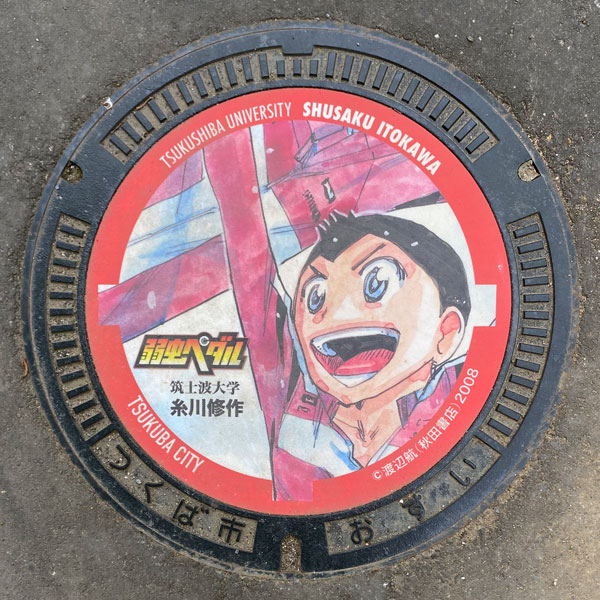
A sticker-type manhole cover featuring Shusaku Itokawa from the spin-off series *Yowamushi Pedal SPARE BIKE*. The words "Tsukuba City" and "Sewage" are printed to the left and right of the opening/closing mechanism at the bottom.
The manhole cover itself features Shusaku Itokawa wearing a Tsukuba University jersey, the *Yowamushi Pedal* title logo, and the words "Tsukuba University" and "Shusaku Itokawa." Around the top are the words "TSUKUSHIBA UNIVERSITY" and "SHUSAKU ITOKAWA," while the bottom has "TSUKUBA CITY" and "© Watanabe Wataru (Akita Shoten) 2008."
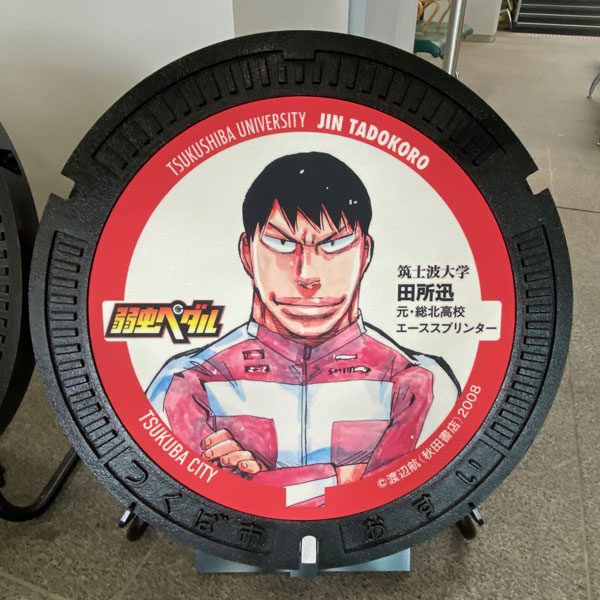
A sticker-type manhole cover featuring Tadokoro Jin from the spin-off series "Yowamushi Pedal SPARE BIKE." The words "Tsukuba City" and "Sewage" are on either side of the opening/closing mechanism at the bottom.
Tadokoro Jin, the senior of the protagonist in "Yowamushi Pedal," appears wearing the Tsukuba University jersey. The image shows Tadokoro Jin, the "Yowamushi Pedal" title logo, and the words "Tsukuba University," "Tadokoro Jin," "Former Sohoku High School," and "Ace Sprinter." Around the top are the words "TSUKUSHIBA UNIVERSITY" and "JIN TADOKORO," while the bottom has "TSUKUBA CITY" and "© Watanabe Wataru (Akita Shoten) 2008."
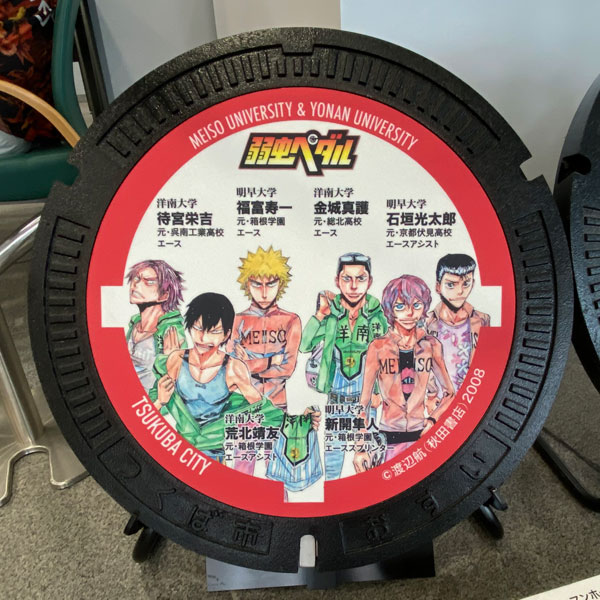
A sticker-type manhole cover featuring six characters from the spin-off series "Yowamushi Pedal SPARE BIKE." The words "Tsukuba City" and "Sewage" are printed to the left and right of the opening/closing mechanism at the bottom.
From left to right on the cover are Eikichi Machimiya (Yonan University), Yasutomo Arakita (Yonan University), Juichi Fukutomi (Meiso University), Shingo Kinjo (Yonan University), Hayato Shinkai (Meiso University), and Kotaro Ishigaki (Meiso University), with the "Yowamushi Pedal" title logo at the top. Around the top of the logo are the words "MEISO UNIVERSITY & YONAN UNIVERSITY," and below are "TSUKUBA CITY" and "© Wataru Watanabe (Akita Shoten) 2008."
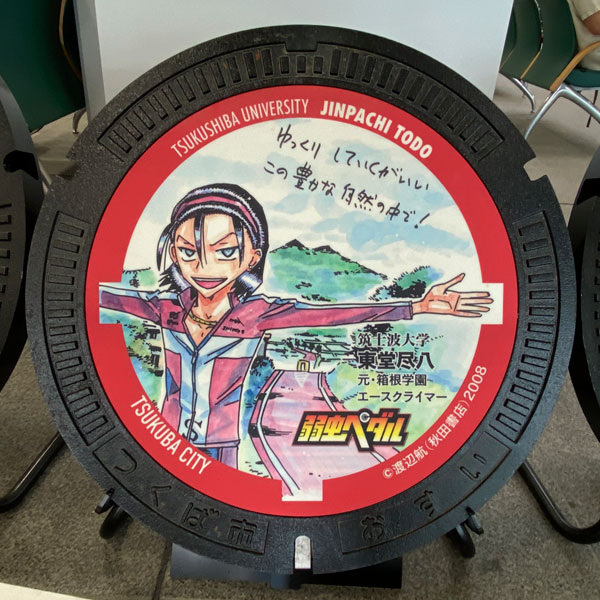
A sticker-type manhole cover featuring Jinpachi Todo from the spin-off series "Yowamushi Pedal SPARE BIKE." The words "Tsukuba City" and "Sewage" are written to the left and right of the opening/closing mechanism at the bottom.
The manhole cover itself features Jinpachi Todo, a former student of Hakone Academy (a rival of Sohoku High School), wearing the jersey of Tsukuba University, with Mount Tsukuba in the background. The handwritten text reads, "Take your time and relax in this rich natural environment!" The words "Tsukuba University," "Jinpachi Todo," "Former Hakone Academy," and "Ace Climber" are also present, along with the "Yowamushi Pedal" title logo. Around the top are the words "TSUKUSHIBA UNIVERSITY" and "JINPACHI TODO," while the bottom has "TSUKUBA CITY" and "© Watanabe Wataru (Akita Shoten) 2008."
Kukizaki 茎崎町
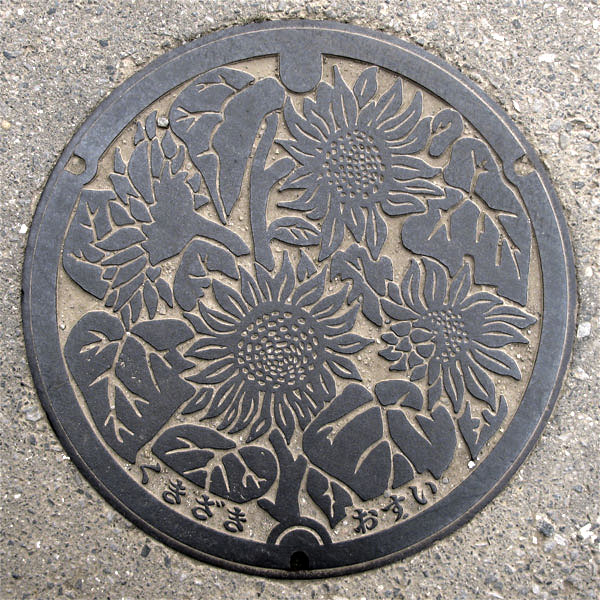
A manhole cover for sewage, depicting the town flower, the sunflower.
Bando 坂東市
The image depicts the city tree ("Zelkova"), the city flower ("Tea Cactus"), and the city bird ("Japanese Bush Warbler") against the backdrop of Mount Tsukuba and Sugao Marsh. To the right of the city emblem, which is a stylized version of the Japanese hiragana character "ba," is the Sugao Marsh Fureai Bridge, a pedestrian bridge that crosses to Asunaro no Sato (Josō City) on the opposite shore.
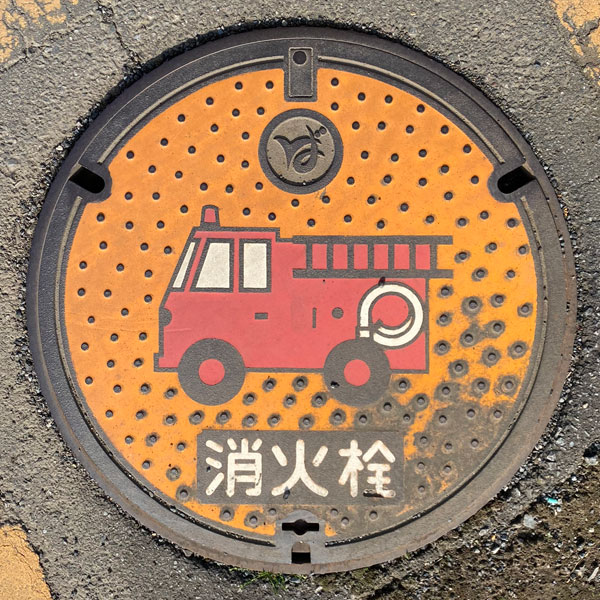
A fire hydrant cover featuring the Bando City emblem. The truck is drawn simply.
Iwai 岩井市
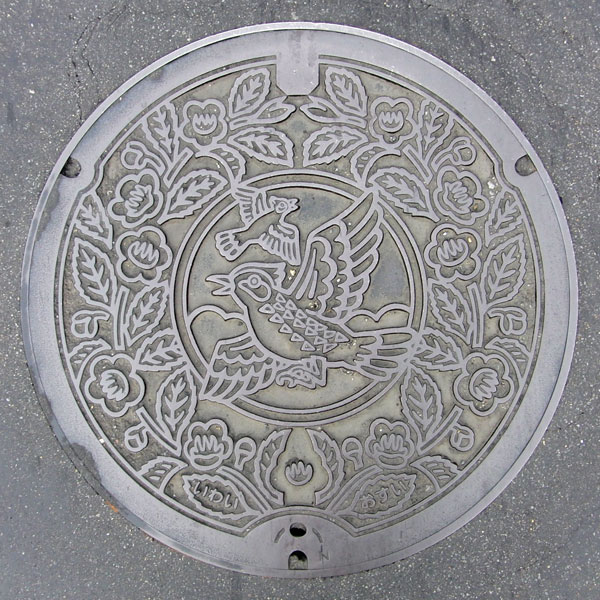
The city's flowers, the "tea flower" and the "skylark," are depicted. It appears to be made of colored sand rather than epoxy resin, resulting in a chic color scheme. To the right of the opening/closing mechanism is the letter "H," indicating it was manufactured by Hinode Waterworks Equipment Co., Ltd.
Sashima 猿島町
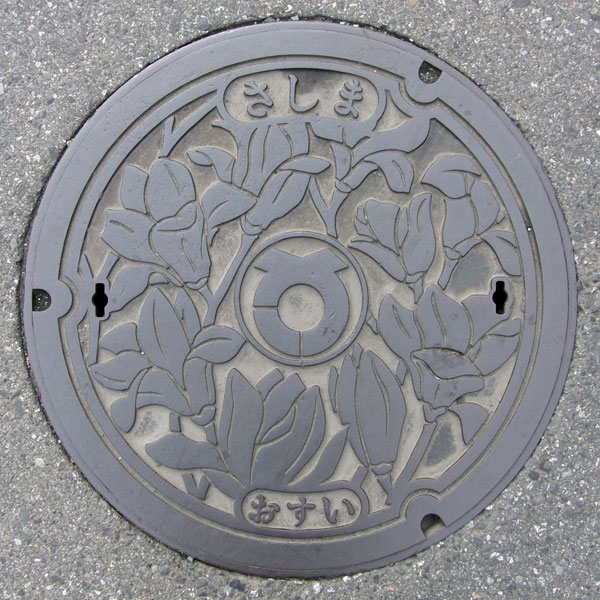
The town's flower, the white magnolia (or white magnolia), is depicted.
Joso 常総市
Mitsukaido 水海道市
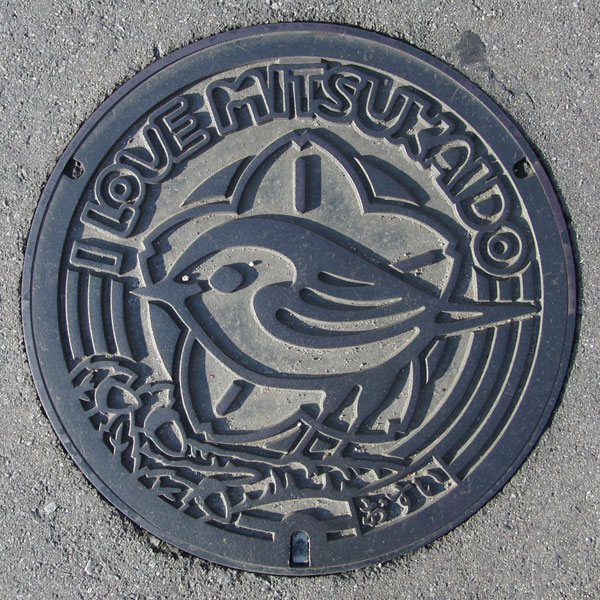
A cover featuring a top-heavy, stylized depiction of the city's bird, the Japanese bush warbler, the city's tree, the oak, and the city's flower, the cherry blossom, along with the words "I LOVE MITSUKAIDO."
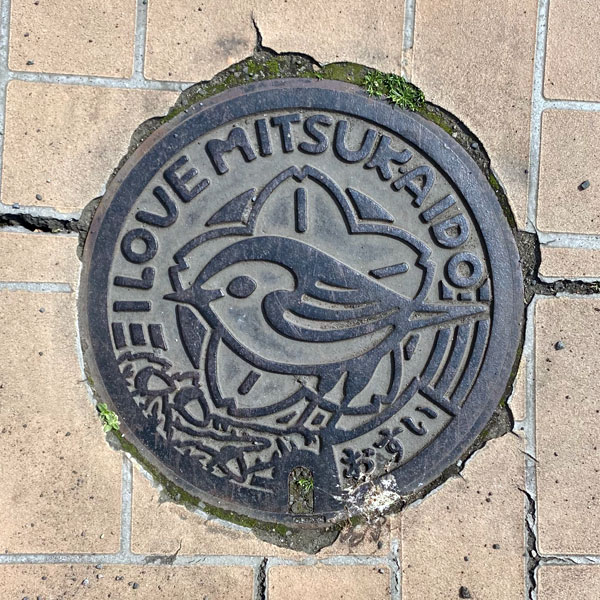
A small cover with the same design as above.
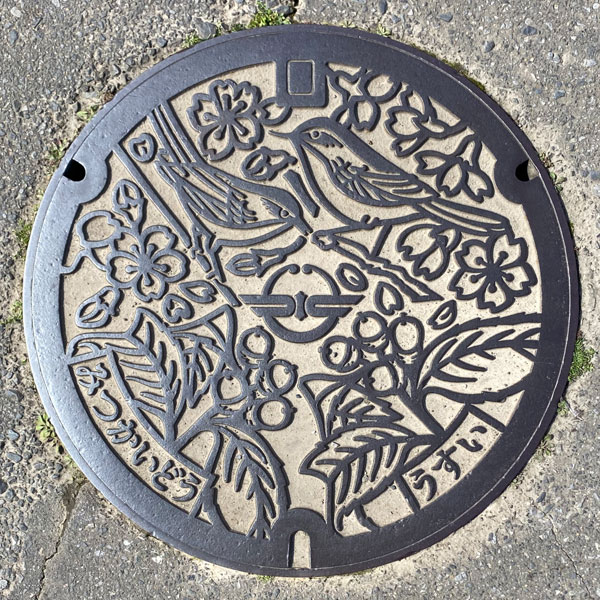
A manhole cover for sewage featuring the city flower "cherry blossom," the city bird "Japanese bush warbler," and the city tree "oak." The former city emblem of Mitsukaido is in the center.
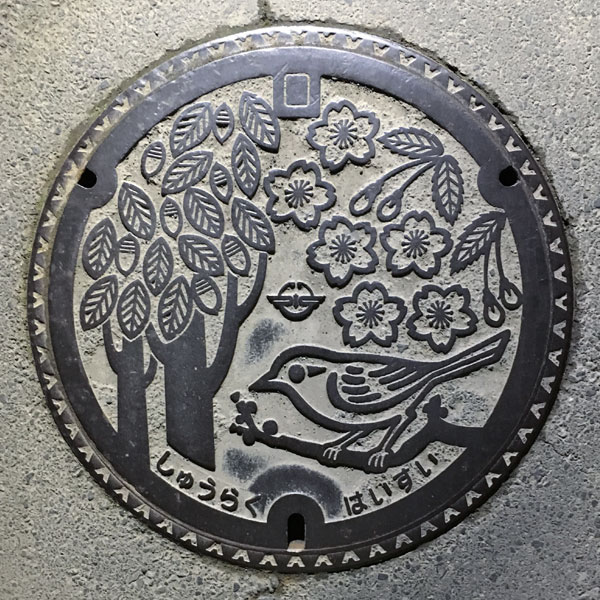
This manhole cover from the agricultural community drainage system in the Hoonji district features the same motif as above, but with a different design. The former Mitsukaido City emblem is subtly placed in the center.
Ishige 石下町
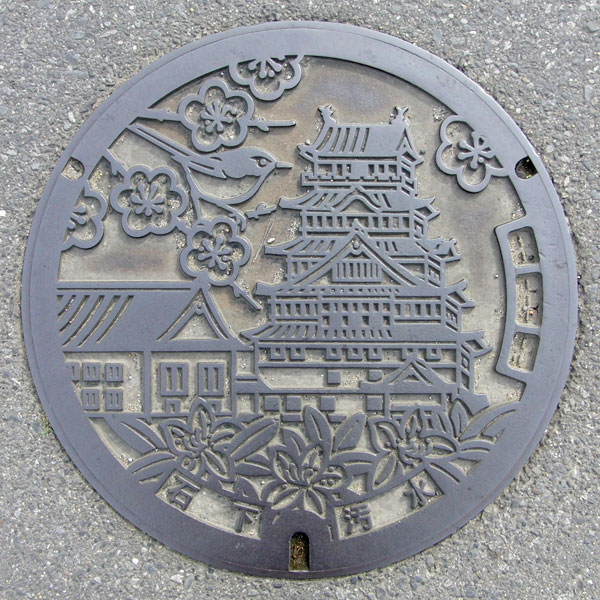
The image depicts Toyoda Castle (Joso City Community Exchange Center), the town's tree (plum blossom), town's flower (azalea), and town's bird (Japanese bush warbler).
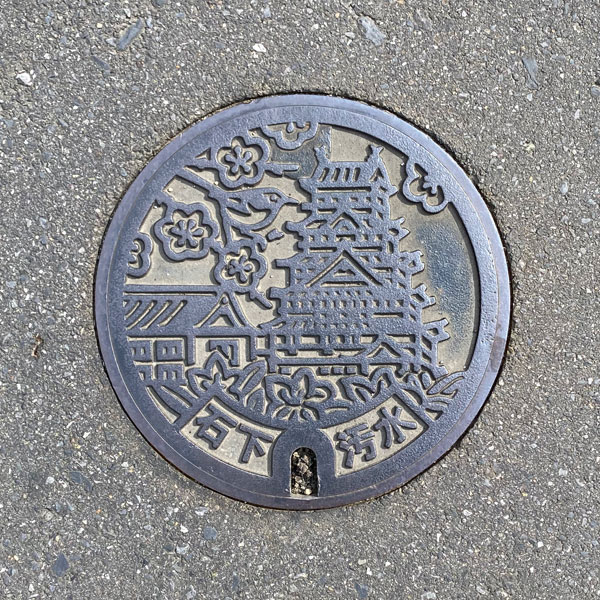
A small cover with the same design as above.
Tsuchiura 土浦市
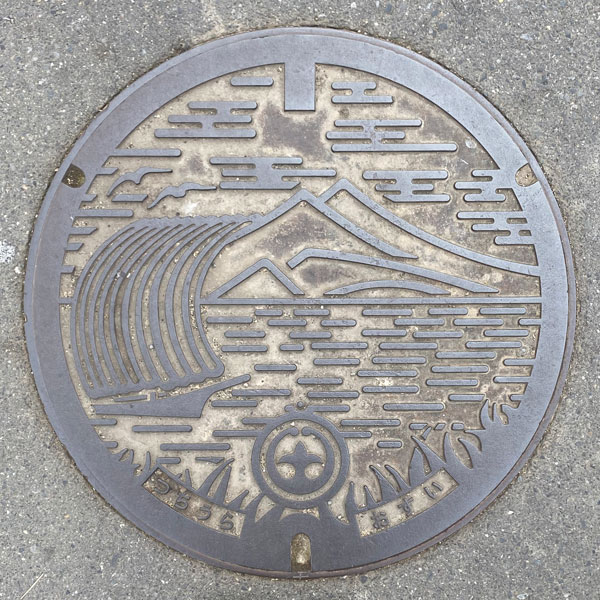
The cover depicts "Mount Tsukuba" and "a sailing boat floating on Lake Kasumigaura."
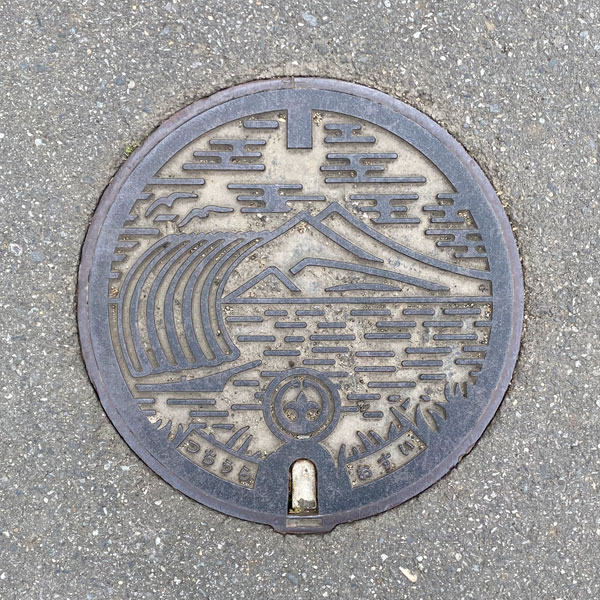
A smaller version with the same design as above.
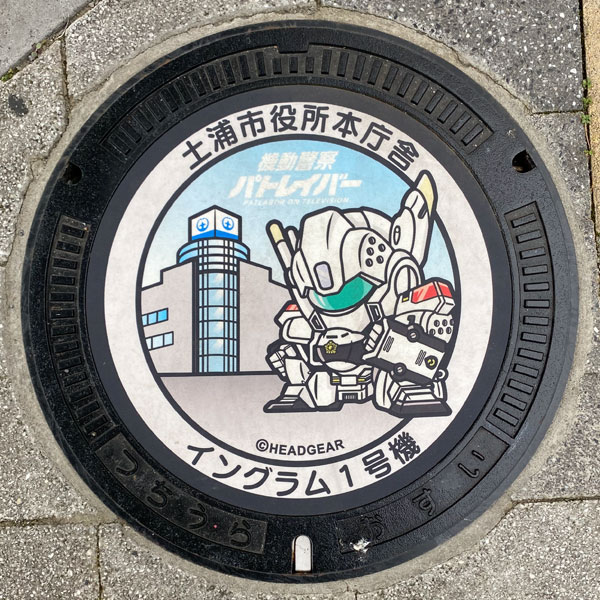
A sticker-type manhole cover featuring the Ingram Unit 1 of the Special Vehicles Division 2nd Platoon (piloted by the protagonist, Officer Izumi Noa) against the backdrop of the Tsuchiura City Hall main building.
The words "Tsuchiura City Hall Main Building" and "Ingram Unit 1" are printed above and below the sticker.
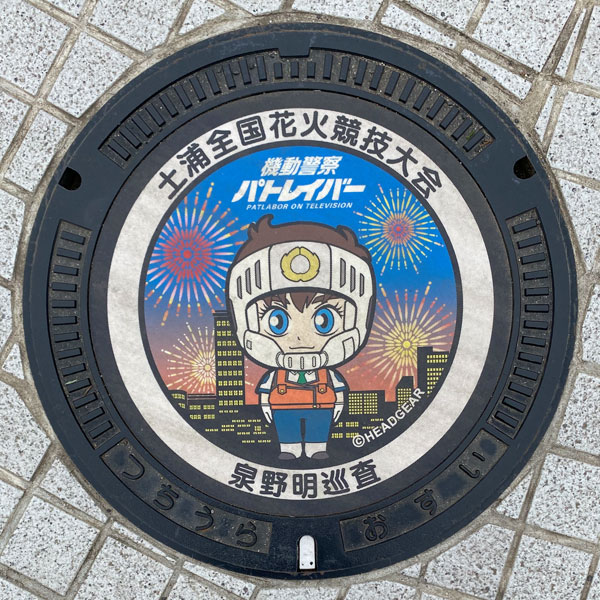
A sticker-type manhole cover featuring the protagonist, Officer Izumi Noa, pilot of the Ingram Unit 1 of the Special Vehicles Division 2nd Platoon, against a backdrop of fireworks.
The words "Tsuchiura National Fireworks Competition" and "Officer Izumi Noa" are printed above and below the sticker.
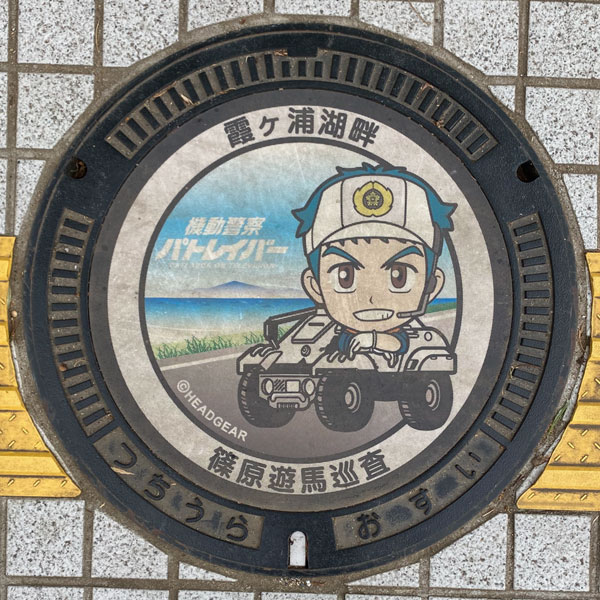
A sticker-type manhole cover featuring "Officer Shinohara Yuma," the command vehicle operator for Ingram Unit 1 of the Special Vehicles Division 2nd Platoon, with Lake Kasumigaura in the background.
The words "Lake Kasumigaura Shore" and "Officer Shinohara Yuma" are printed above and below the sticker.
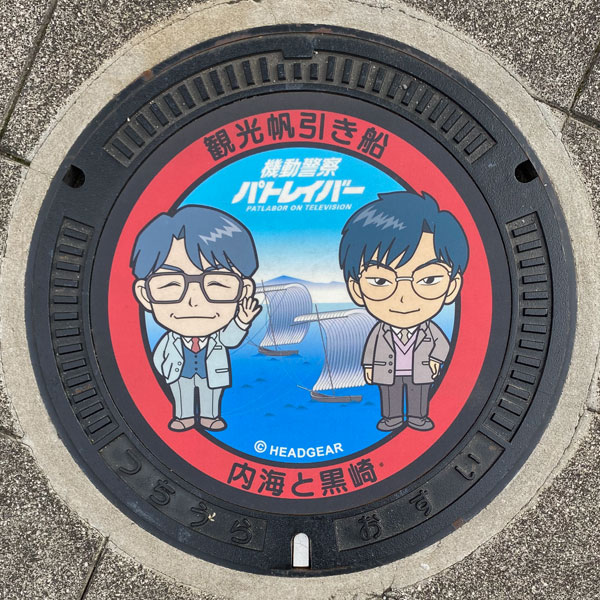
A sticker-type manhole cover depicting "Section Chief Utsumi" and his subordinate "Kurosaki" from Shaft Enterprise Japan's Planning Section 7, with a sailing boat on Lake Kasumigaura in the background.
The words "Sightseeing Sailing Boat" and "Utsumi and Kurosaki" are written above and below the sticker.
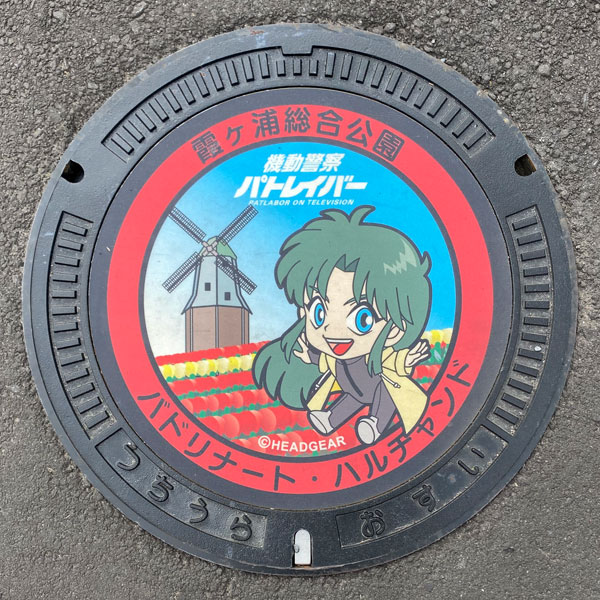
A sticker-type manhole cover featuring Badrinath Harchand, the pilot of the "Griffon," against the backdrop of the Dutch-style windmill and tulips of Kasumigaura Comprehensive Park.
The words "Kasumigaura Comprehensive Park" and "Badrinath Harchand" are printed above and below the sticker.
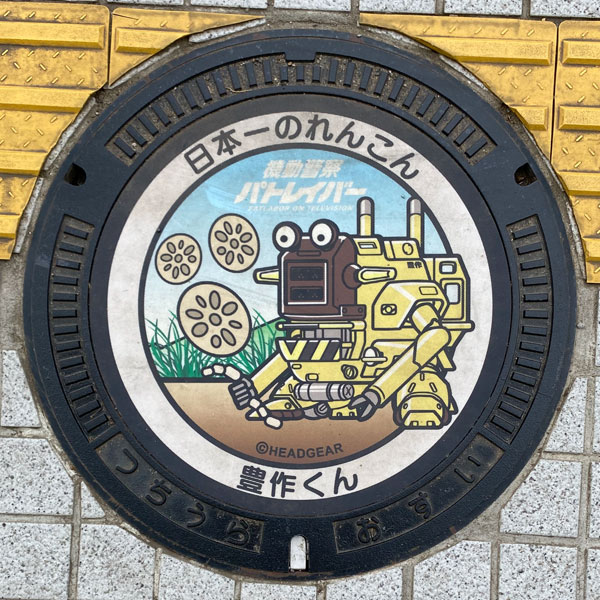
A sticker-type manhole cover depicting "Housaku-kun," an Eseki Agricultural Machinery-made farming laborer working in a lotus root field.
The words "Japan's No. 1 Lotus Root" and "Housaku-kun" are written above and below the sticker.
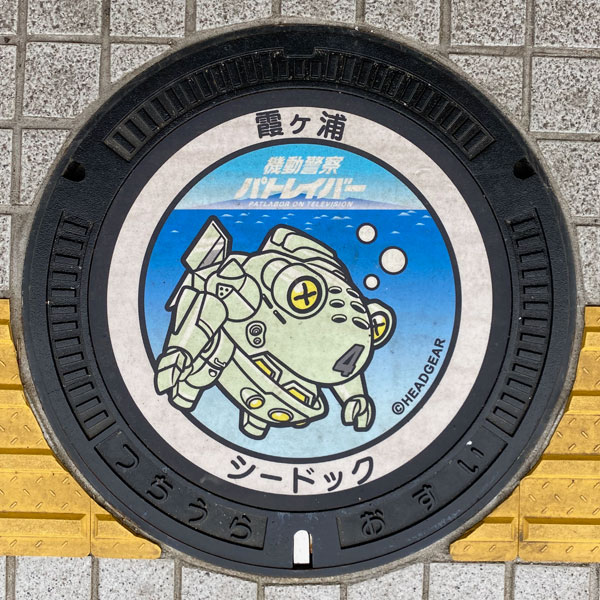
A sticker-type manhole cover depicting "Seedock," an unmanned underwater work vehicle operating in Lake Kasumigaura.
The words "Lake Kasumigaura" and "Seedock" are written above and below the sticker.
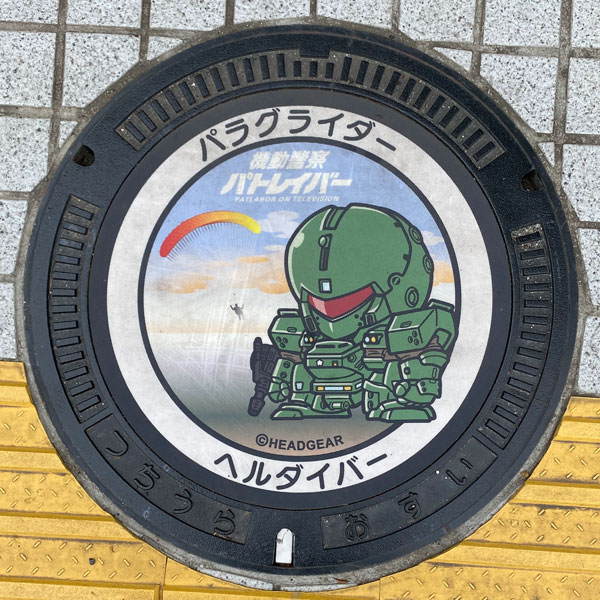
A sticker-type manhole cover depicting the Japan Ground Self-Defense Force's airborne assault labor "Helldiver" against the backdrop of Lake Kasumigaura with paragliders flying.
The words "paraglider" and "Helldiver" are written above and below the sticker.
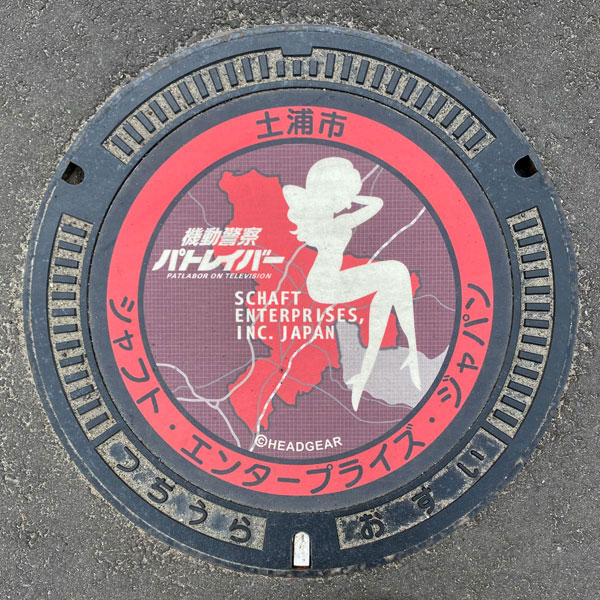
A sticker-type manhole cover featuring the Shaft Enterprise Japan logo against a background of a map of Tsuchiura City.
The words "Tsuchiura City" and "Shaft Enterprise Japan" are printed above and below the sticker.
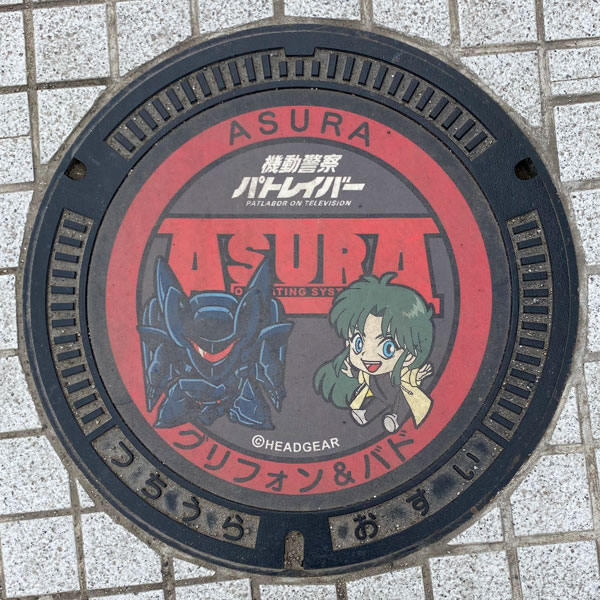
A sticker-type manhole cover depicting the experimental combat prototype Labor "Griffon," manufactured by Shaft Enterprise Japan's Tsuchiura Research Institute, and its pilot, "Badrinart Harchand." The red logo in the background is "ASURA," the operating system of the Griffon.
The words "ASURA" and "Griffon & Bud" are written above and below the sticker.
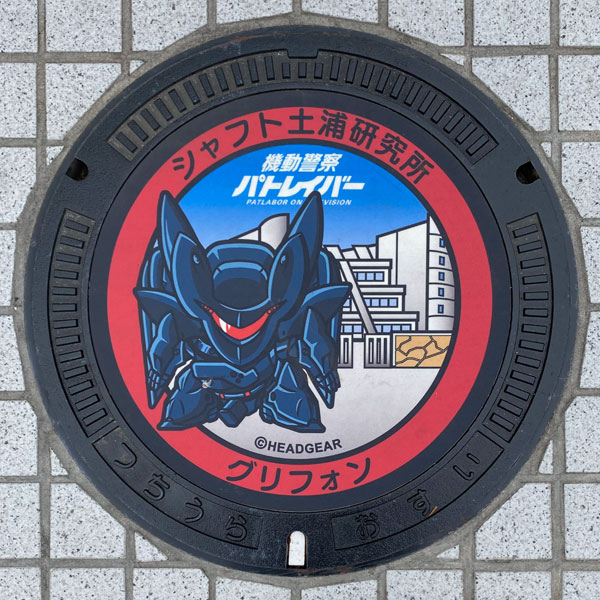
A sticker-type manhole cover depicting the experimental combat prototype Labor "Griffon" with the Shaft Enterprise Japan Tsuchiura Research Institute in the background.
The words "Shaft Tsuchiura Research Institute" and "Griffon" are written above and below the sticker.
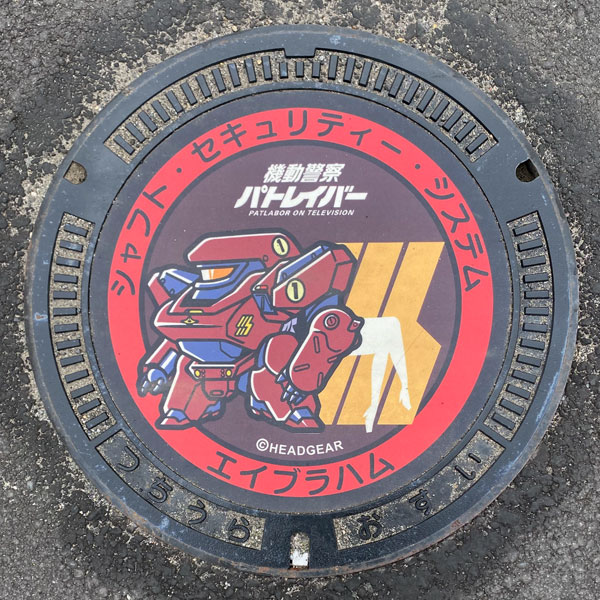
A sticker-type manhole cover depicting "Abraham," a military labor unit manufactured by Shaft Enterprises USA and adopted by the US Army and Marine Corps. Also used by Shaft Enterprises' security unit, "Shaft Security Systems (SSS)."
The words "Shaft Security Systems" and "Abraham" are printed above and below the sticker.
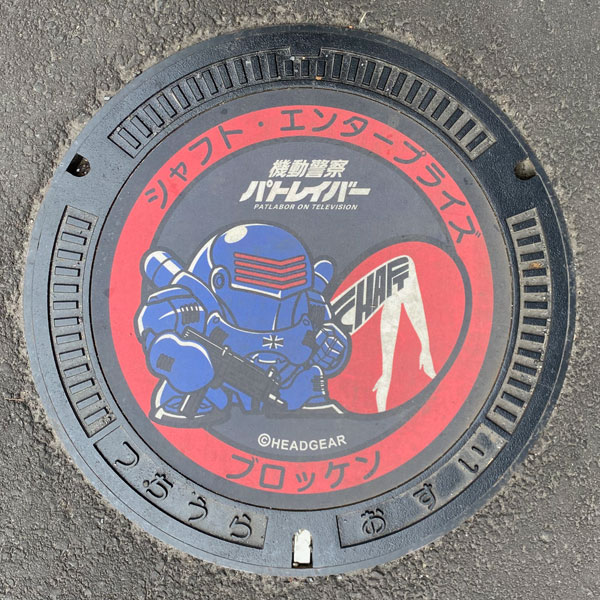
A sticker-type manhole cover depicting the military labor unit "Brocken," developed by Shaft Enterprise Europe.
The words "Shaft Enterprise" and "Brocken" are printed above and below the sticker.
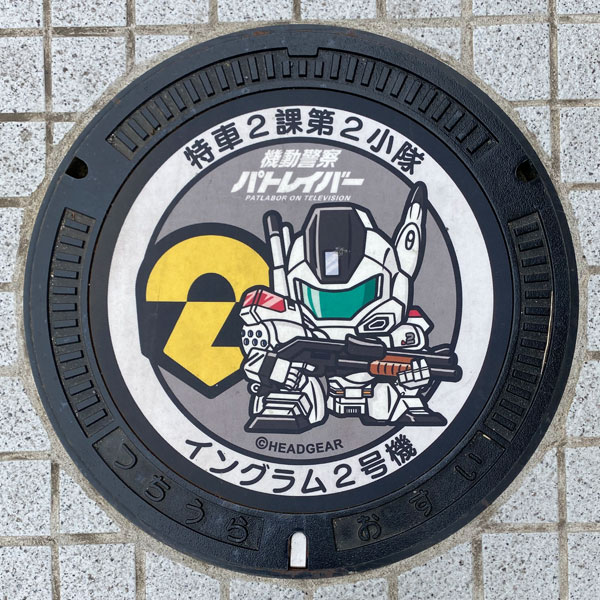
A sticker-type manhole cover depicting Ingram Unit 2 (piloted by Officer Isao Ota) of the Special Vehicles Division 2nd Platoon.
The words "Special Vehicles Division 2nd Platoon" and "Ingram Unit 2" are written above and below the sticker.
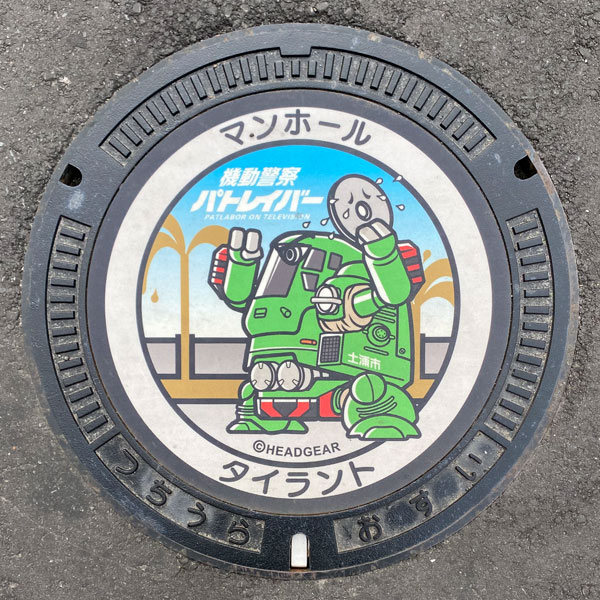
A sticker-type manhole cover depicting "Tyrant," a civil engineering labor robot manufactured by Hishii Industries, effortlessly lifting a manhole cover.
The words "Manhole" and "Tyrant" are printed above and below the sticker.
Niihari 新治村
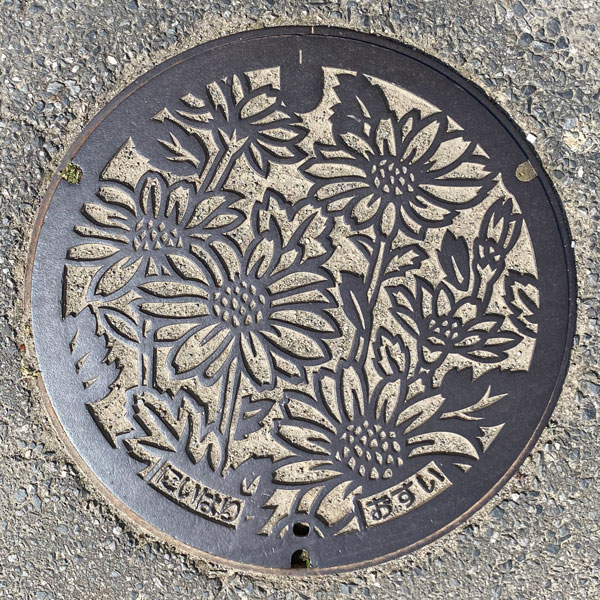
A manhole cover depicting the village flower, the chrysanthemum. It appears to be a wild chrysanthemum, not a cultivated variety.
The former Niihari Village was a place where agriculture, especially fruit cultivation, was thriving. Since I visited in autumn, many persimmons were displayed at the roadside stalls. This area is the northern limit for mandarin orange cultivation and the southern limit for apple cultivation, and pears, grapes, chestnuts, and persimmons are local specialties.
Although the name Niihari Village disappeared after being incorporated into Tsuchiura City, there is still "Ono no Komachi no Sato," a place where legends of the Heian period poet Ono no Komachi remain, and her grave is also located here. Many houses in this area have impressive gates, giving the impression of a much grander past.
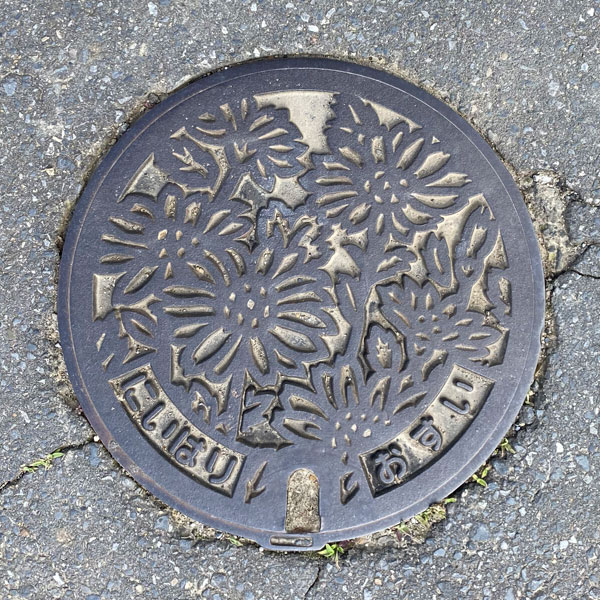
A small cover with thicker lines and a rougher feel.
Kasumigaura かすみがうら市
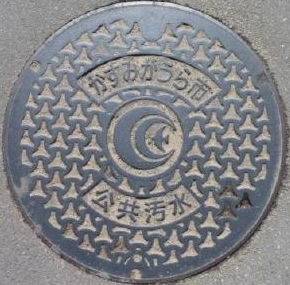
City emblem in the center, "Kasumigaura City" at the top, and "Public Sewage" at the bottom.
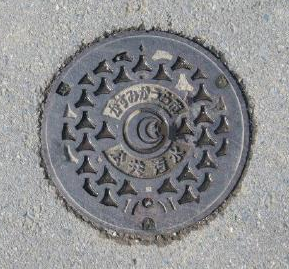
A smaller cover than the one shown above.
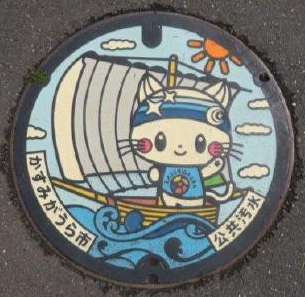
This manhole cover features Kasumigaura City's mascot, "Kasumiga Unya" (nickname "Unya"), and a sailing boat floating on Lake Kasumigaura. Unya is a cute cat-like fairy with sail-shaped ears and paws with a mountain cherry blossom pattern. The boat Unya rides is called a sailing boat, and it has long been a vital part of net fishing on Lake Kasumigaura, the second largest lake in Japan. Although it is no longer used for fishing, it operates as a tourist sailing boat from summer to autumn, and you can observe and photograph it from an accompanying boat.
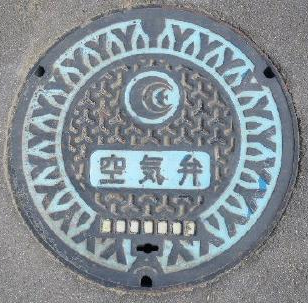
Water supply air valve bearing the city emblem of Kasumigaura City.
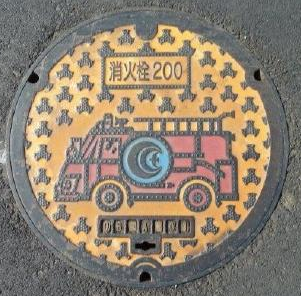
Yellow background with a tetrapod pattern, a fire truck with the city emblem, "Fire Hydrant 200" at the top, and a number frame at the bottom, featuring a slip-resistant design.
Kasumigaura 霞ケ浦町
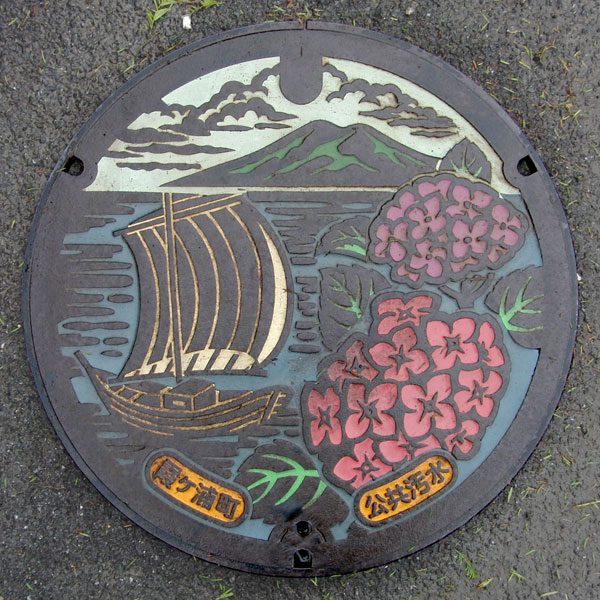
The manhole cover depicts Mount Tsukuba, a sailing boat floating on Lake Kasumigaura, and the city flower, the hydrangea
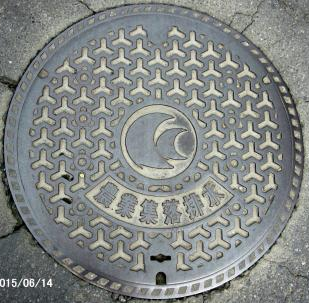
Agricultural drainage manhole cover with a tetrapod pattern and the town emblem. It has the words "Agricultural Drainage" and a keyhole. The frame has a diamond pattern. The town emblem consists of two sailing boats forming the letter "K," and the surrounding circle represents Lake Kasumigaura.
Chiyoda 千代田町
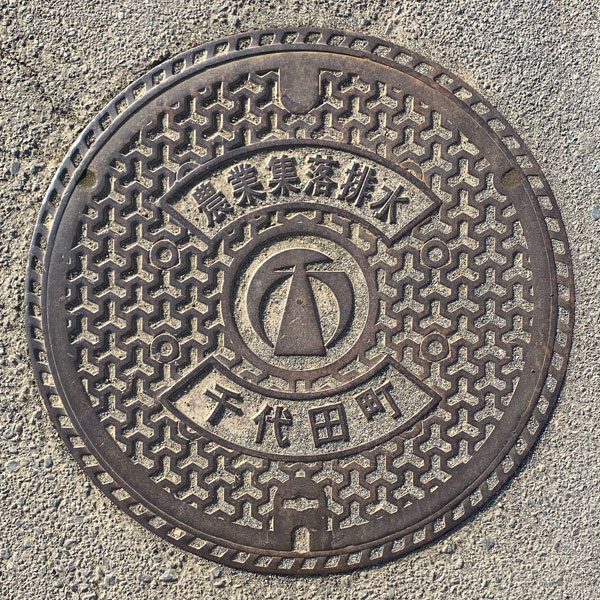
Manhole cover for agricultural drainage in the Niihari district, featuring a Bishamon tortoise shell pattern.
Dejima 出島村
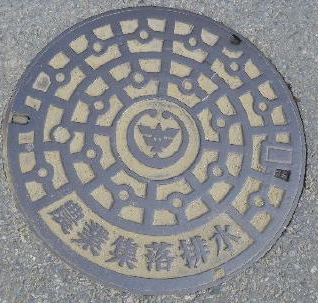
The center features the village emblem of the former Dejima Village.
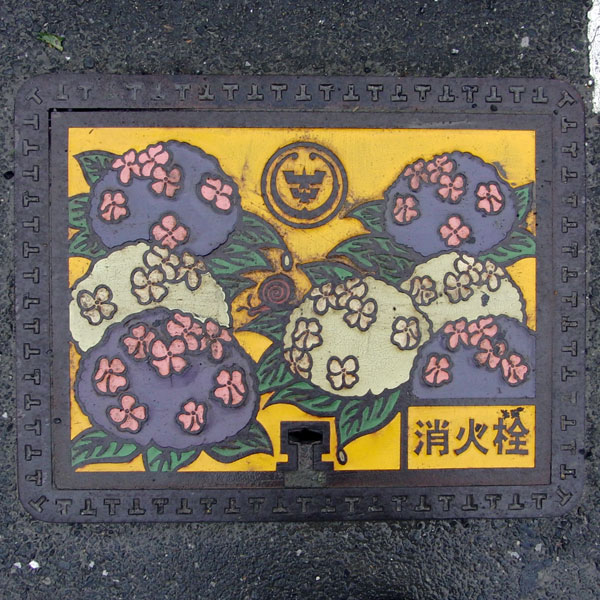
A fire hydrant cover depicting the city flower, the hydrangea.
Namegata 行方市
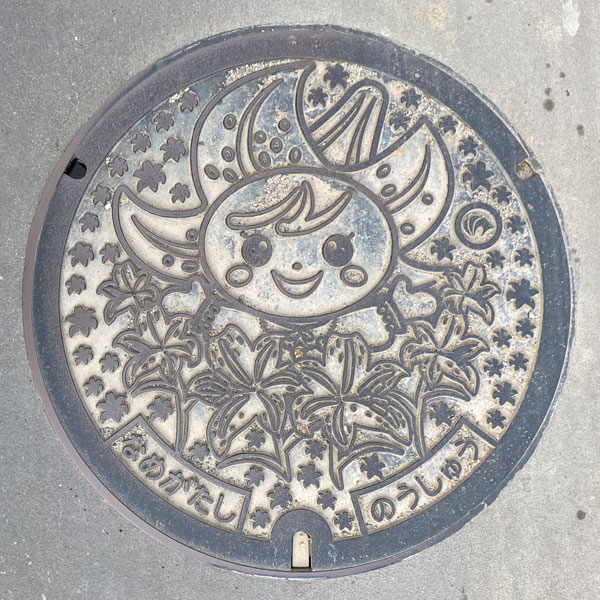
A manhole cover for sewage featuring Nameri-Mikoto, the mascot character of Namegata City. She's wearing a hat adorned with the city flower, the lily, a traditional Japanese garment called a "kantoui," a magatama (comma-shaped bead) made from a local sweet potato, and smiling sweetly with bangs that resemble the initial "N" of Namegata City (as depicted on the manhole card).
Asou 麻生町
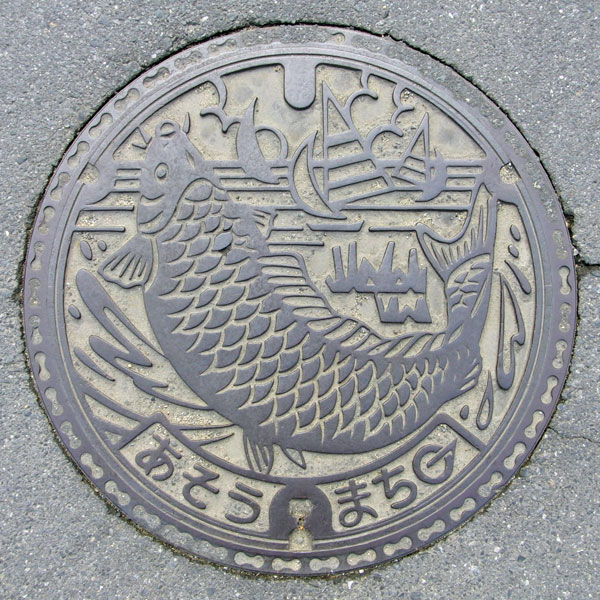
The image depicts Lake Kasumigaura with sailboats and carp, a popular aquaculture industry.
The words "Aso-machi" and the town emblem are at the bottom.
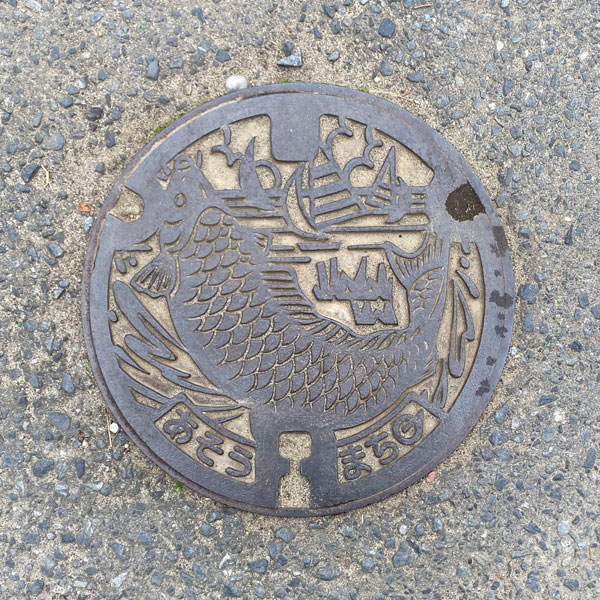
A small plate resembling a miniature version of the manhole cover shown above.
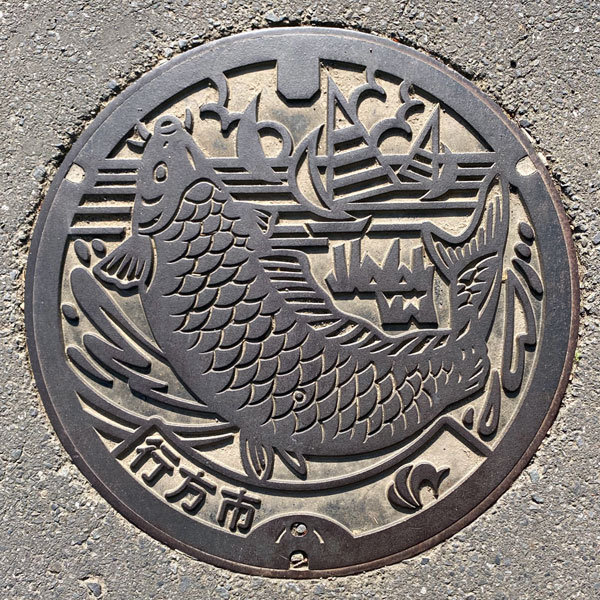
This manhole cover features the former Aso Town design with the words "Namegata City" replaced, and the Aso Town emblem replaced with the Namegata City emblem.
Tamatsukuri 玉造町
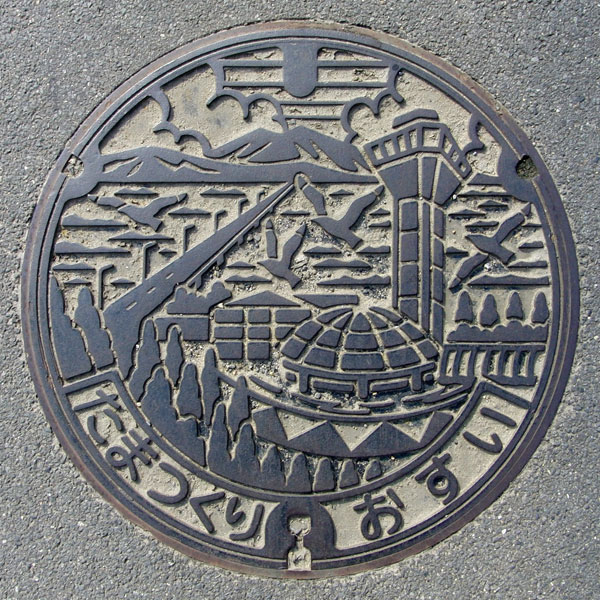
The image depicts the "Rainbow Tower," "Tama Museum," and "Kasumigaura Bridge" of "Kasumigaura Fureai Land," with Mount Tsukuba and Lake Kasumigaura in the background.
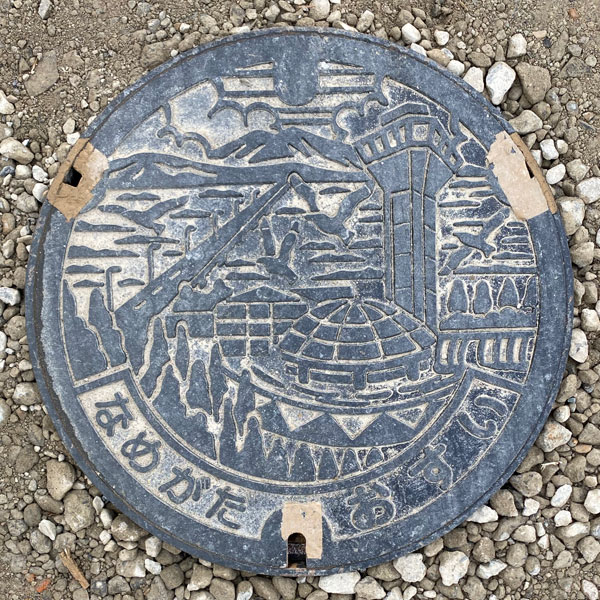
A manhole cover featuring a design from the former Tamatsukuri town with Namegata on the left.
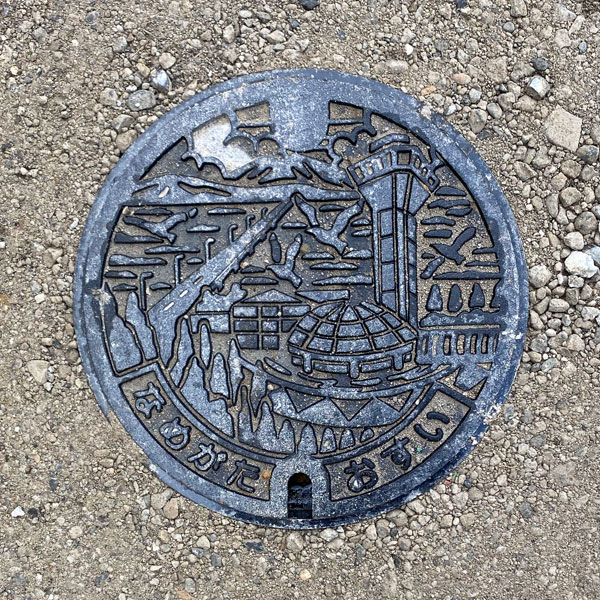
A smaller version with the same design as above.
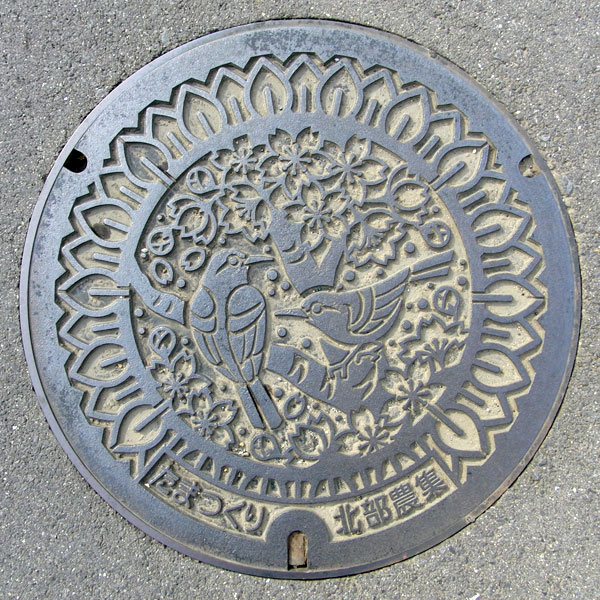
This is a farm waste disposal site in the northern district of Tamatsukuri. The town's flower, the sunflower, is depicted alongside the town's tree, the cherry blossom, and the town's bird, the Japanese bush warbler.
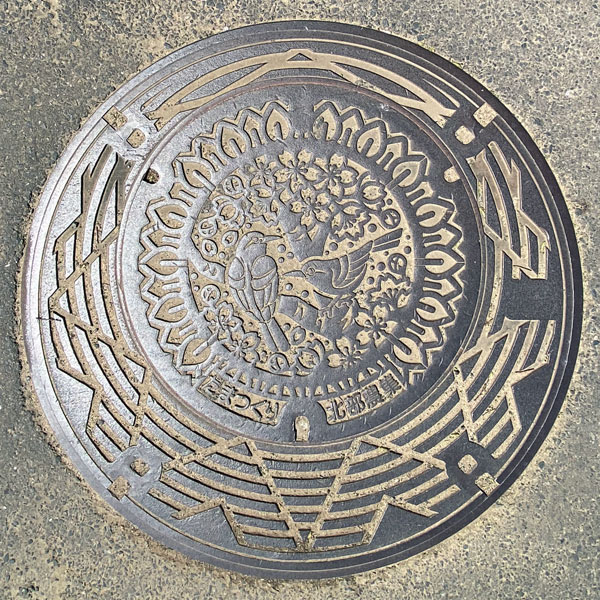
This is a parent-child manhole cover from the agricultural drainage system in the northern district of Tamatsukuri, containing a smaller cover of the same specifications as the larger one. The parent cover is made by Aqua Intec Co., Ltd., the same company that makes the parent-child manhole covers in Itako City.
Kashima 鹿嶋市
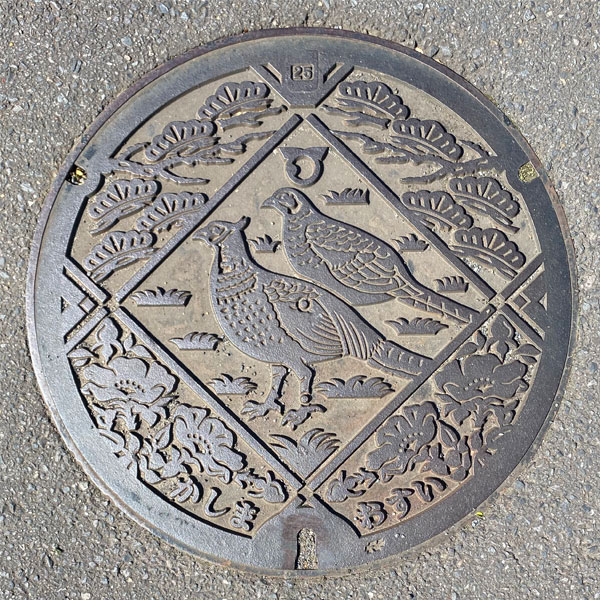
This is a manhole cover for sewage, featuring the city emblem and the city bird, the pheasant (male and female), on the inside, the city tree, the pine, on the upper outside, and the city flower, the Japanese rose (Rosa rugosa), on the lower outside.
Although difficult to see, the logo of Nagashima Casting Co., Ltd. is located below the "O" in "Osui" (sewage).
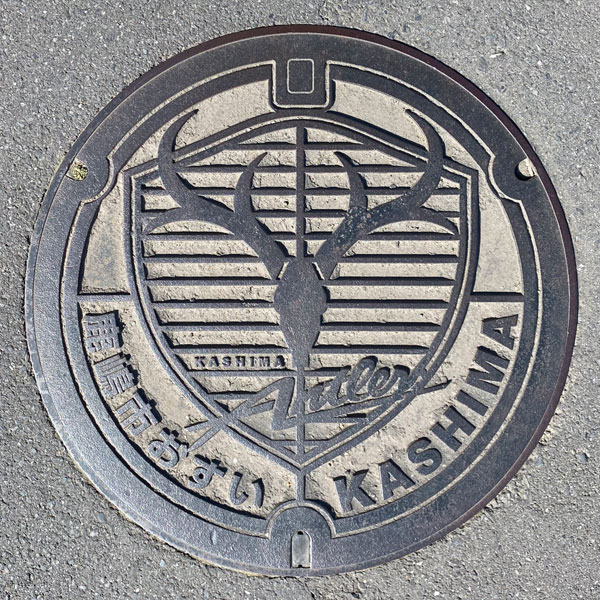
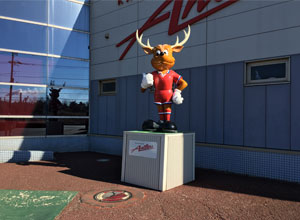
This manhole cover features the team emblem of Kashima Antlers, a J.League team whose home town is Kashima City.
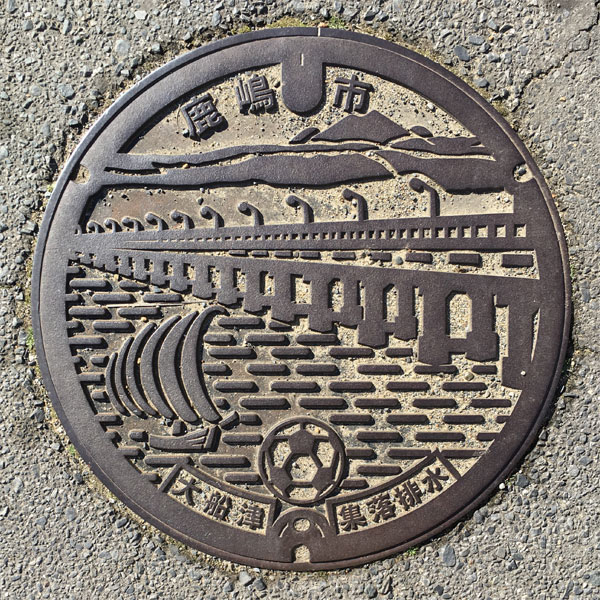
A manhole cover for agricultural community drainage in the Ofunatsu district.
When driving to Kashima City from the Tokyo area, you cross Lake Kitaura via the Jingu Bridge and the Shin-Jingu Bridge. After crossing the Jingu Bridge and turning right (south) at the east end of the bridge, you enter the Ofunatsu district. This manhole cover depicts the Jingu Bridge and a sailing boat viewed from the south, with Mount Tsukuba in the background, and a soccer ball at the bottom, fitting for a city known for soccer.
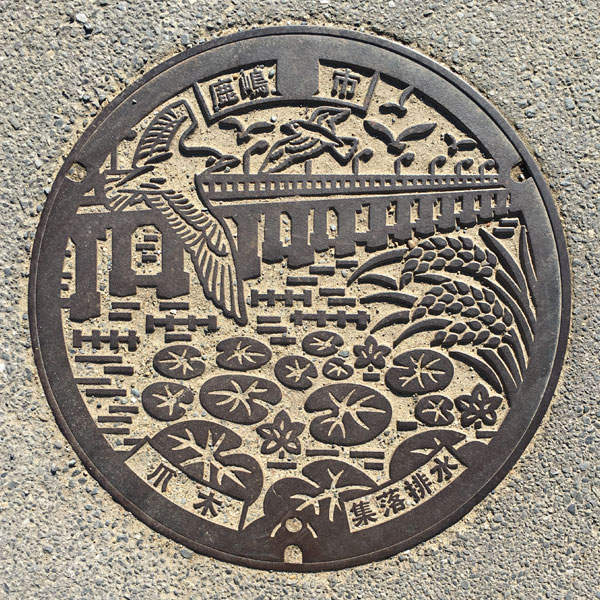
A manhole cover for agricultural community drainage in the Tsumagi district.
When driving to Kashima City from Tokyo, you cross Lake Kitaura via the Jingu Bridge and the Shin-Jingu Bridge. After crossing the Jingu Bridge, turning left (north) at the east end of the bridge leads to the Tsumagi district. This manhole cover depicts the Jingu Bridge viewed from the north, along with seagulls (probably black-headed gulls), water lily leaves and flowers, and rice stalks. A stake resembling a woven bamboo stake is depicted in front of the bridge, but this does not appear to be present on the Ofunatsu district side.
Kashima 鹿嶋町
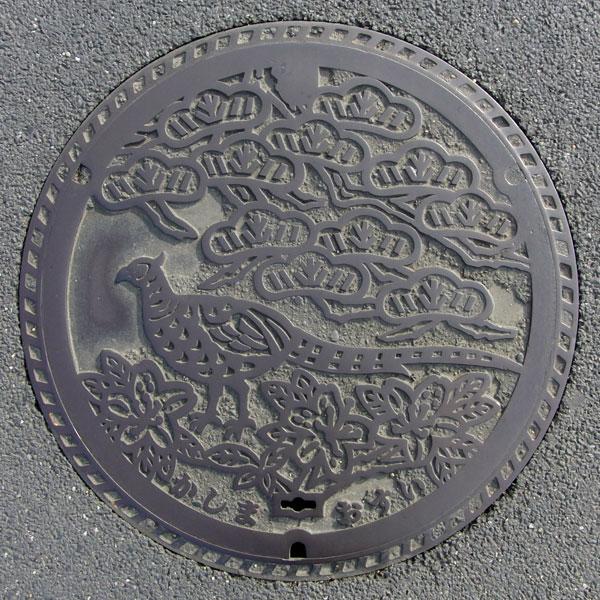
This flower looks like an azalea. However, the "Kashima City Flower, Tree, and Bird" regulations, which came into effect on September 1, 2005, list the flower as the Japanese rose (Rosa rugosa), so this manhole cover predates that date.
Tsukubamirai つくばみらい市
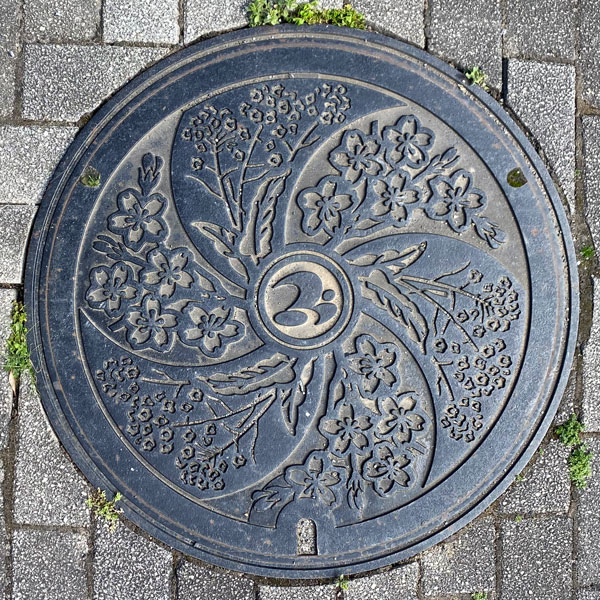
This manhole cover, originally designed during the "Yawara-Ina Sewerage Association" era, has had its center replaced with the Tsukubamirai City emblem.
Since Tsukubamirai City was established, the cherry blossom has become the city tree and the rapeseed flower has become the city flower.
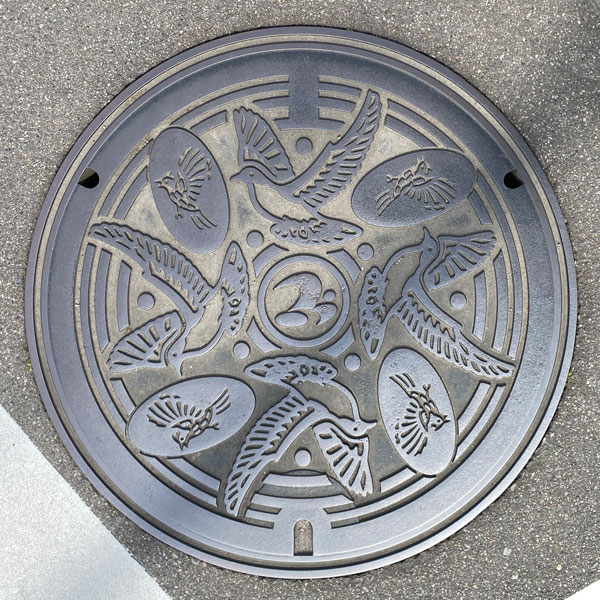
This manhole cover, originally designed during the "Yawara-Ina Sewerage Association" era, has had its center replaced with the Tsukubamirai City emblem.
The city bird of Tsukubamirai City is the skylark.
Ushiku 牛久市
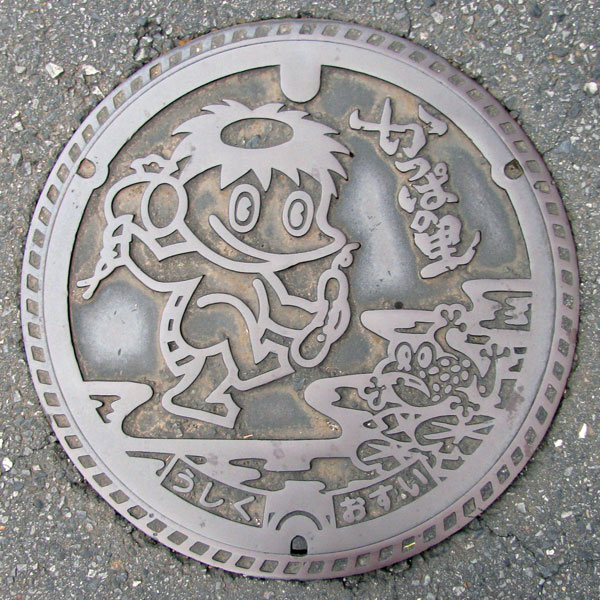
Ushiku City's mascot, "Kyu-chan," a kappa (water imp) holding a mallet in his right hand and a cucumber in his left.
While there seem to be many folk tales about kappas around Ushiku Marsh, it's a bit unfortunate that the marsh's waters actually belong to Ryugasaki City, which is adjacent to Ushiku City.
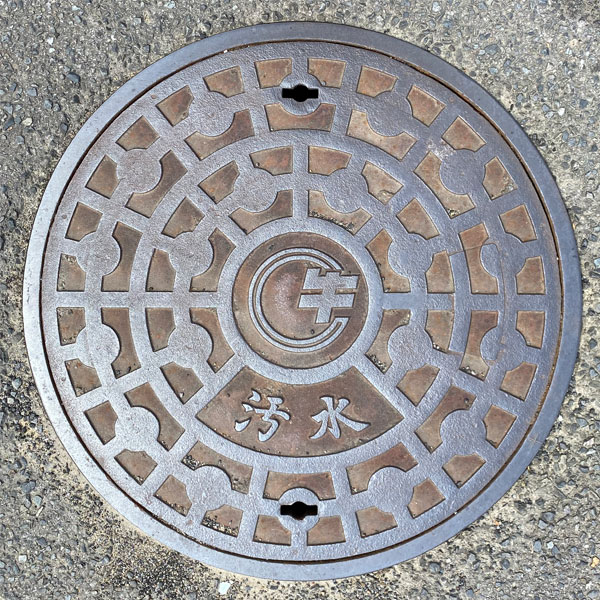
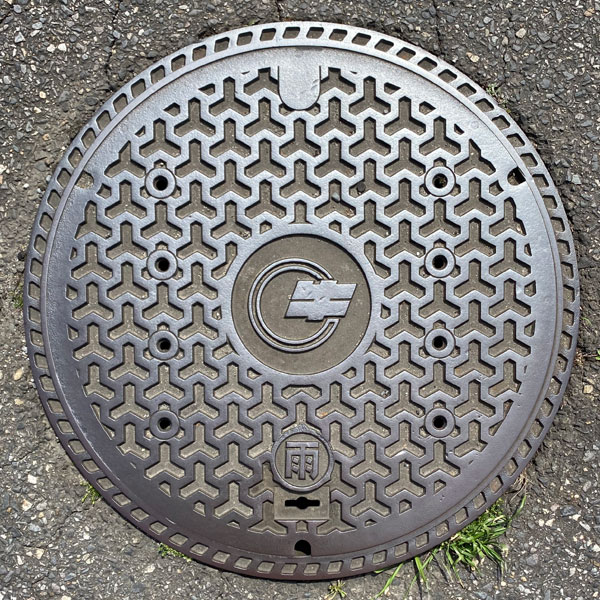
A manhole cover for sewage, featuring the Ushiku City emblem in the center.
Inashiki 稲敷市
Edosaki 江戸崎町
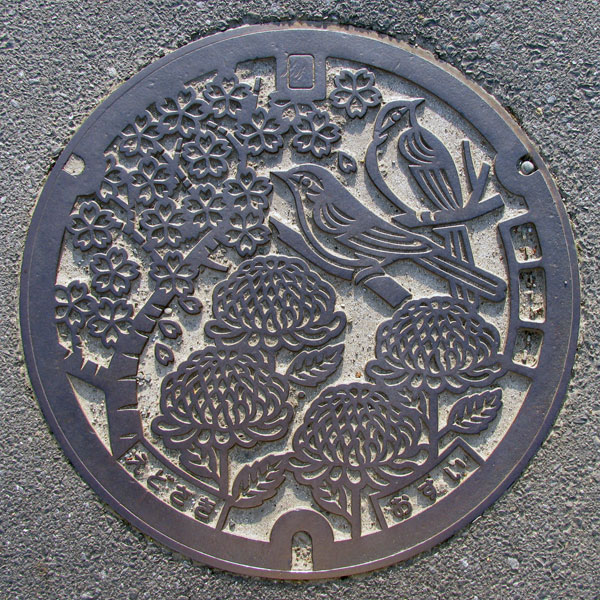
A manhole cover for sewage featuring the town's tree (cherry blossom), flower (chrysanthemum), and bird (Japanese bush warbler). The words "Edosaki" and "Sewage" are written below.
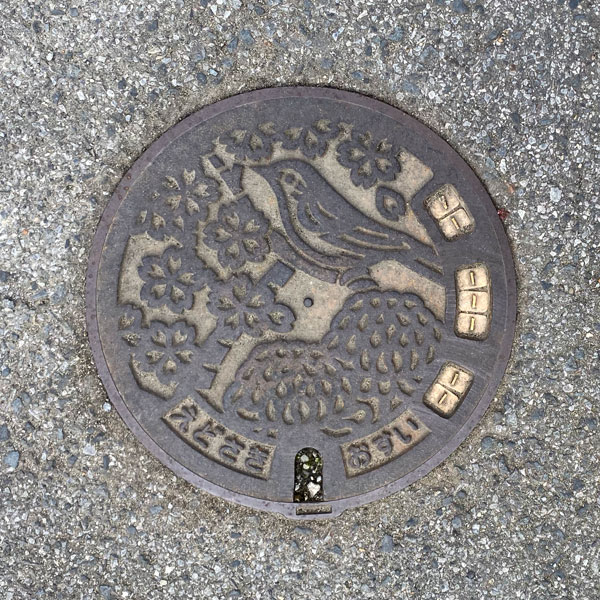
This small drain for wastewater has the same design as above, but with fewer cherry blossoms, chrysanthemums, and nightingales depicted.
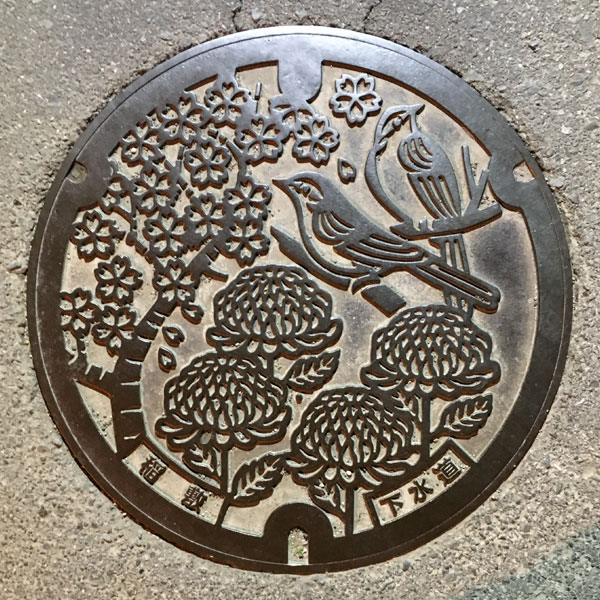
This is a manhole cover for sewage, using the design from the former Edosaki Town, but with the text changed to "Inashiki" and "Sewerage." The new city's tree is the cherry blossom, the flower is the chrysanthemum, and the bird is the Japanese bush warbler, the same as those of the former Edosaki Town.
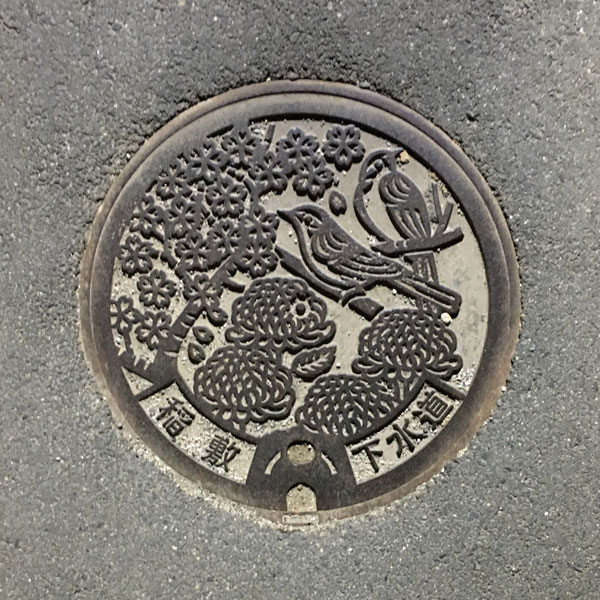
A smaller version with the same design as above.
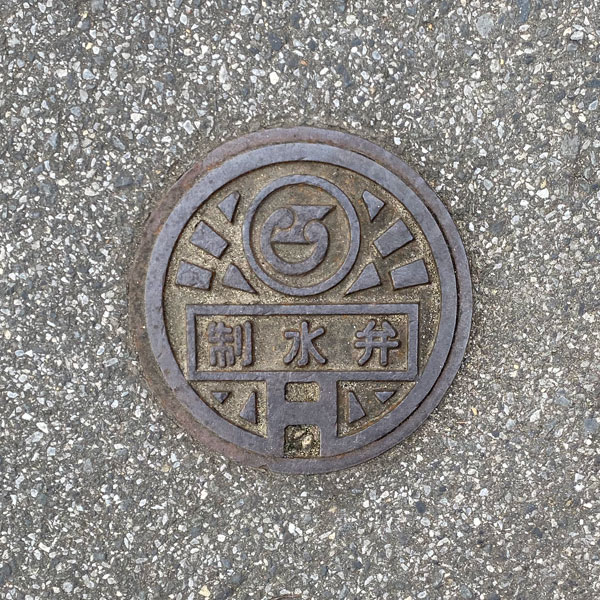
A tiny water control valve cover bearing the former Edosaki town emblem.
Shintone 新利根町
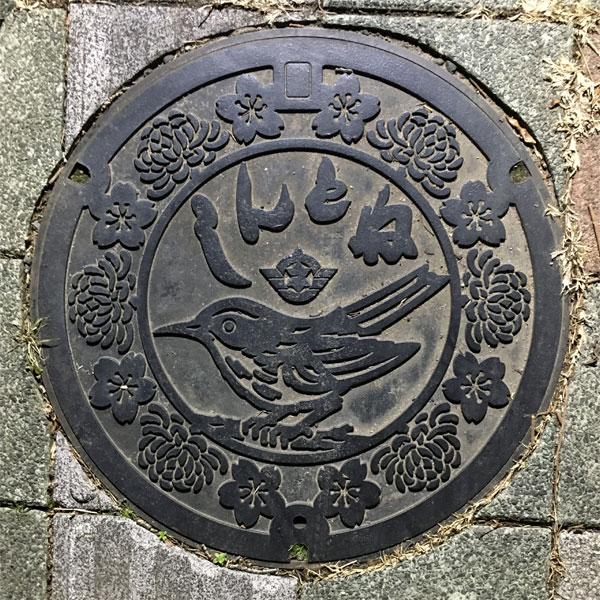
A manhole cover for sewage, featuring the town's tree (cherry blossom), town flower (chrysanthemum) around the perimeter, and the town's bird (Japanese bush warbler), town emblem, and the word "Shintone" within the inner circle.
Azuma 東町
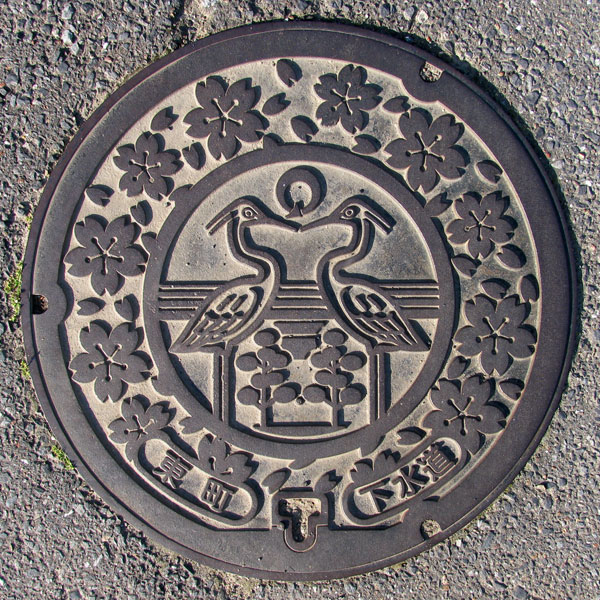
The design is a town emblem featuring the village tree "Maki," the village flower "Sakura," and the village birds "Shirasagi" (white heron) and "Azuma" (Eastern Bluebottle). The words "Higashi-machi" (East Town) and "Sewerage" are at the bottom.
The heron appears to be a "Little Egret" based on its crest feathers, but the four horizontal lines might represent the surface of Lake Kasumigaura.
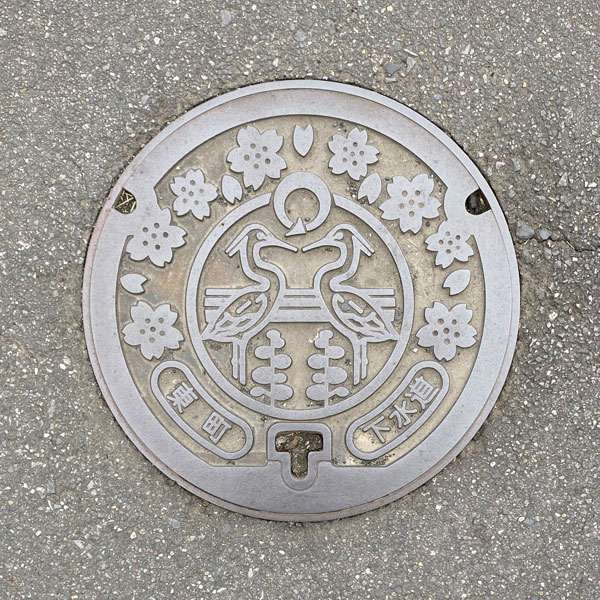
A smaller cover with a simplified design to fit its size. The cherry blossom center is represented by just a dot, and the water surface has three lines with gaps on either side.
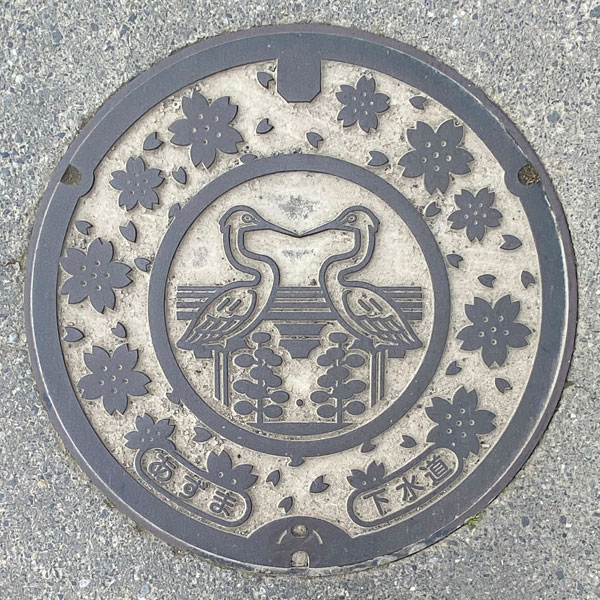
The design is from the former Azuma-machi town, but the town emblem is missing, and the text at the bottom reads "Azuma" and "Sewerage," suggesting it's a manhole cover from after the merger.
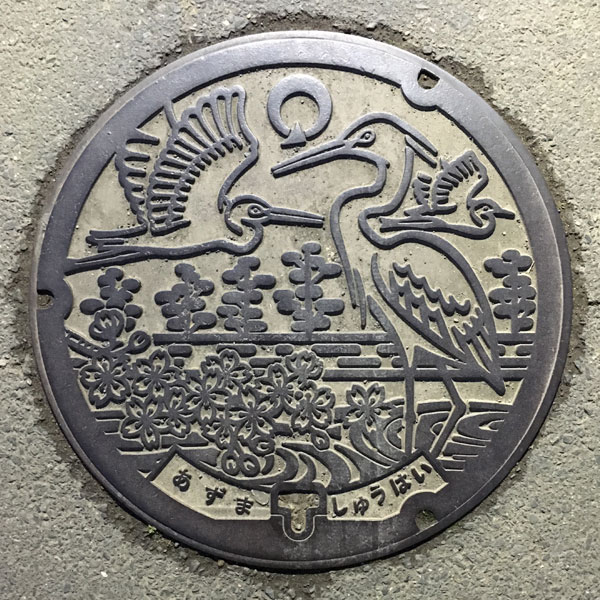
This is a manhole cover for agricultural community drainage in the Magaribuchi district. The design, like the cover above, features the town emblem, incorporating the village tree ("Maki"), the village flower ("Sakura"), and the village birds ("Shirasagi" and "Azuma").
There are now three egrets, two of which are flying. The former Higashi-machi area was a rice paddy region, and in addition to egrets, many sandpipers and plovers can be seen in spring and autumn.
Sakuragawa 桜川村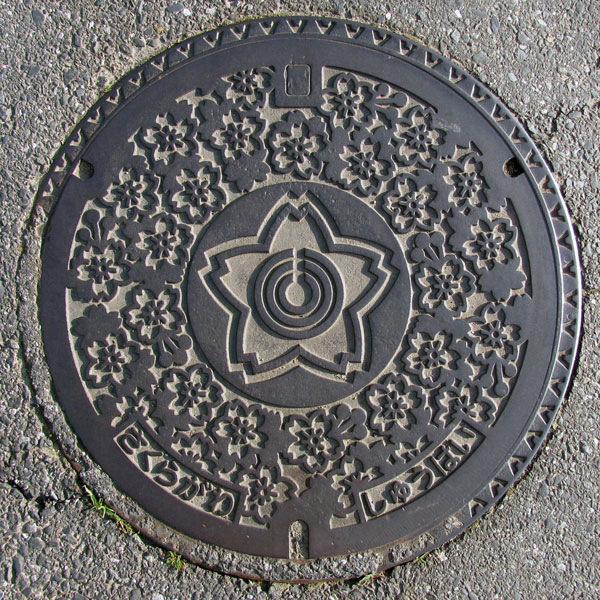
The manhole cover of the agricultural drainage system in the eastern Awa district is covered with cherry blossoms, the village's official tree. Of course, the village emblem, featuring a design of cherry blossoms and a river, is at the center.
Itako 潮来市
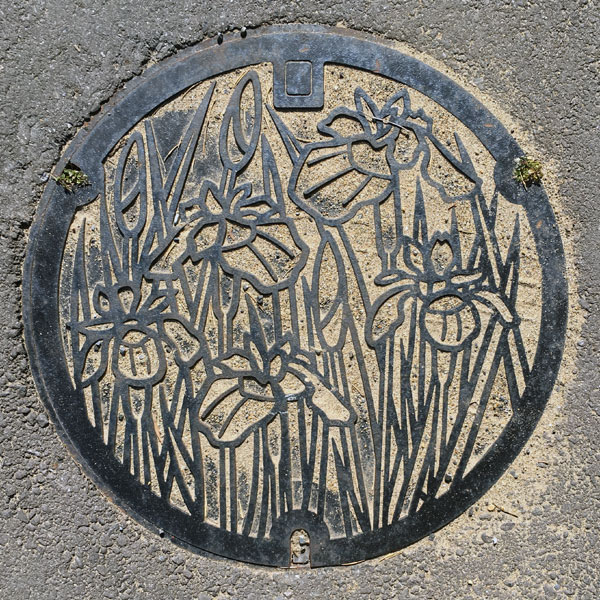
The city flower, the iris, is depicted on it.
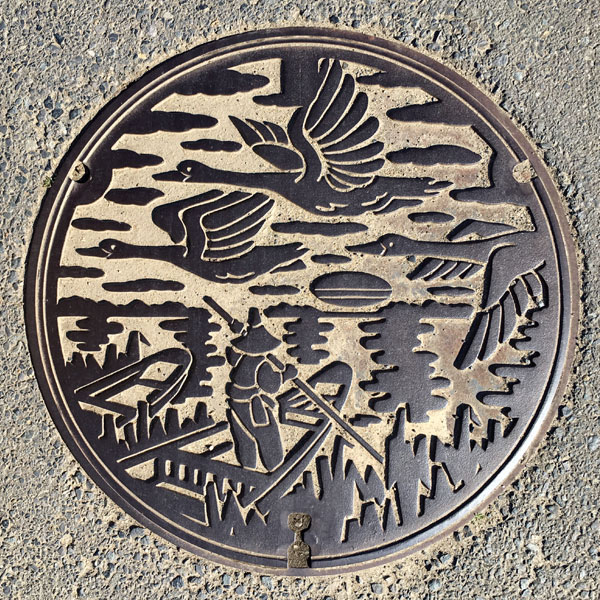
A manhole cover for agricultural community drainage in the Ohara district, facing Lake Kitaura.
A boatman holding a pole, perhaps about to set sail. Swans fly overhead. As dawn breaks, the swans take flight one after another, heading towards the rice paddies where they will feed. Even without color, the manhole cover conveys the atmosphere of a winter morning, with its flattened sunrise and clouds still tinged with faint purple.
Ushibori 牛堀町
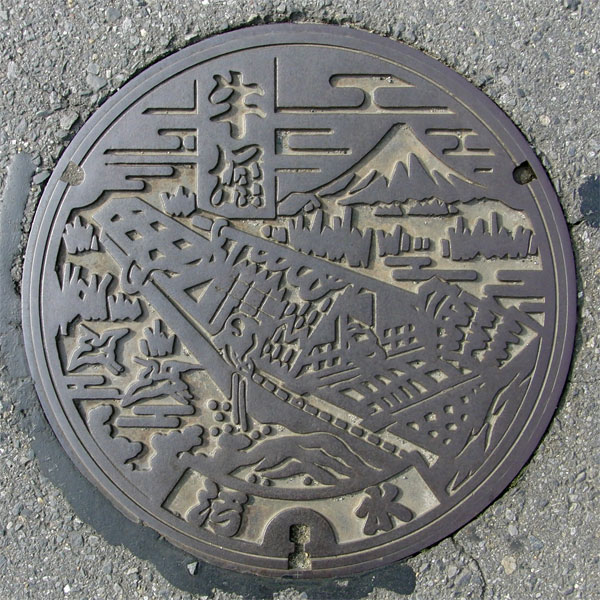
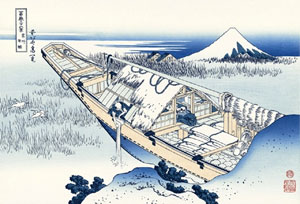
This depicts "Ushibori in Hitachi Province," one of Katsushika Hokusai's "Thirty-Six Views of Mount Fuji."
Moriya 守谷市
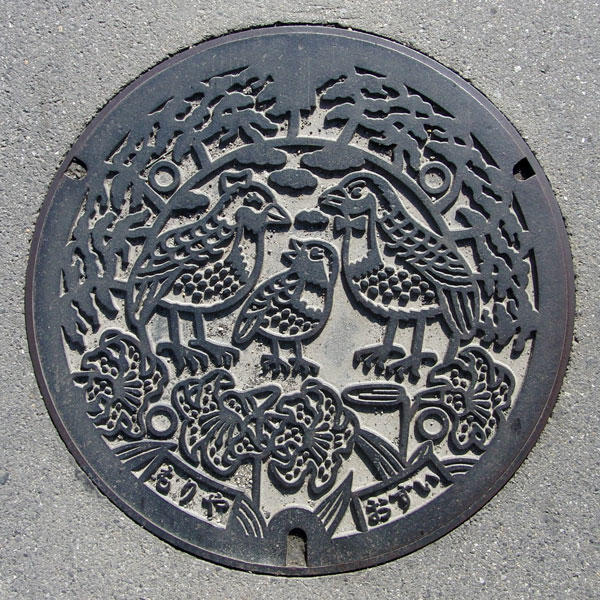
This is a manhole cover for sewage. The design features the city tree, the pine, at the top; the city bird, the Chinese francolin, in the center; and the city flower, the mountain lily, at the bottom. The Chinese francolin's call, "Chotto koi, Chotto koi," is commonly heard, but they prefer to stay in the bushes, so they are rarely seen. During the breeding season, families can sometimes be seen walking along the edge of the forest. They are not native to Japan; they were introduced from southern China and Taiwan as game birds and breed in warmer regions.
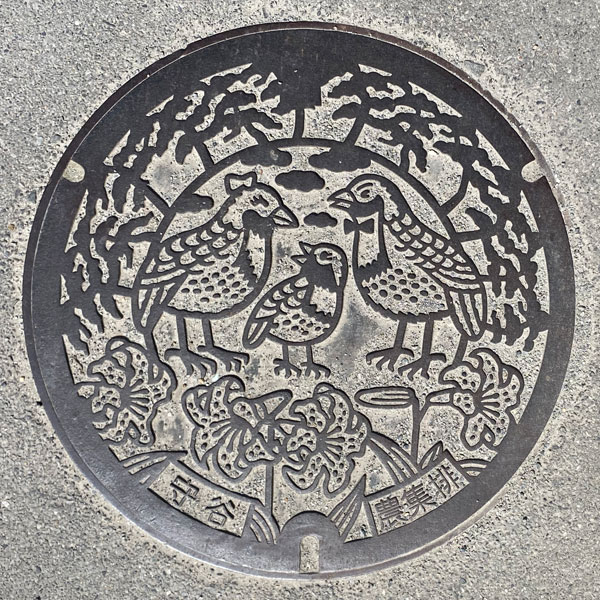
This manhole cover from the Nishibantoi district has the same design as the one above, but with "Moriya (Kanji)" and "Agricultural Drainage" written on the bottom.
Toride 取手市
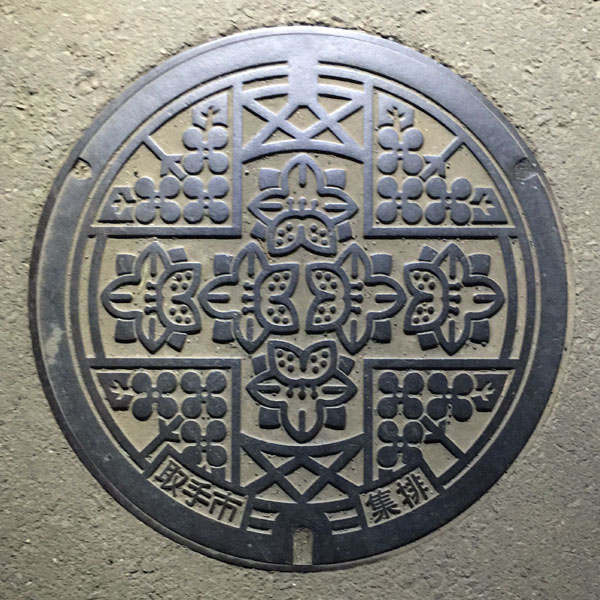
A manhole cover for agricultural community drainage in the Ichinodai district.
It's abstract and a little difficult to understand, but apparently it depicts azaleas (the city flower) and osmanthus (the city tree).
The city emblem in the center.
Fujishiro 藤代町
The town emblem is a stylized representation of the character "fu" from Fujishiro, depicted as a bird in flight.
Ryugasaki 龍ヶ崎市
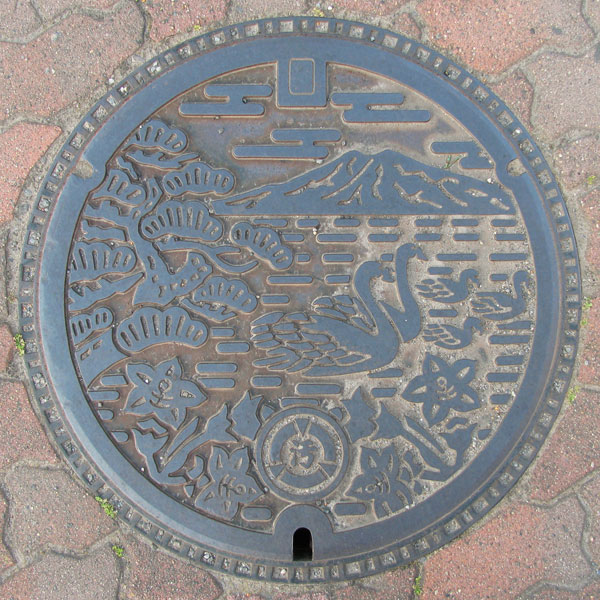
The design features the city bird, the swan, the city tree, the pine, and the city flower, the bellflower, all floating on Lake Ushiku. Mount Tsukuba is in the background. At the bottom is the city emblem, depicting a dragon grasping a jewel with three claws. Of course, the city emblem does not contain the character for "sewage."
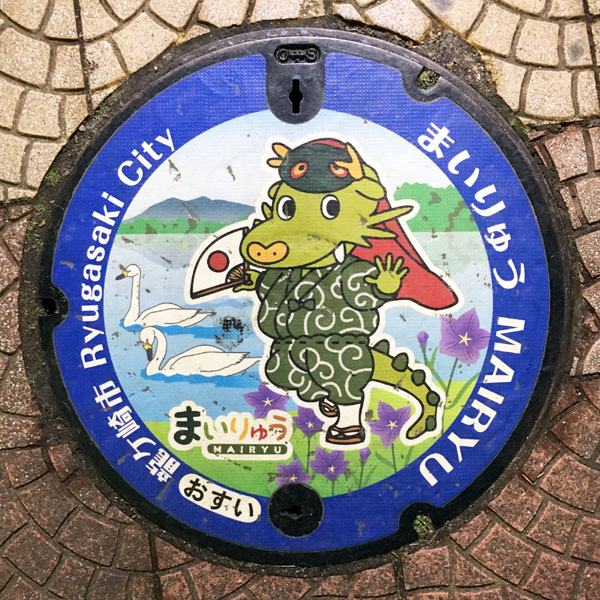
The manhole cover features "Mairyu," a mascot character created by combining the traditional Ryugasaki City event "Tsukumai" and the "Ryu" (dragon) from "Ryugasaki," along with the city flower, the bellflower. The background depicts Mount Tsukuba and the city bird, the swan, floating on Lake Ushiku.
Kamisu 神栖市
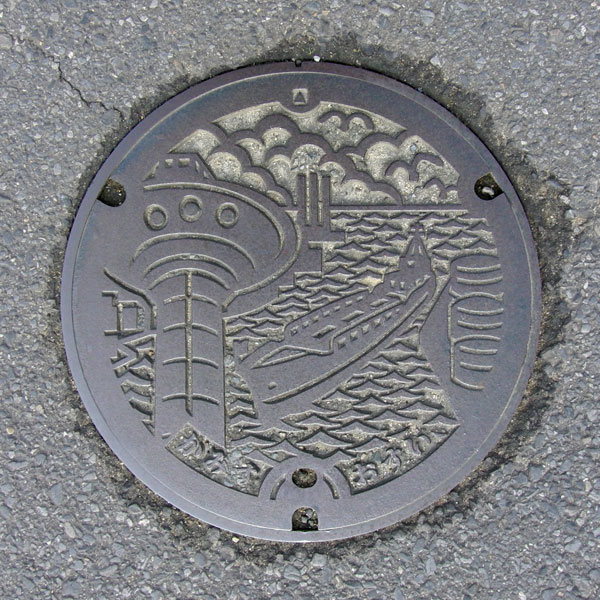
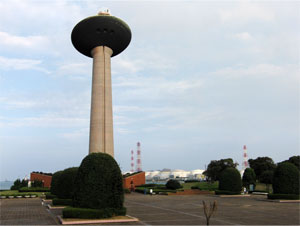
The design is based on Kashima Port and the observation deck at Port Park.
Hasaki 波崎町
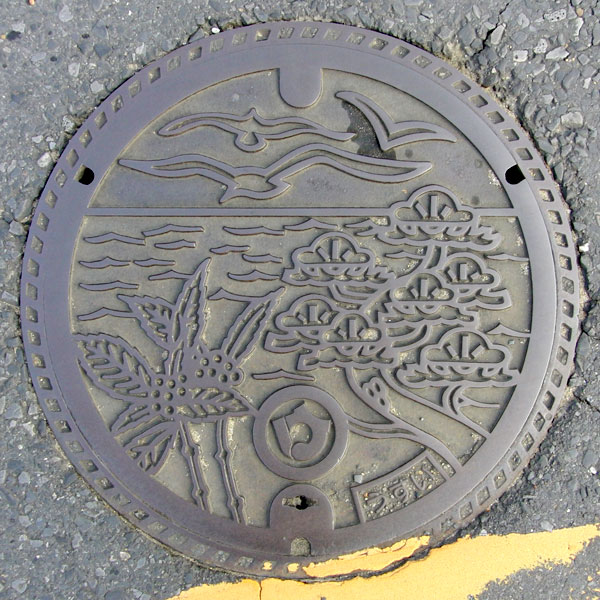
A manhole cover depicting the town's tree (pine), town flower (Ardisia crenata), and town bird (seagull). The town emblem from the Hasaki town era is at the bottom.
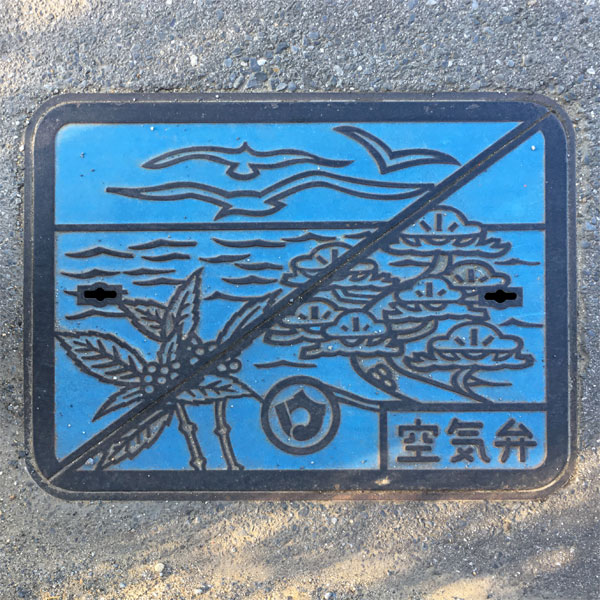
fire hydrant color panel with the same design as above.
Daigo 大子町
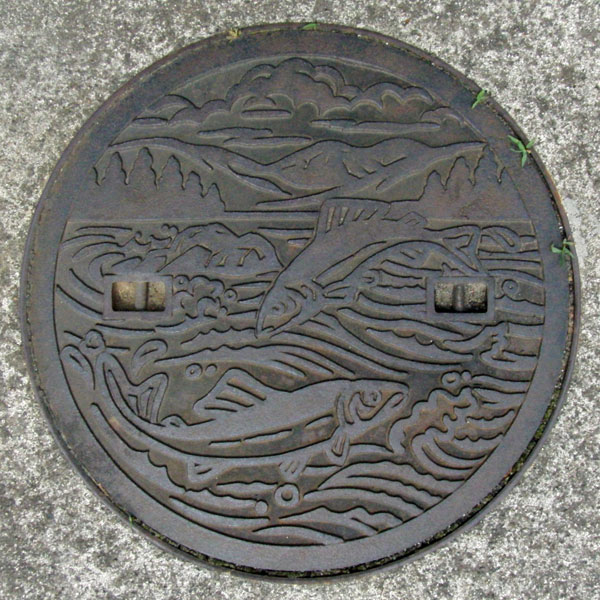
The design is the Kuji River flowing through the central part of the town and the ayu swimming lively.
Shirosato 城里町
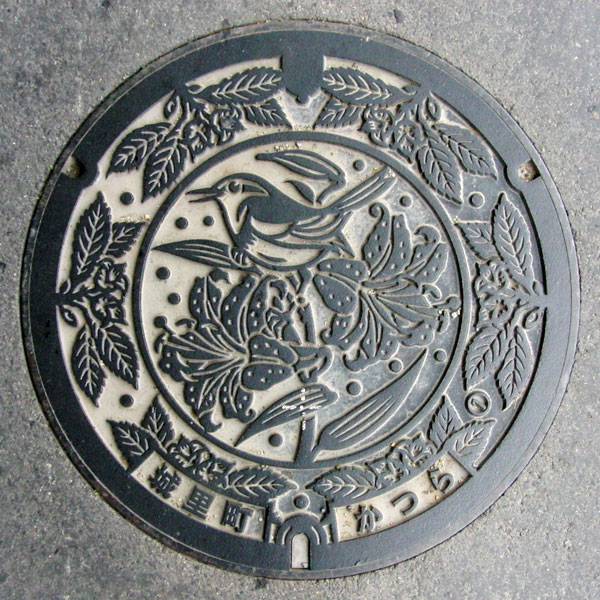
The design is surrounded by the town's flower "Yamayuri" and the town's bird "Uguisu" is surrounded by the town's tree "Sudajii".
The letters below are "Joshoku" and "Johoku."
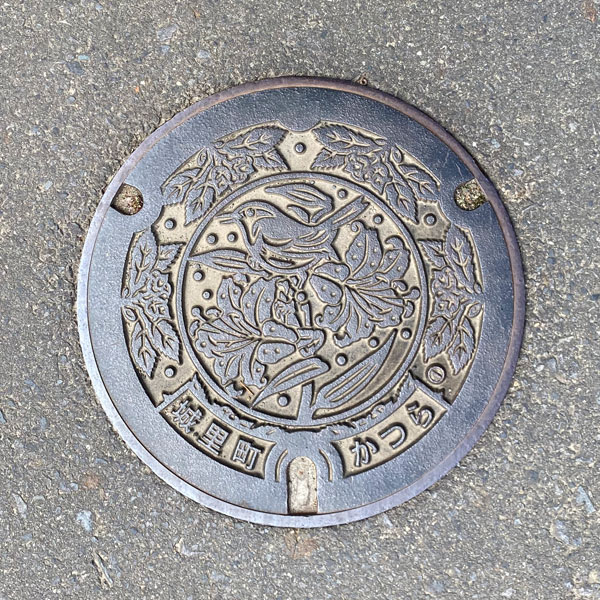
Same design as above.
Johoku 常北町
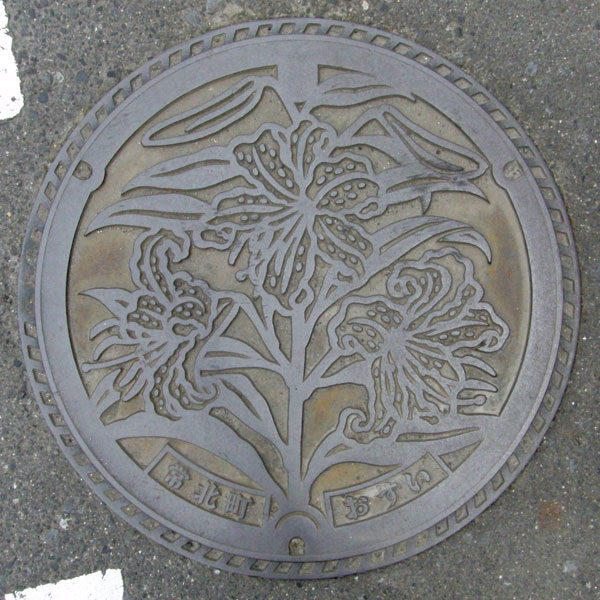
A manhole lid for sewage in the public sewerage that depicts the flower "Yamayuri" in the town of the old town of Tsunekita.
The letters 'Johoku-cho' and 'Osui' are at the bottom.
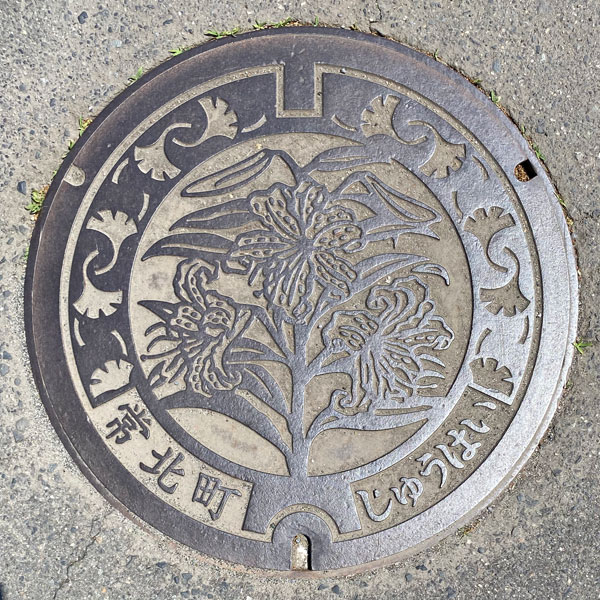
The lid of the Johoku Aoyama area agricultural collection, in which the leaves of the town's tree "Ginkgo" are drawn on the outside of the upper lily design.
Katsura 桂村
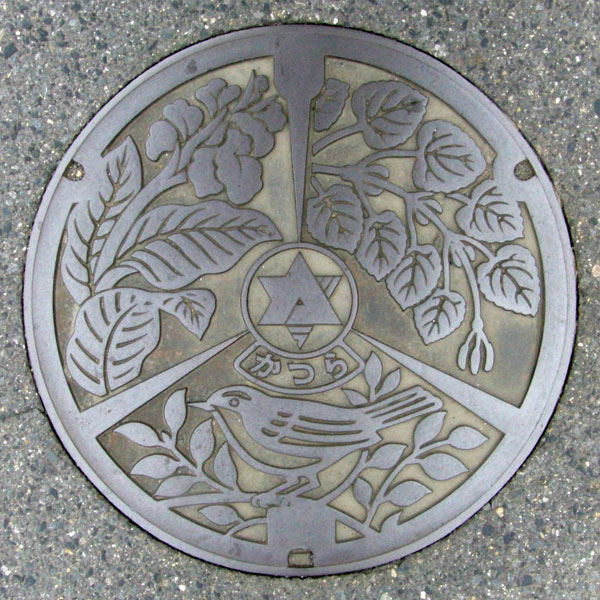
The lid of the specific environmental conservation public sewerage project. The design is the village tree "Katsura" of the village of the former Katsura Village, the village flower "Kanna" and the village bird "Uguisu".
The central village emblem is shaped like a hexagram (six-pointed star), but if you look closely, it is a combination of "Katsura" of katakana.
Ibaraki 茨城町
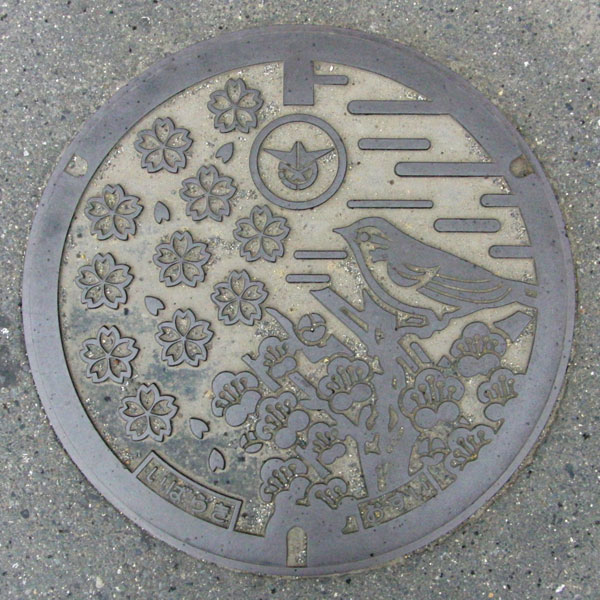
A manhole cover for sewage featuring the town's tree, the plum blossom, the town's flower, the cherry blossom, and the town's bird, the Japanese bush warbler.
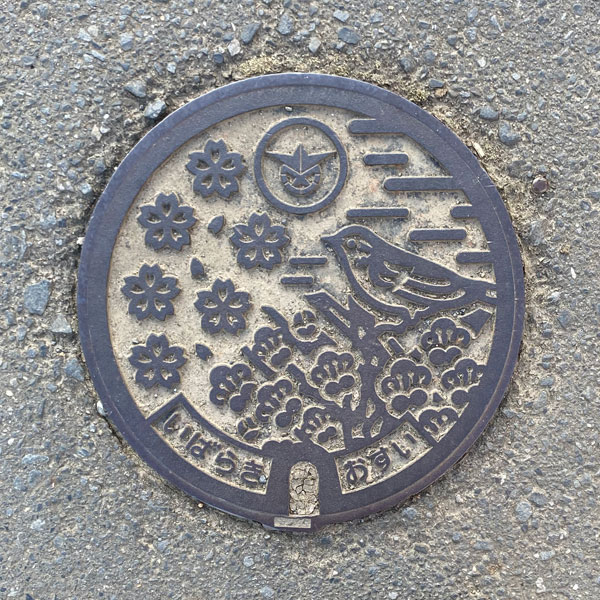
Smaller version of the design above.
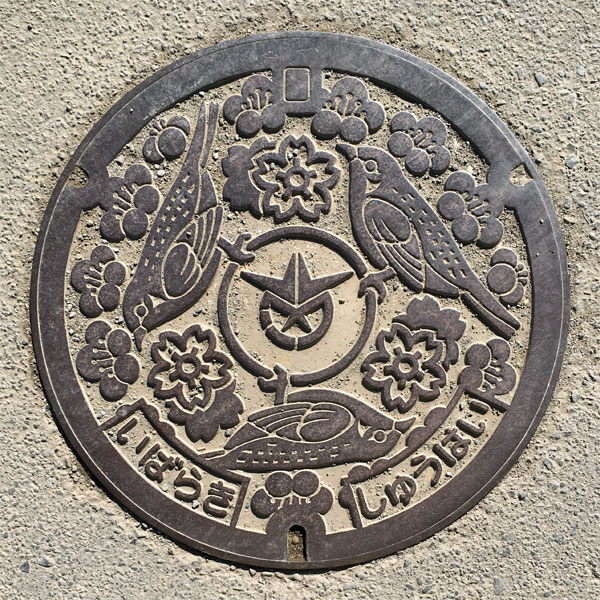
The design, like the manhole cover above, features the town's tree ("plum blossom"), town flower ("cherry blossom"), and town bird ("Japanese bush warbler"), but it is repeated with the town emblem in the center rotated 120 degrees each time.
Oarai 大洗町
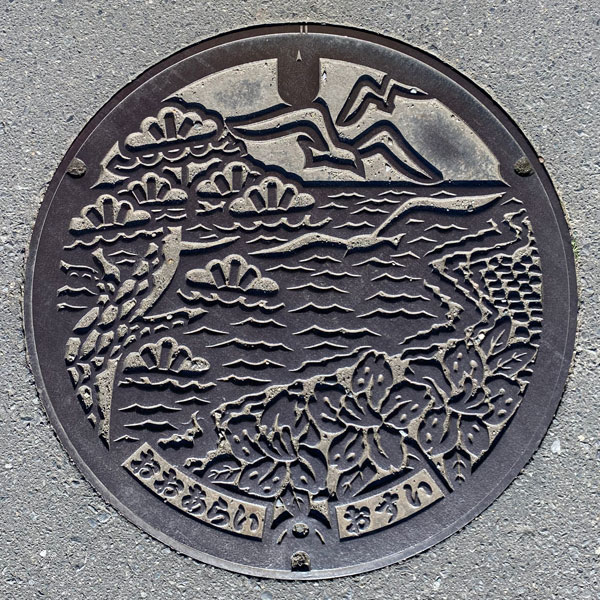
The design features the town's tree, the pine, its flower, the azalea, and its bird, the seagull, against a backdrop of the sea.
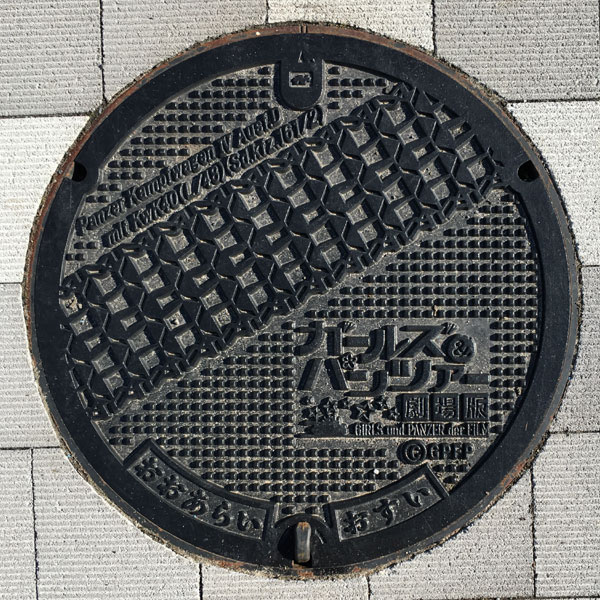
This is apparently a one-of-a-kind manhole cover for sewage, created because Oarai Town is the setting for the original TV anime "Girls und Panzer."
The image from the upper right to the lower left depicts tank tracks, and above them, it reads "Panzer Kampfwagen IV Ausf.D (newline) mit KwK40(L/48)(Sd.kfz.161/2)," which seems to be the specification of the tank driven by the protagonist.
The lower right corner has the words "Girls und Panzer the Movie" and "GIRLS und PANZER der FILM" inscribed on it.
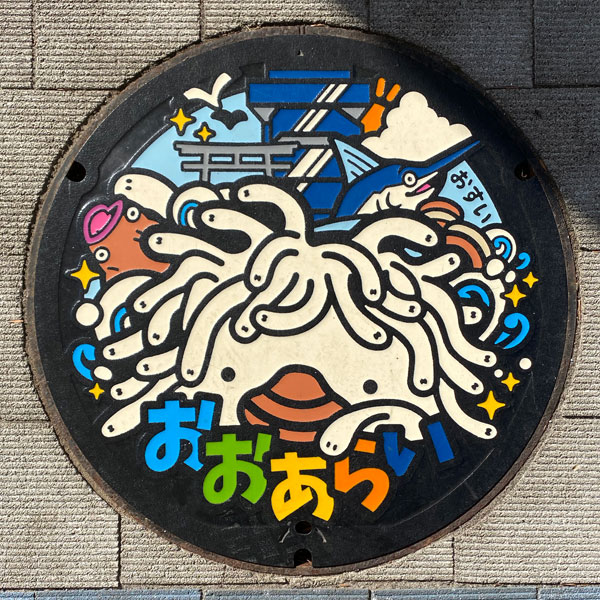
A manhole cover for sewage, featuring Oarai Town's mascot "Araippe," along with the Oarai Marine Tower, the Kamiiso Torii gate, and various marine creatures such as marlin, clams, and anglerfish. This is the manhole cover with the coordinates listed on the manhole card.
While it's unclear what "Araippe" is, its body is said to be made from Oarai Town's specialty "shirasu" (whitebait), its mouth from a "hamaguri" (clam), and its tail from a "kumade" (rake used for clam digging).
Yachiyo 八千代町
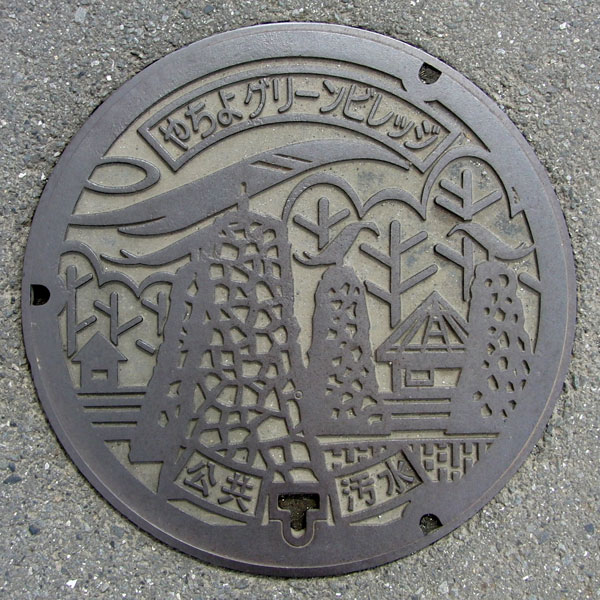
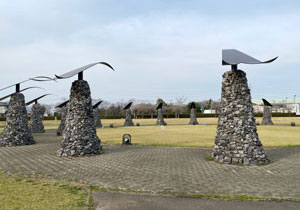
The design is based on a monument at "Yachiyo Green Village," a recreational facility located within the town. The facility includes a multi-purpose plaza, athletic facilities, a wetland botanical garden, a campsite, and the "Yachiyo no Yu" hot spring facility.
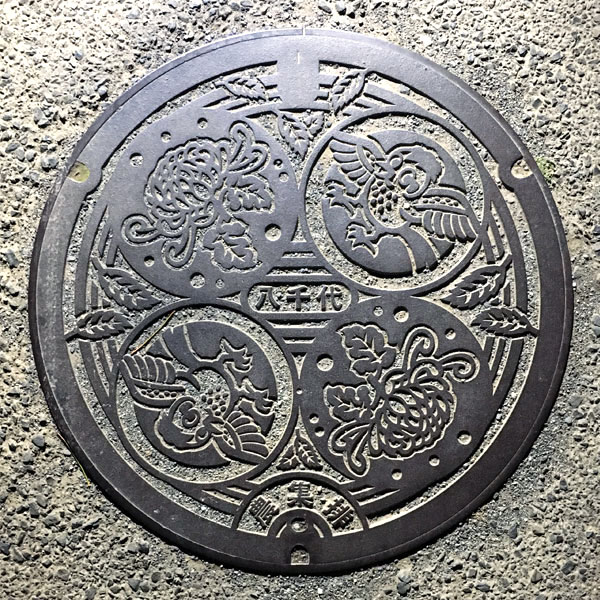
This manhole cover for agricultural community drainage in the Ota district features the characters "Yachiyo" in the center, with the town flower "chrysanthemum" and the town bird "skylark" depicted in four circles, and the leaves of the town tree "zelkova" in the gaps.
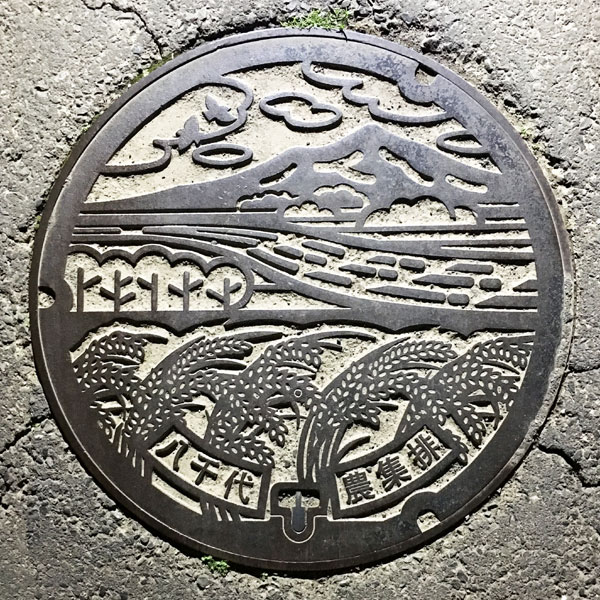
This is a manhole cover for agricultural community drainage in the central Kawanishi district. The manhole covers in the northern Kawanishi district have the same design and lettering.
The design depicts ripe rice stalks against a backdrop of Mount Tsukuba and the Kinugawa River. The bird flying in the upper left is likely the town's official bird, the skylark.
Mount Tsukuba is frequently depicted on manhole covers throughout Ibaraki Prefecture, but it's interesting how its appearance varies by region. This is Mount Tsukuba viewed from the west.
Goka 五霞町
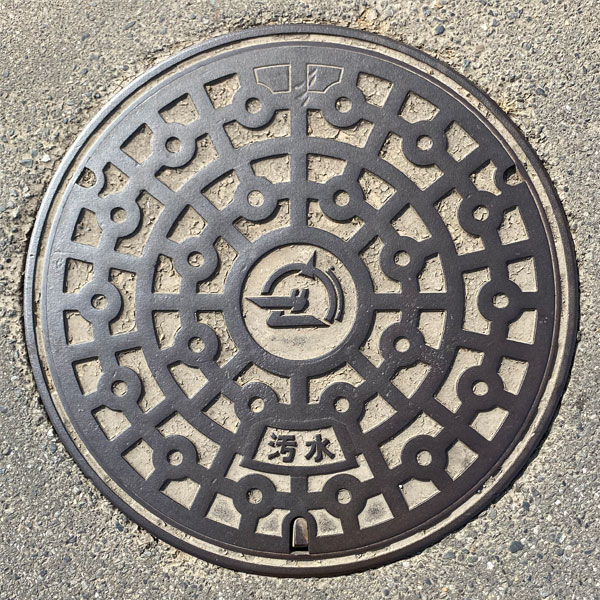
A patterned manhole cover for sewage. The town emblem is in the center.
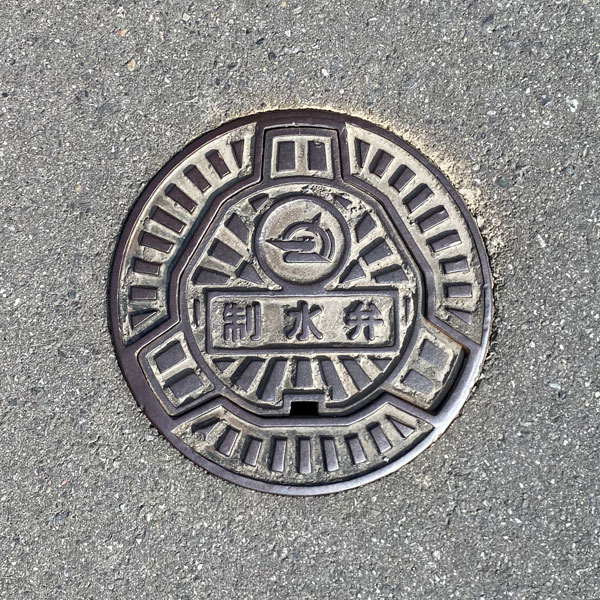
A water control valve cover bearing the town's emblem.
Sakai 境町
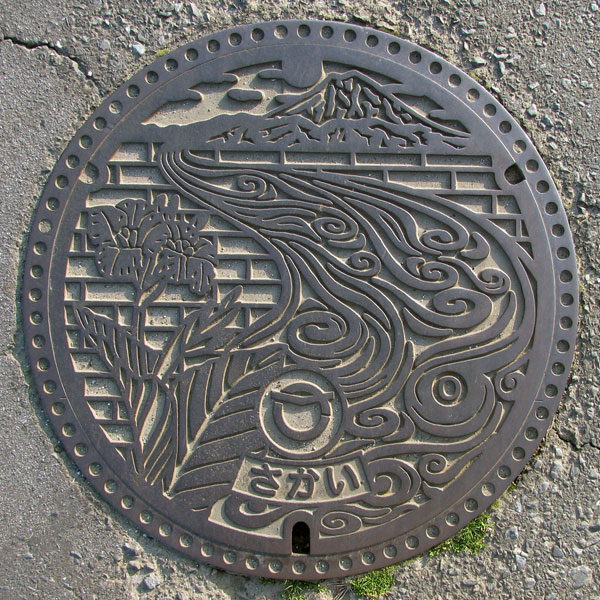
A manhole cover depicting the town flower, the canna lily, against a backdrop of the distant Mt. Tsukuba and the Tone River flowing between Sakai Town and Noda City in Chiba Prefecture. The town emblem, a stylized "sa," is in the center. Hovering your mouse pointer over the image will display a more beautiful cover that was on display inside the town hall. (Display panel in a separate window)
A smaller version with the same design as above.
Ami 阿見町
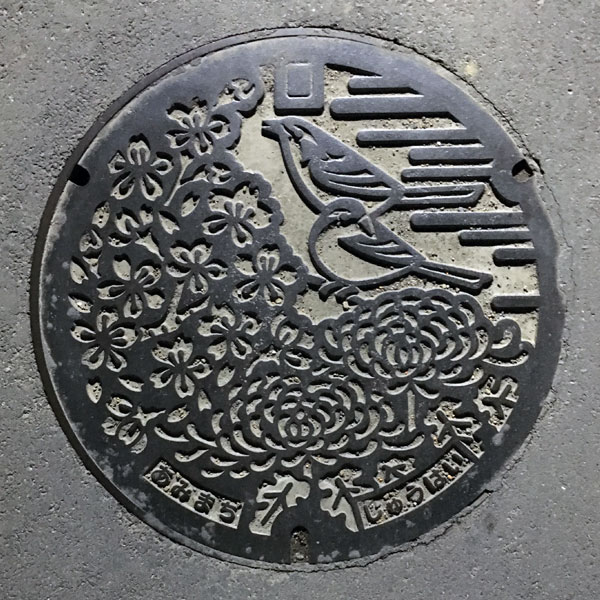
The lid of the agricultural village drainage in the Ogata district of Kimijima is painted with the town tree "sakura", town flower "chrysanthemum", and town bird "uguisu".
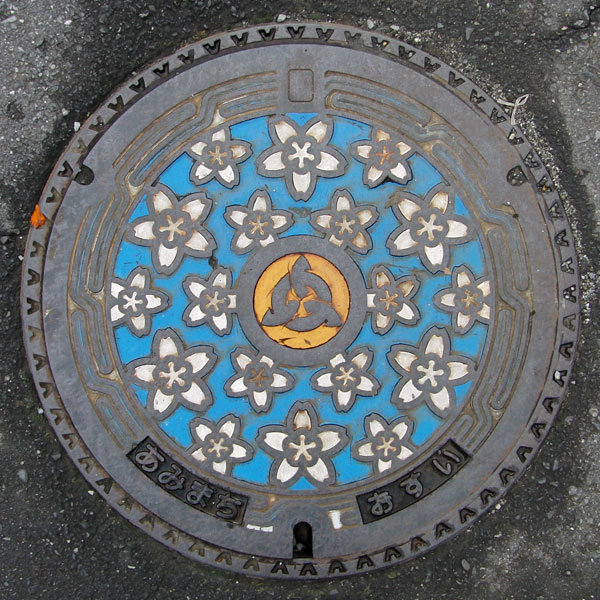
The design features the town's official tree, the cherry blossom.
Kawachi 河内町
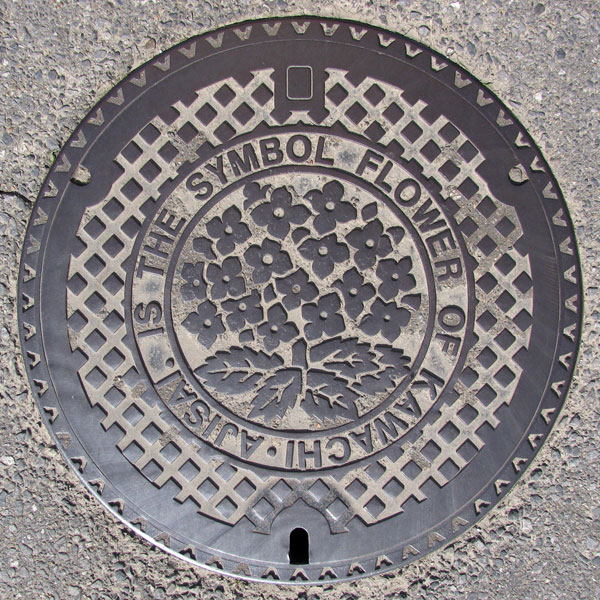
As the sign says, "AJISAI IS THE FLOWER OF KAWACHI," the design is based on the town's official flower, the hydrangea.
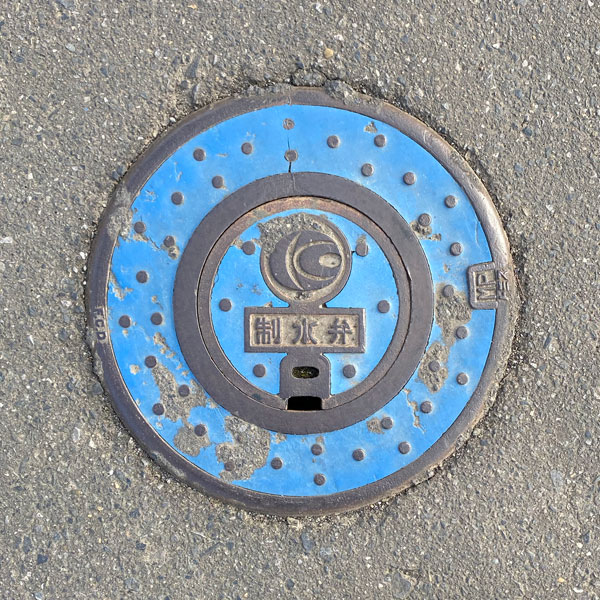
A water control valve cover bearing the town's emblem.
Tone 利根町
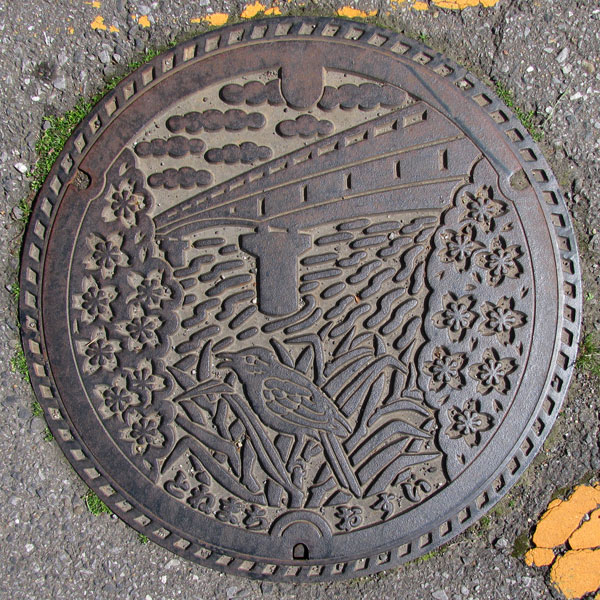
Near the town hall, the "Sakae Bridge" spanning the Tone River, the town flower "Sakura" (cherry blossom), and the town bird "Reed Warbler."
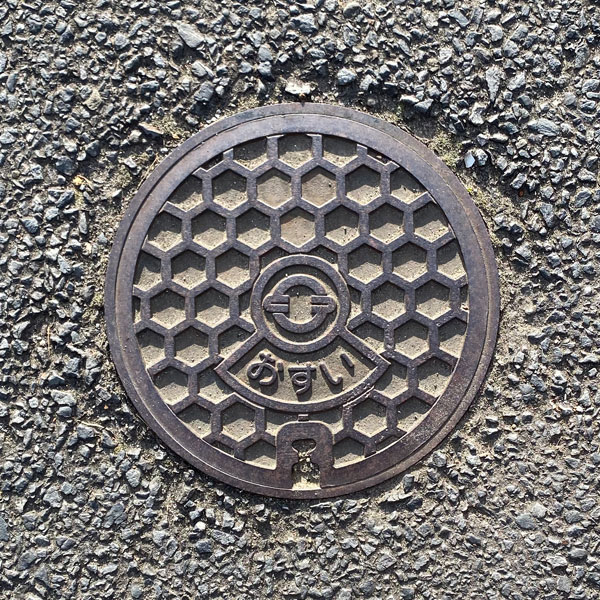
A manhole-sized sewage manhole cover with a tortoiseshell pattern. The town emblem is in the center.
Tokai 東海村
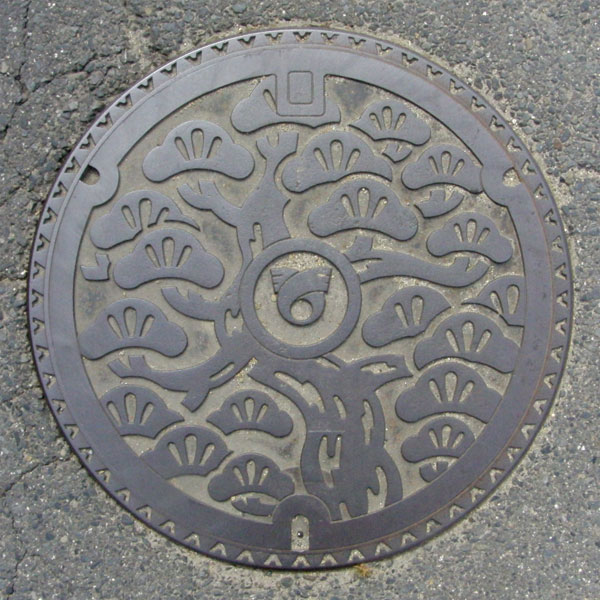
The design features the village tree, the Japanese black pine.
Miho 美浦村
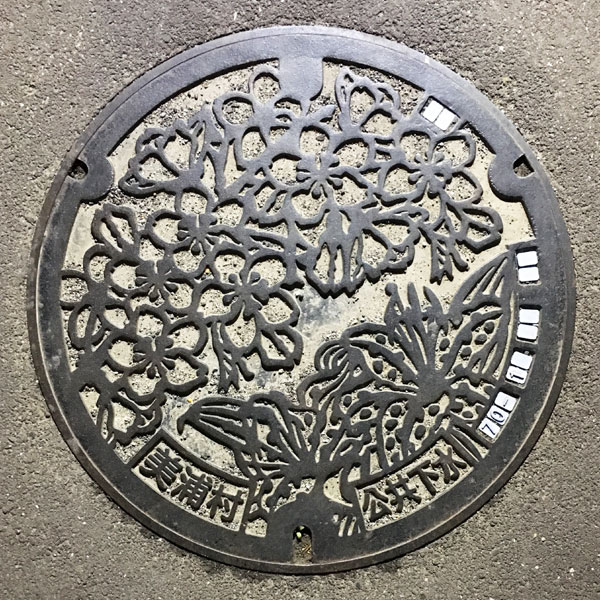
The design incorporates the village tree, the "mountain cherry blossom," and the village flower, the "mountain lily."
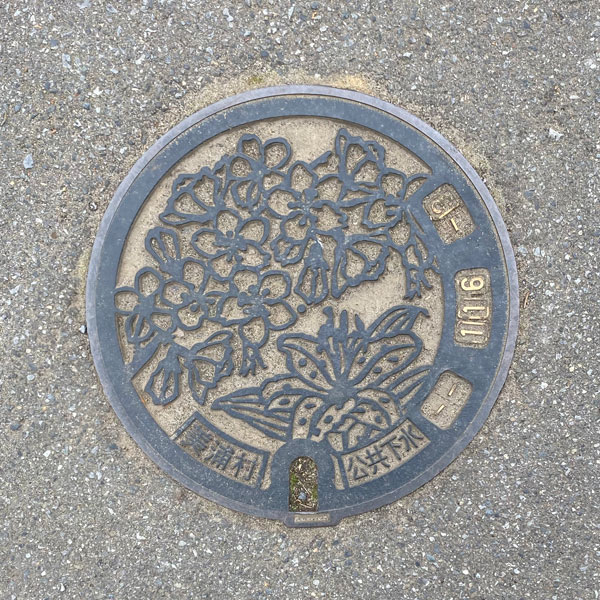
A smaller version with the same design as above.
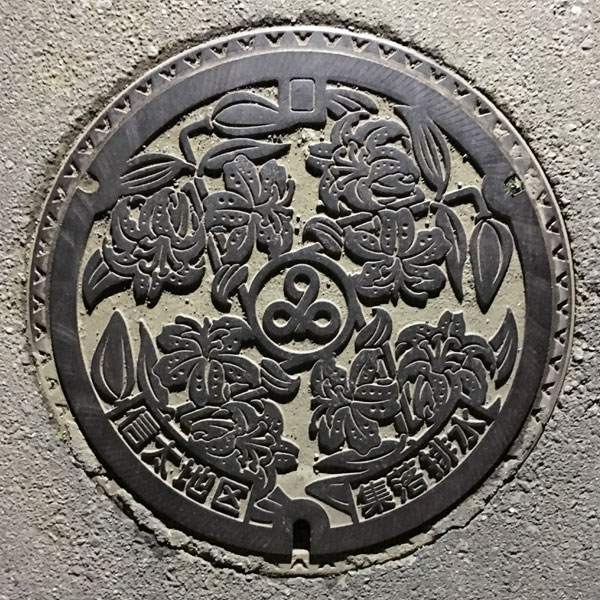
A manhole cover for agricultural wastewater in the Shinoda district, depicting the village flower, the "mountain lily." The words "Shinoda District" are written on the lower left.
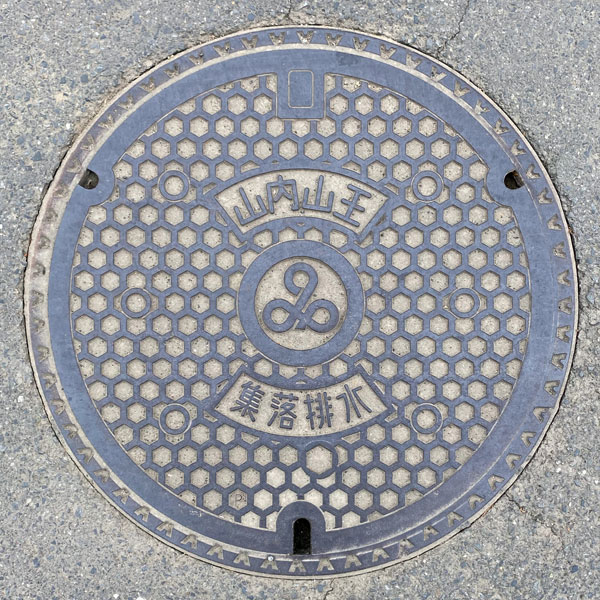
A manhole cover for agricultural drainage in the Yamauchi-Sanno district, featuring a tortoiseshell pattern. The town emblem is in the center, with the words "Yamauchi-Sanno" and "Community Drainage" above and below.
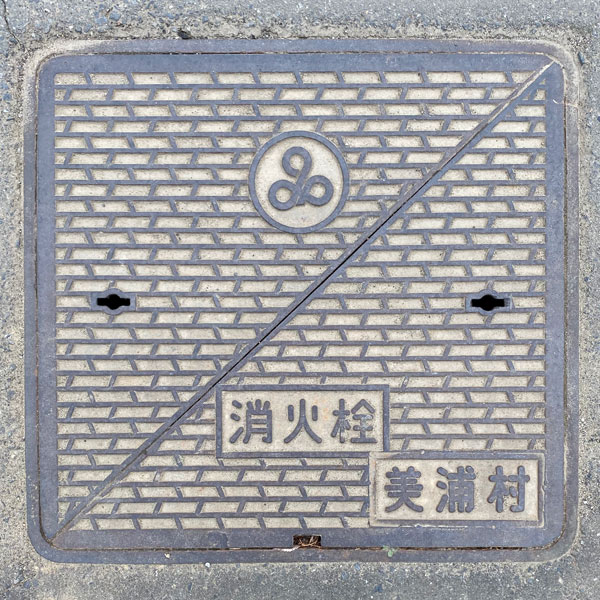
The fire hydrant cover with the village emblem.
Ibaraki Prefecture 茨城県
Hitachi-Takahagi Wide Area Sewerage Association 日立・高萩広域下水道組合
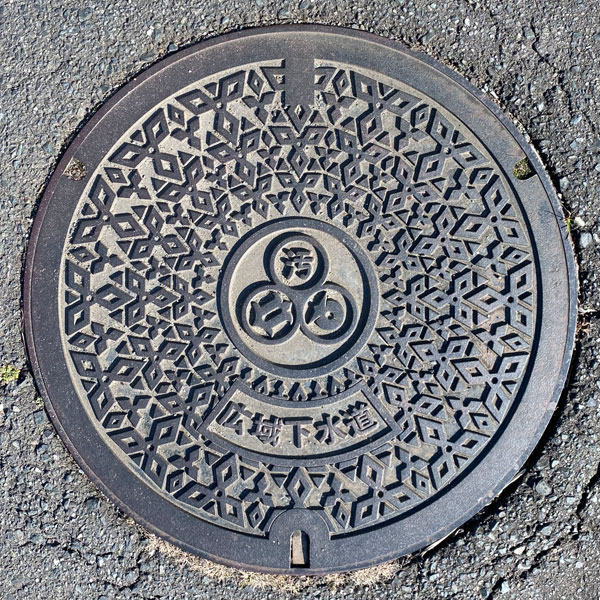
This is a manhole cover from the "Hitachi-Takahagi Wide-Area Sewerage Association," which handles the public sewerage projects in northern Hitachi City and Takahagi City.
Hitachinaka-Tokai Regional Administrative Association ひたちなか・東海広域事務組合
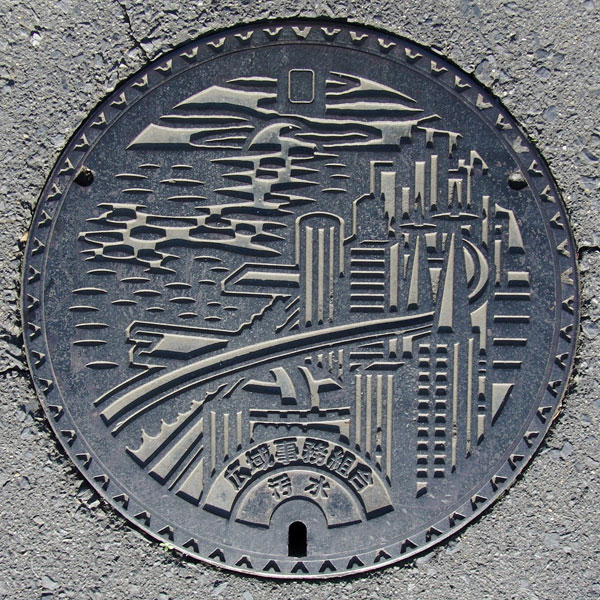
A manhole cover belonging to the Hitachinaka-Tokai Regional Administrative Association. It depicts a futuristic city.
Kinu Kogai Basin Sewerage System 鬼怒小貝流域下水道
The Kinugawa-Kogai basin sewerage system, which covers four municipalities: parts of Shimotsuma City, parts of Joso City, parts of Chikusei City, and Yachiyo Town. The system includes the Shimotsuma main line and the Chiyogawa-Ishishita main line, and the treatment plant is Kinugawa Aqua Station.
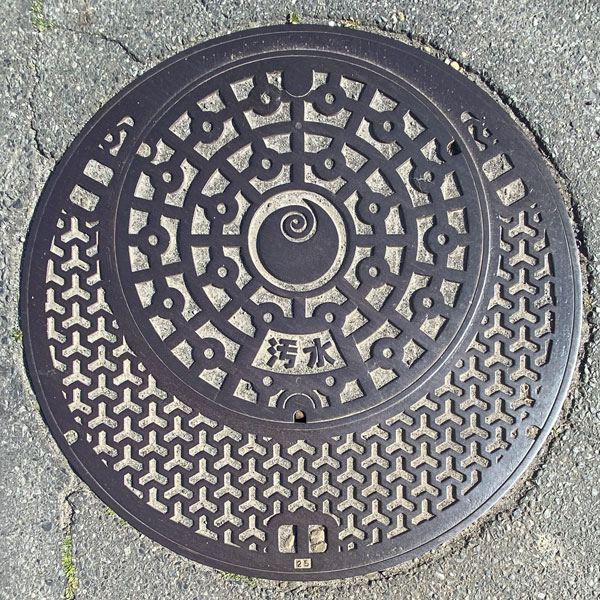
The Ibaraki Prefecture emblem is in the center.
Tanihara-Ina Sewerage Association 谷和原・伊奈下水道組合
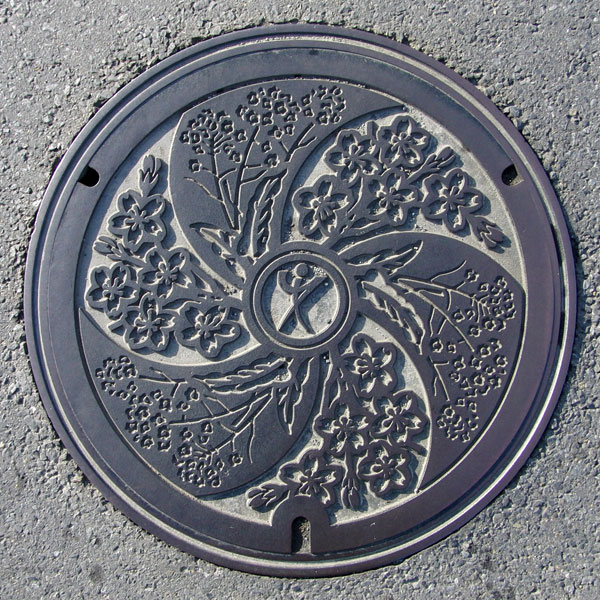
The photo shows the mark of the "Yawara-Ina Sewerage Association," a partial administrative association established in 1993 (Heisei 5). The "Sakura" (cherry blossom) was the tree of the former Yawara Village, and the "Nanohana" (rapeseed flower) was the flower of the former Ina Town.
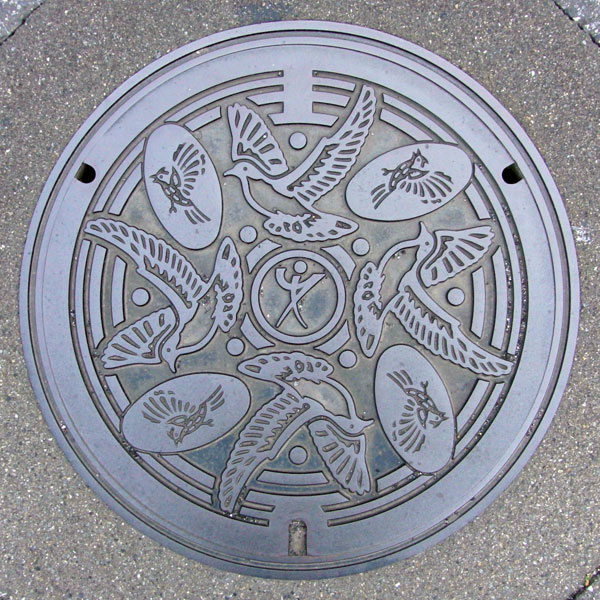
While the current city bird is the skylark, this manhole cover depicts both the skylark from the former Ina Town and the pigeon from the former Tanihara Village.
Toride Regional Sewerage Association 取手地方広域下水道組合
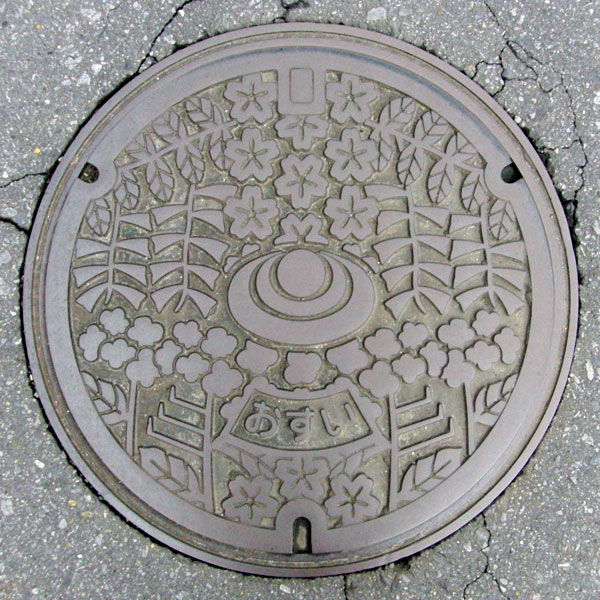
The "Toride Regional Wide-Area Sewerage Association" was established in 1981 by Toride City, Fujishiro Town, and Ina Village. However, due to the merger of Toride City and Fujishiro Town in 2005, and the merger of Ina Town (which became a town in 1985) and Yawara Village (now Tsukubamirai City) in 2006, it is now a partial administrative association of Toride City and Tsukubamirai City.
The design likely features wisteria, cherry blossoms, and rapeseed flowers, as Toride City's flower is wisteria, the former Ina Town's flower was rapeseed, and the former Yawara Village's tree was cherry blossoms. The center is the "Toride Regional Wide-Area Sewerage Association" mark. (The manhole card and sample board descriptions mention azaleas instead of cherry blossoms.)
Kasumigaura Jōnan Basin Sewerage System 霞ヶ浦常南流域下水道
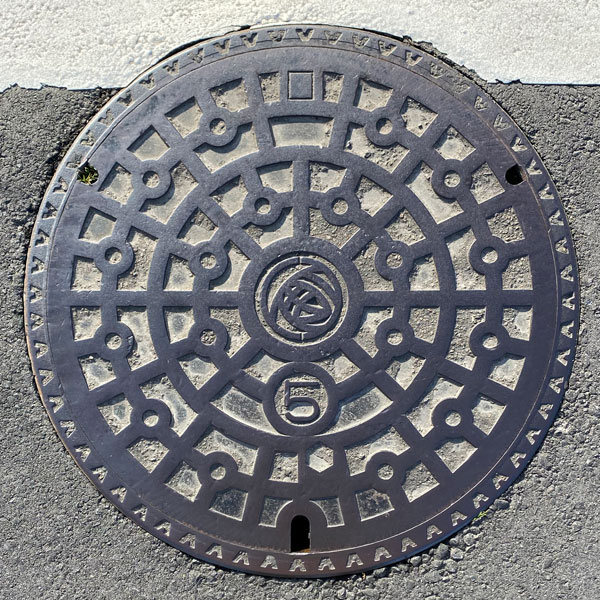
This is a manhole cover for the Kasumigaura Jōnan Basin Sewerage System, covering four cities and two towns: Tsukuba City, Ushiku City, Ryūgasaki City, Tone-machi, Kawachi-machi, and Inashiki City (formerly Shin-Tone-machi). The system includes the Research and Academic City/Tone-machi main line, the Research and Academic City West main line, the Tsukuba main line, and the Kawachi main line, with a total length of 63 km. The treatment plant is the Tone Purification Center.
In the center is the former Ibaraki Prefecture emblem (1966-1911), consisting of the katakana characters "I," "Ha," "Ra," and "Ki."