X Fukuoka 福岡県
Fukuoka 福岡県
Fukuoka 福岡市
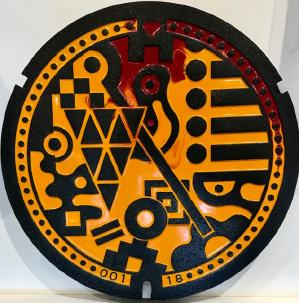
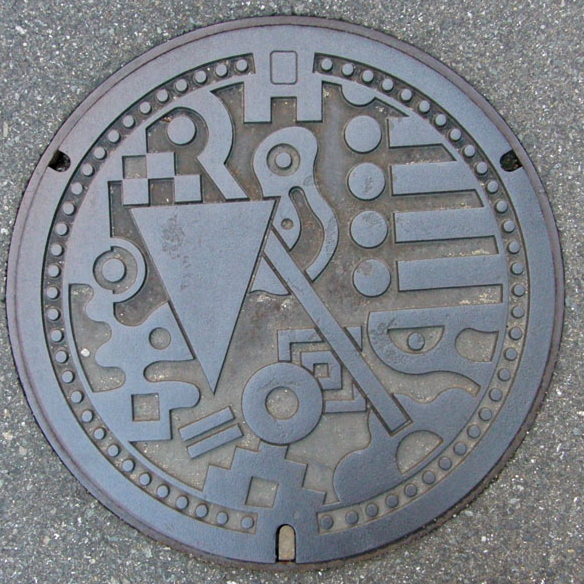
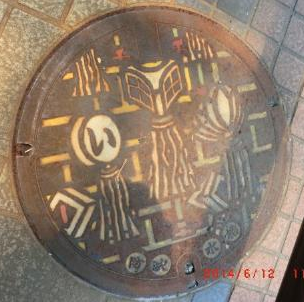
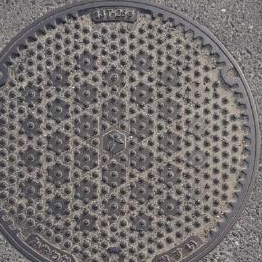
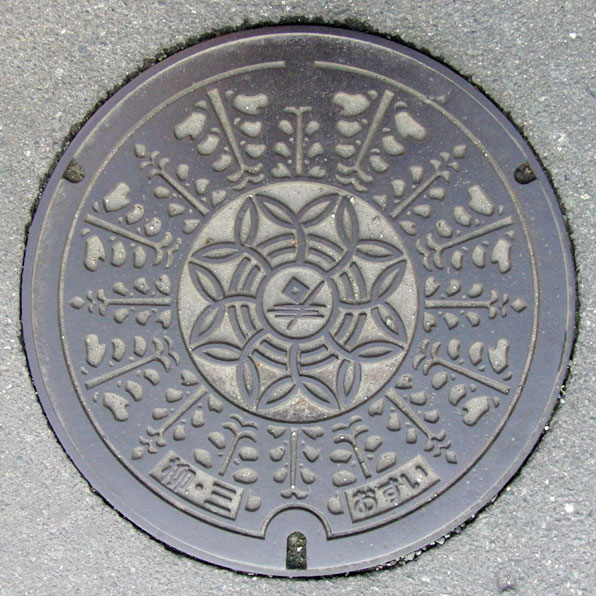
At first glance, the design is hard to recognize. According to Fukuoka City's website, "The combination of abstract designs like birds, yachts, and streetscapes evokes the active image of Fukuoka, the city of people." I see.......
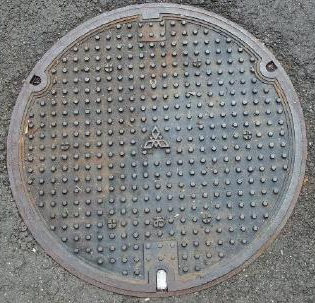
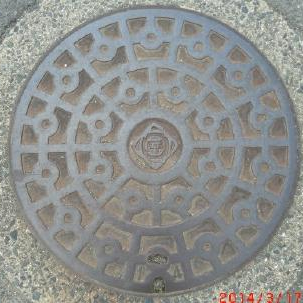
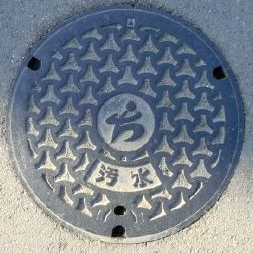
Small hexagons and circles divided into quarters are scattered, forming a non-slip pattern. The city emblem is in the center, and a small 'o' character is at the bottom.
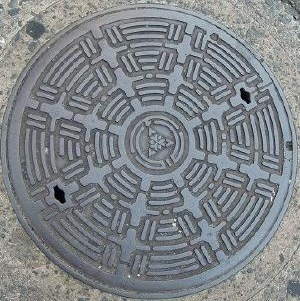
Should I say it's a more complex spiderweb pattern with the city emblem on it...
Cover illustration from 1980 to 1991
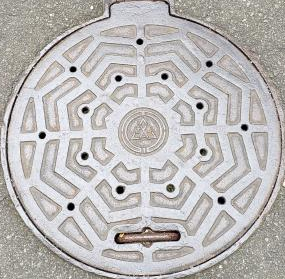
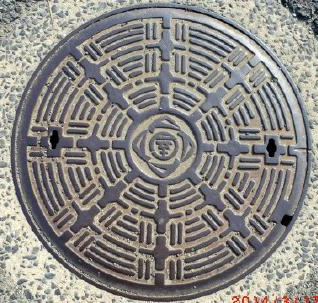
It is a ground pattern that looks like a flower, with spiderweb-patterned dividing lines connected with peaks and valleys. It has a perforated lid with an outer hinge, and the city emblem is placed in the center within the sewer structure.
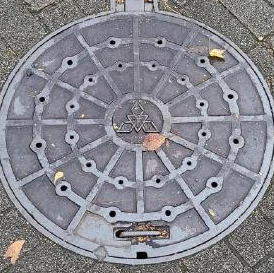
Tokyo city-type ground pattern, lid with external hinges featuring the city emblem with a sewer setting. It's a lid not often seen.
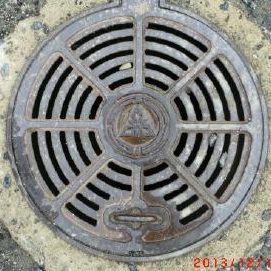
A manhole with an outer hinge, featuring the city emblem and concentric-circle-shaped drain holes. Lid designs from 1980 to 1991.
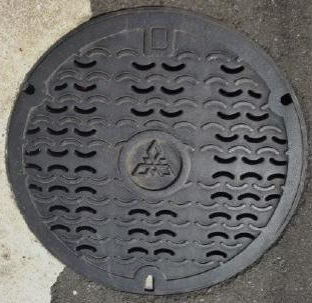
It has the city emblem, and holes are shaped like waves.
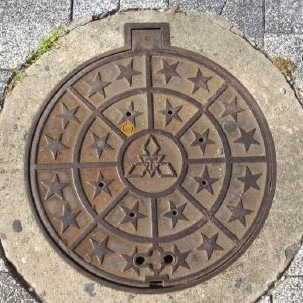
The city emblem has a 'Shimo' mark, and the lid, divided radially into eight sections, has a perforated star pattern.
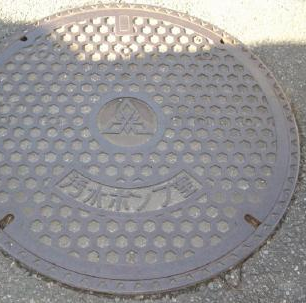
A tortoiseshell pattern with the city emblem and the words 'Sewage Pump Room'.
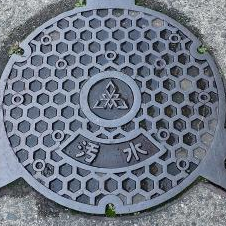
A manhole with a hexagonal pattern, the city emblem, and the characters 'Rainwater,' protruding in three places.
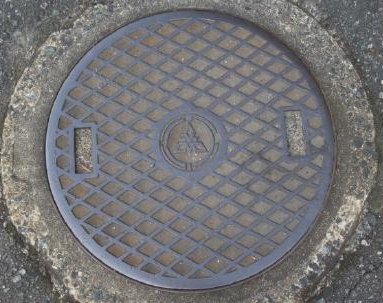
A manhole cover with the city emblem, set in a diamond-patterned base with a sewer arrangement.
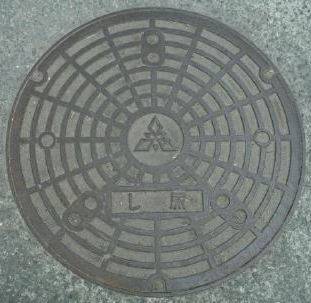
Manhole cover with a spider web pattern, city emblem, and the characters for 'sewage'.
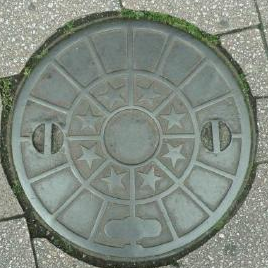
It closely resembles the star lid from Nagasaki City. There are visible scrape marks in the center, with stars around them. It is unclear what kind of lid it is.
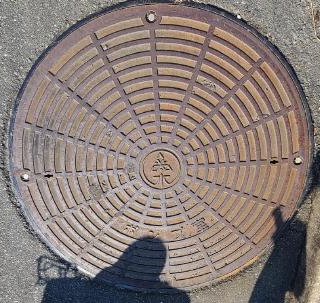
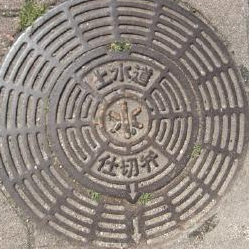
Spider web ground pattern, with the emblem of Fukuoka City Waterworks in the center, and the words 'Pump Room' below. 1.3 meters.
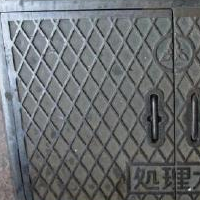
Fukuoka City emblem with the words 'treated water,' split into two panels that open outward. Approximately 50 cm in height and 70 cm in width.
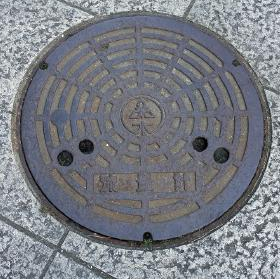
Small lid with a spiderweb pattern, with the emblem of the Fukuoka City Waterworks in the center, and the words 'Flow Meter' below it.
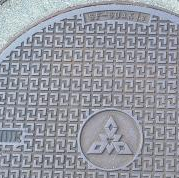
A 90-degree rotation pattern of "", the Fukuoka City emblem in the center, 'Signal' below it, 'SF-60AKI8' at the top, and '◇SF FUKUNISHI' at the bottom.
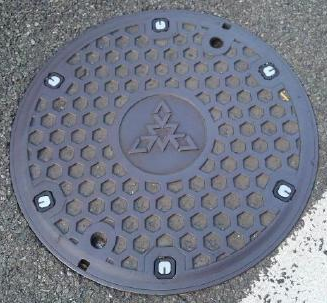
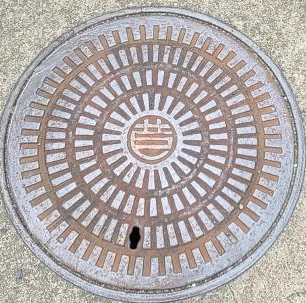
A manhole cover with a tortoiseshell pattern and only a large city emblem in the center. It is secured with metal in six places.
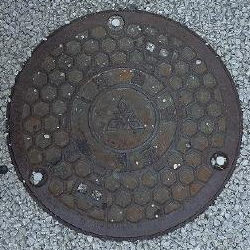
Hexagonal pattern, with the Fukuoka City emblem in the center, and the words 'Pipeline' and 'Electricity' around it.
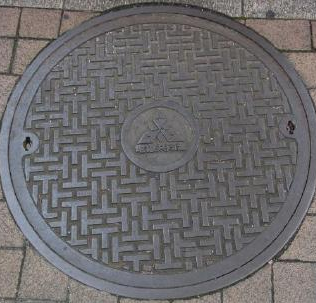
Fukuoka City emblem mark and the characters 'Electric Wire Joint Trench.' T-shaped design, approximately 70 cm in diameter.
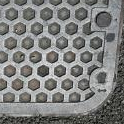
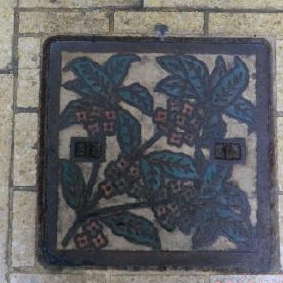
Fukuoka City emblem included, with the characters '通信 N' and a thick tortoiseshell pattern.
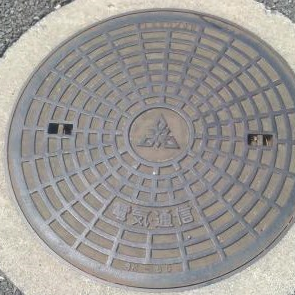
Manhole cover with a spiderweb pattern, the city emblem in the center, and the characters 'Telecommunications' at the bottom.
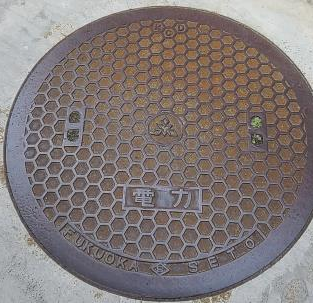
Hexagonal pattern background, city emblem in the center, "Electric Power" below it, at the bottom "FUKUOKA ◇ with S company emblem SETO", and at the top the letters "KCD". Electricity is often seen, but electric power is rare.
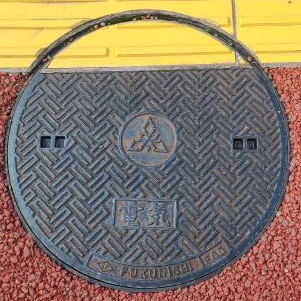
U-shaped ground pattern, city emblem in the center, 'Electricity' below it, '◇SF FUKUNISH FCD' at the bottom, horizontal hooks on the left and right of the center.
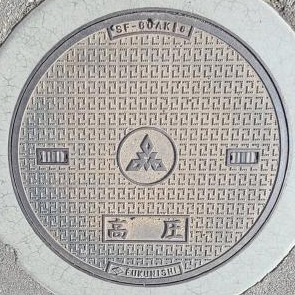
L-shaped combination ground pattern. Anti-slip treatment on the pattern. City emblem in the center, 'High Voltage' below it, '◇SF FUKUNISH' at the bottom, 'SF-60AK 8' at the top, with horizontal hooks on both sides of the center.
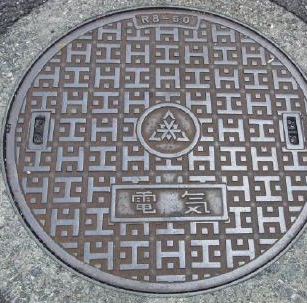
The Fukuoka City emblem has the character for 'electricity.' Diameter is about 60 cm.
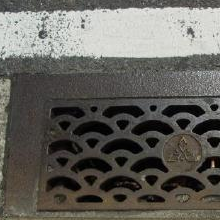
In the center is the emblem of Fukuoka City. There are two hinges on a wave-like mesh design. Approximately 25 cm in height, 60 cm in width, a gutter cover.
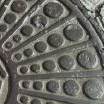
It is an unknown mark. The background pattern of overlapping circles is common on power company covers, but this is said not to be a Kyushu Electric Power cover. Could it be a cover related to the Western Army of the Imperial Japanese Army?
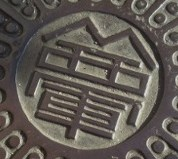
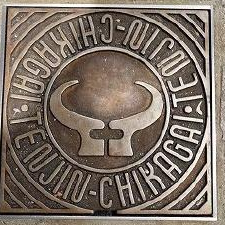
Around the Tenjin Underground Shopping Mall logo mark are the letters 'TENJIN-CHIKAGAI.' Apparently, logo marks featuring a cow are very rare, but because of the deep connection between Sugawara no Michizane (Tenjin-sama), who is the origin of Tenjin, and his 'messenger ox,' a design featuring 'cow horns' was adopted. Moreover, the cow motif is not a Japanese Wagyu but a 'European bison,' which suits the calm atmosphere of the Tenjin Underground Shopping Mall, designed with the image of 19th-century Europe. The design was created by Rei Kurokawa, the sister of architect Kisho Kurokawa, who is also known for designing the Fukuoka Bank headquarters.
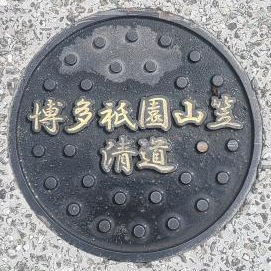
Although it is not a manhole cover, a metal cover indicating the Yamakasa route has been installed. The Yamakasa route refers to the circular path that the Yamakasa festival floats take when offered as a dedication. Inside the route, Yamakasa flags are erected, and the floats move around them. The covers are installed in three locations: within the grounds of Kushida Shrine, in front of Tōchō-ji Temple, and in front of Jōten-ji Temple. It is said that each temple and shrine has its own significance, such as Jōten-ji Temple, where its founder, Shōichi Kokushi, spread sweet water around to pray for the dispersal of epidemics, which is said to be the origin of the Yamakasa festival.
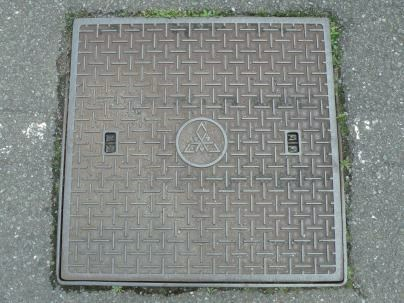
Diagonal lattice pattern, city emblem in the center, opening/closing hooks on both sides, square lid with the letters 'SEIBU KIZAI' at the bottom. Manhole size.
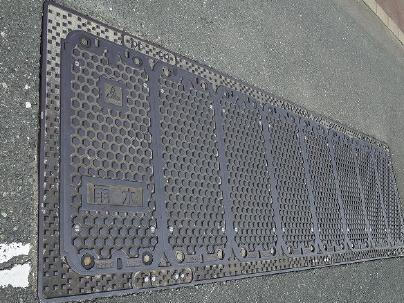
It is an octuple set of 8 pieces, with 4 pieces above and below, of square lids with a tortoiseshell pattern, and only one piece has the city emblem and the characters for 'rainwater'.
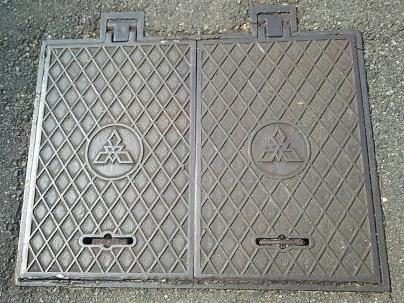
It is a two-unit connected box with the city emblem, an outer hinge, and a square lid. It has a diamond-patterned background.
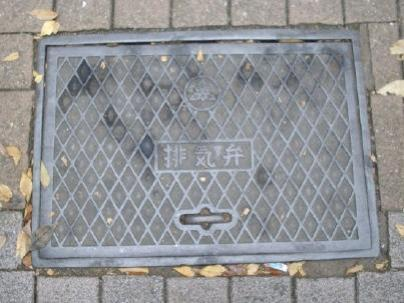
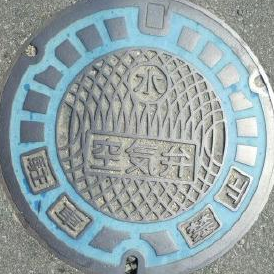
Square-shaped cover with a diamond pattern, featuring the city emblem and the characters 'exhaust valve'.
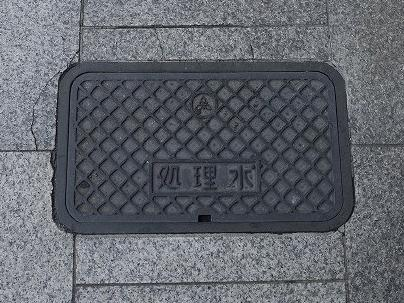
Square-shaped lid with a diagonal lattice pattern, the city emblem, and the characters 'Treated Water'.
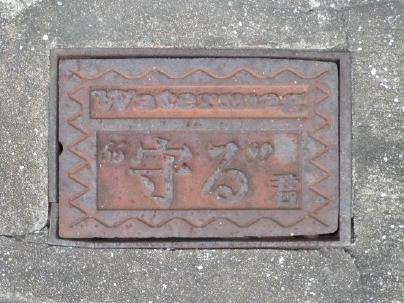
This is a square-shaped lid with the words 'watermag' and '”Protect You”' on it.
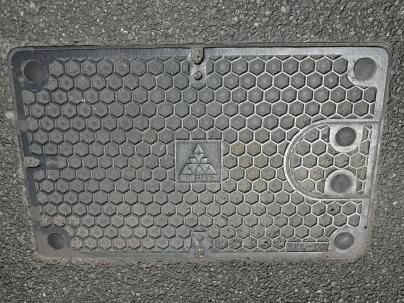
Fukuoka City emblem included, the words 'Joint Utility Duct' with 'KKC-07' at the bottom right, fine hexagonal pattern, rectangular size.

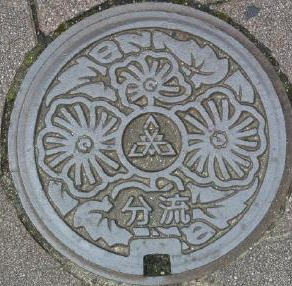
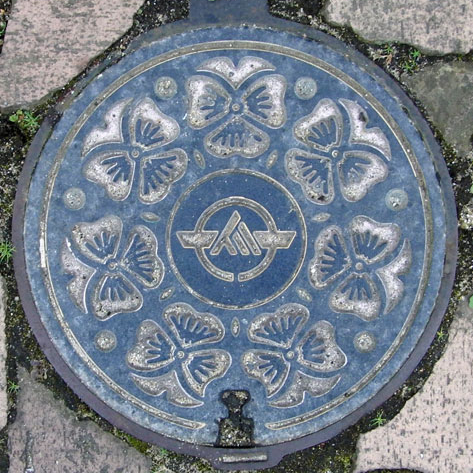
The mark is the emblem of Fukuoka City (combining nine 'Fu' characters). The design arranges the city flower 'Hibiscus mutabilis' around it.
The following information is from the Road and Sewerage Bureau.
From fiscal year 1991, it was only used on manhole covers for small-diameter sewage pits, but starting from fiscal year 2006, it has been unified with the new design of covers that we recently announced. Although the covers with this 'Hibiscus' design are also being gradually replaced with the new design, many of them still remain throughout the city.
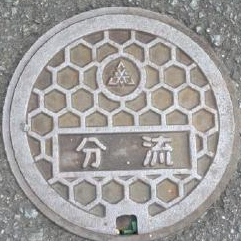
Small lid with a tortoiseshell pattern, featuring the city emblem and the characters 'Bunryū'.
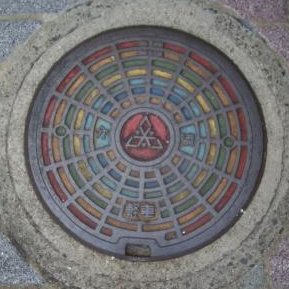
Rainbow-colored with a spider web pattern. A small manhole cover with the words 'Branching' on the left and 'Light Vehicle' at the bottom, flanking the city emblem in the center.
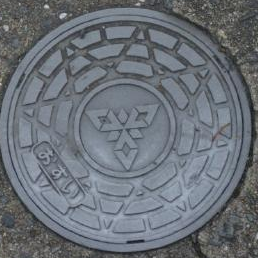
Made of plastic with a generic sun-like patterned lid, featuring the city emblem and the characters 'おすい'.
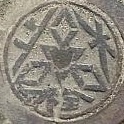
It has the city emblem surrounded with the words 'Stopcock.' Diameter is 10 centimeters. It seems like an antique cover.
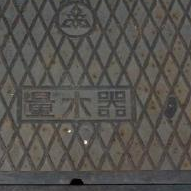
Diamond-shaped ground pattern, the Fukuoka City emblem with the characters 'Water Meter'. Approximately 30 cm tall, 40 cm wide.
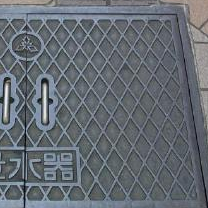
The Fukuoka City emblem has the characters 'Water Meter' on it, split into two panels that open outward. Approximately 50 cm in height and 70 cm in width.
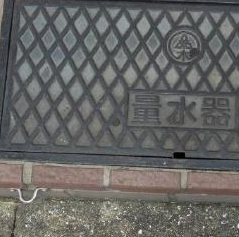
The emblem of the Fukuoka City Waterworks and the characters 'Water Meter.' Rectangular in landscape orientation, with a mesh pattern, approximately 25 cm in height and 40 cm in width.
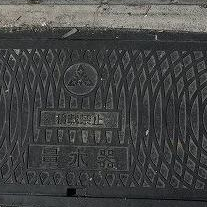
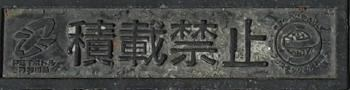
A lid with semicircular patterns on the left and right, featuring the city emblem and the words 'Water Meter.' To the left of 'Do Not Stack,' there are the words and mark for 'Reused PET Bottle,' and to the right of 'Do Not Stack,' the words 'Earth-Friendly' and 'Plastic Recycling.'
Water meter lid (reused PET bottle)
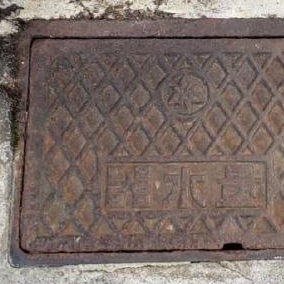
A square-shaped lid with a diamond pattern, featuring the city emblem and the characters 'Water Meter' on the right side.
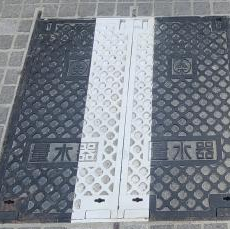
It is a new type of lid. It is a three-link polygon lid with a base pattern combining an octagon and a small circle, with the emblem of the Fukuoka City Waterworks on the top of each lid and the characters 'Water Meter' on the bottom.
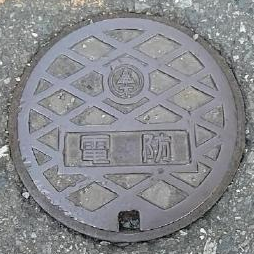
A small cover with the emblem of the Fukuoka City Waterworks and a diamond mesh pattern with the characters 'Denbo'.
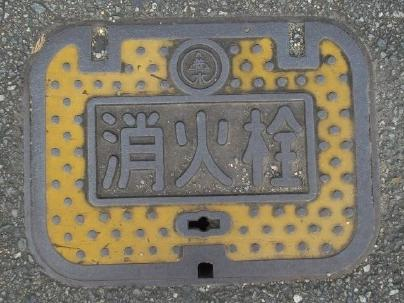
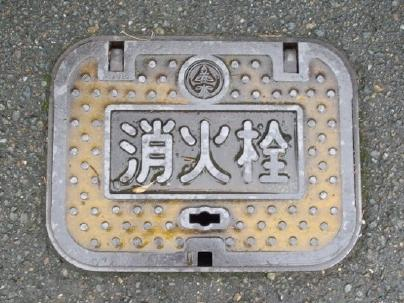
Yellow background with polka dot pattern, the emblem of Fukuoka City Waterworks at the top, and the words 'Fire Hydrant' in large letters in the center.
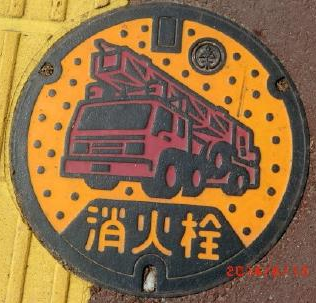
This one is also a different character for '消' and a type without a keyhole at the bottom.
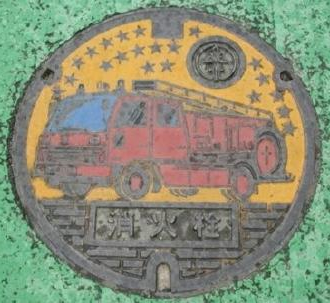
It is a design featuring a ladder truck and the above mark, but in this case, the background is yellow with scattered stars, and the text part at the bottom that says 'fire hydrant' has a dashed pattern.
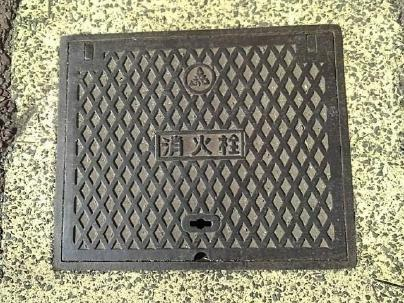
Diamond-shaped ground pattern, city emblem, and the characters 'Fire Hydrant'.
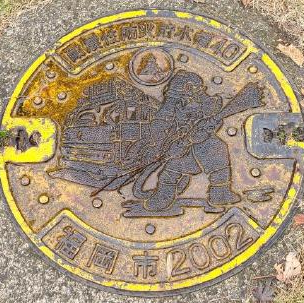
It is a design depicting a fire truck and a firefighter spraying water with a slip-resistant texture. The city emblem and 'Seismic-Resistant Firefighting Water Tank 40' are above, and the text 'Fukuoka City 2002' is below.
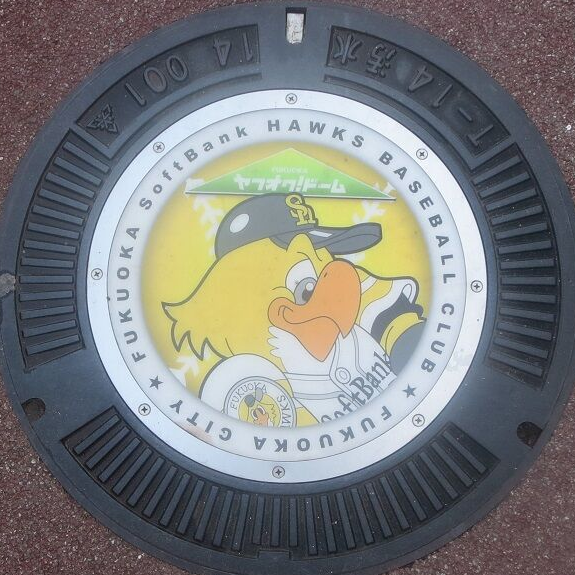
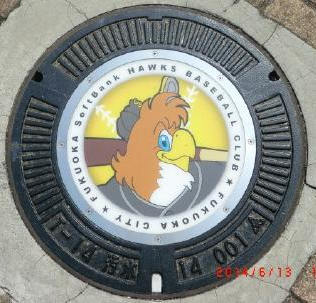
Professional baseball team SoftBank Hawks 'Hawk Family' design, 10 out of 16 illustrations (however, duplicates of the same illustration will not be sent). Installed on March 27, 2014, as a joint project between Fukuoka SoftBank Hawks and Fukuoka City. The design includes Harry and guiding arrows to the Yahoo! Auctions Dome.
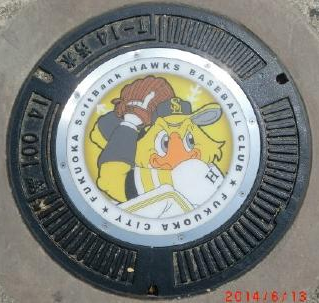
A design where Harry is about to throw a ball.
This is Hercules holding a bat.
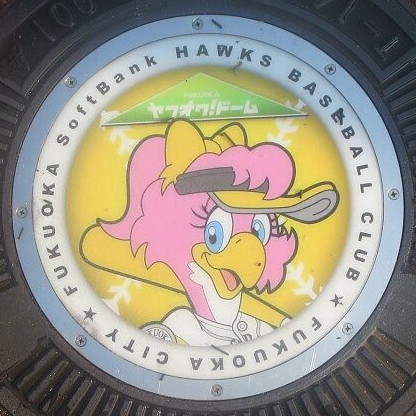
It also includes Honey holding a bat and an arrow pointing to the Yahoo Auctions Dome.
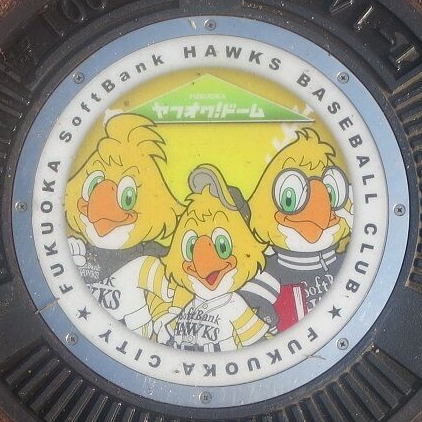
These are Harry's three nephews, Rick, Hock, and Huck. There is also an arrow pointing to the Yahoo! Dome.
With the same design, there are lids with different words: 'Shikiri Valve,' 'Air Valve,' 'Valve Chamber,' 'Drain Valve,' 'Water Supply Valve,' 'Soft Valve,' 'Regulating Valve,' 'Valve Cover,' 'Butterfly Valve,' 'Water Control Valve,' 'Valve Lid,' 'Pressure Reducing Valve,' 'Stop Valve,' and 'Valve.'
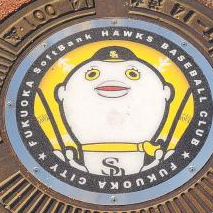
This is the color design of Hawks' mysterious character 'Fuu-san.' It seems that the character is a fairy? larva? of the victory white star jet balloon that is blown away when the team wins after a match.
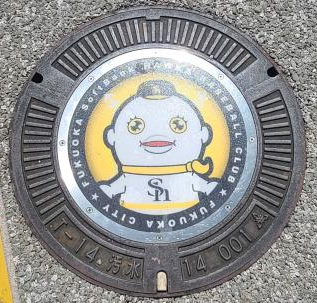
This is a new character, 'Kofuu-san.' There is a rumor that when the Hawks became the best in Japan in 2017, the tears that Fuu-san shed fell onto the white star balloons (Fuu-san version) and caused its birth.
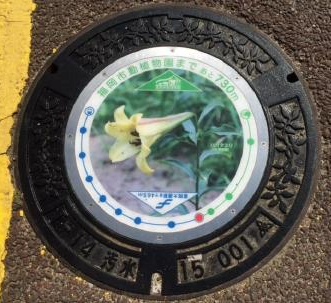
The following 11 plates are manhole covers that were installed in March 2015. Above the photos of the orangutan and chimpanzee, there is a green triangle (animal design) indicating the distance of 1,180 meters to Fukuoka City Zoological and Botanical Garden and the direction to it. Small blue circles with trains drawn around them represent subway stations, and green circles with elephants represent the zoological and botanical garden. These are connected by lines, and a red circle represents the current location of the cover, starting with the first plate. Around the outer edge, there is a leaf pattern and the inscriptions 'T-14 Sewage' and '15 001 Fukuoka City Emblem'.
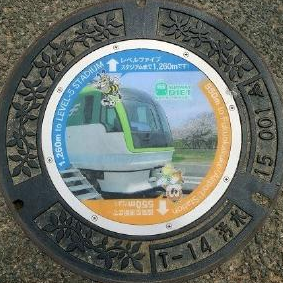
"1,260 m to Level Five Stadium" "550 m to Fukuoka Airport Station"
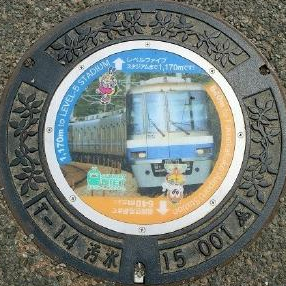
"1,170 m to Level Five Stadium" "640 m to Fukuoka Airport Station"
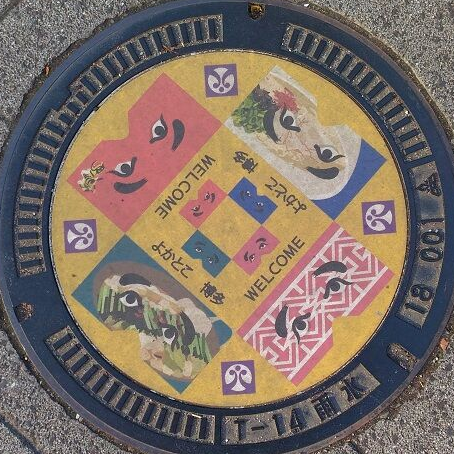
This is a printed seal manhole cover by Hinode Waterworks Equipment, test-installed in front of Hakata Station on the 15th. It features designs of Hakata specialties in the shape of a Hakata nakanaka face, including tonkotsu ramen, motsunabe, and Hakata ori. The text "WELCOME" and "Yokato Hakata" are included, and on the lower part of the iron cover, it reads "T-14 Rainwater" and "17 001 City Emblem."
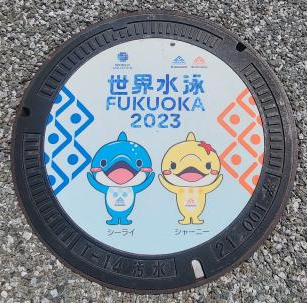
Manhole covers for the World Swimming Championships. A total of 8 covers installed. Printed sticker design featuring the mascot characters Sealy and Sharnie (dolphin motifs) of 'FINA World Swimming FUKUOKA 2022,' holding hands happily. 'T-14,' 'sewage,' '21 001 city emblem.'
*World Swimming Championships 2023 Fukuoka Tournament: July 14 (Fri) to July 30 (Sun), 2023, 17 days
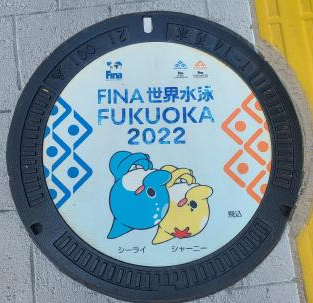
It is a design of the mascot characters Sealy and Sharnie 'diving'.
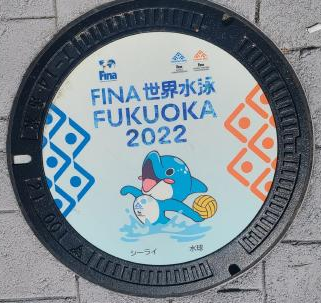
Seirai is playing water polo.
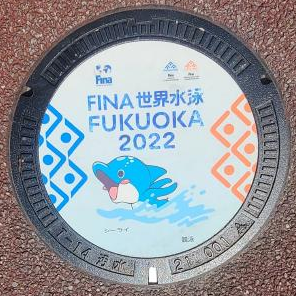
Seirai is doing competitive swimming.
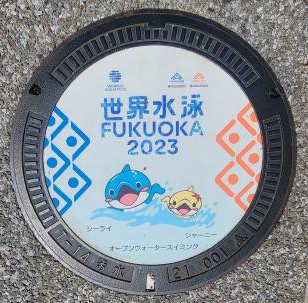
Seerai and Shānii are doing 'open water swimming'.
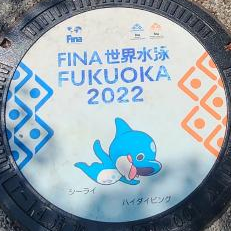
Sealy is doing 'high diving'.
Related: Kitakyushu 北九州市, Fukuoka District Water Supply Corporation 福岡地区水道企業団
Asakura 朝倉市
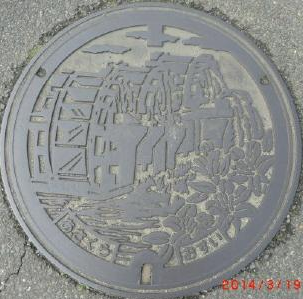
The design of three waterwheels pumping water up to a rice field with an elevation difference. The labels read 'Asakura' and 'Osui'.

It is an ASD with the city emblem, and it says 'Regarding the handling of performance protection materials.' Since it was on a main road, I took the photo by slipping through the gaps.
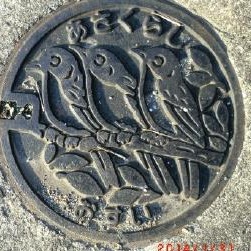
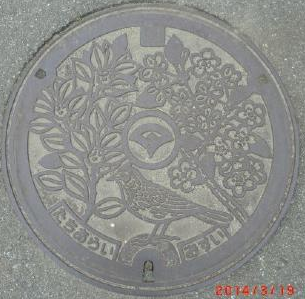
The design of the bird Mejiro, the city bird of Amagi City before the merger (from the Asakura City Urban Construction Department Sewerage Division), includes the characters 'Asakurashi' and 'Osui'.
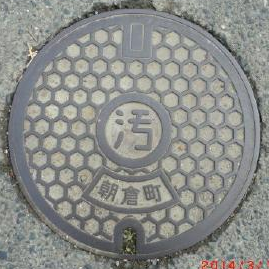
A small lid with a tortoiseshell pattern marked with '汚' and 'Asakuramachi'.
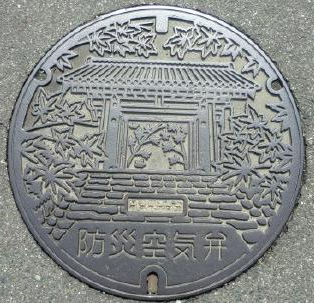
A disaster prevention air valve cover with a design of Akizuki Castle gate and maple leaves.
Former Amagi 旧甘木市
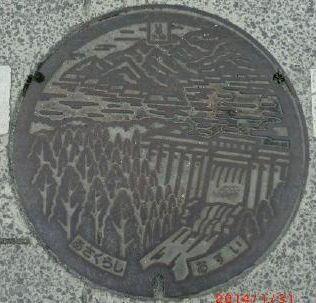
Design of 'Abundant Nature and Dams.' The characters 'Asakurashi' and 'Osui.'
Asakura City has the Egawa Dam and Terauchi Dam, which serve as water sources for the Fukuoka metropolitan area. (From Asakura City Urban Construction Department, Sewerage Division)
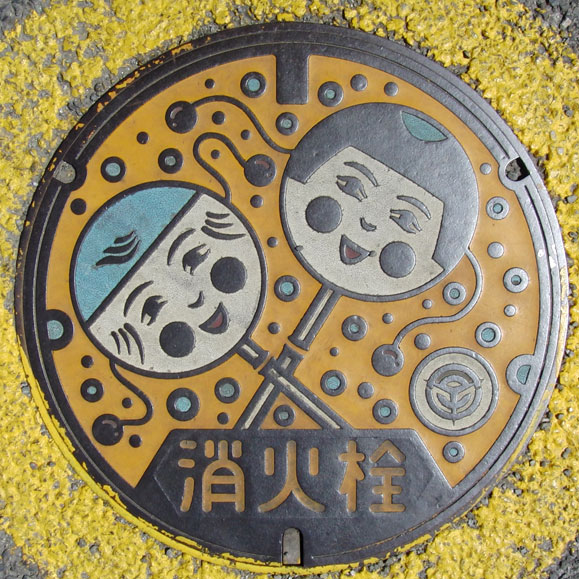
It seems that there is a 'Batabata Market' at Anchouji Temple, and the origin of 'Batabata' is said to be this bean drum used to ward off smallpox.
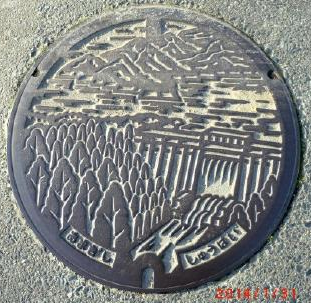
Design of 'rich nature and dams.' The characters 'Amagishi' and 'Shuhai.'
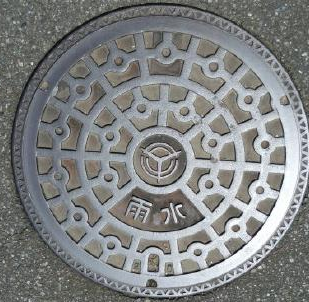
A standard lid with the city emblem and the characters for 'rainwater'.
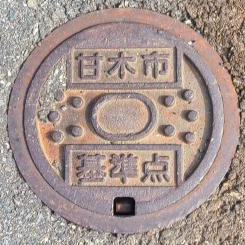
Polka dot pattern, with the words 'Amagi City' above and 'Reference Point' below.
Related: Fukuoka Prefecture Southern Waterworks Corporation 福岡県南広域水道企業団
Iizuka 飯塚市
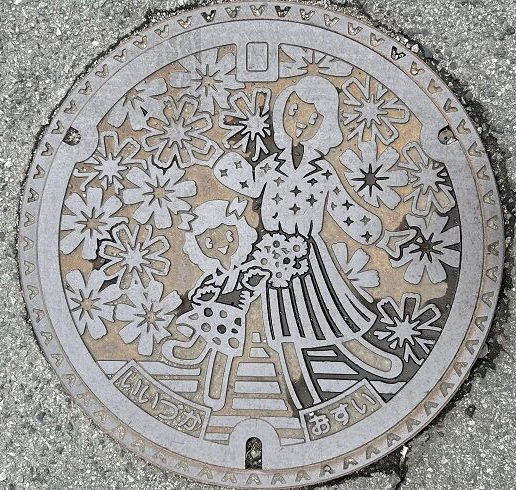
It seems that even the city hall staff are not very familiar with it. There were only two pieces. A girl holding a bouquet and her mother? Or perhaps her older sister? They are depicted against a backdrop of cosmos flowers. At the bottom are the characters 'Iizuka' and 'Osui'.
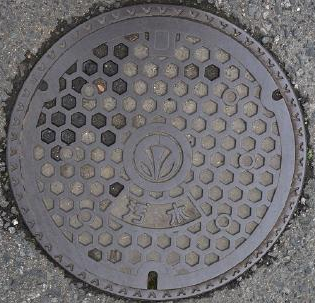
A tortoiseshell pattern with the city emblem and the characters for 'sewage'.
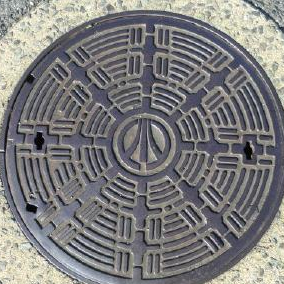
A concentric geometric pattern with the city emblem.
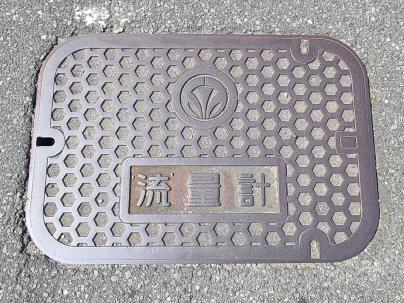
Hexagonal lid with a tortoiseshell pattern, city emblem on top, and the words 'Flow Meter' below.
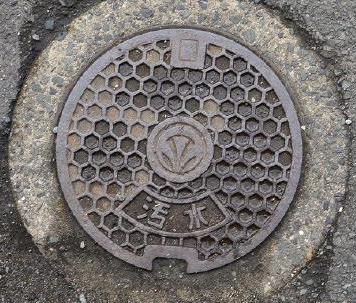
Small cover with a tortoiseshell pattern, featuring the city emblem and the characters for 'sewage'.
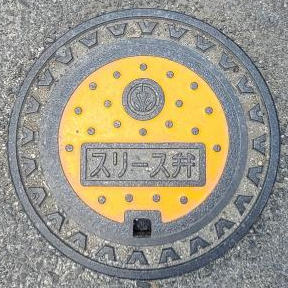
The city emblem and the characters 'Shikiriben' on a tortoiseshell pattern.
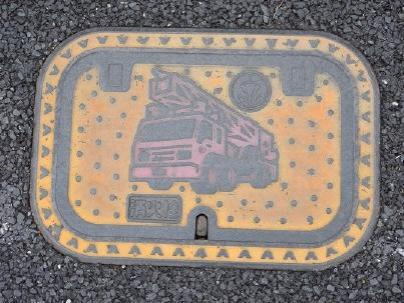
Yellow background with polka dots, a ladder truck and the city emblem, the word 'fire hydrant.' The frame has a yellow background with a V-shaped pattern.
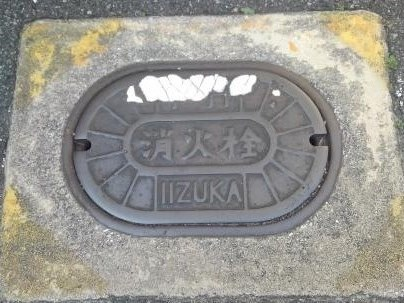
An oval fire hydrant cover with the words 'Fire Hydrant' and 'IIDUKA.' It seems to have existed since before the war.

There is no city emblem or anything like that. Are the flowers around the ladder truck rhododendrons, the flower of the former Chikuho Town? The upper part has the words 'Fire Hydrant' and 'Water Supply,' and the lower part also features a design of flowing water.
Former Iizuka 旧飯塚市
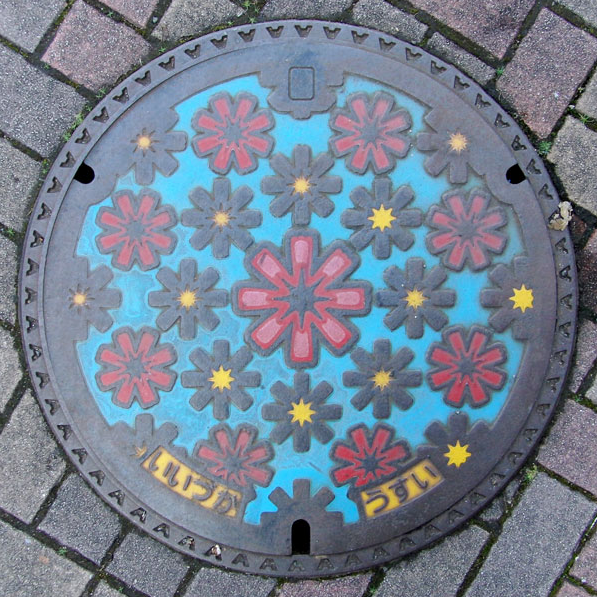
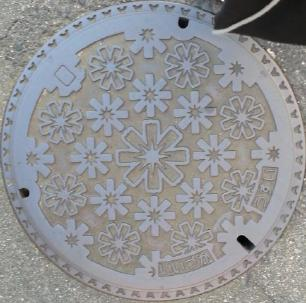
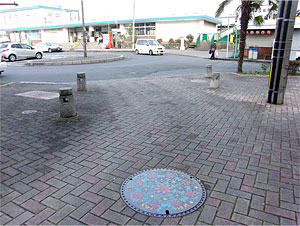
The city's flower, 'cosmos,' is depicted.
Former Chikuho 旧筑穂町
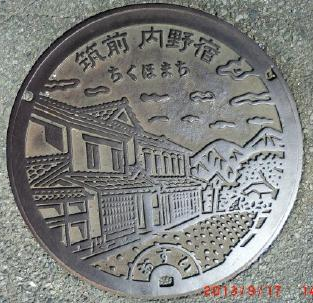
The design of the streetscape of Uchino-juku in Chikuzen. The characters 'Chikuho' and 'Osui'.
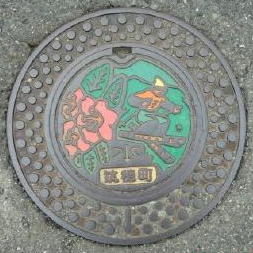
Town flower rhododendron and artificial turf ski color illustration water supply shut-off valve small cover
Itoshima 糸島市
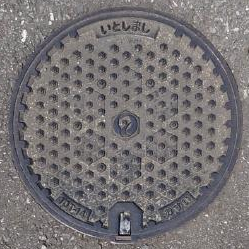
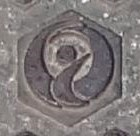
In the center of the Hinode waterway equipment ASD (Anti-Slipping Design) type ground pattern, there is a small emblem of the merged city of Itoshima. On the upper edge, it says 'Itoshima-shi,' on the lower right edge, it says 'Osui,' and on the left edge, it has the model number '11 T-14'.
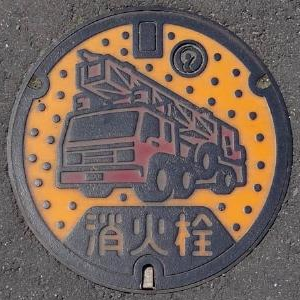
This is a fire hydrant cover often seen with fire trucks, with the words '消火栓' in rounded Gothic characters in the large lower letter frame, and the emblem of Itoshima City in the upper right corner.
Former Maebaru 旧前原市

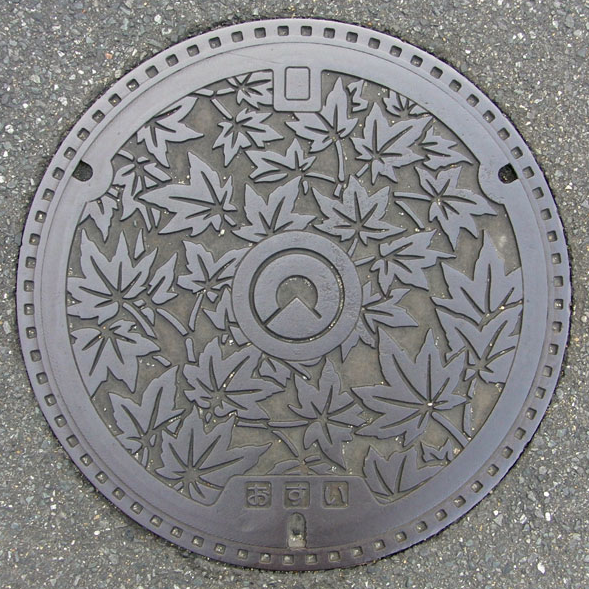
A sewage manhole cover depicting the city's tree, the maple.
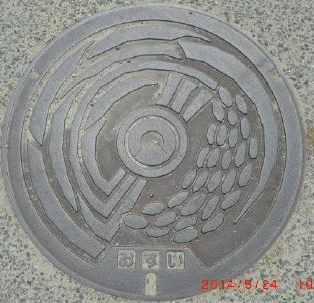
Rice ears are designed to surround the city emblem. The notation 'おすい'.
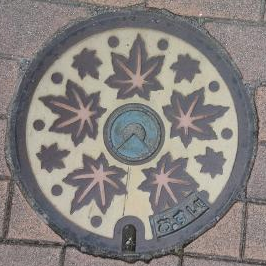
A small color design featuring the city tree, maple, around the old Maebara city emblem. The characters 'おすい' (sewage).
Former Shima 旧志摩町
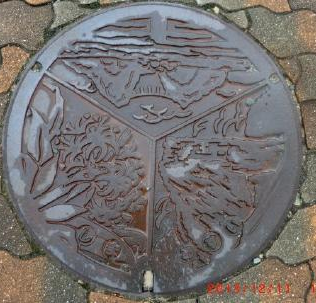
Futami-ga-ura's Meoto Iwa, the scenic and unusual rocks (hexagonal or octagonal basalt columns) of Keya no Oto in Keya, and the flower of the former Shima Town, 'Hamayuu,' are depicted. The notations 'shima' and 'osui' are used.
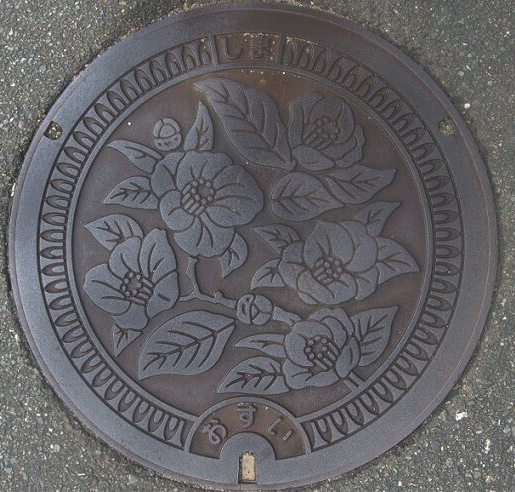
Design of the tree 'Yabutsubaki' from the former Shima Town, what is the design of the outer circumference? The characters 'Shima' at the top and 'Usui' at the bottom.
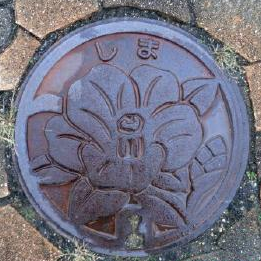
A small lid with a design of the tree 'Yabutsubaki' from the former Shima Town.
Former Nijo 旧二丈町
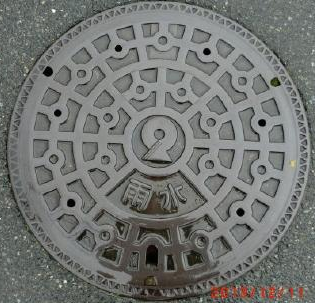
In a perforated standard pattern, the old Nijō Town emblem and the inscription 'Rainwater'.
Related: Fukuoka District Water Supply Corporation 福岡地区水道企業団
Ukiha うきは市
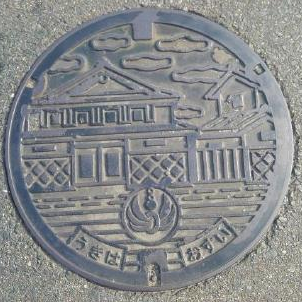
This is a design of the white-walled warehouse-style streetscape of the former Yoshii Town, which has been changed to include the name and emblem of Ukiha City.
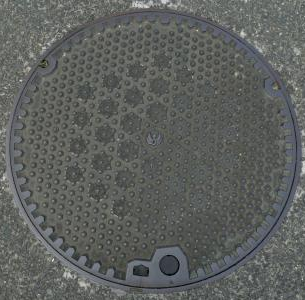
The lid has a non-slip pattern, with a small city emblem in the center, and what is written just below it is a small 'T', not 'shita' (下). The 6 o'clock position is a type commonly seen on CCB lids.
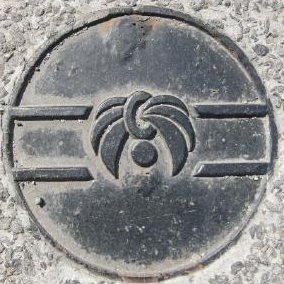
A small size featuring only the city emblem in the center of the two lines.
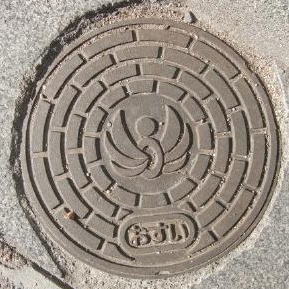
A city emblem in the center with four alternating stacked trapezoids, and the characters 'おすい' below.
Former Ukiha 旧浮羽町
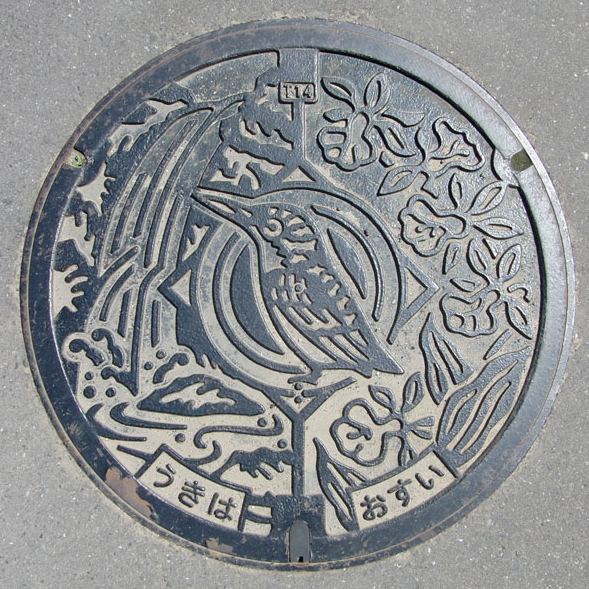
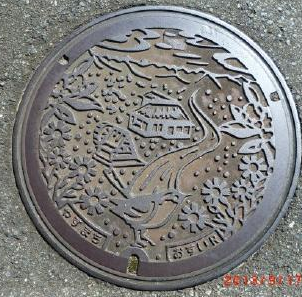
A waterfall is depicted on the left, but it is probably 'Uogaeri no Taki,' one of the three waterfalls of 'Choono no Taki Park.' On the right, the town's flower, 'Ebine,' is depicted, and in the center, the town's bird, the 'Kingfisher,' is depicted.
Former Yoshii 旧吉井町
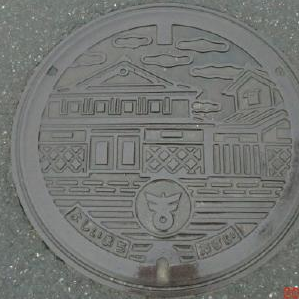
Design of the old town emblem and the streetscape with white-walled warehouse-style buildings. The characters 'Yoshiimachi' and 'Osui'.
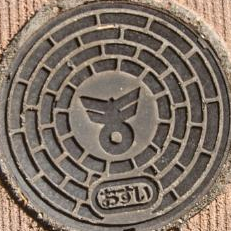
A trapezoid stacked in four alternating layers with the town emblem in the center, and the characters 'おすい' below.
Okawa 大川市
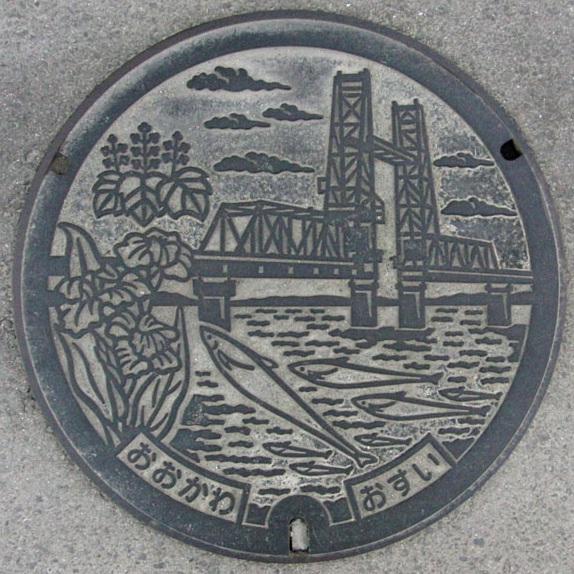
Okawa City is known as a major production area for furniture, but the design on the lid is not of dressers or tables; it features the 'Shōkai Bridge' over the Chikugo River, the city tree 'Paulownia,' and the city flower 'Canna.' In addition, it includes the 'Etsu,' a fish of the anchovy family that is a specialty of the Ariake Sea and only ascends the downstream region of the Chikugo River.
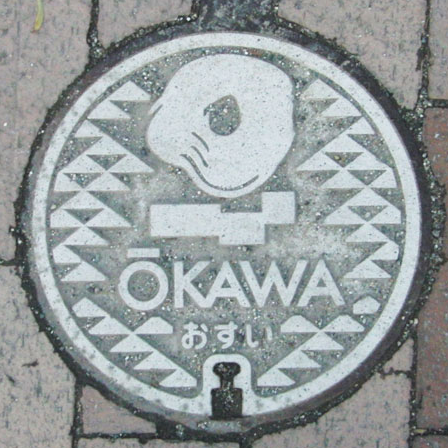
This is a cover for public sewage manholes that was installed on public roads until around Heisei 18 (2006). The design adopts a symbol mark that was decided in Heisei 5 (1993) within the Okawa Comprehensive Interior Industry Promotion Center Foundation. The symbol mark was developed with the main theme combining the first letter 'O' of Okawa in the alphabet and the kanji character '川' (kawa, meaning river). The gracefully and expansively drawn curves full of vitality symbolize the harmony of the hearts of the people gathered in Okawa, and its organic form strongly asserts the humanistic and vibrant nature of Okawa City. Moreover, the base part, constructed with straight lines, represents excellent technical skills and reliable trust cultivated through 450 years of history and tradition. By integrating these two forms, it expresses the comprehensive strength of people, history, and technology, and has a design and meaning fitting for widely representing Okawa to the world as a leading interior city in Japan. (From Okawa City Hall) Color version.
Related: Fukuoka Prefecture Southern Waterworks Corporation 福岡県南広域水道企業団
Onojo 大野城市
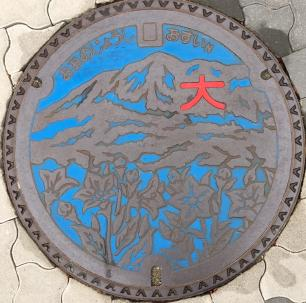
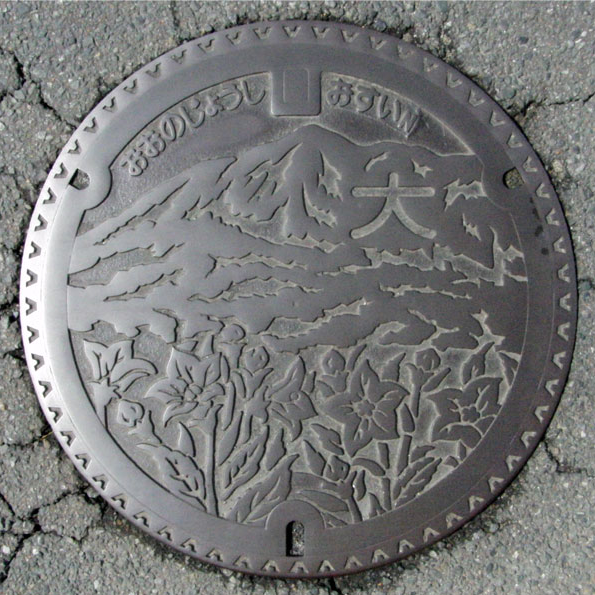
In the background is Shitennoji Mountain, located to the east of the city, where the "Oono Daimonji Festival" is held every year in late September. The city flower of Ono City, the "Balloon Flower," is prominently featured in the design.
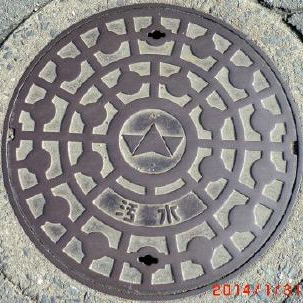
The city emblem and the characters 'sewage' in a standard pattern.
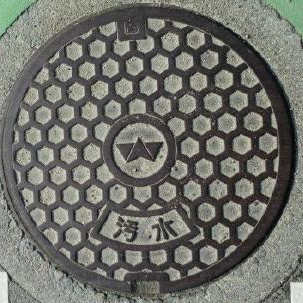
Hexagonal pattern with the city emblem and the word 'Sewage' included.
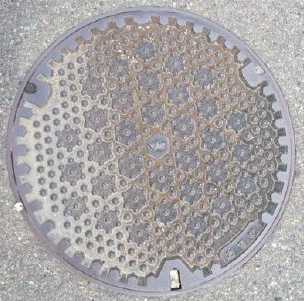
ASD lid, small city emblem in the center, 'Osui' characters at the bottom.

A tortoiseshell pattern with the city emblem and the word 'Fire Hydrant' in yellow, surrounded by a yellow background with polka dots.
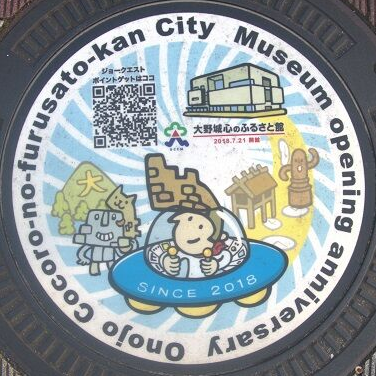
The lids were on display only until the 10th. By the 11th, they had been relocated to the lobby of the Kokoro no Furusato Museum in Ōno Castle. These lids can be made into cards and feature a design commemorating the opening of the Ōno Castle Kokoro no Furusato Museum.
Omuta 大牟田市
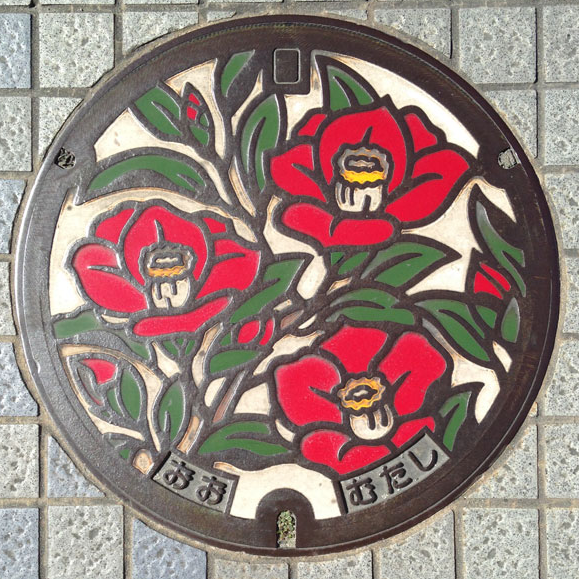
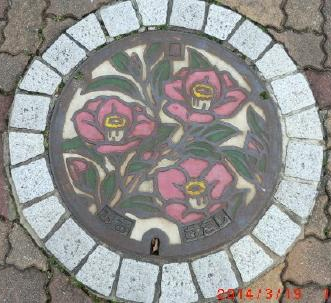
A manhole cover for dirty water with a white background, with the camellia arrangement the same as the two above. Found on both the roadway and the sidewalk. A beautiful cover I discovered on my second visit to Ōmuta.
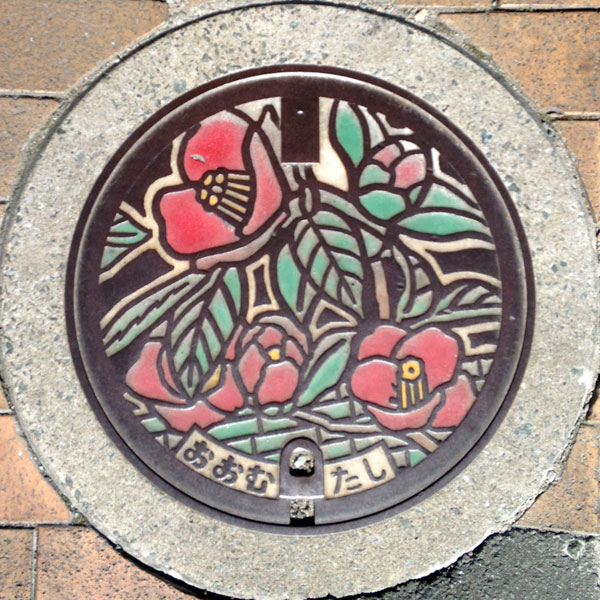
A sewer manhole cover designed with the city's flower, the 'Yabutsubaki' (wild camellia). Among the several types of covers, this was the largest. The characters 'Ōmuta-shi' and 'Osui' are written on the lower part.
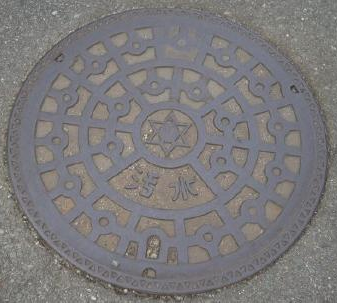
A standard has the city emblem and the characters 'sewage', with a V-shaped pattern.
Sewage manhole cover.
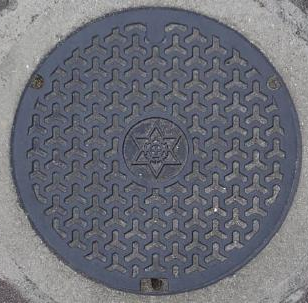
The purpose is not specified, but it is believed to be a manhole cover for sewage. It features the city emblem in the center of a Bishamon tortoiseshell background pattern, and it does not have any text.
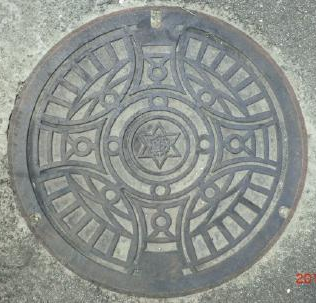
Geometric pattern with the city emblem.
A lid with the same design is used in Agano City, Niigata Prefecture (formerly Yasuda Town). Of course, the city emblems are different, and the lid in Agano City has the characters for 'sewage'.
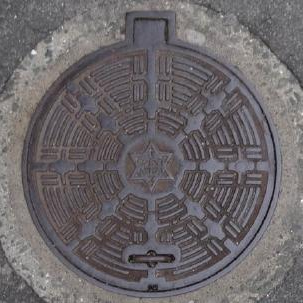
The intended use is not specified, but it is believed to be a manhole cover for sewage. A cross-shaped pattern is arranged in eight radial directions crossing concentric circles, and each of the separated sections is further divided with additional radial lines, creating a complex geometric pattern with the city emblem in the center.
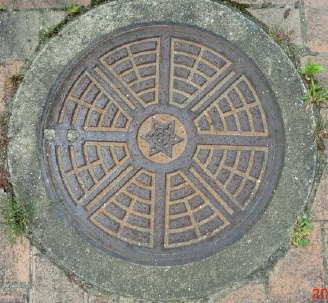
With the city emblem.
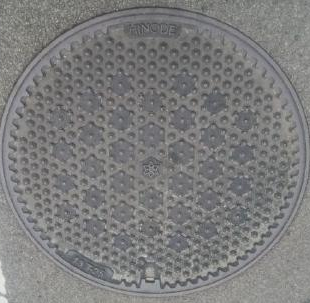
ASD lid made by 'HINODE', with a small city emblem in the center and the characters '13T-25' at the bottom left.
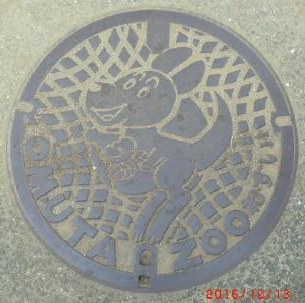
A design of a kangaroo and its child, with the words 'OMUTAZOO' and 'Osui' below.
A sewage manhole cover at Omuta Zoo.
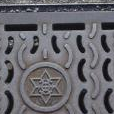
Sidewalk cover with city emblem.
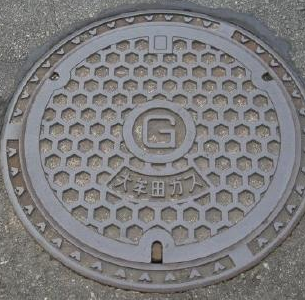
The words 'G' and 'Ōmuta Gas' in a tortoiseshell pattern.
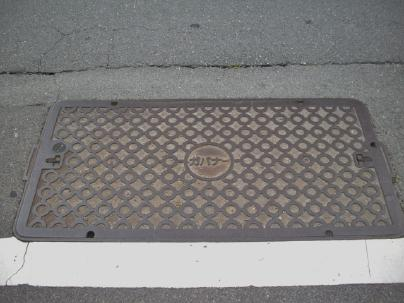
A ground pattern with circles connected in a chain vertically and horizontally, with a square lid in the center bearing the word 'Governor.' Could it be the lid of a governor (pressure regulator)?
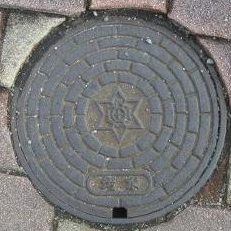
Small size with a concentric circle pattern, bearing the city emblem and the characters for 'sewage'.
Small sewage manhole cover.
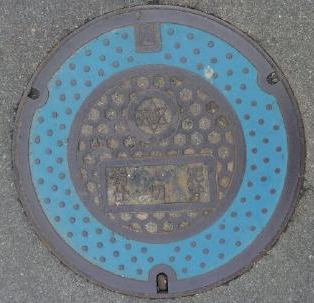
On a tortoiseshell-patterned surface, there is the city emblem and the words 'Sludge Shut-off Valve,' with a blue background and polka dots around the outer edge. There are lids with the same design but with different inscriptions: 'Shut-off Valve,' 'Air Valve,' and 'Valve.'
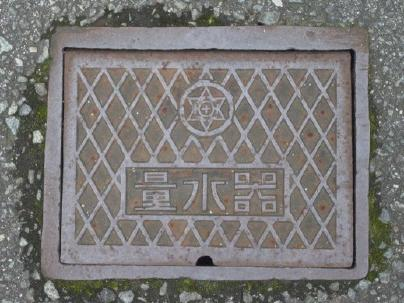
In a diamond-shaped ground pattern, with the city emblem and the characters 'Water Meter'.

A lid with large polka dots on a yellow background, featuring a fire ladder truck design. At the top, it says 'Fire Hydrant,' and at the bottom, between the city emblem, it has the words 'No Parking.'

A rhombus-shaped ground pattern with the words 'Ōmuta City,' the city emblem, and 'fire hydrant' on top, handles on both sides, and a receiving frame with a thick diagonal stripe pattern on a yellow background.
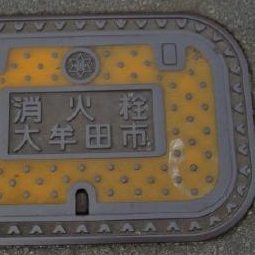
Yellow background with polka dot pattern, the city emblem with the characters 'Fire Hydrant' and 'Ōmuta City'. The receiving frame has a V-shaped pattern.
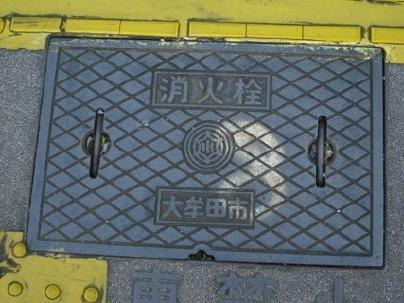
Diamond mesh pattern, water, 'Fire Hydrant' above, 'Ōmuta City' below, handles on both sides.
Firewater tank cover with Matoi color design.
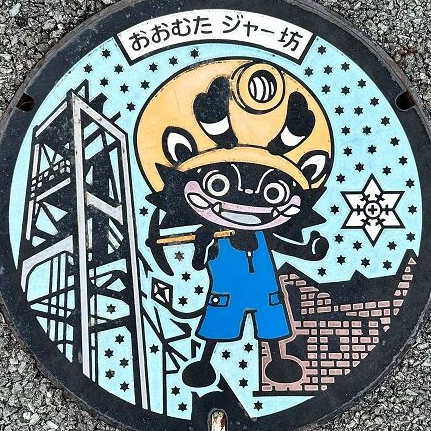
Ōmuta City Hall display manhole cover. This is "Jā-bō," the character for the 100th anniversary of Ōmuta City. He is the incarnation of the serpent from Daijayama, wearing a pickaxe and helmet. The Miike Coal Mine Miyahara Pit is also featured in the design. It will be installed on the ground from April, but the location is said to be secret.
Related: Fukuoka Prefecture Southern Waterworks Corporation 福岡県南広域水道企業団
Ogori 小郡市
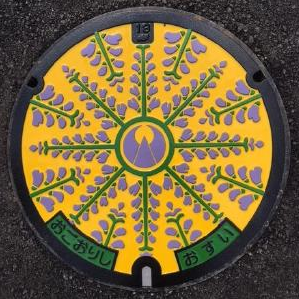
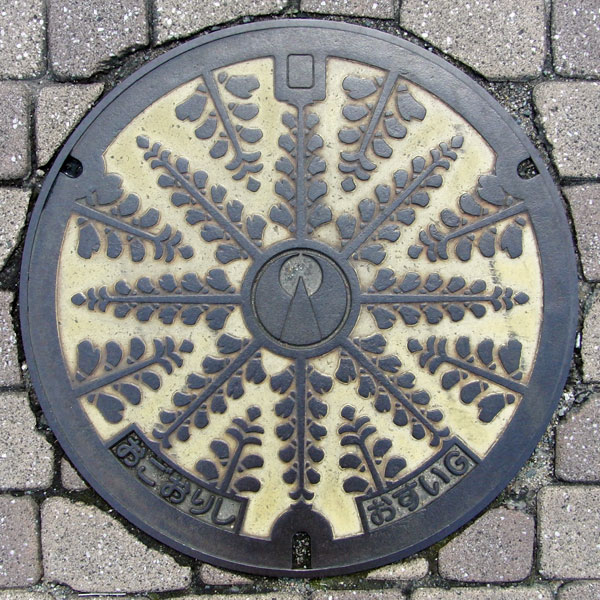
A sewage manhole cover designed with the city's flower, 'Wisteria'.
Related: Fukuoka Prefecture Southern Waterworks Corporation 福岡県南広域水道企業団, Homan River Basin Sewer 宝満川流域下水道
Kasuga 春日市
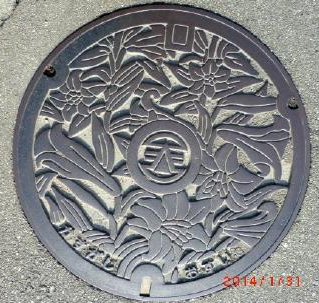
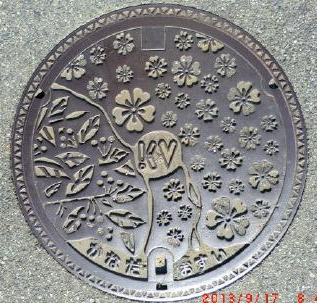
In the above non-color version, the actual installed cover has the city emblem in the center, with the characters 'かすがし' at the top and 'おすいL' at the bottom. The receiving frame has a double oval pattern. 'おすいL' refers to 'T-14', and 'おすいG' refers to 'T-25'.
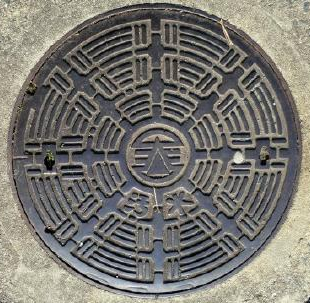
City emblem with the word 'sewage'.
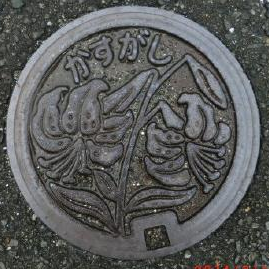
City flower lily and written as 'Kasugashi'.
Small-diameter sewage manhole cover. φ200
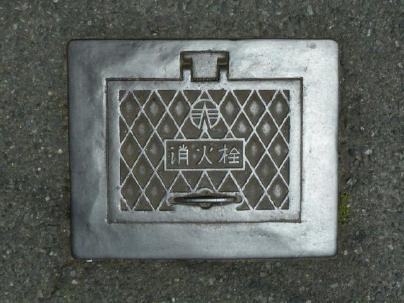
A diamond-shaped ground pattern with the city emblem and the characters 'Fire Hydrant' in thin lines. Below, there is a square lid with a handle and external hinges, without any pattern, and it has a thick frame that looks slippery.
Related: Kasuga Nakagawa Waterworks Corporation 春日那珂川水道企業団
Kitakyushu 北九州市
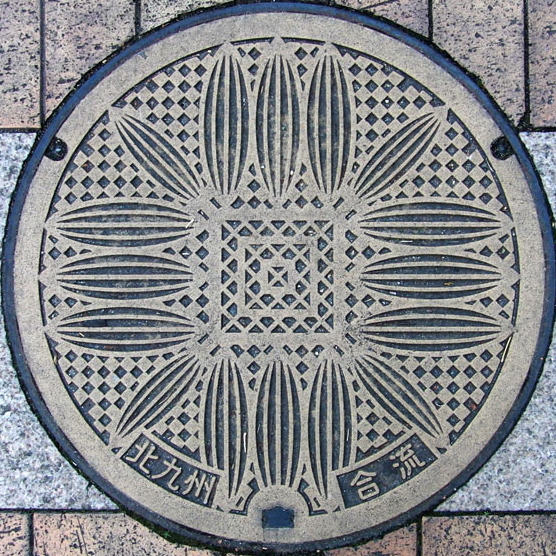
A lid designed with the city's flower, 'sunflower.' For confluence purposes.
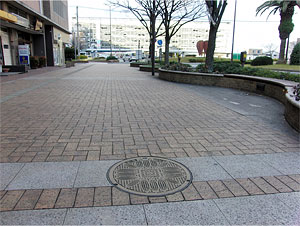

Color manhole cover on display inside the Nichimei Purification Center Sewer Museum. It is a cover depicting the city's flower, 'sunflower,' but the actual installation location seems to be unknown. We would like to somehow find it by inquiring with each ward office, etc.
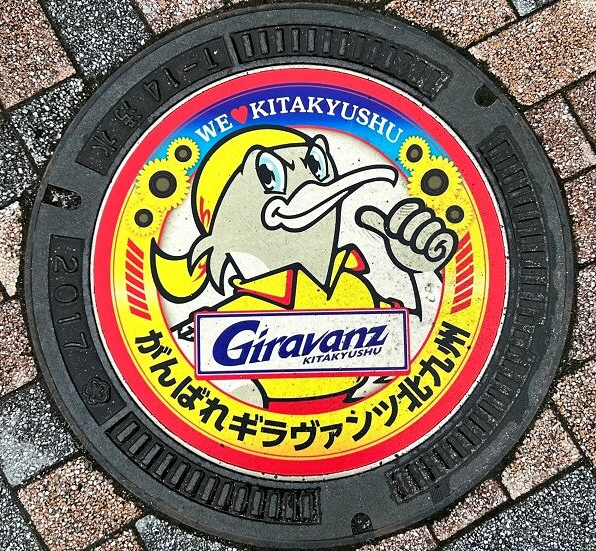
Nichi-Akira Purification Center Display Lid. The same design as above. It is said that this is also one of the two designs that were discarded when the current sunflower design was chosen.
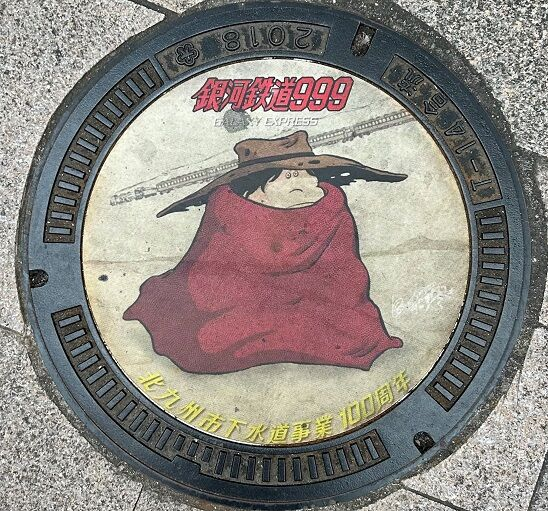
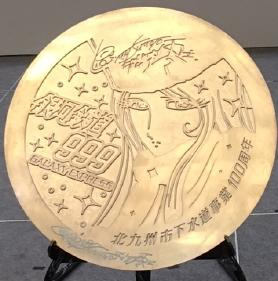
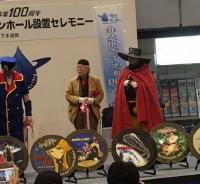
To commemorate the 100th anniversary of the sewage system in Kitakyushu City, design manhole covers featuring Leiji Matsumoto's representative work 'Galaxy Express 999' have been installed at nine locations around Kokura Station and one at Kitakyushu Airport. This is the design manhole cover of Maetel that was displayed at the installation ceremony on May 19. The upper right shows an image of the ceremony, which was attended by Leiji Matsumoto himself.
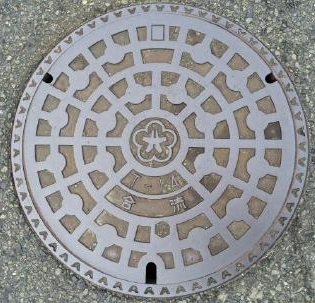
In the center of the standard manhole cover is the city emblem, with the inscriptions 'T-14' and 'Sewage' below it.
'The five petals around the edge represent the unity of the five former cities through the merger, and the center represents the characters for “Kita” of Kitakyushu, “Kyū” of Kyushu, and “Dai.” Additionally, the star-shaped design symbolizes industry with gears and represents the city's development with a radiating pattern.' (From the city's official website)
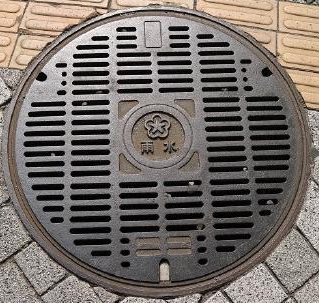
It is a lid with elongated grid-like holes across the entire surface. Inside the central circle are the city emblem and the characters for rainwater.
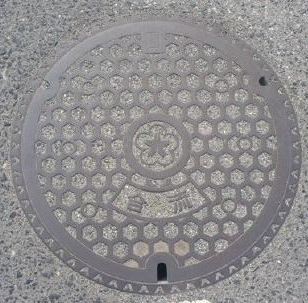
It is a lid with a hexagonal pattern. In the center is the city emblem, below it is the inscription 'Confluence,' and on the receiving frame is a V-shaped pattern.
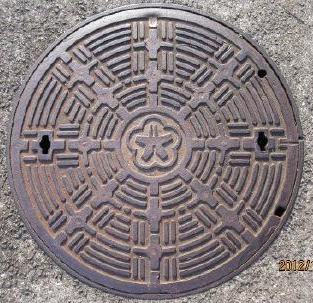
A geometric pattern combining vertical and horizontal lines with a cross, featuring the city emblem.
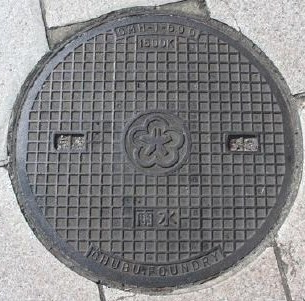
Lattice pattern, city emblem in the center, 'Rainwater' notation below, hooks on the left and right.
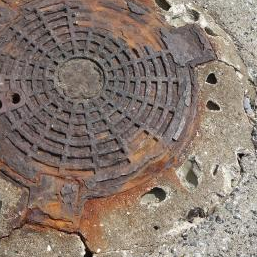
It is a manhole cover with a decayed city emblem in the center and a spider web pattern, with three parts protruding. It is located along the rocks of Tomimigahama, where Myokenzaki Lighthouse stands, and it is a rusty manhole cover whose operational status is unknown. It seems like it would be submerged at high tide.
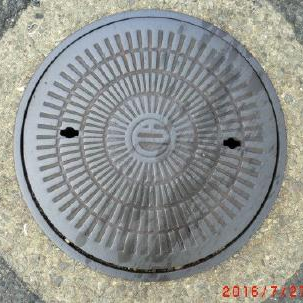
Display lid of the Himeaki Purification Center. It bears the city emblem of the former Tobata City, which disappeared when it merged with Kokura City, Moji City, Wakamatsu City, and Yahata City to become Kitakyushu City on February 10, 1963 (Showa 38). Radial ground pattern.
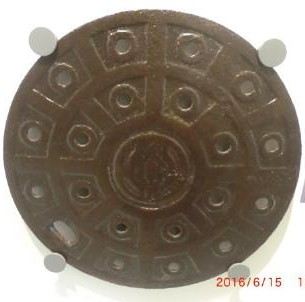
Display lid of the Himei Purification Center. It features the city emblem of the former Kokura City, which ceased to exist when it merged with Moji City, Wakamatsu City, and Yahata City to form Kitakyushu City on February 10, 1963 (Showa 38). It has a Nagoya-style ground pattern.
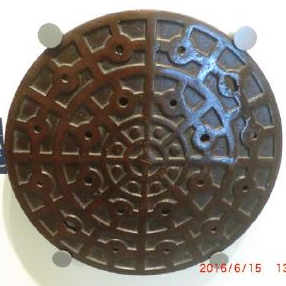
Exhibit lid of the Niche purification center.
The standard lid features the city emblem of the former Yahata City, which disappeared when it merged with Kokura City, Moji City, Wakamatsu City, and Yahata City on February 10, 1963 (Showa 38) to become Kitakyushu City. The city emblem is a mark with eight Japanese flags arranged in a circle in the center.
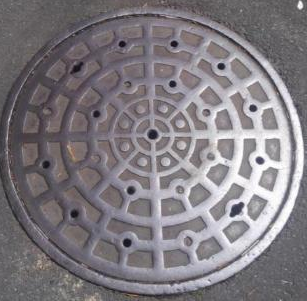
It is not for display; it is the above lid that is still in active use.
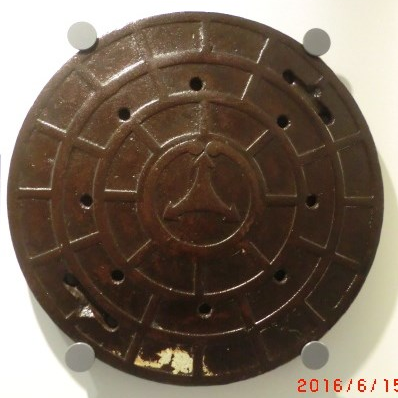
Exhibit lid of the Hiaki Purification Center. It bears the emblem of the former Moji City, which merged with Kokura City, Moji City, Wakamatsu City, and Yahata City on February 10, 1963 (Showa 38) to become Kitakyushu City and thus ceased to exist. The city emblem, fitting for a port town, features an anchor mark.
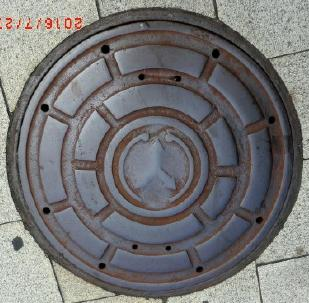
It is the above cover laid on the road.

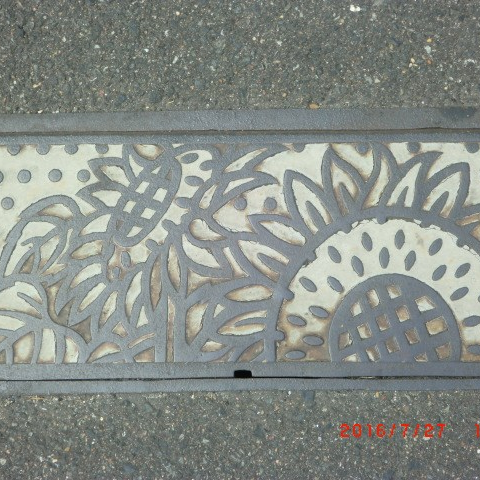
A lid of unknown purpose. A sunflower is depicted on it.
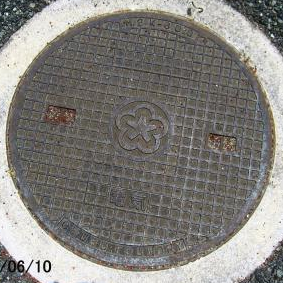
An electrical manhole cover with a mesh pattern background, on which 'M2K-600', the city emblem, 'Electricity', and 'CHUBU FOUNDRY' are inscribed. There are lifting hooks on both sides.
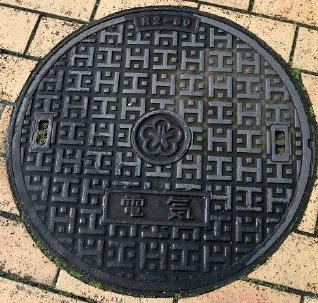
A lid with a pattern combining the character '工' and a ■. The city emblem is inside a circle in the center. 'Electricity' is written below it, and 'R2-60' is written at the top. I received 'R8-60' from donguri188.
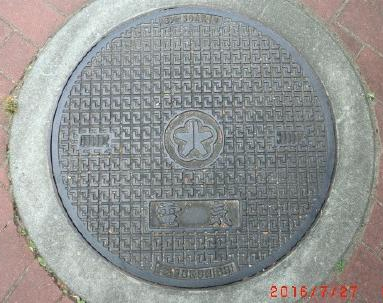
A quotation mark ground pattern made by FUKUNISHI, bearing the city emblem and the characters for 'electricity'.
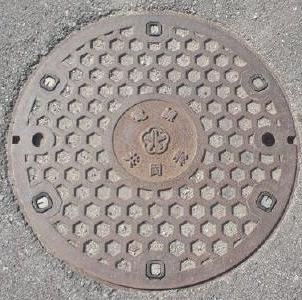
In the central circle of the tortoiseshell pattern, there is the city emblem and the characters 'Electric Cable Joint Duct.' On both sides of the city emblem, there are two lines.
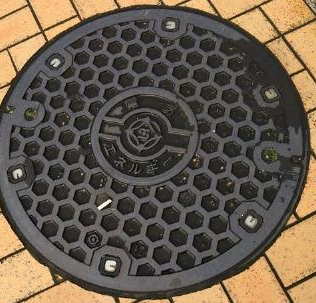
In the center circle of the hexagonal-patterned lid is the mark of the former Shin-Nippon Steel Corporation and the characters for 'Electricity' and 'Energy'.

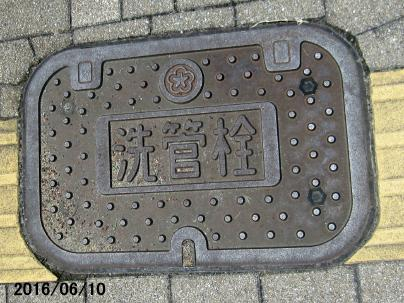
Square cover of a water pipe hydrant with the city emblem. City emblem on a polka dot background, with the characters 'water pipe hydrant'.
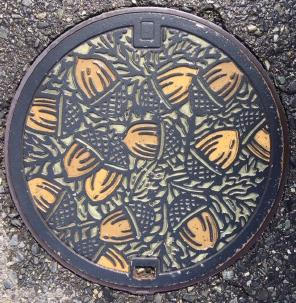
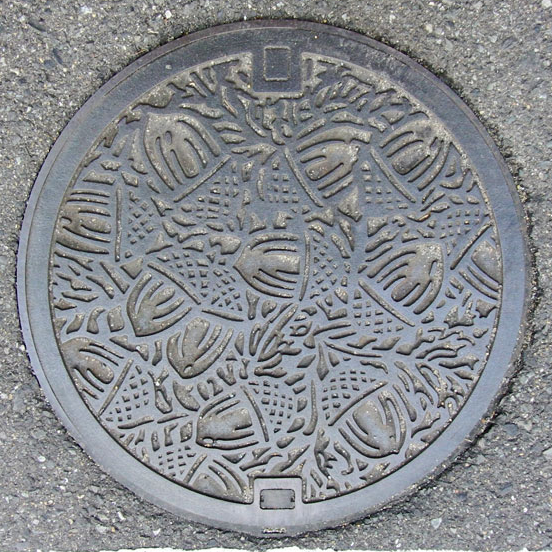
A small panel with sand coating depicting the fruit of the city tree, 'Ichii-gashi'.
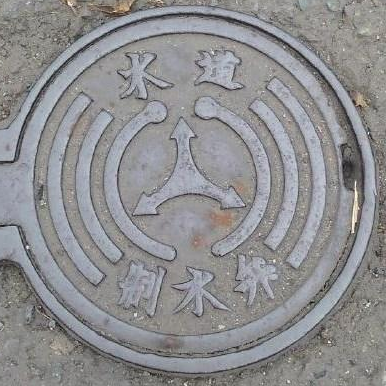
The center is the company emblem of Yawata Steel Co., Ltd. (the former trade name of what is now Nippon Steel & Sumitomo Metal). It was established in 1950 as the successor company to Nippon Steel (Nippon Seitetsu), and the trade name was used for 20 years until it changed to Nippon Steel Corporation in 1970 following a merger with Fuji Steel. The company emblem/logo is commonly called "Maruesu," but the reason for adding a midpoint to the S seems to be unknown. Its use is thought to be for "water pipe air valves."
There are lids with the same design but different inscriptions such as "air valve," "water control valve," and "gate valve."
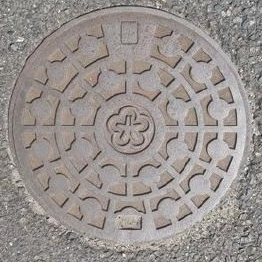
It is a small standard lid. There is a city emblem in the center, and there is no text.

A small lid with a background pattern of tiny squares on a blue ground, with the city emblem on top and the characters 'Shimekiri-ben' below.
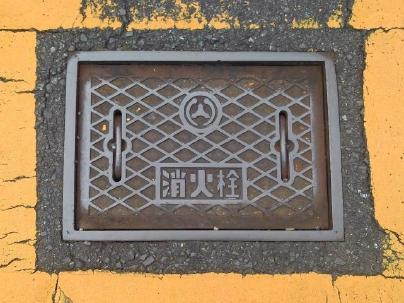
A square-shaped lid with a rhombus mesh pattern featuring the old Moji City emblem and the characters 'Fire Hydrant,' with handles on both sides.
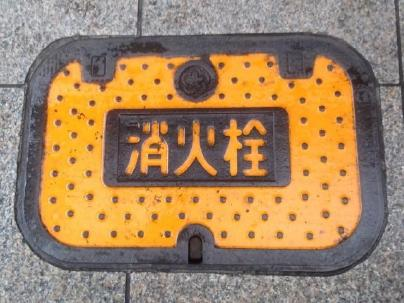
Yellow background with polka dot pattern, city emblem, and the word 'Fire Hydrant' prominently in the center.

A design of a yellow fire department badge with the city emblem, surrounded by a yellow background with polka dots, with the characters 'Fire Prevention' on top and 'Water Tank' on the bottom.
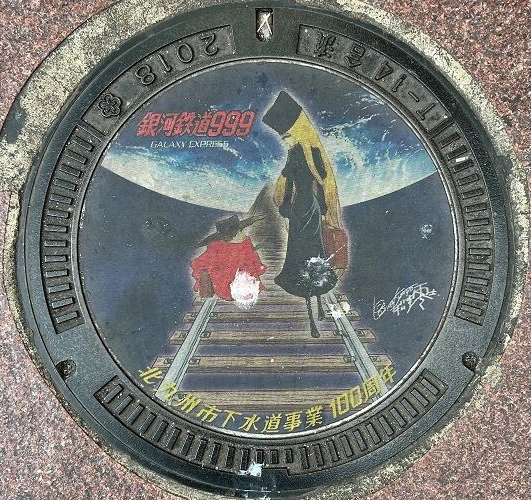
Commemorative manhole cover for the "100th Anniversary of Kitakyushu City Sewage System." Sticker cover featuring Emeraldas from Galaxy Express 999.
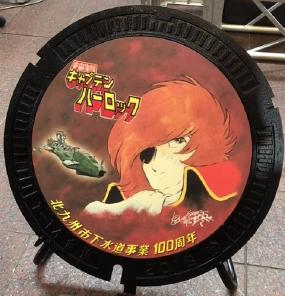
Commemorative manhole cover for the '100th Anniversary of Kitakyushu City Sewage'. Sticker cover featuring Captain Harlock from Galaxy Express 999.
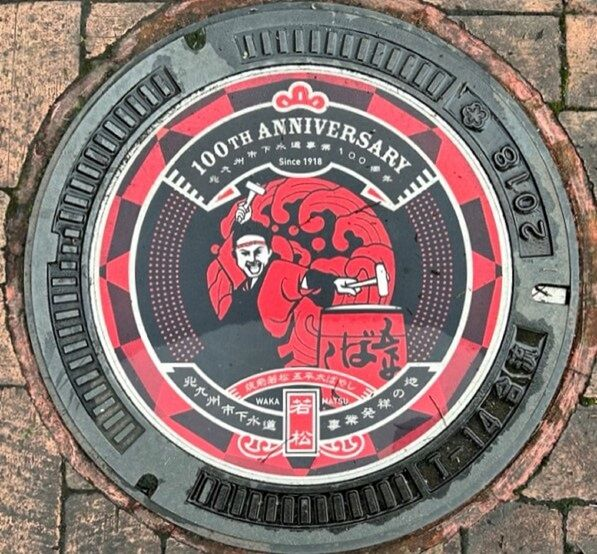
This is a commemorative manhole for the 100th anniversary of the Kitakyushu City sewerage project. Six seal design manholes, inspired by Wakamatsu, the birthplace of Kitakyushu City sewerage, were installed. It features the design of the Hydrangea Festival. "2018" City emblem "T-14 Combined Sewers"
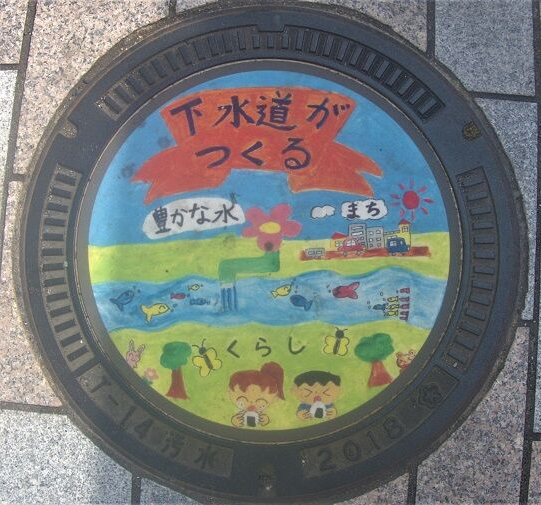
This is the Grand Prize-winning entry from Moji Ward in the Sewerage Poster Contest, titled 'Rich Water, Town, and Life Created by Sewerage,' which was held for fourth graders. Water flows from a faucet, colorful fish swim in a clean river, and children are happily eating rice balls. Below is written 'T-14 Sewage 2018 City Emblem.'
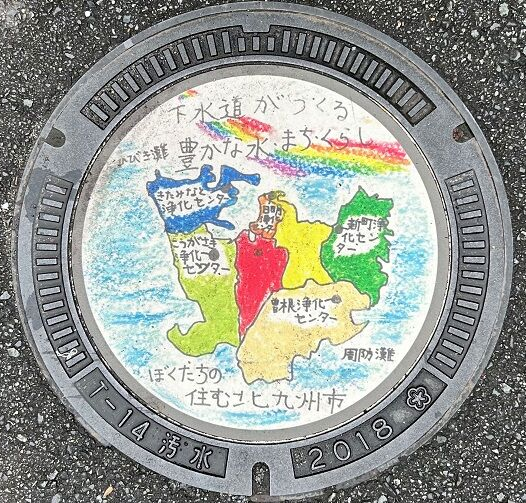
This is the top prize-winning work from Kokura Minami Ward. It depicts the locations of five purification centers in the city: Shinmachi, Hiagari, Sone, Kitaminato, and Kōgōzaki. Below, it says 'T-14 Sewage 2018 City Emblem'.
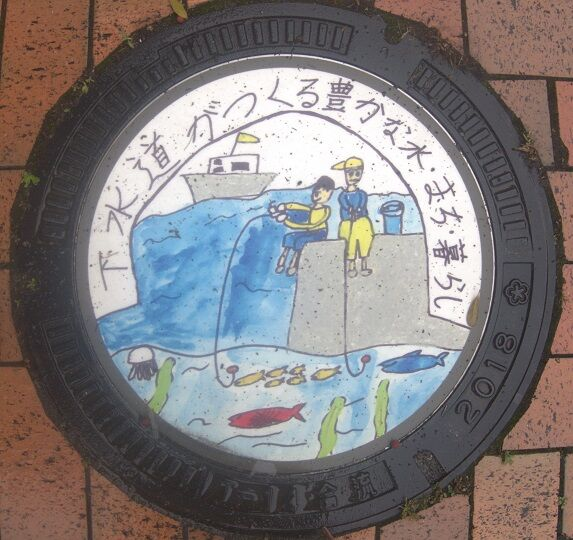
This is the grand prize-winning work from Wakamatsu Ward. Water flowing from a faucet is carefully caught with both hands, and within the overflowing and splashing droplets are depicted drinking water, toilets, rivers, and purification centers. It clearly shows the importance of water in daily life. Below is 'T-14 Confluence 2018 City Emblem'.
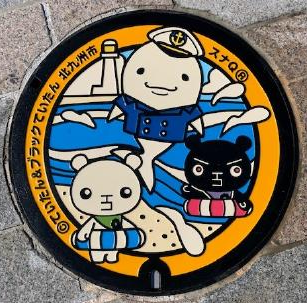
The manhole featuring Kitakyushu Port's mascot character 'SunaQ' also depicts the sea and a lighthouse, along with Kitakyushu City's environmental mascot characters wearing life rings, 'Teitan & Black Teitan.' 'Teitan' is a nickname representing a low-carbon society, with its nose and mouth expressing 'eco.' Teitan's friend, 'Black Teitan,' was originally a character that disliked 'eco,' with its nose and mouth representing 'ego' at the time of its creation. However, after passing the Environmental Capital Certification with a passing score and becoming adept at 'eco,' its nose and mouth were changed to 'eco' in February 2016.
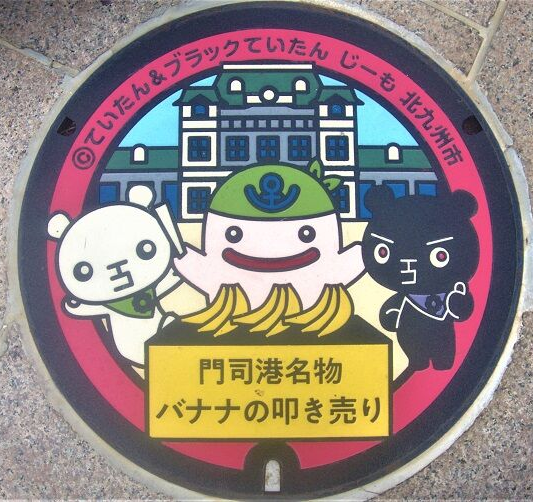
On either side of Kita Kyushu City's mascot character 'Jimo,' who is doing the Moji Port specialty 'banana auction' with Moji Port Station in the background, 'Teitan & Black Teitan' are depicted.
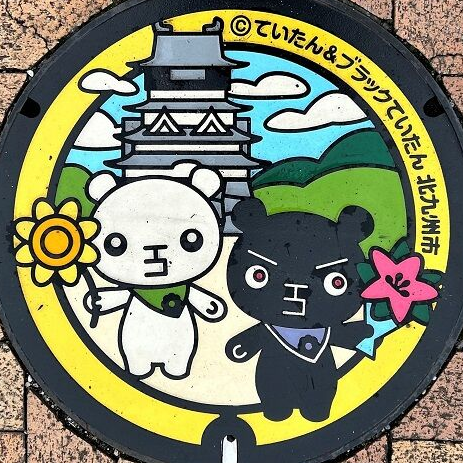
In front of Kokura Castle, 'Teitan & Black Teitan' are depicted holding the flower of Kitakyushu City, the 'sunflower'.
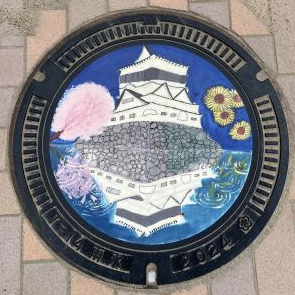
As a heavy rain countermeasure in the central area of Kokura, we constructed the Showa-cho rainwater storage pipe, and the design of its manhole cover was done by the students of Shirogane Junior High School (Kokurakita Ward) in their art class. The design features Kokura Castle and cherry blossoms, as well as the city's flower, the sunflower, reflecting beautifully in the moat. At the bottom, it says 'T-14 Rainwater' and '2024 City Emblem.'
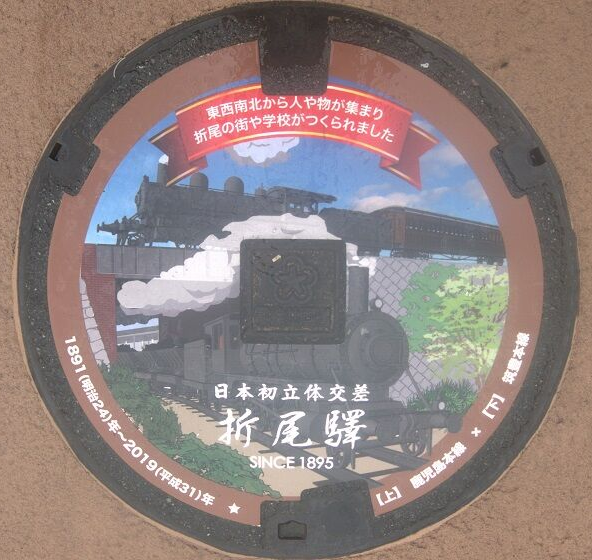
This cover was installed to commemorate the opening of Japan's first vertical railway crossing 130 years ago near JR Orio Station. The design features a steam locomotive running on the Kagoshima Main Line (upper) and Chikuho Main Line (lower), which intersect near Orio Station. Inside the central square are the city emblem and the words 'Electric Wire Shared Duct,' below that, 'Japan's First Vertical Crossing Orio Station' and 'SINCE 1895,' at the top, 'People and goods gathered from the east, west, south, and north, and the town and schools of Orio were created,' and along the lower outer circumference, '1891 (Meiji 24)–2019 (Heisei 31) ☆ [Above] Kagoshima Main Line × [Below] Chikuho Main Line.'
Related: Fukuoka 福岡市
Kurume 久留米市
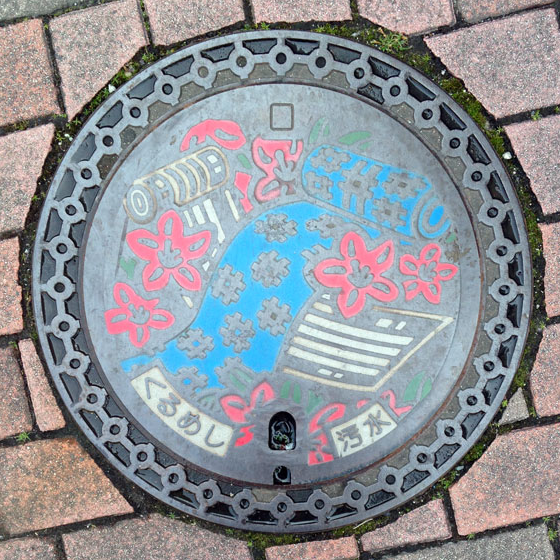
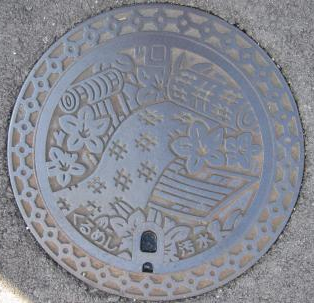
A colored manhole cover for sewage featuring Kurume Kasuri and Kurume azaleas, both Important Intangible Cultural Properties of the nation.
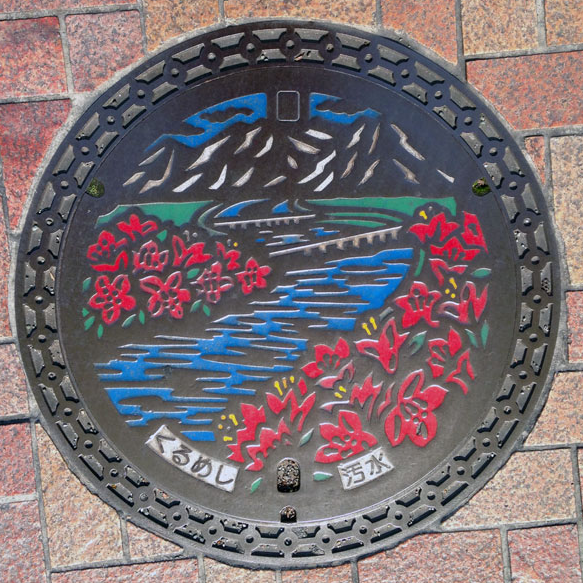
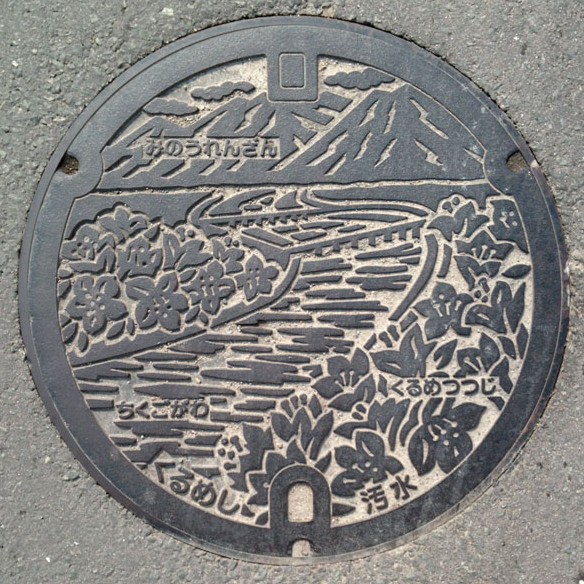
A color manhole cover for sewage featuring the mountain range of Minou Renzan, the Chikugo River, and Kurume azaleas, the city's flower.
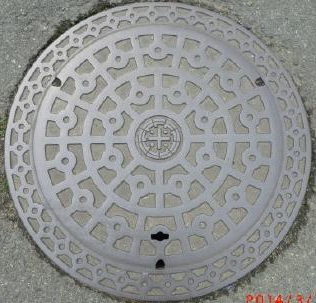
Complies with JIS standards, includes a city emblem and one keyhole. The receiver frame has a pattern of circles connected in a chain.
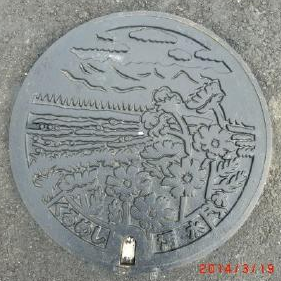
This is the design of the former Kitano Town. The design features the town flower cosmos of the former Kitano Town and the Chikugo River. The labels 'Kurumeshi' and 'Sewage'.
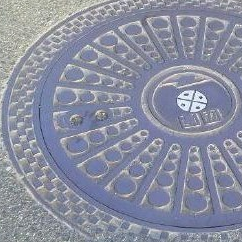
The bubbling textured pattern used on the cover by the power company, with the old Kyushu Electric Power logo in the center and the characters for 'Electric Power'.
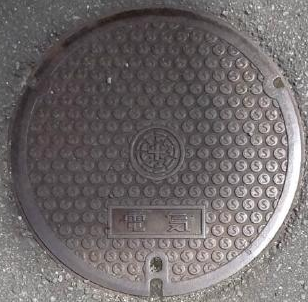
This is a manhole cover for electricity. The city emblem of Kurume City is in the center, and below it are the characters for 'electricity.' The background pattern is filled with a design of the letter 'S' inside circles. An electricity cover with the same background pattern and the name 'SAITO' was found in Hirado City, so it is believed to be from the same manufacturer, but the identity of 'SAITO' is unknown.
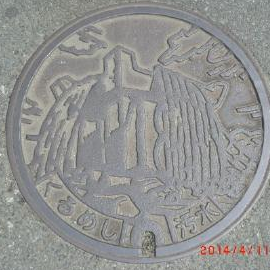
Explanation from Kurume City Enterprise Bureau, Water and Sewerage Department, Sewer Construction Division: 'This design cover was previously used as a public manhole. It depicts the fountain in Chuo Park. Chuo Park is a park located in the central urban area of Kurume City, cherished as a place of relaxation for citizens. In the citizens' plaza (4.7 hectares) within the park, the large fountain "Fountain of Love," created by the world-renowned sculptor Tomonori Toyofuku, and serving as a symbol of the park, is installed.'

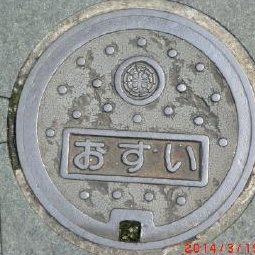
A small cover with a polka dot pattern, the city emblem, and the inscription 'Osui'.
Small cover for a sewage manhole.
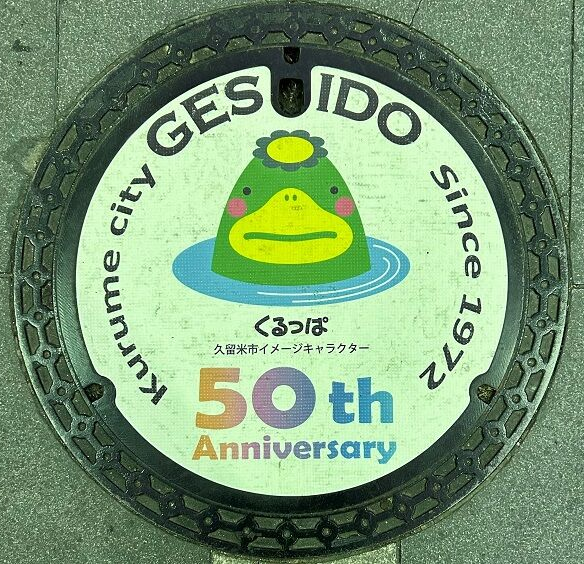
This is a Kappa mascot manhole called 'Kuruppa' from Kurume. When I was looking at Instagram photos from the recent Sewerage Exhibition 2017, I saw Kuruppa's manhole at the edge, so I called Kurume City Hall to ask, and they said they made one of these stickers and one at the purification center (a total of two).
Former Tanushimaru 旧田主丸町
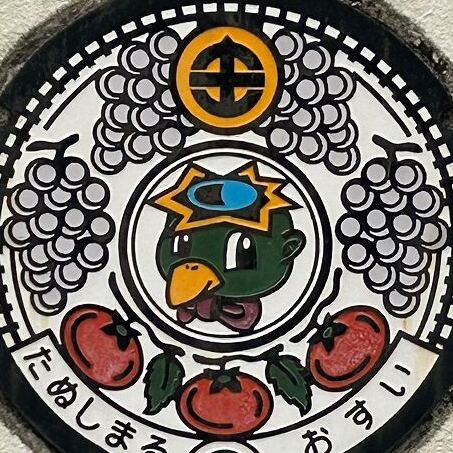
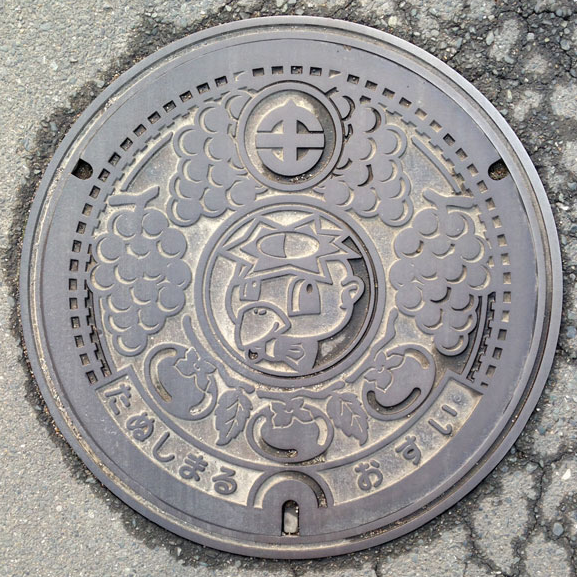
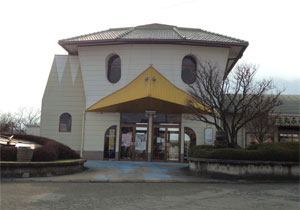
Since being incorporated into Kurume City, this manhole cover has the old town emblem removed, with the letters below saying 'Kurumeshi'. The Tanushimaru Station where this cover was located has a sleeping kappa.
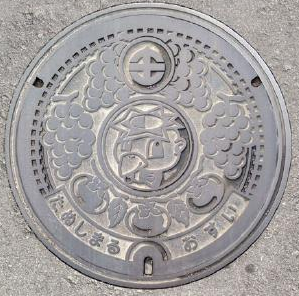
It features the old town emblem and the characters 'Tanushimaru' and 'Osui.' A kappa is in the center. In Tanushimaru Town, fruit and tree cultivation are thriving, and grapes and persimmons are also depicted on the cover. It is said that this place is the birthplace of Kyoho grapes in particular.
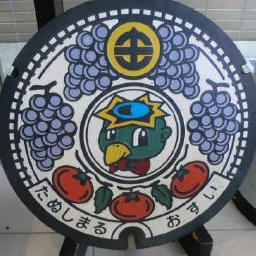
Exhibition manhole cover at Tanushimaru Town General Branch. Colored manhole cover with the above design.
Former Jojima 旧城島町
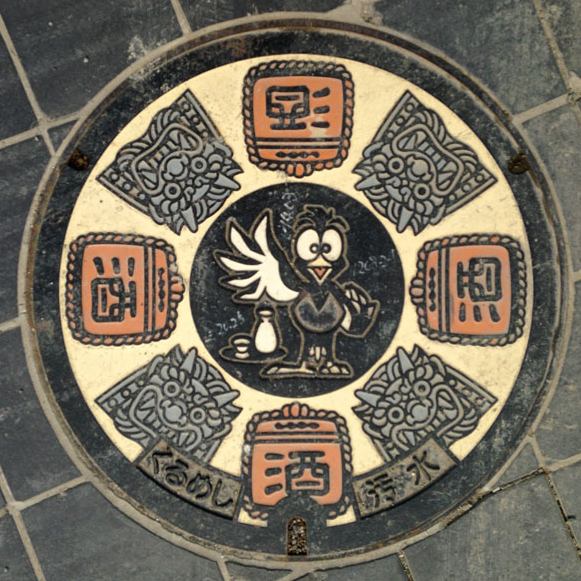
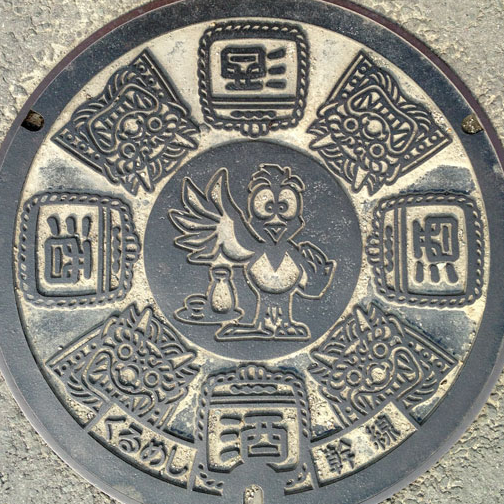
The town's mascot, the magpie 'Ingot-kun', and the local specialty roof tiles (oni-gawara) and sake barrels are depicted.
Former Mizuma 旧三潴町
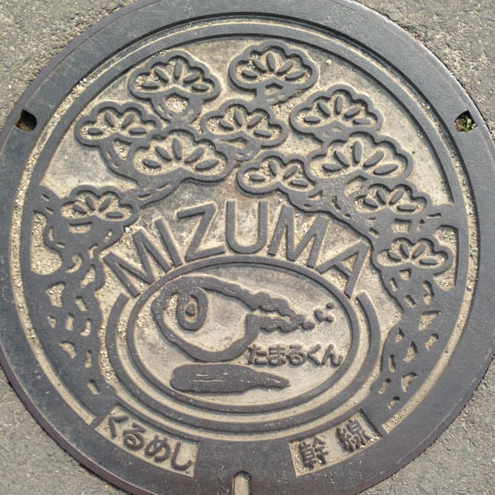
A sewage manhole cover depicting the town's tree 'Pine' and the tadpole 'Tamaru-kun'.
Former Kitano 旧北野町
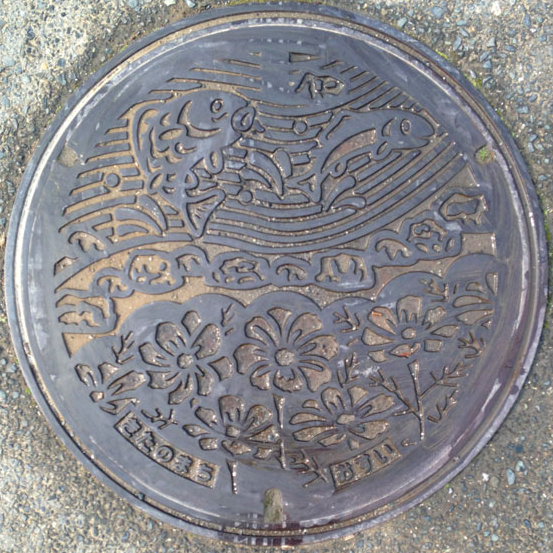
The design depicts the town's flower, the cosmos, and the fish of the Chikugo River (probably carp and sweetfish).
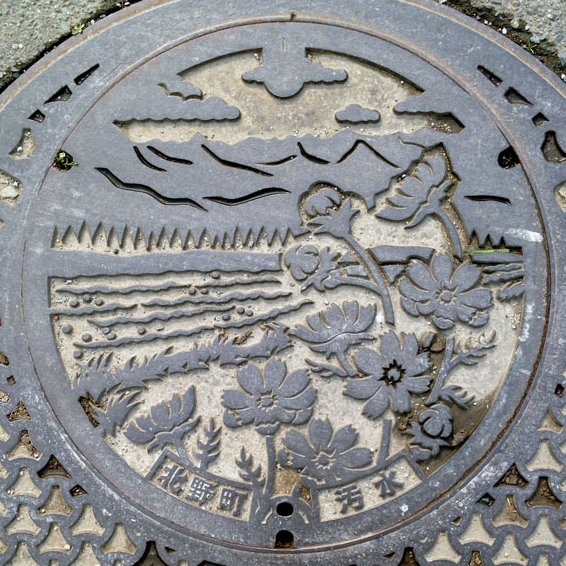
The design is 'Chikugo River' and the town's flower, 'cosmos'.
Related: Fukuoka Prefecture Southern Waterworks Corporation 福岡県南広域水道企業団
Koga 古賀市
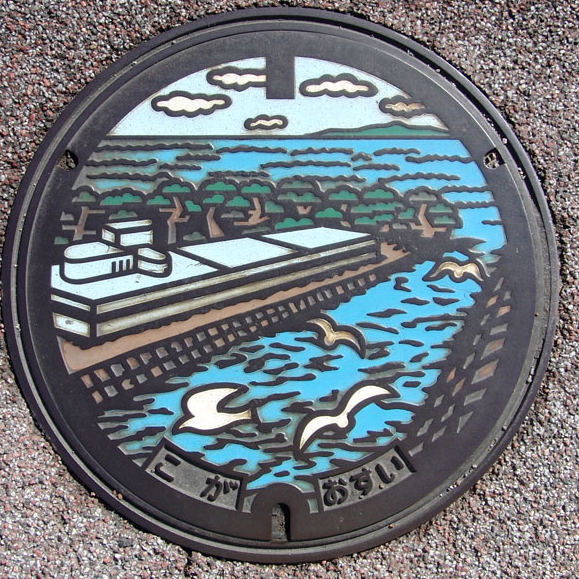
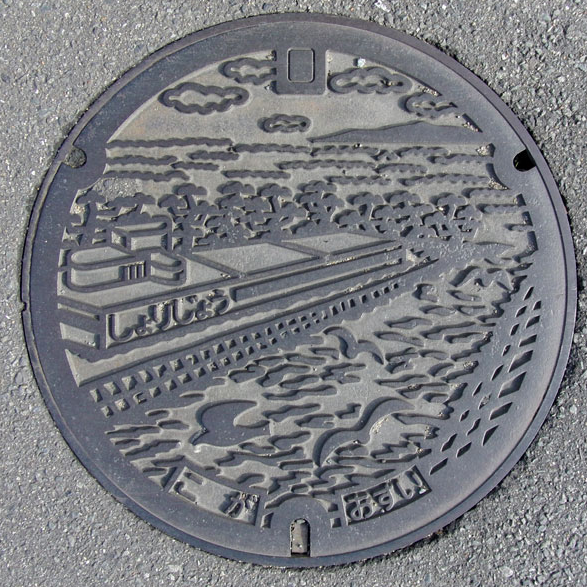
The terminal treatment plant 'Koga Water Reclamation Center' located at the mouth of the Hanatsuru River is depicted.
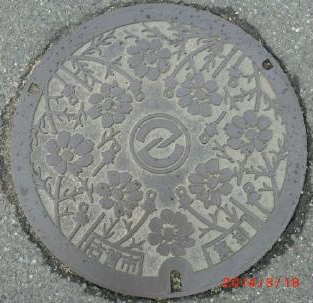
The city emblem in the center. Around it, the city's flower, cosmos. The words 'Koga City' and 'Shuppai'.
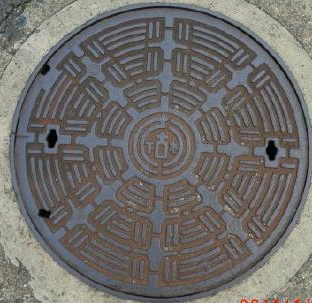
In a standard pattern, the city emblem and the inscription 'Rainwater'. '25' at the bottom.
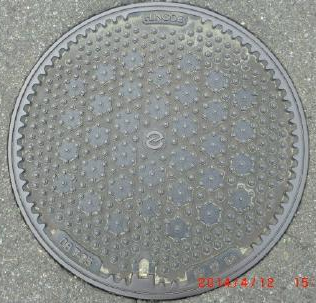
The ASD with the city emblem is for 'sewage' use.
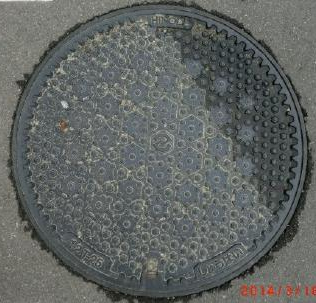
Anti-slip pattern with the city emblem and the inscription '12T-25' and 'Shūhai.' The inscription 'HINODE' is at the top.
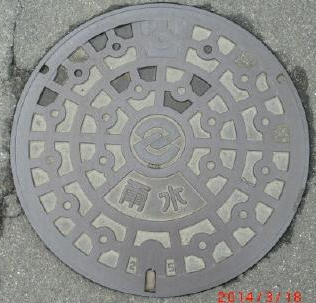
In an old chapter, there are the characters 'sewer'.
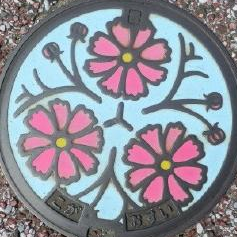
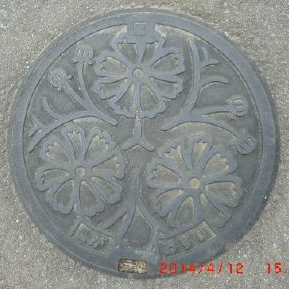
A small plate depicting the city's flower, the 'cosmos'.
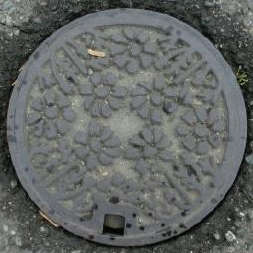
A small lid with a cosmos design and no usage label.
Tagawa 田川市
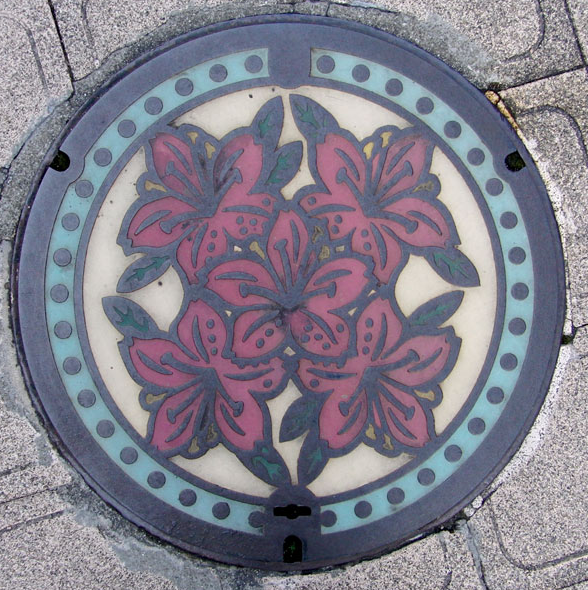
The city's flower, 'azalea,' is depicted.
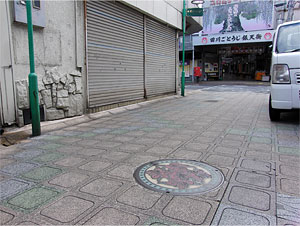
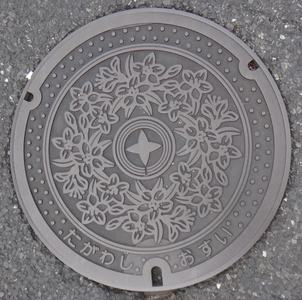
A design of the city's flower, azalea, around the city emblem. The outer edge has a polka dot pattern with the words 'Tagawashi' and 'Osui.' A sewage pipe manhole cover.
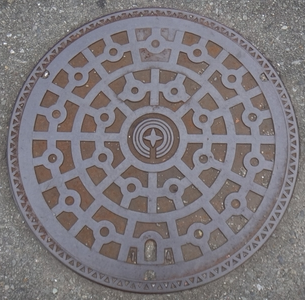
A JIS standard manhole cover with the city emblem in the center. The frame has a 'V' pattern. Sewage pipe manhole cover.

There is a city emblem on the standard lid, and below it, the characters '20' and a handle.
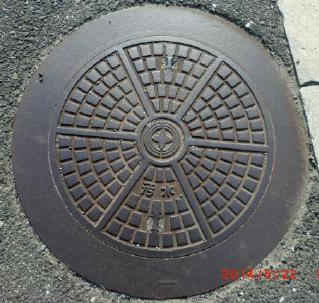
A lid arranged with trapezoids in concentric circles, featuring the city emblem and the characters for 'sewage.' There is a wide receiving frame.
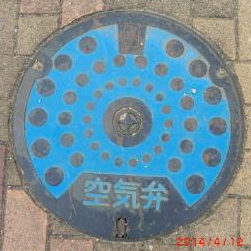
On a blue background, circles increasing in size in three stages are arranged concentrically from the city emblem in the center outward, with the label 'Air Valve' at the bottom. There are lids with the same design but with different text, such as 'Air Valve' and 'Shut-off Valve'.
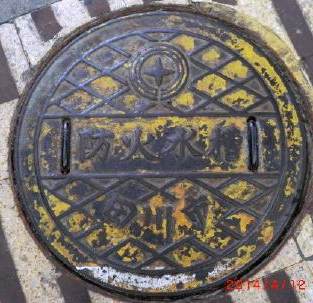
It has a diamond pattern with the city emblem, the inscription 'Fire Prevention Water Tank' and 'Tagawa City,' and handles on both sides.
Related: Tagawa Waterworks Corporation 田川広域水道企業団
Dazaifu 大宰府市
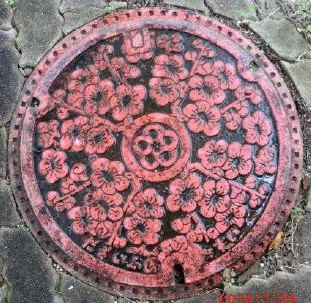
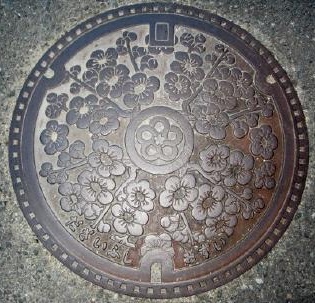
Speaking of Dazaifu, it's the ume (plum) of Tenmangu!?
As expected, the city's flower, the plum, is also depicted on the manhole.
The city emblem is in the center.
At the bottom are the characters 'Dazaifu-shi' and 'Osui'.
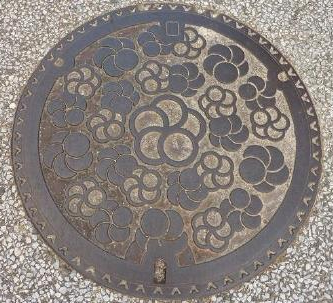
Plums designed in the style of layered plums are drawn all over the lid. Although it is not in color, the texture gives an impression of white and red plums.
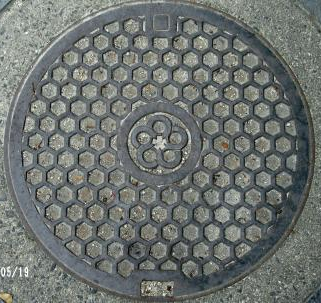
City emblem in the center: A design that places the character '大' of Dazaifu in the center of a plum blossom, the city's flower.
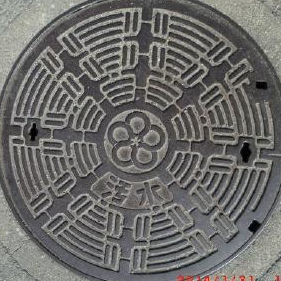
A geometric pattern lid with concentric circles featuring vertical lines and a cross, bearing the city emblem and the characters for 'sewage'.
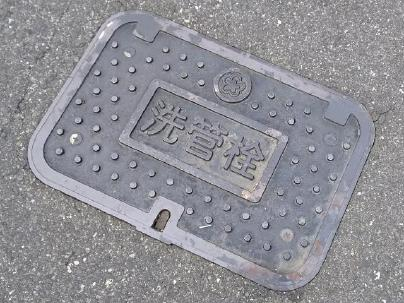
Square lid with polka dot pattern, featuring the city emblem and the words 'Wash Pipe Valve'.
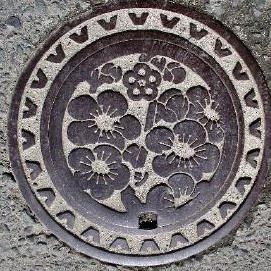
This is a small lid with a plum blossom design. At the base of the plum tree is the character 'シ', and the receiving frame has a V-shaped pattern.
A net-like pattern with the city emblem and the characters 'Shikiriben' (Shut-off valve).
Small shut-off valve cover.
There are covers with the same design but different characters such as 'Shikiriben' (Shut-off valve), 'Dorohakiben' (Mud discharge valve), 'Bataben' (Butterfly valve), 'Kūkūben' (Air valve), and 'Barubu' (Valve).
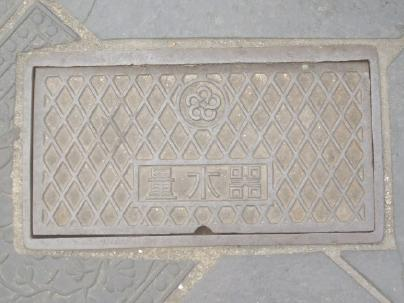
In a diamond-shaped pattern, with the city emblem and the characters 'Water Meter'.
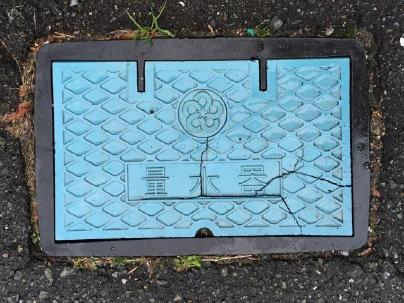
I also found a lid with the city emblem and the word 'water meter.' Unfortunately, it was in a pitiful state because it was made of blue plastic.

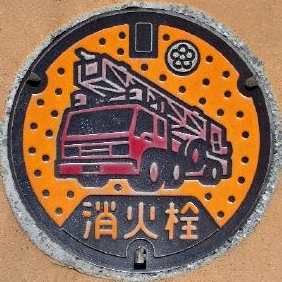
Yellow background with polka dot pattern, featuring the city emblem and the words 'Fire Hydrant.'
Square fire hydrant cover.
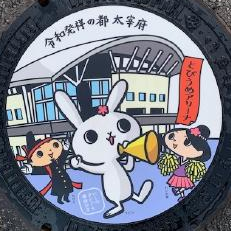
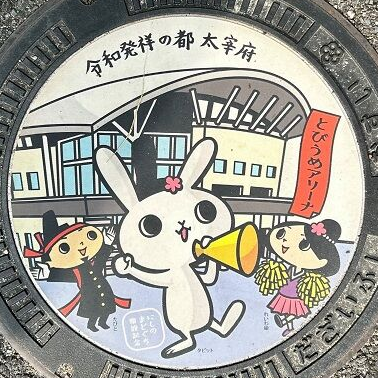
On October 28, three types of 'Reiwa Birthplace Dazaifu' manhole covers were installed. The PR characters are 'Tabibito the Traveler,' 'Reiwa Hime,' and 'Otomo no Tabitto,' with the background being the Tobi-Ume Arena.
The origin of 'Reiwa' comes from Japan's oldest anthology of poems, the 'Manyoshu.' The thirty-two plum blossom poems contained in it were composed here in Dazaifu about 1,300 years ago. The era name 'Reiwa' was taken from the preface of these poems. (From the city website)
Related: Dazaifu 太宰府市
Chikugo 筑後市
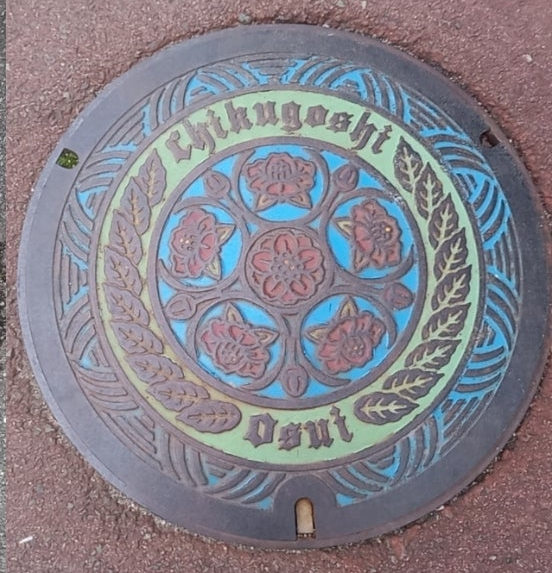
Exhibition cover inside Chikugo City Hall with the above color design.
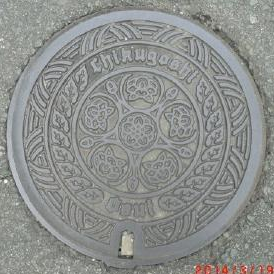
Around the city tree camphor in the center, there is a non-colored design of the city flower sasanqua. The characters 'Cikugoshi' and 'Osui' are said to be in Fraktur, an old German script.
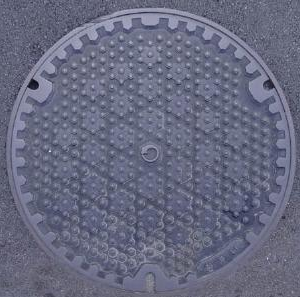
In the center of the ASD (Anti-Slipping Design) type manhole cover manufactured by Hinode Suido Kiki, there is a small city emblem. The only writing is the characters 'おすい' at the lower right edge.
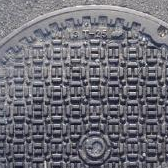
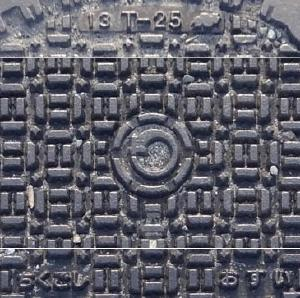
A pattern like [Ni] with a different ASD from the above alternates. In the center is the city emblem, at the upper center are the characters '13 T-25' and the logo of Nagashima Foundry, called 'Enuchi,' and at the bottom are the characters 'Chikugo' and 'Osui'.
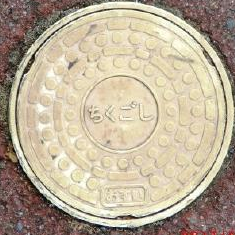
It is a small white plastic piece, with 'Chikugoshi' in the center and 'Osui' at the bottom. The background pattern alternates between circles and rectangles around the circumference.
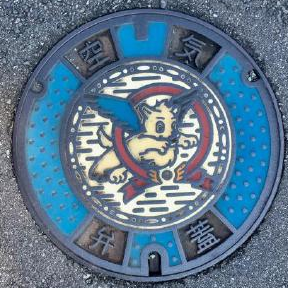
Color design of the Chiku-go. Blue background with polka dots and the words 'Air Valve Cover' around the edge. For Chiku-go, see the fire hydrant below.
Related: Fukuoka Prefecture Southern Waterworks Corporation 福岡県南広域水道企業団
Chikushino 筑紫野市
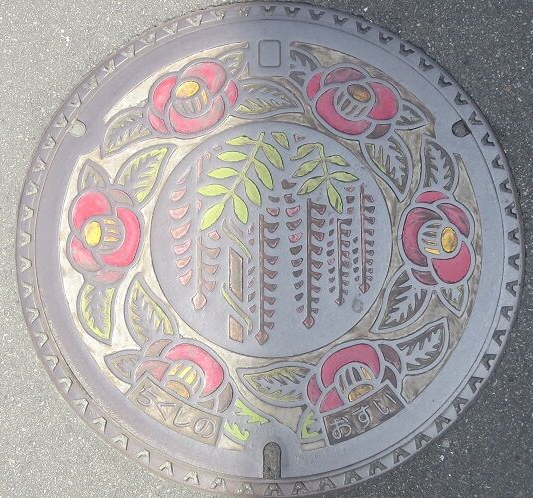
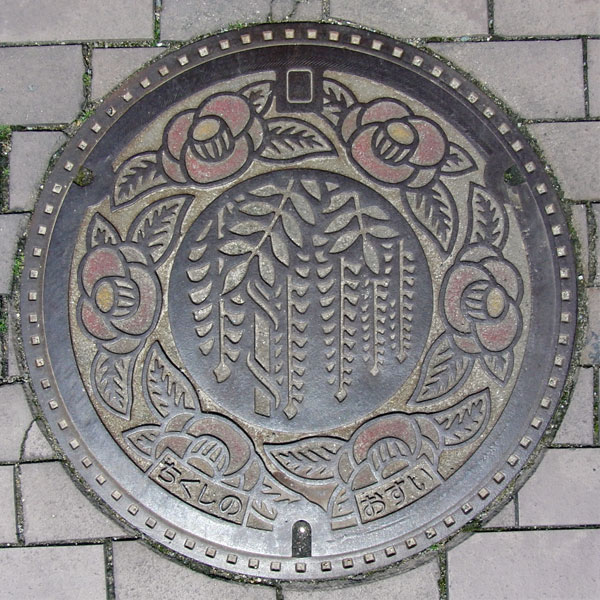
Although it has completely faded, this is a colored manhole cover for sewage featuring the city's flowers, the camellia and wisteria.
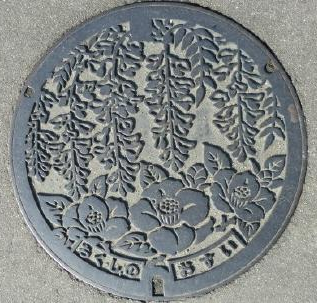
The city's tree, the camellia, and wisteria.
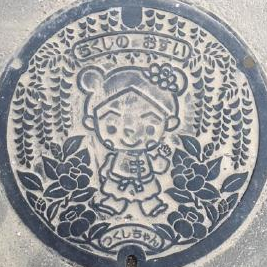
The design features the city's tree, camellia, the wisteria flowers of Musashiji Temple, the oldest temple in Kyushu, and the city's character 'Tsukushi-chan.' The top has the text 'Chikushino Osui,' and the bottom has the text 'Tsukushi-chan.'
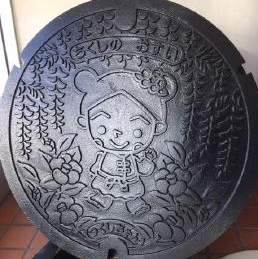
This is the display cover at the entrance of the Chikushino City Water and Sewerage Division. It has the same design as above.
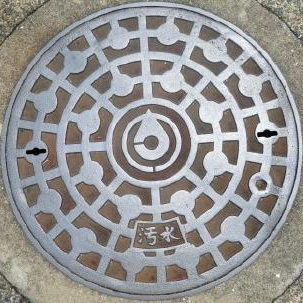
Town emblem and standard pattern with the word 'sewage'.
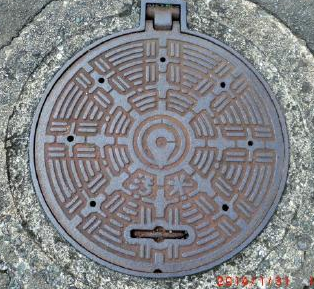
It is a geometric pattern with concentric circles and radial vertical lines forming a cross, with the city emblem and the characters for 'sewage,' and has external hinges.
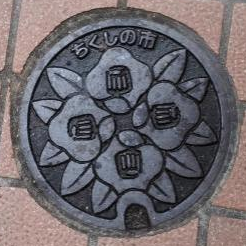
The city's tree, Camellia, has four small flowers.
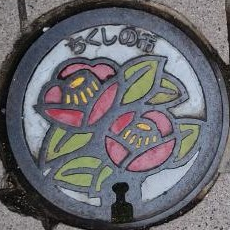
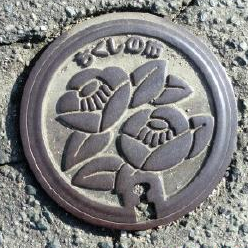
Small cap of the city's tree, camellia.

Polka dot pattern on a blue background, with the city emblem and the words 'Shikiriben.' The receiving frame has a V-shaped pattern.
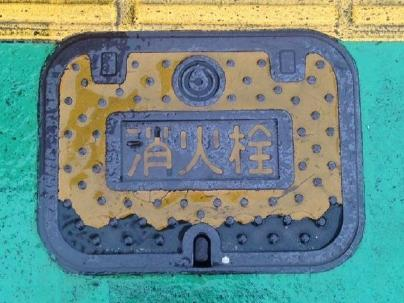
Yellow with polka dots, the city emblem, and the characters 'fire hydrant'.
Nogata 直方市
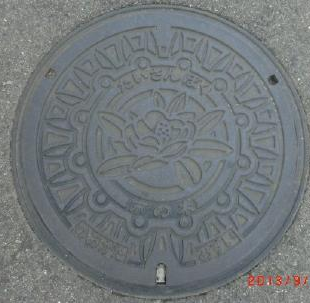
The city's tree, 'Tai-san-boku,' is depicted.
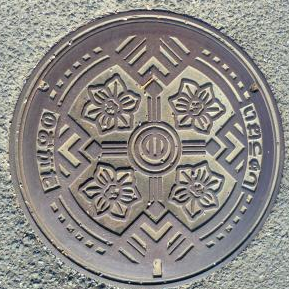
Around the city emblem, four flowers of the city's winter flower, the 'daffodil,' are arranged. By the way, the city's flowers are tulips in spring, lilies in summer, and cosmos in autumn. At 9 o'clock is the text 'Noogata,' and at 3 o'clock is the text 'Shuhai.'
Nakagawa 那珂川市
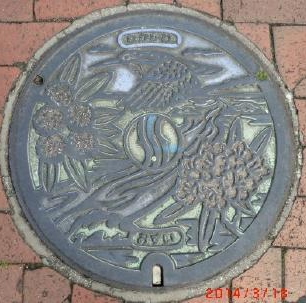
Exhibit cover at Nakagawa Town Hall (now City Hall) at the time of the photo shoot. Color version of the above design.
Related: Fukuoka District Water Supply Corporation 福岡地区水道企業団
Nakama 中間市
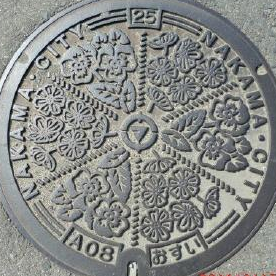
The following is the response from the Sewerage Division of the Water and Sewer Bureau:
"This was created by commissioning a manhole company to design it based on the city's flowers, cosmos and pansy."
The cover is divided diagonally into six sections, alternating the city's flowers, cosmos and pansy. In the center are the city emblem, "NAKAMA CITY," "25," "A08," and an indication for sewage.
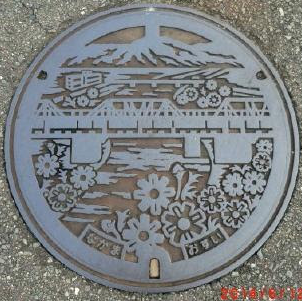
Explanation from the Sewerage Department of the Waterworks and Sewerage Bureau: 'This is a design cover that the city used until fiscal year 2007, depicting a view of the JR elevated bridge from the riverbank of the Onga River in Chukan City.' The city's flower, the cosmos, is also depicted.
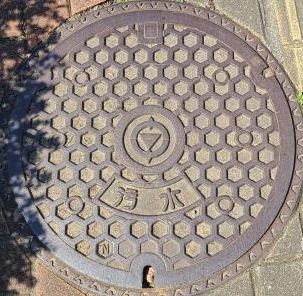
Tortoiseshell pattern, city emblem in the center, 'Sewage' below it, small 'N' near the 7 o'clock position.
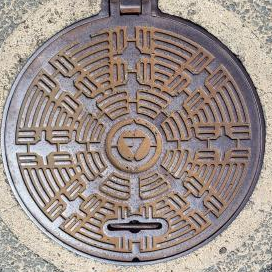
Manhole cover with city emblem and external hinge, with handle at the bottom.
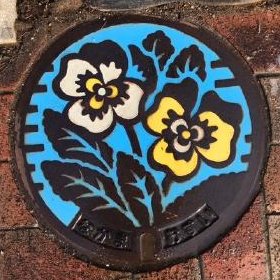
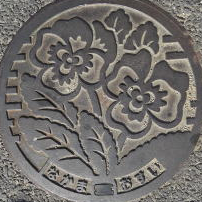
A small lid with external hinges, decorated with the town's flower, the pansy. Markings read 'Nakama-A' and 'Osui 09'.
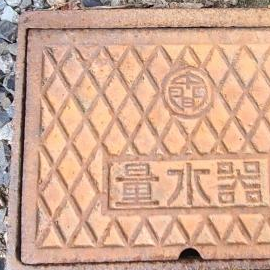
This is a somewhat old water meter cover from Nakama City. It has a diamond background pattern, the characters '水量計' ('Water Meter'), and a mark designed with '(Nakama)' instead of the city emblem. It seems to be a cover from the Nakama Town era, which existed until November 1, 1958 (Showa 33).
Fukutsu 福津市
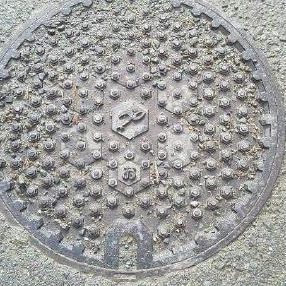
ASD (Anti-Slipping Design) ground pattern, city emblem in the center, with a small 'o' character below it.
Former Tsuyazaki 旧津屋崎町
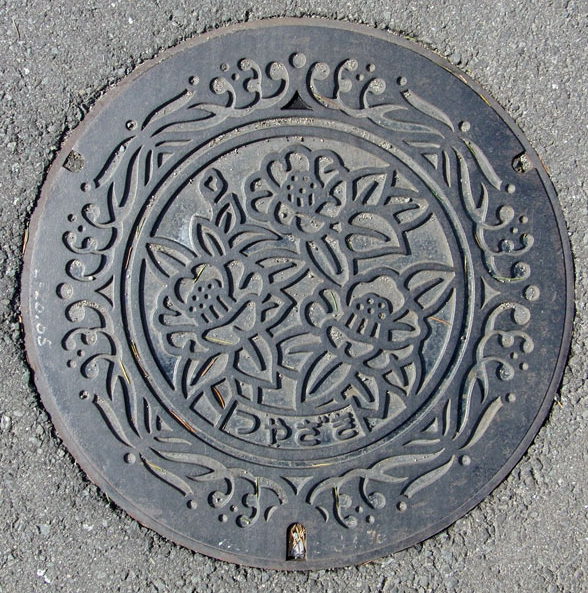
The town's flower, 'camellia,' is depicted.
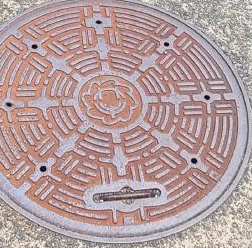
This is a manhole cover with the first-generation town emblem of the former Tsuyazaki Town, featuring external hinges. The background pattern resembles a complicated spider web design.
Former Fukuma 旧福間町
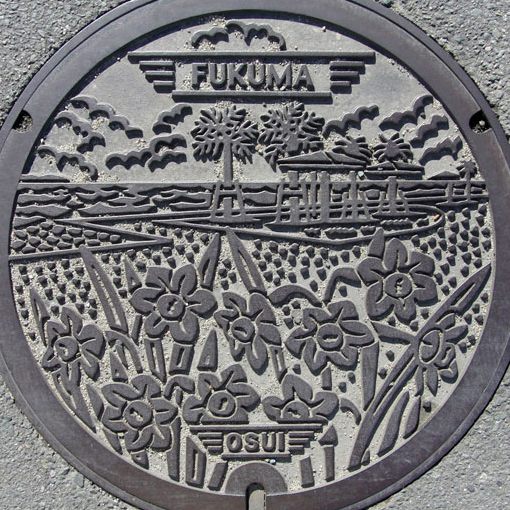
A lid depicting the scenery around Fukuma Fishing Port Seaside Park and the town's flower, the daffodil.
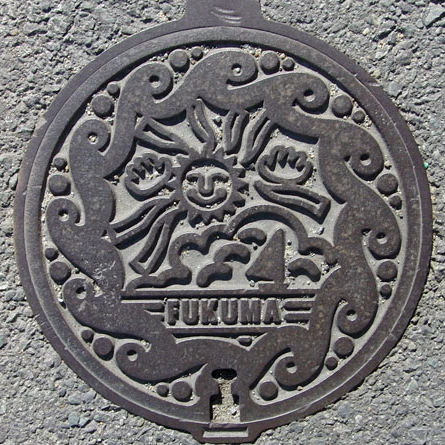
A small disc depicting waves, the sun, and a yacht.
Buzen 豊前市
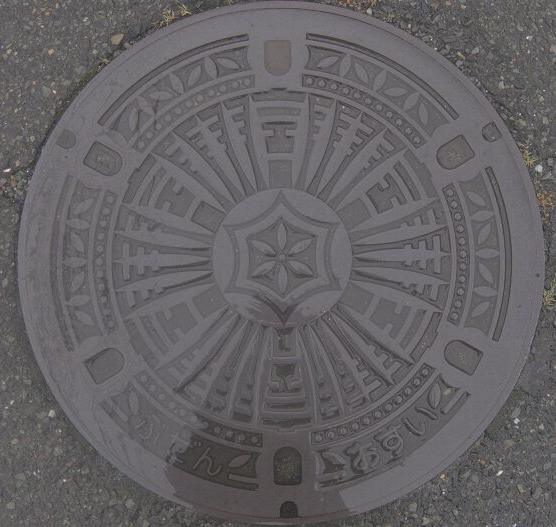
The fruit and leaves of the city's tree, the Chinese bayberry, are designed geometrically. The labels read 'Buzen' and 'Wastewater'.
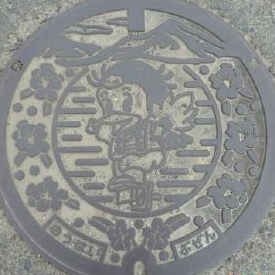
Mount Kubote, where training was conducted as a sacred mountain of Shugendo, and the city's mascot 'Kuboten,' inspired by the crow tengu associated with the mountain, along with the city's flower, Tsukushi rhododendron. The notations 'Nohai' and 'Buzen'.
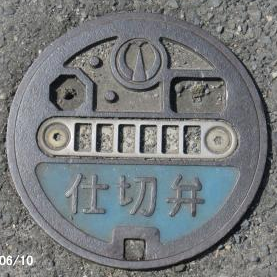
Water valve handhole cover. From the top, the city emblem, only the frame for purpose and size, only the number frame, the characters 'Shikiriben' on a blue background.

On an orange background with polka dots, the city emblem, a ladder truck, and the word 'Fire Hydrant' with a number frame.
City emblem: The 'bu' of Buzen is stylized into a crane shape, symbolizing future development. From the city's website.
Miyama みやま市
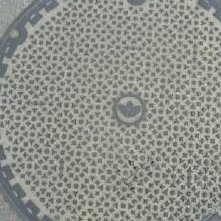
Nagashima cast metal ASPS with the city emblem. The characters 'Miyamashi' and 'Osui'.
Former Yamakawa 旧山川町
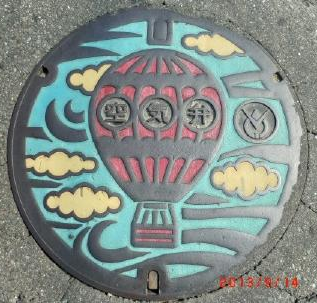
It is a design with a white cloud floating in the blue sky, a bright red balloon, and the town emblem, with the word 'air valve' written on the balloon.
The following information is from the Miyama City Hall, Water and Sewerage Division, Water Supply Section:
When we inquired with the staff who were in charge at the time, we were told that it was an image from the manufacturer's catalog with the Yamakawa Town emblem added. It seems it was not particularly intended to have any special meaning by using the image of a balloon.
In the pattern where semicircles drawn from the left and right overlap, there are the characters 'Water' and 'Air Valve,' and the surrounding area has a blue background with a scattered square pattern and the words 'No Parking.'
Former Setaka 旧瀬高町
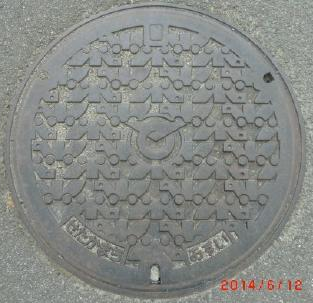
The design of the town emblem and the traditional craft item, a spinning wheel. The characters 'Setaka-machi' and 'Osui'. Nowadays, most manhole covers have been changed to ASD, and I finally found one in a small alley of older houses.
Related: Fukuoka Prefecture Southern Waterworks Corporation 福岡県南広域水道企業団
Miyawaka 宮若市
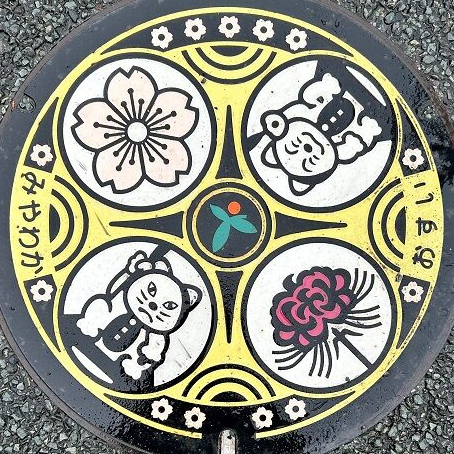
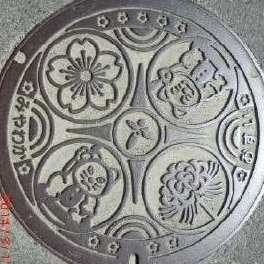
The design of the city's flower, the red spider lily, the city's tree, the cherry tree, and the city's specialty product 'Oideshi Neko,' which was announced on February 22, 2008, surrounding the city emblem. It seems to be named Sakura-chan.
In the center of the ASD (Anti-Slipping Design) type ground pattern manufactured by Hinode Waterworks Equipment, there is a small city emblem. On the upper edge, there is the model number '13T-25' and the logo of the manufacturer, Hinode Waterworks Equipment, and on the lower edge, the characters 'Miyawaka' and 'Osui' are inscribed.
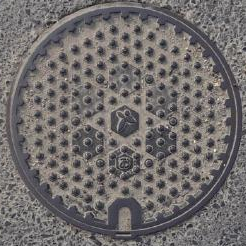
It is a patterned manhole cover of the ASD (Anti-Slipping Design) type manufactured by Hinode Suido Kiki, the same as above, but under the city emblem in the center, there is the character 'お' indicating it is for sewage. There is no information about the city name, model number, or manufacturer.
Former Miyata 旧宮田町
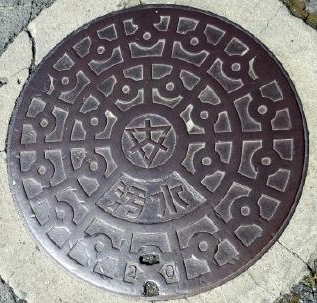
The old Miyata town emblem and the standard pattern with the word 'sewage'.
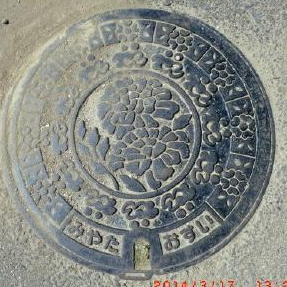
In the center is the old town's flower, the marigold. The pattern around it that looks like an 'M' is the symbol mark of the former Miyata Town. The outermost pattern is a stylized (abstracted in a cartoon-like way) version of the marigold. (From Miyawaka City Hall, General Policy Division) The inscriptions 'Miyata' and 'Osui'.
Former Wakamiya 旧若宮町
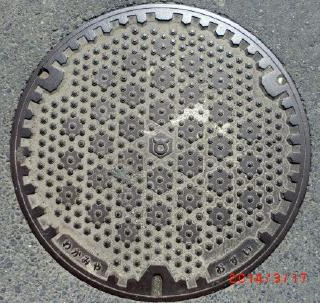
"The characters 'Wakamiya' and 'Osui' with the old Wakamiya town emblem on ASD (anti-slip pattern)."
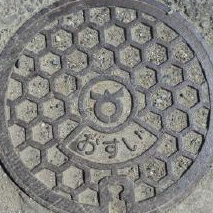
A small version featuring the old Wakamiya town emblem and a tortoiseshell pattern with the characters 'Osui'.
Munakata 宗像市
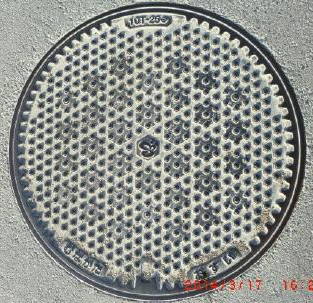
ASD (slip-resistant) manhole with city emblem. Labeled 'Munakata' and 'Sewage'.
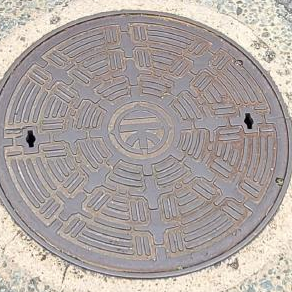
In the center, there is a mark that looks like (Sō), but it does not seem to be the city emblem. What is this mark?
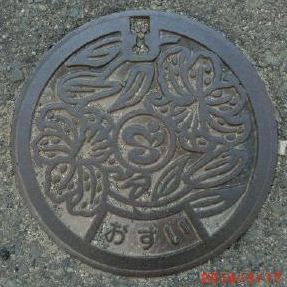
A small lid of the city's flower, Kanokoyuri, bearing the city emblem. Labeled 'Osui'.
Former Munakata 旧宗像市

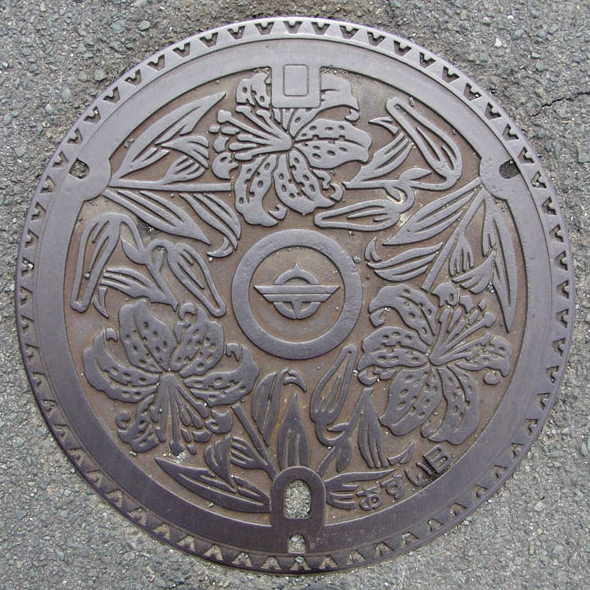
The city's flower, 'Kanoko Lily,' is depicted. The characters 'おすいC'.
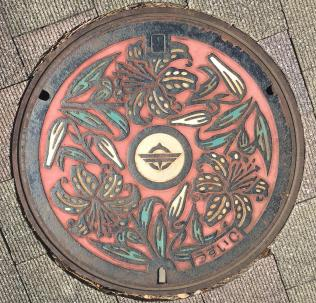
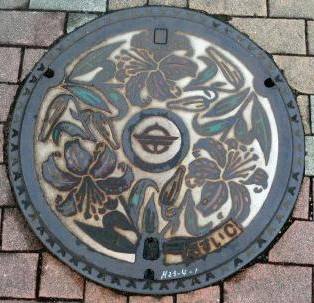
Design of the city flower Kanoko lily with the old Munakata city emblem. The text 'Usui A' is included at the bottom. A (25 tons)
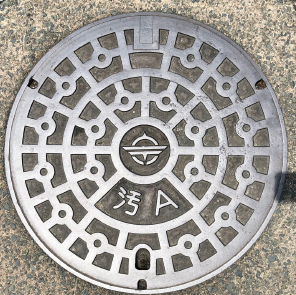
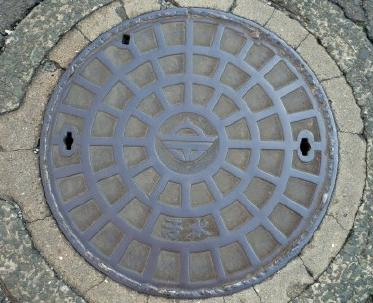
In the center of the standard lid is the former Munakata City emblem, and at the bottom are the characters '汚A'.
With the old Munakata city emblem. The characters for 'wastewater'.
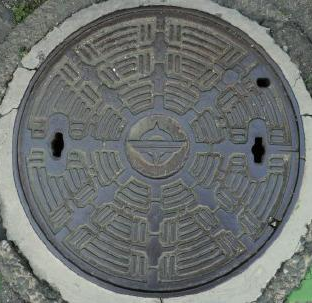
With the old Munakata City emblem.
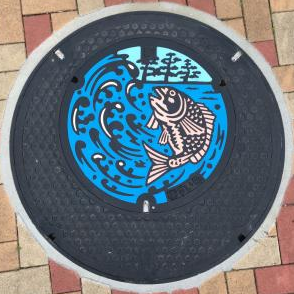
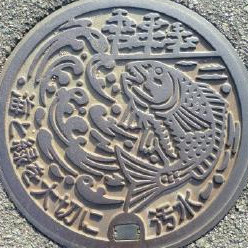
A design of rough waves and sea bream. A pine forest is depicted above the sea bream. The notation 'Osui'.
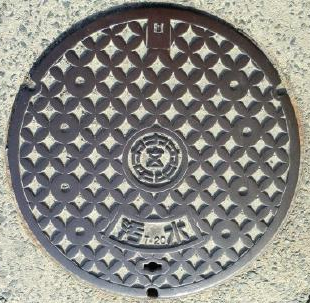
With a cloisonné pattern, marked with the old Genkai town emblem and the notation 'Sewage T20'.
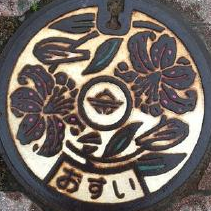
The Kanoko lily has two colored lids. There is a keyhole at 12 o'clock and the word 'おすい' at 6 o'clock.
Yanagawa 柳川市
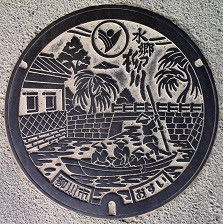
The city emblem of Yanagawa and a scene of boating in the water town of Yanagawa are designed. The characters 'Yanagawa City' and 'Osui'.
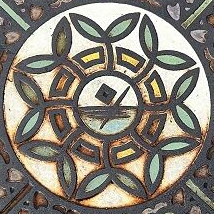
This is a manhole cover used in the joint sewerage project of the former city and the former Mitsuhashi Town, designed with the symbol of the former city and the wisteria flower of the former Mitsuhashi Town. This is the last post for this year. Thank you for stopping by throughout the year. Wishing you a bright New Year.
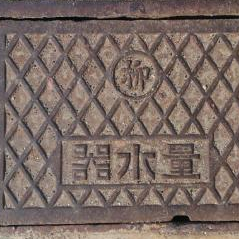
It seems to be an antique lid from the 'Yanagawa Town' era, which existed until the city was established in 1952 (Showa 27). It is a square lid with a diamond-patterned background, with the character 'Yanagi' on top and the characters 'Water Meter' written from right to left at the bottom.
This is the cover of the stopcock that was near the water meter. It also has the character 'Yanagi' on it.
Former Yanagawa 旧柳川市
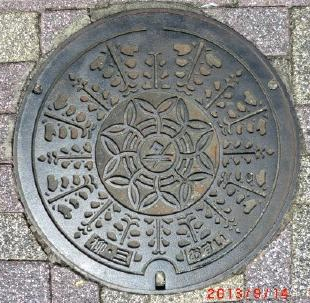
The following is an explanation from the Sewerage Division, Construction Department of Yanagawa City:
"These are manhole covers used in the sewerage projects implemented since 1981 as part of the former Yanagawa City and part of the former Mikasa Town joint association. Since there were no detailed materials available, we conducted interviews with the person in charge at the time the design covers were adopted (presumed to be in 2000), and based on that, the following is assumed. The symbol in the center is the emblem of the former Yanagawa City. The two leaves surrounding it represent the city crest (using the character 'や' to symbolize willow), and the two lines connecting them and the circle represent the 'three' of former Mikasa Town. The grape-like clusters on the outer edge represent the wisteria, which was the town flower of former Mikasa Town." The covers also include the characters 'Yanagawa・Mikasa' and 'Sewage'.
Related: Fukuoka Prefecture Southern Waterworks Corporation 福岡県南広域水道企業団
Yame 八女市
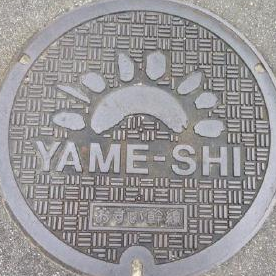
A design combining the city's symbol mark and "YAME-SHI" is placed on a lid with an Ajiro-patterned character design. The symbol mark represents the sunrise and nature, and is inspired by a passage in the Nihon Shoki that says, 'In this region, there is a goddess named Yame-tsuhime, who always dwells in the mountains,' which is said to be the origin of the name Yame. The design features eight goddesses along the mountain ridge. (Part of the comment is from the Yame City Waterworks and Sewerage Bureau)
Former Kurogi 旧黒木町
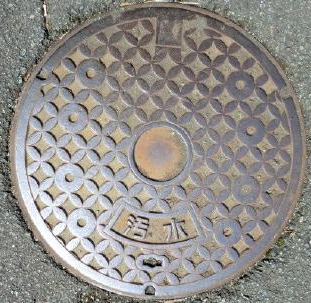
A ground pattern with petals and circles here and there, with the label 'sewage'.
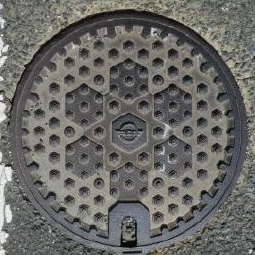
Hand hole of ASD with the former Kuroki town emblem.
Related: Fukuoka Prefecture Southern Waterworks Corporation 福岡県南広域水道企業団
Yukuhashi 行橋市

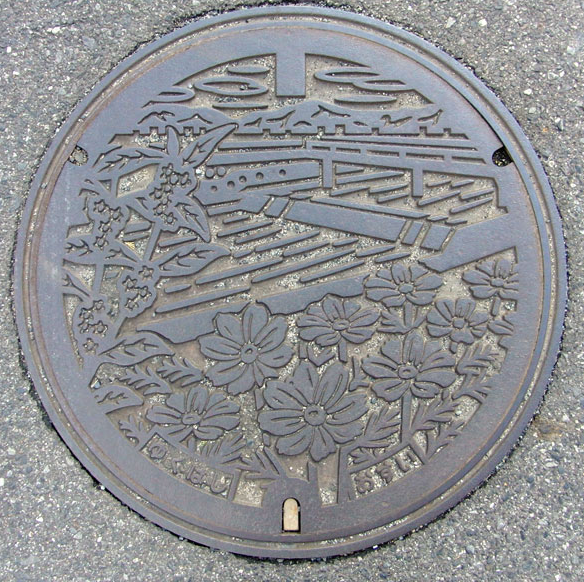
Against the backdrop of the Imagawa River flowing through the city, the city's tree, the Osmanthus, and the city's flower, the Cosmos, are depicted.
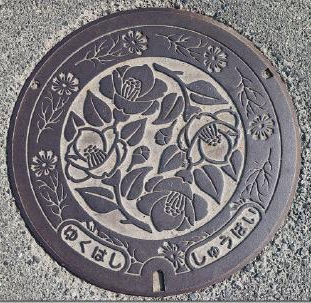
The outer perimeter is decorated with the city's flower, 'cosmos,' and inside are four camellia flowers, reflecting the names of the local areas. At the bottom are the characters 'Yukuhashi' and 'Shuhai.'
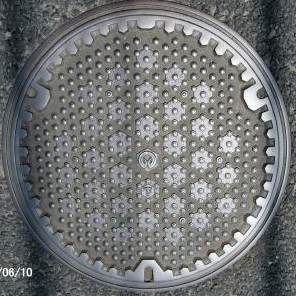
Slip-resistant, ASD sewage pipe manhole cover. In the center are the city emblem and the character "下".
Yukuhashi City Emblem: The character "行" from Yukuhashi is rounded to represent a harmonious city administration, while also symbolizing a growing large tree and a burning flame, representing the city's enthusiastic citizens and symbolizing progress and prosperity. From the website.
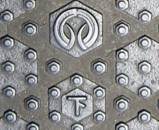
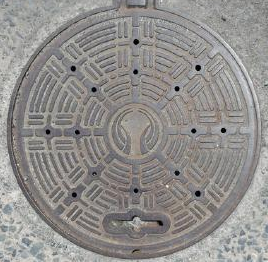
The city emblem is placed in the center. The background pattern combines eight radial lines with concentric circles, where the concentric circles are grouped in threes, and holes are present at the intersections of the concentric circles and radial lines that separate these groups. Short lines are placed in pairs along the radial lines on the outer and central concentric circles. It is a manhole cover with a hinge on the outside and a keyhole at the bottom center.
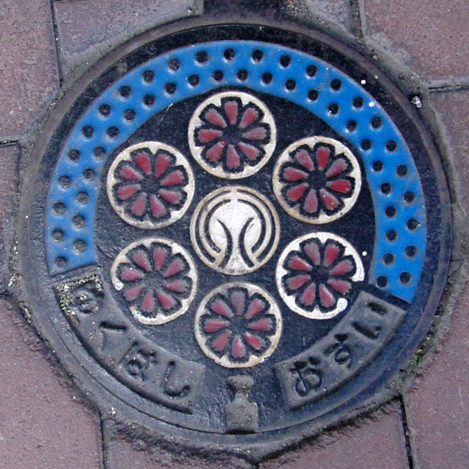
A handhole cover with only cosmos flowers and the city emblem.
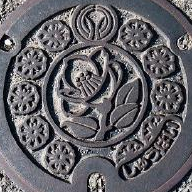
The city emblem on the part, with a single camellia in the central circle, surrounded by the city's flower, cosmos. The characters 'しゅうはい' are at the bottom right.
Sewage manhole cover (17 cm)
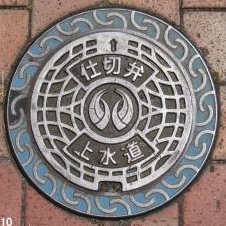
A small water valve cover with a geometric pattern, featuring a 'stop valve,' the city emblem, and 'water supply'.
Dazaifu 太宰府市
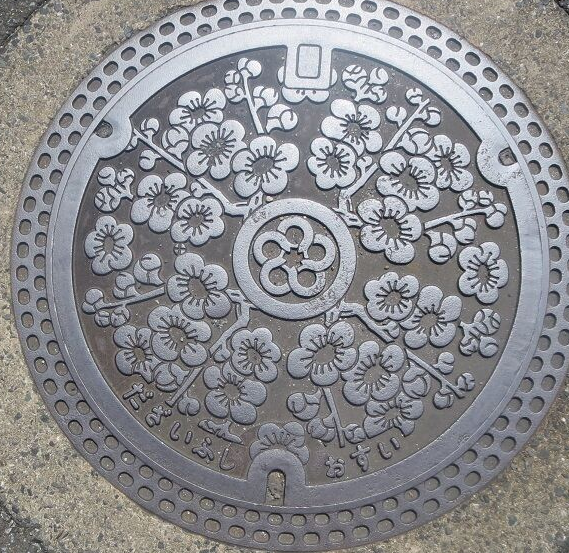
The city emblem and the city's flower, the plum, are designed.
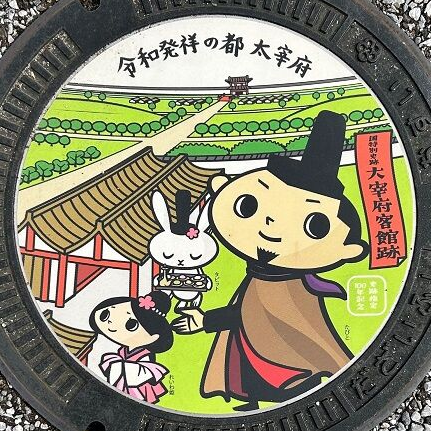
Designed along with the next two lids are the PR characters of 'Reiwa Birthplace Dazaifu,' 'Tabibito no Tabito' and 'Reiwa Hime,' as well as 'Otomo no David.' + Kakukan-ato Historic Site Square.
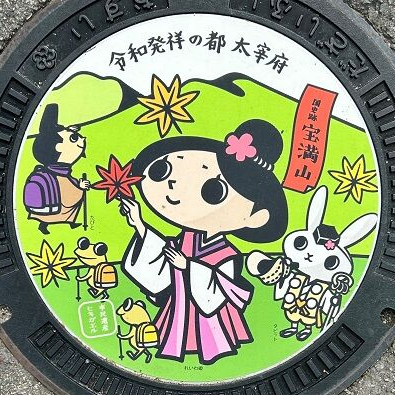
+ Mount Hōman
+Tobiume Arena.
Related: Dazaifu 大宰府市
Ashiya 芦屋町
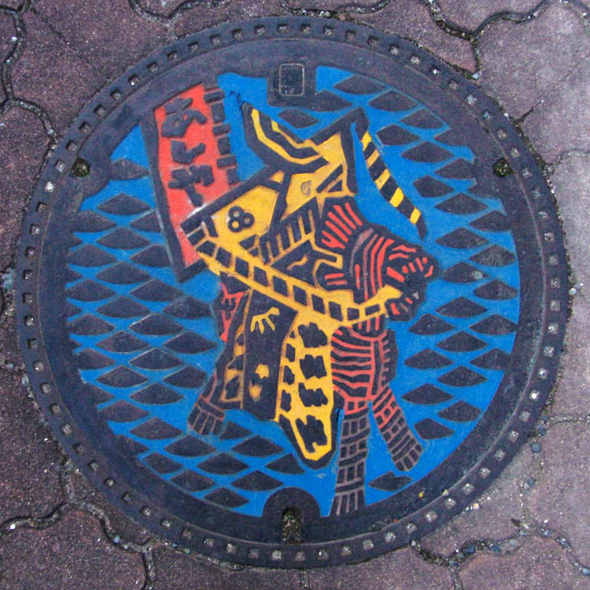
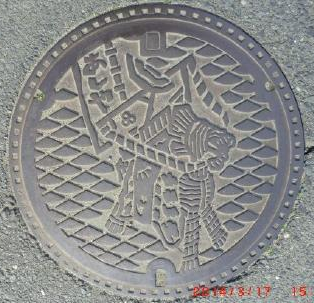
The 'Hassaku Horse' is depicted. Hassaku refers to the first day of the eighth month in the lunar calendar, which corresponds to September 1 today. In households with a newborn boy who is celebrating this day for the first time, this Hassaku Horse is displayed to wish for his healthy growth and success. The straw horse is adorned with paper warrior dolls and banners.
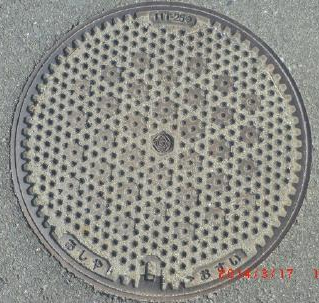
ASD (slip-resistant) pattern with town emblem. Labels 'Ashi-ya' and 'Osui'.
A standard lid that looks like a combination of vertical and horizontal lines, with the town emblem.
Lid with standard pattern and town emblem. Marked '14'.
It looks like an antique manhole cover from before the war, but it is a beautiful manhole cover. The ground pattern has a radial design divided by concentric circles, with a rounded '芦' character inside the central circle.
Itoda 糸田町
This is a standard gate valve without a municipal emblem or municipality name. It has a cobweb-like pattern with the words 'Potable Water,' 'Water,' and 'Gate Valve'.
Related: Tagawa Waterworks Corporation 田川広域水道企業団
Umi 宇美町
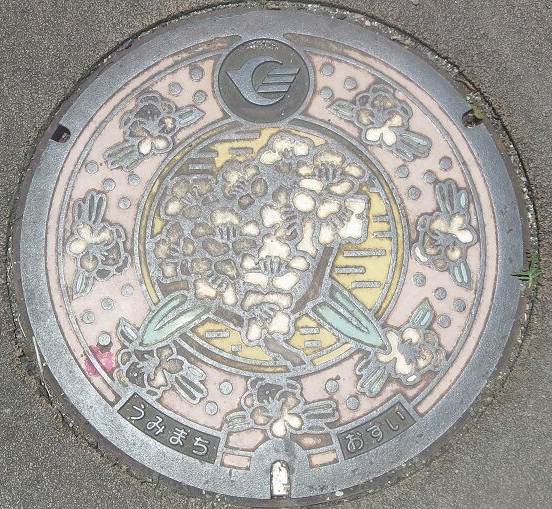
Design of the town emblem and the town flower, Tsukushi Shakunage. Displays of 'Umimachi' and 'Osui'.
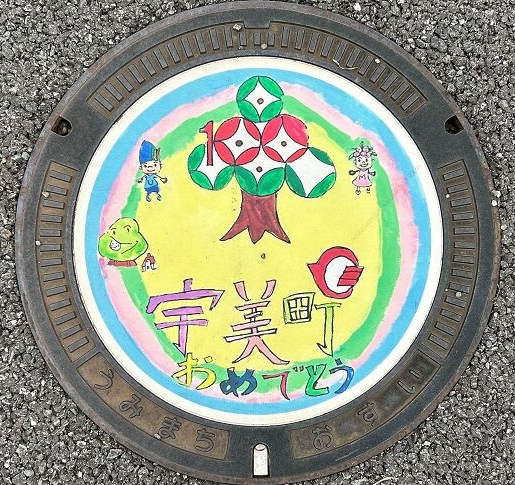
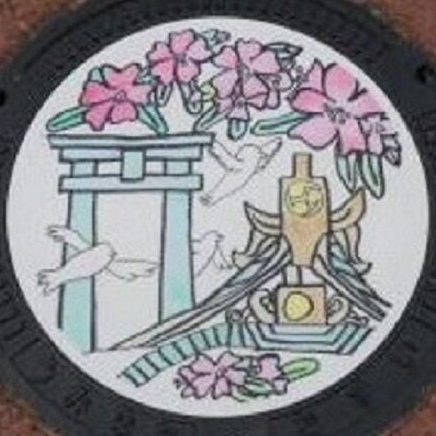
The five excellent works from the 'Sewerage Promotion Poster Contest' aimed at 4th graders of five elementary schools in the town have been turned into manhole covers, with one installed in each school district. They depict Umi Hachiman Shrine and the town flower, Tsukushi Shakunage.
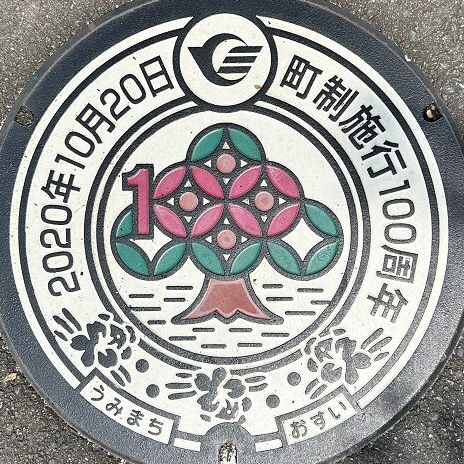
A small item featuring the town's flower, Tsukushi Shakunage. Displays 'Umimachi' and 'Osui'.
Related: Tatara River Basin Sewer 多々良川流域下水道
Okagaki 岡垣町
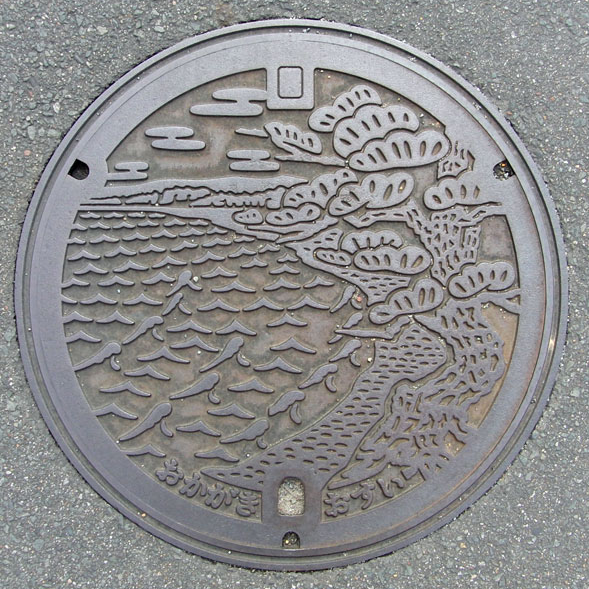
I think it depicts the scenery of Ebizu Coast...
*I found out thanks to the manhole card, but apparently this scenery is "Sanri Pine Grove."
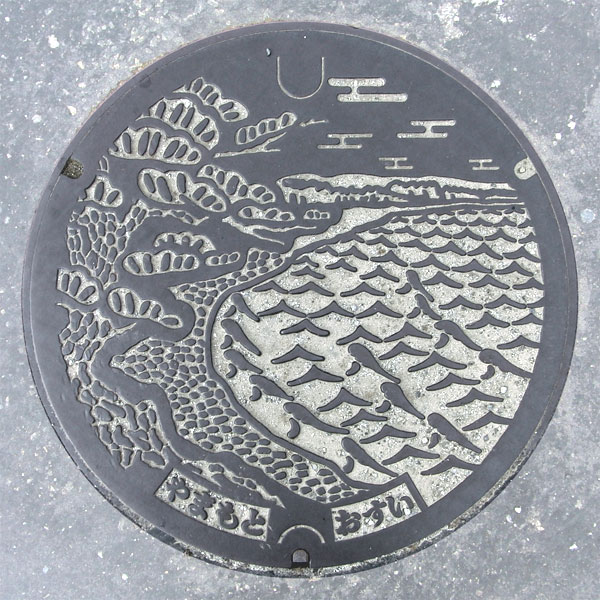
The manhole cover on the left is from Yamamoto Town, Watari District, Miyagi Prefecture.
You can tell at a glance, but it looks very similar to the one from Okagaki Town. The differences are that the left and right are reversed (if you hover your pointer over the left image, a horizontally flipped image will appear, so give it a try), the elevation between sky and land is reversed, and the number of clouds and the shape of the pine branches are slightly different.
It doesn't seem that they have a sister city relationship, though...
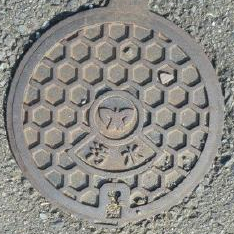
A small hexagonal-patterned lid with the town emblem in the center and the characters 'sewage' just below it. It is the type with the top and bottom of the receiving frame protruding to fit in.
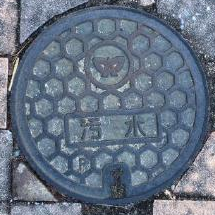
A small cover with a tortoiseshell pattern, the town emblem on top, and the characters 'sewage' below.
Onga 遠賀町
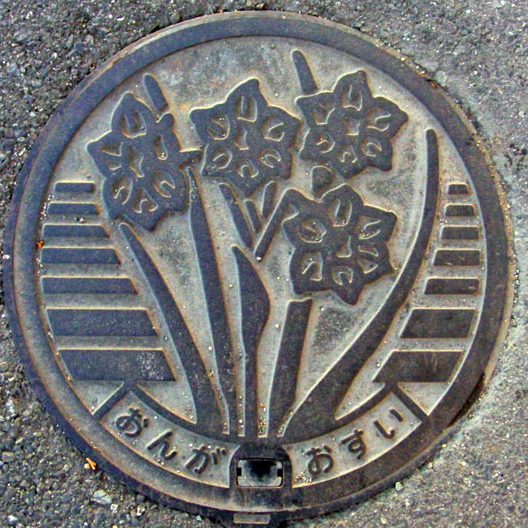
A small board featuring a drawing of daffodils. Only the central part of the top lid is used.
Kasuya 粕屋町
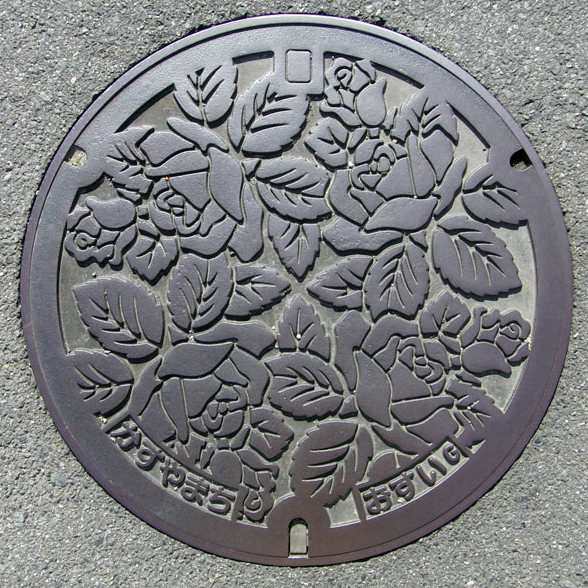
A sewage manhole cover depicting the town's flower, the 'rose'.
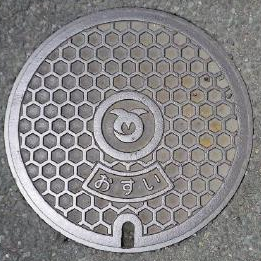
Medium size with a tortoiseshell pattern, town emblem, and the characters 'おすい'.
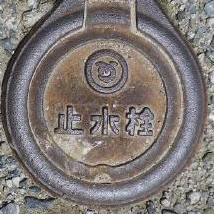
With the town emblem and the characters '止水栓' (stop valve) inscribed.
Related: Tatara River Basin Sewer 多々良川流域下水道
Kawasaki 川崎町
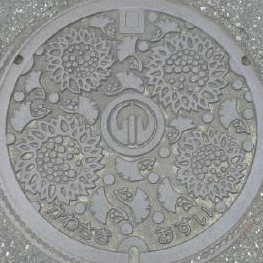
Around the town emblem, the ginkgo leaves and fruits of the town tree and the sunflower of the town flower are depicted. The characters 'Kawasaki' and 'Osui'.
Related: Tagawa Waterworks Corporation 田川広域水道企業団
Kanda 苅田町
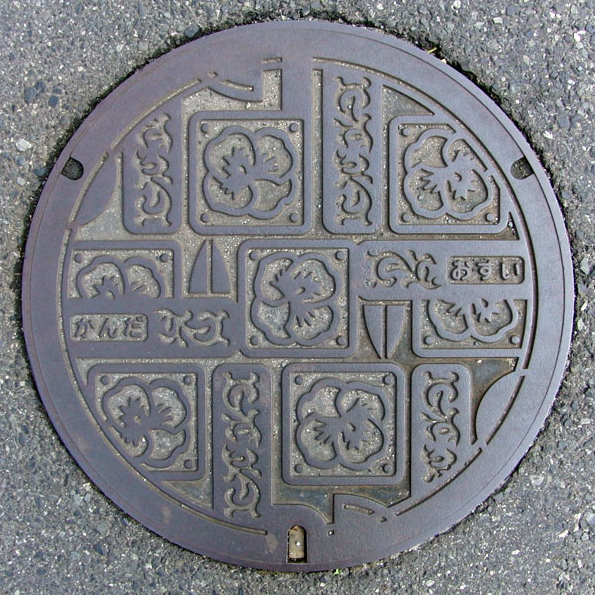
A lid depicting the town's flower, the 'pansy.' Kyoto District is read as 'Miyako-gun.'
The combination of the town's flower 'pansy' and the town emblem.
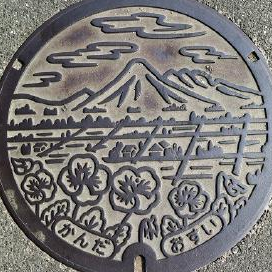
Kanda Town has Kitakyushu Airport, an international port (Kanda Port), and famous automobile manufacturing factories, so it has a strong image as an industrial city. However, along the Konose River, a peaceful rural area spreads out. This is a cover for agricultural village drainage, featuring the town's 'rural landscape' and the town flower, the 'pansy,' in its design. At the bottom are the characters 'かんだ' and 'おすい'.
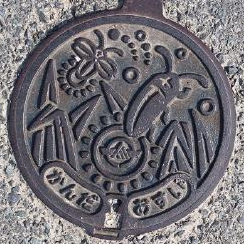
It is a sewer grate cover. The town emblem is depicted within a ring of firefly lights. At the bottom are the characters 'Kanda' and 'Osui'.
Kurate 鞍手町
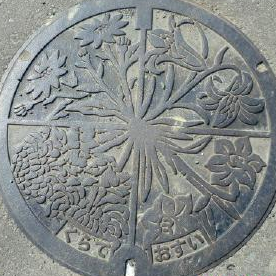
Clockwise from the top, the town's flowers—lily, daffodil, chrysanthemum, and forget-me-not—are depicted, with the labels 'Kurate' and 'Osui.' Four types of town flowers have been designated.
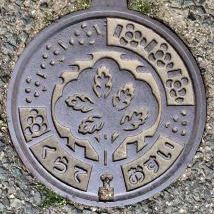
It is a small item with a town camphor tree depicted in the center. The characters 'Kurate' and 'Osui'.
Keisen 桂川町
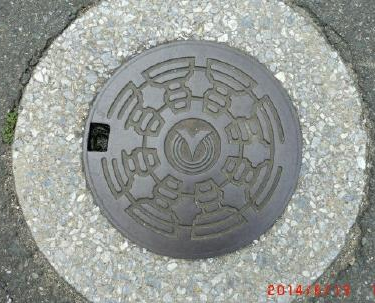
A pattern of concentric circles with vertical and horizontal lines, along with the town emblem and the characters for 'sewage'.
Koge 上毛町
Former Shinyoshitomi 旧新吉富村
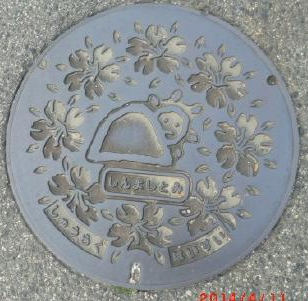
The azaleas of the old village, the Anagahabayama Kofun, and the sun. The notations 'Shin Yoshitomi' and 'Shūraku Haisui'.
Former Taihei 旧大平村
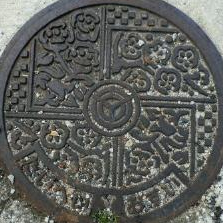
A design featuring the old village emblem, the old village flower sasanqua camellia, and the village tree plum. Labels 'Taihei' and 'Osui'. This is the agricultural community drainage project for the Yatsunami and Yoshioka districts / Tosai district.
Kotake 小竹町
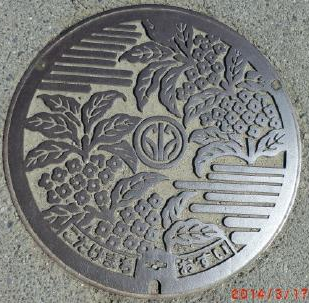
Around the town emblem, the town's tree, the fragrant olive.
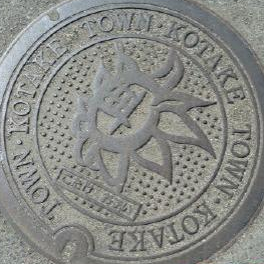
A sign on the town's flower, the sunflower, reads 'Kotake Osui' and 'TOWN・KOTAKE'.
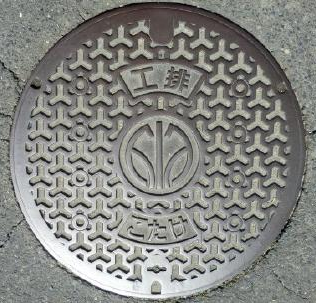
Tetrapod pattern with the town emblem and the markings 'Kōhai' and 'Kotake'.
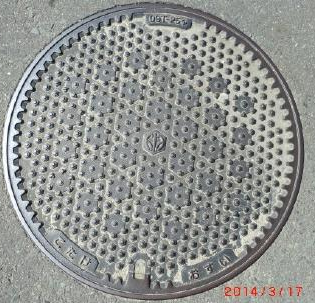
Anti-slip pattern with the city emblem and the display 'Kotake Osui'.
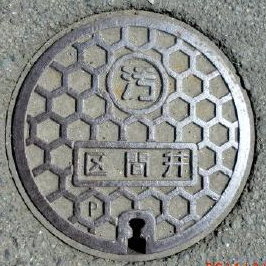
A hand hole with a hexagonal pattern and a display of a 'section valve.' A 'section valve' is a valve installed to divide the pipeline for the maintenance and management of the pipeline that conveys sewage sucked into a vacuum valve from the vacuum valve unit to the vacuum station.
Sasaguri 篠栗町
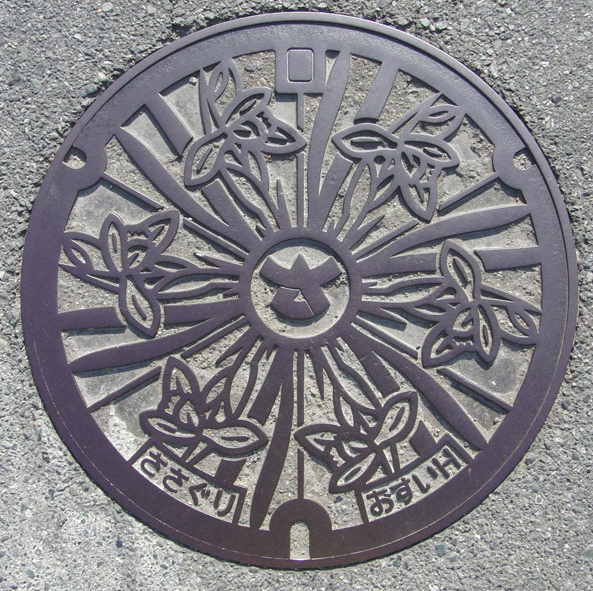
A sewage manhole cover depicting the town's flower, 'Shunran'.
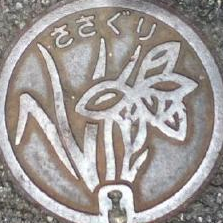
Design of the town flower, the spring orchid.
Related: Tatara River Basin Sewer 多々良川流域下水道
Shime 志免町
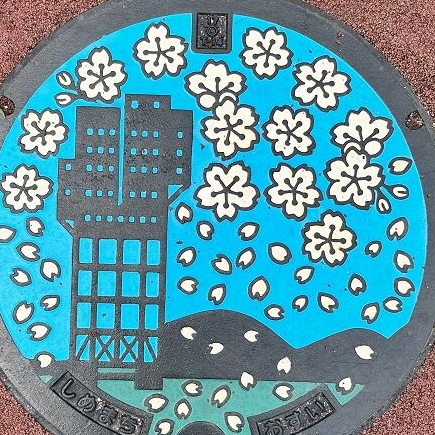
The color design of the town flower, cherry blossoms, and the Shime Mining Plant Headframe. (Manhole Card, 5th series) The characters 'Shime-machi' and 'Osui'.
*The Shime Mining Plant Headframe is a remnant of the Shime Mining Plant (Shime Coal Mine) located in Shime Town, Kasuya District, Fukuoka Prefecture. It is designated as an Important Cultural Property of Japan due to its high value in the history of modern construction technology. (From Wikipedia)
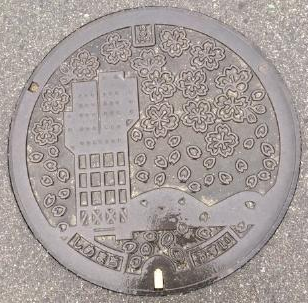
Last year, color manholes and manhole cards were released, but I also found one in black and white.
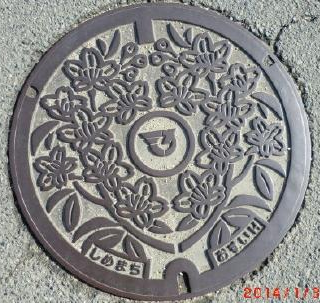
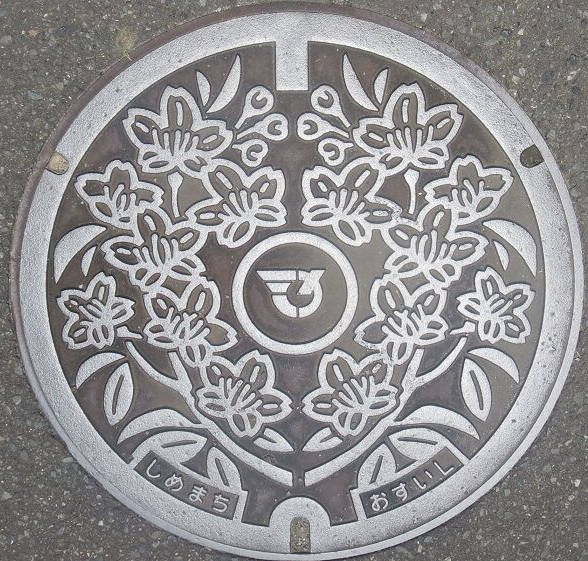
A design of the town's flower, the cherry blossom, around the town emblem. The characters 'Shimemachi' and 'Osui 14'.
There was a lid with the above design inside a glass table. The wall, arms, and camera are reflected, so it may be hard to see. By the way, there is also a lid inside a glass table in Kamagaya City, Chiba Prefecture.
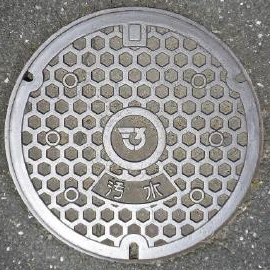
Tortoise shell pattern, town emblem, and the word 'sewage,' medium size.
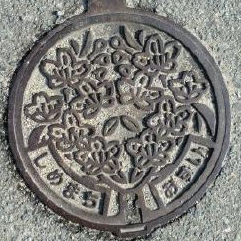
Small lid with external hinges featuring a design of the town's flower, cherry blossoms. Labeled 'Shime-machi' and 'Osui'.
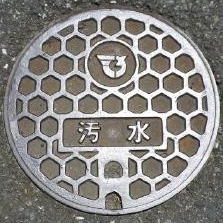
Tortoise-shell pattern, with the town emblem and the characters for 'sewage,' small size.
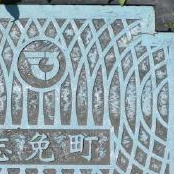
Made of light blue plastic with the town emblem and the characters 'Shime Town'. Background pattern forms semicircles from the left and right.
Related: Tatara River Basin Sewer 多々良川流域下水道
Shingu 新宮町
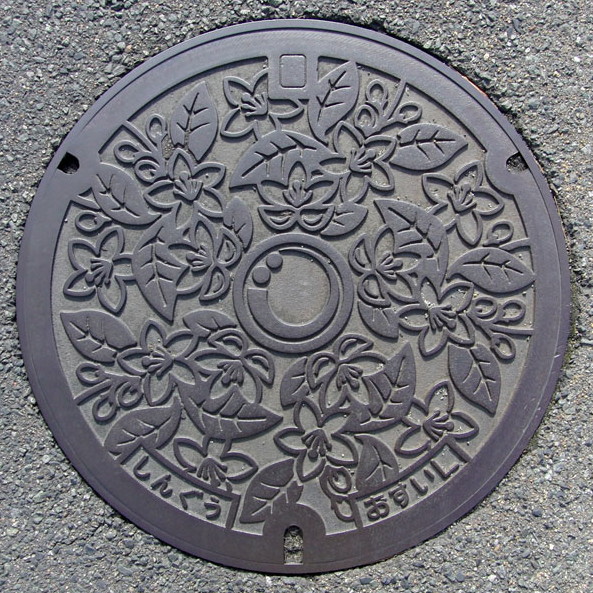
A sewage manhole cover with a depiction of mikan (mandarin orange) flowers.
Standard cover, town emblem in the center, the word 'sewage' on the right.
A pattern that looks old.
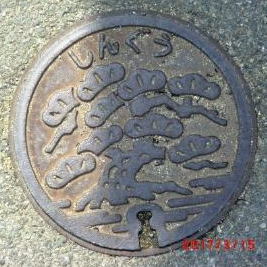
Small model of Machiki's pine design. Labeled 'Shingū'.
There is an upward-pointing arrow with the town emblem in the center, with the word 'Waterworks' above it and 'Shutoff Valve' below it.
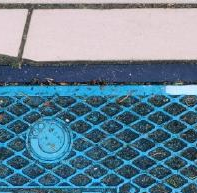
A blue square lid with a diamond mesh pattern, bearing the town emblem and the inscription 'Water Meter'.
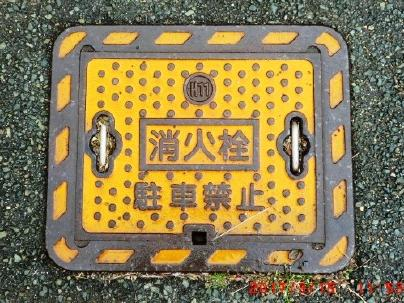
A square cover with polka dots arranged on a yellow background, 'Fire Hydrant' in the center, 'H11' above, and 'No Parking' below. The frame has yellow and iron cover diagonal stripes.
Sue 須惠町
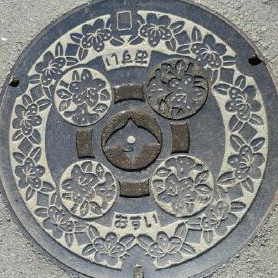
Design of the town emblem and the town flower, azalea. 'Sewage' displayed at the top and bottom.
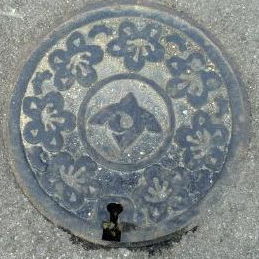
A handhole with a design of the town emblem and the town flower, azalea.
Related: Tatara River Basin Sewer 多々良川流域下水道
Tachiarai 大刀洗町
The town emblem is in the center. Designed around it are the town tree, Ilex integra, the town flower, cherry blossom, and the town bird, skylark. The inscriptions 'Tachiarai' and 'Osui'.
Related: Fukuoka Prefecture Southern Waterworks Corporation 福岡県南広域水道企業団
Chikujo 築上町
Former Tsuiki 旧築城町
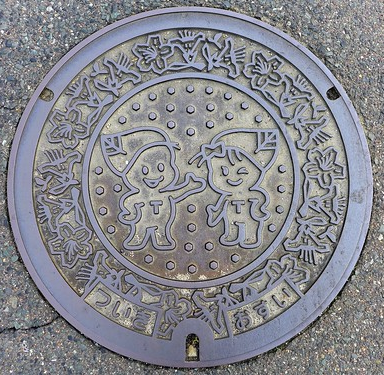
In the center, there are the characters created with the image of the rich nature of Tsukijo Town: on the left, the boy 'Mokumoku,' and on the right, the girl 'Kusukusu.' Around them, the azaleas, the flowers of the old town, are drawn. The labels 'tsuiki' and 'osui' are included.
Former Shiida 旧椎田町
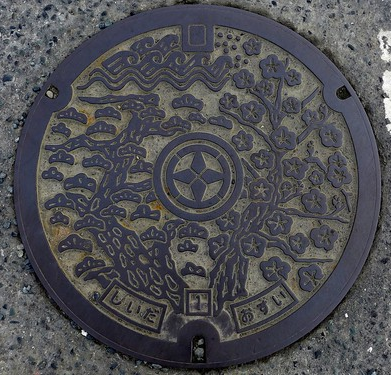
The old town emblem, the old town tree black pine, and the old town flower plum are depicted, with waves drawn at the top. The notation 'Shiida' and 'Osui'.
Chikuzen 筑前町
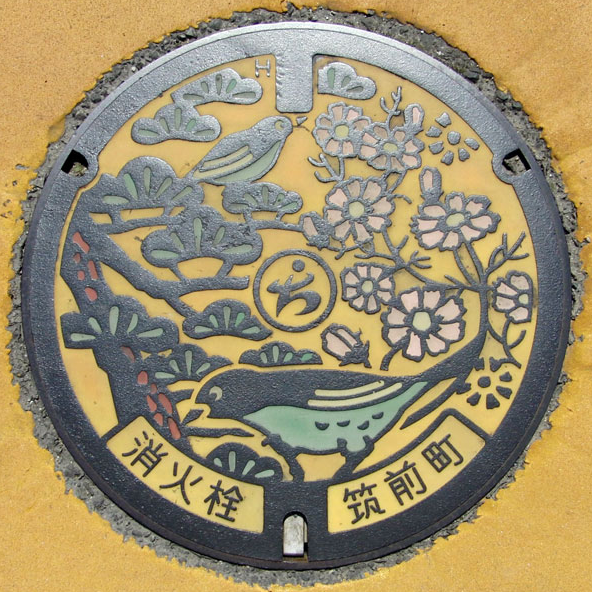
A lid of a color-plated gate valve depicting the flowers of the former Miwa Town, 'Wisteria' and 'Bush Warbler.' The town emblem of Chikuzen Town is placed at the top.
A small cover with a deformable tetrapod pattern, the town emblem, and the characters for 'sewage'.
Former Yasu 旧夜須町
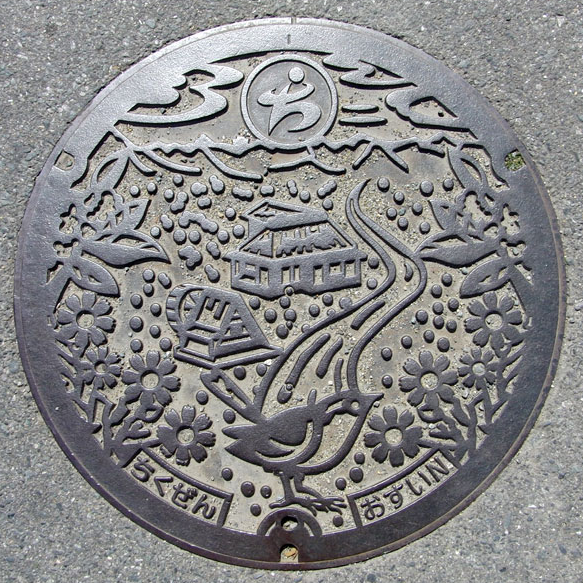
The design of a sewage manhole cover from the former Yasu Town depicts the scenery of Fureai Farm adjacent to Yasunosato Park, along with the town tree 'Osmanthus fragrans', the town flower 'Cosmos', and the town bird 'Japanese bush warbler'. The town emblem of Chikuzen is at the top, and the word 'Chikuzen' is at the lower left.
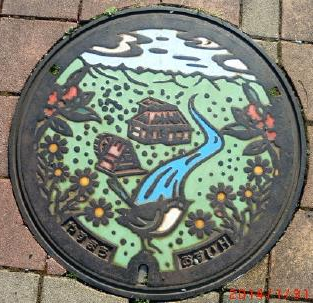
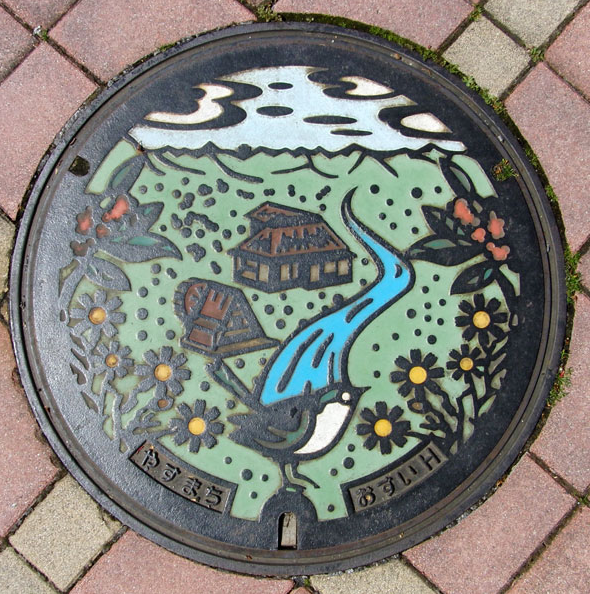
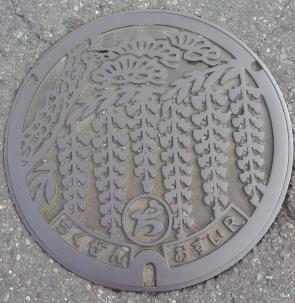
Trees, flowers, and birds of the former Yasu Town... Osmanthus, cosmos, and bush warblers, along with the design of Yasuno-sato Park Fureai Farm. It includes the words 'Yasumachi' and 'Osui R'. The R is the lid manufactured by Rokuhou Sangyo.
Below is the explanation from the Chikuzen Town Office Urban Planning Division:
"The background scenery of houses and waterwheels is a town facility called [Yasuno-sato Park Fureai Farm], which is an old house relocated to the site. The thatched roof was renewed in fiscal year 2011. In addition, it is rented out as a barbecue facility and has become a popular spot. The fields between National Route 386 and the park are planted with sunflowers and cosmos according to the season, making it a place where visitors can nostalgically enjoy the rural landscape of the past."
Former Miwa 旧三輪町
With a design of the tree 'Matsu' and the town flower 'Fuji' from the former Miwa Town, with the Chikuzen Town emblem and the words 'Chikuzen' and 'Osui R' at the bottom. R → Made by Rokuhou Sangyo.
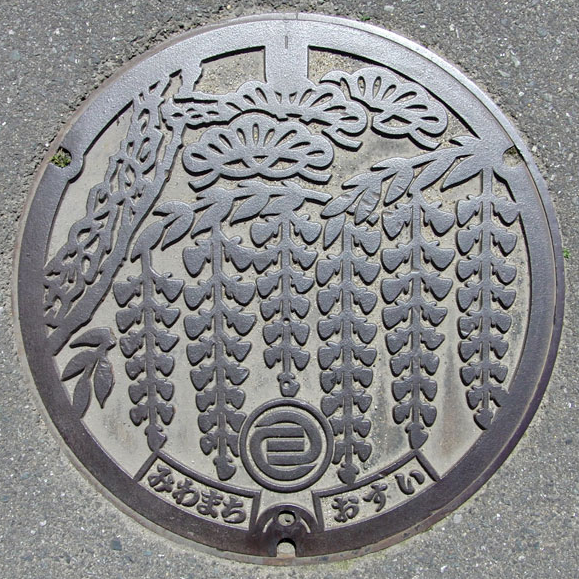
The town's tree is the pine, and the town's flower is the wisteria. The design includes the town emblem and the inscriptions 'Miwamachi' and 'Osui'.
Related: Fukuoka Prefecture Southern Waterworks Corporation 福岡県南広域水道企業団
Hisayama 久山町
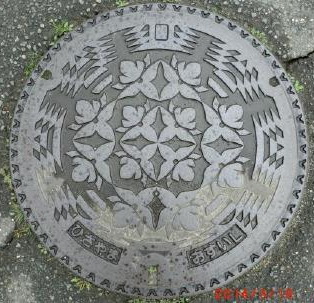
What are the town's flower, the epidendrum, and the jagged edges around the perimeter? The town tree is a zelkova... with the labels 'Hisayama' and 'Osui L'.
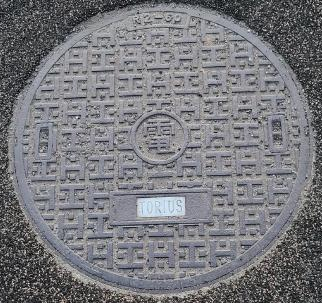
This is an original lid from Trias Hisayama Shopping Center. It has a background pattern with dots above and below the central H, the character '電' in the center, and the word 'TORIUS' below it.
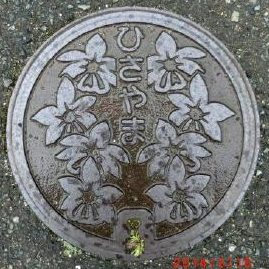
A small lid with a large 'Hisayama' inscription for the town's flower, the Ebine orchid.
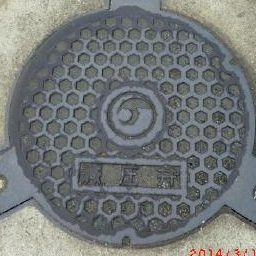
A lid with three external hinges, featuring a tortoiseshell pattern, the town emblem, and the inscription 'Pressure Relief Valve.'
Related: Tatara River Basin Sewer 多々良川流域下水道
Hirokawa 広川町
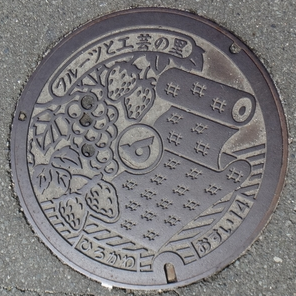
There is a sign that says 'Village of Fruits and Crafts,' depicting grapes and strawberries, Kurume Kasuri (Designated Important Intangible Cultural Property of the Nation, traditional craft) and the city emblem. There are signs reading 'Hirokawa' and 'Osui 14.'
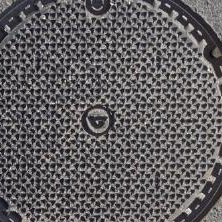
In the center of the slip-resistant patterned surface like a file is the town emblem, and along the lower edge, the words 'Hirokawa' and 'Sewer' are written horizontally.
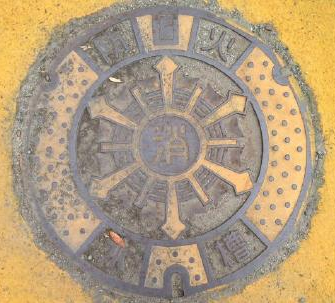
A fire brigade badge with the character '消' in the center, 'fire prevention' above, and 'water tank' below.
Related: Fukuoka Prefecture Southern Waterworks Corporation 福岡県南広域水道企業団
Fukuchi 福智町
Former Kanada 旧金田町
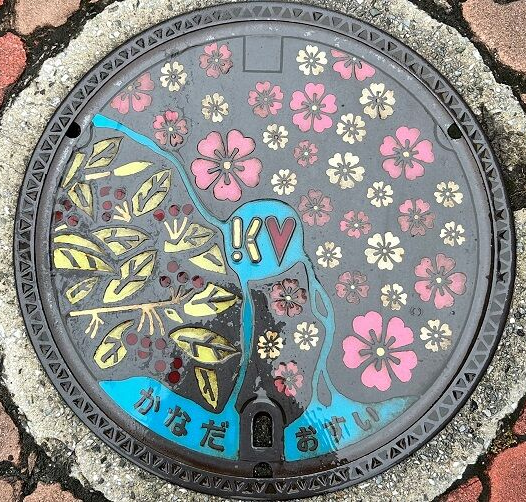
The old Kaneda Town's Chinese Holly tree and the town's flower, the cherry blossom. The characters 'Kanada' and 'Osui'.
Former Hojo 旧方城町
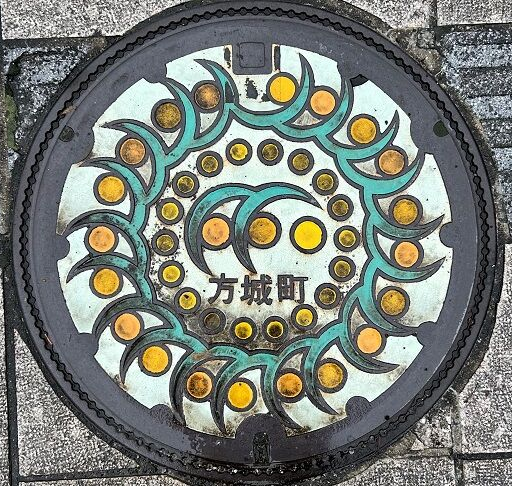
It's a beautiful colored lid, but there is absolutely no clue about the design. I called the town office to inquire about the design, and after about an hour of investigation, they said, 'It's old, there are no staff members who know about it, we think it's from the community plant, but the original designer is unknown.'
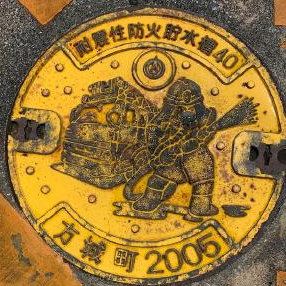
In 2006, the name of Hōjō Town disappeared due to municipal mergers. This is a seismic-resistant fire-fighting water storage tank cover made the year before. It still bears the name Hōjō Town, and for the townspeople, it might become a memorable cover… or so I think.
The design features a fire truck and firefighters in the middle of spraying water. It also includes the town emblem and the words 'Seismic-Resistant Fire-Fighting Water Storage Tank 40' and 'Hōjō Town 2005'.
Related: Tagawa Waterworks Corporation 田川広域水道企業団
Mizumaki 水巻町
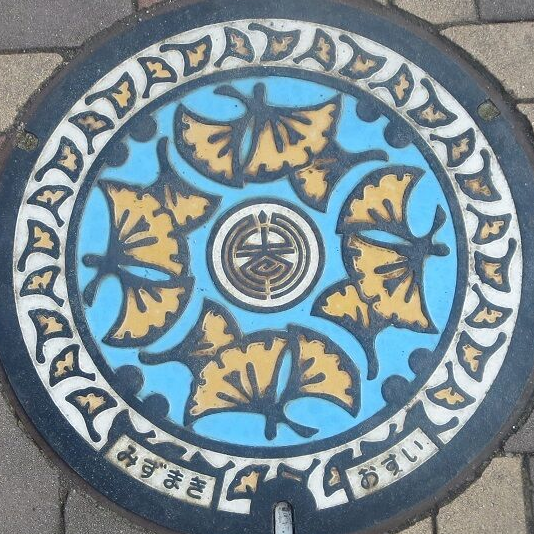
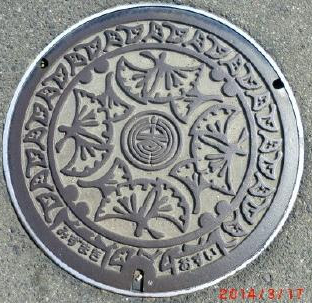
A color design with the town emblem in the center, surrounded by the town tree ginkgo's leaves and fruits, and further surrounded by small ginkgo leaves. Displays 'Mizumaki' and 'Sewage'.
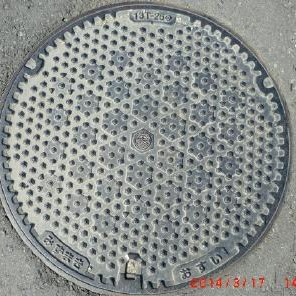
Slip-resistant pattern with the markings 'Mizumaki' and 'Osui'. Mark of Hinode Waterworks Equipment.
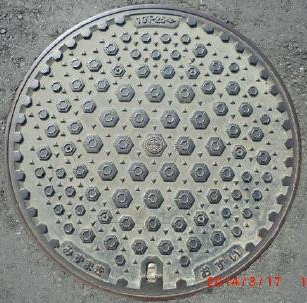
Slip-resistant pattern with the markings 'mizumaki' and 'osui'.
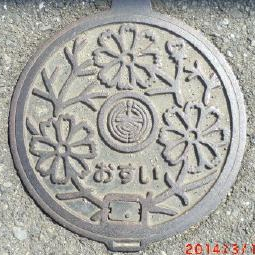
A small lid with the town emblem and the town flower, cosmos, design. Labeled 'Sewage'.
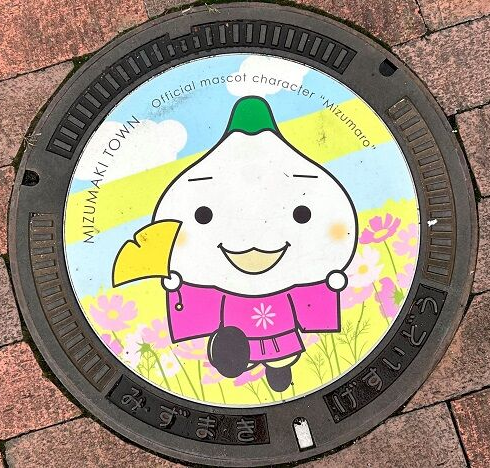
Design of Mizumaki Town's character 'Mizumaro.' Mizumaro is themed after Mizumaki Town's specialty, large garlic, wears clothing featuring the town flower, cosmos, and holds a fan representing the town tree, ginkgo. The background is also decorated with cosmos flowers, and it is a printed seal manhole. The words 'Mizumaki' and 'Sewer' are written on it.
Miyako みやこ町
Former Saigawa 旧犀川町
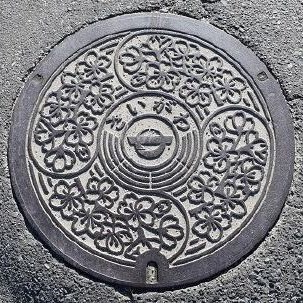
Design of the town tree, cherry blossom. The town emblem is in the center, with the characters 'Saigawa' above it, and the lower part has a spider web-like pattern surrounding it.
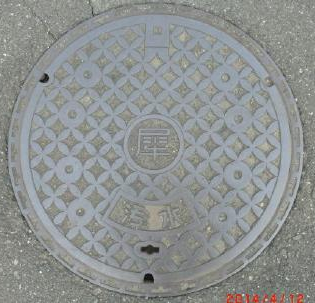
The characters 'Rhinoceros' and 'Dirty Water' in the cloisonné pattern.
Yoshitomi 吉富町
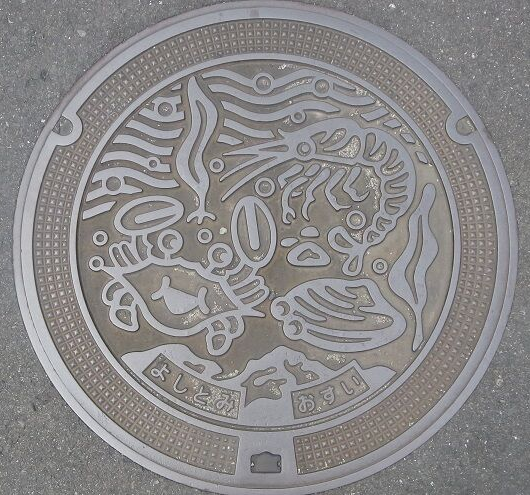
A design featuring seafood from the Suo Sea, including shrimp, crab, shellfish, and kelp.
Sue 須恵町
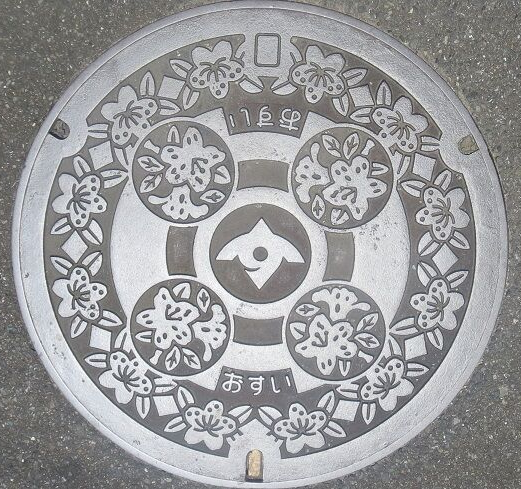
The town emblem and the town flower, azalea, are designed.
Toho 東峰村
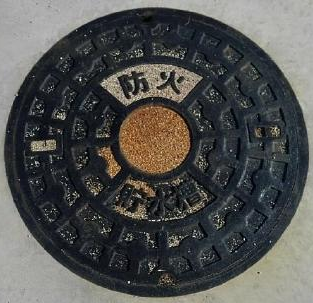
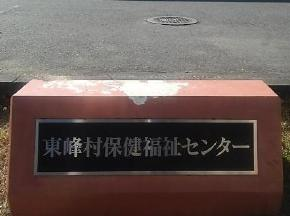
A JIS standard cover with the words 'Fireproof Water Storage Tank.' The reason it looks brown is that sand has accumulated. This is a cover installed in a temporary housing area next to the Toho Village Health and Welfare Center, as shown in the image above. It was during the recovery from a flood disaster.
Fukuoka Prefecture 福岡県
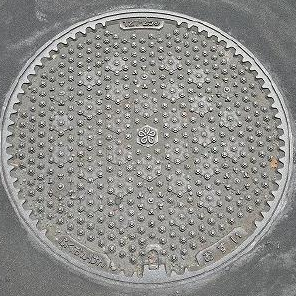
ASD (Anti-Slipping Design) lid, with the prefectural emblem in the center, '12T-25 Hinode Waterworks Co., Ltd. mark' at the top, and the words 'Fukuoka Prefecture' and 'Sewage' at the bottom.
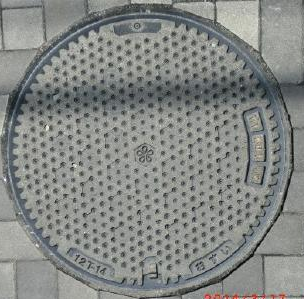
ASD slip-resistant pattern with the prefectural emblem. Markings: '12T-14' and 'Wastewater'.
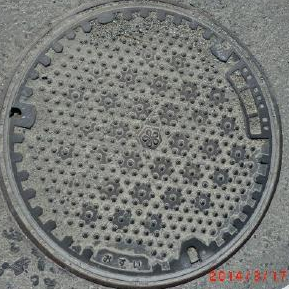
ASD slip-resistant pattern with the prefectural emblem. 'Sewage' is written in the lower left.
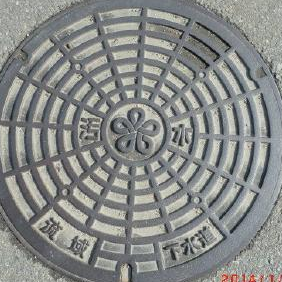
With a spider web pattern, the prefectural emblem, and the characters 'Sewage' and 'Drainage Basin Sewerage' included.
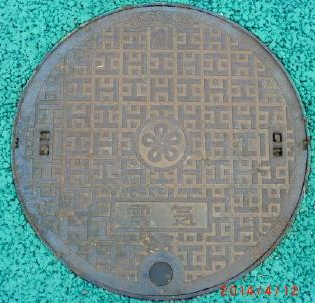
A ground pattern combining H and □ featuring the Fukuoka Prefecture emblem and the word 'Electric'.
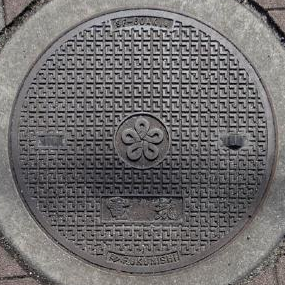
In the center is the prefectural emblem, and the background pattern is a corner bracket shape made by Fukunishi Casting. Below the prefectural emblem, the characters 'Electricity' are written in block style, the lower edge features the Fukunishi Casting logo and the word 'FUKUNISHI', and the upper edge has the model number 'SF-60AK|8'.
This is a manhole cover for electrical use.
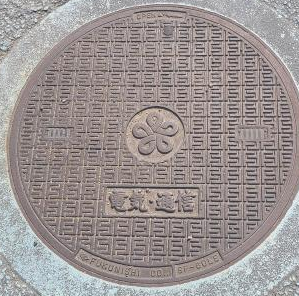
A ground pattern where F meshes together, the prefectural emblem in the center, 'Electricity · Communication' below it, at the bottom 'Company Emblem ◇ SF FUKUNISHI CO..' 'SF-60LE', at the top 'OPEN←', and just below it, a smaller company emblem.
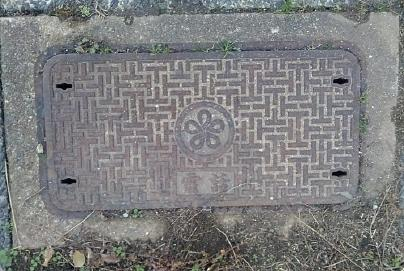
T-shaped patterned square lid, with the word 'Telephone' below the prefectural emblem in the center.
Tagawa Waterworks Corporation 田川広域水道企業団
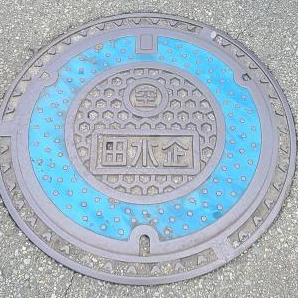
Hexagonal pattern, with the character '空' on top and the characters '田水企' below. Around it is a blue background with polka dots.
In April 2019, the water supply projects of Tagawa City, Kawasaki Town, Itoda Town, and Fukuchi Town were integrated to form the Tagawa Wide-Area Waterworks Enterprise Group.

Related: Tagawa 田川市, Itoda 糸田町, Kawasaki 川崎町, Fukuchi 福智町
Fukuoka Prefecture Southern Waterworks Corporation 福岡県南広域水道企業団
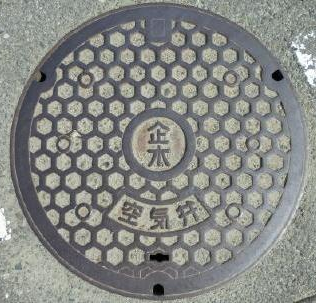
An air valve cover of the Fukuoka Prefecture Southern Wide Area Waterworks Bureau with a tortoiseshell pattern and the characters '企 水' inscribed on it. The Fukuoka Prefecture Southern Wide Area Waterworks Bureau provides tap water to eight cities, three towns, and one waterworks bureau located in the southern part of Fukuoka Prefecture: Kurume City, Okawa City, Chikugo City, Yanagawa City, Omuta City, Yame City, Asakura City, Miyama City, Oki Town, Hirokawa Town, Chikuzen Town, and Mitsui Waterworks Bureau [Ogori City, Kurume City, Tachiarai Town].
Related: Asakura 朝倉市, Okawa 大川市, Omuta 大牟田市, Ogori 小郡市, Kurume 久留米市, Chikugo 筑後市, Miyama みやま市, Yanagawa 柳川市, Yame 八女市, Tachiarai 大刀洗町, Chikuzen 筑前町, Hirokawa 広川町
Homan River Basin Sewer 宝満川流域下水道
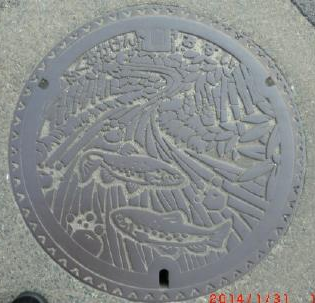
From the Sewerage Division, Department of Architecture and Urban Planning, Fukuoka Prefecture: 'This is the Homan River Basin Sewerage in the Chikugo River system. There are no detailed records of the design, but it is believed to be the Homan River and ayu (sweetfish).' The characters 'ふくおかけん' (Fukuoka Prefecture) and 'おすい' (sewage) are written.
Related: Ogori 小郡市
Tatara River Basin Sewer 多々良川流域下水道
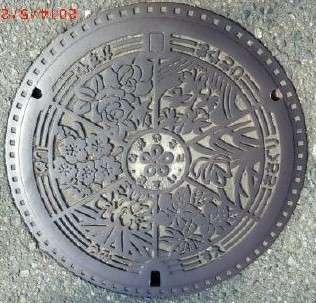
This is the Tataragawa River Basin Sewerage. In the center is the emblem of Fukuoka Prefecture. It is surrounded by the flowers of each town. Umi Town: Tsukushi Rhododendron, Shime Town: Cherry Blossom, Kasuya Town: Rose, Hisayama Town: Ebine, Sasaguri Town: Spring Orchid, Sue Town: Azalea
Related: Umi 宇美町, Kasuya 粕屋町, Sasaguri 篠栗町, Shime 志免町, Sue 須惠町, Hisayama 久山町
Fukuoka District Water Supply Corporation 福岡地区水道企業団
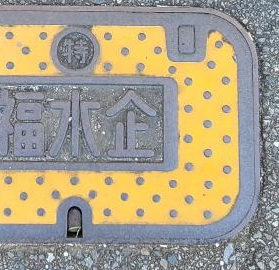
In the center is the mark of the Fukuoka District Waterworks Enterprise Association, below it is the number frame, and at the lower part of the outer edge with a yellow background and polka dot pattern, the characters 'Special Valve' are written. There are lids with the same design but different characters, such as 'Valve Cover,' 'Gate Valve,' and 'Air Valve.'
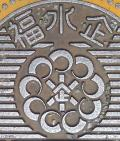
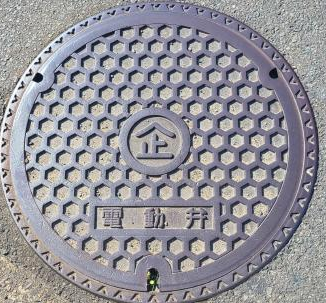
Tortoiseshell pattern, with the character '企' in the center, and the words 'electric valve' below it.
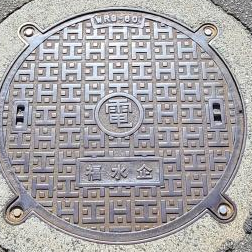
A textured pattern with dots alternating above and below the H and above and below the 工, a bolted 4-ear lid, with the character '電' in the center and '福水企' below it, horizontal hooks on the sides, and 'WR8-60' at the top. This also seems to be a manhole cover for an electric valve.
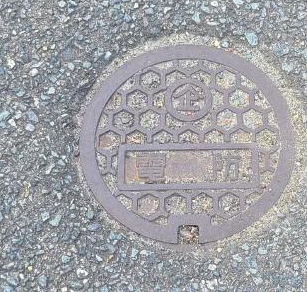
A small lid with a tortoiseshell pattern, with the character '企' on top and '電防' written below.
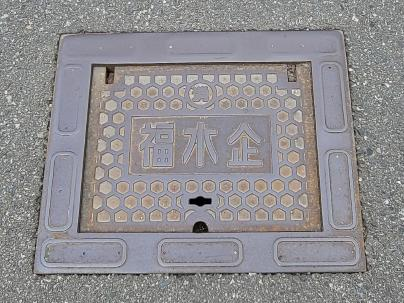
Hexagonal patterned square lid, with 'Fukusui Ki' in the center, the character 'Sho' in small letters above, and 10 ovals on the receiving frame.
Related: Fukuoka 福岡市, Itoshima 糸島市, Nakagawa 那珂川市
Kasuga Nakagawa Waterworks Corporation 春日那珂川水道企業団
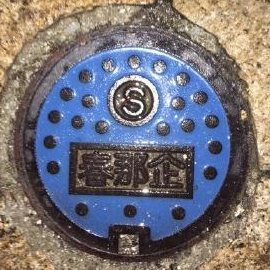
Polka dots on a blue background, with the character '仕' at the top and the characters '春那企' below. '春那企' refers to the Kasuga-Nakagawa Waterworks Enterprise Established Jointly by Kasuga City and Nakagawa Town.
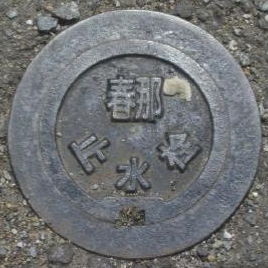
'Haruna' and the characters for 'Stopcock.'
Related: Kasuga 春日市